The downfall of Bronze Age civilization (Late Bronze Age Collapse, Part 1)
O Muse, sing Peleus’ son, Achilles’ wrath.
Accursed, it brought the Greeks untold woes,
And cast untimely many valiant souls
To Hades, leaving heroes’ bodies prey
To dogs and birds; thus Zeus fulfilled his will […].¹
The sack of Troy, once thought largely a matter of legend, now seems plausible to historians and archaeologists. The historical site discovered by Heinrich Schliemann conforms in significant ways to the Homeric account. In fact, there is evidence for at least three separate confrontations between Greek peoples and Trojans, which might have been later conflated and mythologized in various ways in the Iliad (Ἰλιάς), mainly focusing on the last of them. Homer’s text is generally agreed to have actually been an oral tradition from a time when the Greeks had forgotten how to write—a Dark Age.
Emily D. T. Vermeule, classical scholar and archaeologist, makes the case for the war’s historicity:²
[T]he possibility that the Trojan War was [a Greek engagement] with an Anatolian dynast in his walled castle at the height of the early Mycenaean age must at least be considered. Since a fifteenth century Hittite drew a sketch of one of these Achaian warriors in full battle dress and plumed helmet and since one of them dropped his sword (was buried?) as far north as Smyrna, their presence in western Anatolia is not just philologically demonstrated but physically established.
There is additionally a contemporary account from the Hittites, who ruled most of eastern central Anatolia (modern Turkey) about a conflict occurring among their neighbors to the west, seeming to correspond to the Trojan War. In the Tawagalawa letter, written by Hittite king Ḫattušili III, warfare is described with some placename correspondences, summed up thus:³
The Lukka Lands mentioned in the text are classical Lycia, and Wilusa is Ilios/Troy.
The linguistic problems of matching later Homeric Greek versions of words with the centuries-older languages of the region is highlighted by the fact Tawagalawa is thought to be a Hittitization of the Greek Etiokles (Ἐτεοκλῆς), via a reconstructed Mycenaean form *e-te-wo-ke-re-we (something like Eteoklewes). He is also named as the brother of the king of the Ahhiyawa, who seem to correspond to the Achaeans (Ἀχαιοί)—one of the collective names for the Greeks used by Homer. The placename correspondences are Wilusa/ Ilios (Ἴλιος), Lukka/ Lycia (Λυκία), Taruisa/ Troas (Τρῳάς).
Homeric Greek is problematic: it’s a literary dialect of Archaic Greek containing elements of Ionic, Aeolic, Attic, Arcadocypriot, and even a smattering of non-Greek languages. Mycenaean Greek was written in syllabic/ ideographic Linear B, while Hittite adapted Akkadian cuneiform which has similar features, but the systems are otherwise completely unrelated. They are also both Indo-European languages, but from different branches of a vast family tree.
Syllabaries are not ideal for representing languages which are highly vocalic and favor consonant clusters, and both Hittite and Mycenaean Greek have these features, differing sharply from the languages their respective scripts originally represented. Reading either language reminds me of trying to decipher kana-ized English. Take Mycenaean 𐀁𐀩𐀞𐀵 (e-re-pa-to), for example: old as the word is, when you normalize the spelling, you get the very recognizable elep’antos.⁴
At any rate, war survivors from the Trojan side dispersed, some say settling in Europe, tying into national origin myths from Rome to Britain, both of which lack archaeological attestation.
As to the Greeks, the palatial centers as well as many other towns and villages of the Mycenaeans were abandoned, and no further monumental stone buildings constructed. The art of wall painting disappeared, and, since there was no longer a redistributive economy to keep records for, Linear B writing also fell into disuse. The population declined, vital trade links were lost, and the organization of the state, with kings, officials, and armies, vanished. O Brother, Where Art Thou? isn’t far from the mark in transposing Odysseus’ wanderings to the depression-era South.
I only recently ran across the term Late Bronze Age collapse (LBAC). I had heard of the Greek Dark Ages (ca. 1100–ca. 750 BCE), the Fall of Troy, the Exodus (the historicity of which has not been established, but would fit into this context), and even the battles between the Egyptians and the Sea Peoples, which put an end to the New Kingdom period (ca. 1550 BCE–ca. 1077 BCE), but I hadn’t realized the extent to which these events were connected.
The cultural cataclysm of the LBAC included the Near East, the Aegean Region, North Africa, the Caucasus, the Balkans, and the Eastern Mediterranean. The Greek Dark Ages are reckoned to have lasted some 300 years, but many of the civilizations affected simply never recovered.
The extent to which the cultures in the area were in contact during the Late Bronze Age (LBA) was something else of which I was not aware. As Eric Cline⁵ has pointed out, even civilizations not in direct contact were never more than three steps removed from contact with one another in this network. Basically, any of them could both send and receive goods with each other directly or via a few intermediaries.

How do we know? Lots of ways: first, there is the presence of goods from these civilizations in one another’s lands, as I’ve made brief mention of already. There are too many such examples to catalog here, so I’ll discuss one I found quite striking concerning a fresco found in what was an Egyptian port city called Peru-Nefer (modern تل الضبعة Tell El-Dab’a).

The reconstruction shows it’s a scene of bull-leaping, similar to that famously found in the great palace of Knossos in Crete. In addition to the distinctly Minoan motif, this particular type of wall decoration, called buon fresco—painting done with pigments dissolved in water on a thin coat of still-wet plaster—itself originated in Crete.
Therefore, artisans from the island had to have either worked on this piece, or at a minimum, trained those who did. Indeed, there seems to have been a craze for Minoan frescoes in the ancient Levant, as they appear in several locations in Egypt and Canaan, including Tel Kabri (תֵל כַבְרִי, Arabic: تَلْ ألْقَهوَة,Tell al-Qahweh, in modern Israel), Alalakh (Tell Atchana, in modern Turkey), Qatna (تل المشرفة, Tell al-Mishrifeh, in modern Syria), as well as Tell El-Dab’a.
Furthermore, a site called Mari in what’s now Eastern Syria has yielded more than 25,000 clay tablets inscribed with Akkadian text, including a wealth of documentation of ancient trade. Sadly, the site is known to have been looted during the present civil war while archaeologists looked on helplessly. Cline elaborates on the tablets found there:⁶
The archives included records of trade and contact with other areas of the Mediterranean and Near East, with specific mention of unusual items that were received. We also know from these tablets that gifts were frequently exchanged between the rulers of Mari and those of other cities and kingdoms, and that the kings requested the services of physicians, artisans, weavers, musicians, and singers from one another.
Included among the exotic imported objects recorded in the tablets at Mari were […] weapons made of gold and inlaid with precious lapis lazuli, as well as clothing and textiles […] The items had traveled a long way from Crete, acquiring what is now known as “distance value,” in addition to the inherent value that they already held because of the workmanship and the materials from which they were made.
So what happened to this early global trade network? The Sea Peoples have become a bogeyman for the collapse. Often cited in making this claim is a desperate letter King Ammurapi of Ugarit (𐎜𐎂𐎗𐎚) wrote to the King of Alashiya—an ancient regional name for Cyprus:⁷
My father, behold, the enemy’s ships came (here); my cities(?) were burned, and they did evil things in my country. Does not my father know that all my troops and chariots(?) are in the Land of Hatti, and all my ships are in the Land of Lukka? … Thus, the country is abandoned to itself. May my father know it: the seven ships of the enemy that came here inflicted much damage upon us.
Note kings of the time often used familial terms in addressing their allies—using “father”, he is likely simply calling the king his elder close relation, just as people in many places, especially east Asia will use Uncle, or Aunt as a term of respect for someone older despite not being related to them.
As to the Sea Peoples, not much is known about them—even the term used for them was made up by French archaeologists. What is known is they seem to have been quite warlike: the Hittites, Mycenaeans, Canaanites, Cypriots, and others are said to have fallen to them. When they turned toward Egypt, an inscription of Ramesses III names them and their depredations:⁸
The foreign countries made a conspiracy in their islands. All at once the lands were removed and scattered in the fray. No country could stand before their arms, from Khatte, Qode, Carchemish, Arzawa, and Alashiya on, being cut off at [one time]. A camp [was set up] in one place in Amor. They desolated its people, and its land was like that which has never come into being. They were coming forward toward Egypt, while the flame was prepared before them. Their confederation was the Peleset, Tjeker, Shekelesh, Denye(n) and Weshesh, lands united. They laid their hands upon the lands as far as the circuit of the earth, their hearts confident and trusting “Our plans will succeed!”.
Note most kings did not know how to write, with an official scribal class handling the work, but the inscription was ordered by Ramesses and written in his voice. Also, Khatte (Hatti) is Anatolia under the Hittites, Qode is in the southeast of modern Turkey, Carchemish is in the north of modern Syria, and Arzawa is in western Anatolia. Other inscriptions use these and other names, for a total of nine, for which there are some more-or-less conjectural correspondences:
- Denyen (djnjw): Danaans (Δαναοί, a Greek group)
- Eqwesh (jḳwš): Achaeans
- Lukka (rkw): Lycians
- Peleset (prwsṯ): Philistines
- Shekelesh (škrš): Sicels (Sicilians)
- Sherden (šrdn): Sardinians
- Teresh (twrš3): Tyrrhenians (Etruscans)
- Tjekker (ṯkr): Teucrians (a Trojan group)
- Weshesh (wšš): Oscans (an Italic tribe)
There are many theories about the origins of these tribes and what spurred them into action, from migrations driven by famine to a quest for wealth. The Egyptians won a Pyrrhic victory against the Sea Peoples, with Ramesses declaring:⁹
They are capsized and overwhelmed in their places. Their hearts are taken away; their soul is flown away. Their weapons are scattered in the sea.
Those he did not destroy, he claims to have settled in Canaan under the crushing yoke of his rule. But as I mentioned, the victory came at a high cost: the New Kingdom was over, and a decline known as the Third Intermediate Period (ca. 1069 BCE–ca. 664 BCE) began.
The archaeological record seems not to jibe well with Ramesses’ account. Although many cities in the region were destroyed in this period, invasion doesn’t seem to account for all of them—the evidence seems to show some as rebellions, plagues, or natural disasters. A further sign the Egyptian claims may be overblown or misinformed comes in the fact the Greeks appear both as invaders and invaded, as do the Trojans.
The Bronze Age was fueled by the metal of the same name, an alloy of copper and tin. Copper was abundant, with an important center for its production being Cyprus, from which our word copper descends. One etymological analysis says the Mycenaean 𐀓𐀠𐀪𐀍 (ku-pi-ri-jo—kuprios) comes from the Sumerian word for bronze, 𒌓𒅗𒁇 (tsupar). What this leaves out is that an earlier form of the Sumerian word is kupar, which meant copper. To get from there to Κύπρος, we just add the Greek masculine suffix, -ος, and elide the unstressed vowel. pi-ri-jo (kuprios) originates with the Sumerian word for the metal, tsupar. To get from tsupar to Κύπρος, consider first, a confusion with kupar, Sumerian for “bronze”, second, ⟨υ⟩ shifted from an ancient /u/ sound to the classical /y/, and last, the addition of the Greek masculine gender suffix, -ος. The Mycenaean form had an -ios ending, which marks a masculine genitive, so “of copper”, which seems to have been later dropped, as now Κύπριος means someone from Cyprus.
Tin, on the other hand, was hard to get—there was some, but not a lot, in northern Anatolia. Cornwall, which was an important source later, is pretty far away, so most of it seems to have been brought from what’s now Afghanistan. Carol Bell observed:¹⁰
The strategic importance of tin in the LBA was probably not far different from that of crude oil today. The availability of enough tin to produce […] weapons grade bronze must have exercised the minds of the Great King in Hattusa and the Pharaoh in Thebes in the same way that supplying gasoline to the American SUV driver at reasonable cost preoccupies an American President today!
Handily, if you run short on tin, there’s another plentiful metal you can substitute to make bronze. Unfortunately, that metal is arsenic. What’s great about arsenical bronze is weapons and armor manufactured using it actually take on several good properties: arsenic acts as a deoxidizer, so castings are less porous and more ductile, and the capacity for work hardening is also increased, so better cutting edges can be created. Furthermore, it can be given an attractive silver-colored surface.
The downside, of course, is arsenic is categorically toxic. Most copper ore already contains arsenic, and smelting it vaporizes much of whatever is present as arsenic oxide. Ötzi, the Alpine ice-mummy, was carrying a nearly pure copper axe-head and had high levels of copper and arsenic particles in his hair, and so seems to have been involved in smelting. Copper- and bronzesmiths would often end up with chronic arsenic poisoning, causing peripheral neuropathy, a symptom of which is a weakening of the legs and feet.
This may be the dark truth behind ancient myths of lame smiths, Ἥφαιστος (Hephaistos) being a paragon of the type. One can imagine the results of manufacturing arsenical bronze on a large-scale: besides being even worse for metalworkers, anyone touching the finished product would eventually feel the effects of the metal’s toxicity. Copper arsenate, another compound of the same metals, is used as an herbicide, fungicide, insecticide, rodenticide, and slug poison and has been banned for many uses because it is also highly carcinogenic.
A similar factor often overlooked in the fall of Rome, which precipitated a more familiar Dark Age, was lead poisoning. The Romans found lead a wonder metal, using it in plumbing, makeup, and even as a flavor enhancer in their wine. The very word plumbing derives from Latin plumbum, “lead”, which also provides its chemical symbol, Pb.
Before you get all superior, remember we thought it was great to use in plumbing and paint, as well as to burn in our fuel until quite recently, even with a much greater scientific understanding of the situation. It was one of the first times corporations had clear scientific evidence of deleterious effects and chose not to act until forced to do so. And our problems are not over; lead in the pipes was also the problem in Flint, Michigan.
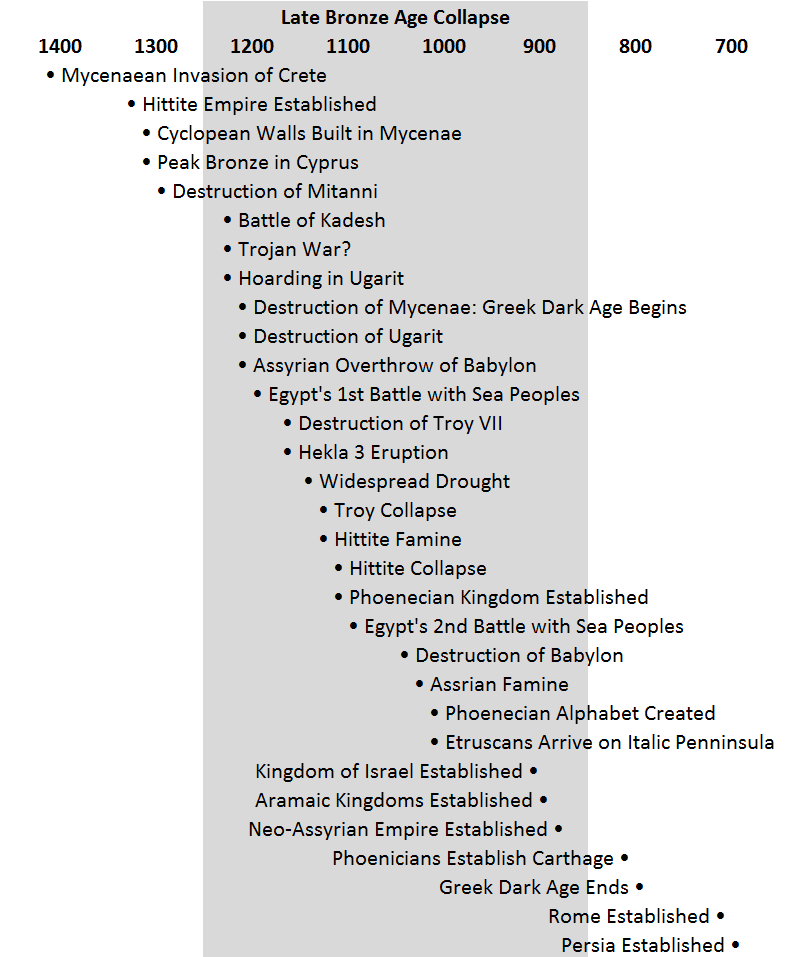
So one way or another, bronze was on the way out. During the Greek Dark Age, edged weapons of iron came into widespread use: by 900 BCE, almost all weapons in grave goods were made of iron. Some even claim the upheavals of the collapse had to do with an escalation of weaponry, including use of iron, or of bows with increased range.
Then as now, earthquakes were a constant danger over much of the region: there are 16 active faults known today. Some theorize an earthquake swarm, a sequence of seismic events over a large area. Just to the left of the famous Lion Gate in Mycenae, the sharp rise in the ground is actually shearing from a fault running through the site.
There were also extended periods of drought in the area, which would be pretty difficult for these ancient agrarian societies to deal with. The fate of the Mayan city of Copán (in modern Honduras) seems to offer a corollary: the city flourished in a fertile mountain valley, supporting a population of 18,000–25,000, but was also very susceptible to dips in farming productivity. Disruption of the food supply in the 8th and 9th centuries meant people had to disperse and live off the land; returning to a subsistence hunting-and-gathering lifestyle.
While Egypt continued to limp along after the LBAC, Greece came back stronger than it ever had been. After the 800s BCE, writing reappeared in Greece, now adopting the Phoenician alphabet, a script much better equipped to describe their language than Linear B, and one much of the world still uses some form of today.
The vacuum left by the downfalls of some civilizations in the area allowed others to rise, including the Phoenicians, the Etruscans, the Romans, the Persians, the Israelites—the groups we think of as the wellsprings of Western civilization.
The apocalypse has haunted our species’ imagination, however—a fall from a past Golden Age to one with diminished capacities and humbler hopes, or the end of all things: the Deluge, the End of Days, the Second Coming, Ragnarǫkkr, Frashokereti. No doubt for those trying to survive through those years of tumultuous destruction and catastrophic change, it was a grim struggle. But the arc of history, it seems, was toward the good. So if we are in the apocalyptical times some suggest, perhaps it will represent an opportunity for some eventual betterment.
Read subsequent articles in the Late Bronze Age Collapse series
Part 3 Addendum: Fruit from a Poisonous Pseudoarchaeological Tree
Notes
- Ὅμηρος (Homer), Ἰλιάς (The Iliad), Book I.1–5: μῆνιν ἄειδε θεὰ Πηληϊάδεω Ἀχιλῆος / οὐλομένην, ἣ μυρί᾽ Ἀχαιοῖς ἄλγε᾽ ἔθηκε, / πολλὰς δ᾽ ἰφθίμους ψυχὰς Ἄϊδι προΐαψεν / ἡρώων, αὐτοὺς δὲ ἑλώρια τεῦχε κύνεσσιν / οἰωνοῖσί τε πᾶσι, Διὸς δ᾽ ἐτελείετο βουλή […]. I’ve translated it to be true to the original, the subject being the word, μῆνιν (wrath). I also believe the name of the hero is given as a patronymic, Πηληϊάδεω ᾿Αχιλῆος, (literally, “son of Peleus Achilles”) as was common in the ancient world.
- John Lawrence Angel, “‘Priam’s Castle Blazing’: A Thousand Years of Trojan Memories”, Troy and the Trojan War, Johanna Mellink Machteld, ed., 1984.
- CTH 181, discussed in Harry A. Hoffner Jr., Letters from the Hittite Kingdom, 2009. My emphasis.
- ⟨p(h)⟩, later expressed by ⟨φ⟩ and with the phonetic value /f/, seems to have been said in Mycenaean Greek as /pʰ/; a hard /p/ with a puff of air after it, which I’ve rendered as ⟨p’⟩. It’s thought to come from an Egyptian word, with the Mycenaean version being the genitive of 𐀁𐀩𐀞 (e-re-pa/ elephās): ivory.
- Eric Cline, 1177 BC: The Year Civilization Collapsed, 2014. The schematic is based on one of his from a lecture on the same topic.
- Ibid.
- Emmanuel Laroche & Charles Virolleaud, Ugaritica V: nouveaux textes accadiens, hourrites et ugaritiques des archives et bibliothèques privées d’Ugarit, 1968.
- John A. Wilson trans., in J.B. Pritchard ed., Ancient Near Eastern Texts relating to the Old Testament, 1969.
- Egerton and Wilson trans., 1936.
- Preface, Cline, 2014.
 Deru Kugi