The Lacuna at the Center of the Universe

The epic Borgesian hoax of “The Aleph”

I have often suspected that the absolute is nothing more than an acoustic accident—one mapped in the sultry tedium of Santos, and rediscovered later in the obscurity of a postscriptum no one was meant to trace.

The postscript in question is dated March first, 1943, and purports to supplement Jorge Luis Borges’ “The Aleph”.¹ It is, of course, no such thing. Borges, ever the mischievous guide, only pretends the addition. The “postscript” was always part of the story—it’s another framing device, another misdirection.

Borges wrote in a letter to his romantic interest Alba Estela Canto in February 1945:²

Esta semana concluiré el borrador de la historia que me gustaría dedicarte: la de un lugar (en la calle Brasil) donde están todos los lugares del mundo.

This week, I will finish the draft of the story I would like to dedicate to you: the story of a place (on Brazil Street) where all the places in the world are found.

We know Borges and Canto met in August 1944, and that he subsequently described his project to write a story—clearly “The Aleph”—about:³

A place that contained all the other places in the world.

Canto typed up the manuscript Borges gave her in 1945, and it was published in Sur magazine in September of the same year.

The false postscript is not unusual. Ever since Miguel de Cervantes’ setup of the second part of Don Quixote,⁴ the pretense of discovered manuscripts, interpolated documents, and editorial afterthoughts has been one of literature’s favorite illusions. Borges leans into it with particular enthusiasm. Like Umberto Eco, who begins The Name of the Rose thus:⁵

On August 16, 1968, I was handed a book written by a certain Abbé Vallet, Le Manuscrit de Dom Adson de Melk, traduit en français d’après l’édition de Dom J. Mabillon (Aux Presses de l’Abbaye de la Source, Paris, 1842).

In so doing, he portrays his novel as a recovered 14th-century manuscript he is merely the translator of. Borges similarly attributes his materials to dubious intermediaries—a forgotten letter from Captain Burton discovered by Pedro Henríquez Ureña.⁶ Although each layer seems authentic, the effect is not to stabilize the story, but to send the reader off in a direction.

This one leads to Sir Richard Francis Burton. Burton was a Victorian polymath, explorer, and linguist who spoke over twenty-five languages and lived a life of deliberate cultural camouflage. He gained fame by infiltrating Mecca in disguise and searching for the source of the Nile. His work was defined by a tireless, obsessive scholarship, filling his volumes with labyrinthine footnotes that explored the darkest and most obscure corners of human geography and linguistics.

He spent his later years as a British Consul—including in Santos, Brazil, a place he hated, calling it boring and humid—and completing his unexpurgated translation of The Book of the Thousand Nights and a Night (BTNN hereafter).⁷

Borges knew his work intimately—his childhood home was an Anglo-Argentine one, and their library contained these books. They are part of his earliest experiences as a writer:⁸

His father, a frustrated novelist who had played a key role in Borges’s literary destiny, destroyed a book of Oriental stories he had written inspired in [sic] the Arabian Nights […].

In his A Universal History of Infamy (UHI hereafter), Borges presents his own translations of two tales from BTTN.⁹ And in his essay, “The Translators of The Thousand and One Nights” (“TTON”, hereafter), he compares various translations of the tales. He notes almost immediately:¹⁰

Burton’s incomparable version [of the Thousand and One Nights […] is not truthful […]. 

It becomes clear Borges regards the BTTN with a mixture of admiration and hostility. Although he notes of his diction, “Each [word] is indubitably the mot juste”, he also says:¹¹

In Burton, the falsification […] resides in the gigantic employ of a gaudy English, crammed with archaic and barbaric words.

This ambivalence matters. Burton is not merely a source for Borges; he is a model of a certain kind of textual excess—one in which commentary threatens to overwhelm the thing it comments upon. And it is into this excess that Borges directs us.

In the postscript of “The Aleph,” the references come quickly: According to legend, Alexander the Great (Iskandar to the Persians) devised a tower-mounted mirror that reveals all within sixty farsangs, allowing his men to strike marauding pirates. The sevenfold cup of Kai Kosru (کیخسرو) refers to the Cup of Jamshid (جام جم, jām-e Jam). This Jām was a legendary cup of scrying, believed to contain the elixir of immortality and to reveal the seven heavens and reflect the entire world, uncovering hidden truths. The mirror that Tariq ibn-Ziyad (طارق بن زياد) found is mentioned briefly in BTNN, with similar properties, but noted as counterfeit.¹² Borges translates the same tale in UHI.¹³

True History refers to Lucian of Samosata’s second-century work hailed by some as the first work of science fiction, but which is actually a satire of travelers’ tales. We find there:¹⁴

καὶ μὴν καὶ ἄλλο θαῦμα ἐν τοῖς βασιλείοις ἐθεασάμην κάτοπτρον μέγιστον κεῖται ὑπὲρ φρέατος οὐ πάνυ βαθέος. ἂν μὲν οὖν εἰς τὸ φρέαρ καταβῇ τις, ἀκούει πάντων τῶν παρ᾽ ἡμῖν ἐν τῇ γῇ λεγομένων, ἐὰν δὲ εἰς τὸ κάτοπτρον ἀποβλέψῃ, πάσας μὲν πόλεις, πάντα δὲ ἔθνη ὁρᾷ ὥσπερ ἐφεστὼς ἑκάστοις: τότε καὶ τοὺς οἰκείους ἐγὼ ἐθεασάμην καὶ πᾶσαν τὴν πατρίδα, εἰ δὲ κἀκεῖνοι ἐμὲ ἑώρων, οὐκέτι ἔχω τὸ ἀσφαλὲς εἰπεῖν. ὅστις δὲ ταῦτα μὴ πιστεύει οὕτως ἔχειν, ἄν ποτε καὶ αὐτὸς ἐκεῖσε ἀφίκηται, εἴσεται ὡς ἀληθῆ λέγω.

I saw also another strange thing in the same court: a mighty great glass lying upon the top of a pit of no great depth, whereinto, if any man descend, he shall hear everything that is spoken upon the earth: if he but look into the glass, he shall see all cities and all nations as well as if he were among them. There had I the sight of all my friends and the whole country about: whether they saw me or not I cannot tell: but if they believe it not to be so, let them take the pains to go thither themselves and they shall find my words true.

Although I’m unsure what “spear” Borges means—sphere?—the Satyricon gives us:¹⁵

His igitur indumentis decenter ornati, ante consessum in suggestu sydereo positam quandam sphaeram caelatam varietate multipici conspicantur, quae ita ex omnibus compacta fuerat elementis, ut nihil abesset, quidquid ab omni creditur natura contineri. Illic omne caelum, aer, freta, diversitasque telluris, claustraque fuerant tartarea. Urbes etiam, compita, cunctorumque species animantium, tam in specie quam in genere numerandae. Quae quidem sphaera imago quaedam videbatur, ideaque mundi. In hac quid cuncti, quid singuli nationum omnium populi quotidianis motibus agitarent pedeire, formante speculo relucebat.

Thus fittingly adorned, they looked at a certain sphere carved with manifold variety, which was placed before their seat on a starry platform. It was composed of all elements in such a way that nothing of what is believed to be contained in the whole of nature was absent. There was the whole sky, the air, the seas, the diversity of lands, and the gates of Tartarus. Also the cities, the crossroads, and all kinds of living things counted by species and by genus. This sphere, indeed, appeared to be some kind of image and idea of the world. In the mirror so formed, one could see what all people and each individual from all peoples and all nations strove to accomplish.

And the Faerie Queene passage is also relevant:¹⁶

The great Magitien Merlin had deuiz’d,
By his deepe science, and hell-dreaded might,
A looking glasse, right woundrously aguiz’d,
Whose vertues through the wyde worlde soon were solemniz’d.
It vertue had, to shew in perfect sight,
What euer thing was in the world contaynd,
Betwixt the lowest earth and heuens hight,
So that it to the looker appertaynd;
What euer foe had wrought, or frend had faynd,
Therein discouered was, ne mote pas,
Ne ought in secret from the same remaynd;
For thy it round and hollow shaped was,
Like to the world it selfe, and seemed a world of glas.

These are not random. They establish a lineage of objects that claim to contain everything—and, just as often, fail to do so. The Aleph appears, at first, to be their culmination. It is not.

Borges strengthens the illusion by invoking what seems to be a deeper precedent, writing in “TTON”:¹⁷

Is it not portentous that on night 602 King Schahriah [شهریار] hears his own story from the queen’s lips?

This is the mise en abyme—the literary infinity—of BTTN, which Borges attempts to create his own version of in “The Aleph”. Just as Shahrazad (شهرزاد) tells the king the story of him being told the story, Borges attempts to have you read the story of you reading the story.

Italo Calvino took up this gauntlet in his novel If on a winter’s night a traveler.¹⁸ I’ve often said, just as Dan Brown did with a single line of Eco’s Foucault’s Pendulum, a writer could make a career of writing the tales suggested with similar brevity in Borges. In just this way, Calvino gives us a novel in second-person perspective: the story of the reader reading the story they are reading. Still, the momentary piercing of the veil we get in “The Aleph” is perhaps a better realization of the trope—the stark “I saw your face”, at the end of an exhaustive list of things appearing in the Aleph.¹⁹

But the scene isn’t in BTTN. The mise en abyme Borges describes is another of his deceptions: the tale there actually tells of a prince wandering the woods alone, who comes across a woman captured by an Ifrit (عفريت). Shahrazad appears nowhere in Burton’s Night 602, her sister Dunyazad (دنیازاد) is not to be found, and there is a complete absence of newlywed virgins doomed to be decapitated at dawn.²⁰

And on the page of BTNN Borges suggests in “The Aleph”, we find “The Nazarene Broker’s Story”.²¹ This story is not uninteresting—in fact, a tale within a tale within a tale in the style of The Saragossa Manuscript.²² It tells of a young man who delays collecting payment from a Christian broker who sold his sesame. At last dining with him, he reveals he lost his right hand stealing after spending all his money on a woman he loved. In the end, he repays the broker in full—and gives him his fortune besides.

These are not mistakes. They are deliberate misdirections. He smuggles these not only into fiction but into “TTON”—an ostensibly nonfiction essay. The reader is invited to verify the references, to descend into Burton’s labyrinth—and to discover, eventually, that the center is empty.

Even the supposed corroborations—the mirror of Lucian, the enchanted glass of Spenser—do not resolve into a single tradition so much as a proliferation of analogues. Each promises total vision. None delivers it. The pattern is not convergence, but repetition.

To follow Borges’ references seriously is to end up where they all lead: not to the tale itself, but to Burton’s apparatus—to the footnotes, the appendices. The story gestures downward, into the literal basement of the text.

There are actually 10 volumes of Burton’s BTTN—the only full translation in the English language—which he followed up with a further seven, entitled The Supplemental Nights to the Thousand Nights and a Night. Borges does not name which in his citation. However, as we know, Burton’s version is famed for its marginalia.

This brings us to Volume X. It contains the final tale of the cycle, as well as the conclusion of the frame-story of Shahrazad, but these are achieved by page 62 of the 532-page tome. The main matter of the volume is a 240-page “Terminal Essay”. Turning here to page 272, we encounter unexpectedly:²³

The question, therefore, arises, what is “Alif.”

The answer is, at first glance, technical. The passage discusses the translation of poetry, a topic near and dear enough to Borges he penned two essays on the topic: “Two Ways to Translate” and “The Homeric Versions”.²⁴ Here it is specifically on how to render verses from Arabic, about which Borges was especially critical of Burton in “TTON”, calling it:²⁵

[A] procedure that was unfortunate from the start, since it contradicted his own rule of total literalness. His ear was as greatly offended against as his sense of logic […].

The BTTN passage continues:²⁶

It is the first of the twenty-eight Arabic letters, and has, through the medium of the Greek Alpha nominally entered into our alphabet, where it now plays a rather misleading part. Curiously enough, however, Greek itself has preserved for us the key to the real nature of the letter. In Άλφα the initial a is preceded by the so-called spiritus lenis (⁠᾿), a sign which must be placed in front or at the top of any vowel beginning a Greek word, and which represents that slight aspiration or soft breathing almost involuntarily uttered, when we try to pronounce a vowel by itself.

Just as Isaac Newton famously probed his own eye socket with a bodkin to learn more about how he perceived the world before studying it, here Burton—and Borges—delve into the alphabet as a basic element of their medium. The view of the Alif Burton expresses was an old one:²⁷

Aleph non est vocalis, sed tenuissimae aspirationis nota, quae cuiusvis ex quinque vocalibus sono terminari potest. Id enim valet quod apud Graecos tenuis spiritus.

Aleph is not a vowel, but a very thin aspiration note, which can end with any of the five vowel sounds. For it is the same as the Greeks’ thin breath.

But even this is wrong, or at least outdated. In the same year BTTN was published, German classicist Friedrich Blass opined that the Greek term equivalent to spiritus lenis, ψιλὸν πνεῦμα (psilòn pneûma), could only mean lack of aspiration.²⁸

As I have noted previously, the Phoenicians taught their alphabet to the Greeks in the early eighth century BCE. The Phoenician alphabet was an abjad—its vowels were implicit. The Phoenician letter ʾālep ⟨𐤀⟩ representing the glottal stop /ʔ/ was repurposed in Greek as ⟨Α⟩ to represent the vowel /a/. In the same way, ⟨𐤄⟩ /h/ and ⟨𐤏⟩ /ʕ/—all consonants in Phoenician—became the Greek vowels ⟨Ε⟩ /e/ and ⟨Ο⟩ /o/, respectively.

With the spread of the Ionic alphabet, where ⟨Η⟩ (eta) was used to mark a vowel, the letter lost its earlier consonantal value. As a result, aspiration—though phonemically significant—went unmarked in writing. In some places, half the old consonantal ⟨Η⟩ was repurposed to indicate this sound and written on the line like a regular letter. Around 200 BCE, Aristophanes of Byzantium adapted this sign, not as a full letter but as a mark (⟨ ̔⟩) placed above an initial vowel to distinguish otherwise identical words. This came to be known as δασὺ πνεῦμα (dasỳ pneûma) or spiritus asper—rough breathing.

The spiritus lenis later came to be used in opposition to this mark—i.e., an initial vowel would always be written with one or the other mark. Strange as it seems, it denotes the absence of this /h/ sound at the beginning of a word. As John C. Rolfe notes:²⁹

The pedantic practice of medieval scribes and modern printers by which one breathing or the other is written over every initial vowel does not establish a presumption that ancient Greek had a glottal stop.

As a translator of classics, Borges would have known this, thus we can see it as another cause for him to take Burton to task. The spiritus lenis does not indicate a sound at all. It marks the absence of one. A vowel without aspiration. A beginning defined by what is not there. A sign for nothing.

And this is another central theme of “The Aleph”—our instruments are flawed. Describing the simultaneity of the Aleph is impossible because of the sequential nature of language. You can see an exploration of this in the 2016 film Arrival. Borges here is taking this to the most rudimentary level—the flawed ability of writing to accurately represent sound.

The Aleph—the point in space that contains all other points, the place from which the entire universe may be seen simultaneously—appears to promise totality. It is introduced alongside mirrors, cups, and spheres that claim to reflect or encompass the world. It is framed by references that suggest an ancient lineage of such devices.

But each of those references is unstable. Some are counterfeit. Some are misremembered. Some are simply invented. The path they trace does not lead to a deeper truth, but to a series of dead ends. And at the end of that path, we find not a key, but a void.

Although it may seem Borges commits his deceptions merely for the pleasure of doing so, they are actually structural. He constructs a scholarly apparatus whose purpose is ultimately not to authenticate the narrative, but to destabilize it. Burton, because of his massive body of work and ridiculous erudition, provides fertile ground for Borges to sow his false seeds. As another example, Borges attributes “The Mirror of Ink” in UHI to a Burton work entitled The Lake Regions of Central Africa.³⁰ ³¹ But this book is just what it says on the tin—a travelog, with no such matter within. Borges is counting on the reader’s acceptance of the reference.

But if a reader does take that journey, what emerges is not a hidden truth beneath the text, but a demonstration: that the search for such a truth can be steered, manipulated, and ultimately frustrated.

In “Tlön, Uqbar, Orbis Tertius”, Borges imagines a world conjured into existence by the accumulation of texts.³² In “Death and the Compass”, the appearance of pattern leads only to destruction.³³ Again and again, Borges presents order itself as something constructed rather than innate and discovered. “The Aleph” is no exception.

Near the end of the story, Borges shifts registers. The Aleph, initially described in visual terms, becomes something else—something closer to an auditory phenomenon, a compression rather than an image. Again, he quotes the fictitious Burton letter:³⁴

But the aforesaid objects (besides the disadvantage of not existing) are mere optical instruments.

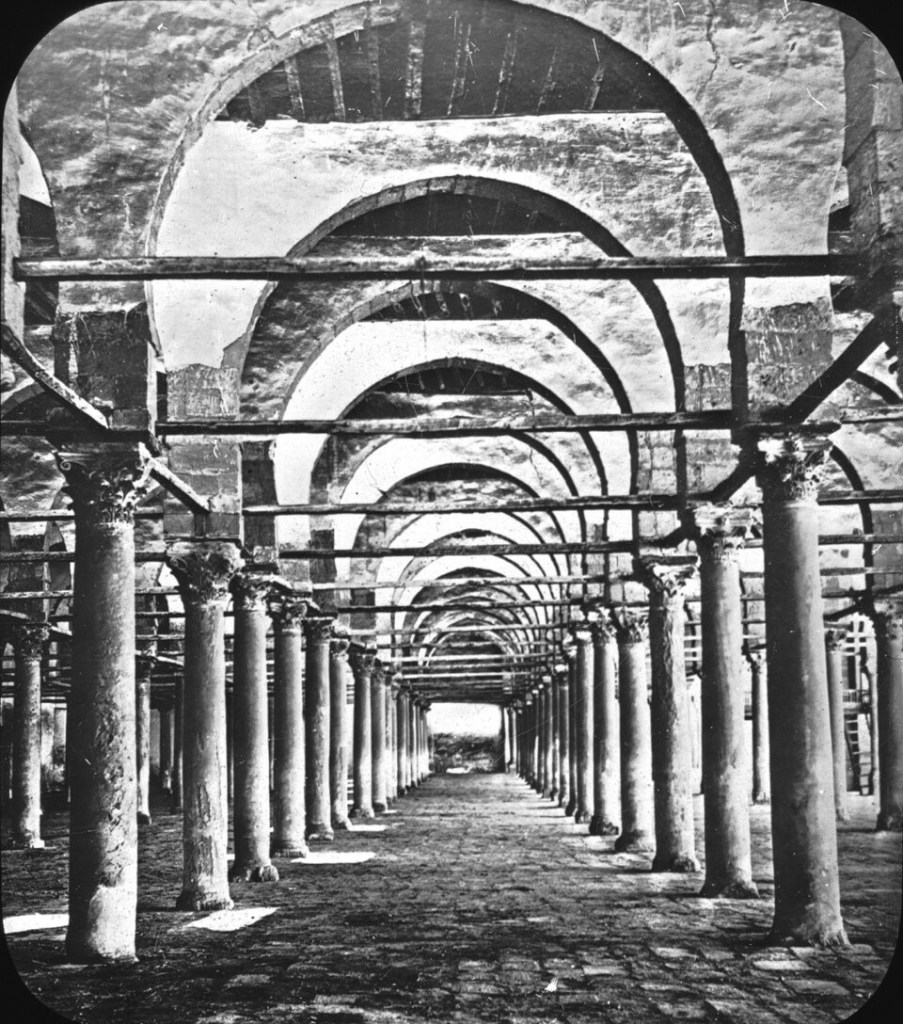
This pseudo-Burton goes on to suggest “the entire universe lies inside one of the stone pillars” of the Amr ibn al-As Mosque (مَسْجِد عَمْرِو بْنِ الْعَاصِ), in Cairo. It is true, as the “Captain” notes, “the pillars come from other temples of pre-Islamic religions”.³⁵ Having visited many such mosques in Central-to Southwest Asia and North Africa, I can tell you this was often the case and can be seen in the image of it. They were typically spolia from earlier Greek and Roman structures.

But here Borges is simply offering a physical journey analogous to the one we have undertaken through his literary references. The mosque, rebuilt and expanded many times over the centuries, features a forest of columns. And, as it was initially built in the seventh century, the column in question may have already crumbled to dust.

Thus, at the center of “The Aleph”’s universe there is no infinite sphere, no perfect mirror, no all-containing point. There is only a lacuna—carefully framed, meticulously cited, and impossible to fill.


Notes

  1. Jorge Luis Borges, “El Aleph” (“The Aleph”), 1945. English version, Norman Thomas Di Giovanni trans., in collaboration with the author.
  2. Estela Canto, Borges a contraluz (Silhouette of Borges), 1989. Note Williamson says the original is in English.
  3. Edwin Williamson, Borges, a life, 2004.
  4. Miguel de Cervantes Saavedra, Don Quixote de la Mancha, 1620.
  5. Umberto Eco, Il nome della rosa (The Name of the Rose), 1980.
  6. Borges, 1945.
  7. أَلْفُ لَيْلَةٍ وَلَيْلَةٌ, ʾAlf Laylah wa-Laylah (The Book of the Thousand Nights and a Night: A Plain and Literal Translation of the Arabian Nights Entertainments), Richard Francis Burton, trans., 1888.
  8. Suzanne Jill Levine, “Jorge Luis Borges and the Translators  of the Nights”, Translation Review, 2012.
  9. Borges, Historia universal de la infamia (A Universal History of Infamy), 1935. English version, Di Giovanni trans., 1972.
  10. Borges, “The Translators of The Thousand and One Nights”, 1936; the English version is from Selected Non-Fictions, Esther Allen, trans., 1999.
  11. Ibid.
  12. Borges, 1945.
  13. Borges, 1935.
  14. Λουκιανὸς ὁ Σαμοσατεύς (Lucian of Samosata), Ἀληθῆ διηγήματα (True History), ca. 167 CE; English translation, Charles Whibley, 1894.
  15. Martianus Minneus Felix Capella, De nuptiis Philologiae et Mercurii (On the Marriage of Philology and Mercury), also called De septem disciplinis (On the Seven Disciplines), or Satyricon, 1599, my translation.
  16. Edmund Spenser, The Faerie Queene, III.ii.18–19, 1590.
  17. Borges, 1936.
  18. Italo Calvino, Se una notte d’inverno un viaggiatore (If on a winter’s night a traveler), 1979.
  19. Borges, 1945.
  20. Burton, 1888.
  21. Ibid.
  22. Jan Potocki, Manuscrit trouvé à Saragosse (The Saragossa Manuscript), 1805.
  23. Burton, Vol. X, 1888.
  24. Borges, “Las dos maneras de traducir” (“Two Ways to Translate”), 1926 and “Las versiones homéricas” (“The Homeric Versions”), 1932, both, collected in English in On Writing, Suzanne Jill Levine ed., 2010.
  25. Borges, 1936.
  26. Burton, Vol. X, 1888.
  27. Theodore de Beze, Alphabetum Graecum, Cap. 1, De Literis Graecis, in genere, 1554, as reprinted by E. Drerup, Die Schulaussprache des Griechischen 1.160.
  28. John C. Rolfe, “The Use of Devices for Indicating Vowel Length in Latin”, Proceedings of the American Philosophical Society, 1922.
  29. Ibid.
  30. Borges, 1935.
  31. Burton, The lake regions of Central Africa: a picture of exploration, 1860.
  32. Borges, “Tlön, Uqbar, Orbis Tertius”, 1940, Ficciones, 1944. Hurley, trans., 1998.
  33. Borges, “La muerte y la brújula” (“Death and the Compass”),1942, Ficciones, 1944. Andrew Hurley, trans., Collected Fictions, 1998.
  34. Borges, 1945.
  35. Ibid.

Soup, Scoundrels, and Battle Music

Beethoven’s mythical temper and the origin of the Romantic roar (“Coprophony”, Addendum)

Following my article on Wolfgang Amadeus Mozart’s use of foul language, I ran across what seemed a similar instance concerning Ludwig van Beethoven. But looking into it further, it is not the same at all.

In 1825, the critic Gottfried Weber criticized the composer’s Wellington’s Victory, thus:¹

Es sind nicht musikalische Farben, deren van Beethoven sich hier bedient, […] sondern Täuschungen der scenischen Akustik […] Kanonen-Maschinen und andere den Lärm der Schlacht nachahmende Geräusch-Instrumente […] nur kindisch und lächerlich erscheinen können.

It is not musical colors that van Beethoven makes use of here […] but rather the deceptions of scenic acoustics […] cannon machines and other noisemakers mimicking the noise of battle [… which] can only appear childish and ridiculous.

On his copy of the journal Weber’s article appeared in, Beethoven wrote:²

Ach du erbärmlicher Schuft, was ich scheiße, ist besser, als du je gedacht!

O you wretched scoundrel, what I shit is better than anything you’ve thought up.

The comment has none of the fun or rebelliousness of Mozart’s rhymes, codeswitching, or wordplay. It’s blunt and its profanity serves that purpose. One might take it instead as an example of Beethoven’s supposedly famous temper.

Let’s look into that. Ferdinand Ries, Beethoven’s pupil, friend, and secretary, relates one such incident:³

Beethoven war manchmal äußerst heftig. Eines Tages aßen wir im Gasthaus zum Schwanen zu Mittag; der Kellner brachte ihm eine unrechte Schüssel. Kaum hatte Beethoven darüber einige Worte gesagt, die der Kellner eben nicht bescheiden erwiederte, als er die Schüssel […] ergriff, und sie dem Kellner an den Kopf warf. Der arme Mensch […] konnte sich […] nicht helfen; die Brühe lief ihm das Gesicht herunter. Er und Beethoven schrieen und schimpften, während alle anderen Gäste laut auflachten.

Beethoven was sometimes extremely volatile. One day, we were eating at the Gasthaus zum Schwanen at noon; the waiter brought him the wrong dish. No sooner had Beethoven uttered a few words about it—to which the waiter replied quite impertinently—than he seized the dish […] and threw it at the waiter’s head. The poor man […] couldn’t defend himself; the broth ran down his face. He and Beethoven screamed and cursed, while all the other guests laughed loudly.

This is an account from someone who actually knew Beethoven, recounting it to illustrate his statement, “Beethoven was sometimes extremely volatile.” Later biographers—of whom there have been many—seem to have taken this as their license to concoct narratives of their own.

There is an oft-repeated tale of Beethoven’s so-called “first rock star” temperament that, as I’ll explain, is errant crap. It regards a falling out with his patron, Karl Alois, Prince Lichnowsky of Woschütz. Supposedly, with the French occupying the city, he tried to coerce the composer into playing for them. Beethoven allegedly left in a huff, destroyed a monumental bust he had of the prince, then sent a note reading:⁴

Fürsten hat es und wird es noch Tausende geben; Beethoven gibt’s nur einen.

There have been and will be thousands of princes; there is only one Beethoven.

This “quote” is nearly ubiquitous, but it’s nearly a whole-cloth fabrication. It’s noteworthy that the account it appears in was written around 45 years after Beethoven’s death, it relies on earlier anecdotal tradition, and the original letter it supposedly draws from is nicht bekannt (unknown).

What Ries actually says about this falling out is both specific and fairly tame. First, he sets up the situation as:⁵

Im Jahre 1807 sollte Beethoven’s Oper Leonore wieder auf die Bühne gebracht werden, die bekanntlich im Jahre 1805 durchgefallen war. Die Hauptursache dieses Mißlingens war, daß sie zuerst aufgeführt wurde, als die Franzosen, und zwar erst seit kurzem, Wien besetzt hatten. Damals waren alle Musikliebhaber und reicheren Leute, welche nur immer konnten, entflohen, so daß meistens nur französische Offiziere im Theater sich einfanden.

In 1807, Beethoven’s opera Leonore was scheduled to be staged once again—an opera which, as is well known, had met with failure in 1805. The primary cause of this failure was that it had originally been performed at a time when the French—having occupied the city only shortly before—were in control of Vienna. At that time, all music lovers and wealthy citizens who were able to do so had fled, such that the theater was attended almost exclusively by French officers.

The French occupiers being philistines, a group of the composers friends decide to meet to help shorten the opera:⁶

Es bestand diese aus dem Fürsten, der Fürstinn […], dem Hofrathe von Collin, dem Stephan von Breuning, welche beide lektern sich über die Abkürzungen schon besprochen hatten, dann dem Herrn Meyer, erstem Bassisten, Herrn Röckel und Beethoven. Anfänglich vertheidigte dieser jeden Tact; als man sich aber allgemein dahin aussprach, daß ganze Stücke ausbleiben müßten und Herr Meyer erklärte, kein Sänger könne die Arie des Pizarro mit Effect singen, wurde Beethoven grob und aufgebracht.

The group consisted of the Prince, the Princess […], Court Councilor von Collin, and Stephan von Breuning—the latter two having already conferred regarding the cuts—as well as Mr. Meyer, the principal bass, Mr. Röckel, and Beethoven. Initially, Beethoven defended every single bar; however, when the general consensus emerged that entire sections would have to be omitted—and Mr. Meyer declared that no singer could perform Pizarro’s aria with proper effect—Beethoven became rude and irate.

Still, he eventually agreed to all the changes, and despite his more customary audiences eventually returning, never reinstated the excised passages. So it was actually a productive meeting, and Ries notes:⁷

Diese Sitzung dauerte von 7 Uhr Abends bis 2 Uhr, wo ein fröhliches Mahl die Sache beschloß.

This session lasted from seven in the evening until two in the morning, when a convivial supper brought the proceedings to a close.

Far from confirming a single detail of the mythic falling out between Beethoven and his patron, Ries gives an entirely different reason, concerning an “Andante in F”:⁸

Als Beethoven es unserm Freunde Krumpholz und mir zum erstenmale vorspielte, gefiel es uns auf’s höchste und wir quälten ihn so lange, bis er es wiederholte. Beim Rückwege, am Hause des Fürsten Lichnowsky vorbeikommend, ging ich hinein, um ihm von der neuen herrlichen Composition Beethovens zu erzählen und wurde nun gezwungen, das Stück, so gut ich mich dessen erinnern konnte, vorzuspielen.

When Beethoven first played it for our friend Krumpholz and me, we were utterly delighted by it, and we pestered him until he played it again. On my way home—passing by Prince Lichnowsky’s residence—I went inside to tell him about Beethoven’s magnificent new composition, whereupon I was compelled to play the piece myself, as best I could recall it.

After Lichnowsky learned what Ries could recall of the tune, the Prince visited Beethoven, saying he had composed a piece he wished to play for him:⁹

Der bestimmten Erklärung Beethovens, er wolle es nicht hören, ungeachtet, setzte sich der Fürst hin und spielte zu des Componisten Erstaunen einen guten Theil des Andante.

Despite Beethoven’s emphatic declaration that he did not wish to hear it, the Prince sat down and, to the composer’s astonishment, played a good portion of the Andante.

This caused a rift between Ries and the composer, who rightly deduced Lichnowsky must have learned the piece from him:¹⁰

Beethoven wurde hierüber sehr aufgebracht und diese Veranlassung war Schuld, daß ich Beethoven nie mehr spielen hörte. Denn er wollte nie mehr in meiner Gegenwart spielen und begehrte mehrmals, daß ich bei seinem Spiele das Zimmer verlassen sollte.

Beethoven became extremely incensed over this, and this incident was the reason I never heard Beethoven play again. For he refused ever to play in my presence thereafter, and on several occasions demanded that I leave the room while he was playing.

Lichnowsky knew this was his fault and attempted to intervene:¹¹

Ich hörte nachher, Lichnowsky wäre gegen Beethoven wegen seines Betragens sehr heftig geworden, da doch nur Liebe zu seinen Werken Schuld an dem ganzen Vorfalle und folglich auch an seinem Zorne sei. Diese Vorstellungen führten jedoch nur dahin, daß er nun auch der Gesellschaft nicht mehr spielte.

I later learned that Lichnowsky had confronted Beethoven quite vehemently regarding his behavior, arguing that nothing but a love for his works was to blame for the entire episode—and, consequently, for his own outburst of anger. Yet these remonstrances served only to ensure that he would no longer play for the [Prince’s] company, either.

Beethoven’s reaction here is understandable. Ries has taken a piece the composer is still working on and performed and taught it to his patron behind his back. This is Beethoven’s creation—his livelihood—of course he guards it jealously.

Certainly, Ries relates other incidents, but the only one about which he gives any real detail is that of Zum Schwanen. And even there, it’s relatable—the waiter gives him the wrong dish, then says something sassy when Beethoven points out the mix-up. That’s pretty rage inducing.

Also, as Ries and many others note, the composer’s trouble with his hearing exacerbated his grumpiness. To his brothers Kaspar Karl and Johann, Beethoven expresses his despair over his progressive deafness and imminent death:¹²

O ihr Menschen, die ihr mich für feindselig, störrisch oder misanthropisch haltet oder erkläret, wie unrecht tut ihr mir […] war ich früh genöthigt mich abzusondern, allein zu leben […].

O you people, who deem or declare me to be hostile, obstinate, or misanthropic—how unjustly you treat me! […] I was compelled to withdraw myself early, to live alone […].

Returning to Wellington’s Victory, the project was proposed to Beethoven by his friend Johann Nepomuk Mälzel. Mälzel was an inventor, engineer, and showman, specializing in musical automata. It seems he was more showman than inventor, as he is best known for purchasing the chessplaying Turk—Wolfgang von Kempelen’s fraudulent automaton—then reselling it at an absurd markup, and the mechanical metronome, whose design he essentially swiped from Dietrich Nikolaus Winkel.

Mälzel was looking for a piece for his Panharmonicon. The mechanical musical instrument could imitate many orchestral instruments as well as sounds like gunfire and cannon shots. Thus, the “deceptions of scenic acoustics” Weber complains of were actually built in from the start. Furthermore, the piece was intended to depict a massive battle—specifically, the rout of Napoleon’s army by the British.

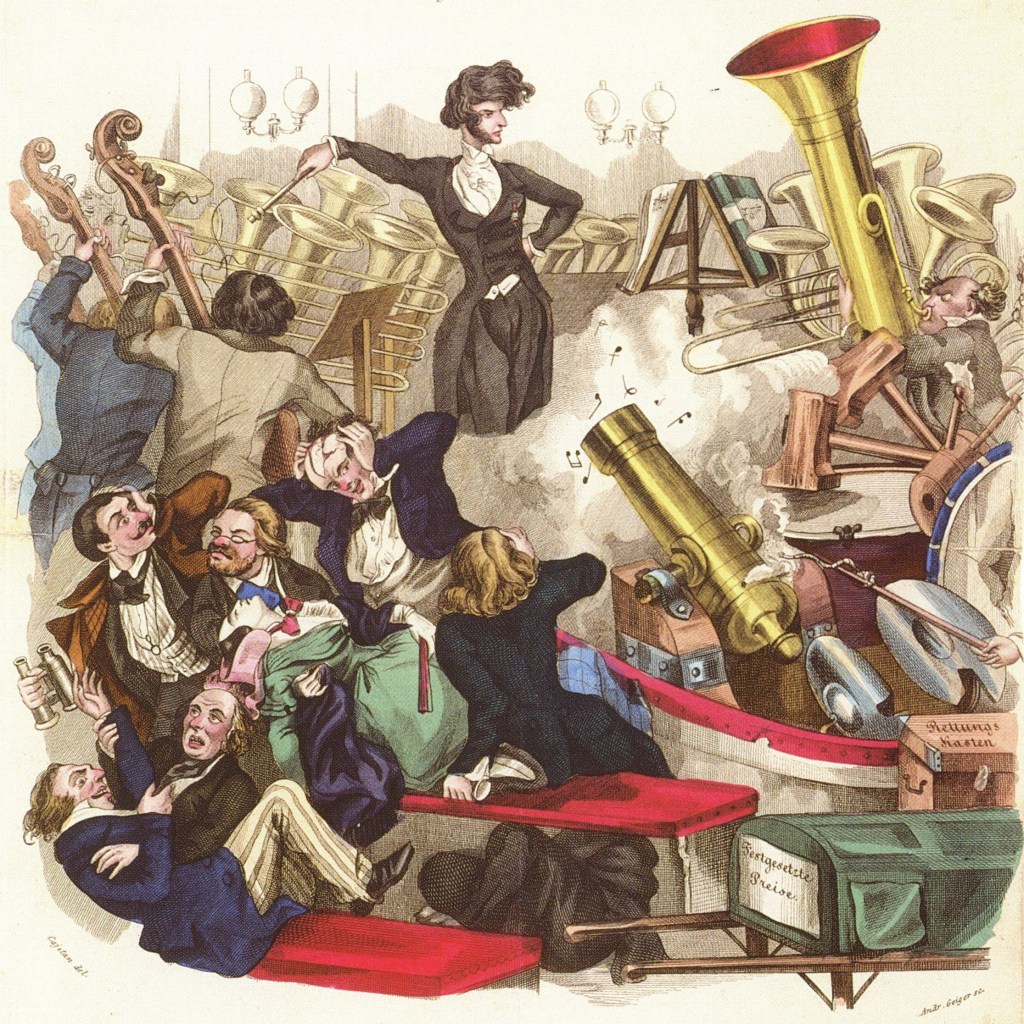
Still, Beethoven escalated far beyond his friend’s machine’s capabilities. 100 musicians were arranged in two groups at either side of the stage as the opposing armies, with numerous percussionists, including snare drums beating orders to the soldiers, bass drums intended to simulate cannons, and ratchets just being noisy.

The piece’s premiere in 1813 was a massive spectacle: Antonio Salieri was one of the two conductors, and Giacomo Meyerbeer and Ignaz Moscheles—both famous composers themselves—joined the orchestra. And despite Weber’s feeling that music should be:¹³

[…] der reinen Tonkunst geweihten Tempel […].

[…] the temple consecrated to the pure art of notes […].

The work was so enthusiastically received by the public it had to be performed several more times. If anything about Beethoven makes him the “first rock star”, it’s this piece’s intentional sonic assault.

But far from backing away from Beethoven’s supposed excesses, fortissimi only got louder after him. Instrument designs even evolved to accommodate the need. Strings moved from gut to wire. Flutes shifted from wood to metal. The biggest shift was in the brass: new designs expanded both range and power. The result wasn’t just more sound, but a higher ceiling for what loud meant.

Some 30 years later, Louis-Hector Berlioz envisioned an ensemble of 867 musicians, saying of it:¹⁴

Dans l’agitation, il rappellerait les tempêtes des régions tropicales; il éclaterait comme un volcan. Il ferait entendre les plaintes, les murmures et les bruits mystérieux des forêts vierges, les cris, les prières, les chants de triomphe ou de deuil d’un peuple à l’âme expansive, au cœur ardent, aux passions fougueuses. Son silence même imposerait par sa solennité, et les tempéraments les plus rebelles frémiraient à l’aspect de son crescendo montant, comme au rugissement d’un immense et sublime incendie.

When in a state of agitation, it would recall tropical storms. It would erupt like a volcano. It would convey the laments, whispers, and mysterious sounds of virgin forests, the shouts, prayers, songs of triumph or lamentation of a people with an expansive soul, an ardent heart, and fiery passions. Its silence would strike awe through its solemnity, and the most recalcitrant temperaments would shudder at the sight of its surging crescendo, like the roar of an immense and sublime conflagration.

Though not quite achieving this ambition, the composer’s Symphonie fantastique heads in this direction. In the fifth movement, which crescendos with a surge of overwhelming volume, including a pair of large church bells.

​This is the true legacy of Beethoven’s “childish” battle music. While Wellington’s Victory may have been intended as a crowd-pleasing gimmick, it actually shattered the existing acoustic ceiling. By demanding greater physical power than a standard orchestra could provide, Beethoven paved the way for the auditory onslaught that became the Romantic standard. And the musical world has been pumping up the volume ever since.


Read the original Article

Coprophony


Notes

  1. Gottfried Weber’s, “Über Tonmalerei” (“On Tone-Painting”), Cäcilia: eine Zeitschrift für die musikalische Welt (Caecilia: A Journal for the Musical World), 1825. The work he’s referring to is Ludwig van Beethoven, Wellingtons Sieg (Wellington’s Victory, Op. 91), often called the “Battle Symphony”, 1813.
  2. Beethoven’s personal copy of Cäcilia, H. C. Bodmer Collection, HCB V8.
  3. Franz Gerhard Wegeler and Ferdinand Ries, Biographische Notizen über Ludwig van Beethoven (Biographical Notes on Ludwig van Beethoven), 1838.
  4. Franz Xaver Boch, Wiener Deutsche Zeitung (The Viennese German Gazette), August 1873.
  5. Wegeler and Ries, 1838.
  6. Ibid.
  7. Ibid.
  8. Ibid.
  9. Ibid.
  10. Ibid.
  11. Ibid.
  12. Beethoven, Heiligenstädter Testament (Heiligenstadt Testament), October 1802.
  13. Weber, 1825.
  14. Louis-Hector Berlioz, Grand traité d’instrumentation et d’orchestration modernes (Grand Treatise on Instrumentation and Modern Orchestration), 1844.

Jazz: Agent of Cultural Transformation

Japan dancing to the enemy’s music (Taishō, Part 6)

In earlier articles in this series, I’ve argued the Taishō era (大正時代, 1912–1926) occupies a unique place in Japanese history.

As another way to understand how drastic the culture shift was, consider the grandparents of a child born at the era’s dawn lived in the Edo period’s (江戸時代, 1603-1867) closed feudal society, governed by Confucian hierarchy. That child, on the other hand, was likely to move from the countryside to Tōkyō (東京), work in a factory, and listen to jazz.

As previously noted, Japan benefited economically from World War I. The mechanism for this was international commerce, through which they also became a major consumer of both material objects and intangible items from Europe and America. Thus, Japanese society underwent rapid globalization. Some approved:¹

[Writer] Nitobe [Inazō (新渡戸 稲造)] implored his countrymen to abandon a stubborn fondness for the particularistic ethics of the past. Instead, he argued, the Japanese had to visualize themselves as possessing attitudes, values, and behaviors that were the common property of all peoples who made up the emerging democratic and capitalist world order.

Others shunned foreign influence, such that early-twentieth-century Japanese  were torn between the imported and the domestic, often termed the double life:²

The double life is at best an expense and an inconvenience, we are told, and at worst a torment, leading to crises of identity and such things.

The soundtrack to this cultural schism was decidedly jazz—jazz resounding from multitudinous cafés on the neon-lit streets of Ginza (銀座). The divides jazz created mirrored those in the political and cultural realms of the Taishō era. Your stance on jazz defined you—you either embraced its cosmopolitan pulse or rejected it as a decadent invasion of traditional values.

From the 1910s on, jazz came to Japan via its port cities from both foreign and Japanese musicians working on ocean liners. It was just as identifiable as the other emblems of the global style of the mobo and moga (モボ; “modern boys”, モガ; “modern girls”): flapper hairstyles, short dresses, bell-bottoms, haikara (ハイカラー; high collars), and round-rimmed roido spectacles (ロイド, named for American silent film star, Harold Lloyd), even using the zūja-go argot (ズージャ語; “jazzese”) to signal in-group membership:³

Clearly, in the 1920s jazz was conspicuous evidence for the emergence of an Americanized global culture, and thus was a favorite target of nationalist assaults wherever a trumpet bent a blue note. Ultimately concerns over the nation’s cultural identity and its status in the new world order provided the subtext for Japan’s early experience of jazz. The widely held belief that jazz music itself was not a mere byproduct but rather an agent of cultural transformation—engendering what social critic Ōya Sōichi called a “culture of the senses”—was born from anxieties that many Japanese felt regarding their nation’s ever-shifting self-image.

As to the cafés, I mentioned in Part 2B, European-style cafés began appearing with Café Printemps (カフェー・プランタン) in 1911. By 1939, there were some 37,000, concentrated mainly in Ginza—dubbed the Paris of the East (東洋のパリ; Tōyō no Pari). ⁴ Originally intended as places writers and painters could gather and discuss art, some transitioned easily to jazu-kissa (ジャズ喫茶; jazz cafés), the first such being Tōkyō’s Blackbird (ブラックバード) in 1929. Jazu-kissa played the latest records on gramophones for their clientele.

Already by mid-Taishō, Japan’s urban middle class was firmly in the grip of dansu netsu (ダンス 熱; “dance fever”). Modan (モダン; moderns) were required to know how to one-step, two-step, and fox-trot. In 1923, US music magazine Metronome reports:⁵

The Japanese are jazzing by day and by night. […] Foreign dancing undoubtedly has come to stay. It is much in evidence in Tokio and has spread into Yokohama, Osaka and Kobe, although not to any extent outside of the big cities.

The article goes on to discuss some reservations, including those of Harvard graduate Dr. Takuma Dan:⁶

I approve of the mixed dancing, but we have to go slow. It is dangerous for our young girl, brought up in the purely Japanese way, and who therefore never sees outsiders except in a formal way. She has been taught that she must embrace no man except her husband. It is confusing and dangerous. But to the girl who has had a foreign education, who has spent two or three years in the United States, it is all right. She has got the spirit of the thing and it is good. It allows a proper opportunity for the sexes to meet before marriage as Americans do. Our marriage arrangements will be the last of our customs to change. We are adopting very fast all sorts of Western customs and practices, but parents will arrange the marriages of their children for a long time yet. The so-called love matches which now occasionally take place are rarely happy. My son goes to dances. My daughters have not learned as yet—they are all married and have their duties.

Nonetheless, it should also be clear those consuming foreign culture and embracing modernity were a subculture, often villainized and harassed:⁷

For most of the twentieth century, in fact, jazz folk were singled out as inimical to the national project of nurturing and preserving Japan’s cultural ‘‘essence,’’ even if that essence was subject to constant reformulation as circumstances dictated.

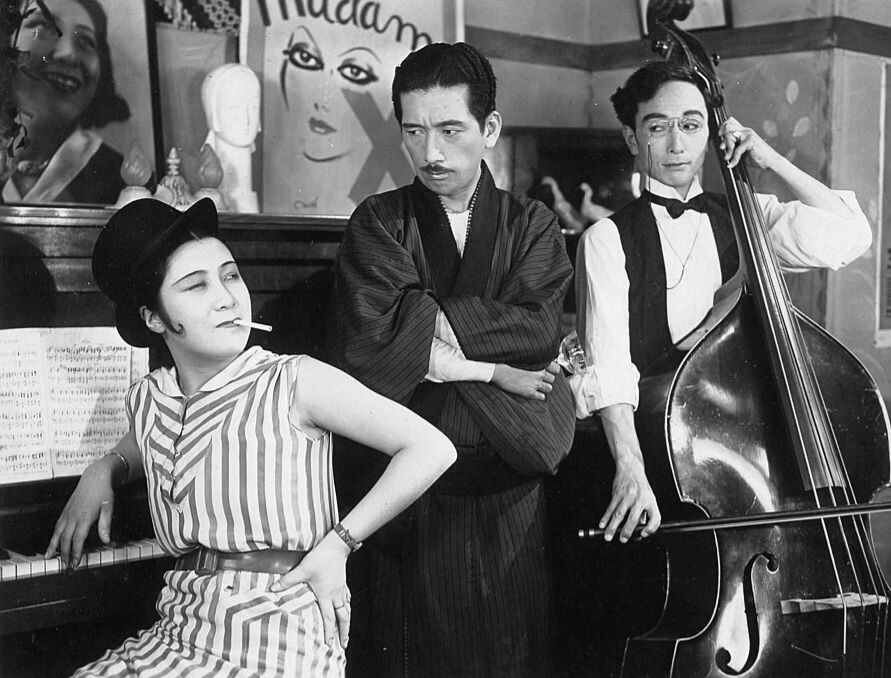
Gosho Heinosuke’s (五所平之助) 1931 film, The Neighbor’s Wife and Mine (『マダムと女房』; Madamu to Nyōbō) perhaps captures the situation best. In addition to revolving around the topic of jazz, this is Japan’s first feature-length talkie.

First, it’s important to note the English translation of the title is wildly misleading. The literal translation would be The Madam and the Wife, which I can understand avoiding. Also, the neighbor in question definitely seems unmarried. Madamu was a term of the café scene of early 20th century Japan. It is related to moga, but implies a more sophisticated and financially independent version of the Westernized, progressive woman—specifically, the manager of a café. In English, the word has the connotation of a proprietress as well, but unfortunately of a brothel, hence the awkward rendering of the title. The madamu of this film, meanwhile, clearly runs a jazu-kissa.

Kitamura Komatsu’s (北村 小松) script is self-referential, if not autobiographical, featuring a playwright—a field Kitamura studied at Keiō University (慶應義塾大学; Keiō Gijuku Daigaku)—struggling to meet his deadline. The screenwriter attended this prestigious Tōkyō school after his rural upbringing in Aomori (青森), at the northern tip of Japan’s main island. The cultural whiplash Kitamura must’ve felt is mirrored in that of the film’s protagonist.

As a point of personal connection, Keio later moved its main campus to Hiyoshi, Yokohama (日吉, 横浜). This is the town I lived and worked in, designing games for Kōei (光栄), whose name comes—in zūja-go fashion—from a reversal of the vowels of the school’s name.

In The Madam and the Wife, Shibano Shinsaku (芝野 新作, played by Watanabe Atsushi; 渡辺 篤) rents a house as a quiet place to complete his play. It doesn’t work out as planned—he is constantly disturbed by various noises, particularly a neighbor (i.e., the madamu, Yamakawa Takiko; 山川 滝子, played by Date Satoko; 伊達 里子) playing loud jazz music. The following exchange ensues:⁸

Shibano: Hey. Go next door and tell the band to stop playing.
[Shibano] Kinuyo [played by Tanaka Kinuyo; 田中 絹代]: I can’t make such a selfish request.
Shibano: Go tell them they’re disturbing the whole neighborhood.
Kinuyo: Who cares? It’s jazz. You should do your work at that tempo.
Shibano: Idiot! Can’t you see I’m suffering?

When Shibano goes himself to complain, Yamakawa invites him in to meet the band and join the party. After a drink loosens him up, the playwright begins to appreciate their Western music. Soon, he is singing and dancing enthusiastically to “The Age of Speed” (『スピード時代』; “Supīdo Jidai”) keeping the beat by tapping his glass with a spoon, then using a slapstick. At the end of the song he declares:⁹

That was great! It got me all fired up.

When he returns home, Kinuyo is displeased at his intoxicated state and jealous of him spending time with the “modan garu” at the party. She calls her “dangerous” and her Western clothes “suggestive” and “erotic”, but later admits she wants “a dress like that”. Shibano replies only:¹⁰

Writers fee: 500 yen. Actions speak louder than words. 

The film could easily have been subtitled How I Learned to Stop Worrying and Love Jazz—an allegory on being less rigid and embracing modernity. The Shibano family is depicted as rather formal at the beginning of the film. Tanaka has the distinctive rural accent of her native Yamaguchi (山口), Honshu’s (本州) westernmost province—funnily at the very opposite end of the island to the screenwriter. They also wear traditional clothing and Mrs. Shibano is elaborately coiffed.

Additionally, at the outset, the protagonist is a bit of a jerk: He insults a painter’s work—even calling him a rumpen (“loafer”; ルンペン)—and gets into a fight with him. He plays mājan (麻雀; mahjong) with his friends until after midnight, with his deadline looming and the household running low on money—and it’s clear he’s missed deadlines before. The Shibano marriage is clearly strained.

In the film’s epilogue, after being inspired by jazz, Shibano has clearly completed his work on time. The family is happily returning from a trip to a department store, many purchases in hand. Their look is more modan, with the playwright and his daughter in Western attire, and his wife’s hair in finger waves. The whole family enjoys one another’s company. Nearing home, they hear their neighbor’s band strike up “My Blue Heaven”. They agree it’s great and happily sing along together as the credits roll.¹¹

The rosy view presented by a group of artsy filmmaking urbanites, however, was still far from that of the increasingly reactionary and nationalistic government. The Tokkō (特別高等警察; Special Higher Police), established in 1911, and 1925’s Public Security Preservation Law (治安維持法) saw widespread surveillance of cafés and dance halls and censorship of radio waves and movie theaters. Finally, in autumn 1937, the Home Ministry seized authority to regulate jazz venues, declaring:¹²

[T]he existence of dance halls and dance schools, which rebel against our national conditions, disturb womanhood, encourage frivolity in our youth, and exert not a little bad influence on the nation’s public morality [is] truly undesirable.

Well before war with America began in earnest, jazz was declared “the enemy’s music” (敵性音楽; tekisei ongaku). But this genie couldn’t be put back in the bottle.

As a mark of how inseparable from Japanese culture jazz had become by the early ’30s, in an article addressed “To Our Brothers and Sisters in the Village”, one rural paper questioned their country’s military adventurism:¹³

Manchuria is now Japan’s possession, but has your life changed? Has it become any easier? Have you been able to pay back any of the capital you have borrowed? Have your sisters been able to make one kimono, or your brothers go to a cafe to listen to jazz? I know the answer: it is a resounding “No!”

Striking here is the placement of jazz alongside kimono as the—frustrated—goals of Japanese villagers.

During the war, jazz simply hid behind other names—keiongaku (軽音楽; “light music”) and saron myūjikku (サロンミュージック; “salon music”). These were acceptable to state censors and cultural nationalists, as well as jazz musicians and their eager audiences.

With the war over, the jazz scene resurged almost immediately. Japanese musicians returned to performing openly, and American artists soon followed. By 1953, DownBeat magazine described Louis Armstrong’s SRO extended tour of the country thus:¹⁴

Receiving the largest guarantee of anyone who had ever visited Japan, Louis earned an average of $2,500 per night as against fifty percent of the gross. There was also prepaid round trip transportation for a party of 12. Before the unit left the States, they’d received four weeks advanced [sic] salary ($72,000) […]

Armstrong himself said of the tour:¹⁵

Japan—how many people would think the Japanese would dig our music the way they did?


Read previous articles in the Taishō series

Part 1: Japan’s Turbulent Taishō

Part 2A: Epochal Architecture

Part 2B: When Tokyo Moved West

Part 3A: Asakusa Movies

Part 3B: Asakusa Opera

Part 4: The Mysteries of Zūja-Go

Part 5: How “Alice” Grew Big in Japan


Notes

  1. John L. McClain, Japan: A Modern History, 2001.
  2. Edward Seidensticker, History of Tokyo 1867-1989 From Edo to Showa: The Emergence of the World’s Greatest City, 2019.
  3. E. Taylor Atkins, Blue Nippon: Authenticating Jazz in Japan, 2001.
  4. Michael Hoffman, “The Taisho Era: When modernity ruled Japan’s masses”, The Japan Times, July 2012.
  5. Grace Thompson Seton, “The Jazzing Japanese”, Metronome, January 1923.
  6. Ibid.
  7. Atkins, 2001.
  8. 『マダムと女房』 (The Madam and the Wife), 1931.
  9. Ibid.
  10. Ibid.
  11. Ibid.
  12. Quoted in 永井良和 (Nagai Yoshikazu), 『社交ダンスと日本人』 (Shakō dansu to Nihonjin; Social Dance and the Japanese), 1991.
  13. 小浦 初美 (Koura Hatsumi), 「農村 の 兄弟 へ」 (“Noson no kyodai e”; “To Our Brothers and Sisters in the Village”), 『神科 時報』 (Kamishina Jihō; Kamishina Times), May 1932, quoted in McClain, 2001.
  14. “Pops’ Japan Tour a Smash”, DownBeat, January 1954.
  15. Ricky Riccardi, What a Wonderful World: The Magic of Louis Armstrong’s Later Years, 2011 .

Repainting the Roses

How Tudor propaganda and Shakespeare named a war (DeDisneyfication, Part 7B Addendum)

In my original article I touched on Edward IV’s queen consort, Elizabeth Woodville, and how Lewis Carroll’s Through the Looking-Glass, and What Alice Found There (TLG) reflects the Shakespearean image of queens, knights, and the perilous game for the English crown.

It turns out The White Queen—the first novel in Philippa Gregory’s The Cousins’ War series—takes this a step further, using many of the tropes and metaphors from TLG in portraying its subject. Gregory’s title itself cleverly points to Woodville as an important Yorkist queen, as well as to the game of chess and thereby to Carroll’s work.

Gregory’s novel has been widely praised for evoking a sense of history as gameboard, one reviewer observing:¹

Gregory sets her players up like chess pieces, moving them around skilfully and swiftly, with wonderful results.

This White Queen book was adapted into a TV series in 2013, with its script presenting some clear counter-influence from the Alices. In Episode 1, when—at her mother’s (Janet McTeer) urging—Woodville (Rebecca Ferguson), dispossessed of her husband’s Lancastrian estates after his death in battle, petitions Edward (Max Irons) in person for redress. Her family is wary of the king’s reputation as a womanizer and argues as to the wisdom of switching their allegiance to the Yorkist side. Woodville takes a seat at a nearby table, delivering the seeming non sequitur:²

Will anyone play chess?

The line works on two levels—on the surface, a nervous diversion in a tense room, but beneath that, the literal win-or-die game for the monarchy of England that serves as the framing device for TLG.

Still, the chess allusion persists. In Episode 3, Isabel Neville (Eleanor Tomlinson) is lamenting to her sister Anne (Freya Mavor) how their father, Warwick (James Frain) is bartering them to forge alliances as he turns against Edward:³

We are their pieces on a board, Annie.

Again, it’s not just metaphor; it’s an acknowledgment that in the worldview of both The White Queen and the Alices, life—especially for women—is governed by rules that pre-exist the individual and outlive them. Turning to Shakespeare, Humphrey, Duke of Gloucester, says to Queen Margaret of Anjou:⁴

Madam, the king is old enough himself
To give his censure. These are no women’s matters.

Obviously, Shakespeare is neither a historian nor a contemporary source, but he’s reflecting his understanding even queens were not meant to take part in political or governmental affairs. Instead, women were to remain within the boundaries prescribed by society.

Back in Episode 1 of The White Queen, Woodville’s family does go over to Edward’s side. Commanded to muster troops, Baron Rivers (Robert Pugh) and his sons turn out with their men at arms. As they join the main force of the Yorkists, Warwick says:⁵

Tell me, if I scratch that [white] rose, will I find its true red color underneath?

Where the chess references might be dismissed, this one unmistakably mirrors the absurdity of Carroll’s royal gardeners anxiously repainting roses to suit royal preference I quoted in the original article.

And as with so many of the scenes in Alice’s Adventures in Wonderland (AiW), this too originates in Shakespeare. In 1 Henry VI, he imagines the origin of the Wars of the Roses, also contributing to the idea for its modern name—in the Bard’s time they were simply known as “the civil wars”. Unable to settle a legal dispute, a group of nobles retires to the gardens of the Temple Church:⁶

[Richard] Plantagenet: Since you are tongue-tied and so loath to speak,
In dumb significants proclaim your thoughts:
Let him that is a true-born gentleman
And stands upon the honour of his birth,
If he suppose that I have pleaded truth,
From off this brier pluck a white rose with me.
[First/ Second Duke of] Somerset: Let him that is no coward nor no flatterer,
But dare maintain the party of the truth,
Pluck a red rose from off this thorn with me.

As the scene continues, the followers of each faction pick and wear red and white roses to show their allegiances. Near the scene’s end, Richard de Beauchamp foresees the horrors of the wars to follow:⁷

And here I prophesy: this brawl to-day,
Grown to this faction in the Temple-garden,
Shall send between the red rose and the white
A thousand souls to death and deadly night.

Shakespeare continues to develop the theme throughout his histories, calling Richard II a “fair rose”⁸ and referring to Henry IV as “this thorn”.⁹  He even plays out Warwick’s “prophecy”, thus:¹⁰

King Henry VI: O pity, pity, gentle heaven, pity!
The red rose and the white are on his face,
The fatal colours of our striving houses:
The one his purple blood right well resembles;
The other his pale cheeks, methinks, presenteth:
Wither one rose, and let the other flourish;
If you contend, a thousand lives must wither.

Shakespeare seems to have judiciously robbed these ideas from Edward Hall’s Chronicle, the full title of which is:¹¹

The union of the two noble and illustre famelies of Lancastre & Yorke, beeyng long in continual discension for the croune of this noble realme, with all the actes done in bothe the tymes of the princes, bothe of the one linage and of the other, beginnyng at the tyme of Kyng Henry the Fowerth, the first aucthor of this devision, and so successively proceadyng to the reigne of the high and prudent prince Kyng Henry the Eight, the undubitate flower and very heire of both the sayd linages.

The frontispiece of the second edition of the book, published in 1550, turned this idea visual, representing the York and Lancaster family trees as a pair of briar roses. At the top, Henry VIII appears in majesty at the junction of both vines.

Still earlier, in 1486, the Croyland Chronicle presents the following verse:¹²

Anno milleno, C. quater, quater atque viceno,
Adjunctis quinque, cum lux Sextilis adesset
Duplex undena, dentes Apri stupuerunt,
Et vindex albae, rosa rubra refulget in ore.

On the 22nd day of August, 1485, the tusks of the boar were blunted, and the red rose, avenger of the white, shines upon us.

I’ve previously noted the boar was Richard III’s personal device. The white rose was similarly a badge of the Yorkists, beginning with Edmund of Langley, the first Duke of York, in the late fourteenth century. According to historian George Goodwin, there is considerable evidence of its use on:¹³

[B]anners, coats-of-arms, jewellery, stained glass, seals, coins, and paintings.

The red rose as a symbol of the House of Lancaster, however, is a different case. There is literally not a single firm contemporary use of it as an emblem before the Battle of Bosworth Field. Even the term Lancastrian is applied retroactively—Shakespeare never uses it. In turn the red was incorporated into the Tudor rose, superimposing a white rose on a red one, when Henry married one of Woodville’s children, Elizabeth of York.

Both emblems were retrospective propaganda, neatly packaging the bloody civil wars as justly resolved and presenting a continuity of the Lancastrians with a dynastic claim to the throne of England equal to that of Henry’s wife, which their union further strengthened.

The author of the Croyland Chronicle’s Second Continuation seems to have quaffed deeply of the Tudor Kool-Aid, often criticising Richard III and referring to Henry in glowing terms like:¹⁴

Principem hunc novum […] cœpit laudari ab omnibus tanquam Angelus de cœlo missus, per quem Deus dignaretur visitare plebem suam, & liberare eam de malis quibus hactenus afflicta est supra modum
This new prince […] began to be praised by all as an angel sent from heaven through whom God had deigned to visit his people and set them free from the evils which had hitherto afflicted them beyond measure.

And again, the Bard latched onto these same ideas, having Henry Tudor promise in his final speech in Richard III:¹⁵

[…] We will unite the white rose and the red.
Smile heaven upon this fair conjunction,
That long have frown’d upon their enmity!

The White Queen takes this all one step further, collecting all the revisionist mythology and symbolism embodied in Carroll and Shakespeare’s works and reapplying it—ahistorically—to the original events.

As Gregory is dealing in historical fiction, she must bend to audience expectations. I’ve navigated those waters repeatedly myself, building Rome with a 500-year premature amphitheater. Even Shakespeare is guilty of this: the Temple Garden—which, while it did exist in Richard Plantaganet’s time, was only an orchard—wasn’t redesigned as a formal garden until 1591, to include a terrace, walkways, and probably roses.


Read subsequent articles in the DeDisneyfication series

Part 8: Guerrillas and the “Jungle”

Part 9A: Through a Magic Mirror Marred

Part 9A Addendum: The Woods “Over the Wall”

Part 9B: The Sum of its Versions

Part 9C: The “Snow White” Studio

Part 9D: Snowhaus

Part 10: The Little Less-Than

Part 11: Batmouse 3D

Part 12: Mork & Scheherazade


Read previous articles in the DeDisneyfication series

Part 1: Straightening out “Hunchback”

Part 2: Making over “Mulan”

Part 2 Addendum B: Your Western Wuxia Is Weak

Part 3A: “Hercules”: Myths and Mistakes

Part 3B: Doing Hera’s Work on “Hercules”

Part 4: Tale As Old As Agriculture

Part 4 Addendum: The Enchanted and the Postmodern

Part 5: Putting “Pocahontas” to Rest

Part 5 Addendum: Powhatan’s Mantle

Part 6: Trouble with “Tarzan”

Part 7A: The Wrong Rabbit Hole

Part 7A Addendum A: Curious Curation

Part 7A Addendum B: “Alice” in Revolt

Part 7A Addendum C: How “Alice” Grew Big in Japan


Notes

  1. Diane Baker Mason, “The White Queen, by Philippa Gregory”, The Globe and Mail, September 2009.
  2. Episode 1, “In Love With the King”, The White Queen, 2013.
  3. Ibid, Episode 3, “The Storm”, 2013.
  4. William Shakespeare, 2 Henry VI, 1.3.122–23, 1591.
  5. Episode 1, The White Queen, 2013.
  6. Shakespeare, 1 Henry VI, 2.3.25–33, ca. 1591.
  7. Ibid, 124–128.
  8. Shakespeare, Richard II, 5.1.8, 1595.
  9. Shakespeare, 1 Henry IV, 1.3.180, ca. 1597.
  10. Shakespeare, 3 Henry VI, 2.5.96–102, 1591.
  11. Edward Hall, The Union of the Two Noble and Illustre Families of Lancastre and Yorke (often called Hall’s Chronicle), 1548.
  12. Anonymous, possibly John Russell, Alia Continuatio (Second Continuation), Rerum anglicarum scriptorum Veterum Tom. I. Quorum Ingulfus nunc primum integer, cæteri nunc primum prodeunt (aka Croyland Chronicle), 1486. I used the William Fulman edition of 1684. Note the date—22nd of August, 1485—is phrased poetically; literally it’s “one thousand, 100 times four (=1400), four times 20 (=80), and five, when the light of the sixth month (August) was present, twice 11 (=22).”
  13. George Goodwin, Fatal Colours: Towton 1461England’s Most Brutal Battle, 2012.
  14. Anonymous, 1486.
  15. Shakespeare, Richard III, 5.5.20–22, ca. 1592–1594.

More Genre Coffin Nails

Clan lords and intertubes (Interactive Storytelling, Part 3 Addendum)

In this seriesprevious entry, there was another important element in the demise of the adventure genre I should have discussed: the advent of the internet.

When there was no internet, if you were playing Sam & Max Hit the Road, and got stuck, there weren’t a lot of options open to you. The main one was calling LucasArts’ Hint Line and paying 1.99 USD per minute for help.

The internet was opened to the public in 1991, and by 1993, it started actually being used as such. America Online’s carpet-bombing strategy of distributing free trial disks came the same year. Quake allowed multiplayer online matches via the internet in 1997, a year before Grim Fandango’s release.

The problems this posed for game companies working in the adventure genre were manifold: not only would there be game walkthroughs available online nearly as soon as someone solved them, but the revenue stream from tip lines also dried up. Most importantly, the genre was feeling long-in-the-tooth compared to other offerings and needed not just an evolution, but a revolution.

By the time I was designing quests like The Cairn Stones in Diablo II, I was very aware of the issue. It’s for this reason I used the procedural generation already used to generate dungeons, and many other elements. In the Cairn Stones quest, the order of both on the scroll and the stones are randomized. This means the solution to your stones won’t necessarily be the same as another player’s and a walkthrough will do you no good.

The much more elaborate puzzles in the adventure genre, however, did not lend themselves well to such design solutions. Escape from Monkey Island included the “Monkey Kombat” subgame, wherein “monkey words” each defeated two others in rock-paper-scissors fashion. Which defeated which was randomized, so requiring exploration to solve. But it felt tedious rather than fun and was one of the most hated elements of the game.

I felt actual puzzle gameplay was outside what made sense for Diablo II, so Cairn Stones was really just lock-and-key—get the scroll, have it translated, and use it on the stones. Even still, a player could just keep clicking the stones and hit on the solution fairly easily.

I did have to face actual puzzle gameplay in the internet age when I joined the strike team for WarCraft Adventures: Lord of the Clans (WCA).

In Blizzard’s parlance of the time, a strike team was a group from one studio tapped to look at another’s first playable, give feedback, and make recommendations. I did this for StarCraft, then joined the team to continue in this role right up to its successful launch. WCA was less fortunate.

While Diablo revitalized a supposedly dead genre, we did so by making significant changes to it, removing the P&PRPG cruft in favor of a quick-to-the-fun experience that still had a ton of depth to explore. WCA brought nothing new to the table. One reviewer of a leaked section of gameplay hit the nail on the head, calling it:¹²

[A] conventional, borderline dull point-and-click adventure [… that] doesn’t quite feel like Warcraft.

Despite Blizzard’s protests to the contrary, the playable really was that bad. I’d have enjoyed working in the genre and taking on the challenge of innovating it for the internet age. But it would have required a full reboot just to get to the level of a decent adventure game for the previous decade.

For these reasons, I lobbied hard for the game’s cancellation. I was pleased to have eventually convinced Blizzard’s leadership a mercy killing was the best course of action.


Read previous articles in the Interactive Storytelling series

Part 1: Lizzie’s Game

Part 2: Those Frumious Jaws

Part 3: Hijinx and Deconstruction


Notes

  1. Wes Fenlon, “The inside story of Warcraft Adventures: Blizzard’s lost point-and-click adventure”, PC Gamer, December, 2016.

Mork & Scheherazade

The strange origins and permutations of Aladdin (DeDisneyfication, Part 12)

Aladdin (علاء الدين, “Alāʼu d-Dīn”) isn’t merely the best-known of the tales of One Thousand and One Nights (أَلْفُ لَيْلَةٍ وَلَيْلَةٌ, ʾAlf Laylah wa-Laylah, OTON hereafter), it’s emblematic of it to the point of being synecdochical.

And yet, if you consider the actual corpus of those tales, it’s an odd one. 

First, there’s the fact it’s set in China. This may seem surprising given the Southwest Asian associations of OTON, but many authors, translators, and scholars collected the work over many centuries from South and West Asia and North Africa.

Some tales trace their roots back to ancient and medieval Arabic, Sanskrit, Persian, and even Mesopotamian literature. Most tales, however, were originally folk stories from the Abbasid and Mamluk eras, while others, especially the frame story, come from the Pahlavi Persian work Hezār Afsān (هزار افسان), and may ultimately be translations of still older Indian texts.

Additionally, to the original audience of the tale, China represented a distant, exotic land associated with wealth, mystery, and magnificence. While Chinese cities like Chang’an were widely renowned for their grandeur, ordinary people wouldn’t have access to the details. Instead, the names in the “China” of Aladdin are Arabic and Persian, and other cultural markers—the Sultan, the vizier, and the genie—similarly draw on Southwest Asian traditions.

In fact, Aladdin shares its origin with only 10 other tales in the original European publication of OTON. These can be traced to Hanna Diyab (اَنْطون يوسُف حَنّا دِياب), a Maronite Christian from Aleppo, who told the stories to French writer Antoine Galland in the early 18th century. Galland, who was translating OTON into French, included Aladdin in his collection despite the tale not being part of the original Arabic manuscript.

All three of the best-known tales of OTON are absent from the original canon. Of these, two can be traced to Diyab—Aladdin and Ali Baba and the Forty Thieves (علي بابا والأربعون لصا, Ali Baba wal Arba’in Lisa), while Sindbad the Sailor (سندباد البحري, Sindibādu l-Bahriyy) is its own cycle apparently deriving from travellers’ tales of the Abbasid Caliphate (750–1258).

The other OTON tales transmitted directly to Galland by Diyab are:

  • Alī Khawājā and the Merchant of Bagdad
  • The Ten Viziers
  • The Ebony Horse
  • The Sultan of Samarkand and His Three Sons
  • Khawājā Hasan al-Habbāl
  • The Caliph’s Night Adventures
  • Prince Ahmed and the Fairy Perī-Bānū
  • Sīdī Nuʿmān
  • The Two Sisters Who Envied Their Cadette
  • Blind Man Bābā ʿAbdallāh

Following Galland’s inclusion of Aladdin in his version of OTON, the story gained immense popularity and underwent various adaptations, also being translated into Arabic and included in subsequent versions of OTON as if it had always been there.

Aladdin became a staple in Western literature, with numerous translations and retellings throughout the 19th and 20th centuries, eventually finding its way into the realm of theater and film. The 1924 film The Thief of Bagdad, while not a direct adaptation of Aladdin, drew heavily on its themes and aesthetics, influencing subsequent interpretations.

In 1992, Disney released its animated film Aladdin, falling just past the apex of the Disney Renaissance.

True to the Disney pattern, they chose a beloved tale with dozens of retellings to crib from. They threw out most of the plot apart from a few key elements—the lamp and the genie—and grafted on new characters and story elements. Where the original has Aladdin as a poor tailor’s idle son, the animation studio makes him a thief with a heart of gold. The strong-willed and independent Princess Jasmine is also reimagined from Princess Badroulboudour (بدر البدور Badru l-Budūr—full moon of full moons), whose key attribute is her beauty.

Agrabah, in fact, was intended to be Baghdad, the name being a near-anagram. This was almost certainly a legacy of The Thief of Baghdad. The film’s timing, however, between the Gulf Wars, rendered that location more toxic than exotic. But just as Diyab’s version of China was entirely imagined, so too was Disney’s version of Baghdad. The difference is Diyab projected his own culture onto a romanticized location, while Disney presented a vague amalgamation of Southwest and South Asian cultures, freighting it with all the stereotyped, exoticized baggage of centuries of Western imperialism.

As is typical of Disney films, there is clear bad-guy coding—ethnic accents and “foreign” features, in this case, large aquiline noses. The nose thing seems to have been so essential to the portrayal of villains in the film it inspired Jafar’s (Jonathan Freeman) henchman Iago (Gilbert Gottfried) being a parrot, so having a literal beak.

Notably, these two main baddies break the mold accent-wise. Jafar speaks in a posh English accent—another bad guy trait common across Disney films. Gottfried, of course, sounds like himself, but is there for comedic value, so it makes sense.

Of course, there is also good-guy coding—American accents, Westernized features. For example, Aladdin’s (Scott Weinger) appearance and personality are modeled on Tom Cruise.¹

These elements, coupled with repeated references to chopping off various bits of people’s anatomy, seem to have slipped by the “number of Arab scholars and consultants” Disney consulted during production.² In turn, the American-Arab Anti-Discrimination Committee complained about the portrayal of its people in the film. The animation studio responded by Band-Aiding the video release with a two-line rewrite of “Arabian Nights”’ lyrics.

And while Robin Williams’ performance as Genie was clearly a strength of the film, it gave rise to trends that are not so great. The first is the move toward using so-called named talent in animation.

The Golden Age of American Animation was populated with giants like Mel Blanc, who literally voiced most of the iconic Warner Bros. characters of the era, from Yosemite Sam to Tweety Bird. The Simpsons is a notable remaining bastion, with only six voice actors playing 30-odd main characters.

Williams, too, was a talented mimic capable of dozens of voices. He was respectful of the tradition of voice acting in animation as well, and was hesitant to accept the role, finally agreeing with the understanding his name would not be used in Aladdin’s marketing.

But studio chief Jeffrey Katzenberg, having already begun the named talent escalation, casting Vincent Price in The Great Mouse Detective, and Joey Lawrence, Billy Joel, Bette Midler, and Huey Lewis in Oliver & Company, couldn’t not exploit Williams’ box office draw. While not actually naming Williams in their advertising for the film, Disney used his voice and the Genie character in all of it, as well as for every manner of merchandise. There was little Williams could do:³

[He…] accused Disney executives of lying to him and breaching an agreement not to use his voice to merchandise products. The feud went on for a year, finally ending after Katzenberg left the studio and his replacement, Joe Roth, formally apologized.

Regardless, the film was a massive BO smash, yielding 20× its budget—504.1M USD. Nor did subsequent actors have the qualms Williams did about attaching their names to animated films. So, as film critic Lindsay Ellis notes:⁴

[L]essons were learned from the success of Aladdin. Cynical, cheap lessons. We saw it begin to some degree with The Lion King, and then more with Pocahontas (Mel Gibson was one of the biggest stars in the world at the time), but then after that, starting with the ones that were seriously in production after Aladdin was released, every Disney movie had a Genie knockoff featuring some extremely bankable comedic talent.

The other trend sparked by Williams’ portrayal of Genie came from his heavy use of contemporary pop-cultural references. While inherent to his comedic stylings, and even the reason for his success, Disney, and indeed Hollywood writ large’s takeaway was to copy and paste. Such references became a substitute for original humor, relying on the audience’s recognition of other media rather than creating jokes rooted in the story itself. Ellis describes the trend thus:⁵

[I]n a post-Shrek celebrity-driven animated feature world, well [this type of humor]’s not all there is, but in terms of sheer volume, it’s most of it.

One specific instance of this can be scrutinized: In Aladdin, Genie is playing chess with Carpet (yes, that’s the flying carpet’s name), who takes one of his pieces. Genie morphs into a caricature of Rodney Dangerfield, complete with a necktie he loosens nervously, and delivers the line, also in an impression of the comedian:⁶

I can’t believe it—I’m losing to a rug!

Is it funny? Reasonably so: Dangerfield’s Borscht-Belt one-liners were characteristically self-deprecating, so this fits the pattern. Disney seems to have seen as a high-water mark, as there’s even a high-end official figurine called “I’m Losing to a Rug” capturing the scene. This apparently also led to a reprise of the gag four years on in The Hunchback of Notre Dame. Hugo the gargoyle (Jason Alexander) is playing poker with a pigeon, and utters the immortal laff line:⁷

I’m losing to a bird!

Unlike its forebear, this has been broadly mocked. Apart from the Aladdin precedent, nothing about the gag makes sense. I’ve mentioned the gargoyles before. Ellis says of them:⁸

Most people’s post-mortem will agree that the centrality of these cartoonishly grotesque gargoyles in a dark and serious story did far more harm than good […].

Where Carpet is clearly sentient, there is no logic to a gargoyle and a pigeon playing poker—beyond them both existing at the top of the cathedral—let alone the pigeon winning. Giving Disney the benefit of the doubt, the link might be that George Costanza of Seinfeld, also played by Alexander, is a loserly character like Dangerfield’s comedy persona. Uncharitably, it’s just a poorly recycled gag.

Such recycled gags have become Disney’s stock-in-trade, signaling which is the case. To keep picking on Hunchback, here’s a far-from-complete list, just of gags in the film with references external to the film’s world:

  • Belle walks down a street
  • A Parisian has Carpet draped over his arm
  • Clopin’s “Court of Miracles” dance refers to “L’apprenti sorcier” (“The Sorcerer’s Apprentice”)
  • Esmeralda (Demi Moore) is presented essentially as an exotic dancer, referring to the actress’ role in Striptease
  • The gargoyles’ names refer to the book’s author and one of the Andrews sisters
  • The Goofy yell is heard
  • The entire “A Guy Like You” number—the gargoyles play with absurd props like neon signs, wedding cakes, and other modern paraphernalia throughout the song, and Hugo strikes an Elvis Presley-esque pose
  • Jafar’s old man disguise is used
  • The crowd carries Pumbaa on a stick
  • Quasi (Tom Hulce) trying on wigs makes reference to his role in Amadeus

Though obviously hyperbolic, one meme gif even cites Hugo as “the death of comedy” overall, not merely in Disney Animation Studio films.

The 1994 Aladdin sequel, Return of Jafar, marks the beginning of Disney’s direct-to-video strategy and, according to media analyst Matthew Ball, the beginning of the end of the Disney Renaissance.⁹ Williams doesn’t appear in it, and it does nothing memorable with the world of Aladdin, but it was certainly effective monetarily.


Read previous articles in the DeDisneyfication Series

Part 1: Straightening out “Hunchback”

Part 2: Making over “Mulan”

Part 2 Addendum B: Your Western Wuxia Is Weak

Part 3A: “Hercules”: Myths and Mistakes

Part 3B: Doing Hera’s Work on “Hercules”

Part 4: Tale As Old As Agriculture

Part 4 Addendum: The Enchanted and the Postmodern

Part 5: Putting “Pocahontas” to Rest

Part 5 Addendum: Powhatan’s Mantle

Part 6: Trouble with “Tarzan”

Part 7A: The Wrong Rabbit Hole

Part 7A Addendum A: Curious Curation

Part 7A Addendum B: “Alice” in Revolt

Part 7A Addendum B: How “Alice” Grew Big in Japan

Part 7B: Alice’s Adventures in the Cousins’ War

Part 7B Addendum: Repainting the Roses

Part 8: Guerrillas and the “Jungle”

Part 9A: Through a Magic Mirror Marred

Part 9A Addendum: The Woods “Over the Wall”

Part 9B: The Sum of its Versions

Part 9C: The “Snow White” Studio

Part 9D: Snowhaus

Part 10: The Little Less-Than

Part 11: Batmouse 3D


Notes

  1. David Koenig, Mouse under glass: secrets of Disney animation & theme parks, 1997.
  2. John Evan Frook, “‘Aladdin’ lyrics altered”, Variety, July 1993.
  3. Koenig, 1997.
  4. Lindsay Ellis, “How Aladdin Changed Animation (by Screwing Over Robin Williams)”, Lindsay Ellis (YouTube), May 2019.
  5. Ellis, 2019.
  6. Aladdin, 1992.
  7. The Hunchback of Notre Dame, 1996.
  8. Ellis, “The Case for Disney’s The Hunchback of Notre Dame”, Lindsay Ellis (YouTube), October 2017.
  9. Matthew Ball, “What Is an Entertainment Company in 2021 and Why Does the Answer Matter?”, MatthewBall.co, May 2021.

Translating an Etruscan Votive Inscription

A bronze statuette from San Casciano dei Bagni (Continuity of Magic from East to West, Part 3A Addendum)

Back in 2016, a friend of mine, who has sadly passed since, sent me an article about archaeologists unearthing a stele at Poggio Colla, near the town of Vicchio in Tuscany. The stone bore an inscription of which the headline announced:¹

Etruscan Code Uncracked

My friend said, possibly jokingly:

Okay, Stieg, give ’em a hand here.

My response was I just needed a good picture of it. This might seem like false bravado, but, as we shall see, I was able to test my abilities about a year ago. More on that in a bit.

The article detailed the find from a monumental temple. The object is now known as the Vicchio Stele. The report also said although there were 70 letters in the inscription, which they assumed was dedicatory or votive, they could only recognize the word 𐌉𐌊 (ki), “three”.² 𐌊 (⟨k⟩) is actually pretty rare in Etruscan, and we generally see the word for three as 𐌉𐌂 (ci), but there can be several orthographic variants for any given word. 𐌂 (⟨c⟩), 𐌊 (⟨k⟩), and 𐌒 (⟨q⟩) all have identical phonetic values; /k/.

Several years later, in 2022, one of the coolest archaeological discoveries was an excavation at San Casciano dei Bagni, Italy. The town sits 43 miles (70 kilometers) southeast of Siena. Just as with Aquae Sulis (Modern Bath), hot springs were found there, and baths were built over them. Horace refers to them as the Fontes Clusini in a 20 BCE discussion of which baths he should visit.³

[…] inuidus aegris
qui caput et stomachum supponere fontibus audent
Clusinis […].

[…] envying those invalids, who have the courage to expose their head and breast to the Clusian springs […].

Latin Clusium comes from Etruscan 𐌍𐌉𐌔𐌅𐌄𐌋𐌂 (Clewsin), also known as 𐌔𐌓𐌀𐌌𐌀𐌂 (Camars), a powerful city of the Etruscan Dodecapolis (600–500 BCE). And as at Bath, Chamalières, Parioli, and many others, the spring was also a sacred site. As such, votive items were deposited in the water, and such depositions make up the archaeological finds, which comprise 24 bronze statuettes and thousands of coins.

In the course of searching for more information on them, I saw a video in which I could see a clear Etruscan inscription on the skirt of a headless female figure holding a snake and a patera. I transcribed it (reading right-to left as in the image) as:

So, transliterated that’s:

au scarpe au welimnal persac cwer fleresh hawensl

Which I broke down as:

  • Au[le]: (male given name)
  • Scarpe: (male given name “pointed”)
  • Au[le]: (male given name)
  • Welimnal: (family name “presser”) + of
  • Persac: (name “Perseus?”) + and
  • cwer: statue
  • fleresh: (the) deity + of
  • hawensl: propitiate + for

Taken All together:

Aule Scarpe and Aule Welimnal Perse [give this] statue of the deity for propitiation.

I shared these findings with a professor of Etruscology, who said this seemed like a pretty good analysis. She also pointed me to a set of videos of a conference presenting various elements of the finds from the spring at San Casciano dei Bagni. One interesting thing regarding the votive statues—apparently their weights were multiples of each other.⁴ This clearly reflects the bargaining aspect of religion the Etruscans seem to have passed on to the Romans.

I also learned the statue in question dated to the mid-second century BCE. Although I’d seen it headless, they found the head, with a crown representing the towers of a city. Adriano Maggiani, professor of Etruscology and Italic antiquities at the Ca’ Foscari University of Venice, drew conclusions differing slightly from mine. His transcription and the beginning of what has been named S. Casciano Inscription no. 3 were the same. But he gives the overall translation:⁵

Aule Scarpe son of Aule and of a Persian Welimnei [gave it] as a sacred thing to the Goddess of the Spring.

Maggiani provides some important additions here. First, Persia is a toponym rather than a personal name. Persia does not refer to what we now call Iran. Etruscan has a penchant for dropping vowels from the second syllables of words and there’s also an alternation between 𐌔 (⟨s⟩) and 𐌑 (⟨sh⟩), so it’s actually Perushia, or what we now know as Perugia.

Even the Greeks attempted to analyze the name of Persia (the other one) as relating to Perseus, so I think I can be forgiven here. Additionally, there are at least two inscriptions from this site where a different version of the same word is given 𐌄𐌋𐌉𐌔𐌓𐌄𐌐 (Persile) meaning “of Perushia”. This is also the earliest inscription bearing the Etruscan name of this area.

Cwer is uncertain, with the meanings being assumed from context. “Statue”, “sacred thing” and “gift” are given as possible interpretations. I think Maggiani’s addition of “as a” is unnecessary.

I admit I was reaching to get “for propitiation” from hawensl. I could find no words beginning with haw- instead finding 𐌍𐌄𐌅𐌀 (aven), which coupled with the -sl ending gave this meaning. None of the glossaries I’ve looked at have hawensl. According to Maggiani, there are five dedications to the Flere of Hawens. There are another two from San Casciano dei Bagni, I had no access to, and also apparently the devices of this statue—the patera and snake—match images of the deity so named.⁶

Still, I must disagree slightly with Maggiani’s reading. We can’t interpret the c as both a coordinating conjunction (“and”) and at the same time an adjectival ending changing Perushia into Perushian. So instead I’d go with:

Aule Scarpe Aule’s son of the Welimnei the Perushian [gives this] sacred thing to the Goddess of the Spring.

This interpretation makes more sense. It fits with a type of name we see across ancient Europe where someone’s full name is given as:

[idionym], [patronym], of [locative or ethnic byname]

For example, the Gaulish name:⁷

Segomaros Villonios Toutiús Nemausatis
Segomaros [son] of Villú, of [the] tribe of Nemausus (Nimes)

However, instead of three names, this inscription gives us five with both a locative and an ethnic byname. All the other types of names being accounted for, what’s Scarpe? I interpret it as a cognomen.

Cognomena, as originally used, addressed an issue with Roman names: the limited number of praenomina—essentially given names. Even with a nomen it became difficult to discern which Marcus you were referring to, so cognomina were added. Initially, these described physical or personality traits.

In the example of Gaius Mucius Scaevola, there may have been many other Gaiuses among the Mucii, and so he was called Scaevola—“left-handed”—to distinguish him from the others. These names proved so useful they came to be used by themselves, and this guy was simply identified as Scaevola.

We know the Etruscans used this type of name, for example 𐌄𐌈𐌓𐌖𐌐𐌀 (Apurt’e), meaning “the lucky”. We can see in Inscription 3, not only are there two Aules and the name is therefore fairly common, but also it’s common enough the abbreviation Au is sufficient. Both Maggiano and I interpreted Scarpe as a name, and given its meaning, “pointed”, it also seems to fit the idea of a nickname based on a trait: Aule, “the Sharp” so:

Aule “the Sharp” Aule’s son of the Welimnei the Perushian [gives this] sacred thing to the Goddess of the Spring.

Even though the inscription elides the words, I’ve also ventured here “give” should be in the present tense, matching the donat form formulaically used on the Roman votives inheriting this tradition.

This also casts an interesting light on the Chimera of Arezzo, which is inscribed only with:

𐌋𐌉𐌅𐌂𐌔𐌍𐌉𐌕
tinscwil
[a] gift for Tinia

The object is another votive, but similar to the pig from Pompeii—one from a private lararium. The reason? Votives for deposition in public shrines need to say who the donor is.

As for the Vicchio Stele, it seems it was inscribed on a kind of sandstone that’s easily degraded, so getting a good picture really is the challenge, rather than translation.

Notes

  1.  Rossella Lorenzi, Etruscan Code Uncracked, Archaeology (website), 2016.
  2. Ibid.
  3. Quintus Horatius Flaccus (Horace), Epistulae (Letters) I.15.9 (Addressed to Numonius Vala), 20 BCE.
  4. Dentro il sacro (Inside the Sacred), January 2023.
  5. S. Casciano Inscription no. 3, Adriano Maggiani, “Le iscrizioni etrusche su votivi di bronzo La divinità e i suoi devoti” (“The Etruscan inscriptions on bronze votives, The deity and her devotees”), Dentro il sacro (Inside the Sacred), January 2023.
  6. Ibid.
  7. Heather Rose Jones, “Name Constructions In Gaulish”, 2001, citing Pierre-Yves Lambert, La Langue Gauloise, 1995.

The Enchanted and the Postmodern

Surrealist threads in “La Belle et la Bête” (DeDisneyfication, Part 4 Addendum)

I wrote about Disney’s Beauty and the Beast some time back, and hadn’t planned to revisit it. However, I’ve recently been reading Nicholas Jubber’s The Fairy Tellers. The book discusses the originators of various well-known fairy tales, including Gabrielle-Suzanne Barbot de Villeneuve. Within this section on the author of “La Belle et la Bête” (the tale’s original name, “B&B” hereafter), Jubber claims the work contains “surreal elements”.¹

I’m not bothered by the apparent anachronism of applying a word coined in 1917 to describe a status quo-challenging movement to a fairy tale written in 1740. However, the term is too often over- or misused. In the fairy tale genre of folklore, you can expect to encounter magic, enchantments, and whimsical creatures. And in general use, surreal means dreamlike or fantastical, so there’s clear overlap there.

Some elements of “B&B” definitely belong in the realm of folktale and myth. When the father arrives at the Château de la Bête, food is laid out and invisible servants attend him. This is not surreal, but commonplace in these tales. We see it repeatedly in Italo Calvino’s Italian Folktales.² Likewise, the super-swift horse conveying the father home and returning Belle to the castle. The transgression provoking the Beast’s wrath is picking a rose, which we see many corollaries to in myth: drinking from a sacred well, slaying an animal (often a deer), or even eating literal forbidden fruit.

Meanwhile, in the realm of art and culture, the surreal is more specifically defined. While there is an idea of giving expression to the unconscious, surprising juxtapositions are central to the movement. As André Breton, one of its leaders, stated in his manifesto:³

I believe in the future resolution of these two states, dream and reality, which are seemingly so contradictory, into a kind of absolute reality, a surreality, if one may so speak.

The illogic and non sequitur of surrealism are indeed what Jubber is referring to. He says:⁴

[S]urreal elements in Gabrielle-Suzanne’s fiction reflect a class in trouble, squeezed between monarchical absolutism and the rise of the merchant class. The Beast, courting Belle with magical gifts but locked in the castle by a curse, echoes the real-world aristocracy, stupefying itself with flamboyant delights while real power trickled away.

And many elements of “B&B” go further than the usual wonderments of fairyland. While we expect enchanted objects and magical occurrences, de Villeneuve takes it to a different level with passages like:⁵

[T]he monkey Captain of the Guard, by the beak of his parrot Interpreter, announced the visit of some ladies.

Where earlier works in the Animal as Bridegroom motif feature mere animals, particularly bears, as in “East of the Sun and West of the Moon”,⁶ “B&B” has the actual Beast. In the urban environs of Enlightenment Paris (1715–1801), the terror of natural creatures had waned. Royal menageries were already well known and the city’s first zoo was only a few decades off.

Instead, de Villeneuve conjures her thoroughly chimerical Bête with his elephant’s trunk, enormous weight, and clanking scales, and who roars and howls.⁷ She gives these details, but few others, and with no attempt made to reconcile them into a whole. This allows the reader’s imagination to do the work—an excellent use of the Umberto Eco-esque open work.

Neither does she include the usual fairytale journey from poverty to riches, from rural to urban. Rather, Belle’s father is a merchant—a member of the bourgeoisie from “a great city wherein trade flourishes abundantly”.⁸ The family descends into poverty because of his speculation. He has invested in shipping, but rather than returning with goods to sell for a profit, the ships run afoul of storms and sink.

This seems an obvious reflection of actual issues de Villeneuve had to face. Widowed at 26, she found her husband had gambled away his wealth. Leaving her to:⁹

[…] parcel out the estate piece by piece, her property slipping away in “a succession of sales, attempts at recovery, contracts of retrocession, debtors’ seizures or standing requests”.

De Villeneuve drew on her knowledge of the noble classes she once belonged to for her tale. It’s clear Château de la Bête is really Versailles, with a hall of mirrors and a vast garden at which Belle’s “eyes were enchanted; they had never seen anything in nature so beautiful”, including:¹⁰

[…] groves […] ornamented with admirable statues and numberless fountains […].

Further, she:¹¹

[P]ortrays the Beast as the victim of an ancient and malignant fairy who cursed him when the handsome youth turned down her amorous advances. The story encrypts the corrupt and vicious intrigues of court life, of fortune-hunting and marriage-braking [sic], pandering and lust in the ancién regime […].

And in this regard, the surrealism borders on satire, for example, with the “monkeys”:¹²

[T]wo tall young apes, in court dresses […] advanced and placed themselves with great gravity beside her. Two sprightly little monkeys took up her train as her pages. A facetious baboon, dressed as a Spanish gentleman of the chamber, presented his paw to her, very neatly gloved […].

When it comes to the surreal and “B&B”, it’s obvious to point to the 1946 film of Jean Cocteau, a notable surrealist. Interestingly, however, he took an entirely different tack. We can assume he has full knowledge of the tenets of the movement, but he flips the script—going for a stylized realism and a realistic fantasy:¹³

To realism, I would oppose the simplified, formalized behavior of characters out of Molière […]. To fairyland as people usually see it, I would bring a kind of realism to banish the vague and misty nonsense now so completely outworn.

The juxtaposition of elements remains, of course, but becomes still more surprising. 

The biggest change from de Villeneuve’s version of “B&B” to Disney’s and other modern ones is the portrayal of the Beast.

De Villeneuve’s Belle never falls in love with la Bête. Rather, she directs her affections toward a man termed “the Unknown”, who appears in her dreams. She describes him as, “a young man, beautiful as Cupid is painted”.¹⁴ portrayed as perfect in all other ways as well. Belle’s final crisis is choosing between the Unknown and la Bête, and when she accepts the monster, he becomes the prince. Similarly, Disney intended their Beast to be hideous and their Prince to be beautiful. But the tubeosphere has widely expressed disappointment with their Prince Charming.

So what happened between de Villeneuve and Disney? Cocteau. He had this effect clearly in mind:¹⁵

My aim would be to make the Beast so human, so sympathetic, so superior to other men, that his transformation into Prince Charming would come as a terrible blow to Beauty.

The other strategy he used to accomplish this was to twist his portrayal of the Prince:¹⁶

Slyly, and with much effort, I persuaded my cameraman [Henri] Alekan to shoot Jean Marais, as the Prince in as saccharine a style as possible.

And indeed, la Bête’s final transformation is parasitic—rather than returning to his true form, he steals the appearance of Belle’s human suitor, Avenant.

De Villeneuve innovated the animal bridegroom to instill new horror. She even employed the other meaning of bête, presenting him as stupid. Cocteau, on the other hand, wanted to subvert the standards of beauty he felt remained too narrow and conventional in his time, still hearkening back to these fairy tales. In the press book for the premiere of La Belle et la Bête in Los Angeles, he’s raw about how the film was received in France:¹⁷

There has never yet been an instance of something new not baffling the esthetes, the critics and the public, lazily accepting familiar formulas. The least challenge is apt to awaken a brutal and unpleasant response.

It seems this was just a slow burn. Just as Futurists like Filippo Tommaso Emilio Marinetti expanded our notions of beauty to include the machine, Cocteau did so for the beast. As he relates poet Paul Eluard said:¹⁸

[T]o understand my film version of Beauty and the Beast, you must love your dog more than your car.


Read subsequent articles in the DeDisneyfication series

Part 5: Putting “Pocahontas” to Rest

Part 5 Addendum: Powhatan’s Mantle

Part 6: Trouble with “Tarzan”

Part 7A: The Wrong Rabbit Hole

Part 7A Addendum A: Curious Curation

Part 7A Addendum B: “Alice” in Revolt

Part 7A Addendum B: How “Alice” Grew Big in Japan

Part 7B: Alice’s Adventures in the Cousins’ War

Part 7B Addendum: Repainting the Roses

Part 8: Guerrillas and the “Jungle”

Part 9A: Through a Magic Mirror Marred

Part 9A Addendum: The Woods “Over the Wall”

Part 9B: The Sum of its Versions

Part 9C: The “Snow White” Studio

Part 9D: Snowhaus

Part 10: The Little Less-Than

Part 11: Batmouse 3D

Part 12: Mork & Scheherazade


Read previous articles in the DeDisneyfication series

Part 1: Straightening out “Hunchback”

Part 2: Making over “Mulan”

Part 2 Addendum B: Your Western Wuxia Is Weak

Part 3A: “Hercules”: Myths and Mistakes

Part 3B: Doing Hera’s Work on “Hercules”

Part 4: Tale As Old As Agriculture


Notes

  1. Nicholas Jubber, The Fairy Tellers: A Journey Into the Secret History of Fairy Tales, 2022.
  2. Italo Calvino, Fiabe italiane (Italian Folktales), 1956.
  3. André Breton, “Manifesto of Surrealism”, 1924.
  4. Jubber, 2022.
  5. Gabrielle-Suzanne Barbot de Villeneuve, “La Belle et La Bête”, 1740, translated in “The Story of Beauty and the Beast”, Four and Twenty Fairy Tales Selected from Those of Perrault, and Other Popular Writers, J. R Planché (trans.), 1858.
  6. Peter Christen Asbjørnsen and Jørgen Engebretsen Moe, “East of the Sun and West of the Moon”, East of the Sun and West of the Moon: Old Tales from the North, 1914.
  7. De Villeneuve, 1740.
  8. Ibid.
  9. Jubber, 2022.
  10. De Villeneuve, 1740.
  11. Marina Warner, “On beauties and their beasts”, Sight and Sound, 2021.
  12. De Villeneuve, 1740. She uses the collective monkeys to include apes as well.
  13. Jean Cocteau, “Once Upon a Time—French Poet Explains His Filming of Fairy Tale”, from the original press book for the U.S. premiere of La Belle et la Bête, 1946.
  14. De Villeneuve, 1740.
  15. Cocteau, 1946.
  16. Ibid.
  17. Ibid.
  18. Ibid.

Rebel Tongue

Irish language and resistance

Readers here will know that together with my work in games, I’ve dealt with narrative fiction of various kinds, and have discussed worldbuilding and dialogue, among other aspects of the craft. I’ve also been an editor, and acted in this capacity recently for the talented Mariah Torsney’s historical fiction novel, Roseleigh. It was fun to learn about the areas of history in the book that were new to me. In particular, I found her use of the Irish language and its relation to the country’s struggle for independence interesting.

I first encountered the Irish language when I was 11 and my mother purchased the Horslips record, Happy to Meet—Sorry to Part. She bought it because it looked like a concertina—a musical instrument she was learning at the time. I liked it because it friggin’ rocked. It’s generally counted as the first Celtic rock album, followed much later by other bands I’ve enjoyed, such as Big Country, The Pogues, Dropkick Murphys, and The Real McKenzies.

Among Happy to Meet—Sorry to Part’s 14 tracks, there were two, “An Bratach Bán”, and “Bím Istigh Ag Ól” whose names, and indeed lyrics, weren’t in English. Though having a familiar sound, it was completely incomprehensible to me. In those days before the internets, there was nowhere to turn to learn more, and even now, asking the tubes does little good—we only learn the titles translate to “The White Flag”, and “I’m Inside Drinking”, respectively.¹ Now as then, I accept these songs for their musical qualities, being unable to grasp their content.

In my widening studies of myths during my teen years, I encountered those of the Celts, learning a few words. When I visited Ireland for the first time, I saw with interest that the signage was bilingual. Also on that trip, while visiting his relatives near Killarney, Brendan, a friend of my brother’s, said he felt bad for not being able to understand the older couple’s thick accents. I could reassure him I had definitely heard Irish words.

At one time, the Irish language was in full retreat in its home country. While Ireland had been invaded several times previously, under Henry VIII, England’s thorough conquest began, culminating in 1603 with Hugh O’Neill’s surrender to James I. This reshaped the island into a feudal tributary and eventually part of Great Britain. Naturally, the English preferred their own language be used for administration, and even though the Irish almost unanimously refused conversion to the state religion of Anglicanism, the Catholic church in a perverse effort to show their flock as “civilized” promoted the use of English among them as well. Even as early as the late 1270s, Edward I was warned:²

Hybernica lingua vobis et vestris sit inimica.

Irish-speakers are enemies to you and yours.

Although in 1800 the majority of people spoke Irish, as bilingualism spread from the city centers, being a monolingual Irish speaker branded one a rustic peasant. The people themselves sought to shed this stigma, forcing their children to learn English:³

I have myself reported the fact that the anxiety of the people to learn English in parts of Ireland which I have visited is so intense that they have instituted a sort of police system over the children to prevent them uttering a single word of Irish—they themselves not knowing a single word of English—so that, under such circumstances, a child when he went home at night was a sort of dummy if he had not other children to communicate with. I saw in such cases that the intelligence of the children was positively stunted—that it dwindled away.

The so-called Potato Famine (1845–1852)—known in Irish as an Drochshaol, “the hard times”—of course landed hardest on those same Irish-speaking rural farmers. 1M people died, and another 1–1.5M emigrated, taking their language with them to mainland Britain, Australia or the Americas. By 1841, the census showed Irish speakers had dwindled to less than half the population.⁴ Monoglot speakers declined still more sharply: from 800,000 in 1800, 319,602 by mid-century, and only 16,873 in the early 20th century.⁵

However, as I’ve discussed in my posts on argots, language can be a form of resistance as well. In the case of Irish, in addition to being the native language of their land, it was completely incomprehensible to the British, and so, effectively, a secret language. This deviation from the official language and use of Irish was seen as subversive, banned by the British, in turn pushing the Irish further towards radicalism.

From the late 1800s to World War I, Europe experienced significant societal changes, many focused on language revival. In Ireland, this was twofold: a literary revival, led by W. B. Yeats and a linguistic revival whose most important writers were Peadar Ua Laoghaire and Pádraig Pearse. By 1884, the bilingual Irisleabhar na Gaedhilge (Gaelic Journal) began publication with a masthead announcing it was:

Exclusively devoted to the preservation and cultivation of the Irish Language

Of these, Pearse came to be one of the more important figures in Ireland’s fight for independence as well. At 16 he joined Conradh na Gaeilge (the Gaelic League), and by 23 he became the editor of the league’s newspaper, An Claidheamh Soluis (The Sword of Light, referring to a weapon of myth).

Schooled as a barrister, Pearse only tried one case, which became emblematic of the conjoined struggles for Irish independence and language. In defiance of a law requiring carts to bear the owner’s name in English, poet, author, and songwriter, Niall Mac Gioll Bhridé (Anglicized as Neil McBride) had on his, in Gaelic script, “N. MAC GIOLLA ḂRIĠDE FIOḊ-MÓR”. Mac Gioll Bhridé refused to pay the one-shilling fine a bobby demanded of him for displaying “illegible” writing and defended himself in court only to be fined another shilling. Pearse took on his appeal, and also lost, but brought publicity to the case, declaring:⁶

[I]t was in effect decided that Irish is a foreign language on the same level as Yiddish.

Although Conradh na Gaeilge was apolitical, Irish speakers at recruitment meetings were arrested and jailed for sedition. Some remained unsure of their language’s value. When Pearse spoke extolling Irish in one of the strongest remaining Irish-speaking areas in the country, his native South Connemara, one listener said:⁷

Ach cěn mhaith i nuair a théann tú thar An Teach Dóite.

Little good is it when you go beyond An Teach Dóite.

The small village of An Teach Dóite marked the eastern extent of An Gaeltacht—the Irish-speaking community at the time.

By the time of the Easter Rising, Pearse had become one of the highest-ranking leaders of both the Óglaigh na hÉireann (Irish Volunteers) and the Bráithreachas Phoblacht na hÉireann (Irish Republican Brotherhood). After the rebels stormed the General Post Office and made it the headquarters of the Rising, Pearse stood outside the building to read the Proclamation of the Irish Republic.

After six days of fighting, Pearse was captured, court-martialled, and executed by firing squad at Kilmainham Gaol, along with many others. Many of the organizations involved in the Gaelic Revival were banned in 1919, including Óglaigh na hÉireann, Sinn Féin, and Conradh na Gaeilge and Cumann na mBan (The Irishwomen’s Council). Senior British army officer ‌General Neville McCready, later admitted such bans only had the effect of turning moderates into extremists.⁸

Once Ireland finally achieved independence in 1921, the Irish language could be freely taught. Although there are few, if any monoglot Irish speakers today, nearly 25% of the populace have some knowledge of the language, spreading even to urban areas.

One thing Brendan’s relative told me about—partially through his wife, who spoke more English—was a pilgrimage site nearby. It’s Anglicized as Cahercrovdarrig, also sometimes called the “‘The City’ of Shrone”, but he named it Cathair Crobh Dearg. Crobh Dearg, meaning “Red Claw”, refers to a pagan figure, likely a local form of the triple goddess, the Morrígna, who later morphed into a Christian saint. Within the site, there is a ruin of what might be a megalithic tomb, an ogham stone, an earthen mound, a sacred well, and an altar stone. A Bealtaine ritual also became Christianized into a May Day event with adherents making circuits of the grounds reciting prayers.

The otherworld, according to the Irish, is only three feet away—even closer in places like Cathair Crobh Dearg. So too, apparently, is the Rebellion. In 1915, the site was used to test improvised explosive devices in preparation for the Easter Rising.⁸


Notes

  1. “Happy to Meet—Sorry to Part”, Wikipedia, retrieved May 2024.
  2. J. A. Watt, “Gaelic Polity and Cultural Identity”, New History of Ireland, A. Cosgrove (ed.), 1993.
  3. P. J. Keenan, 1868, quoted in Diarmuid Ó Donnchadha, Costaran Taoide (The Tide Is Turning), 1995.
  4. John O’Beirne Ranelagh, A Short History of Ireland, 1994.
  5. Iarfhlaith Watson & Máire Nic Ghiolla Phádraig, “Is there an educational advantage to speaking Irish? An investigation of the relationship between education and ability to speak Irish”, International Journal of the Sociology of Language, 2009.
  6. Pádraig Pearse, An Claidheamh Soluis, June 1905.
  7. Maureen Wall, “Decline of the Irish language”, A View of the Irish Language, Brian Ó Cuív (ed.), 1969.
  8. Paraphrased in Helene O’Keeffe, “Banned! Why nationalist groups were driven underground in 1919”, Atlas of the Irish Revolution, April 2020.
  9. noeldonnellon, “Cathair Crobh Dearg: An important pilgrimage site for pagans and early Christians, named for a Celtic goddess-turned-saint”, Atlas Obscura, November 2017.

Hijinx and Deconstruction

The last of the adventure genre’s greats (Interactive Storytelling, Part 1)

When I wrote the previous article on so-called interactive storytelling, I was repeatedly reminded that while I had taken a year to finally look at Black Mirror: Bandersnatch, that work’s genre deconstruction had missed the boat by a quarter century. 1993 saw the release of two important entries into the adventure game genre: Sam & Max Hit the Road (S&MHtR) and Gadget: Invention, Travel, & Adventure (Gadget).

It’s worth mentioning Myst was also released in 1993. The game was a sales juggernaut, moving over 6.3M units worldwide. Despite this impressive market penetration, I am not alone in counting Myst a massive step backwards, not only for the genre, but for games as a whole. Next Generation magazine termed it “gaming’s bleakest hour”.¹ There’s some gatekeeping nonsense about how Myst’s fans aren’t real gamers, but the gist of the actual criticism runs:²

[B]ehind its slick graphics and enigmatic sense of mystery, Myst was hopelessly shallow. The entire game consisted of puzzles locked behind puzzles, and while those enigmatic riddles were devious, they were also limited.

The interaction consisted of things like going to one room, seeing a door that needs to be opened, backtracking to a different room, throwing a lever, returning to the first room and noting the result… over and over forever. And, as noted above, the payoff for solving a puzzle was yet another puzzle:³

The puzzles are based exclusively on trial and error: the epitome of poor game design. […] The designers were good at creating a facade of mystical nonsense: you weren’t stuck because the game was bad, but because you just didn’t “get it.”

So, from a gameplay standpoint, the game falls well short of elevating the genre. Even three years on, one critic said:⁴

Myst led many publishers to believe that pretty screens meant more than pace and logic. We’re still recovering.

Having lived through this era, I can confirm the wrong lessons were learned by management in the games biz. The success of Myst served to further amp up the usual focus on flashy trash.

Myst is even regarded as having negatively impacted the success of actually good games in the genre like S&MHtR.⁵

PC gamers who had cut their teeth on Myst found it difficult to switch mental gears from the funereal elegance of Cyan’s work to the cartoonish whimsy of Sam & Max Hit the Road.

S&MHtR continued the tradition of LucasArts’ SCUMM-engine games, of which The Secret of Monkey Island (1990) remains the best entry. I already mentioned some of the important gameplay improvements present in this series. Monkey Island even directly referenced lame genre tropes, for instance, having a literal Red Herring inventory item. To be clear, this refers to items that seem to be useful, but are not. Appropriately, in Monkey Island, the item goes to feed a troll.

I was a fan of Sam & Max from its first incarnation as a funny book during the indie comix explosion of the mid-’80s. It was a standout for originality, humor, and amazing art. These elements are carried through to the game, making it excellent as well.

The self-aware humor is amped up, with the protagonists taking every opportunity to reference being in an absurd video game. There are fourth wall-breaking moments aplenty, including one where repeatedly directing Sam to pick up an item results in him starting to cry, and Max addressing you directly:⁶

Max: Now you’ve done it! You’ve broken Sam’s spirit with your stupid attempts to pick up that silly object!

Still, I’ll admit the hijinx of Sam & Max aren’t for everyone. In fact, though they made it to the small screen in 1997, their animated adventures were canceled after a single season, retaining cult status.

But the best work deconstructing the interactive narrative form for my money is Gadget. Its gameplay is fairly standard to the genre, and if anything, is more linear as it doesn’t present the usual false choices.

Where the game really shines is in the atmosphere its discordant soundscape, deliberately uncanny-valley visuals, and rambling, sometimes incoherent dialogue creates:⁷

Each second of the game is filled with paranoia and dread. Every cryptic story about mind control, every abandoned and unexplorable railway station, and every allusion to an apocalyptic future builds on a suspenseful and overpowering darkness.

The reason for this is Shōno Haruhiko (庄野 晴彦) came at the whole project from a different direction:⁸

[T]he work’s emphasis was not on action or gameplay, but to give a strong sense of presence to the game world and its environment. With the oppressive atmosphere and the preservation of tension and mystique, I was aiming to derive a quiet catharsis, based heavily on an element of ambiguity.

I can make no claims as to Shōno’s awareness of Umberto Eco’s definition of the open work (opera aperta)—that’s not something we ever discussed—but he definitely hit on one of the important elements here.

Although Gadget failed to find a big audience outside Japan, its influence can still be felt. One of the game’s spinoffs was The Third Force: A Novel of Gadget, penned by Mark Laidlaw and eedited by yours truly. Laidlaw’s name might ring a bell if you’re familiar with the Half Life series which he went on to write for. I certainly detected some distinct Gadget flavor when I first played Half Life, and put two and two together when I read the credits.

Strangely, the game and its ancillary items, particularly the art book Inside Out With Gadget, found an eager audience in Hollywood, including directors Guillermo del Toro and David Lynch.⁹ Indeed, this is how I came to (briefly) work with the latter.

I’ll spoil Gadget’s ending—it’s a 21-year-old game, so get over it. It’s one of the best twists I’ve ever encountered in a game. In games, and particularly adventure games, as a player, you generally need to buy into their premise, no matter how far-fetched. When you follow all the clues and reach the final scene in Gadget, you learn you are the 13th patient, and the mind-control experiment performed on you is declared successful. Of course, this is only my reading, as it’s ambiguous.

Five years later came the absolute death knell of the adventure game in the form of Grim Fandango (GF). A critical darling bedecked with accolades, it bombed so hard commercially, not only LucasArts, but their main rival Sierra Online—of which Blizzard was a subsidiary when I worked there—canceled their planned offerings in the genre.¹⁰ Indeed, lacking the knowhow to retool for other game types, these giants would walk the earth no more.

GF’s reviewers praised the characters, setting, and story, but weren’t so accepting of the actual mechanics:¹¹

Charming as the characters are, I found “Grim Fandango’s” gameplay intermittently grating. Some of the puzzles in the game are so idiosyncratic that they seem predicated less on the deployment of practical reasoning than on the achievement of a mystical mind-meld with the game’s project lead, Tim Schafer […] I sometimes found myself mashing the interact button while Manny patrolled a tiny area searching for the appropriate pixels.

While Gadget’s linearity and limited interactivity compared to that of GF might seem to make for a worse game, it doesn’t. The level of gameplay in Gadget is consistent with the rest of the game, and the elements work together to create the type of experience Shōno was interested in. As for GF, players may have taken issue with the inconsistency between its gameplay and the sophistication of its other elements.

Read previous articles in the Interactive Storytelling series

Part 1: Lizzie’s Game

Part 2: Those Frumious Jaws

Notes

  1. “Crib Sheet”, Next Generation, November 1996.
  2. Jeremy Parrish, “When SCUMM Ruled the Earth”, 1UP.com, June 2011.
  3. Next Generation, 1996
  4. Ibid.
  5. Parrish, 2011.
  6. Sam & Max Hit the Road, 1993.
  7. Phil Salvador, “GADGET: Invention, Travel, & Adventure”, The Obscuritory (website),
  8. Dieubussy, “Haruhiko Shono: A Prophet of the Digital Age”, Sorrel Tilley, trans.,  CoreGamer, January 2009.
  9. Salvador, 2014.
  10. “Adventure Series: Part III Feature”, The Next Level. November 28, 2005.
  11. Christopher Byrd, “Grim Fandango Remastered review: A witty but tedious classic”, Washington Post, February 2015.