Mentalis restrictio in the US Constitution (Logic of Lies, Part 5 Addendum)
As the new members of the executive branch were inaugurated in the US, I was struck by the language of the Vice Presidential oath of office—notably, it’s quite different from the one used for the President. Here’s how it runs:¹
I, [full name] do solemnly swear that I will support and defend the Constitution of the United States against all enemies, foreign and domestic; that I will bear true faith and allegiance to the same; that I take this obligation freely, without any mental reservation or purpose of evasion; that I will well and faithfully discharge the duties of the office on which I am about to enter. So help me God.
And there’s that term; “mental reservation”. This is the casuistry-based Jesuitic proposition condemned by Catholics and Protestants alike since the 17th century. This doctrine of equivocation was employed in order to say one thing while having something entirely different in one’s mind. Here, we’re talking about a “lie of necessity” a malefactor could use to infiltrate a government.
Using this phrase in the oath seems archaic—perhaps reflecting the country’s founding in the late 18th century. Looking at what is provided for the swearing in of the President in the US Constitution, however, there’s much simpler language:²
I do solemnly swear (or affirm) that I will faithfully execute the Office of President of the United States, and will to the best of my Ability, preserve, protect and defend the Constitution of the United States.
This oath has remained much the same since its use by George Washington in 1789. The only elements changed are the inclusion of the oath-taker’s full name, and the concluding line, “So help me God”.
The Vice Presidential oath of office is not set out in the Constitution and instead uses the same language as for any member of Congress. That document merely specifies such members, “shall be bound by Oath or Affirmation to support this Constitution”.³ The first Congress interpreted this fairly literally into a brief statement, thus:⁴
I do solemnly swear (or affirm) that I will support the Constitution of the United States.
So how did these 14 words expand to the rather lengthy oath we now hear and how did it come to include swearing not to engage in Jesuitical equivocation? According to the website of the US Senate, these changes stem from the 19th century:⁵
[T]he current oath is a product of the 1860s, drafted by Civil War-era members of Congress intent on ensnaring traitors.
President Abraham Lincoln himself initially spurred the current affirmation, termed the “Ironclad Test Oath”, using the expanded oath for civil servants within the executive branch in 1861. In an emergency session, Congress enacted legislation for their own expanded oath to be taken by employees in the legislature. The new language was drafted, argued, delayed by war, and eventually applied across the board in 1884.
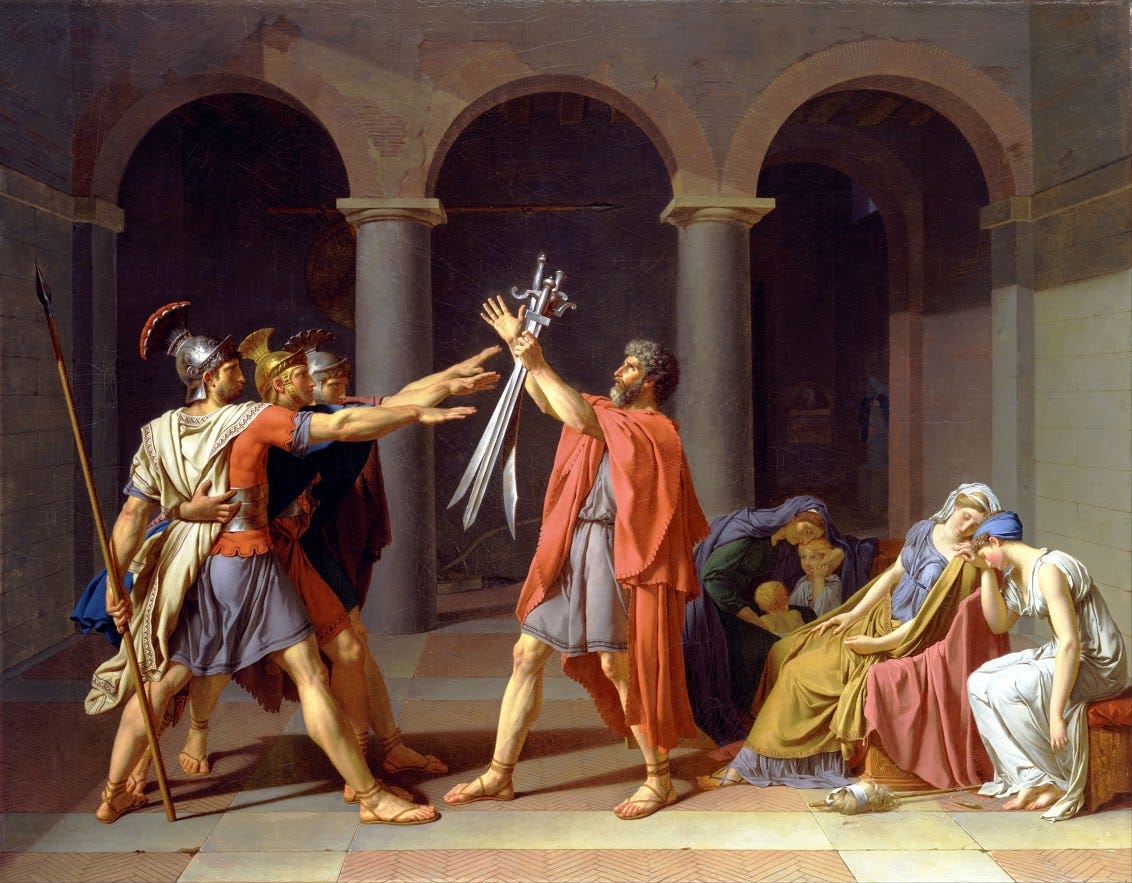
“Without mental reservation” appears in many oaths as it turns out, including that used by US military enlistees, though I highly doubt any but a very few understand what they are swearing to. And in fact, the phrase actually refers to a specific type of untruth in which one utters one part aloud and the rest in their mind, thus “telling the truth to God”. Literally, this unspoken part is reserved from human ears and is instead mental. Thus, theoretically, one could take the original congressional oath of office and practice mental reservation like so:
I do solemnly swear that I will support the Constitution of the United States (only as far as it serves my own interests).
So the mental reservation language is added to the oath presumably to prevent this sort of thing, but it seems to me one could still take the same approach:
I take this obligation freely, without any mental reservation (as far as you know)….
There is, of course, another element to the doctrine of mental reservation which moral theology and philosophy have struggled with forever: when it is permissible to lie. One prolific and popular moral theologian, St. Alphonsus Liguori (1696–1787) says it must be for a “just cause”, which he defines broadly:⁶
Justa autem causa esse potest quicumque finis honestus, ad servanda bona spiritui vel corpori utilia.
[A] just cause can be any honest end whatsoever, for the keeping of things good for the spirit or useful to the body.
To be fair, the specific cases of just cause he lists do seem reasonable, including a priest protecting the seal of confession, a defendant or witness illegitimately interrogated, and a traveler coming from a town falsely believed to be infected with plague. Still, he goes on to say, “an absolutely serious cause is not required”.⁷
And another respected scholar in much more recent time, Benoît Merkelbach, clearly knowing the history of deception and specifically Liguori’s work on the subject, makes it still more general:⁸
[…] dummodo ad veritatem occultandam iusta causa adsit et aliud medium desit honestum […].
[…] as long as a just cause is present, and other honest means of hiding the truth is wanting […].
First, it’s entertaining such works are still written in a moribund language in modern times, second, the lack of irony with which Merkelbach produces the phrase, “honest means of hiding the truth”, is astounding, but third, and most importantly to our topic, it seems exactly the process of casuistry described by Pope Francis is at work here, where general laws are established on the basis of exceptional cases.⁹ It’s also worthy of note, the pontiff’s comment was in the context of the sexual abuse cases that have plagued the Catholic Church in recent decades, in which many officials were clearly far less than honest, often using casuistry to rationalize their mendacity.
Moving to the realm of moral philosophy, Immanuel Kant makes his case by positing a man who needs to borrow money, realizes no one will lend it to him unless he promises to repay it, and which he won’t be able to repay—all consistent with the Jesuitical doctrines above—and therefore produces the maxim:¹⁰
[W]hen I believe myself to be in need of money I shall borrow money and promise to repay it, even though I know that this will never happen.
And Kant further states, were this case to become a universal law, just as Francis felt such things would:
[If] everyone, when he believes himself to be in need, could promise whatever he pleases with the intention of not keeping it would make the promise and the end one might have in it itself impossible, since no one would believe what was promised him but would laugh at all such expressions as vain pretenses.
And while all of this may have been a matter of conjecture in the 17th and 18th centuries, as we know, this is exactly what has come to pass. Regardless of what may be considered moral, people have lied to benefit themselves to such an extent a matter such as a loan has become a highly legalistic one, with few options apart from bankruptcy to escape a debt, and sometimes not even that, as with student loans, among others.
And furthermore, this slippery slope has led us inevitably to the Russian doctrine of what Timothy Snyder calls “implausible deniability” weaponizing the combination of fact and its evil twin, disinformation. The example he cites is the Russian invasion of Crimea:¹¹
The adage that there are two sides to a story makes sense when those who represent each side accept the factuality of the world and interpret the same set of facts. Putin’s strategy of implausible deniability exploited this convention while trying to destroy its basis. He positioned himself as a side of the story while mocking factuality. […] Western Editors, although they had the reports of the Russian invasion on their desks in the late days of February and the early days of March 2014, chose to feature Putin’s exuberant denials. And so the narrative of the Russian Invasion of Ukraine shifted in a subtle but profound way: it was not about what was happening to Ukrainians, but about what the Russian president chose to say about Ukraine. A real war had become reality television, with Putin as the hero. […] When Putin later admitted that Russia had invaded Ukraine, this only proved that the Western press had been a player in his show.
OK, I know I said in my previous article I was going to give politics a rest, but these things are closely intertwined and certainly this is a realm where various types of deception are most at play. Neither of the moral theologians I’ve discussed here could have foreseen how things have ended up. Right or wrong, they believed people are essentially good and even if there were a bit of fibbing, society would not be harmed. Instead, the jinn they have released can never be returned to its bottle.
On the other hand, Kant’s view is a utopian one; as Umberto Eco tells us, truth is in the realm of the theoretical: limited by our abilities as humans to perceive and communicate it. And of course, there are those white lies we all tell to preserve the feelings of others. Still, the issue with the products of casuistry is how they seek to create statements that are sort of true, but really not, As Liguori says:¹²
[N]on decipimus proximum, sed ex justa causa permittimus ut ipse se decipiat.
[W]e do not deceive our neighbor, but for a just cause we allow that he deceive himself.
Where I would reply with the Berber saying:
A smooth lie is better than a distorted truth.
Read previous articles in the Logic of Lies series
Part 1: The Fakes That Launched a Thousand Ships
Part 2: It’s Fascinating What One Can Deduce about a Man Just by Knowing his Name
Part 3 Addendum: Fruit from a Poisonous Pseudoarchaeological Tree
Part 4: Romancing the Hellenes
Part 5: Descent into the Absurd
Notes
- “Oath of Office”, United States Senate (website); emphasis mine.
- US Constitution, Article II, Section 1, Clause 8.
- Ibid, Article IV, Clause 3.
- US Senate.
- Ibid.
- Alphonsus Maria de Liguori, Theologia moralis, 1905-1912.
- Ibid, “non requiritur causa absolute gravis […].”
- Benoît Henri Merkelbach. Summa Theologiae Moralis, 1938.
- Francis X. Rocca, “Pope to meet with sex abuse victims for first time in June”, Catholic News Service, 2014.
- Immanuel Kant, Grundlegung zur Metaphysik der Sitten (Groundwork for the Metaphysic of Morals), 1785, Mary J. Gregor, trans., 1998.
- Timothy Snyder, The Road to Unfreedom: Russia, Europe, America, 2018.
- Liguori, 1905–1912.
 Deru Kugi