Beethoven’s mythical temper and the origin of the Romantic roar (“Coprophony”, Addendum)
Following my article on Wolfgang Amadeus Mozart’s use of foul language, I ran across what seemed a similar instance concerning Ludwig van Beethoven. But looking into it further, it is not the same at all.
In 1825, the critic Gottfried Weber criticized the composer’s Wellington’s Victory, thus:¹
Es sind nicht musikalische Farben, deren van Beethoven sich hier bedient, […] sondern Täuschungen der scenischen Akustik […] Kanonen-Maschinen und andere den Lärm der Schlacht nachahmende Geräusch-Instrumente […] nur kindisch und lächerlich erscheinen können.
It is not musical colors that van Beethoven makes use of here […] but rather the deceptions of scenic acoustics […] cannon machines and other noisemakers mimicking the noise of battle [… which] can only appear childish and ridiculous.
On his copy of the journal Weber’s article appeared in, Beethoven wrote:²
Ach du erbärmlicher Schuft, was ich scheiße, ist besser, als du je gedacht!
O you wretched scoundrel, what I shit is better than anything you’ve thought up.
The comment has none of the fun or rebelliousness of Mozart’s rhymes, codeswitching, or wordplay. It’s blunt and its profanity serves that purpose. One might take it instead as an example of Beethoven’s supposedly famous temper.
Let’s look into that. Ferdinand Ries, Beethoven’s pupil, friend, and secretary, relates one such incident:³
Beethoven war manchmal äußerst heftig. Eines Tages aßen wir im Gasthaus zum Schwanen zu Mittag; der Kellner brachte ihm eine unrechte Schüssel. Kaum hatte Beethoven darüber einige Worte gesagt, die der Kellner eben nicht bescheiden erwiederte, als er die Schüssel […] ergriff, und sie dem Kellner an den Kopf warf. Der arme Mensch […] konnte sich […] nicht helfen; die Brühe lief ihm das Gesicht herunter. Er und Beethoven schrieen und schimpften, während alle anderen Gäste laut auflachten.
Beethoven was sometimes extremely volatile. One day, we were eating at the Gasthaus zum Schwanen at noon; the waiter brought him the wrong dish. No sooner had Beethoven uttered a few words about it—to which the waiter replied quite impertinently—than he seized the dish […] and threw it at the waiter’s head. The poor man […] couldn’t defend himself; the broth ran down his face. He and Beethoven screamed and cursed, while all the other guests laughed loudly.
This is an account from someone who actually knew Beethoven, recounting it to illustrate his statement, “Beethoven was sometimes extremely volatile.” Later biographers—of whom there have been many—seem to have taken this as their license to concoct narratives of their own.
There is an oft-repeated tale of Beethoven’s so-called “first rock star” temperament that, as I’ll explain, is errant crap. It regards a falling out with his patron, Karl Alois, Prince Lichnowsky of Woschütz. Supposedly, with the French occupying the city, he tried to coerce the composer into playing for them. Beethoven allegedly left in a huff, destroyed a monumental bust he had of the prince, then sent a note reading:⁴
Fürsten hat es und wird es noch Tausende geben; Beethoven gibt’s nur einen.
There have been and will be thousands of princes; there is only one Beethoven.
This “quote” is nearly ubiquitous, but it’s nearly a whole-cloth fabrication. It’s noteworthy that the account it appears in was written around 45 years after Beethoven’s death, it relies on earlier anecdotal tradition, and the original letter it supposedly draws from is nicht bekannt (unknown).
What Ries actually says about this falling out is both specific and fairly tame. First, he sets up the situation as:⁵
Im Jahre 1807 sollte Beethoven’s Oper Leonore wieder auf die Bühne gebracht werden, die bekanntlich im Jahre 1805 durchgefallen war. Die Hauptursache dieses Mißlingens war, daß sie zuerst aufgeführt wurde, als die Franzosen, und zwar erst seit kurzem, Wien besetzt hatten. Damals waren alle Musikliebhaber und reicheren Leute, welche nur immer konnten, entflohen, so daß meistens nur französische Offiziere im Theater sich einfanden.
In 1807, Beethoven’s opera Leonore was scheduled to be staged once again—an opera which, as is well known, had met with failure in 1805. The primary cause of this failure was that it had originally been performed at a time when the French—having occupied the city only shortly before—were in control of Vienna. At that time, all music lovers and wealthy citizens who were able to do so had fled, such that the theater was attended almost exclusively by French officers.
The French occupiers being philistines, a group of the composers friends decide to meet to help shorten the opera:⁶
Es bestand diese aus dem Fürsten, der Fürstinn […], dem Hofrathe von Collin, dem Stephan von Breuning, welche beide lektern sich über die Abkürzungen schen besprochen hatten, dann dem Herrn Meyer, erstem Bassisten, Herrn Röckel und Beethoven. Anfänglich vertheidigte dieser jeden Tact; als man sich aber allge. mein dahin aussprach, daß ganze Stücke ausbleiben müßten und Herr Meyer erklärte, kein Sänger könne die Arie des Pizarro mit Effect singen, wurde Beethoven grob und aufgebracht.
The group consisted of the Prince, the Princess […], Court Councilor von Collin, and Stephan von Breuning—the latter two having already conferred regarding the cuts—as well as Mr. Meyer, the principal bass, Mr. Röckel, and Beethoven. Initially, Beethoven defended every single bar; however, when the general consensus emerged that entire sections would have to be omitted—and Mr. Meyer declared that no singer could perform Pizarro’s aria with proper effect—Beethoven became rude and irate.
Still, he eventually agreed to all the changes, and despite his more customary audiences eventually returning, never reinstated the excised passages. So it was actually a productive meeting, and Ries notes:⁷
Diese Sitzung dauerte von 7 Uhr Abends bis 2 Uhr, wo ein fröhliches Mahl die Sache beschloß.
This session lasted from seven in the evening until two in the morning, when a convivial supper brought the proceedings to a close.
Far from confirming a single detail of the mythic falling out between Beethoven and his patron, Ries gives an entirely different reason, concerning an “Andante in F”:⁸
Als Beethoven es unserm Freunde Krumpholz und mir zum erstenmale verspielte, gefiel es uns auf’s höchste und wir quälten ihn so lange, bis er es wiederholte. Beim Rückwege, am Hause des Fürsten Lichnowsky vorbeikommend, ging ich hinein, um ihm von der neuen herrlichen Composition Beet Hovens zu erzählen und wurde nun gezwungen, das Stuck, so gut ich mich dessen erinnern konnte, vorzuspielen.
When Beethoven first played it for our friend Krumpholz and me, we were utterly delighted by it, and we pestered him until he played it again. On my way home—passing by Prince Lichnowsky’s residence—I went inside to tell him about Beethoven’s magnificent new composition, whereupon I was compelled to play the piece myself, as best I could recall it.
After Lichnowsky learned what Ries could recall of the tune, the Prince visited Beethoven, saying he had composed a piece he wished to play for him:⁹
Der bestimmten Erklärung Beethovens, er wolle es nicht hören, ungeachtet, sekte sich der Fürst hin und spielte zu des Componisten Erstaunen einen guten Theil des Andante.
Despite Beethoven’s emphatic declaration that he did not wish to hear it, the Prince sat down and, to the composer’s astonishment, played a good portion of the Andante.
This caused a rift between Ries and the composer, who rightly deduced Lichnowsky must have learned the piece from him:¹⁰
Beethoven wurde hierüber sehr aufgebracht und diese Veranlassung war Schuld, daß ich Beethoven nie mehr spielen hörte. Denn er wollte nie mehr in meiner Gegenwart spielen und begehrte mehrmals, daß ich bei seinem Spiele das Zimmer verlassen sollte.
Beethoven became extremely incensed over this, and this incident was the reason I never heard Beethoven play again. For he refused ever to play in my presence thereafter, and on several occasions demanded that I leave the room while he was playing.
Lichnowsky knew this was his fault, and attempted to intervene:¹¹
Ich hörte nachher, Lichnowsky wäre gegen Beethoven wegen seines Betragens sehr heftig geworden, da doch nur Liebe zu seinen Werken Schuld an dem ganzen Vorfalle und folglich auch an seinem Zorne sei. Diese Vorstellungen führten jedoch nur dahin, daß er nun auch der Gesellschaft nicht mehr spielte.
I later learned that Lichnowsky had confronted Beethoven quite vehemently regarding his behavior, arguing that nothing but a love for his works was to blame for the entire episode—and, consequently, for his own outburst of anger. Yet these remonstrances served only to ensure that he would no longer play for the [Prince’s] company, either.
Beethoven’s reaction here is understandable. Ries has taken a piece the composer is still working on and performed and taught it to his patron behind his back. This is Beethoven’s creation—his livelihood—of course he guards it jealously.
Certainly, Ries relates other incidents, but the only one about which he gives any real detail is that of Zum Schwanen. And even there, it’s relatable—the waiter gives him the wrong dish, then says something sassy when Beethoven points out the mix-up. That’s pretty rage inducing.
Also, as Ries and many others note, the composer’s trouble with his hearing exacerbated his grumpiness. To his brothers Kaspar Karl and Johann, Beethoven expresses his despair over his progressive deafness and imminent death:¹²
O ihr Menschen, die ihr mich für feindselig, störrisch oder misanthropisch haltet oder erkläret, wie unrecht tut ihr mir […] war ich früh genöthigt mich abzusondern, allein zu leben […].
O you people, who deem or declare me to be hostile, obstinate, or misanthropic—how unjustly you treat me! […] I was compelled to withdraw myself early, to live alone […].
Returning to Wellington’s Victory, the project was proposed to Beethoven by his friend Johann Nepomuk Mälzel. Mälzel was an inventor, engineer, and showman, specializing in musical automata. It seems he was more showman than inventor, as he is best known for purchasing the chessplaying Turk—Wolfgang von Kempelen’s fraudulent automaton—then reselling it at an absurd markup, and the mechanical metronome, whose design he essentially swiped from Dietrich Nikolaus Winkel.
Mälzel was looking for a piece for his Panharmonicon. The mechanical musical instrument could imitate many orchestral instruments as well as sounds like gunfire and cannon shots. Thus, the “deceptions of scenic acoustics” Weber complains of were actually built in from the start. Furthermore, the piece was intended to depict a massive battle—specifically, the rout of Napoleon’s army by the British.
Still, Beethoven escalated far beyond his friend’s machine’s capabilities. 100 musicians were arranged in two groups at either side of the stage as the opposing armies, with numerous percussionists, including snare drums beating orders to the soldiers, bass drums intended to simulate cannons, and ratchets just being noisy.
The piece’s premiere in 1813 was a massive spectacle: Antonio Salieri was one of the two conductors, and Giacomo Meyerbeer and Ignaz Moscheles—both famous composers themselves—joined the orchestra. And despite Weber’s feeling that music should be:¹³
[…] der reinen Tonkunst geweihten Tempel […].
[…] the temple consecrated to the pure art of notes […].
The work was so enthusiastically received by the public it had to be performed several more times. If anything about Beethoven makes him the “first rock star”, it’s this piece’s intentional sonic assault.
But far from backing away from Beethoven’s supposed excesses, fortissimi only got louder after him. Instrument designs even evolved to accommodate the need. Strings moved from gut to wire. Flutes shifted from wood to metal. The biggest shift was in the brass: new designs expanded both range and power. The result wasn’t just more sound, but a higher ceiling for what loud meant.
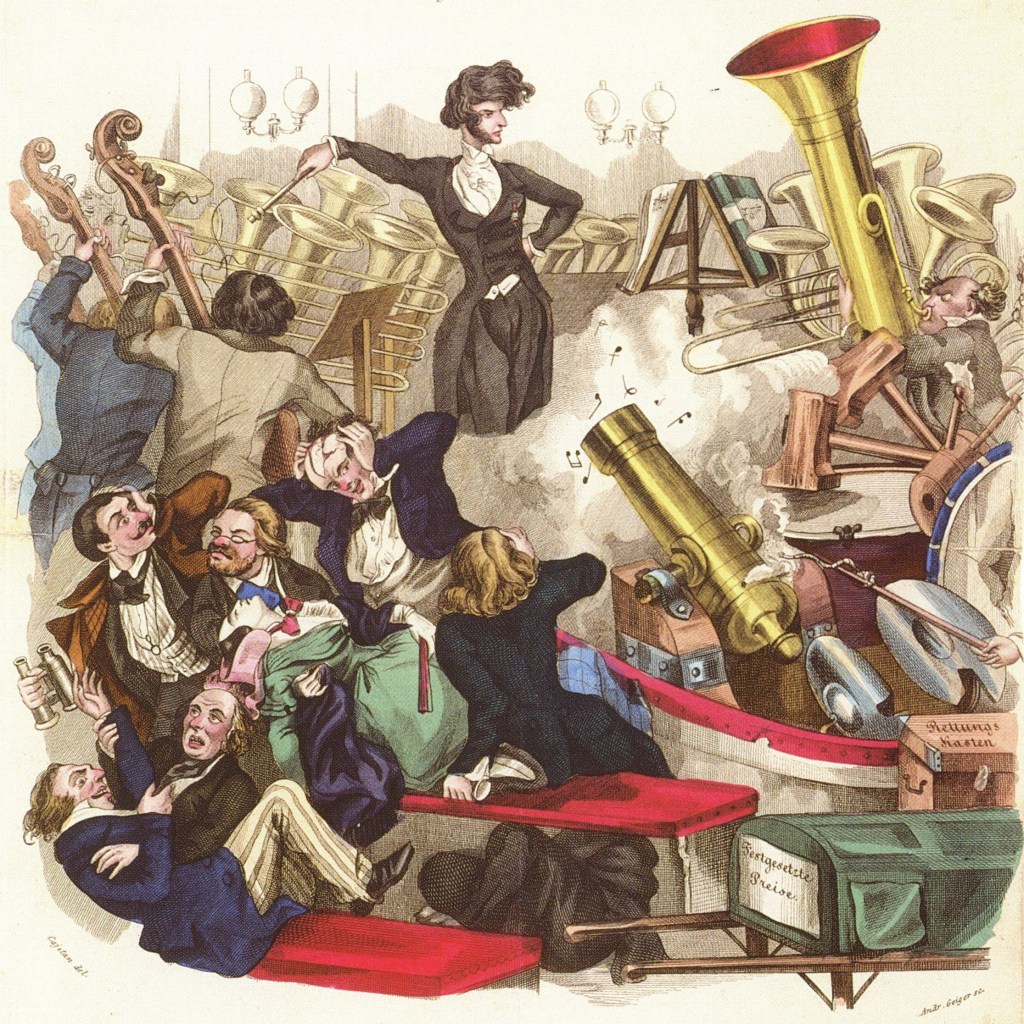
Some 30 years later, Louis-Hector Berlioz envisioned an ensemble of 867 musicians, saying of it:¹⁴
Dans l’agitation, il rappellerait les tempêtes des régions tropicales; il éclaterait comme un volcan. Il ferait entendre les plaintes, les murmures et les bruits mystérieux des forêts vierges, les cris, les prières, les chants de triomphe ou de deuil d’un peuple à l’âme expansive, au cœur ardent, aux passions fougueuses. Son silence même imposerait par sa solennité, et les tempéraments les plus rebelles frémiraient à l’aspect de son crescendo montant, comme au rugissement d’un immense et sublime incendie.
When in a state of agitation, it would recall tropical storms. It would erupt like a volcano. It would convey the laments, whispers, and mysterious sounds of virgin forests, the shouts, prayers, songs of triumph or lamentation of a people with an expansive soul, an ardent heart, and fiery passions. Its silence would strike awe through its solemnity, and the most recalcitrant temperaments would shudder at the sight of its surging crescendo, like the roar of an immense and sublime conflagration.
Though not quite achieving this ambition, the composer’s Symphonie fantastique heads in this direction. In the fifth movement, which crescendos with a surge of overwhelming volume, including a pair of large church bells.
This is the true legacy of Beethoven’s “childish” battle music. While Wellington’s Victory may have been intended as a crowd-pleasing gimmick, it actually shattered the existing acoustic ceiling. By demanding greater physical power than a standard orchestra could provide, Beethoven paved the way for the auditory onslaught that became the Romantic standard. And the musical world has been pumping up the volume ever since.
Read the original Article
Notes
- Gottfried Weber’s, “Über Tonmalerei” (“On Tone-Painting”), Cäcilia: eine Zeitschrift für die musikalische Welt (Caecilia: A Journal for the Musical World), 1825. The work he’s referring to is Ludwig van Beethoven, Wellingtons Sieg (Wellington’s Victory, Op. 91), often called the “Battle Symphony”, 1813.
- Beethoven’s personal copy of Cäcilia, H. C. Bodmer Collection, HCB V8.
- Franz Gerhard Wegeler and Ferdinand Ries, Biographische Notizen über Ludwig van Beethoven (Biographical Notes on Ludwig van Beethoven), 1838.
- Franz Xaver Boch, Wiener Deutsche Zeitung (The Viennese German Gazette), August 1873.
- Wegeler and Ries, 1838.
- Ibid.
- Ibid.
- Ibid.
- Ibid.
- Ibid.
- Ibid.
- Beethoven, Heiligenstädter Testament (Heiligenstadt Testament), October 1802.
- Weber, 1825.
- Louis-Hector Berlioz, Grand traité d’instrumentation et d’orchestration modernes (Grand Treatise on Instrumentation and Modern Orchestration), 1844.
 Deru Kugi