Japan’s domestication of Carrollian subversion (DeDisneyfication, Part 7A Addendum C/ Taishō, Part 5)
Lewis Carroll’s Alice books hold a unique place in Japanese culture. Including both Alice in Wonderland (AiW) and Through the Looking-Glass, and What Alice Found There (TLG), there have been a whopping 425 translations and 1,271 editions of AiW alone —far more than in any other language.¹ Many of Japan’s cultural elite produced translations and adaptations of Alice, including renowned authors such as Mishima Yukio (三島 由紀夫), Akutagawa Ryūnosuke (芥川 龍之介), and Kikuchi Kan (菊池 寛), and award-winning artists like Yayoi Kusama (草間 彌生).²
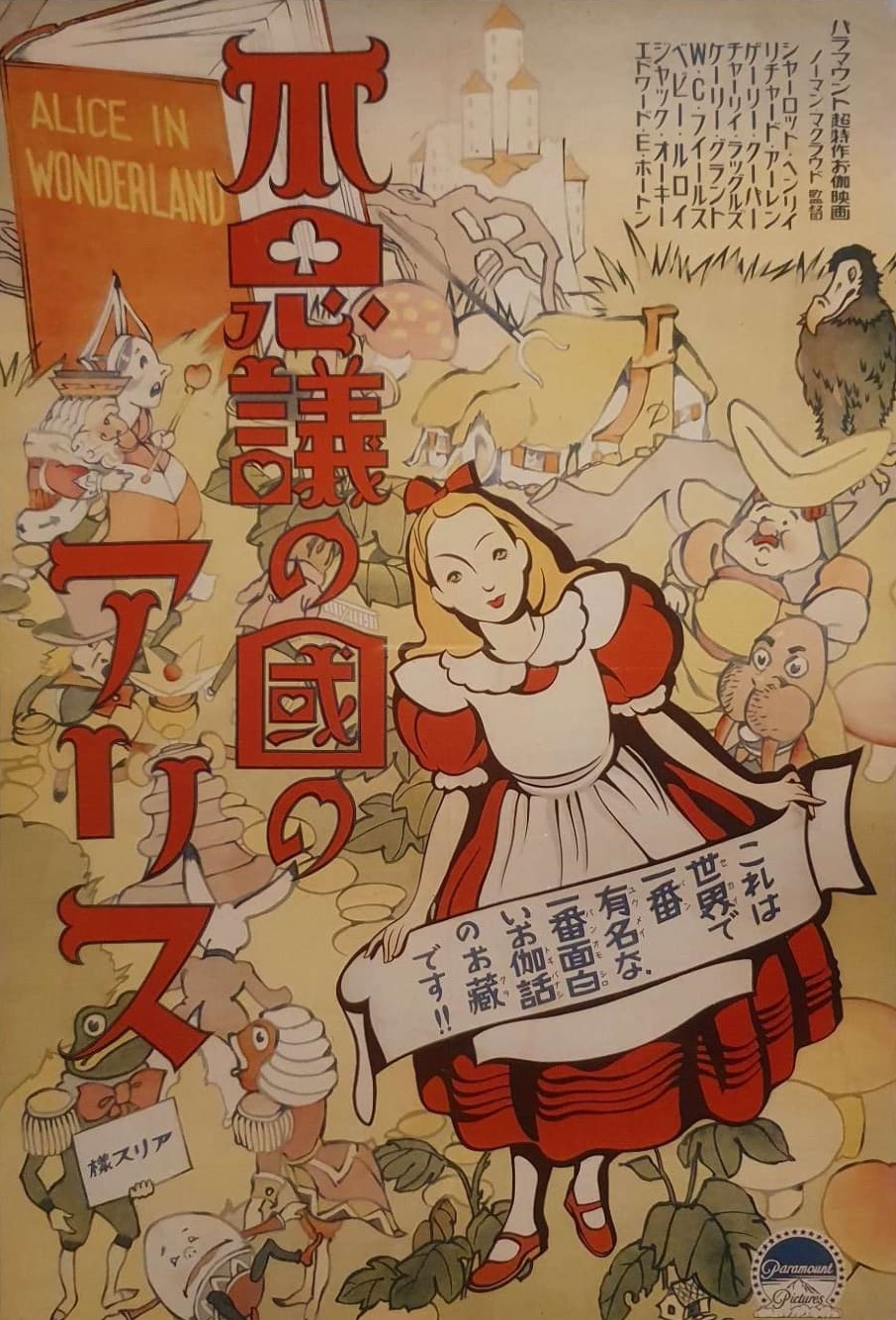
Sadly, the Victoria & Albert’s (V&A), “Alice: Curiouser and Curiouser”, virtually ignored the important place Carroll’s works reached within Japanese culture. The show featured only marginal mention of their impact in Japan—literally including a loli (ロリ, short for ロリータ, rorīta, the kanaization of Lolita) dress, a manga (漫画), and a poster for the Japanese release of the 1931 US film. Three items for 425 translations.
What the exhibit missed was not simply Alice’s popularity in Japan, but the specific reasons for it—reasons quite different from those that made the works beloved in English. The most important is political. Alice arrived at the exact moment when Japanese intellectuals were learning to take humor seriously and losing the freedom to speak plainly.
The two Alice books have had a strong presence in Japan since the turn of the last century, oddly beginning with Hasegawa Tenkei’s (長谷川 天渓) translation of TLG as Kagami Sekai (「鏡世界」, “Mirror World”), published in serial form throughout 1899. AiW followed nine years later, in 1908, translated by Shizu Nagayo (永代 静雄) as Arisu no Monogatari (『アリスの物語』, Alice’s Tale). Further translations appeared in 1910, -11, and -12, and apart from a wartime gap, when the government had a tight rein on printing in general, they have continued regularly until today.
These books could not be dismissed as frivolous. As Carroll’s nephew, Stuart Dodgson Collingwood, observed in 1898:³
With the exception of Shakespeare’s plays, very few, if any, books are so frequently quoted in the daily Press as the two “Alices.”
This was the kind of observation Meiji era (明治時代, Meiji jidai, 1868–1912) intellectuals paid attention to. Here was a work cited alongside Shakespeare, yet built entirely on nonsense, absurdity, and the subversion of authority. And it arrived at a moment when humor itself was being formally rehabilitated.
The dominant educational paradigm in Japan prior to Meiji was Neo-Confucianism (朱子學, shushigaku), which saw humor as useless folly. But early contact with Western learning challenged that view. One English rhetoric textbook nearly any Meiji university student would have used stated:⁴
[The] degradation of any dignified object, whether animate or inanimate, which has hitherto inspired us with feelings of admiration and awe, tends to awaken the ludicrous emotion […].
As historian Junji Yoshida notes:⁵
Meiji learners of English rhetoric were […] impelled to reflect on, if not to renounce, their former denigration of laughter as mere frivolity.
The Confucian stigma didn’t simply dissolve—it was formally overruled by the very Western learning Japan’s modernizers had embraced. Humor was legitimate. Humor was rhetorical. And this mattered enormously because at the exact moment intellectuals were freed to explore humor in all its forms, they were also losing the freedom to say what they meant directly.
Even in the freewheeling Meiji era, there was a growing backlash to expanding individual freedoms. A Publication Ordinance (出版条例, Shuppan Jōrei) was already in place by 1869. The Libel Law (讒謗律, Zanbōritsu) and the Press Ordinance (新聞紙条例, Shimbunshi Jōrei) followed in 1875, the latter so severe it forced the shutdown of radical presses like the Hyoron Shinbun (評論新聞, literally, “Critical Newspaper”, but styled The Review in English). Restrictions in the subsequent Taishō era (大正時代, Taishō jidai, 1912–26) were still more strict:⁶
The draconian Public Security Preservation Law of 1925 (治安維持法), put in place only two months after universal manhood suffrage, marked the biggest reversal of the Taishō Democracy. It was intended to suppress political dissent, specifically targeting socialism and communism. Under the law, an Orwellian thought police was formed, the Tokubetsu Kōtō Keisatsu (特別高等警察: “Special Higher Police”, often shortened to Tokkō), whose mandate was the criminal investigation of political groups and ideologies representing a threat to public order. They arrested over 70,000 people during the time the law was on the books, 1925–1945.
Satirical magazines in the mode of Punch were one answer. Charles Wirgman founded Japan Punch (ジャパン・パンチ) in 1862 after working for the original British publication and immigrating to Japan. Kitazawa Rakuten (北澤 楽天) also founded Tōkyō Puck (東京パック) in 1905. Just as Punch originated the modern sense of the term “cartoon”, Rakuten was also the first to use “manga” with its current meaning. The word ponchi-e (ポンチ絵)—derived from the magazine’s name—described a subgenre of ukiyo-e (浮世絵) featuring humorous or satirical themes.
Nonetheless, there was also a veritable explosion of publishing for censors to deal with. From 1923 to 1936, a near tripling in the number of books. The government necessarily had to focus on large-circulation items such as newspapers, while smaller ones could often escape censorship.
Many political radicals also became kōdanshi (講談師 “storytellers”), who were far less easily regulated. Through this medium, they could use humor to communicate subversive political ideas in talks termed jiyū kōdan, (自由講談, “freedom lectures”). The use of humor-masked radicalism spread to other resistant media—folk and pop songs, the latter of which became a national craze, Asakusa Opera, as well as such unlikely means as folk dance.
Carroll’s connection to Punch via his illustrator John Tenniel only strengthened the association: the same satirical tradition that had spawned Japan Punch and Tōkyō Puck had produced the most widely cited children’s books in the British press. The Alice books became notable as exemplars of how seemingly harmless children’s literature could be thoroughly subversive—and crucially, Carroll’s nonsense does not resolve into a message. It cannot be pinned to a single reading. This is what makes it durable as cover: a censor can identify a direct political statement, but a tea party whose rules make no sense is merely a tea party—until it isn’t.
This is the context behind that loli dress and manga panel the V&A displayed without comment. The exhibit showed artifacts downstream of over a century of cultural absorption, but not the political story that drove the absorption in the first place.
The Alice books were not simply translated into Japanese—they were made Japanese. The early translations were really adaptations, with material either omitted or significantly altered. Difficulties were compounded by the distance between cultures and languages; the very notion of children’s literature was new to Meiji Japan, so these works were necessarily pioneers of this genre. The level of challenge in translating Carroll’s works can be seen in the fact in more recent years it was taken on by Naoki Yanase (柳瀬 尚紀) who has also executed Japanese versions of works by James Joyce and Jorge Luis Borges.
A variety of strategies were used to make the books more acceptable to a Japanese audience, beginning with the protagonist’s name. Hasegawa changed it completely to Mii-chan (みいちゃん, where -chan is a title affix for children). Maruyama Hakuya (丸山 薄夜) renamed her Ai-chan (愛 being a standard Japanese name meaning “love”) in 1910’s Ai-chan no yumemonogatari, (『愛ちゃんの夢物語』, Ai-chan’s Dream Story).
Others followed: Ayako-san (綾子さん) in Niwa Goro’s (丹羽 五郎), Kodomo no yume (『子供の夢』, Children’s Dreams), in 1884, Aya-chan (あやちゃん) in Saijo Yaso’s (西條 八十) 1921 “Kagamikuni Meguri” (「鏡國めぐり」, “Mirror Country Tour”), and Sukko-chan (すゞ子ちゃん) in Suzuki Miekichi’s (鈴木 三重吉) “Chichū no sekai” (「地中の世界」, “Underground World”). Despite all this, eventually, Arisu (アリス) won out, even becoming a commonly used Japanese girl’s name from 1920 on.
Illustrations show the common pattern where foreign forms were borrowed during the Meiji era but discarded in the Taishō era (大正時代, 1912–1926) in favor of Japanese ones. In Ai-chan no yumemonogatari, an Art Nouveau style reminiscent of Alfons Mucha is apparent, though Ai-chan has dark eyes and hair. A 1911 collection, Kodomo no yume: Chōhen otogibanashi, falls back on more traditional imagery—Alice wears a bob but is dressed in a kimono, and amenbo (飴棒, water striders) populate the pool of tears.⁷
The domestication went deeper still. A 1952 Disney picture book conflated the White Rabbit with the Hare of Inaba (因幡の白兎 Inaba no Shirousagi) from the Kojiki—a collection of myths, legends, and semi-historical accounts—giving him a river to cross to match the folktale, where none exists in Carroll.⁸ It describes one of Alice’s size-changing episodes thus:⁹
Suddenly, her height, she thought, grew tall like an obake [お化け] […].
This recasts her metamorphosis as a yōkai (妖怪)—a class of spirits and monsters in Japanese folklore—shapeshifting. The foreign nonsense had been grafted onto native folklore. The technique was the same one the kōdanshi used: take a form that arrived from outside and make it speak the local language.
The first true translation wasn’t published until Kusuyama Masao’s Fushigi no kuni of 1920, which included both Alice books, rendering terms such as “Anglo-Saxon” and “ham sandwich” (アングロ・サクソン, Anguro Sakuson and ハム・サンドウィッチ, hamu sandōitchi) in katakana, and footnoting Carroll’s invented words.¹⁰ By this point, Japanese audiences were far more familiar with Western culture, yet, as Sean Somers notes, even this work:¹¹
[E]mphasizes a hybridized Arisu, a figure who retains Western properties augmented with elements that suggest Japaneseness.
So even accuracy could no longer fully separate Alice from the Japanese soil she’d been planted in.
It should be clear from all this the V&A’s three Japanese items are not tokens of a minor cultural footnote. They are fragments of a story the exhibit chose not to tell—a story in which Carroll’s nonsense arrived at the precise historical moment when Japan needed exactly this kind of weapon: literature that could be taken seriously because Britain took it seriously, that could carry political subversion because its meaning could never be fixed, and that could be domesticated so thoroughly it stopped looking foreign at all.
The exhibit missed the freedom lectures of the kōdanshi. It missed the reason Alice grew so big in Japan in the first place—not because she was cute, though she became that too, but because she was useful. And I definitely begrudge them the space taken up by their VR experience, which my correspondents assure me was just as terrible as I imagined.
This article is part of the “Alice in Wonderland” miniseries within the DeDisneyfication series and the Taishō series
Notes
- Jon Lindseth & Alan Tannenbaum, Alice in a World of Wonderlands, 2015.
- I cannot responsibly omit Yayoi is deeply problematic—google her yourself.
- Stuart Dodgson Collingwood, The Life and Letters of Lewis Carroll (Rev. C. L. Dodgson), 1898.
- W. D. Cox, The Principle of Rhetoric and English Composition for Japanese Students, 1882, quoted in Junji Yoshida, “Shifting Meanings of Humor at the Dawn of Literary Modernism in Meiji Japan”.
- Ibid.
- Stieg Hedlund, “Japan’s Turbulent Taishō”, Deru Kugi (blog), June 2017.
- 『子供の夢長編おとぎ話』 (Children’s Dreams: Feature-Length Fairy Tales), 1911, cited in Samantha Johnson, “Chasing the White Rabbit in Tokyo: 100 Years of Alice in Japan”, 2017.
- 太 安万侶 (Ō no Yasumaro), 古事記 (Kojiki, Records of Ancient Matters), ca. 711.
- 『ふしぎの国のアリス』 (Fushigi no kuni no Arisu, Alice in Wonderland), 1952. Though it uses the by then standard name for Carroll’s book, it actually presents a translation of a book called Walt Disney’s Alice in Wonderland Meets the White Rabbit (A Little Golden Book), retold by Jane Werner, adapted by Al Dempster, original story by Lewis Carroll, 1951. Quoted in Johnson, 2017.
- Kusuyama Masao (楠山 正雄), 『不思議の国』 (Fushigi no kuni, Wonderland), 1920, details from Amanda Kennell, “Alice In Evasion: Adapting Lewis Carroll In Japan”, 2017.
- Sean Somers, “Arisu in Harajuku: Yagawa Sumiko’s Wonderland as Translation, Theory, and Performance”, Alice Beyond Wonderland: Essays for the Twenty-first Century, 2009.

