Japan’s dance fever (Taishō, Part 6)
In earlier articles in this series, I’ve argued the Taishō era (大正時代, 1912–1926) occupies a unique place in Japanese history.
As another way to understand how drastic the culture shift was, consider the grandparents of a child born at the era’s dawn lived in the Edo period’s (江戸時代, 1603-1867) closed feudal society, governed by Confucian hierarchy. That child, on the other hand, was likely to move from the countryside to Tōkyō (東京), work in a factory, and listen to jazz.
As previously noted, Japan benefited economically from World War I. The mechanism for this was international commerce, through which they also became a major consumer of both material objects and intangible items from Europe and America. Thus, Japanese society underwent rapid globalization. Some approved:¹
[Writer] Nitobe [Inazō (新渡戸 稲造)] implored his countrymen to abandon a stubborn fondness for the particularistic ethics of the past. Instead, he argued, the Japanese had to visualize themselves as possessing attitudes, values, and behaviors that were the common property of all peoples who made up the emerging democratic and capitalist world order.
Others shunned foreign influence, such that early-twentieth-century Japanese were torn between the imported and the domestic, often termed the double life:²
The double life is at best an expense and an inconvenience, we are told, and at worst a torment, leading to crises of identity and such things.
The soundtrack to this cultural schism was decidedly jazz—jazz resounding from multitudinous cafés on the neon-lit streets of Ginza (銀座). The divides jazz created mirrored those in the political and cultural realms of the Taishō era. Your stance on jazz defined you—you either embraced its cosmopolitan pulse or rejected it as a decadent invasion of traditional values.
From the 1910s on, jazz came to Japan via its port cities from both foreign and Japanese musicians working on ocean liners. It was just as identifiable as the other emblems of the global style of the mobo and moga (モボ; “modern boys”, モガ; “modern girls”): flapper hairstyles, short dresses, bell-bottoms, haikara (ハイカラー; high collars), and round-rimmed roido spectacles (ロイド, named for American silent film star, Harold Lloyd), even using the zūja-go argot (ズージャ語; “jazzese”) to signal in-group membership:³
Clearly, in the 1920s jazz was conspicuous evidence for the emergence of an Americanized global culture, and thus was a favorite target of nationalist assaults wherever a trumpet bent a blue note. Ultimately concerns over the nation’s cultural identity and its status in the new world order provided the subtext for Japan’s early experience of jazz. The widely held belief that jazz music itself was not a mere byproduct but rather an agent of cultural transformation—engendering what social critic Ōya Sōichi called a “culture of the senses”—was born from anxieties that many Japanese felt regarding their nation’s ever-shifting self-image.
As to the cafés, I mentioned in Part 2B, European-style cafés began appearing with Café Printemps (カフェー・プランタン) in 1911. By 1939, there were some 37,000, concentrated mainly in Ginza—dubbed the Paris of the East (東洋のパリ; Tōyō no Pari). ⁴ Originally intended as places writers and painters could gather and discuss art, some transitioned easily to jazu-kissa (ジャズ喫茶; jazz cafés), the first such being Tōkyō’s Blackbird (ブラックバード) in 1929. Jazu-kissa played the latest records on gramophones for their clientele.
Already by mid-Taishō, Japan’s urban middle class was firmly in the grip of dansu netsu (ダンス 熱; “dance fever”). Modan (モダン; moderns) were required to know how to one-step, two-step, and fox-trot. In 1923, US music magazine Metronome reports.⁵
The Japanese are jazzing by day and by night. […] Foreign dancing undoubtedly has come to stay. It is much in evidence in Tokio and has spread into Yokohama, Osaka and Kobe, although not to any extent outside of the big cities.
The article goes on to discuss some reservations, including those of Harvard graduate Dr. Takuma Dan:⁶
I approve of the mixed dancing, but we have to go slow. It is dangerous for our young girl, brought up in the purely Japanese way, and who therefore never sees outsiders except in a formal way. She has been taught that she must embrace no man except her husband. It is confusing and dangerous. But to the girl who has had a foreign education, who has spent two or three years in the United States, it is all right. She has got the spirit of the thing and it is good. It allows a proper opportunity for the sexes to meet before marriage as Americans do. Our marriage arrangements will be the last of our customs to change. We are adopting very fast all sorts of Western customs and practices, but parents will arrange the marriages of their children for a long time yet. The so-called love matches which now occasionally take place are rarely happy. My son goes to dances. My daughters have not learned as yet—they are all married and have their duties.
Nonetheless, it should also be clear those consuming foreign culture and embracing modernity were a subculture, often villainized and harassed:⁷
For most of the twentieth century, in fact, jazz folk were singled out as inimical to the national project of nurturing and preserving Japan’s cultural ‘‘essence,’’ even if that essence was subject to constant reformulation as circumstances dictated.
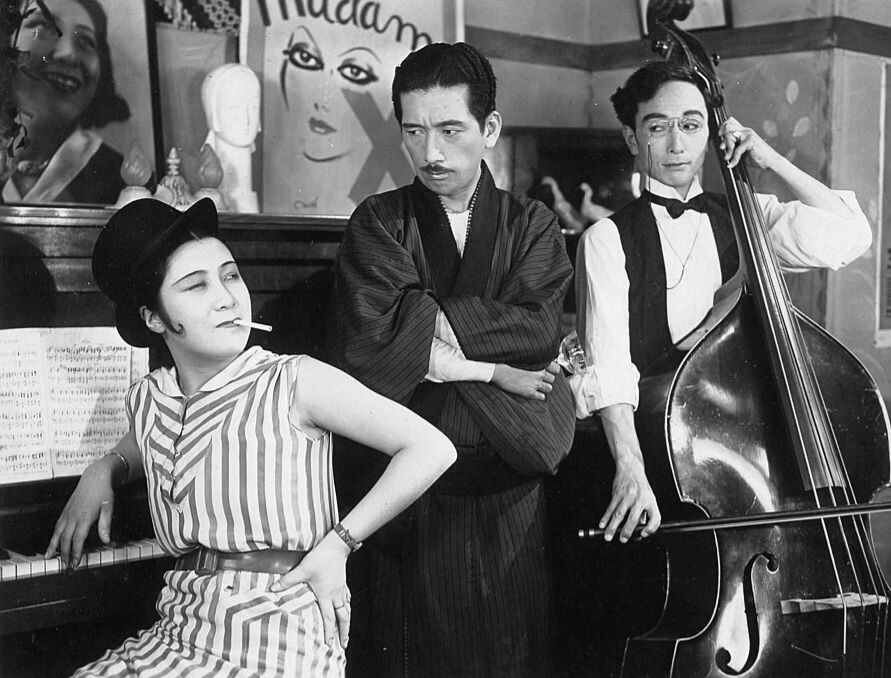
Gosho Heinosuke’s (五所平之助) 1931 film, The Neighbor’s Wife and Mine (『マダムと女房』; Madamu to Nyōbō) perhaps captures the situation best. In addition to revolving around the topic of jazz, this is Japan’s first feature-length talkie.
First, it’s important to note the English translation of the title is wildly misleading. The literal translation would be The Madam and the Wife, which I can understand avoiding. Also, the neighbor in question definitely seems unmarried. Madamu was a term of the café scene of early 20th century Japan. It is related to moga, but implies a more sophisticated and financially independent version of the Westernized, progressive woman—specifically, the manager of a café. In English, the word has the connotation of a proprietress as well, but unfortunately of a brothel, hence the awkward rendering of the title. The madamu of this film, meanwhile, clearly runs a jazu-kissa.
Kitamura Komatsu’s (北村 小松) script is self-referential if not autobiographical, featuring a playwright—a field Kitamura studied at Keiō University (慶應義塾大学; Keiō Gijuku Daigaku)—struggling to meet his deadline. The screenwriter attended this prestigious Tōkyō school after his rural upbringing in Aomori (青森), at the northern tip of Japan’s main island. The cultural whiplash Kitamura must’ve felt is mirrored in that of the film’s protagonist.
As a point of personal connection, Keio later moved its main campus to Hiyoshi, Yokohama (日吉, 横浜). This is the town I lived and worked in, designing games for Kōei (光栄), whose name comes—in zūja-go fashion—from a reversal of the vowels of the school’s name.
In The Madam and the Wife, Shibano Shinsaku (芝野 新作, played by Watanabe Atsushi; 渡辺篤) rents a house as a quiet place to complete his play. It doesn’t work out as planned—he is constantly disturbed by various noises, particularly a neighbor (i.e., the madamu, Yamakawa Takiko; 山川 滝子, played by Date Satoko; 伊達 里子) playing loud jazz music. The following exchange ensues:⁸
Shibano: Hey. Go next door and tell the band to stop playing.
[Shibano] Kinuyo [played by Tanaka Kinuyo; 田中 絹代]: I can’t make such a selfish request.
Shibano: Go tell them they’re disturbing the whole neighborhood.
Kinuyo: Who cares? It’s jazz. You should do your work at that tempo.
Shibano: Idiot! Can’t you see I’m suffering?
When Shibano goes himself to complain, Yamakawa invites him in to meet the band and join the party. After a drink loosens him up, the playwright begins to appreciate their Western music. Soon, he is singing and dancing enthusiastically to “The Age of Speed” (『スピード時代』; “Supīdo Jidai”) keeping the beat by tapping his glass with a spoon, then using a slapstick. At the end of the song he declares:⁹
That was great! It got me all fired up.
When he returns home, Kinuyo is displeased at his intoxicated state and jealous of him spending time with the “modan garu” at the party. She calls them “dangerous” and their Western clothes “suggestive” and “erotic”, but later admits she wants “a dress like that”. Shibano replies only:¹⁰
Writers fee: 500 yen. Actions speak louder than words.
The film could easily have been subtitled How I Learned to Stop Worrying and Love Jazz—an allegory on being less rigid and embracing modernity. The Shibano family is depicted as rather formal at the beginning of the film. Tanaka has the distinct rural accent of her native Yamaguchi (山口), Honshu’s (本州) westernmost province. They also wear traditional clothing, and Mrs. Shibano is elaborately coiffed.
Additionally, at the outset, the protagonist is a bit of a jerk, fighting with a painter after insulting his work, playing mājan (麻雀; mahjong) with his friends until after midnight with his deadline looming and the household running low on money—and it’s clear he’s missed deadlines before. Their marriage is clearly strained.
In the film’s epilogue, after being inspired by jazz, Shibano has clearly met his deadline. The family is happily returning from a trip to a department store, with many purchases in hand. Their look is more modan, with the playwright and his daughter in Western attire, and his wife’s hair in finger waves. The whole family enjoys one another’s company, and when, nearing home, they hear their neighbor’s band strike up “My Blue Heaven”, they agree it’s great and happily sing along together as the credits roll.¹¹
The rosy view presented by a group of artsy filmmaking urbanites, however, was still far from that of the increasingly reactionary and nationalistic government. The Tokkō (特別高等警察; Special Higher Police), established in 1911, and 1925’s Public Security Preservation Law (治安維持法) saw widespread surveillance of cafés and dance halls and censorship of radio waves and movie theaters. Finally, in autumn 1937, the Home Ministry seized authority to regulate jazz venues, declaring:¹²
[T]he existence of dance halls and dance schools, which rebel against our national conditions, disturb womanhood, encourage frivolity in our youth, and exert not a little bad influence on the nation’s public morality [is] truly undesirable.
Well before war with America began in earnest, jazz was declared “the enemy’s music” (敵性音楽; tekisei ongaku). But this genie couldn’t be put back in the bottle. As a mark of how inseparable from Japanese culture jazz had become by the early ’30s, in an article addressed “To Our Brothers and Sisters in the Village”, one rural paper questioned their country’s military adventurism:¹³
Manchuria is now Japan’s possession, but has your life changed? Has it become any easier? Have you been able to pay back any of the capital you have borrowed? Have your sisters been able to make one kimono, or your brothers go to a cafe to listen to jazz? I know the answer: it is a resounding “No!”
Striking here is the placement of jazz alongside kimono as the—frustrated—goals of Japanese villagers.
During the war, jazz simply hid behind other names—keiongaku (軽音楽; “light music”) and saron myūjikku (サロンミュージック; “salon music”). These were acceptable to state censors and cultural nationalists, as well as jazz musicians and their eager audiences.
With the war over, the jazz scene resurged almost immediately. Japanese musicians returned to performing openly, and American artists soon followed. By 1953, DownBeat magazine described Louis Armstrong’s SRO extended tour of the country thus:¹⁴
Receiving the largest guarantee of anyone who had ever visited Japan, Louis earned an average of $2,500 per night as against fifty percent of the gross. There was also prepaid round trip transportation for a party of 12. Before the unit left the States, they’d received four weeks advanced [sic] salary ($72,000) […]
Armstrong himself said of the tour:¹⁵
Japan—how many people would think the Japanese would dig our music the way they did?
Read previous articles in the Taishō series
Part 1: Japan’s Turbulent Taishō
Part 2B: When Tokyo Moved West
Part 4: The Mysteries of Zūja-Go
Part 5: How “Alice” Grew Big in Japan
Notes
- John L. McClain, Japan: A Modern History, 2001.
- Edward Seidensticker, History of Tokyo 1867-1989 From Edo to Showa: The Emergence of the World’s Greatest City, 2019.
- E. Taylor Atkins, Blue Nippon: Authenticating Jazz in Japan, 2001.
- Michael Hoffman, “The Taisho Era: When modernity ruled Japan’s masses”, The Japan Times, July 2012.
- Grace Thompson Seton, “The Jazzing Japanese”, Metronome, January 1923.
- Ibid.
- Atkins, 2001.
- 『マダムと女房』 (The Madam and the Wife), 1931.
- Ibid.
- Ibid.
- Ibid.
- Quoted in 永井良和 (Nagai Yoshikazu), 『社交ダンスと日本人』 (Shakō dansu to Nihonjin; Social Dance and the Japanese), 1991.
- 小浦 初美 (Koura Hatsumi), 「農村 の 兄弟 へ」 (“Noson no kyodai e”; “To Our Brothers and Sisters in the Village”), 『神科 時報』 (Kamishina Jihō; Kamishina Times), May 1932, quoted in McClain, 2001.
- “Pops’ Japan Tour a Smash”, DownBeat, January 1954.
- Ricky Riccardi, What a Wonderful World: The Magic of Louis Armstrong’s Later Years, 2011 .
 Deru Kugi