Luhrmann namechecks but doesn’t come correct (“Roll Over McFly” Addendum C, Gladwellocalypse, Part 4 Addendum)
I like Baz Luhrmann. Moulin Rouge! (2001) is a film that works on a level most spectacles don’t even attempt. I’ll quote myself from an interview a while back:¹
Christian [Ewan McGregor] is drawn into the Bohemian world by Toulouse-Lautrec [John Leguizamo] and a narcoleptic Argentinean [Jacek Koman]. Now, this is very entertaining and engaging on the surface level, but it also really works well on the symbolic, mythical level: The dwarf is small physically because his power is not of the physical world, and the narcoleptic spends more time in the subconscious world of dreams than he does in this one.
Luhrmann’s movies have always been fascinated with surfaces and rarely been particularly interested in multi-dimensional people. His attempt to recontextualize Romeo and Juliet had its hits and misses, but was entertaining. The Campbellian monomyth I spotted in Moulin Rouge! implies the use of archetypes, which is definitely the case in that film.
This is what Luhrmann is good at. Surfaces that shimmer. Archetypes that resonate. Myth deployed as structure.
The problem with Elvis (2022) is that Elvis Presley’s story is not an archetype. It’s a specific history with specific receipts. And Luhrmann made an archetype movie about it anyway.
Luhrmann’s Elvis has been thoroughly fact-checked. The Smithsonian documented what it compresses.² Others have noted what it rearranges, what it gets roughly right. Music journalist Alanna Nash put a fine point on its fabrications:³
It’s all a Baz Luhrmann fever dream.
This article is not concerned with adding to that inventory. What interests me is the direction of the errors—because they all point the same way, and this pattern tells you more about the film’s failure than any individual inaccuracy does.
Certainly, as Alfred Matthew “Wierd Al” Yankovic notes, music biopics, “play around with the facts for dramatic purpose”.⁴ In particular, he was “inspired” by Bohemian Rhapsody (2018), which he called, “famously not accurate in a lot of ways”,⁵ to turn his own into a sendup:⁶
Maybe I should do a biopic but just have it go completely off the rails.
Elvis’s most revealing fabrication is not a detail it gets wrong but the genre it invents. Luhrmann depicts Presley fusing blues and gospel into something new—a creation myth, complete with the threshold-crossing required by the monomyth. The young man hears two traditions, synthesizes them in a moment of divine inspiration, and rock and roll is born.
But rock and roll already existed. Black musicians had already made it. Presley didn’t fuse two traditions into a new genre—he heard a genre that was already there and performed it. This is an important distinction: a creation myth requires a creator, while a performer entering an existing genre is just a performer. There is no threshold to cross. There is no alchemical moment. There is a kid from Tupelo who heard something and was a good mimic.
Luhrmann needs the creation myth because without it there is no monomyth. The hero’s journey requires a transformation—the ordinary world yielding to the extraordinary one.
If Presley simply heard rock and roll and started singing it, there is no journey. There is just a career. And careers are not what Luhrmann makes movies about.
This is not a fact-checking failure. No amount of sloppy research makes you depict someone inventing a genre that predates him. This is the archetype demanding an origin story and the filmmaker supplying one.
This is the same mechanism I examined in “Roll Over McFly”. Back to the Future plays the false origin myth as comedy—Marty literally invents rock and roll on stage while Chuck Berry listens on a telephone—but the underlying operation is identical. A white performer is given a creation moment that erases the prior existence of a Black musical tradition.
Robert Zemeckis does it as a sight gag. Luhrmann does it as monomyth. The tone is different but the erasure is the same. In both cases, rock and roll is presented as something that begins rather than something that was already there—and in both cases, the false origin places a white body at the point of creation.
The film attempts a nod to Presley’s influences—one of the areas Nash calls out as:⁷
[T]he tremendous pains Baz has taken to make this story seem “woke” […].
Luhrmann shows him as inspired by black gospel music during his youth in Tupelo, then moving to Memphis where he hears singers like Arthur “Big Boy” Crudup (Gary Clark Jr.) and Sister Rosetta Tharpe (Yola). Of these, Nash notes:⁸
Elvis is famously quoted as saying, “Down in Tupelo, Miss., I used to hear old Arthur Crudup bang his box the way I do now and I said, if I ever got to the place I could feel all old Arthur felt, I’d be a music man like nobody saw.” But it’s unclear whether this was on the radio or in person.
Willie Mae “Big Mama” Thornton (Shonka Dukureh) appears in the film. The exploitation is acknowledged. But acknowledgment and engagement are different operations, and Luhrmann has never been especially interested in the second.
Consider the key scene about Thornton’s “Hound Dog”. Prior to Presley’s (Austin Butler) first TV appearance he is talking to B. B. King (Kelvin Harrison Jr.).⁹
King: So what’s it gonna be? How you gonna blow their wigs off?
Presley: Well, the network wants me to do a ballad. But I’m thinking about cutting it up with “Hound Dog”.
King: Woo! Elvis Presley, “Hound Dog”, and Uncle Miltie [Milton Berle]. Strange things are happening every day.
The scene implies a direct lineage—Elvis takes “Hound Dog” from the Black tradition, with King’s blessing, and carries it into the white mainstream. The transaction looks clean. A song crosses the color line in a moment of shared enthusiasm.
But Elvis didn’t learn “Hound Dog” from Thornton’s record. He saw Freddie Bell and the Bellboys perform it in Las Vegas—white performers who had already reworked it into a novelty number. The chain from Thornton to Presley was not Black woman to white man. It was Black woman to white men to white man—a song already laundered through white performance before Elvis ever touched it. The film erases the intermediary because the intermediary complicates the archetype: a system already in operation is not a mythic crossing. It is a mechanism. And mechanisms are not what Luhrmann shoots.
Then there’s the montage. Luhrmann scores Tharpe’s “Strange Things Are Happening Every Day” over the aftermath of Elvis’s TV appearance—a Black gospel record from 1944. The song intends these strange things as divine mystery, the inexplicable operations of grace. In Luhrmann’s edit suite, the strange thing happening is Elvis. A Black woman’s recording of a song about God becomes the soundtrack to a white man’s ascension. This is the McFly maneuver—the Black artist’s work conscripted retroactively into the white performer’s origin story. Tharpe is not a person in this montage. She is a needle drop.
The Elvis discourse has always been polarized in a way that makes it easy to process as myth. On one side: the rock and roll messiah, the white kid who loved Black music and brought it to the world. On the other: Chuck D’s:¹⁰
Elvis was a hero to most, but he never meant shit to me
[S]traight-out racist, that sucker was simple and plain
These are archetypes—the savior and the fraud—and Luhrmann’s lens is naturally drawn to that binary because binaries are what spectacle runs on.
The film doesn’t just frame Presley on the messiah side of this binary—it performs it. When he is bewildered by his sudden fame, he goes to Club Handy in Memphis, where Black crowds greet him with adulation and he seeks the counsel of B.B. King. When he’s lost in the machinery of his movie career, a Black gospel performer on television calls him back to the music he loves. The pattern is consistent: whenever Elvis needs authenticating, Black communities provide it. Whenever he needs rescuing from the white industry around him, Black music is the rescue.
Photographic archivist Michael Ochs crystallizes the underlying logic:¹¹
[A] lot of people in retrospect attack Elvis for stealin’ the black music and making it white. I say Elvis Presley had a black soul with a white face […].
This is the immaculate miscegenation as ontology—the crossing presented not as something that happened through contracts and exploitation, but as something Elvis simply was. The mechanism disappears because there is no mechanism. Just a miraculous condition.
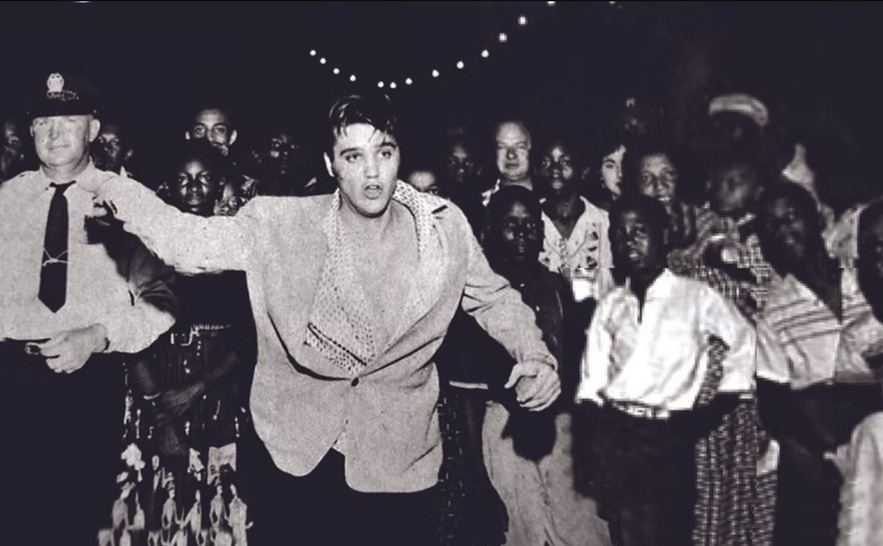
When Luhrmann tells Presley’s story as a mythic rise and fall, he is doing the same thing the music industry did in the 1950s—taking something specific and converting it into something universal. Something that feels like it means something without requiring you to follow the money. The shimmer replaces the receipt. This is precisely what Margo Jefferson describes as immaculate miscegenation:¹² cultural mixing presented as a kind of virgin birth, with no visible mechanism, no paper trail. Luhrmann’s Elvis is that process performed in real time.
And it mythologizes in both directions simultaneously—flattening Elvis into the appropriation archetype while flattening the appropriation itself into spectacle. Reductive about the man and reductive about the system at the same time. Not because Luhrmann is dishonest. Because his toolkit—monomyth, archetype, spectacle—is structurally incapable of rendering the thing that actually happened. The system is not an archetype. It is a set of contracts. And contracts are not cinematic.
This article is part of the Gladwellocalypse series and an addendum to “Roll Over McFly”
Notes
- Shannon Drake “The Lexicon of Latin”, The Escapist, October 2006.
- Grant Wong, “The True History Behind Baz Luhrmann’s ‘Elvis’”, Smithsonian Magazine, June 2022.
- Chris Willman, “‘Elvis’ Fact or Fiction: Colonel Tom Parker Biographer on What’s Real and What’s Not in Baz Luhrmann Biopic”, Variety, June 2022.
- Emily Aslanian, Weird Al on How His ‘Completely Off the Rails’ Biopic Came About, TV Insider, December 2022.
- Russ Burlingame, “Weird Al Yankovic Reveals Bohemian Rhapsody Inspired Him to Make His Own Biopic”, Comicbook.com, June 2023
- Aslanian, 2022.
- Willman, 2022.
- Ibid.
- Elvis (film), 2022.
- Carlton Ridenhour, Eric Sadler, Hank Boxley, and Keith Boxley, “Fight the Power”, 1989.
- Quoted (but not cited) in “Elvis Presley and the Black Community: Dispelling the Myths”, Elvis Presley biography (website), February 2020.
- Margo Jefferson, “Ripping Off Black Music”, Harper’s Magazine, 1973.
 Deru Kugi