The classical way of thinking is interested only in the work of art, never the artist. The classics believe in absolute perfection and seek it out. They despise localisms, oddities, contingencies.
And the latter:
Romantics never seek the work of art, but rather the man himself. […] That reverence for the I, for the irreplaceable human difference that is any I, justifies literal translations.
The essay concludes with two representative translations of the first line of Martín Fierro, an epic poem about the titular gaucho by Argentine José Hernández:²
Aquí me pongo a cantar. Al compás de la vigüela
We can translate them in a long-winded literal way: “In this same place where I am, I am beginning to sing with my guitar,” and with high-sounding paraphrase: “Here, in the company of my guitar, I begin to sing, […].”
For comparison, the “standard translation” offered in the essay is:
And here I begin to sing—to the rhythm of the vihuela.
Although Borges taxonomizes the classical and romantic types, though he does decry poetic cliché, he does not seem to favor either. And nor do I. Elements of each seem appropriate to me in different situations.
By way of illustration, let’s look at some Dante. When Robert Pinsky’s translation of the Inferno came out, I heard good things and picked it up. A passage I had not remembered from my previous reading caught my eye:³
In that part of the young year when the sun Goes under Aquarius to rinse his beams, And the long nights already begin to wane
Toward half the day, and when the hoarfrost mimes The image of her white sister upon the ground— But only a while, because her pen, it seems,
Is not sharp long—a peasant who has found That he is running short of fodder might rise And go outside and see the fields have turned
To white, and slap his thigh, and back in the house Pace grumbling here and there like some poor wretch Who can’t see what to do; and then he goes
Back out, and finds hope back within his reach, Seeing in how little time the world outside Has changed its face, and takes his crook to fetch
His sheep to pasture.
First, this simile that begins Canto XXIV is one of the longest in the work, a welcome reprieve from Dante’s extensive revenge fantasies and classical references. Second, I loved the bucolic imagery which then shifts to refer to Virgil (the peasant) who is leading Dante (his flock),⁴ which, of course, is also classic Christian symbolism.
But the structure is frankly annoying—basically the last bit of each sentence has been shoved into the next line throughout, and the rhymes are pretty weak. An excellent illustration of the problem of trying to preserve an original’s meter, especially Dante’s intricate, interlocking terza rima scheme. Sun/ wane, beam/ mimes/ seems, ground/ found/ turned, rise/ house/ goes, wretch/ reach/ fetch are some rough rhymes, but it seems meter and rhyme were Pinsky’s secondary focus, as he says in his Translator’s Note, apologizing for the difficulties. I’ll let him off the hook just a bit by noting even in more rhyme-rich Italian, and with all his poetic skill, Dante rhymes both tempra and faccia with themselves in the passage.
It was second nature to consult the original:⁵
In quella parte del giovanetto anno che ’l sole i crin sotto l’Aquario tempra e già le notti al mezzo dì sen vanno,
quando la brina in su la terra assempra l’imagine di sua sorella bianca, ma poco dura a la sua penna tempra,
lo villanello a cui la roba manca, si leva, e guarda, e vede la campagna biancheggiar tutta; ond’ei si batte l’anca,
ritorna in casa, e qua e là si lagna, come ‘l tapin che non sa che si faccia; poi riede, e la speranza ringavagna,
veggendo ‘l mondo aver cangiata faccia in poco d’ora, e prende suo vincastro e fuor le pecorelle a pascer caccia.
And, as I have suggested, my version is indeed a mix. Just as with the Aeneidpassage, I feel it’s important to understand the original and its context, but it’s still more important the metaphors of the original make sense in English:
In that moment of the fledgling year when the Sun douses his crown beneath Aquarius and the night becomes half a day’s length,
When the Frost traces the image of her white sister upon the ground, even though her quill’s sharpness lasts but briefly,
The peasant, low on fodder, rises and gazes out, and seeing all the countryside gone pale, slaps his thigh,
He turns back indoors, lamenting to and fro—a poor wretch who knows not what to do; but then, returning, his hope revives,
Seeing how the world’s face has changed in so short a while, takes up his staff and drives his lambs to pasture.
I won’t digress into a belabored discussion of the reasoning behind each word I chose, but just to give one example, the original has crin—“hair” as what the sun is “putting under Aquarius”, and Pinsky has the sun “rinse his beams”, both of which seem strange to my ears. I gave the sun a crown, which seemed a more sensible image using its triple meaning as the item of regalia—and of course the sun is king of the heavens—and the sun has an aurora using the cognate word corona, and also the top of the head. In any case, I think my overall rendering lets the depth and resonance of the original shine through.
Read subsequent articles in the Translating Poetry series
In Jorge Luis Borges’ essay, “Two Ways to Translate”, he begins by citing the Italian quip traduttore, traditore (“translator, traitor”), which he then goes on to discredit thus:¹
[I] believe in the good translations of literary works (not to mention didactic or speculative works) and am of the opinion that even poetry is translatable.
Nonetheless, in another essay on the topic, “The Homeric Versions”, he also concedes that it is not easy:²
[N]o problem is as consubstantial to literature and its modest mysteries as the one posed by translation. […] Translation […] seems destined to illustrate aesthetic debate. The model to be imitated is a visible text, not an immeasurable labyrinth of former projects or a submission to the momentary temptation of fluency.
He discusses one specific problem, that of a shared context between writer and reader:³
Evaristo Carriego’s poems will appear slighter to a Chilean’s ear than to myself: I will have a feeling for those Southside sunsets, the local characters, and even the details of a landscape not registered but latent, such as a corral, a fig tree behind a rose-colored wall, a bonfire in the street.
Pointing back to the notion framed in traduttore, traditore that the original text is somehow sacrosanct, and therefore all translations are lesser works, he continues,⁴
To assume that every recombination of elements is necessarily inferior to its original form is to assume that draft nine is necessarily inferior to draft H [i.e. Homer’s draft]—for there only can be drafts. The concept of the “definitive text” corresponds only to religion or exhaustion.
Long before I first encountered Borges, and especially these lesser-known essays of his, I was tinkering with conlangs, and one of the ways I would test them is to try to use them to translate poetry. Within fairly brief passages, I could quickly see if a lexicon needed expanding, if the grammar and morphology I was creating were sufficient to the task.
The first poetry translation I did into a real language was, rather oddly, of a Chinese poem into Japanese. The poem by Du Fu (杜甫), reminded me of haiku both in its succinctness and its feeling of mono no aware (もののあわれ); a wistful sense of the ephemerality of reality. Indeed, the famous haiku (俳句) poet, Matsuo Bashō (松尾 芭蕉), seemingly influenced by this poem, penned a quite similar one. Du Fu’s runs:⁵
蟬聲集古寺,鳥影度寒塘。
Cicadas’ voices echo in the old temple. Birds’ shadows fly across the cold pond.
The matching of the exact parts of speech and relationships of the words in the two lines was another intriguing element that caused it to stick in my mind. And so, when I was working in Japan, where I was doing a great deal of translation of Japanese game text into English, I decided to share it with some of my coworkers there, as:⁶
蝉の声古い寺院で響きます。 鳥の影寒い池で飛びます
Semi no koe, furui tera de hibikimasu. Tori no kage, samui ike de tobimasu.
Translating poetry from other languages into English began for me with a passage from Virgil, and my experience followed Borges’ description closely. Indeed in all the examples discussed in this series, I encountered the work in English translation, was struck by it, consulted the original, and executed my own version.
During the development of Diablo II, I was looking for an inspirational piece regarding hell, and the one from Dante’s Inferno was feeling a bit tired—“Lasciate ogni speranza, voi ch’entrate […]” (“Abandon all hope, ye who enter here….”).⁷ It’s actually a great passage, but was one of the pieces I had been using to test conlangs for some time. I ran across this section of the Aeneid:⁸
Just in the gate, and in the jaws of hell, Revengeful Cares and sullen Sorrows dwell; And pale Diseases, and repining Age, Want, Fear, and Famine‘s unresisted rage; Here Toils, and Death, and Death’s half-brother Sleep (Forms terrible to view), their sentry keep; With anxious Pleasures of a guilty mind; Deep Frauds before, and open Force behind; The Furies iron beds; and Strife, that shakes Her hissing tresses, and unfolds her snakes.
Overall it was interesting, and in fact, the Inferno passage is an homage to this one. But some of it felt a bit clumsy to me, in particular, the forced meter and rhyme: In this version, Dryden expands the original by an entire line to make it work. So, although I’ll admit to being a Latin novice at the time, I turned to the source, finding:
vestibulum ante ipsum primisque in faucibus Orci Luctus et ultrices posuere cubilia Curae, pallentesque habitant Morbi tristisque Senectus, et Metus et malesuada Fames ac turpis Egestas, terribiles visu formae, Letumque Labosque; tum consanguineus Leti Sopor et mala mentis Gaudia, mortiferumque adverso in limine Bellum, ferreique Eumenidum thalami et Discordia demens vipereum crinem vittis innexa cruenti.
I took on my own translation, yielding:
Before the entrance, at the very maw of Orcus, Grief and unrelenting Anxiety make their Lair, Here pallid dwells Disease, sad Senescence, And Fear, corrupting Hunger, and squalid Poverty, Shapes terrible to behold, Death and Exhaustion; Then Sleep, of one blood with Death, and Dark Joys, and against the gate, deadly War, The Fates in rooms of iron and frenzied Strife, Her snaky hair bound in ribbons oozing gore.
Attempting to preserve the meter, much less adapt a different one seemed a fool’s errand, and rhyming is, let’s be honest, a bit of a silly linguistic game. Instead I was interested in the metaphors the original work was dealing in, the resonances and nuances of its diction.
My focus initially was on using English cognates of the Latin words when they were available, but words like senescence later seemed like they’d only appear on the SAT. I did have enough restraint to not use consanguineous, and indeed many more Latin words that have been borrowed directly into English, since at a certain point it would cease being a translation. Furthermore, when I was working on Gods and Heroes, I came to understand the passage presented several lesser deities of the Roman pantheon, and these had accepted English equivalents. Dryden, too, seems to have been unaware of the standard renderings of these deities’ names. I’ve capitalized them in my translation, below. Additionally, my ability to parse the fairly complex Latin had increased significantly, I had studied Roman culture in great depth, and I had read the Aeneid in its entirety. This resulted in another pass from this period:
Before the antechamber, even in the very gullet of Orcus, Grief and unrelenting Cares have made their lair, Here abide discoloring Diseases, melancholy Old-Age, And Fear, corrupting Hunger, and squalid Want, Forms dreadful to behold: Death and Distress; Next, Death’s kinsman Sleep, and the soul’s Guilty Joys, and opposite the threshold, death-bringing War, And the Furies’ chambers of iron, and frenzied Strife, Her snaky tresses bound in a gore-smeared band.
As far as a series of drafts, mine improved by coming to grips with the issues Borges pointed out. And in fact, these drafts, as Borges suggests, are merely some relatively stable ones, there were many more in between them. Greater understanding of the original language and cultural context and an attempt to bring that information to a modern English-speaking audience informed the more recent one. Rather than focusing on cognates of the original Latin words in English, I moved toward diction relatively accessible to a moderately educated reader, but containing resonances attempting the depth of the model’s.
I’ll close with one final Borges quote summing up his (and my) thoughts on the topic:⁹
The original is unfaithful to the translation.
Addendum
I quite recently learned from a course on Roman architecture the term fauces, an inflected form of which, faucibus, appears in the first line of the Virgil verse, which both Dryden and I took in an anatomical sense of “jaws, maw, gullet”, is actually an architectural feature common to Roman houses.¹⁰ As further such language is used by Virgil (vestibulum, cubilia, limine, thalami), we can conclude his intent is to juxtapose these mundane domestic elements with the horrible creatures appearing within them, similar to the white vitta (“hairband”), and the blood staining it. Yet another draft was therefore needed:
Before the anteroom, even at the very entrance of Orcus, Grief and unrelenting Cares have made their parlors, Here dwell discoloring Diseases, melancholy Old-Age, And Fear, corrupting Hunger, and squalid Want, Forms dreadful to behold: Death and Distress; Next, Death’s kinsman Sleep, and the soul’s Guilty Joys, and opposite the doorway, death-bringing War, And the Furies’ iron bedrooms, and frenzied Strife, Her snaky tresses bound in a gore-smeared band.
Read subsequent articles in the Translating Poetry series
Jorge Luis Borges, “Two Ways to Translate” (“Las dos maneras de traducir”), 1926, collected in English in On Writing, Suzanne Jill Levine ed., 2010.
Borges, “The Homeric Versions” (“Las versiones homéricas”), 1932, also collected in On Writing.
Borges, 1926.
Borges, 1932.
杜甫 (Du Fu), 《和裴迪登新津寺寄王侍郎》 (A Companion Piece to Pei Di’s “Climbing Xinjin Temple, Sent to Vice-Director Wang”), 3–4, 760. I found the original after a great deal of searching, and it turns out this was just one couplet of a longer work and most translations I found have “gather” rather than “echo”, as I heard it from some Cal prof’s lecture.
Looking at this now, the spatial relations need some work….
Dante Alighieri, Divina Commedia, Canto III.3, ca. 1308–1320.
Publius Vergilius Maro (Virgil), Aeneis (Aeneid), VI, 273–81, 19 BCE, this is from the 1697 John Dryden translation.
“[E]l original es infiel a la traducción.” Borges, “On William Beckford’s Vathek” (“Sobre el Vathek de William Beckford”), 1943, collected in Selected Non-Fictions, 1999.
Diana E. E. Kleiner, “5. Lifestyles of the Rich and Famous: Houses and Villas at Pompeii”, Roman Architecture, 2016.
The outsider as a source of innovation (Creator Styles, Part 2)
Some commented on my previous article on creator styles, I was comparing apples and oranges—individual artists versus the team dynamic at work in video game development—but was I? Actually, schools of art provide something of a corollary. In these schools, individuals with shared goals work closely together, learning from one another to advance the aesthetic they are trying to achieve. As David Galenson notes in Old Masters and Young Geniuses, we should remember:¹
[A]rtistic innovations are not made by isolated geniuses, but are usually based on the lessons of teachers and the collaboration of colleagues.
Certainly, there remain differences in these contexts, as the artists are still creating their own individual works, but there are also situations like studios where works would be executed under the name and direction of a master by various artists, etc., and the Brothers le Nain even worked on one another’s paintings, to such an extent art historians are still trying to puzzle out which of the brothers is responsible for which elements of which works.
And so, as I continued to peruse Galenson’s work, a passage leapt off the page at me:²
What appears to be necessary for radical conceptual innovation is not youth, but an absence of acquired habits of thought that inhibit sudden departures from existing conventions.
He’s talking about van Gogh, an artist instrumental in the Impressionist movement. Obviously, using him as the example here is charged because of his mental instability and eventual suicide, but it’s also inarguable he was an artistic genius. He had his own ideas, so he moved to the middle of nowhere, perfected his style, and then, unfortunately, went crazy.
And, in the team-based creation process of games, a van Gogh sounds like a troublemaker, right? There needs to be unity; everyone on the same page, rowing in the same direction. Wrong:³
[W]ith astonishing speed van Gogh gained a knowledge of the methods and goals not only of Impressionism but also of Neo-Impressionism, and he became acquainted with Paul Gauguin, Émile Bernard, and a number of other young artists who were developing a new Symbolist art.
And, yet we know van Gogh clashed with his contemporaries, as well as his brother Theo, repeatedly. When he left Paris for Arles, it was partly from exhaustion from his work, having produced some 200 paintings during his two years in the capital. But also because his personal style was diverging from Impressionism and he knew the group would never accept it. In his own words:⁴
Instead of trying to reproduce exactly what I see before me, I make more arbitrary use of color to express myself more forcefully. […] I have tried to express the terrible passions of humanity by means of the red and green […].
This passage shows how he is moving past the strict dictates of the movement to explore new territory showing the way to Symbolism, Fauvism, and Expressionism. But the clashes still weren’t over—when Gauguin came to visit and paint with him, they had a massive quarrel: van Gogh threatened his colleague with a straight razor and then used it to slice off part of his own ear.
In the world of game development, I have championed passionate people, and especially those whose views are not mainstream. This can be a tough row to hoe: management typically dislikes disruption and sees “company culture” as monolithic; a world where everyone plays nice and gets along. My view is different perspectives, devil’s advocates, red-teaming, as long as they can be kept constructive and no one loses an ear, make a team stronger.
In my briefencounters with Hollywood, I’ve seen how sycophancy can distort the creative process: those who should be challenging an artist instead simply say yes. I’ll provide one salient anecdote: when a coworker of mine and I were on the set of Antitrust,⁵ Tim Robbins improvised a line about creativity, saying, “Use the left side of the brain”. Everyone fell over each other to confirm it was correct. It’s not.⁶ My colleague, another pilgrim in this unholy land, looked at me imploringly. “We’re not here to fight this fight,” I told him, sotto voce, “they’ll just have to fix it in post.”
Perhaps I relate to the ear-lopper role because I’ve lived it. When I got into game development, I did so very much as an outsider, in terms of nearly everything: influences, experience, values, goals. I was perhaps even more of an outsider than van Gogh—he at least was attracted to a school of painting, while I entered a medium wherein various genres and styles coexist, many times even within companies. On top of this, my first real development role was in Japan.
Working in Japan was pretty crazy—basically nearly no one in the company had the intent to make games, instead they were recruited as unskilled workers graduating from university to become sararīman (サラリーマン). Derived from English “salary-man”, the term refers to white-collar workers for corporations but also implies lifetime employment, for whichever company makes the best offer, including banks, or electronics manufacturers, or whatever. Whether they came to have passion or even aptitude for their work was a matter of complete happenstance. And indeed, even those who succeeded often did so only to see their ambitions crushed, as they typically had little control over the strict hierarchy within which they worked. Of the handful of Americans I worked with in this organization, none were on the creative side: they were translators or programmers, just as likely to fit into their roles as their Japanese counterparts. I’m not sure if any besides me continued in games—I certainly haven’t run across any of them.
Then there was me. I’ve already detailed some of my background in earlier posts, so I won’t belabor the point here. On top of that, I came from art school, believing in the integrity and grand potential of the medium, rather than thinking of games in terms of a set of genre-defined components.
And indeed, although I clashed strongly with many teams, especially early in my career, I feel it is appropriate to credit the successes of games I’ve worked on to my nontraditional approach. The very name of this blog, which comes from the Japanese expression, deru kugi wa utareru (出る釘は打たれる), reflects this. The phrase roughly translates to “the nail that sticks up gets pounded down”, though I’ve taken only the first part, having avoided the second.
Read subsequent articles in the Creator Styles series
David Galenson, Old Masters and Young Geniuses: The Two Life Cycles of Artistic Creativity, 2007.
Ibid.
Ibid.
Vincent van Gogh, Letter to Theo, Arles, ca. August 1888.
Antitrust, 2001.
The pop psychology notion on the lateralization of the brain holds the left side is logical and the right creative, but current science doesn’t bear this out, so it’s actually doubly wrong.
How political humor has paved the way to political hell
No more Daily Show; no more Last Week Tonight; no more Full Frontal; no more Real Time. I’m off them all. It will be hard, and it will feel like a loss, but I’m solidly done. “Why?” you might well ask, and I’ll tell you: It’s Malcolm Gladwell’s fault.
I’ve read pretty much everything Gladwell has written, and when it somehow got by me, a friend told me about his podcast, Revisionist History. I heartily and unreservedly recommend RevHist and all Gladwell’s work¹—he’s made a career of questioning conventional wisdom and digging into poorly understood and overlooked topics.
In one RevHist episode, “The Satire Paradox”,² he covered political humor, focusing on whether it was effective in changing opinions or achieving actual change. It resonated with some current events when I was listening to it, but that’s as far as it went—I agreed with Gladwell that we shouldn’t let politicians off the hook by ignoring their political issues and instead treating them with humor.
But Gladwell did his homework, and he shares that homework with us. For every episode of his RevHist, he supplies a section of reference docs, and reading, watching, and listening to this additional information is a great way to get some of the depth his 45-minute format doesn’t permit.
For this particular episode, one of the reference docs was an article called “Sinking Giggling into the Sea”, discussing Harry Mount’s The Wit and Wisdom of Boris Johnson. And this piece gives the topic both barrels. Or maybe every possible barrel.³
The article begins by discussing the rise of anti-establishment political humor in the UK. Coe traces the lineage of the genre from Beyond the Fringe to Monty Python, Have I got News for You, and That Was the Week That Was. He points out the creators of this brand of comedy are essentially those “trained to lead” the establishment they criticize, engaging in some good-natured rebellion during or after attending Oxford or Cambridge. He also points out being anti is a vague and not necessarily pointful position.
Then he gets mean. He cites Steve Fielding, introduced only as “an academic”:
[I]n accepting this view of politicians as uniformly corrupt and useless, the public are embracing a dangerous new stereotype, since it ‘can only further reinforce mistrust in the public realm, a mistrust that some political forces seek to exploit’.
The Fielding thread goes on:
The idea that politicians are morally inferior to the rest of us is ‘a convenient view, for it means we, the audience, the voters, are not to blame for anything: we are not to blame because we are the victims of a politics gone wrong’.
Indeed, the amazing depths to which the tone of political discourse has fallen can easily be seen to reflect this. The “low standards” to which we hold egomaniacal charlatans are the standards we have created and accepted. The fact it’s become difficult to distinguish news from satire has been so often remarked on #NotTheOnion has become a thing, but this is neither weird nor eerie; it’s a causal relationship.
Turning to the comedians themselves, Peter Cook, a widely acknowledged “comic genius” and perhaps one of the greatest practitioners of this form of humor, seems to have grown to understand its limits:
Famously, when opening his club, The Establishment, in Soho in 1961, Cook remarked that he was modelling it on ‘those wonderful Berlin cabarets which did so much to stop the rise of Hitler and prevent the outbreak of the Second World War’.
Michael Frayn, a critic, takes even squarer aim:
[T]he middle classes felt some vague guilt accumulating for the discrepancy between their prosperous security and the continuing misery of those who persisted in failing to conform, by being black, or queer, or mad, or old. Conceivably they felt the need to disclaim with laughter any responsibility for this situation, and so relieve their consciences without actually voting for anything which might have reduced their privileges.
Bullseye.
The piece returns to Boris Johnson, whom the book reviewed is ultimately about, and who has been able to cleverly take advantage of this climate to rise to political power, even satirizing himself in order to render himself “safe” to the public through laughter. This bullying xenophobic demagogue, with clear echoes this side of the pond, is the type of political leader we have come to deserve.
So goodbye Trevor, adieu John, adios Sam, and auf wiederschauen Bill.
Old Norse magical symbols, and ones that aren’t (Viking Esoterica, Part 3)
A while back, a friend on Facebook shared a link to an interview with Björk from 1988. In the video, she’s talking some endearing nonsense about televisions and lyingpoets. But what struck me immediately was the tattoo on her upper arm.
I’ll cut to the chase; this strange, eight-legged thing is a Galdrastafur, or Icelandic Magical Stave. This particular one is the Vegvisir, which is meant to keep one from losing their way. The literal translation is veg, “way” + visir, “guide”.
It seems to have been tempting for translators to relate it to German Wegweiser, “signpost”, but while it comprises cognate terms, this is incorrect. It has also been characterized as a “Viking compass” because of its eight legs, but this is also wrong.
There is a wide variety of these staves, with my personal favorite being the Smjörhnútur (lit. “butter-knot”), which protects one from bewitched butter. I might even have gotten a Björkesque tat of it, but unfortunately, it’s a bit nondescript; it just looks like an irregular pentagram with a vertical line down the middle. Additionally, as a fencer, I don’t cotton much to the idea of someone jabbing me with a sharp metal object without my being allowed to jab back.
Unfortunately, for those interested in the historical lore of the Vikings, these are not that. In fact, they are from a much later date, apparently around the 15th–19th centuries, with most of the corpus coming from the 17th, so in historical terms it would be a mistake on the order of attributing Leaves of Grass to Dante Alighieri.
As with the other elements of Nordic esoterica I’ve discussed in this series, this is partly because of the appropriation of these symbols by various groups, and in particular, Neo-Pagans, though it should be noted, also black metal groups.
The best known Galdrastafur by far is the Ægishjálmur. Performing a quick Google search for it returns “about 166,000 results”, more than triple the population of 50,400 in Iceland in 1703.
Indeed, in addition to many a tattoo, it has seen increasing use in Vikingy settings of late, appearing in particular on round wooden shields. And again, this is a massive anachronism. It is true, however, that while never used by Vikings, these signs do incorporate elements of runes and pagan symbols.
The place in history of the Galdrastafir matches more closely with the Maleus Malefacarum. The emphasis on witchcraft is a demonstration of the turning back toward superstition of a people who have nominally accepted the Christian faith. Similar to the pentacles of the Clavicula Salomonis or the magical signs, even including some figures quite similar to Galdrastafir, on this scroll I took a picture of in the Tiroler Volkunstmuseum (Tyrolian Museum of Folk Art), Innsbruck.
The Ægishjálmur is even shown in a Wikipedia article labeled as Ægishjálmr, with the article’s name having been partly backformed from Icelandic into Old Norse—in which it should properly be Ǿgishjalmr.¹
To be fair, this word does exist in Old Norse; it was just never used to refer to this symbol as it hadn’t been invented yet. Instead, it literally meant: “helm of terror”, which appears to be skaldic language for a terror-striking glancerather than a physical object.
Let me quickly note Icelandic, which some mistakenly think is synonymous with Old Norse, features several changes to both orthography and pronunciation, including -r → -ur for strong masculine noun endings, made, one imagines, to avoid the difficulty in pronouncing a consonant as its own syllable, but it also creates an -ur/-ir pluralization that is linguistically abhorrent. Other North Germanic languages simply dropped the ending, e.g., the Old Norse form of my name is Stigr (the ⟨e⟩ simply representing a modern spelling variant which the Novelist with the Dragon Tattoo also used).
Back to the Ǿgishjalmr, we read in Fáfnismál:²
[Fáfnir] k[vað]: “[…]Ægis hjálm bar ek um alda sonum meðan ek um menjum lág; einn rammari hugðumk öllum vera, fannka ek marga mögu.
[Sigurðr] k[vað]: Ægis hjálmr bergr einugi hvar [s] skulu reiðir vega; þá það finnr er með fleirum kjömr að engi er einna hvatastr.
Fafnir said: “The helm of terror I wore among the sons of men, while I lay on the neck-rings; more powerful than all I thought myself to be, I didn’t encounter any equals”
Sigurd said: “The helm of terror protects no one, Where furious men have to fight; A man finds out when he comes among a multitude; That no one is bravest of all.”
The conversation seems not to be about an actual helm, but the fear the dragon Fafnir instills in mortals. If this is so, the place of the word hjalmr in the kenning is locating the cause of fear in the head, or more specifically, the face and eyes.
All the Magical Staves are essentially material manifestations of Abracadabra—meaningless mummery whose effect, if any, is psychological. These signs essentially represent an evolution: Before writing, there were symbols. Then, when writing was created, it was magic in itself, as we have seen in our discussion of runes. The defixiones of the Romans, the papyri (πάπυροι) of the Greeks, are magical formulae written simply using words—sometimes accompanied by magical charakteres, but the formulae take primacy—and even in Sumerian, one of the first written languages, apotropaic tablets, as well as ones bearing curses fit this pattern. It is only later, when words are no longer obscure enough, symbols return.³
udug’khulne alaḫulne puakuba!
May the evil udugs and the evil alas tremble!
In this Sumerian incantation, an udug (𒌜) is a ghost/ demon of the desert, mountain, sea, and tomb, while an ala (𒀀𒇲) is a demon of suffering; the two are often mentioned together. In both cases, but particularly the latter, the descriptor khul (𒅆𒌨)—“evil”—seems fairly redundant, but it seems good utuks were sometimes called on to combat the evil ones.
So, did the Vikings use magical symbols other than runes and bindrunes? Yes, there were a few.
The best known of these is the Thor’s hammer (Þórrshmmarr). This is often shown as a simple T-shaped emblem of the thunder god’s weapon. Some say this might be a cross variant, like a Tau cross, but the crosses found in post-Christian Scandinavian carvings are of a fairly distinct type, and the serpents that also tend to appear with the Þórrshamarr don’t make sense to Christian symbolism, whereas Þórr is a dragonslayer of some renown.
Even as late as the turn of the last century, a T shape was traditionally carved above doorways in southern Tyrol (I’m not sure why the Tyroleans keep turning up here…), for protection from many kinds of evils but storms, in particular. In runic carvings, it is clear it is an invocation of the god to hallow and protect.
The so-called valknutr is another one. So-called because the term is actually a modern coinage, while its true name is unknown, although many point to this passage as referring to it, and personally, I agree:⁴
Hrungnir átti hjarta þat er gert var af hǫrðum steini ok tindótt með þrimr hornum, sem síðan er gert ristubragð þat er Hrungnishjarta heitir.
Hrungnir had a heart that was made of solid stone and sharply pointed with three points like the symbol for carving that is called Hrungnir’s heart has since been made.
The image is rendered either as three interlocking triangles similar to the Borromean rings or as a unicursal trefoil knot. There are few attested, but here’s one:
There is also this image from the Snoldelev Stone in Ramsø, Denmark, which is literally three interlocking horns, and might be another variant, or the specific sign referred to in the passage above:
There are various lines of thinking on the symbol’s use, mainly in association with Oðinn, and possibly relating to his ability to bind and unbind minds. If the hrungnishjarta name is correct, however, there is also a connection to Þórr, as the slayer of this jǫtunn: Hrungnir, had entered Valhalla (Valhǫll), gotten drunk and was wrecking the place, so they called Þórr. Þórr threw his hammer, and Hrungnir threw his weapon, a massive whetstone. Mjǫllnir shattered the whetstone and slew the giant, with shards raining down on Midgard (Miðgarðr) to become flint, and one jagged chunk lodged forever in Þórr’s head.
The Marvel folks seem to have opted for what is perhaps a more elegant version, known as the triquetra, using the symbol on their Thor’s hammer, but which is not found in Viking art.
The other symbol the Vikings clearly used is, unfortunately, one that can never be taken back: the swastika. It appears on several bracteates, including one that also includes the alu formula, so showing it bears a charm. The swastika is also associated with Þórr, and may simply have been another depiction of mjǫllnir.
Through all three parts in this series, we have seen Norse esoterica is a minefield of misinformation and appropriation by Neo-Pagans and Nazis. Even beyond this, much of the material has been mishandled and misrepresented.
I’m often down with the “rule of cool”, but it’s important to at least understand if you’re taking liberties with historicity, and definitely if you’ve been duped by reappropriations. It’s also important to understand the context of how these things were used, and to take care in how you represent them—even simply doubling sól, the runic equivalent of ⟨s⟩, might make someone think you’re into Gene Simmons.
Read previous articles in the Viking Esoterica series
Fáfnismál (Fáfnir’s sayings) 15–18, Konungsbók (King’s Book, also known as the Codex Regia) GKS 2365 4º, ca. late 13th century. Note this is a normalized version of the manuscript’s Old Icelandic, written in Latin script. The original renders the term as Ęgis hialm. I’ve used the English translation from Carolyne Larrington, The Poetic Edda, 1996.
Text 60.10, Nippur, ca. 2112–2004 BCE, referenced in Graham Cunningham, Deliver Me from Evil: Mesopotamian Incantations, 2500–1500 BC, 1997.
Snorri Sturluson, Skáldskaparmál (The Language of Poetry), f. 21r, p. 39, The Uppsala Edda (better known as the Codex Upsaliensis) DG 11 4º, ca. first quarter of the 14th century, Anthony Faulkes trans, 2012.
How Willem II’s sword wound up in the Witham (Solving the Sword, Part 5)
I have posited the mysterious Witham Sword was Dutch, with the inscription it bears associating it with Willem II. If this hypothesis is correct, there were many opportunities for it to move to England after Willem’s son, Floris V, retrieved it from West Frisia: Floris was in the British Isles extensively, arranging his treaty with Edward I of England and making his case in the Great Cause of Scotland, negotiating at length with Robert the Bruce for mutual support. Floris’ son, Jan I, was raised in the royal court for a decade as well, and Jan’s English wife, Elizabeth, returned to Holland with him, but on his death at only 16, she returned home.
Although Jan’s death represented the end of Willem’s direct line, Jean II, the old count’s nephew, cemented rule of Holland and Hainault upon his succession, also—finally—adding Zeeland. By the succession of Jean’s son, Willem III, not only was rulership in the area firmly settled, but his marriage to Joan de Valois, sister of the future king of France, Philip VI, and subsequent marriages of their daughters, Margaretha to Louis IV, the Holy Roman Emperor, and Philippa to Edward III of England meant the family was directly connected to essentially all the major power brokers in Europe.
And Philippa presents yet one more opportunity for the sword’s arrival in England. But regardless of how it got there, why bother bringing it there just to throw it in a river—a misguided attempt to see if the Lady of the Lake’s hand would emerge from the water to catch it? Indeed, I don’t think that’s what happened: Let’s look at yet another sword:
This sword, found along with some 80 others in the Dordogne river, is presumed to have been from the Battle of Castillon, fixing the date at 1453. The swords, all now in similar condition, were packed into barrels after the battle and shipped away on barges, which then sank. The sword is therefore actually 200 years newer than the Witham sword but clearly in significantly worse shape, with rust eating away its edges and causing several notches to appear. This strongly suggests not only was Willem’s sword not lobbed into the Witham during his lifetime, it was probably done much later even than the Castillon sword.
So we’ll turn our focus instead to a motive for ditching the sword: The Low Countries and England have always had a strong connection; although Calais sits closer, it’s not by much, and indeed France was often the mutual enemy against which these two united. This became even truer with the rise of their shared Protestant faith on a continent dominated by Catholicism. Still, a significant breach in these cordial relations did occur. We’ll have to go halfway around the world and hundreds of years later to find it.
Ironically, the breach directly resulted from the closeness of the two nations. By the late 16th century, the Portuguese and Spanish were in a cold trade war with the Dutch¹ and English. For the most part, this was carried out through embargoes, privateering, diplomacy, and the occasional taking by force of colonial outposts. Anglo-Dutch cooperation against the Iberian powers was formalized with the Treaty of Defense of 1619. Because economic factors were foremost in this alliance, the main bodies involved, rather than the nations, were the British East India Company (EIC) and the Dutch East India Company (Vereenigde Oost-Indische Compagnie, VOC), who additionally created a Council of Defense in Batavia (Modern day Jakarta, Indonesia). So hand in glove did these companies work their employees were commonly to be found in one another’s vessels and outposts. The treaty’s regulations allowing this were to be tested in a set of unfortunate circumstances in Amboyna, Indonesia (AKA Ambon Island, present-day Maluku), in 1623.
Although the governments and companies were allied on paper, on the ground, they were still competitors; there were more-or-less petty grievances, tensions, jealousies, and mutual suspicions. Amboyna had all these in abundance: the VOC’s governor for the area, Herman van Speult, seeing signs the Sultan of Ternate, a former power center in the area, was favoring the Spanish, thought the British might ultimately be behind this reversal of allegiance. Their treaty stated each country was to maintain and police the posts it occupied, which the governor interpreted as meaning he had legal jurisdiction in the area. He rounded up suspects, tortured (waterboarding was the method employed), tried, and executed 10 employees of the EIC, nine Japanese ronin (浪人, rōnin—mercenaries), and one Portuguese employee of the VOC. Four more Englishmen and two Japanese were also found guilty but pardoned.
The EIC, however, did not share van Speult’s opinion of the law. Instead, they believed that the joint body in Batavia should have tried the case. The British dubbed the incident a “massacre”, and proceeded to put out broadsheets including images drawn from martyrology, demonizing the Dutch and fomenting war.
Still, though anti-Dutch sentiment was clearly inflamed, actual war had to wait another 29 years until the pretext could be employed. The Dutch head of state (stadtholder), Frederick Henry, deeply deplored the regicide committed by Oliver Cromwell, having backed Charles I of England in the English Civil war. Indeed, there were Royalists and pro-Commonwealth factions across Europe plotting and inveigling, which, added to the mix of economic tensions proved a powder keg. It was lit when Lieutenant-Admiral Maarten Tromp was slow to lower his flag to General-at-Sea Robert Blake in the English Channel and the latter fired on him.
Although the “Amboyna Massacre” was hardly a true casus belli, it was now used as a pretext, as it was in the two Anglo-Dutch Wars to follow, in 1665 and 1672. It was such a never-forget moment it’s referenced in Gulliver’s Travels when the eponymous hero boards a Dutch ship called the Amboyna in Japan, pretending to be a “Hollander”. When he refuses to trample a crucifix, the Emperor promises to keep it quiet:²
For he assured me, that if the secret should be discovered by my Countrymen, the Dutch, they would cut my Throat in the Voyage.
Many pejorative terms including the descriptor Dutch entered the English language around this time: Dutch courage—false bravado gained by the consumption of alcohol—being the most common today.³ Others include:
Dutch bargain or Dutch reckoning: an arbitrary bill that only goes up if you try to negotiate it
Dutch-bellied, Dutch-built, Dutch-buttocked or Dutch-cut: poorly built or ungainly
Dutch concert: where every instrument plays a different tune
Dutch defense: the treacherous or cowardly delivery of a thing into enemy hands
Dutch leave: desertion
Dutch nightingale: a frog, alluding to the country’s marshiness, as well as the people’s poor singing ability
Dutch uncle: someone who is not a relative, yet offers frank advice and/ or rebukes as if they were
Dutch widow: a prostitute
In a similar period of anti-German sentiment, WWI, George V of England changed the name of his House from Saxe-Coburg and Gotha to Windsor. If occasions like this are enough to make the highest of royals change their names to make allegiances clear, certainly keeping around relic tying you to whomever national hatred is turned against would also seem in need of remedy.
So much the more so in Lincolnshire, center of the wool trade with the Low Countries since the Late Middle Ages, with its own village of New Holland and district of South Holland. John of Gaunt, son of Phillipa of Hainault and Edward III held the proverbial vast tracts there, and a street in the town of Lincoln bears his name, as does a football ground formerly home to Lincoln City.
It’s hard to trace who lived in Lincoln Castle down the years, or who the descendants of this or that duke might be, but I think the sword was in this area from the time of John of Gaunt, until, during some Anglo-Dutch War, through some combination of spite and desire to not be thought of as pro-Dutch, some successor or inheritor took this ancient relic of a forgotten line and flung it into the Witham.
And for comparison, I present a Hungarian river find sword; this one from the 17th century, which appears to have gone into the drink shortly after its creation:
You can see the condition of this blade bears a strong resemblance to the Witham sword; the grip is gone, there is an eating away of the flat surfaces, but the edge is intact. It is interestingly archaic in type, but I am assured of the date—perhaps it’s a sword of rank, just as the French Sabre de Troupe à Pied Modèle 1831 resembled a Roman gladius.
It is beyond my scope, and indeed my abilities, to eliminate all the variables in drawing equivalencies among these three swords, but we have the dates of manufacture for all three, and approximate dates for the submersions of the swords I’ve brought in for comparison. All three were found in large, slow-moving rivers prone to silting—all were found during dredging operations. None of them appear to have been scabbarded when sunk; generally, while the organic parts of scabbards, just as with grips, decay quickly, the metal fittings do not, however none of these finds mention any such pieces. If you’re feeling these examples are cherry-picked, I don’t blame you, but sadly I chose them because of the scarcity of reliable evidence rather than its abundance: give me access to the arms collections of several European musea and I’ll be happy to conduct a more thorough survey.
Is the case I made airtight? Hardly, but based on the information I could access, I’ve put together what I think is a fairly compelling hypothesis. Short of making a late career change into academia or being independently wealthy with nothing but time on my hands like the guy in Tim’s Vermeer, this is where the trail must end for me: this blade with which Willem II planned to enforce his ambition to expand his realm, unite the Low Countries, and become a player on the greater European stage, passed through many hands. It was lost to the Frisians, but Floris V recovered it. Willem’s family eventually achieved the high rank and status he had sought, and the sword became an heirloom of the Lancasters. And in a time of ill-feeling between the two nations, someone saw fit to lob it in the river.
Addendum
I ran across a great quote perfectly summing up the anti-Dutch sentiment in England, especially in the latter half of the 17th century:⁴
What trades and artifices of all kinds do they set up, to the ruin of many a poor Englishman that has lived an apprentice and bondman seven years to attain his art and occupation? What trades are there in which they have not stocks going, or scriveners with money to lend? What land is to be sold, or mortgage to be had, that they have not the first refusal of? What marriages of man or woman falls amongst them that they will enrich the English with so long as any of their country or tribe is found amongst them? What maritime town, or other of account within twenty miles of the sea, opposite to Holland, that is not stuffed or filled with their people, to the impoverishing of the inhabitants and dwellers? What masses of money and gold have they, against the laws of the realm, transported out of it as truth has made it plain?
I also found more terms of disparagement using the descriptor “Dutch”, including a different meaning for Dutch bargain:
Dutch almanac: gibberish
Dutch bargain: a one-sided deal or one concluded over drinks
Dutch father: same as Dutch uncle
Dutch feast: where the host gets drunk before the guests or monopolizes the booze
Although some will say it is not technically correct, I’ll use Holland and Dutch to refer to the United Provinces of the Netherlands and its people, respectively. This simplifies things, maintains clarity, and is a common usage.
Jonathan Swift, Gulliver’s Travels, 1726.
Dutch treat, also called going Dutch, is tempting, but is actually a US English term from much later, and probably refers to German (Deutsch)-speaking immigrants. There is a plethora of terms like this in the English language, with their time of origin strongly indicating the disfavored group of that day.
Revolt, flood, war, revenge, murder, and betrayal in the reign of Floris V (Solving the Sword, Part 4)
During a military incursion into West Frisia in 1256, Willem II of Holland managed to end up with only a small contingent of foot soldiers and floundering in a semi-frozen lake near the town of Hoogwoud where his foes were able to make short work of him. The most current theory of his death is it was not deliberate. The Frisians simply saw a foreign knight leading his infantry across the iced-over Berkmeer and attacked. Only after the deed did one of them recognize the red lion of Holland and the black eagle of Germany on his arms and ask his fellow warriors what in God’s name they had done.
Generally, slaying royalty was bad business. It was much more profitable to hold them for ransom, trading them either for gold or for various other concessions rather than killing them and triggering a war of vengeance. It’s quite easy to imagine the Frisians setting Willem free on the condition he relinquish his claims on their lands, for example. As things stood, although they couldn’t have known it at the time, they had just doomed West Frisia to another three decades of war with, and ultimately complete subjugation by Holland.
As things stood, they apparently were careful with the king’s corpse, salting his remains to prevent decay, and burying him deep in the ground in a wooden box, rather than trying to hide what they had done by scattering the remains. Some presentiment seems to have been at work they’d eventually have to return the king’s body, and, I’d venture, his effects, including the sword, which were similarly kept safe.
Floris was only one-and-a-half years old when his father Willem was slain. Just as with Willem’s succession at a young age, his holdings as Count of Holland and Zeeland were kept provisionally by his uncle, Floris de Voogd, until he was old enough to rule for himself in 1266. Unfortunately, eight years before his majority, his uncle passed away, precipitating a battle over the custody of his realms between his aunt Aleid (Willem’s sister; her husband, Jean de Avesnes, had also passed away in 1257, leaving her to rule Hainault) and Otto II, Count of Guelders. Otto’s victory in the battle of Reimerswaal in 1263 enabled him to become regent for the remaining three years.
Presumably to settle the bad blood between the counts of Hainault and Flanders, Floris married Beatrix, daughter of Jean de Avesnes’ hated rival, Gui de Dampierre, in 1269. With things in the rest of the Low Countries seemingly thus settled, the purpose of avenging his father’s death at the hands of the West Frisians, apparently always in the back of his mind, came to the fore.
Floris first invaded Friesland in 1272, but gained little ground, and had to return home in 1274 as the peasantry of Haarlem, Alkmaar, and the surrounding areas joined the West Frisians in a revolt, later known as the Uprising of the Kennemers (Opstand der Kennemers).¹ The Bishop of Utrecht, who had turned against Holland near the end of Willem II’s reign, suborned the nobles whose lands bordered on his bishopric, including Gijsbrecht IV and Arnoud of Amstel, Zweder of Abcoude, and Herman VI van Woerden to seize the opportunity to also join the rebellion. Utrecht’s disgruntled craftsmen further swelled the revolt’s ranks. Floris rapidly put all these forces down, annexing the diocese of Utrecht, the regions of Waterland and Gooi, as well as the borderlands of Amstel and Woerden.
Finally, in 1282, Floris was able to return to Frisia, where his victory at the battle of Vronen crushed resistance in the area. Then he went in search of his father’s bones. Many legends surround both where Willem was buried and how it came to be known, but I’ll relate the most common (although folkloric) of these: By the time Floris reached the area of Hoogwoud, only four old men who knew the location of Willem’s corpse were still alive—after all, 27 years had passed at a time when the average lifespan wasn’t much more than that, and moreover in an area wracked by nearly constant warfare. These old men were simply executed one at a time until the last begged for his life in exchange for showing the count to the location of his father’s corpse.
Digging down two and a half meters, they found the coffin, which was apparently such a triumph for Floris that he carried the remains back to Middleburg at once and interred them with solemn ceremony in the Abbey Church (Abdijkerk) there.
A chapel was built on the site of Willem’s first burial as well, which subsequently fell into ruin, but has been rebuilt within the grounds of the West Frisian Farm Museum (Museumboerderij West-Frisia).
Still, Floris did not end the war, however, and indeed it took another six years of wars and severe flooding before the West Frisians finally decided they’d prefer to be on good terms with Holland, signing a treaty in 1289.
One of these floods in particular is noteworthy: known as the Sint-Luciavloed, it was the sixth largest in history. This North Sea tidal surge occurred on the 14th of December, 1287, the day after St. Lucia’s Day, from which it takes its name. It enveloped the river Vlie and a nearby freshwater lake, sweeping away natural clay and dune barriers, and submerging peatlands to create what is now known as the Zuiderzee, also greatly enlarging the Waddenzee and IJsselmeer bodies of water.
Starum, Frisia’s oldest city and a powerful trading center, fell into decline as it no longer was accessible from the sea, with the formerly landlocked Griend taking its place even though the island in the Waddenzee it sat on was all but wiped out. Somewhere between 50,000 and 80,000 people lost their lives in the cataclysm, with entire villages vanishing completely. Importantly, the Zuiderzee’s inlet now divided West Frisia from Frisia proper, with Holland becoming its sole neighbor and isolation the only alternative to making peace, so peace was made.²
Floris constructed four castles in Medemblik, Wijdenes, Eenigenburg, and Alkmaar, to keep his new and restless subjects in check. However, he also built dikes in the area to keep incidents like the Sint-Luciavloed from recurring, as well as many roads, and these structural improvements soon endeared him to the people, as well as increasing Holland’s importance in regional agriculture. He assaulted Frisia proper as well, but even though he gained little more than a beachhead, from 1291 on he appended Lord of Frisia to his titles.
Whatever Floris’ expectations might have been when he wed Beatrix, her father Gui seems to have been intractable. The records show Floris’ attempt at a formal alliance in 1277 was rebuffed, and when, in 1287, Rudolf I of Germany, first of the Habsburgs, gave Floris the rights to the area controlling access to the Scheldt river (Zeeland-bewester-Schelde), thus infringing on Flemish lands, relations hit a new low.
In 1290, encouraged by local nobles who supported his rule, Gui invaded the area, and when Floris arranged a meeting to try to work things out, his father-in-law imprisoned him in the castle of Biervliet, a town in Zeeland. Only when the Count of Holland agreed to relinquish his claims on the area was he released.
Flanders, as had often been the case, was backed by France, so Floris sought to ally himself still more firmly to England. In 1285, Floris betrothed his son Jan to Edward I’s daughter Elizabeth, also sending the infant to be raised and educated in the English court. The treaty thus sealed provided huge advantages for Holland, including making Dordrecht the center of the wool trade from the island nation and providing fishing rights off its coast.
However, during the Great Cause of Scotland, in which Floris was one of the few legitimate contenders for succession to the throne—his great-grandmother Ada was King William I “the Lion” of Scotland’s sister—Edward did not support him, ruling John Balliol the rightful king instead.
The winds were shifting in the Low Countries as well, with Flanders finally turning its back on France, so Floris seized the opportunity to switch his allegiances as well. His cousin, Jean II of Hainault, having succeeded in 1280, was already allied with the French, and in 1296, persuaded him to join in order to finally crush the despised Dampierres. Far from accomplishing this end, however, it led to Floris’.
Edward appealed to the very same nobles Floris had defeated and disgraced during the Opstand der Kennemers. They set upon Floris during a hunt and took him prisoner with the object of delivering him to England. But the local peasantry, now solidly behind the charismatic ruler who had brought them such prosperity, rose up to prevent this. When the nobles attempted to leave Muiderslot castle with the count, they were met by an angry mob, panicked and slew Floris rather than allow his escape.
This senseless killing spread the revolt across Holland, with commoners even in West Frisia clamoring for revenge for their count. The murderer, Gerard of Velzen, was captured and executed, while the other lords fled the country for their lives. The title of this article, God of the Peasants, is the English translation of Floris’ nickname, Der Keerlen God, which reflects the sentiments of his subjects.
The tale I have presented here strongly suggests Willem’s sword came back to Floris, if not when he recovered his father’s remains, then certainly by the end of his own life, after he had become immensely favored by all the commoners of his realm, which had come to include the area in which his father died, West Frisia. The close relationship between Holland and England, despite some bumps in the road, also grew considerably during his reign, which I’ll discuss further in Part 5.
Read subsequent articles in the Solving the Sword series
Kennemer is the demonym of Kennemerland, an area of dunes stretching from Haarlem to Alkmaar.
It is known simply as “The Great Storm” in England where there was also massive flooding and damage, with hundreds dead and the decline of the port city of Dunwich.
Willem II consolidates the Low Countries with a new sword (Solving the Sword, Part 3)
Outside the Binnenhof palace in The Hague, stands a golden statue of its builder. Though little known elsewhere, Netherlanders venerate him as a founding father, and the continued popularity of the name Willem dates from his rule.
The statue bears the inscription:
Ter nagedachtenis van Willem II Roomsch Koning en Graaf van Holland, Begunstiger der stedelijke vrijheden, beschermer der kunst, stichter der kasteelen in ‘s-Gravenhage en Haarlem, geb. MCCXXVII †MCCLVI† In memory of William II, King of the Romans and Count of Holland, supporter of urban liberties, protector of art, founder of castles in The Hague and Haarlem, born 1227, died 1256
This is the king I was led to by the “mysterious inscription” of the Witham Sword. In a feud between the papacy and Holy Roman Emperor (HRE) Frederick II, Willem was crowned [link to from] in full regalia to this same throne—therefore the anti-king—and proceeded to score a series of battlefield victories, forcing Frederick to shift his focus to the south.
By the mid-13th century, Frederick had been excommunicated by two different Popes, deposed as HRE, a crusade against him was preached, and two different anti-kings had been elected to invade his territories, and, if possible, do him in. While certainly troubled by these events, rather than sulking, he had simply withdrawn from northern Germany and continued his consolidation of the Italian peninsula.
Despite Willem’s successes, the German princes had still not closed ranks behind the ruler, still regarding him with suspicion as Pope Innocent’s pawn. Those presiding over Willem’s election had been almost entirely ecclesiastical, and some princes, such as the Duke of Saxony, had even directly opposed it. While still continuing to attempt to politick his way through this imperial/ pontifical mess, the anti-king withdrew his forces from the south in order to direct them instead toward goals closer to home.
This opportunity came about via Jean I d’Avesnes, Willem’s brother-in-law. He had married Willem’s sister, Aleid, in 1246, and supported him in the siege of Aachen. That accomplished, Jean had a bone to pick with his mother, Marguerite II, Countess of Flanders, and entreated his new and powerful relative to take his part. Indeed, the, the timing of his marriage suggests it was specifically intended to gain him an ally in the Wars of Flemish Succession (as marriage often had strategic aims in those days), though it had preceded William’s election, which event must then have seemed fortunate beyond Jean’s wildest dreams. On the other hand, Willem’s ambitions in the region were already clear as well.
The bad blood between Jean and Marguerite came following the first conflict in the War of the Flemish Succession, in which Jean had battled his younger half-brother, Guillaume III de Dampierre. King Louis IX of France and Bishop Odo of Tusculum had finally intervened, settling Flanders on Guillaume and Hainault on Jean.¹
Now however, with Louis away on the Seventh Crusade, it had become clear Marguerite had no plans to relinquish Hainault, so Jean turned on both her and the king, asking Willem to annex Hainault to his lands and give it to Jean to rule as its count which should already have been his right twice over. Hainault, along with much of central Europe, was already an Imperial fiefdom, so this act, like Willem’s later declaration of his kingship of Zeeland, was merely taking something his by right and attempting to make it his in fact. As for the newly crowned Emperor, the appeal of extending his rule in the Low Countries was clear. He seems to have allowed himself to be persuaded, adding Hainault to his titles. And here, finally, is where the Witham sword enters the story.
To the trained eye, the Witham sword differs greatly from the Zeremonienschwert. Although not as elaborate as ceremonial swords were to become, the latter blade is clearly meant for symbolic rather than martial use. The square grip would make it painful to wield, and it looks blade-heavy as well. As I noted earlier, the pommel has been changed. The original could have been a heavier one—based on the style of the parts of the sword that are original, I’d guess it was a large, square cross-sectioned disk—and again fairly unergonomic. The square guard is bulky and its shape ineffective. The blade is unadorned, its cross section is flat—overall it seems intended simply to look impressive sheathed, which in fact it would typically be, as the coronation ceremony has the officiant gird the king with the scabbarded sword. It was apparently used for knightings under the Habsburgs, which would have involved unsheathing it, but by then it would have been fully anachronistic, and impressive mainly for its glitter and history.
Everything about the blade from Lincolnshire, by contrast, says it is a weapon of war: It has a heavy pommel to balance the weight of the blade and a sturdy, double-fullered, lenticular cross-section. The guard is thin but functional, with flared ends to arrest a foe’s blade. The grip is missing, having likely decomposed in the river, which means it was of organic material, likely wood and leather, to absorb the shocks of cuts, thrusts, and parries. Shark- or ray skin, called shagreen, was a popular grip covering as the scaly surface was naturally nonslip.
Even the inscription is in keeping with its warlike purpose; the invocation is meant to gain the favor of God and inspire valor in battle. It is now my conjecture this sword was created upon the declaration of William’s kingship of Hainault, perhaps Jean’s gift to his brother-in-law. It also makes sense as the last title presented in the inscription, with the purpose of going to war with the Dampierres, which is exactly what occurred. Willem seems to have declared his kingship over Hainault in 1249, while his title Duke of Swabia was appended in 1254, giving a five-year window for the inscription, as the Witham sword does not bear the latter title. He also became King of Zeeland in 1256.
The war was focused on Zeeland, sitting between Flanders and Willem’s base in Holland.² Here Willem and Jean, and their Brabantine allies scored a series of victories in the five-year conflict. These culminated with the decisive battle of Westkapelle, in 1253, which crushed military resistance in the area, forcing Marguerite and Gui de Dampierre (his older brother, Guillaume, having been killed earlier in the conflict) to acknowledge the earlier settlement granting Hainault to Jean.
This treaty was not worth the vellum it was written on, however, as the treacherous Marguerite also promised Hainault to Louis IX’s brother Charles d’Anjou. Willem entreated aid from Henry III of England to balance the scales. Charles attacked Jean at Valenciennes, where the Frenchman was soundly defeated and nearly killed.
In the end, it took King Louis’ return from the crusades to settle the matter and set Jean firmly on the Hainault throne. But even before all this was resolved, apparently dissatisfied with his gains in the Flemish wars, Willem had already turned to his forces against the West Frisians, his neighbors to the northeast, in a new series of battles.
Widening our focus back to Europe’s ongoing political turmoil, in 1250, Frederick II died, and was succeeded by his son Conrad IV. The pope swiftly excommunicated him, deposed him as HRE, and stripped him of his duchy of Swabia, conferring it on anti-king Willem instead. Already in the previous year at the papal Council of Lyon, Willem had started negotiations for an imperial coronation in Rome, even performing the Officum Stratoris et Strepae; a strange ceremony originated by Emperor Constantine. He describes it thus:³
[H]olding the rein of [the Pope’s] horse, out of reverence for blessed Peter we performed for him the office of a groom.
Essentially, this was an act of humility before the Church and, as such, many rulers flatly refused to do it.
The next year, Willem married Elizabeth, the daughter of Otto the Child, Duke of Brunswick-Lüneburg, thereby becoming the symbolic head of the Guelphs. The Guelphs and the Ghibellines were two opposing parties Dante often referenced in his Divine Comedy (Divina Commedia). The Hohenstaufens—to which Frederick II belonged—essentially headed up the latter, refusing to acknowledge the church’s authority over temporal matters, while the church predictably backed the former. This alliance added secular backing to Willem’s former, mainly ecclesiastical support, and allowed his re-election as the German King in 1252.
These events snowballed with the death of Frederick’s successor, Conrad, even despite Innocent IX perishing in the same year, with disarray created in both successions. In 1254, the Rhenish League decided to pay homage to the anti-king, and his indisputable re-coronation in Rome was planned for 1256. But this was not to be.
Even with his kingship of Germany seemingly about to be settled, Willem still was focused on the consolidation of the Low Countries under his rule. He continued his campaign in West Frisia, where an expedition near the town of Hoogwoud on 28 January 1256 proved his undoing.
Cut off from his troops and having lost his bearings, Willem tried to cross a frozen lake called the Berkmeer. The ice could not support him cap-a-pie in mail atop his destrier, so horse and rider plunged into the frigid morass beneath. In this soggy, cold, dismounted, and bemired state, the Frisians made short work of him, and buried him under a house in the region.
There are several depictions of the event, all of which seem to depict the Frisians as brutish and cruel, but really, they were only trying to remain free from feudal subjugation. In some depictions, at least, there is a dissenter among them.
It is not recorded what was done with Willem’s arms and armor, including, according to my theory, the Witham sword, but as expensive and well-wrought trophies, one can imagine the Frisians did not want to part with such gear easily. Perhaps they split the loot, each carrying off a few items.
Oh, and just by the way, Willem is my 25th great-uncle. I only found this out about a week before this article’s publication. My mother-in-law’s hobby is genealogy; she’s been working on my wife’s side of the family for several years now but has recently turned to mine.
Closely following my penning of Part 1 (which is to say in completely independent research), she excitedly told me I was related to Edward III of England, tracing back from my mother’s grandfather, Peter Keplinger. I found this interesting, but not especially so until she mentioned his wife Phillipa of Hainault. Yep, that’s right; I am a direct descendant of Jean d’Avesnes and Willem II’s sister, Aleid.
Addendum
Unexpectedly, while reading Prague in Black and Gold, I ran across an interesting take on the renewal of Willem’s attempt at the German kingship:⁴
At the beginning of his reign, Otakar [II of Bohemia] supported the candidacy of Wilhelm of Holland, who was also backed by a league of Rhenish towns, but by 1254 his own chances were propitious: the German princes were not unwilling to consider him, the rich son of a Hohenstaufen princess, secret negotiations were held, and Wilhelm of Holland suggested his willingness to withdraw his candidacy if it paid off sufficiently.
This fits my view Willem was much more concerned with consolidating his power in the Low Countries than tilting at the windmill of ruling the HRE.
Read subsequent articles in the Solving the Sword series
I use the French forms here as this seems to reflect both the extraction and loyalties of this family (at least initially). Jean is often given as John or Jan as well.
A map representing the proper time period and region was impossible to find, so I had to adapt one; the political regions shown are generally correct.
I have emphasized the English translation of the ceremony’s name here.
Peter Demetz, Prague in Black and Gold, 1997. He oddly uses the German form of Willem’s name.
Willem II’s coronation as German anti-king (Solving the Sword, Part 2)
I took up the challenge of deciphering the inscription on a sword found in the River Witham in Lincolnshire, dating to around the 13th century and of possible German manufacture.¹ Using my limited knowledge of Latin, comparisons from other sword inscriptions, numismatics, and the styles of royalty from the region and time period, I was able to render the “indecipherable” inscription thus:
+NDXOXCHWDRGHDXORVI+
in Nomine Domini (patris et filii et spiritus sancti) Comes Hollandia Willelmus, Rex Germania et Hainault XpiσtOσ Regnat! (xpiσtoσ) Vincit! (xpiσtoσ) Imperat!
In the Name of the Lord; of the Father and of the Son, and of the Holy Ghost Count of Holland Willem by the grace of God, King of Germany and Hainault by the will of God Christ reigns! Christ conquers! Christ commands!
Since this links the sword to Willem II of Holland, I now will attempt to show how it fits into his story and how it might’ve ended up at the bottom of a river in England. And so I will, but first more background is needed.
But even before that, a minor digression: it has been pointed out I was perhaps a bit breezy with the quod erat demonstrandum for my solution. As is typical for codebreaking, there were many abortive attempts before I reached my conclusion. In fact, it’s rather important to have tried and discarded several theories—if I had reached my solution without missteps, I’d have been pretty suspicious of it myself. In fact, even after finding a solution that worked well, I continued to tinker, seeing if anything fit even better.
There were several theories I pursued only to return to the drawing board; I can’t say positively how many, but I recall these two dead ends:
OXO is a sign for the Holy Trinity, so perhaps the XO is another one.
Nope, XOX is well documented, but there is no variant XO, and in fact, as a digraph, it makes little sense standing for three of anything.
Hey, the letterform the original article interpreted as an ⟨R⟩ looks more like a variant of ⟨N⟩.
Sorry, there are no styles I can find in this pattern, and the initial ⟨N⟩is a different letterform, so why would the inscriber use two different ones?
In fact, my research for this article has already proved some of my earlier conclusions incorrect and I’ll amend them here.
Returning to my candidate for the sword’s owner, Willem II of Holland’s life was brief, but eventful. He was born in February 1227 to Mathilde of Brabant and Floris IV of Holland. The latter died in a tournament when his son was only seven. Though Willem succeeded to the throne, he was placed under the guardianship of his uncles for five years. When he finally assumed the countship, few would have imagined this 12-year-old noble from the Low Countries was soon to become one of the most powerful kings in Christendom. Still, despite the heights he attained, he is poorly documented in history, overshadowed by his better-known contemporaries. Some imply that he was merely a pawn of Pope Innocent IX, without real power or authority.
There is even a tale the citizens of Utrecht once pelted him with stones, but there seems little basis for it. The information here is drawn in bits and pieces from a dozen sources—some of them contradictory—and stitched together in order to make some sense of it.²
Here is an early seal of the count. The image is of a type commonly used among young nobles, presenting him sitting astride a horse, hunting with a falcon and a dog.
It bears the straightforward inscription:
SIGILLUM : WILLELMI: COMITIS : HOLLANDIE Seal of Willem, Count of Holland
The form is quite similar to the one I based the first part of my solution on, which helps bear it out.
In the times Willem lived in, the Papacy and the Holy Roman Emperor (HRE) were constantly vying for power and riches but in the third year of his pontificate, during the Council of Lyon, 17 July 1245, Innocent IV went after then-HRE Frederick II in a big way. The papal bull, Ad apostolicae dignitatis apicem (Raised to the Height of Apostolic Dignity), served as final notice: Having already excommunicated him for all the various (trumped up) crimes he had committed, Innocent now declared Frederick a heretic and deposed, and clergy throughout the empire were instructed to preach a crusade against him. It should be noted Frederick had also been excommunicated by Innocent IV’s predecessor, Gregory IX, so it was nothing new to him.
When words failed to have the desired immediate effect, the pope turned to force instead, backing Heinrich Raspe, landgrave of Thuringia, as anti-king and sending him to invade Frederick’s home territory of Sicily and kill him, but though there was some initial progress, the gambit did not succeed: At the end of the next year, it was Heinrich rather than Frederick who was dead, and a new catspaw was needed to advance the papal ambitions.
On the other side, under some duress, Frederick II issued the Statutum in favorem principum (Statutes in Favor of the Princes), which essentially declared the independence of the various secular princes under his rule. This, together with his denial of papal authority, allowed the various kingdoms in the empire to essentially do as they wished, and made him popular with them as long as he stayed out of their affairs and kept the clergy out as well.
Henry II of Brabant was the first choice for the next anti-king, but he pointed the papal envoys toward his young and talented nephew for the role instead. They conferred with all the parties involved and soon had a decision. On the 3rd of October 1247, the archbishops of the Lower Rhine, headed by Archbishop Conrad of Cologne and some other clerics, met in Worringen to elect the 19-year-old Willem as their new German king. Note Roman King, German King, and HRE were used essentially synonymously. I’ve generally used German King to avoid confusion, and also because the schism was essentially a north/ south one, corresponding roughly to modern Germany/ Italy.
Certainly Innocent seems not to have been disappointed. Just as Heinrich had before him, he went immediately to battle, conquering the forces of Frederick’s son and successor, Conrad IV, in Kaiserswerth and Dortmund, early in 1248. Frederick responded by shifting his focus back to the Italian peninsula and southern Germany, with one notable exception.
In the spring of the same year, Willem sent his men ahead to the city of Aachen (it sits on the French-German border, so it’s also known as Aix-la-Chapelle.), where HREs had been crowned since the time of Charlemagne, but they found the gates barred, as the town remained loyal to Frederick. As a coronation was needed for Willem to seem anything but a Church-backed pretender, a siege was his only option and his troops descended in force, supported by more from Flanders, Picardy, Brabant, and later Frisia. Within five months, the besiegers had flooded much of the city by damming the nearby Wurm river, and the inhabitants were damp, hungry, and prey to the various missiles being incessantly lobbed over the walls; reports indicate trebuchets, mangonels, and pedreros—a kind of early swivel gun—were employed in the battle. Still, they might have continued to hold out if a rumor of Frederick’s death had not begun to circulate. Thinking their leader was gone, the nobles pledged fealty to the Church and Willem; the siege was lifted, and he was finally crowned on November first.
In Part 1 I said this is where the Witham sword would enter the tale, but further research has altered my view. Indeed, another sword has presented itself for this role, the Zeremonienschwert (“Ceremonial Sword”). This sword, part of the Imperial Regalia, was made on Frederick II’s home turf, Palermo, as part of a set of vestments for his coronation as HRE in 1220. However, rather than remaining his personal possession, it passed into the hands of the German princes for safekeeping in Nuremberg, whence they would fetch it to Aachen as needed.
Apart from a few elements, the sword is original: in 1346, Charles IV of Luxembourg added a new pommel, bearing an imperial eagle on one side, and the Bohemian lion on the other. And although it is not widely acknowledged, the uppermost lozenge-shaped plates on each side of the scabbard I would posit were added by Willem II.
This detail sharply contrasts with the Byzantine style of the rest of the sword, and this particular type of eagle, with dramatically bent wings, sparse feathers, and a triangular tail, originated in the North around midcentury. Indeed, the form is so synonymous with Germany, it remains essentially unchanged in today’s Bundesadler (“Federal Eagle”):
In heraldic terms, it is described as or (on a gold field) eagle displayed sable (wings outstretched, in black) beaked and membered gules (red beak and feet). A coin minted under Frederick’s rule in 1231 shows a bird barely of the same species:
As another point of information, this coin’s obverse reads, “C[a]ESAR AUG[ustus] IMP[erator] ROM[anorum]” (Caesar Augustus, Emperor of Rome), and the reverse, “FRIDE RICUS”. It is known as an Augustale, and was minted in Messina.
Neither the previous anti-king Heinrich nor Conrad IV were ever crowned, and so would never have even seen the regalia, and a long interregnum followed Willem’s reign, so the eagle’s addition can only have been done by him, especially as the next emperors, the Habsburgs, added a distinctive second head to the imperial eagle. As the empire came to its ultimate end in this city of the Habsburgs, the sword is currently housed in Vienna’s Kaiserliche Schatzkammer (Imperial Treasury).
Here is Willem’s seal, dating from his coronation:
He is shown seated on a throne with the regalia of crown, scepter, and orb. It reads:
WILLELMUS : DEI : GRACIA: ROMANORUM : REX : SEMPER : AUGUSTUS Willem, by the grace of God, king of the Romans. Always august.
Semper Augustus is an imperial motto derived from the original title of the role, Romanorum Imperator Augustus, which recalls the Roman emperor Augustus. The most coveted bloom during Holland’s tulip mania 400 years later was named Semper Augustus, with many others named for Dutch admirals and generals, so perhaps the name’s a tribute to Holland’s Roman emperor?
In any case, the inscription is quite a different formulation from the sword’s, but much more in keeping with the purposes of Willem’s election and coronation: using the phrase dei gratia, Innocent, who likely had a more or less direct hand in the seal’s creation, seeks to establish Willem’s God-given right to the temporal leadership of Christendom, and passes over his hereditary title as unimportant.
The seal of Frederick II is nearly identical in form and inscription:
Also appending:
ET REX SICILIA And King of Sicily
So we can already see the different styles used for Willem, each reflecting different time periods and purposes. He goes on to attain still more titles, and which ones he uses also reflect the ends he hopes to achieve. My opinion of the sword’s ownership has not changed—only where and how it enters the story has. And I’ll get back to that in Part 3.
Addendum
While doing research for Part 3, I ran across some lovely images of Willem II’s coronation as King of Germany. Of the two, the second is more contemporary, drawn from the 14th century Brabantsche Yeesten (Brabantine Deeds). In it, the imperial coat of arms is nearly identical to the Bundesadler though it anachronistically shows the two-headed eagle of the Habsburgs.
Read subsequent articles in the Solving the Sword series
Julian Harrison, “Help Us Decipher This Inscription”, British Library Medieval manuscripts blog, 2015.
At this point I had not intended to get quite as into history as this site has since done, so I failed to cite my sources and it would be tough to reconstruct them now. Apologies to readers with such concerns.
How I deciphered an indecipherable inscription (Solving the Sword, Part 1)
My Facebook memories tell me an article appeared in the British Library’s Medieval Manuscripts blog roughly a year ago, with the language-nerd-clickbait title, “Help Us Decipher This Inscription”.¹ I bit and was far from disappointed.
The item in question was found in the River Witham, Lincolnshire, in July 1825, and was presented to the Royal Archaeological Institute by the registrar to the Bishop of Lincoln.
The rest of the known information was as follows:
A double-edged sword, 13th century, possibly of German manufacture but discovered in England in the 19th century.
And finally, this:
An intriguing feature of this sword is an as yet indecipherable inscription, found along one of its edges and inlaid in gold wire. It has been speculated that this is a religious invocation, since the language is unknown. Here’s what the inscription seems to read:
+NDXOXCHWDRGHDXORVI+
As an amateur historian, I’d call my knowledge spotty: I know a lot about a few specific times and places, but I have definite blind spots as well. And codebreaking, which is essentially what this comes down to? I’ve dabbled in it and certainly have done my fair share of crosswords. As for the languages of Medieval Europe, one would need to decipher this, I know a bit, and enough about the etymological drift of words from Latin and the Germanic languages. I acknowledge a much greater than passing knowledge of the weapons and warfare of the Middle Ages due to a number of factors.
In any case, something about this particular challenge seemed to be right up my alley. I had also recently returned from a family trip to Europe full of such relics, and perhaps flushed from that experience, I decided I’d give this riddle of steel a shot.
So to work. First, it is more than safe to assume this sword belonged to an aristocrat. An inscribed sword in the hands of a man at arms would make little sense. He would be unlikely to be able to read it, let alone have any use for such fripperies. He’d have been most likely to pick out the gold wire and sell it instead of seeing such wealth squandered in this way. Meanwhile, among the elite, inscribed swords were very much in vogue.
Next, the inscription is extremely likely to be in Latin. Much as English is today, Latin was at that time a lingua franca, or international language. Typically, Latin inscriptions, even going back to Roman times, are initialisms. SPQR is a well-known example, meaning:
S[enatus] P[opulus]q[ue] [R]omanus The Senate and People of Rome
One can also see here, this is not a strict initialism—the ⟨q⟩ appears mid-word. And in fact, initialism and abbreviations appear mixed together in many inscriptions from the period in question, which obviously increases the challenge—these letters might stand for nearly anything.
The time and location of the sword places it in Medieval Christendom when religious and martial zeal went hand in hand, and so sword inscriptions tended to be invocations. These are generally marked by a cross appearing at least at the beginning and often also at the end, just as this one is. Such crosses, often with T-shaped crossbars, have religious and heraldic significance as a cross potent or Jerusalem cross. There are also a few better known inscription/ initialisms; DIC, NED, and SDX:
D[ominus] I[esus] C[hristus]: Lord Jesus Christ
N[omen] E[ternum] D[ei]: In the name of eternal God
S[anctus] D[ominus] X[ristus]: Holy Lord Christ
As can be seen above ⟨Χ⟩, the Greek letter chi can be used, as can Latin ⟨C⟩ for Christ. ⟨X⟩ also forms a cross, and so doubles down on the symbolism.²
For the purpose of deciphering, elements of the inscription have to be relatively common dicta latina, not just any possible formulae with the pattern of the initialisms: If people couldn’t understand your sword inscription relatively easily, it would defeat the purpose. Also, if the codebreaker is just making things up, the chances of being correct rapidly decline.
Like any good codebreaker, I looked for an irregularity as a chink in the armor to exploit—a way in. It was the ⟨W⟩.
Latin contained the sound /w/, but spelled it with the letter ⟨v⟩. This ⟨v⟩ did double duty in fact, for both consonantal /w/ and vocalic /u/. In writings conservative of Latin orthography, one sees the occasional MVSEVM. On the other hand, some have used ⟨u⟩ in order to give Classical Latin its proper phonetic values, as in ueni, uidi, uici.
The letter ⟨w⟩ is a relatively recent innovation. The consonantal form of the Latin ⟨v⟩ had shifted in its pronunciation by the Medieval period, leaving the Germanic /w/ sound unrepresented in the alphabet. For a while, the runic form ⟨ƿ⟩, known as wynn was borrowed, but it’s too similar both to ⟨p⟩ and to ⟨þ⟩ (called thorn with the phonetic value /θ/ or /ð/, which was also soon dropped in favor of ⟨th⟩), so eventually, ⟨uu⟩ or ⟨vv⟩ came to be used, which soon were ligatured together, and ultimately became our modern ⟨w⟩.³ In fact, its very name reflects this origin—a doubling of ⟨u⟩.
Because of all this, it is very clear the inscription’s ⟨W⟩ cannot stand for a Latin word. So what word is this? Generally, what people want to write on swords is their name. One such is:⁴
ERICVSDXCNERICSDX
Which can be analyzed as:
ERICVS D[v]X C NERIC[v]S D[v]X
Duke Ericus (C) of Närke (Duke)
The ⟨C⟩ here is interpreted as a chrismon—a symbol for Christ. Inscriptions using both ⟨C⟩ and ⟨X⟩ for this purpose are known. I’ll note there is some oddness with the repetition of the word dux, but other inscriptions bear out this interpretation.
Looking across the names common to the European aristocracy of the time, there is one that jumps out as both non-Latin and quite popular: it’s clear to me this name is some form of William. The name is of Germanic origin and particularly favored since the Norman conquest of England. But which William? As I have selected it because of its popularity, among the rolls of the nobility, there is many a William, Wilhelm, Wellëm, Wilhelmus, Willelmus, and Willem to choose from, so I needed a way to narrow the field.
Looking back at the example of Ericus’ sword, what appears together with the aristocrat’s name is his title. I needed to find a style, in the sense of the proper address of a noble, matching this pattern. After poring at some length over the various Williams of the period, one seemed to finally fit the bill (yes, I did): Willem II of Holland.
Why did he stand out? First of all, his title is count, so in Latin his name and title would be rendered as:
C[omes] H[ollandia] W[illelmus]
And so matching the beginning of the middle section of the inscription:
+NDXOXCHWDRGHDXORVI+
So why not choose his grandfather, Willem I of Holland? Well, it turns out Willem II also became King of Germany when Frederick II was excommunicated, and for whatever reason, the southern Belgian region of Hainault was also thrown into the bargain. So that gives us:
Promising, but what about the ⟨D⟩s? Well, in the religion-obsessed Middle Ages, it’s an odds-on bet ⟨D⟩ = some form of deus. And in fact, noble styles commonly use it. I interpret this as:
Count of Holland Willem by the grace of God, King of Germany and Hainault by the will of God
This not only neatly fills out this middle section, this is a very common style of form, and also reflects the way in which he received his titles: “by the grace of God” meaning he was born into this role, and “by the will of God” reflecting he came into this role later in his life. The dei nutu phrasing is used in a roughly contemporary legal argument as to whether a Parisian college was entitled to collect rent on the marketplaces and mill-houses of Rouen under Henry V of England. They make it clear Normandy was his by right of conquest, not by inheritance, with the phrase:⁵
[…] Divino Nutu, Ducatum nostrum Normanniae, & alias Partes in Regno Franciae Nobis subjectas, Conquisivimus.
[…] by divine Providence, our aforesaid Duchy and other parts of the Realm of France are subject, by Conquest.
I consider this section solved.
Turning to the initial section, now we have confirmed the inscription is in Latin and of a Christian character, it’s very easy to understand this as the very common invocation inscription initialism:
[in] N[omine] D[omini]
In the name of God
The XOX following this, similar to the chrismon used on Ericus’s sword, is a symbol, also sometimes appearing as OXO, for the Holy Trinity.
The final section is more difficult, but the clue to it comes from Willem’s German kingship. In the words of Professor Henry Jones (Senior), “I shuddenly remembered my Charlemagne.” Ever since his rule and adoption of Roman traditions, one hymn in particular became nearly synonymous with the emperor: Laudes Regiæ—“Praises of the King”.⁶ The first six words in particular, Christus vincit! Christus regnat! Christus imperat! (“Christ conquers! Christ reigns! Christ commands!”) became Charlemagne’s battle cry, and were repeated often among the kings of Europe.
The use of this hymn is fantastically self-serving for the kings of Christendom. It closely associates their own temporal kingships with the spiritual kingship of Christ—the divine right of kings delivered in six words. So it’s not just a common motto, it is essentially THE dictum latinum among these kings. Here, for example, is an Écu á la Couronne:
The coin was issued by Holy Roman Emperor (HRE) Charles VI in 1384. The obverse bears the legend:
In fact, numismatics in the Christian Middle Ages has much in common with the sword inscriptions of the day, and both are quite similar to noble seals: names, titles, and invocations make up much of the matter. We can already see the similarity of the style given here and the one I have interpreted for the sword. Finally, Willem is technically the anti-king. He was raised to this position by political powers in opposition to HRE Frederick II, so it is important to establish his legitimacy, which is exactly the purpose of this phrase. For all these reasons, I am on very firm ground in interpreting the last part of the inscription as:
The XO form for Christ is somewhat uncommon—Christus is the Latin form, but an initial ⟨X⟩ is frequently used, and as it is the Greek form, ⟨O⟩ goes along with it, and in fact the Écu á la Couronne also uses the Greek form, though a different one.⁷ I also feel the inscriber might have liked the symmetry with the OXO earlier in the inscription. This makes the full inscription:
[in] N[omine] D[omini] (patris et filii et spiritus sancti)
In the Name of the Lord; of the Father and of the Son, and of the Holy Ghost Count of Holland Willem by the grace of God, King of Germany and Hainault by the will of God Christ reigns! Christ conquers! Christ commands!
In summary, I think this sword was made for Willem II’s coronation as the King of Germany and Hainault, proclaiming his new title and the divine legitimacy of his office. Obviously, my explanation fits well with its German manufacture as well. I also have some ideas as to how the sword of a ruler from the Low Countries of the Continent ended up in a river in England, which I will discuss in upcoming articles. But the pieces I have presented here fit together solidly. I’d have liked to submit my solution to the British Library, but they had received such overwhelming response, comments were closed.
Read subsequent articles in the Solving the Sword series
Julian Harrison,“Help Us Decipher This Inscription”, British Library Medieval manuscripts blog, 2015.
Greek was also the language of the earliest Bibles in the West, with the Latin Vulgate appearing much later. Latin ⟨I⟩ of course corresponds to English ⟨J⟩.
⟨þ⟩ is called thorn with the phonetic value /θ/ or /ð/, which was also soon dropped in favor of ⟨th⟩. Analogous to the creation of ⟨w⟩ as a ligature of two letters becoming its own ghapheme is German ⟨ß⟩ (known as Eszett or scharfes S) joining the letters ⟨s⟩ and ⟨z⟩.
Karlstad Sword, Värmlands Museum. Närke is a province in Sweden.
“Pro Canonicis de Poissy” (“For the Canons of Poissy”) 16 Dec 1421, 10:161, in Rymer’s Foedera, ed. Thomas Rymer, 1739-1745. Emphasis mine.
Also known as Laudes Imperiale, “Praises of the Emperor”, in Charlemagne’s case.





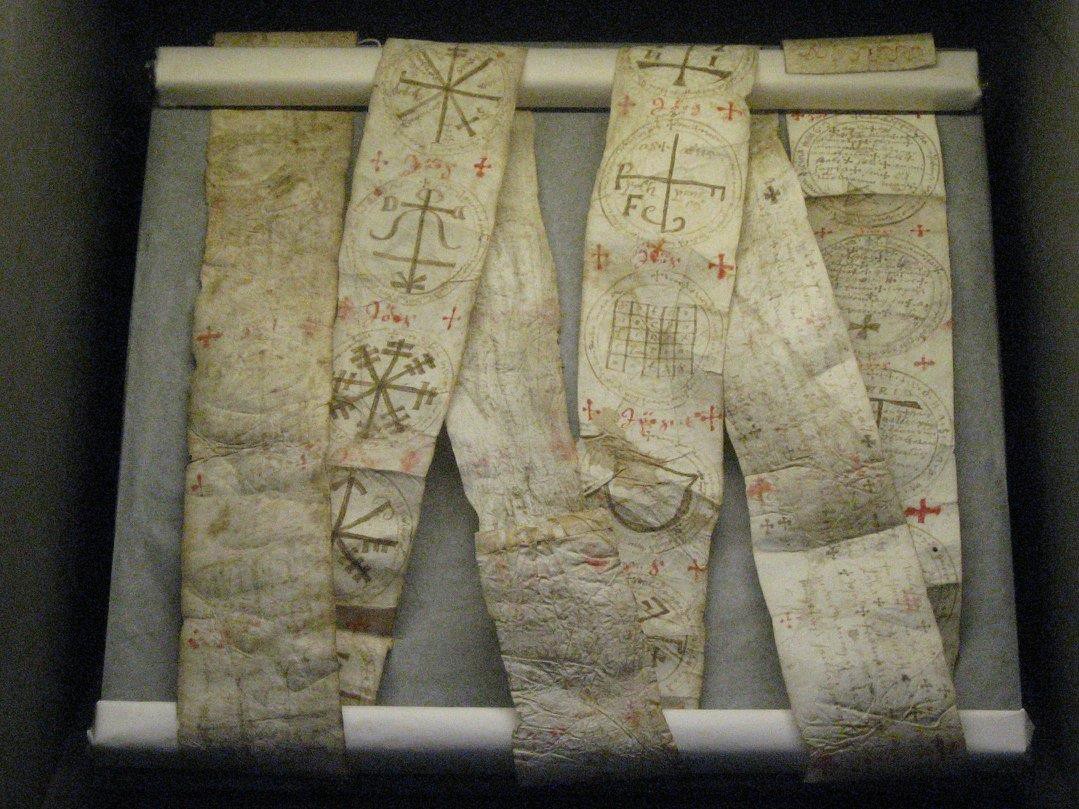

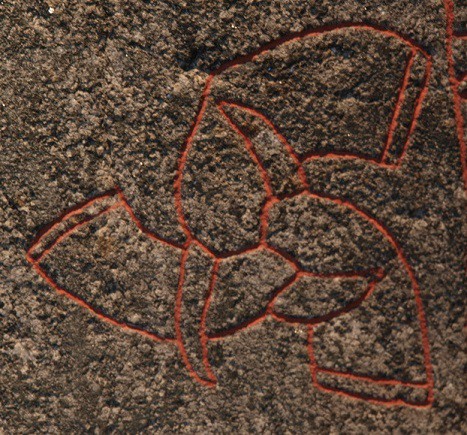
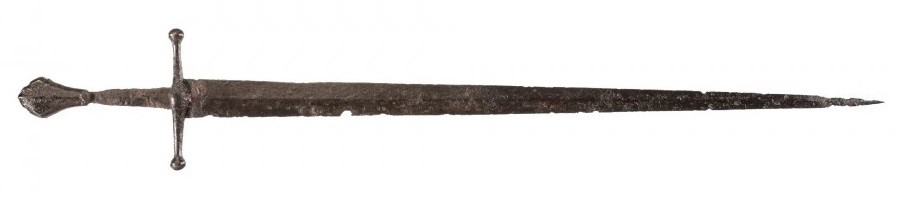
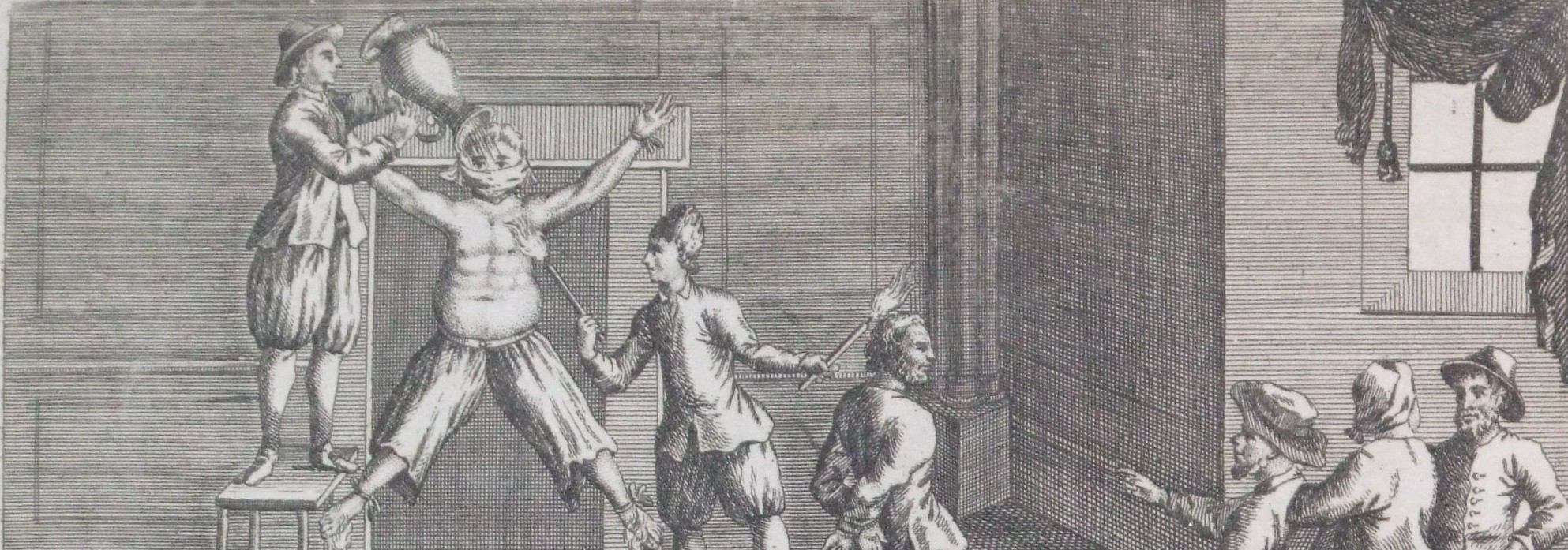


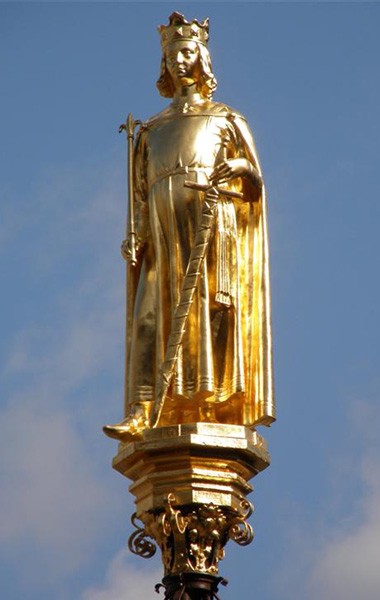
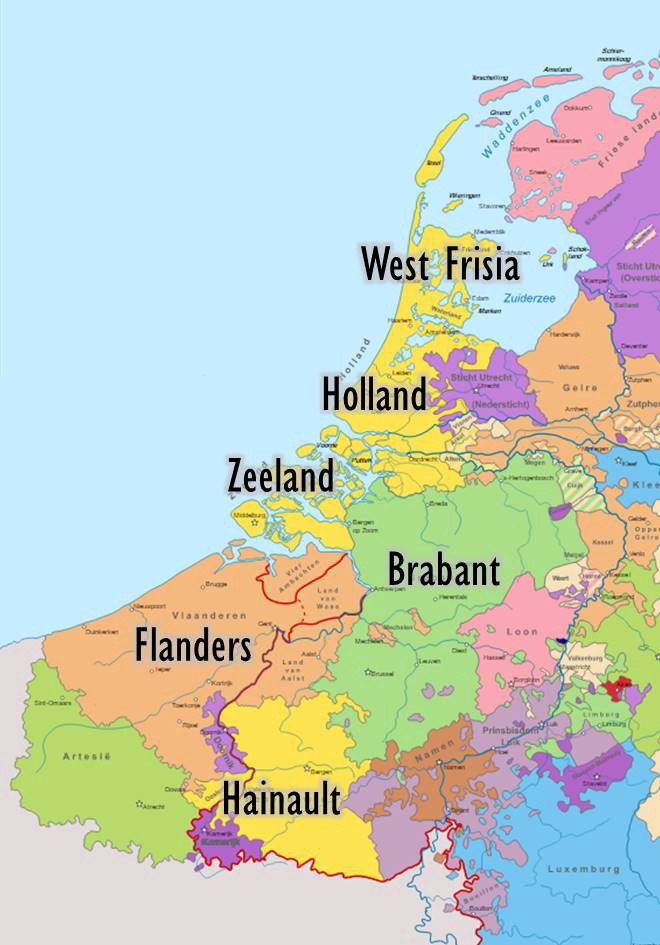

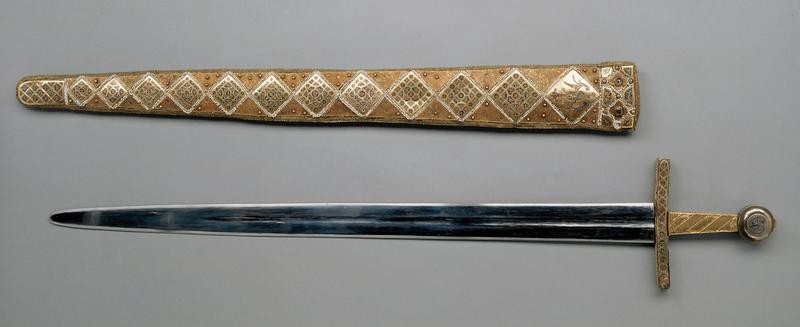
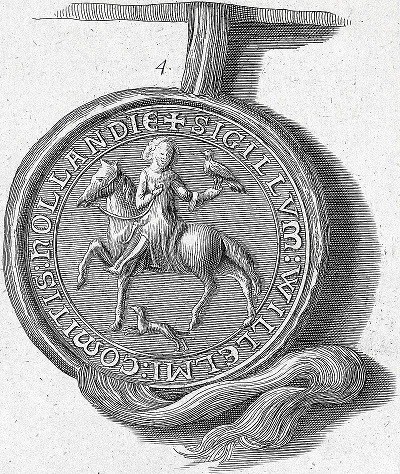


 Deru Kugi