Failed solutions to an ancient rebus (Sator Square, Part 2)
The so-called Sator Square, a palindromic grid of letters which can be read beginning at any of the four corners, has captured people’s imaginations for millennia. Early in its history, those who ostensibly understood it inscribed it widely, and it eventually came to have a cultural value similar to that of the Icelandic Rune Staves I have also written about. More recently, lacking a key to its understanding, scholars and layfolk have theorized about its meaning. So, in something of a turnabout from my posts about the Witham Sword, I want to evaluate some of the different solutions to this mysterious square.¹
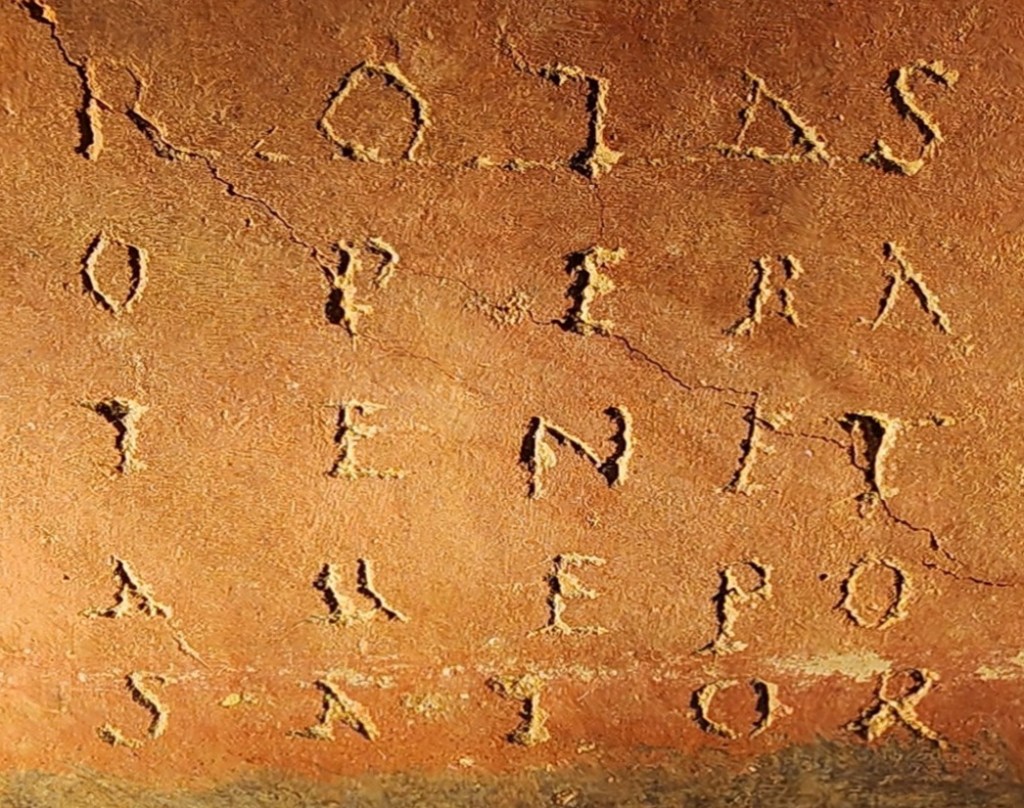
The square appears in graffiti scratched into the walls of Pompeii, buried under ash from Vesuvius before 79 CE, and has been generating theories ever since.
The text reads:
R O T A S
O P E R A
T E N E T
A R E P O
S A T O R
Five Latin words—or near-words—arranged so they read identically in four directions: left to right, right to left, top to bottom, bottom to top. The central word, TENET, forms a cross. The whole structure is palindromic, geometrically perfect, and almost-but-not-quite meaningful. Arepo appears nowhere else in Latin literature. The grammar is just coherent enough to invite a reading and just strange enough to refuse one.
That refusal is the source of everything that follows.
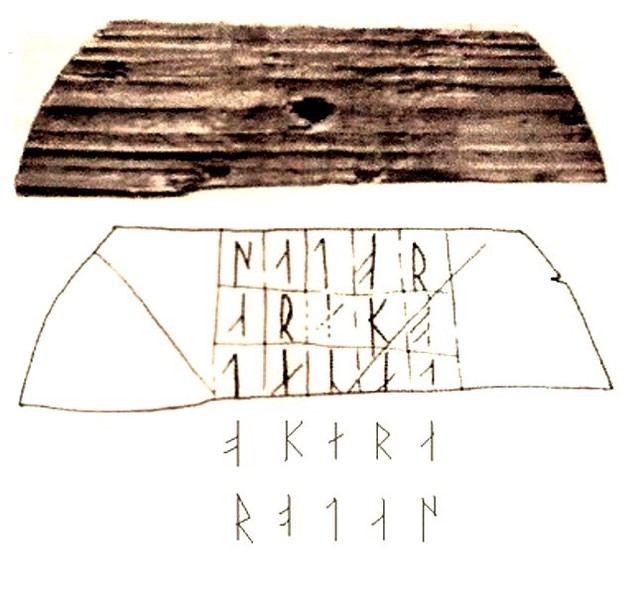
The square has appeared widely, reaching a status some have described as memelike long before the intertubes began trading in such stuff. Its earliest appearances were on the Italian Peninsula, but it has been seen in France, Portugal, and as far away as England and Syria. There is even a runic inscription of the square. Although somehow this has been characterized and spread across the internet as being a runestone, it is (as can be seen in the image below) carved into wood—the bottom of a wooden bowl, partly missing, but which doubtless finished the Square.²
Then, as I noted, the secret of the square seems to have been lost. The earliest known attempt at a decipherment of the Square came from a Byzantine scribe in the 14th century, but there have been many since. The 19th century saw a boom in scholarly efforts, which continued until last century when they dropped off, with codebreakers either feeling it to be unsolvable or being satisfied with the efforts already made.
Rose Mary Sheldon provides us with an exhaustive 34-page bibliography of the solutions posited.³ What unites these non-starters is not that they guess the wrong composer. It is that they all assume a composer in the first place—a single mind encoding a single secret. Each theory then “discovers” exactly the secret its author went looking for. Hold that pattern in mind; by the end of this series it will turn out to describe not just the failed theories but the successful-looking ones too.
First there’s the one of that first Byzantine scribe, who broke it down thus:⁴
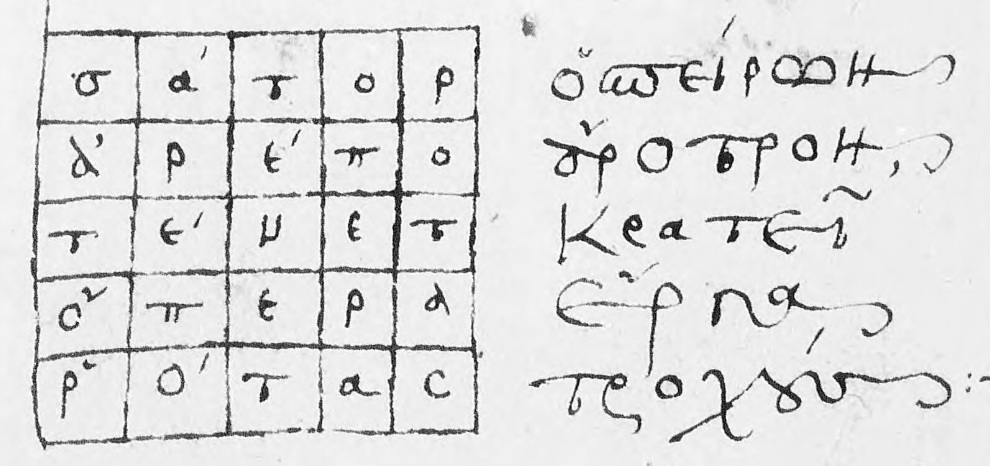
σάτορ—ὁσπεἱρων [sower]
άρέπο—ἄροτρον [plow]
τένετ—ϰρατεί [holds]
ὄπερα—ἔργα [works]
ρότας—τροχούς [wheels]
There are problems, of course. Mainly these are around arepo, which would continue to bedevil would-be codebreakers as we shall see. The scribe here claims is ἄροτρον (L. arepum, of which arepo would be an inflected form) supposedly meaning “plow”, although it is found in no other source. Some have suggested a borrowing from a Gaulish or Celtic term, *arepos, which again is nullibiquitous. The asterisk is used by linguists to mark a reconstructed word—that is, one unattested but conjectured to exist.
Wanting arepo to mean plow or opera rotas to somehow imply it seems a clear case of confirmation bias: “it says ‘sower’ so it must say ‘plow’.” I think given the brevity of the rebus, the inclusion of such redundancies would actually be quite undesirable. Still, it lives on in many modern interpretations which hold the phrase’s full translation, with the other words translating in order as “the sower”, “to hold”, “works”, and “wheel”, is therefore:
The sower holds the plow, the works, the wheels.
Others have decided arepo is a proper name, again choosing to set aside the fact it’s a hapax legomenon, and so render the phrase:
The sower Arepo holds the works, the wheels.
They somehow feel “the works, the wheels” implies a plow, even though the plows of the appropriate time in no way resembled such a description.
Frustration with the word led some to dismiss it as a term like abracadabra—without meaning, but while some such terms are attested, it’s a far from satisfying conclusion. Abracadabra, rather, seems to derive from ΑΒΛΑΝΑΘΑΝΑΛΒΑ (ablanathanalba), a palindromic term associated with the rooster-headed anguipede, ΑΒΡΑΣΑΞ (Abrasax). Ad repo, “I creep towards” is another interpretation suggested, but results in still worse nonsense.
Yet another suggestion is the Latinized and shortened name of the popular god of good luck from Graeco-Roman Egypt, Harpocrates (Har-pa-khered, “Horus the Child”).
To get from Harpocrates to Arepo, elide the initial ⟨h⟩ (the Greek is Ἁρποκράτης), inject a vowel ⟨e⟩ to break up the consonant cluster ⟨rp⟩, drop the entire second half, and Robert is your father’s brother.
The meaning (in a charitable reading) thus becomes a decently apotropaic formula:
The sower Harpocrates keeps in check toils and tortures.
Never mind the god is nowhere depicted as a “sower”, appearing in Egyptian stelae perched on a crocodile’s back, snakes clutched in his outstretched hands—an image calling to mind Herakles…. And later, and especially in the Graeco-Roman context, as a child with a finger pressed to his lips. Varro was apparently the first to describe the gesture thus:⁵
[…] Harpocrates digito significat, ut taceam.
[…] Harpocrates with his finger makes a sign to me to be quiet.
However, it is important to note this pose actually relates to the form of the hieroglyph for “child”, and did not have a meaning relating to silence or secrecy in its original context. This sometimes-winged figure was later conflated with Cupid—Cupid with a uraeus on his head, though later forms morphed it into a topknot. If anything, he is shown holding a cornucopia—the polar opposite of the idea of sowing.
The next major direction of exploration came from the idea the inscription should be read boustrophedonically. The term means “as (plowing) oxen-turn”, therefore referring to a reading alternating directions, so:
SATOR
OPERA
TENET
(TENET)
OPERA
SATOR
The image of plowing oxen probably was a temptation to employ this type of reading, but it’s just more fruit of the poison arepo tree. And again, applying a generous amount of imagination to the reading, we can interpret this as the New Testament dictum:⁶
[W]hatever a man sows, that he will also reap.
This solution also has its share of issues: first, inscriptions in boustrophedon appeared only in the prehellenic Greek (until 510 BCE) and archaic Etruscan (until 480 BCE) periods, coinciding with the advent of the Phoenician-based alphabet into those cultures, before they had settled on a single reading direction; left-right for Greek and right-left for Etruscan. So these predate the first known appearance of the square by just about 500 years.
Second, in boustrophedon inscriptions, the letters themselves are typically reversed to show the reading direction. Such inscriptions also invariably begin left to right, while this solution requires a right-to-left start. That is, this solution would require the versions beginning with sator to be the older, original form, which contradicts all evidence. Indeed, the desire to read the cryptogram boustrophedonically may have actually prompted the current dominance of the sator-first form.
Finally, the symmetry of the square is a major element of its magic, or at any rate, aesthetics. The 5×5=25 form is destroyed by the 30-letter reading required for the boustrophedon to work. Furthermore, the words arepo and rotas are omitted entirely in this solution, which seems like taking the easy way out.
As you may have also noticed, we have now entered a realm where interpretations are based on the idea the inscription is a Christian one. And the locations it has been found in suggest such an association, as they include Benedictine and Cistercian abbeys, a cathedral, an Anglican church, and a private chapel.
And many other seeming links to Christian tradition have been noted in potential solutions: an old Cappadocian tradition gave the shepherds of the Nativity the names Sator, Arepon, and Teneton. An old Byzantine biblical tradition names the Three Magi as Ator, Sator, and Peratoras. And the Ethiopians and Abyssinians invoke the Savior by enumerating the five nails of the Cross: Sador, Alador, Danet, Adera, and Rodas.
Attempts were also made to read the opening lines of the square as a set of abbreviations, similar to those I used in my solution for the Witham Sword:
SAlvaTOR A REx Pontifex O
and
SATOR A Rerum Extremarum Principio Omni
Of the two, the first is execrable and the second only somewhat less so, but again, nowhere apart from this posited solution to the Square are these words found together—a fairly clear sign there was no such phrase to code into a rebus.
One solution has seduced historians for decades. It interprets the Square as an anagram of the opening words of the Lord’s Prayer. This is the non-starter that refuses to die, so I’ll give it a clean death here.
In 1926, German evangelical preacher Felix Grosser proposed the square’s 25 letters could be rearranged into a cross: PATERNOSTER reading horizontally and vertically, intersecting at the shared ⟨N⟩, with two ⟨A⟩s and two ⟨O⟩s left over—Alpha and Omega, the divine bookends from the Apocalypse of John.⁷ The diagram is elegant. It is also a conjuring trick, and there are three independent reasons to put it in the ground.
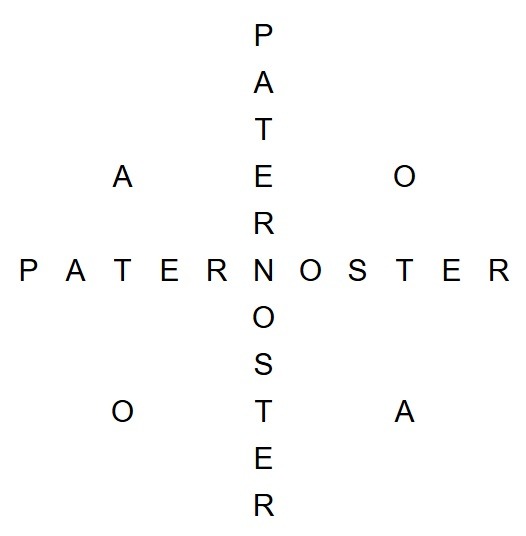
First, the cross itself is Grosser’s invention, not the square’s. One might argue there is a cross formed by the two TENETs, but it is a requirement of the form rather than a designed feature. So you have to disassemble the square and rebuild it in a shape it never occupied. And this rebuild has a deficit—two complete PATERNOSTERs require two Ns, but the square contains exactly one. What you actually get is:
PATERNOSTER
PATEROSTER
AAOO
The cross format conceals this unsatisfying result by sharing the ⟨N⟩ at the intersection, the way a crossword does. But the claim is not that the square is a crossword. The claim is that it encodes PATER NOSTER. The encoding requires you to add the very structure—the cross—that makes the single ⟨N⟩ look sufficient. Grosser did not discover a hidden message; he discovered 25 letters can be shuffled into a near-fit, and decorated the gap.
Some aver this could not possibly be a coincidence, and so must be the solution. But what should have ended the discussion 50 years ago is this: the method is empty. In 1968, Paul Veyne notes:⁸
Les lettres qui composent le palindrome sont si banales et leurs fréquences respectives si peu anormales […].
The letters that make up the palindrome are so commonplace, and their respective frequencies so unremarkable […].
This allows dozens of other anagrams to be produced using the 25 letters of the square. He gives these seven as dating to the Middle Ages (ca. 500–1500):⁹
Ora, operare, ostenta te, Pastor
Pray, labor, show thyself, O Shepherd
Satan, ter oro te, reparato opes.
Satan, thrice I pray to thee: restore my wealth
Satan, oro te pro arte, a te spero
Satan, I pray to thee for thy craft; in thee I place my hope
Retro, Satana, toto opere asper
Get thee behind me, Satan, rough in all thy works
Satan, ter oro te, opera praesto
Satan, I pray thee thrice: perform the works
Oro te, Pater, oro te, Pater, sanas
I pray thee, Father, I pray thee, Father: thou healest
O Pater, ores pro aetate nostra
O Father, mayest thou pray for our generation
Many of these are equally Christian readings with an equally valid claim to intention, which is to say none. To demonstrate this further, Veyne added:¹⁰
Petro et reo pater rosa Sarona
To Peter, both defendant and father, the rose of Sharon
Sat orare potentes ore parato
It is enough to pray, O mighty ones, with a prepared mouth
In 2000, an Italian cruciverbalist presented the ultimate reductio:¹¹
Sottrar oro a paperone: saette
Stealing gold from Scrooge McDuck: arrows
Pornostar: parte osee a teatro
Porn star: Hosea’s part at the theater
O porta estera o porta esterna
O foreign gate, o outer gate
But the Paternoster reading is a defective, repeated palindrome of only 13 letters. With these Veyne produces:¹²
Stat Noe e prora
Noah stands at the prow of the Ark
Se portant ora
The faces carry themselves forth
Est nota pro reo
It is a mark in favor of the defendant
Potare Nestora
To give drink to Nestor
Orarat nepotes
He had prayed for his descendants
Raro, nate, potes
Rarely, my son, are you able
Ostento parare
To prepare a portent
Separaret Noto
It would sever by the South Wind
E re nota portas
From a known matter, you bring forth
Portae nostrae
Our gates
The existence of such counter-anagrams is not a curiosity. It is the proof that anagramming is a reader’s activity, not a writer’s signature. You find what you bring.
As for the Paternoster cross, no historical receiver of the square ever produced the independently. No Coptic scribe drew it. No charm-maker in Iceland or Nubia or medieval Italy mentions it. It appears for the first time in a German academic journal in the 20th century, proposed by a man who was looking for Christ in everything he touched. The Paternoster cross is not a discovery. It is the most successful fraud in the history of the field—a modern projection so structurally pleasing that it has been mistaken for an ancient signal for a hundred years.
Finally, the Alpha-Omega reading is anachronistic:¹³
ἐγώ εἰμί τὸ Ἄλφα καὶ τὸ Ὦ […].
I am the Alpha and the Omega […].
This has as its source the Book of Revelation by the Apostle John. Although this was to become one of the titles of Christ and God, traditional sources and historians agree its first use dates to the reign of the Roman emperor Domitian (81–96), and so could not possibly have been used in Pompeii.
The interpretive framework that turns leftover ⟨A⟩s and ⟨O⟩s into a Christological signature postdates the artifact by at least a generation. Strip the Alpha-Omega reading, and the four leftover letters are just that—leftover. Bad anagrams produce remainders. Grosser elevates his to theology.
In fact, the discovery of the first of the Pompeiian Squares in 1936 was most likely the cause of the decline of scholarship on the issue more specifically than the cases I mentioned earlier—nearly everything had to be simply thrown away. The second, while actually found in 1925, was in much worse shape, coming from a ruined house, and was only able to be identified via the model of the other graffito.
What this graveyard of failed theories reveals isn’t scholarly incompetence. Each generation brought its own framework and found the square accommodating—Christian interpreters found a Nativity, Kabbalists found the Tetragrammaton, the Byzantine scribe found a field. The square doesn’t give up its meaning. It gives back yours.
These non-starters share a tell: each requires the square to be specifically legible—as Christian, as Mithraic, as whatever—when the square’s actual talent is to be vaguely legible as holy to everyone. A theory that needs the square to mean one thing precisely is fighting the one quality that made it travel.
This article is part of the Sator Square series
Notes
- B950, Corinium Museum, 2nd century, my image.
- Nä Fv1979;234, Örebro, Sweden, ca. 14th century.
- Rose Mary Sheldon, “The Sator Rebus: An Unsolved Cryptogram”, Cryptologia, July 2003.
- Grec 2511, p.68, Bibliothèque nationale de France, ca. 15th century.
- Marcus Terentius Varro, De lingua latina libri XXV (On the Latin Language in 25 Books), 5.10, ca. 47–44 BCE.
- Gal. 6.7, King James Bible (KJV), 1611, though the original dates to ca. 40–60.
- Felix Grosser, “Ein neuer Vorschlag zur Deutung der Sator-Formel” (“A New Proposal for Interpreting the Sator Formula”), Archiv für Religionswissenschaft, 1926.
- Paul Veyne, “Le carré Sator ou beaucoup de bruit pour rien” (“The Sator Square, or Much Ado About Nothing”), Bulletin de l’Association Guillaume Budé: Lettres d’humanité, December 1968.
- Ibid.
- Ibid
- Stefano Bartezzaghi, Lessico e Nuvole (Vocabulary and Clouds), la Repubblica, June 2000.
- Veyne, 1968.
- Rev. 1:8, ca. 95 CE.

