Lizzie’s Game

In the decidedly limited labyrinth of false choice (Interactive Storytelling, Part 1)

“[…] The Garden of Forking Paths is an incomplete, but not false, image of the universe as Ts’ui Pên conceived it. In contrast to Newton and Schopenhauer, your ancestor did not believe in a uniform, absolute time. He believed in an infinite series of times, in a growing, dizzying net of divergent, convergent and parallel times. This network of times which approached one another, forked, broke off, or were unaware of one another for centuries, embraces all possibilities of time. We do not exist in the majority of these times; in some you exist, and not I; in others I, and not you; in others, both of us. In the present one, which a favorable fate has granted me, you have arrived at my house; in another, while crossing the garden, you found me dead; in still another, I utter these same words, but I am a mistake, a ghost.”

“The Garden of Forking Paths” (“GoFP”), Jorge Luis Borges¹

Elizabeth Bennet: It is your turn to say something, Mr Darcy. I talked about the dance. Now you ought to remark on the size of the room or the number of couples.

Mr Darcy: I’m perfectly happy to oblige. Please advise me on what you would like most to hear.

Pride & Prejudice (P&P

This pair of quotes illustrates the difference between the promise of interactive storytelling and the reality.

The promise is you can “choose your own adventure”—an ever-widening possibility space leads down paths unique to your experience through ramifications ever more varied, you make meaningful choices in a vast world.

The reality is this system almost always yields an unsatisfying experience: The choices fail to provide real agency because they are necessarily limited, and even the choices that are allowed are often false ones. And typically, in the end, you are just trying to guess what the designer wants you to do.

French philosopher Gilles Deleuze used Borges’ story whence the first quote is drawn to demonstrate the Leibnizian concept of several impossible worlds existing simultaneously, as well as to address the problem of future contingents first discussed by Aristotle. The many-minds, and many-worlds interpretations of quantum mechanics, and the idea of the multiverse, also relate closely, and have drawn inspiration from “GoFP”. The possibilities created by its model increase exponentially, rapidly cascading towards the infinite. Borges’ “The Library of Babel” and “The Book of Sand” also discuss infinite texts. He had a profound loathing of mirrors, which is also reflected (yes, I did) in “The Other” and “Tlon, Uqbar, Orbis Tertius” which discuss them.³ This last work also contains the line: “Mirrors and copulation are abominable, because they increase the number of men”, which bears on both elements.

Unfortunately, this Borges tale also inspired the idea of interactive storytelling.

In the 1945 children’s book, Treasure Hunt, pseudonymous author Alan George allowed the reader to choose among a set of actions at the end of each section of the story. It appeared only a few years after “GoFP”, so it’s hard to know if there was an influence, but the book’s cover does declare it “A MAZE In Volume Form”, so at the very least it’s a convergent work. In the world of computer interactivity, the mechanism described by Borges seems to have been favored from early on: from 1964 to 66, a program called ELIZA, used the format in the creation of an interactive artificial therapist. And with the advent of computer and video games, the idea really took off, appearing from quite early on, and rapidly becoming ubiquitous, particularly in visual novels, dating sims, adventure games, and RPGs.

The essential problem with this schema is how rapidly it grows in size. Even the absurdities Borges perpetrates are well thought out, however, though he warns the reader subtly: When his Doctor Albert says GoFP (That is, the fictional book, not the short story in which the book appears) is “incomplete”, it is because he realizes that containing infinite possibilities within the physical and therefore finite form of a book is not possible. And indeed, even freed from the bounds of a physical book, creating a large number of meaningful branches is difficult in reality.

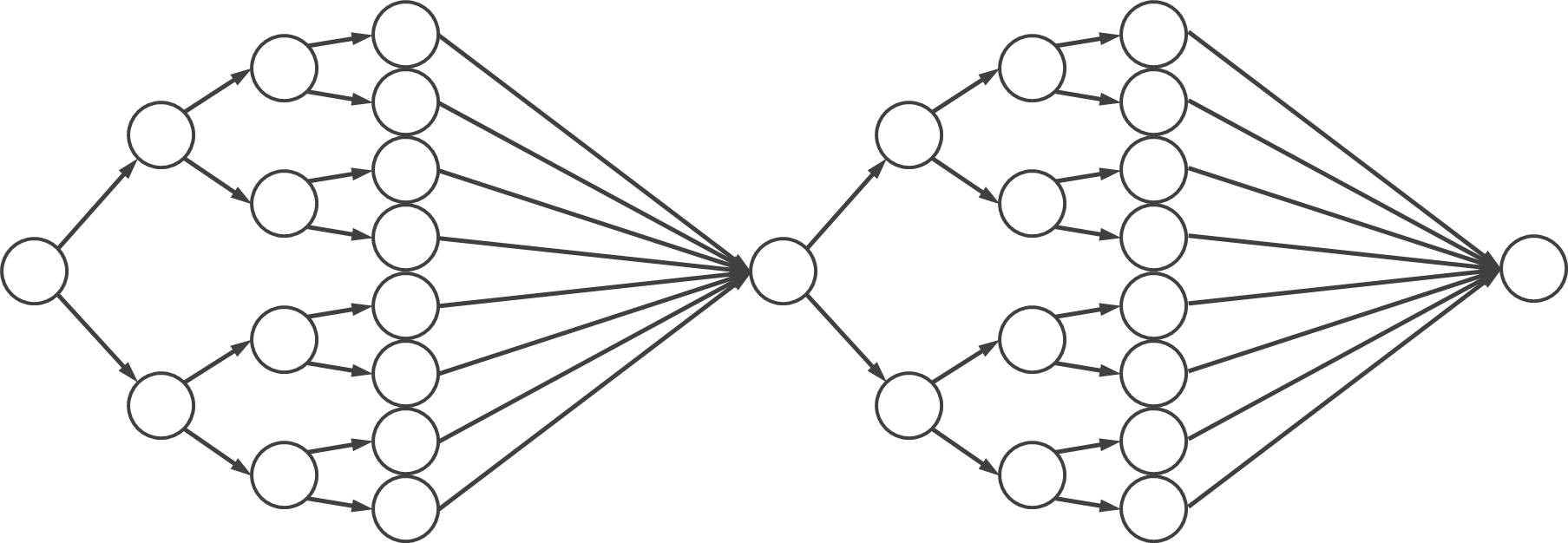
As envisioned by Borges, the decisions at each node are binary—likening it to a labyrinth, he essentially says you can go left or right at each fork. If you created a work of interactive storytelling on this plan, with only a pair of choices at each branching, the amount you would need to write would expand exponentially. By the time you get only 10 choices deep in this tree, the number of branches would be 2 to the 10th, or 1,024. Every time you add one level of depth, the number of branches doubles, so 11 would take you to 2 to the 11th, or 2,048. The Lernaean Hydra is an embodiment of the terror inspired in the Ancient Greeks by geometric progressions as its multiplying heads develop in this exact fashion.

Most of the history of this trope, then, is concerned with ways to limit these choices in order to make production even possible. One way this has been done is through a structure called a foldback, which has been described in various other ways, perhaps most entertainingly as the well-fed-snake model. It essentially means regardless of the choices made, eventually the branches reconverge, then bifurcate again, then reconverge again.

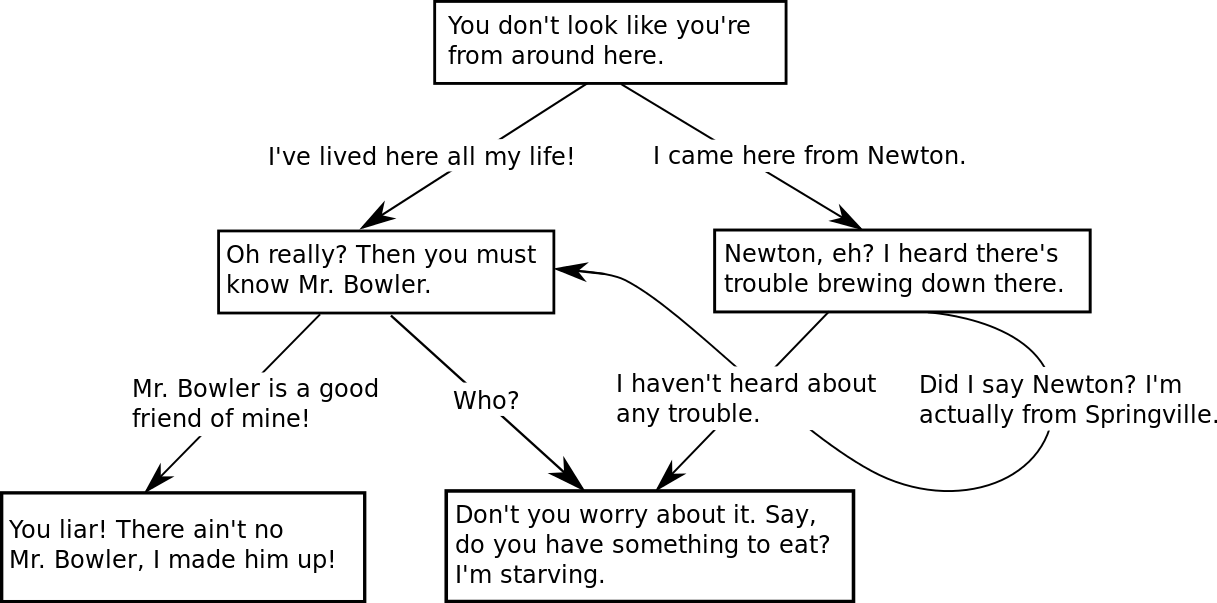
Another, similar one involves what’s called cycling, where specific branches turn back to other nodes than the one they branched from. Often a work will use both of these together in various combinations.⁴

The problem with both solutions is the choices you make don’t matter. The things you thought you were choosing collapse, or turn in directions you didn’t want to go. In her irony-impaired article, “Why in-game dialogue and character conversations matter”, Megan Farokhmanesh says:⁵

Although dialogue can branch—and often will—depending on player choice, writers must be aware that only one nugget of information will move the player forward. Everything else must eventually fold back into that conclusion. […] Part of a writer’s job, then, comes with thinking up many different questions that ultimately lead to the same answer.

And Brent Ellison describes this type of technique thus:⁶

One common technique employed to give the player a greater illusion of freedom is to have multiple responses lead to the same path.

To be clear, both of these sources are talking about how to make lack of choice look to the player like choice.

To get more concrete, I recently played The Legend of Zelda: Breath of the Wild, which features branching dialogue. At the beginning of the game, you meet a mysterious Old Man, and the dialogue options essentially allow you to either treat him with trust or suspicion. And it doesn’t matter. If you react the former way, he is glad. If the latter, he shrugs it off. You’ve made an hour’s worth of decisions changing nothing, and the game’s just begun. Once in a while, what you choose does make a difference though—you just don’t know, unless you either replay repeatedly or go online and find out what you’re supposed to do. I’m definitely not saying this isn’t a great game; I just don’t think this element was needed.

One marginally acceptable reason for employing this system is to attempt to force players to pay attention to the dialogue instead of simply clicking through it as quickly as possible because they think it might matter. But frankly, I reject this as well—just write more engaging dialogue not pretending to offer a choice.

Additionally, most of the decisions we make in reality are much more complex, with many more options as to both what we choose to do, as well as to how. Add more than a binary choice, though, and the expansion of branches becomes even more explosive. Treasure Hunt’s choice nodes were limited to the ends of sections because the book allowed several choices—essentially, the creator of such a work must decide between breadth and depth. And regardless of how many options are given, the chances are good, people being what they are, there will be other choices they wish they had.

One of the things people who like this trope reference is the multiple endings such stories can have. However, this again is a production issue as to how many can be provided.

In interactive novels, many endings are often given, but the preponderance of them are simply different ways to die. Indeed, what better way could there be to end a branch? Writers get extremely inventive about it, to the point many such works are less choose your own adventure, and more choose your own death—the interactive equivalent of the Final Destination movies.

Turning to electronic entertainment, these paths, which are essentially fail states, could go on much longer: you did not pick up an object you should have several scenes ago, so preventing progress, being a common one.

LucasArts’ The Secret of Monkey Island was a breakthrough in 1990 because it was impossible for the protagonist, Guybrush Threepwood, to die. It was probably the first adventure game I ever completed because it also made sure you had all the items you needed to progress. There was nothing interesting to me in being killed off by game designers trying to show they were more clever than me, and their games were quickly shelved.

In addition, Monkey Island’s dialogue was extremely well written, and even branches ultimately leading nowhere were at least entertaining. The puzzle-solving, though skewed, fit well with the wacky gameworld, a consistent internal logic instead of a lesser designer’s punitive “because I said so”.

In games where branching dialogue is the primary gameplay focus, the player’s choices often affect game characters’ attitudes toward the player’s character in one way or another, with the player attempting to guess the “best” response in order to maximize game character disposition in their favor. And ultimately, these characters are stand-ins for the designer, who typically desires a specific response attitudinally, even beyond the strictures of a system seeking to falsify choice.

And this gets back to the P&P quote: similar to these game mechanisms, Elizabeth Bennett requires Mr. Darcy to respond in a very narrow range and she’s ready with a verbal fusillade when he missteps. His reply in the quote, intended to charmingly evade the trap, draws a fairly cold:

That reply will do for present.

Still, it’s better than a character taking the response you felt was kind of close to what you actually wanted to say as a very personal slight that can only be solved via extremely one-sided personal combat. If this sounds far-fetched, you haven’t played a lot of these games.

Even the term “interactive storytelling” in the context of video games has always bothered me. Good storytelling is always interactive regardless of the medium; a conversation between the creator and the audience. Kurosawa Akira’s (黒沢 明) 1950 film, Rashōmon (『羅生門』) provides an excellent example of how effectively that dynamic can be used: the viewer is presented with four versions of a story, and must choose which to believe, or, as indeed, is the point, which elements of which stories to select to construct the real truth as the accounts all carry the biases of the tellers.

Although Borges’ views of the movie are difficult to ascertain, he was known to be a fan of Taishō-period writer, Akutagawa Ryūnosuke, upon whose short story, “In a Grove”, the film is based. The film takes its name and frame story from another of Akutagawa’s works.⁷ The short story also involves the subversion of the mystery genre, just as in Borges’ “Death and the Compass”,⁸ as well as going on to play a game with the reader, ultimately questioning the existence of objective truth. I can only think Borges would have approved.


Read subsequent article in the Interactive Storytelling series

Part 2: Those Frumious Jaws

Part 3: Adventure Game Hijinx and Deconstruction


Notes

  1. Borges, “El jardín de senderos que se bifurcan”, 1941, translated by Andrew Hurley in Collected Fictions, 1998.
  2. I’m quoting the 2005 film adaptation.
  3. Borges, “La biblioteca de Babel” (“The Library of Babel”), 1941, “El libro de arena” (“The Book of Sand”), 1975, “El otro” (“The Other”), 1972, and “Tlon, Uqbar, Orbis Tertius”, 1940, all also translated in Hurley, 1998.
  4. Image by Dcoetzee via Wikipedia.
  5. Megan Farokhmanesh, “Why in-game dialogue and character conversations matter”, Polygon, March 2014.
  6. Brent Ellison, “Defining Dialogue Systems”, Gamasutra, July 2008.
  7. 芥川 龍之介 (Akutagawa Ryūnosuke), 「藪の中」 (“In a Grove”, Yabu no Naka), 1922 and 「 羅生門」 (“Rashōmon”), 1915.
  8. Borges, “La muerte y la brújula” (“Death and the Compass”), 1942, also translated in Hurley, 1998.

The Unfit “King”

I didn’t cry and there’s nothing wrong with me (Gladwellocalypse, Part 2)

The new season of Malcolm Gladwell’s podcast, Revisionist History, is really good. It started off with one on golf, which was a bit of a softball—I don’t know the demographics of the podcast’s listeners, but I somehow don’t think the rich jerks and CEOs the piece puts in its sights are among them, or if they are, it remotely hurt their feelings. But then he moved on to some pretty deep and serious topics: terrorism, desegregation, the Civil Rights Movement, racist Winston Churchill—discussing the Bengal famine of 1943, which I’ve also written about indirectly as one element of British imperialism in India. And then came one on country music.¹

Now as a writer I get it: sometimes you need to lighten things up, or if nothing else, go a bit afield from the topics you usually cover—the eclecticism of my own articles is evident. And also, you can’t always please everyone. Finally, if Season One of RevHist was an indicator, there’s going to be one I just disagree with. This, it seems, is that one. So in spite of my wife hating it when Malcolm and I fight, here goes:

I know he’s not intending to be scientific by comparing Rolling Stone’s list of top 100 rock songs as if they were emblematic of what all the writers, performers, and listeners think about the genre, to the small sampling of individual country songs he has handpicked for their tear-jerking qualities. The corpus of rock music is much larger than country’s and covers a wider range of topics.

And rock isn’t really a genre at all, and hasn’t been for a long time, but a supergenre—maybe even a megagenre. Even the list he quotes demonstrates this when it mentions The Ronettes and Nirvana in the same breath. Wikipedia lists some 43 genres of rock in their article on the topic, which links still more articles that get even more specific.² Many maps and family trees have been created and argued about regarding how all of these interrelate.

One exemplar Gladwell puts forth is Unwed Fathers, and specifically the line:³

Your daddy never, meant to hurt you ever
He just don’t live here, but you got his eyes.

Right from its name, the song is not about these two—the mother and child have no agency in the tale, and only exist as the hapless victims of the titular men. These are generic, not specific people, and definitely not real ones.

Just to stick to the same theme for something like an apples-to-apples comparison, I offer Everclear’s “Father of Mine”. I’m not even really a fan of this band—I own no CDs and no songs and never have, but just from catching it on the radio, this one gets me way more—the refrain “Daddy gave me a name/ then he walked away”, is pretty raw, but then it has lyrics like:⁴

Father of mine,
Tell me where did you go?
Yeah, you had the world inside your hand
But you did not seem to know.

These seem to me to drill down into a sense of loss much more effectively than the country piece. Maybe because Gladwell had a fairly idyllic upbringing, while mine was less so, my feelings are a bit more attuned to the story Everclear’s Art Alexakis tells from his own experience as a child abandoned by his father. He writes about the sadness, but also the bitterness, anger, and how hard it is to let other people in afterwards. That’s quite specific and also quite real.

And I’m talking about specificity because Gladwell offers it as the reason country music’s lyrics are sadder. While I’ve already offered a counterexample, I’d also disagree with the point as a general rule. Detail can actually make songs less relatable. Turning back to “Unwed Fathers”, the lyrics make sure to let you know it’s an “Appalachian Greyhound station”, but its story happens everywhere and at every time. Hilariously, the song was translated into Swedish as “En ogift mamma” (“An Unwed Mother”) and saw success.

There is a device used across a variety of media called a cipher, also known as the everyman after a 15th-century English morality play of the same name, as well as by a variety of other names. The idea is the audience is presented with rather undeveloped elements, particularly around place and character, and they fill in the details, or more specifically, their own details—putting themselves into the work. A listener not from the Smoky Mountains listening to “Unwed Fathers” might feel alienated; that there is something about this experience that is outside their understanding, when there’s really not.

Gladwell next advances the idea since everyone is from the same area, they all have a shared context allowing them to be more specific.⁵ Here I think he’s delved into complete nonsense.

Maybe my take on this comes from having lived in Japan, a large, highly homogenous society. I can tell you in their case, at least, it leads not to more, but to less specificity—their shared worldview means they can say less and still be understood perfectly.

In fact, this is the idea behind haiku, and its predecessor, tanka. The Japanese, and particularly those of the imperial court, were bored of hearing so many words, and the strictures of the syllabic poetic form were created, at least in part, so rather than being explicit, composers would be forced to employ metaphors. Matsuo Bashō, a master of haiku, is famous for the piece:⁶

古池や蛙飛びこむ水の音

An ancient pond
A frog jumps in
The splash of water

This seems simple and pictorialist at first blush, but as Dorothy Britton notes:⁷

It carries one, in imagination, to the veranda of a temple in Kyoto, perhaps overlooking a landscaped garden hundreds of years old with a moss-edged pond. One hears the sudden plop of a frog jumping into the dark water on a still spring afternoon. But the thought process started by this poem go on and on. The pond could be eternity, God or the Ultimate Truth about this universe and man. And we, brash mortals with our works and investigations—each one of us no better than a frog jumping—make but a moment’s splash, and the ripples circle and die away….

Gladwell talks about “layering” in country songs; this is layering.

Next he interviews Bobby Braddock, songwriter of the showcased pieces, and the main subject of the story, searching for the source of his weepy lyricism:⁸

Your… kind of … tolerance for emotional volatility seems extraordinary.

Braddock replies:

I guess “tolerance” is probably a pretty good word for it.

I kept expecting Gladwell to circle back and replace it with wallowing. Instead, he says, much more favorably:

[…] Braddock is from the musical side of the United States where emotion is not something to be endured, it’s something to be embraced.

He goes on to detail how Braddock used to eavesdrop on other people’s cell phone conversations, which presumably inspired some of his works.⁹ That’s just creepy, and voyeuristic would indeed be a good descriptor for many of the country lyrics Gladwell talks about.

“He Stopped Loving Her Today”, the Braddock song Gladwell dwells on most, is again, pretty creepy.¹⁰ It’s about a couple that breaks up, but the man never stops obsessing about her until he dies. That’s not a touching sentiment in my book.

And there’s also a certain inauthenticity coming from observing these emotional states and perceiving them from the outside. Braddock is looking for tools to extract tears from our faces, not telling heartfelt stories of things he has actually experienced.

I’d liken it to ER—I had to stop watching the show, even though the acting and characters were great, because every time a pregnant mother came into the hospital, you knew she was a Chekhov’s Gun, and it was just a matter of when and how they were going to use her to shoot you square in the feels. Real, heartfelt emotion does not have a North-South divide, but I don’t want to have my feelings manipulated by made-up narratives with nothing but a profit motive revealed when the layers are peeled back.

Part of the premise of Gladwell’s piece was shown in its subtitle: “A musical interpretation of divided America”. In other words, he’s saying our political differences match those in the emotionality of our preferred musical styles, with rock standing in for the North and country for the South.¹¹ And maybe he’s right—maybe I’ve just touched on why Astroturfing and wedge issues work better in the red states.

To conclude, let me throw a gauntlet back at Gladwell: listen to Bruce Springsteen’s “One Step Up”. Again, I’m not a fan of The Boss, but even before I read his recent autobiography, Born to Run, I could tell this song was highly personal. After reading the book, I know the album it comes from, Tunnel of Love, was written during his first marriage that was just not working out. If you don’t consider this New Jerseyan’s sparely worded tale of a dysfunctional relationship, blue-collar squalor, drinking to forget, and potential marital infidelity to be on a par, if not far beyond, any manufactured melodrama delivered in a folksy twang, maybe you’re the one who’s beyond help.¹²

But only in this regard—I look forward to more RevHist (Update: not so much anymore). RevHist episodes have come out, both about racism in the legal system and they were also excellent.


Read subsequent articles in the Gladwellocalypse series

Part 2 Addendum: Gladwell’s Golf Guff Gets Grief

Part 3: Descent into the Absurd

Part 4: The Immaculate Miscegenation


Read previous articles in the Gladwellocalypse series

Part 1: The Limits of “Revisionist History”


Notes

  1. Malcolm Gladwell, “The King of Tears”, Revisionist History, July 2017.
  2. “List of rock genres”, Wikipedia, retrieved August 2017.
  3. John Prine & Bobby Braddock, “Unwed Fathers”, first performed by Tammy Wynette on Even the Strong Get Lonely, 1983, quoted in ibid.
  4. Art Alexakis, Greg Eklund & Craig Montoya, “Father of Mine”, Everclear, So Much for the Afterglow, 1998.
  5. Gladwell, July 2017.
  6. 松尾 芭蕉 (Matsuo Bashō), 「古池や」 (“Old Pond”), 『蛙合』(Kawazu Awase, Frog Contest), 1686.
  7. Dorothy Britton, A Haiku Journey, 1980.
  8. Gladwell, July 2017.
  9. Ibid.
  10. Bobby Braddock & Curly Putman, “He Stopped Loving Her Today”, first performed by George Jones on I am What I Am, 1980, cited in ibid.
  11. Ibid.
  12. Bruce Springsteen, “One Step Up”, Tunnel of Love, 1987.

I Fear Them When They Bear Gifts

The iconography of an interview with a Russian official

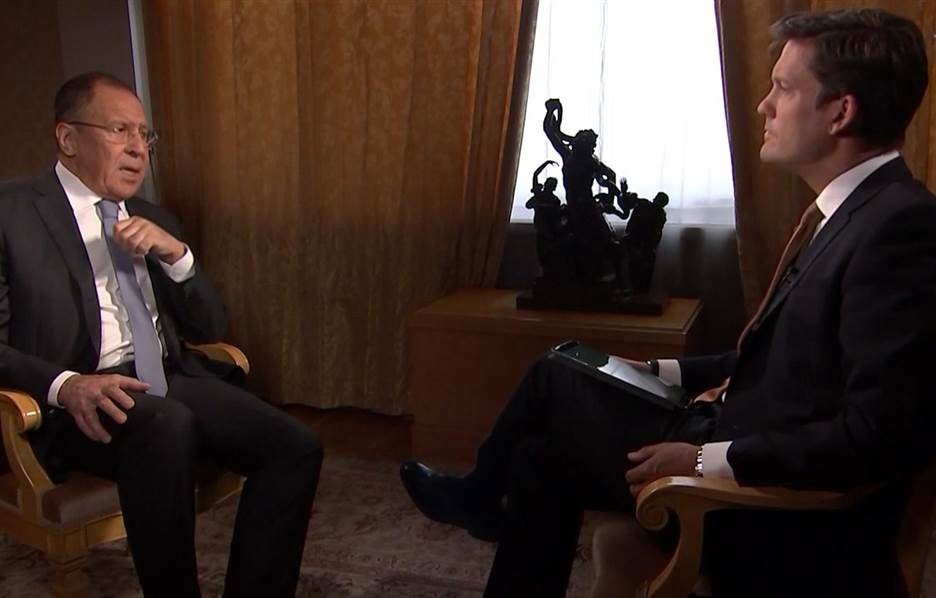
When Russia’s Foreign Minister Sergey Lavrov (Сергей Викторович Лавров) was interviewed by Keir Simmons of NBC News this past week, his overall belligerence when discussing meetings between Presidents Trump and Putin (Дональд Джон Трамп, Владимир Владимирович Путин) during the G20, including references to kindergarten and trips to the bathroom, was hardly unexpected.

Lavrov and his underling Sergey Kislyak (Сергей Иванович Кисляк) are perhaps best known here for their inappropriate-seeming Oval-Office meeting with Trump, during which they shared many chuckles with him, and he shared state secrets with them.

Kislyak, long seen by US intelligence as a spy and recruiter of spies for the country—which the Russian Federation naturally hotly denies—found himself at the center of a scandal due to his perceived chumminess with the Trump campaign and administration. Apparently, even seen through the lens of Russian ethics, this violated norms enough to force him to tender his resignation this week. Indeed, as an American, I no longer possess the status to denigrate Russian moral standards, since at least for Kislyak, there were consequences.

Lavrov, despite his participation in the White House yuckfest, seems to not be going anywhere, at least for the time being. Rarely cordial in such interviews, his exaggerated testiness in this one is understandable in light of his having to bid one of his top officials and fellow Sergey adieu due to the optics this smug representative of the US press was rehashing yet again.

Nonetheless, even without the perspective provided by all of this specific context, a truculent, sarcastic interview given by a Russian official is very much par for the course, as I’ve already suggested. What struck me instead was the statuette placed on the table between interviewer and interviewee.

Although it’s strangely difficult to pin down solid information, this dimly lit, heavily curtained location appears to be a room within the Ministry of Foreign Affairs of the Russian Federation in Moscow (Министерство иностранных дел Российской Федерации, MFA).

In this oppressively monochrome environment, with unremarkably dressed men, and vague patterns, this one thing stands out, even silhouetted as it is in the filtered light of the sheer-draped window. A trio of human figures, posed dramatically within a triangular composition, can be made out.

Although I’ve lengthened the process of semiosis here, the work was instantly recognizable to me: it’s a miniature of Laocoön and His Sons. The hero’s name is Λαοκόων in Ancient Greek. The statue is also called The Laocoön Group (Gruppo del Laocoonte in Italian).

The sculpture it is based on is a massive marble one, unearthed in Rome in 1506 and thereafter displayed in the Belvedere Court Garden of the Vatican, itself likely a copy of a Greek original lost to the ages. Napoleon Bonaparte had it taken to the Louvre for a time, as he did with many works he admired during his reign. Some such spoils were repatriated, others remain in Paris. The Papal rights as the original looters of Laocoön and His Sons were upheld.

This appears to be the same work praised by Pliny the Elder as a masterwork.¹ Standing at around six feet, seven inches tall, the piece is made of at least seven interlocking pieces of marble—the total number is in doubt as some pieces are missing, and some have been restored—despite Pliny’s description of it as carved from a single piece. However, Pliny’s attribution of the piece to a trio of Rhodian artists, Agesander, Polydorus, and Athenodoros (Ἁγήσανδρος, Πολύδωρος, Αθηνόδωρος), is generally accepted.² It is considered one of the finest examples of Hellenistic baroque sculpture—that is, while it is not from the Baroque period, but long before, it marshals many of the same formal elements to create a sense of motion, drama, and grandeur.

Indeed, since its excavation—as well as prior to its inhumation, according to Pliny³—it has been admired by many, particularly artists, for its impressive virtuosity. Michelangelo Buonarroti was one of the first, if not the first, even going to the dig site to view the piece, which influenced him profoundly in his later work, including the Slave sculptures on the tomb of Pope Julius II, as well as several of the Ignudi and the figure of Haman in the Sistine Chapel ceiling.

It became an icon both of artistic excellence, as well as of human agony, particularly the rendering of Laocoön’s face, with its contorted features meant to reflect not just his own physical pain, but also the despair caused by the deaths of his two sons, which he ineffectively attempts to stay. The image of his eyes frantically peering heavenward in search of divine aid echoes through many a Passion of Christ and the martyrdoms of innumerable saints.

A number of copies of the work were made, beginning with Baccio Bandinelli’s commission by Pope Leo X, completed in 1525, and which now resides in Florence’s Ufizzi Gallery (Galleria degli Uffizi); every major art museum in Europe has one today. Woodcuts and small models also proliferated throughout the West, further expanding the piece’s influence among artists notably including Titian, Peter Paul Rubens, and William Blake.

In the 18th century, miniature versions were created, probably both in Italy and in France, in gilt bronze, and based on the predilections of the Russian Empire at the time, I’d imagine the one still extant in the MFA is French, and dates from this era.

One of the reasons we can date this one is the position of Laocoön’s right arm. When the piece was unearthed by the Italians, this section was missing. A contest was held to imagine the pose of the arm and reconstruct it. Michelangelo was alone in thinking it should be bent back, others feeling the position should be more heroic, pulling the serpent away and breaking out of the composition’s triangularity.

In 1906, a marble arm was found by Ludwig Pollak, an Austro-Czech classical archaeologist, antiquities dealer, and museum director, in a builder’s yard near the find site of the statue. He found it stylistically similar to Laocoön, and presented it to the Vatican Museums, where it sat in a warehouse like the lost Ark of the Covenant for nearly five decades.

Eventually, someone tried this arm, finding the drill holes for a metal connecting post between the two sections aligned perfectly. As can be seen in the marble version above, the restored arm is bent, in the position Michelangelo predicted. The work the Russians possess shows the older, incorrect arm position.

So who is this Laocoön dude, and why have things gone so badly for him and his sons? He is part of the story of the Greek conquest of Troy, though he is not mentioned by Homer. A priest of Poseidon, he is one of the two Trojans who argue against taking a certain giant wooden horse built by the Greeks inside the city gates. The other is Cassandra (Κασσάνδρα), doomed to see what the future holds but to be believed by no one when she spoke of it.

In the Aeneid, Laocoön speaks the famous lines:⁴

Equo ne credite, Teucri
Quidquid id est, timeo Danaos et dona ferentes.

Do not trust the Horse, Teucrians,
Whatever it is, I fear the Danaans even when they bear gifts.

Teucrians and Danaans are Homeric collective names for the Trojans and Greeks, respectively. Although the stories vary, Athena, siding with the Greeks, typically sends a pair of serpents (which recalls Hera’s intended fate for Herakles) to punish Laocoön when he strikes the horse with his spear, and advocates for it to be burnt. For the Trojans (and Greeks), sons existed to give honor to their fathers’ names—providing them a small bit of immortality—so going after them is a pretty serious dick move. Even today, it smacks of Mob tactics, if nothing else.

When the snakes reach the trio, the Aeneid relates:⁵

Ille simul manibus tendit divellere nodosperfusus sanie vittas atroque veneno, clamores simul horrendos ad sidera tollit: qualis mugitus, fugit cum saucius aramtaurus et incertam excussit cervice securim.

As he reached out his hands to tear at the coils, his hairband soaked with gore and black poison,
He then also raised dreadful cries to the heavens: like the bellowing of a wounded
Sacrificial bull that flees, shaking from its neck an ill-struck axe.

This section interestingly mirrors the description of Strife at the entrance to Hades, also in the Aeneid:⁶

[…] Discordia demens
vipereum crinem vittis innexa cruenti

[…] frenzied Strife,
Her snaky tresses bound in a gore-smeared band.

A vitta, which I’ve rendered as “hairband”, and “band” (since the inclusion of “tresses” made “hair” implicit in the latter case), is an element of priestly attire made of white woolen cloth, and its pollution with dark gore and venom would have been a striking image to the Romans. Other translators have used chaplet or fillet to translate the term, but I find these so archaic as to carry no meaning for the modern reader.

As an allegory, the death of Laocoön is ambiguous: was he punished for acting against the gods, or for being right? He presents a figure similar to Prometheus in this regard.

And now we return to the meaning of this statuette in the context of the interview. Is it there to cast the Russians as those who speak truth, “though the heavens fall”, or as a warning to those who would tell an unpopular truth?

The reality is the Russians probably saw no significance in placing this statue within the scene of the Foreign Minister’s interview other than as pure ostentation: something old and gold to display the power and wealth of their nation, caring about classical myth almost as little as we.


Notes

  1. Gaius Plinius Secundus (Pliny the Elder), Naturalis Historia (Natural History), 36.11, 77–79 CE.
  2. Ibid, ., “ex uno lapide eum […]”.
  3. Ibid, “[…] opus omnibus et picturae et statuariae artis praeferendum.” (“[…] a work preferable to all others in the arts of both painting and statuary.”).
  4. Publius Vergilius Maro (Virgil), Aeneis (Aeneid) II, 48–49, 19 BCE; I’ve used my own translations, here and below.
  5. Ibid, II. 220–224.
  6. Ibid, VI. 281.

Apocalypse BCE

The downfall of Bronze Age civilization (Late Bronze Age Collapse, Part 1)

O Muse, sing Peleus’ son, Achilles’ wrath.
Accursed, it brought the Greeks untold woes,
And cast untimely many valiant souls
To Hades, leaving heroes’ bodies prey
To dogs and birds; thus Zeus fulfilled his will […].¹

The sack of Troy, once thought largely a matter of legend, now seems plausible to historians and archaeologists. The historical site discovered by Heinrich Schliemann conforms in significant ways to the Homeric account. In fact, there is evidence for at least three separate confrontations between Greek peoples and Trojans, which might have been later conflated and mythologized in various ways in the Iliad (Ἰλιάς), mainly focusing on the last of them. Homer’s text is generally agreed to have actually been an oral tradition from a time when the Greeks had forgotten how to write—a Dark Age.

Emily D. T. Vermeule, classical scholar and archaeologist, makes the case for the war’s historicity:²

[T]he possibility that the Trojan War was [a Greek engagement] with an Anatolian dynast in his walled castle at the height of the early Mycenaean age must at least be considered. Since a fifteenth century Hittite drew a sketch of one of these Achaian warriors in full battle dress and plumed helmet and since one of them dropped his sword (was buried?) as far north as Smyrna, their presence in western Anatolia is not just philologically demonstrated but physically established.

There is additionally a contemporary account from the Hittites, who ruled most of eastern central Anatolia (modern Turkey) about a conflict occurring among their neighbors to the west, seeming to correspond to the Trojan War. In the Tawagalawa letter, written by Hittite king Ḫattušili III, warfare is described with some placename correspondences, summed up thus:³

The Lukka Lands mentioned in the text are classical Lycia, and Wilusa is Ilios/Troy.

The linguistic problems of matching later Homeric Greek versions of words with the centuries-older languages of the region is highlighted by the fact Tawagalawa is thought to be a Hittitization of the Greek Etiokles (Ἐτεοκλῆς), via a reconstructed Mycenaean form *e-te-wo-ke-re-we (something like Eteoklewes). He is also named as the brother of the king of the Ahhiyawa, who seem to correspond to the Achaeans (Ἀχαιοί)—one of the collective names for the Greeks used by Homer. The placename correspondences are Wilusa/ Ilios (Ἴλιος), Lukka/ Lycia (Λυκία), Taruisa/ Troas (Τρῳάς).

Homeric Greek is problematic: it’s a literary dialect of Archaic Greek containing elements of Ionic, Aeolic, Attic, Arcadocypriot, and even a smattering of non-Greek languages. Mycenaean Greek was written in syllabic/ ideographic Linear B, while Hittite adapted Akkadian cuneiform which has similar features, but the systems are otherwise completely unrelated. They are also both Indo-European languages, but from different branches of a vast family tree.

Syllabaries are not ideal for representing languages which are highly vocalic and favor consonant clusters, and both Hittite and Mycenaean Greek have these features, differing sharply from the languages their respective scripts originally represented. Reading either language reminds me of trying to decipher kana-ized English. Take Mycenaean 𐀁𐀩𐀞𐀵 (e-re-pa-to), for example: old as the word is, when you normalize the spelling, you get the very recognizable elep’antos.⁴

At any rate, war survivors from the Trojan side dispersed, some say settling in Europe, tying into national origin myths from Rome to Britain, both of which lack archaeological attestation.

As to the Greeks, the palatial centers as well as many other towns and villages of the Mycenaeans were abandoned, and no further monumental stone buildings constructed. The art of wall painting disappeared, and, since there was no longer a redistributive economy to keep records for, Linear B writing also fell into disuse. The population declined, vital trade links were lost, and the organization of the state, with kings, officials, and armies, vanished. O Brother, Where Art Thou? isn’t far from the mark in transposing Odysseus’ wanderings to the depression-era South.

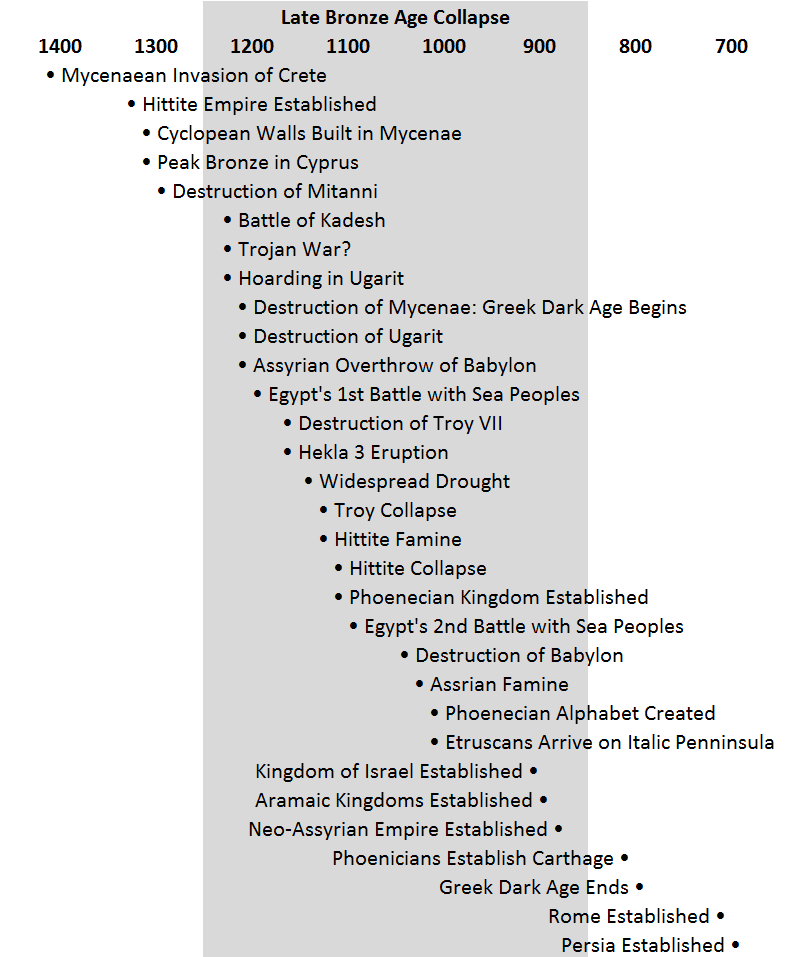
I only recently ran across the term Late Bronze Age collapse (LBAC). I had heard of the Greek Dark Ages (ca. 1100–ca. 750 BCE), the Fall of Troy, the Exodus (the historicity of which has not been established, but would fit into this context), and even the battles between the Egyptians and the Sea Peoples, which put an end to the New Kingdom period (ca. 1550 BCE–ca. 1077 BCE), but I hadn’t realized the extent to which these events were connected.

The cultural cataclysm of the LBAC included the Near East, the Aegean Region, North Africa, the Caucasus, the Balkans, and the Eastern Mediterranean. The Greek Dark Ages are reckoned to have lasted some 300 years, but many of the civilizations affected simply never recovered.

The extent to which the cultures in the area were in contact during the Late Bronze Age (LBA) was something else of which I was not aware. As Eric Cline⁵ has pointed out, even civilizations not in direct contact were never more than three steps removed from contact with one another in this network. Basically, any of them could both send and receive goods with each other directly or via a few intermediaries.

How do we know? Lots of ways: first, there is the presence of goods from these civilizations in one another’s lands, as I’ve made brief mention of already. There are too many such examples to catalog here, so I’ll discuss one I found quite striking concerning a fresco found in what was an Egyptian port city called Peru-Nefer (modern تل الضبعة Tell El-Dab’a).

The reconstruction shows it’s a scene of bull-leaping, similar to that famously found in the great palace of Knossos in Crete. In addition to the distinctly Minoan motif, this particular type of wall decoration, called buon fresco—painting done with pigments dissolved in water on a thin coat of still-wet plaster—itself originated in Crete.

Therefore, artisans from the island had to have either worked on this piece, or at a minimum, trained those who did. Indeed, there seems to have been a craze for Minoan frescoes in the ancient Levant, as they appear in several locations in Egypt and Canaan, including Tel Kabri (תֵל כַבְרִי, Arabic: تَلْ ألْقَهوَة‎,Tell al-Qahweh, in modern Israel), Alalakh (Tell Atchana, in modern Turkey), Qatna (تل المشرفة‎, Tell al-Mishrifeh, in modern Syria), as well as Tell El-Dab’a.

Furthermore, a site called Mari in what’s now Eastern Syria has yielded more than 25,000 clay tablets inscribed with Akkadian text, including a wealth of documentation of ancient trade. Sadly, the site is known to have been looted during the present civil war while archaeologists looked on helplessly. Cline elaborates on the tablets found there:⁶

The archives included records of trade and contact with other areas of the Mediterranean and Near East, with specific mention of unusual items that were received. We also know from these tablets that gifts were frequently exchanged between the rulers of Mari and those of other cities and kingdoms, and that the kings requested the services of physicians, artisans, weavers, musicians, and singers from one another.

Included among the exotic imported objects recorded in the tablets at Mari were […] weapons made of gold and inlaid with precious lapis lazuli, as well as clothing and textiles […] The items had traveled a long way from Crete, acquiring what is now known as “distance value,” in addition to the inherent value that they already held because of the workmanship and the materials from which they were made.

So what happened to this early global trade network? The Sea Peoples have become a bogeyman for the collapse. Often cited in making this claim is a desperate letter King Ammurapi of Ugarit (𐎜𐎂𐎗𐎚) wrote to the King of Alashiya—an ancient regional name for Cyprus:⁷

My father, behold, the enemy’s ships came (here); my cities(?) were burned, and they did evil things in my country. Does not my father know that all my troops and chariots(?) are in the Land of Hatti, and all my ships are in the Land of Lukka? … Thus, the country is abandoned to itself. May my father know it: the seven ships of the enemy that came here inflicted much damage upon us.

Note kings of the time often used familial terms in addressing their allies—using “father”, he is likely simply calling the king his elder close relation, just as people in many places, especially east Asia will use Uncle, or Aunt as a term of respect for someone older despite not being related to them.

As to the Sea Peoples, not much is known about them—even the term used for them was made up by French archaeologists. What is known is they seem to have been quite warlike: the Hittites, Mycenaeans, Canaanites, Cypriots, and others are said to have fallen to them. When they turned toward Egypt, an inscription of Ramesses III names them and their depredations:⁸

The foreign countries made a conspiracy in their islands. All at once the lands were removed and scattered in the fray. No country could stand before their arms, from Khatte, Qode, Carchemish, Arzawa, and Alashiya on, being cut off at [one time]. A camp [was set up] in one place in Amor. They desolated its people, and its land was like that which has never come into being. They were coming forward toward Egypt, while the flame was prepared before them. Their confederation was the Peleset, Tjeker, Shekelesh, Denye(n) and Weshesh, lands united. They laid their hands upon the lands as far as the circuit of the earth, their hearts confident and trusting “Our plans will succeed!”.

Note most kings did not know how to write, with an official scribal class handling the work, but the inscription was ordered by Ramesses and written in his voice. Also, Khatte (Hatti) is Anatolia under the Hittites, Qode is in the southeast of modern Turkey, Carchemish is in the north of modern Syria, and Arzawa is in western Anatolia. Other inscriptions use these and other names, for a total of nine, for which there are some more-or-less conjectural correspondences:

  • Denyen (djnjw): Danaans (Δαναοί, a Greek group)
  • Eqwesh (jḳwš): Achaeans
  • Lukka (rkw): Lycians
  • Peleset (prwsṯ): Philistines
  • Shekelesh (škrš): Sicels (Sicilians)
  • Sherden (šrdn): Sardinians
  • Teresh (twrš3): Tyrrhenians (Etruscans)
  • Tjekker (ṯkr): Teucrians (a Trojan group)
  • Weshesh (wšš): Oscans (an Italic tribe)

There are many theories about the origins of these tribes and what spurred them into action, from migrations driven by famine to a quest for wealth. The Egyptians won a Pyrrhic victory against the Sea Peoples, with Ramesses declaring:⁹

They are capsized and overwhelmed in their places. Their hearts are taken away; their soul is flown away. Their weapons are scattered in the sea.

Those he did not destroy, he claims to have settled in Canaan under the crushing yoke of his rule. But as I mentioned, the victory came at a high cost: the New Kingdom was over, and a decline known as the Third Intermediate Period (ca. 1069 BCE–ca. 664 BCE) began.

The archaeological record seems not to jibe well with Ramesses’ account. Although many cities in the region were destroyed in this period, invasion doesn’t seem to account for all of them—the evidence seems to show some as rebellions, plagues, or natural disasters. A further sign the Egyptian claims may be overblown or misinformed comes in the fact the Greeks appear both as invaders and invaded, as do the Trojans.

The Bronze Age was fueled by the metal of the same name, an alloy of copper and tin. Copper was abundant, with an important center for its production being Cyprus, from which our word copper descends. One etymological analysis says the Mycenaean 𐀓𐀠𐀪𐀍 (ku-pi-ri-jo—kuprios) comes from the Sumerian word for bronze, 𒌓𒅗𒁇 (tsupar). What this leaves out is that an earlier form of the Sumerian word is kupar, which meant copper. To get from there to Κύπρος, we just add the Greek masculine suffix, -ος, and elide the unstressed vowel. pi-ri-jo (kuprios) originates with the Sumerian word for the metal, tsupar. To get from tsupar to Κύπρος, consider first, a confusion with kupar, Sumerian for “bronze”, second, ⟨υ⟩ shifted from an ancient /u/ sound to the classical /y/, and last, the addition of the Greek masculine gender suffix, -ος. The Mycenaean form had an -ios ending, which marks a masculine genitive, so “of copper”, which seems to have been later dropped, as now Κύπριος means someone from Cyprus.

Tin, on the other hand, was hard to get—there was some, but not a lot, in northern Anatolia. Cornwall, which was an important source later, is pretty far away, so most of it seems to have been brought from what’s now Afghanistan. Carol Bell observed:¹⁰

The strategic importance of tin in the LBA was probably not far different from that of crude oil today. The availability of enough tin to produce […] weapons grade bronze must have exercised the minds of the Great King in Hattusa and the Pharaoh in Thebes in the same way that supplying gasoline to the American SUV driver at reasonable cost preoccupies an American President today!

Handily, if you run short on tin, there’s another plentiful metal you can substitute to make bronze. Unfortunately, that metal is arsenic. What’s great about arsenical bronze is weapons and armor manufactured using it actually take on several good properties: arsenic acts as a deoxidizer, so castings are less porous and more ductile, and the capacity for work hardening is also increased, so better cutting edges can be created. Furthermore, it can be given an attractive silver-colored surface.

The downside, of course, is arsenic is categorically toxic. Most copper ore already contains arsenic, and smelting it vaporizes much of whatever is present as arsenic oxide. Ötzi, the Alpine ice-mummy, was carrying a nearly pure copper axe-head and had high levels of copper and arsenic particles in his hair, and so seems to have been involved in smelting. Copper- and bronzesmiths would often end up with chronic arsenic poisoning, causing peripheral neuropathy, a symptom of which is a weakening of the legs and feet.

This may be the dark truth behind ancient myths of lame smiths, Ἥφαιστος (Hephaistos) being a paragon of the type. One can imagine the results of manufacturing arsenical bronze on a large-scale: besides being even worse for metalworkers, anyone touching the finished product would eventually feel the effects of the metal’s toxicity. Copper arsenate, another compound of the same metals, is used as an herbicide, fungicide, insecticide, rodenticide, and slug poison and has been banned for many uses because it is also highly carcinogenic.

A similar factor often overlooked in the fall of Rome, which precipitated a more familiar Dark Age, was lead poisoning. The Romans found lead a wonder metal, using it in plumbing, makeup, and even as a flavor enhancer in their wine. The very word plumbing derives from Latin plumbum, “lead”, which also provides its chemical symbol, Pb.

Before you get all superior, remember we thought it was great to use in plumbing and paint, as well as to burn in our fuel until quite recently, even with a much greater scientific understanding of the situation. It was one of the first times corporations had clear scientific evidence of deleterious effects and chose not to act until forced to do so. And our problems are not over; lead in the pipes was also the problem in Flint, Michigan.

So one way or another, bronze was on the way out. During the Greek Dark Age, edged weapons of iron came into widespread use: by 900 BCE, almost all weapons in grave goods were made of iron. Some even claim the upheavals of the collapse had to do with an escalation of weaponry, including use of iron, or of bows with increased range.

Then as now, earthquakes were a constant danger over much of the region: there are 16 active faults known today. Some theorize an earthquake swarm, a sequence of seismic events over a large area. Just to the left of the famous Lion Gate in Mycenae, the sharp rise in the ground is actually shearing from a fault running through the site.

There were also extended periods of drought in the area, which would be pretty difficult for these ancient agrarian societies to deal with. The fate of the Mayan city of Copán (in modern Honduras) seems to offer a corollary: the city flourished in a fertile mountain valley, supporting a population of 18,000–25,000, but was also very susceptible to dips in farming productivity. Disruption of the food supply in the 8th and 9th centuries meant people had to disperse and live off the land; returning to a subsistence hunting-and-gathering lifestyle.

While Egypt continued to limp along after the LBAC, Greece came back stronger than it ever had been. After the 800s BCE, writing reappeared in Greece, now adopting the Phoenician alphabet, a script much better equipped to describe their language than Linear B, and one much of the world still uses some form of today.

The vacuum left by the downfalls of some civilizations in the area allowed others to rise, including the Phoenicians, the Etruscans, the Romans, the Persians, the Israelites—the groups we think of as the wellsprings of Western civilization.

The apocalypse has haunted our species’ imagination, however—a fall from a past Golden Age to one with diminished capacities and humbler hopes, or the end of all things: the Deluge, the End of Days, the Second Coming, Ragnarǫkkr, Frashokereti. No doubt for those trying to survive through those years of tumultuous destruction and catastrophic change, it was a grim struggle. But the arc of history, it seems, was toward the good. So if we are in the apocalyptical times some suggest, perhaps it will represent an opportunity for some eventual betterment.


Read subsequent articles in the Late Bronze Age Collapse series

Part 2: Whither the Wanax?

Part 3: The Luwian Menace

Part 3 Addendum: Fruit from a Poisonous Pseudoarchaeological Tree


Notes

  1. Ὅμηρος (Homer), Ἰλιάς (The Iliad), Book I.1–5: μῆνιν ἄειδε θεὰ Πηληϊάδεω Ἀχιλῆος / οὐλομένην, ἣ μυρί᾽ Ἀχαιοῖς ἄλγε᾽ ἔθηκε, / πολλὰς δ᾽ ἰφθίμους ψυχὰς Ἄϊδι προΐαψεν / ἡρώων, αὐτοὺς δὲ ἑλώρια τεῦχε κύνεσσιν / οἰωνοῖσί τε πᾶσι, Διὸς δ᾽ ἐτελείετο βουλή […]. I’ve translated it to be true to the original, the subject being the word, μῆνιν (wrath). I also believe the name of the hero is given as a patronymic, Πηληϊάδεω ᾿Αχιλῆος, (literally, “son of Peleus Achilles”) as was common in the ancient world.
  2. John Lawrence Angel, “‘Priam’s Castle Blazing’: A Thousand Years of Trojan Memories”, Troy and the Trojan War, Johanna Mellink Machteld, ed., 1984.
  3. CTH 181, discussed in Harry A. Hoffner Jr., Letters from the Hittite Kingdom, 2009. My emphasis.
  4. ⟨p(h)⟩, later expressed by ⟨φ⟩ and with the phonetic value /f/, seems to have been said in Mycenaean Greek as /pʰ/; a hard /p/ with a puff of air after it, which I’ve rendered as ⟨p’⟩. It’s thought to come from an Egyptian word, with the Mycenaean version being the genitive of 𐀁𐀩𐀞 (e-re-pa/ ⁠elephās⁠): ivory.
  5. Eric Cline, 1177 BC: The Year Civilization Collapsed, 2014. The schematic is based on one of his from a lecture on the same topic.
  6. Ibid.
  7. Emmanuel Laroche & Charles Virolleaud, Ugaritica V: nouveaux textes accadiens, hourrites et ugaritiques des archives et bibliothèques privées d’Ugarit, 1968.
  8. John A. Wilson trans., in J.B. Pritchard ed., Ancient Near Eastern Texts relating to the Old Testament, 1969.
  9. Egerton and Wilson trans., 1936.
  10. Preface, Cline, 2014.

Roll Over McFly

Offhanded aggression in “Back to the Future”

Chuck Berry slowly replaces the handset on its cradle and stares dazedly at the phone for a long minute. He springs to his feet and digs through his bags for the notebook he uses to jot down ideas on the road, leafing through it to the right page. He looks down at his song. It’s eerie someone managed to come up with something so similar (identical?). He had had a feeling when he penned it, it was a good one; another follow up to “Maybelline”, the crossover hit he was currently riding high on.

But now, hearing some suburban kid playing it, it was clear it was too old school, already mainstream and square. It was time to get out of his comfort zone and come up with something new to really shake things up. It’s ironic Marvin had thought Chuck was looking for a new sound when he wasn’t and now he needed to, because of that call. He tears the page out, crumples it, and tosses it in the direction of the trash basket. He shakes his head: that was a close one.

We all know the scene. Marty McFly (Michael J. Fox) is playing guitar on “Earth Angel” with Marvin Berry (Harry Waters Jr.) and the Starlighters for the Enchantment Under the Sea high school dance. But afterwards, he decides to bust out an “oldie from where he’s from” and slays “Johnny B. Goode”. The crowd goes wild.

The movie is sloppy with its 1955 facts across the board; IMDB’s “Goofs” page is immense.¹ And sure, it was harder to do research when the film was made, you had to actually relocate your physical body to an inconveniently situated place known as a library, and find books made of paper whose contents could not be easily searched, rather a crude, almost necessarily erroneous device—the index—had to be consulted. Today, we have facts at our literal fingertips and can find out what the popular songs and movies were at any given date nearly instantaneously.

And also sure, the film is a comedy; not to be taken too seriously, but the science fiction elements, and specifically time travel, mean the entire premise is closely connected to an accurate depiction of a suburban California town in November 1955. It’s not: IMDB lists 14 anachronisms, and it’s pretty far from exhaustive. And no, I’m not going to fix IMDB.

Turning just to Marty’s performance with The Starlighters, there are several such problems, which are worth mentioning as they go to overarching issues: That guitar did not exist then, that amp did not exist then, those effects did not exist then.

The song as well as the guitar are clearly meant to allude to Chuck Berry, but he played a Gibson ES-350T, which was his trademark until the manufacturer discontinued it in 1963. Only then did he switch to the ES-355. No one in the ’50s had a red guitar either—most of them were some kind of sunburst. Red didn’t happen until the ’60s.

The gag line on which all of this hangs comes when Marty is soloing and the injured frontman finds a phone:²

Chuck! Chuck, it’s Marvin. Your cousin, Marvin Berry. You know that new sound you’re looking for? Well, listen to this!

As I’ve already indicated, Chuck was not looking for a new sound, as Marvin would have known. “Maybelline” was already a huge hit. It had sold over a million copies and hit number one on Billboard’s R&B chart and broke into the overall US chart as well, reaching number five only a few months previous to the movie’s timeline, and had stayed there.

Furthermore, the film is set in November 1955, with little left of the year in which Berry is known to have written “Johnny B. Goode”, so another likely miss historically. Indeed, Berry was to score nine more R&B-charting singles, as well as five that crossed over into the US chart as well before the release of this song. Two of these, “School Day (Ring! Ring! Goes the Bell)”, and “Sweet Little Sixteen” charted higher in both categories: “School Day” reached number one R&B, number three US and “Sweet Little Sixteen”, number one and number two, compared with “Johnny B. Goode”’s performance of number two and number eight. The actual songwriting of “Johnny B. Goode”, rather than being a “new sound” was very much a rocked-up country blues song (as many were), exactly along the lines of “Maybelline” and these other hits.

I’ll note despite the awkwardness of the throwaway laff line, the movie did introduce a new generation to Chuck Berry’s musical genius; a silver lining.

Elvis Presley is commonly thought of as the personification of the white appropriation of rock and roll and the subject of Sam Phillips’ declaration,³

If I could find a white man who had the Negro sound and the Negro feel, I could make a billion dollars.

And again, the film misses the boat as Phillips and Presley had already done this, rerecording Arthur Crudup’s R&B hit “That’s All Right” in July 1954. And even Elvis was also far from the first, despite what Phillips thought.

Then we come to the actual influences on the song the film attempts to efface: the opening riff is a note-for-note copy of the intro to Louis Jordan and His Tympany Five’s song, “Ain’t That Just Like a Woman (They’ll Do It Every Time)” from 1946, well predating the fictitious McFly performance.

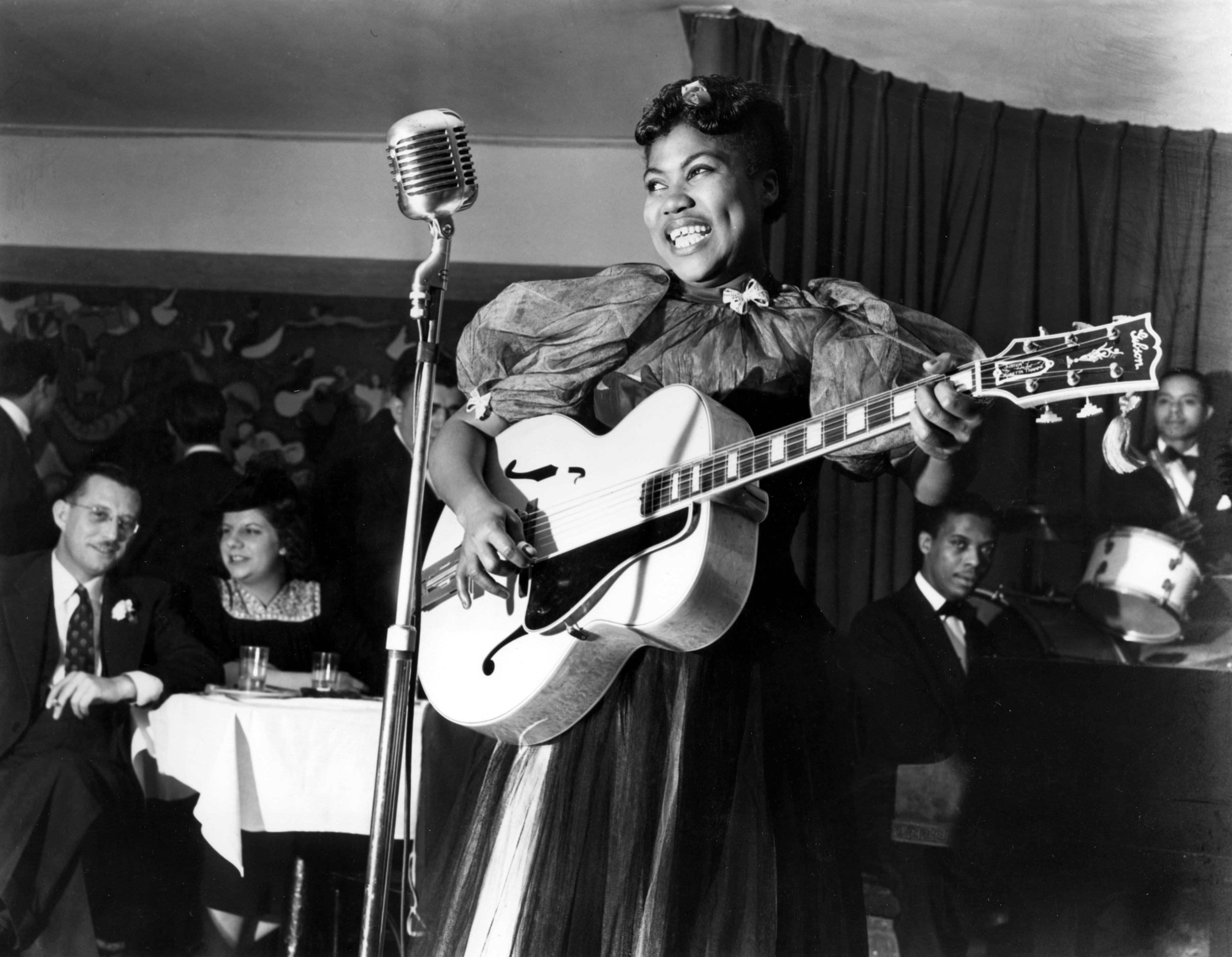
As for the guitar sound, if that was what Marvin meant (sans effects), Berry’s inspiration for that, as it was for many rockers before and since, including Little Richard, Johnny Cash, Elvis Presley, and Jerry Lee Lewis, was not only not white but also not male: “Godmother of rock and roll” Sister Rosetta Tharpe.

The real shame of Marty teaching Chuck his business is it abrogates Tharpe. Listen to a few bars of her song “That’s All”, originally recorded in 1938, and you’ll hear the guitar sound that actually inspired Berry—it’s unmistakable.

And this is where the real problem arises. The filmmakers think about (or at least portray) rock and roll as being born suddenly in the mid-’50s. Check the date for Tharpe’s song again—1938. Elements recognizable as characteristic of rock and roll actually began to appear still earlier, in the blues of the ’20s. There is debate about which song is the proper one to cite, but I’d offer Papa Charlie Jackson’s “Shake That Thing” of 1925 as a notable paterfamilias, despite his use of a banjo guitar; a six-string banjo using guitar tuning. Uncoincidentally, Jackson was one of the earliest black musicians to have his work covered in recordings by whites, as The Allen Brothers did with his “Salty Dog Blues” in 1926.

Mainstream culture seems to think rock and roll’s history begins more specifically, at the point of its becoming white, making it possible for a Marty to deracinate it in 1955, but you’d actually have to go all the back to around 1670 in ports like Ouidah, and through them into the whole of what once was the Slave Coast of Africa, to reach what’s ultimately being whitewashed.

That the history of black American music begins in Africa (apart from the obvious) is attested in the English words associated with it, like the Kikongo meanings, if not etymologies, for words like jazz and funky. The concept of “cool” which has become integral to American culture, and perhaps even the world’s, is distinctly African, embodied in words like Yoruba itutu “(aesthetically) cool”, and the Fɔngbe phrase é na fa, “it will be cool”, which carries the exact same connotations on both sides of the Atlantic.

The whole reason rock and roll is the music of rebellion is deeply embedded in its history, which is also why it appealed to white teens in the conformist America of the middle of the last century. As Berry said of “Maybelline”,⁴

It came out at the right time when Afro-American music was spilling over into the mainstream pop.

Again, the history of black entertainers performing for white audiences goes way back, with venues like the Cotton Club strictly adhering to this format, beginning in 1923. They also required dancers and chorus girls to be light-skinned, as their advertising stated:

Tall, Tan, and Terrific!

The Brown Paper Bag Test was a common measure for “acceptable” skin color. These women also had to be at least five-foot-six and under 21.

The whole point of having Marvin’s band play in lily-white Hill Valley is to try to be cool, though Marvin should have been able to land way better gigs just on the basis of being the cousin of an already huge star. Marty playing with the Starlighters, however, would be problematic as it makes them a miscegenated band.

When Rosetta Tharpe was backed by white performers, The Jordanaires (who would also later play with Elvis), they could not stay at the same hotels or eat in the same establishments and many Southern venues simply refused to let them play. Certainly California would have been somewhat less strict, but the entire issue is glossed over, despite 3-D and Skinhead (that’s really his name) calling one of the Starlighters “spook” and the whole group “reefer addicts”, respectively. And, in fact, the lazy stereotyping of the film does have the band smoking pot.⁵

As for Marty himself, he is a deeply flawed character. Mr. Strickland (James Tolkan), a teacher at his high school characterizes him, not incorrectly, as a “slacker”: he lies to his parents, his audition tape is rejected, he’s frequently tardy to school, not especially bright, overly concerned with his physical appearance, and wantonly destructive of Doc Brown (Christopher Lloyd)’s personal property. All of this is useful to the film as it makes him a highly relatable everyman for the audience, as well as being an effective driver for the plot as he bumblingly and repeatedly creates temporal issues he must then strive to correct.⁶

His performance of “Johnny B. Goode” is the penultimate such event—his note to Doc about his being shot in 1985 being the final one—but which apparently has no consequences other than Doc not dying. In the middle of “Earth Angel”, he is hovering on the brink of nonexistence, his hand becomes transparent, he ceases to be able to play, he is being unmade. Then the tide turns, his future parents dance and fall in love and he revives. He has literally just finished fighting to reverse the disruptions his trip into the past has caused, when with absolute disregard, he attempts to erase the genius of Berry, presumably a hero of his, in order to claim it for himself.

As for Marty’s portrayer, the performance was not Fox at all: Mark Campbell did the singing and Tim May played the guitar. Mojo Nixon took issue, singing in 1987’s “Elvis is Everywhere”,

Michael J. Fox has no Elvis in him.

Asked why he cast the film star as an “Evil anti-Elvis”, Nixon is unrepentant, refusing to dial back his criticisms based on Fox’s being “sick”—Fox was diagnosed with Parkinson’s disease in 1991 and has been semi-retired since 2000—and it’s also worth noting Nixon has also accepted the revisionist idea of white rock and roll:⁷

In Back to the Future and in that terrible Paul Schrader movie with the Springsteen song, Light of Day, Michael J. Fox desperately wanted to be a rock-and-roller. He’s not! He is an evil yuppie twit, and he always will be an evil yuppie twit. He can’t be a rock-and-roller.

In the end, Marty breaks rock and roll. Even discarding the classic grandfather paradox he has created, performing a song he learned from Chuck Berry for Chuck Berry—so he wouldn’t have written it for Marty to learn it so Marty could never have performed it. ’Cause Chuck Berry never would have borrowed anything from a nerdy suburban white boy, no matter how good.

In the new timeline he has created, in the future he returns to, white rock and roll will have been what black musicians will have had to create a counter-culture to even sooner, which will then have been co-opted by mainstream culture. In Marty McFly’s new 1985, being a guitar hero, no matter how skilled, will have been made passé, irrelevant. Popular music will have either gone retro, led by banjo or accordion, or new, unheard of instruments will have been invented—almost anything but guitar, bass, and drums.


Read the addenda to Roll Over McFly”

Addendum A: The Immaculate Miscegenation

Addendum B: Appropriating a Missing Past


Notes

  1. “Goofs”, Back to the Future (1985), IMDB.
  2. Back to the Future, 1985. 
  3. Quoted in Jerry Hopkins, Elvis: The Biography, 1971, though it is disputed.
  4. NBC Evening News, March 18, 2017.
  5. Back to the Future, 1985.
  6. Ibid.
  7. Tom Murphy, “Mojo Nixon “un-retires” with Whiskey Rebellion”, Westworld, April 2012.

Japan’s Turbulent Taishō

Echoes of a failed revolution (Taishō, Part 1)

I have long been fascinated by Japanese history, but it is not the tales of the daimyō battling to become shōgun in the Sengoku period, nor the flowering of Japanese Buddhism and aesthetic culture in the Heian period, embodied in works like The Tale of Genji that caught my attention. Rather, it is the all-but unheralded Taishō era (大正時代, 1912–26).

This brief era is wedged between the better-known rapid modernization of the Meiji era and the peak of Japan’s imperial ambitions in East Asia, which ultimately led to WWII in the Pacific, during Shōwa.¹ I should also note Taishō set the stage for that Japanese belligerence.

I became interested in the era when I lived in Tōkyō. In 1988, the Tōkyō Metropolitan Art Museum (東京都美術館) had an exhibition called simply “1920年代日本展” or in English, “The 1920’s in Japan” (sic). The artifacts featured were interesting, mainly because of the sheer variety appearing. I purchased and still possess the catalog of the show, which is the size of a telephone book. The foreword gives some idea of the scope:²

Included in this show are more than 400 exhibits; paintings, sculptures, photographs, architectural and urban design plans, plans for stage sets, films, products of industrial and graphic design, and related works of reference.

More than 150 artists are represented here. Some were active in a number of fields; many influenced one another; they all in one form or another expressed some aspect of the spirit of the age.

And it’s additionally worth noting not all these artists were Japanese—the influence of Western art was at a zenith, and so pride of place in the book is given to the work of Frank Lloyd Wright, and in particular the second Imperial Hotel. This Wright edifice was built 1919–1923 near the Imperial Palace grounds in Tōkyō.

So how did this decade under an emperor whose neurological conditions left him unable to carry out public functions produce such a wealth of art?

To expand briefly on the mental state of Emperor Taishō (大正天皇), whose personal name was Yoshihito (嘉仁), it’s perhaps best summed up in the last of his rare public appearances, where he famously rolled up the speech he had prepared for the opening of the national legislature and peered through it at the assembled dignitaries as if it were a telescope.

Taishō proper was arbitrarily cut short by the poor health of the emperor for which it is named, but there is an argument to be made for a Greater Taishō. This includes the first three decades of the 20th century (1900–1930)—which share, according to Sharon Minichiello:³

[…] political philosophies, new technologies, imperial possibilities, economic systems, art, and cultural forms.

Thus defined, we can certainly see the era’s first decade as its ascent and the final one as its decline. The ’20s, as the central decade, would make sense as the most representative and productive.The event many cite as defining Taishō is WWI: Japan joined the Allied Powers near the close of the conflict in somewhat opportunistic fashion, and indeed the resulting economic boom was characterized by historian Jeffrey Hanes thus:⁴

[World War I] sent Europe to its knees and brought Japan to its feet.

With Germany focused on the war in Europe, Japan swooped on its territories in East Asia as an occupying force. When they declared war on the side of the Allied Powers, their new friends were happy to legitimize these annexations. The collapse of Imperial Russia with the Bolshevik Revolution (1917–1922) also removed a key rival from contention for hegemony over the Far East. Japan joined the League of Nations as one of the Big Five members of the new international order.

Towards the end of the conflict, and with the resources of the other allies greatly depleted, Japan was increasingly called upon to fulfill needs for a wide variety of materials needed to continue to prosecute the war. This allowed Japanese industry to both diversify and expand rapidly.

The Nishihara Loans (西原借款), of which there were eight totaling ¥145M, were made mainly to the Chinese government in 1917 and 1918. These moved Japan from debtor to creditor status for the first time. In return, Japan’s claims to the formerly German Kiautschou Bay (膠州灣) concession in Shandong (山東半島) were confirmed, control of the railways in Shandong Province was granted, and their rights in Manchuria (滿洲) were extended.

However, as with other elements of Taishō proper, Greater Taishō announced this trend. In 1905–1918, stimulated by the Russo-Japanese War, the economy began to grow and shift from agriculture to industry. The increase was fueled mainly by spending for the war effort, further driven by foreign loans, inflation, and increasing imports. The war also resulted in the expansion of Japan’s influence into Korea and southern Manchuria.⁵

The meteoric rise of the Japanese economy left rural regions hollowed out as young men and women migrated into the urban centers where work was plentiful and high-paying in factories and offices. Inflation became runaway, peaking immediately following WWI, and leading to rice riots (米騒動) in 1918. Rice, a major staple in Japan then as now, had a government-fixed low buying price from farmers, but the selling price to consumers was allowed to spiral out of control.

Though perhaps innocuous-sounding, these riots included strikes, looting, bombings of official buildings, and armed clashes between protesters and police. During the three months in which the riots took place, there were 417 separate incidents involving more than 66,000 dissidents, of which 25,000 were arrested, and 8,200 convicted of crimes for which the punishments meted out ranged from minor fines to execution.

Meanwhile, the newly citified Japanese were able to achieve an unprecedented degree of financial independence regardless of their class, place of origin, or even gender. Although these new urbanites were a necessary ingredient in the nation’s economic growth, they also represented a source of increasing political tension.

The men were a problem because the group often leaned farther Left than the Taishō demokurashii (Taishō Democracy, 大正デモクラシー) was willing to bend. Initially, their vote was limited based on taxation, but after various groups, including students and laborers, united to demand liberalization of the vote, full suffrage for males beginning at age 25 was granted under the General Election Law (普通選挙法) of 1925.

However, this was somewhat mitigated by the fact these mobo (モボ, an abbreviation of モダンボーイ: “modern boys”) were likely to be under control of the institutions of the military or the workplace, which could therefore sway their votes.

As for their female counterparts, the moga (モガ, from モダンガール: “modern girls”), however, social conservatives found their fun-loving, financially and sexually independent Westernized brand of womanhood threatening despite their ineligibility to vote.

The post–WWI economic boom ended abruptly, with crop prices falling in 1920 and remaining low and unstable for several years, while local taxes continued to rise. This downturn landed on mid- and lower-income farmers especially hard. Even though these issues could clearly be attributed to the government, the various coalitions of the period unhesitatingly turned the public’s focus toward the sentimental issue of the plight of the farmers, both to attack opponents and to gain votes.

Although the rhetoric contrasting these “real Japanese” with degenerate urbanites was effective, it was pure lip service. No action was ever taken by the central government to actually aid impoverished farmers.

In our own time and place, nothing has changed: coastal elites is a dog-whistle term for an essentially similar group to the urban Japanese. Perhaps our version has an extra soupçon of racism and/or antisemitism absent among the largely homogenous populace of Japan. New York values and cuck are some still newer and more specific flavors of this disparagement.

Sarah Palin expressed the opinion many conservatives hold—or at least represent themselves as holding to their red-state constituents—about this rural-urban divide:⁶

We believe that the best of America is in these small towns that we get to visit, and in these wonderful little pockets of what I call the real America, being here with all of you hard-working, very patriotic, very pro-America areas of this great nation.

Returning to the mobo and moga, the terms referred to trendy, fashion-conscious city dwellers in the ’20s and early ’30s. They were portrayed as superficial, luxury-addicted, and corrupt, indeed besotted with the values of the West, and Westerners were similarly characterized. The modern lifestyle was painted as posing a threat of destroying the “Japanese spirit”.

It is a matter of some irony given the above labels, the terms also eventually became associated with Marxism. This is a tipoff the state was happy to tie whatever ethics it was hostile toward to this group.

Mobo was essentially an updating of the term haikara (ハイカラー: “high collar”), coined near the turn of the century, in 1898. According to Jason G. Karlin, the term, originally referring to a specific kind of shirt,⁷

[M]igrated to become a marker of novelty, fashion, and consumption in late Meiji discourse. In short, it came to exemplify the ephemeral and transitory qualities of modern culture.

The Western-inspired dandyism the term implies was an outward sign to the world of economic success and social status. This was what made the group represented by the term so easy for politicians to steer public wrath toward: they were easy to identify and objects of jealousy.

Moga were still more reviled. Many conservative social critics perceived them as a threat, not just because of the issues ascribed to moderns of both sexes, but in particular because of their independence, and the perception they were eschewing traditional social and gender roles. The overall feeling was moga were becoming more masculine while dandified mobo were adopting feminine traits.

Bankara (蛮カラー: “barbarous-collar”) was a group created in opposition to haikara, by social critics, particularly the satirical magazine The Tokyo Puck (東京パック). Karlin describes it thus:⁸

The bankara man was an anticonsumer who rejected materiality and the lures of Western culture. The term bankara carried associations with stoic sincerity and a conservative resistance to novelty expressed through an unadorned and rugged appearance […]. Just as the high-collared shirt was the defining emblem of the high-collar gentleman, the bankara man was identified by his tucked up sleeves, exposed forearms, and dark complexion.

Furthermore, he notes,

[T]he bankara man is portrayed as a vigilante who protects the weak and defenseless […].

In the Taishō era, this role in particular is continuously expanded and mythologized in various forms of fiction and nonfiction, extending to the idea of protecting the entire Far East against Western aggression. The rural Boy Scout movement came to embody these ideals, rapidly becoming highly militarized.

Ultimately, Taishō was a failed revolution, since the result was increased authoritarianism and imperialism. The draconian Public Security Preservation Law of 1925 (治安維持法), put in place only two months after universal manhood suffrage, marked the biggest reversal of the Taishō demokurashii. It was intended to suppress political dissent, specifically targeting socialism and communism.

Under the law, an Orwellian thought police was formed, the Tokubetsu Kōtō Keisatsu (特別高等警察: “Special Higher Police”, often shortened to Tokkō), whose mandate was the criminal investigation of political groups and ideologies representing a threat to public order. They arrested over 70,000 people during the time the law was on the books, 1925–1945.

But the close of the era of the moderns really came with the devastation wrought upon the Tōkyō-Yokohama metropolitan area by the Great Kantō earthquake (関東大震災) and subsequent firestorm in which roughly 100,000 people were killed in 1923.

Tanizaki Junichiro, who had been part of the Bohemian lifestyle of Taishō and whose home in the area was also destroyed, reacted:⁹

[…] I felt a surge of happiness which I could not keep down. “Tokyo will be better for this! I said to myself […].

His enthusiasm for the West was discarded, with his focus shifting instead toward Japanese aesthetics and culture.

Religious leaders echo these sentiments still, declaring the destruction, specifically of urban centers, to be “God’s wrath” because of their debauchery. Pastor John Hagee named Hurricane Katrina such an event, citing the city’s level of sin, specifically homosexuality, as the reason:¹⁰

What happened in New Orleans looked like the curse of God, in time if New Orleans recovers and becomes the pristine city it can become it may in time be called a blessing.

Regardless, the heyday of Taishō had passed. Such heady times were not to return to Japan until the asset price bubble of the ’80s (バブル景気, baburu keiki: “bubble condition”).

The curators of the Tōkyō Met intended their show to inspire change, if not to gently warn against getting too carried away with superficialities in such economic high times:¹¹

[In the ’20s, Japan] underwent rapid processes of urbanization, industrialization and internationalization. The period was in some ways analogous to our own; and it was, in fact, then that the prototype of our contemporary environment was formed. “The 1920’s in Japan” tries to illuminate the age by looking at the art it produced. […]

We sincerely hope that visitors to “The 1920’s in Japan” will listen and respond to—in the spirit of this age—these young voices of around 60 years ago.

Sadly, this wasn’t to be. Lacking moral direction and feeling complacent in their country’s economic dominance, the Japanese of the close of the Shōwa period spent their days as cog-in-a-prestigious-machine sararīman, their nights drinking mizuwari (水割り: whiskey and water) and singing karaoke, and their weekends in nonstop shoppingu. Then the economic bubble burst, and the chance was squandered for perhaps another 60 years; maybe forever.


Read subsequent articles in the Taishō series

Part 2A: Epochal Architecture

Part 2B: When Tokyo Moved West

Part 3A: Asakusa Movies

Part 3B: Asakusa Opera

Part 4: The Mysteries of Zūja-Go

Part 5: How “Alice” Grew Big in Japan


Notes

  1. Lots of references, so I thought Id de-clutter by moving them into a note: daimyō (大名), shōgun (将軍), Sengoku period (戦国時代, 1467–1600), Heian period (平安時代, 794–1185), The Tale of Genji (源氏物語), Meiji era (明治時代 1868–1912), Shōwa era (昭和時代 1926–89).
  2. Catalog, 「1920年代日本展」(“The 1920’s in Japan”), 東京都美術館 (Tōkyō Metropolitan Art Museum), 1988. 
  3. Sharon A. Minichiello, “Introduction”, Japan’s Competing Modernities: Issues in Culture and Democracy 1900–1930, 1998.
  4. Jeffrey Hanes, “Media Culture in Taishō Osaka”, Japan’s Competing Modernities
    Issues in Culture and Democracy, 1900–1930, Sharon A. Minichiello, ed., 1998.
  5. Minichiello, 1998.
  6. Sarah Palin, “fundraiser”, Greensboro, North Carolina, October 2008.
  7. Jason G. Karlin, “The Gender of Nationalism: Competing Masculinities in Meiji Japan”, The Journal of Japanese Studies, 2002.
  8. Ibid.
  9. 谷崎 潤一郎 (Tanizaki Junichiro), 1923., quoted in Edward Seidensticker, Low City, High City: Tokyo from Edo to the Earthquake: How the Shogun’s Ancient Capital Became a Great Modern City, 1867–1923, 1983.
  10. Pastor John Hagee, interview, The Dennis Prager Show, September 2006.
  11. Tōkyō Metropolitan Art Museum, 1988.

Jack Burton: Anti-White Savior

The unlikely journey of “Big Trouble in Little China” from box-office flop to cult classic

I saw Big Trouble in Little China (BTiLC) upon its original theatrical release in 1986. The critics did not like it. Roger Ebert wrote:¹

[S]pecial effects don’t mean much unless we care about the characters who are surrounded by them, and in this movie the characters often seem to exist only to fill up the foregrounds […] straight out of the era of Charlie Chan and Fu Manchu, with no apologies and all of the usual stereotypes.

What the ever-perverse Ebert saw as one of the film’s strengths, its special effects, were actually pretty cut-rate. Boss Films contracted to do the work for less than $2M. As a comparison, Ghostbusters spent more than double that, $5.7M on SFX with Boss two years earlier.² ³ This made for some pretty cheesy effects, notably a D&D Beholder-type animatronic, and a demon-ape suit, both of which stood out as the dismally floppy latex creations they were. The animatronic was actually fairly sophisticated, apparently, operated by several puppeteers and using dozens of cables controlling its facial expressions and there was also a specially designed matte system used to film it. All of which sounds like a massive waste of money, since it was on screen for only a few minutes and didn’t look at all good. Still, Ghostbusters’ Slimer was similarly cheesy.

As to Ebert’s claims about stereotypes, a boycott of the film as a “white man’s product” in which Asians’ roles were minimized was also called for, seeming to agree with his point.

Nor was Newsweek’s David Anson a fan:⁴

[O]ne can’t help feeling that Carpenter is squeezing the last drops out of a fatigued genre.

This falls even farther from the mark: BTiLC was the first of something brand new. A big-budget Hollywood martial arts film had never been made previously and contrary to Anson’s gloomy predictions, many have been made since. Indeed, one of BTiLC’s troubles was it was rushed in order to not be eclipsed by another American chopsocky flick, The Golden Child, which, with Eddie Murphy’s star power, was expected to dominate Christmas. The Golden Child was the eighth-largest grossing film of the year, raking in $79.8M in domestic BO.⁵ The film’s Rotten Tomatoes score is 26%/ 47%, so one can see how big a factor Murphy’s draw was on the release, even though it was clearly not very good.⁶

Meanwhile, audiences seemed to have validated the criticisms of BTiLC; it grossed only $11.1 million in North America, failing to earn back even half of its $25 million budget. It had seemingly been relegated to the trash heap of history.⁷ ⁸

Director John Carpenter was quite annoyed with all of this as well as the lack of marketing support from the studio (Fox) who he said “didn’t get it”:⁹

The experience [of BTiLC] was the reason I stopped making movies for the Hollywood studios. I won’t work for them again. I think Big Trouble is a wonderful film, and I’m very proud of it. But the reception it received, and the reasons for that reception, were too much for me to deal with. I’m too old for that sort of bullshit.

So just to quickly recap: the effects were cheesy, it included dubious “Chineseness”, it had been rushed to market, and it was disliked by both critics and audiences. I liked it immediately.

For some reasons let’s back up, way up: I was a kung fu kid.

It probably started with The Monkey King (《西遊記》). The title is typically translated as Journey to the West, but the book from my childhood was named for the main character. My copy, which I still own, is a weird one: it’s a massive quarto not likely intended as a kids’ book. It was (I later learned) required reading for a class my mother took on Asian Literature. It’s an Anglo-Czech effort, translated into Czech by Zdena Novotná (credited as editor), and then into English by George Theiner, with Chinese-esque woodblock-esque illustrations by Zdeněk Sklenář, and published in 1964. But when I read its title, even though it sat high on the top shelf, I was intrigued—what or who is this king of monkeys?

All this happened before I had mastered reading—the title was about the limit of my abilities—so I demanded it be read to me.

And what was inside was something new. Although I was a big fan of several kinds of mythology, I could tell this was different. Sun Wukong (孫悟空), with his glittering eyes, magical staff, and mischievous personality, eating the peaches of immortality, roasting in Lao-Tzu’s (老子) furnace, rebelling against heaven, including a battle of transformations similar to Loki’s in Norse Gods and Giants, fighting demons, and walking on clouds—all this was, if not already up my alley, my new alley forever.

Today my bookshelf boasts not only that original volume but Arthur Waley’s Monkey: A Folk Novel of China, and two different nicely illustrated versions of the quelling of the White Bone Demon (Monkey Subdues the White-Bone Demon, by Wang Hsing-Pei, and Monkey and the White Bone Demon, by Jill Morris), as well as a silver-and-cloisonne statuette of old Sun I found in Hong Kong. I also originated a design for a game based on the book, which did get made, though I can’t speak for the results as I had moved on by then.

Returning to my childhood, in the early ’70s, I saw The Magic Serpent (怪竜大決戦) on TV by chance some Saturday morning at my grandmother’s house. I don’t think I immediately associated the two experiences, but now I was seeing things that looked like what was in the book: dudes hiding in trees and underground, flying through the air, transforming into giant monsters—oh yeah!

I wanted more. On weekend mornings and evenings, when I had access to a TV, I’d troll the UHF dial, and when video rental places started appearing, I’d search their Action sections for anything even vaguely Asian—with many disappointments. There were also some bright spots, like when I was in high school and WGN showed Five Deadly Venoms (五毒)—you could tell who the cognoscenti were: the ones trying to imitate the moves of Centipede, Snake, Scorpion, Lizard, and Toad in the halls. And eventually there was Samurai Sunday, which showed different martial arts movies weekly on Channel 66.

When I was a student at The School of the Art Institute of Chicago, I discovered a run-down theater a few blocks away called the McVickers that showed these films back to back to back all day long for a buck. Every time I had a break between classes, it was the best dollar I could ever spend.

Built in the early ’20s, the McVickers was once a lovely neo-classical building with live theatrical performances. When I went there, it was barely ahead of being shut down in 1984, and then demolished in 1985. Its fluted columns were overshadowed by a rundown, garish, tacked-on marquee with two-foot-high red letters blaring titles like 36th Chamber of Shaolin, Fistful of Talons, Shogun Assassin. I didn’t realize it at the time, but I had stumbled across a rare, authentic, classic kung fu palace grindhouse.

Hollywood producer and Chicago native, William Horberg, recalls the place thus:¹⁰

It was like a rock concert with the audience of mostly drunk or homeless people shouting out to the screen as if they were interacting live with the characters in the movie.

The floors were sticky, the films were dubbed and subbed in a variety of languages from the familiar to the obscure, the seats threadbare or just plain broken. I’d generally end up seeing the end of one movie and the beginning of another, so I often had no idea what was going on. None of these things mattered; it was glorious. Later, another US wuxia (武俠) flick, The Last Dragon, captured the kung fu palace grindhouse vibe in its opening scene. My brother made the connection and took to calling me Bruce Leroy for a while. As a note, wuxia is a film genre similar to kung fu, but with fantasy elements instead of the grittiness usually associated with the latter.

I studied Asian martial arts: Kenjutsu (剣術), Northern Sil Lum Kung Fu (北少林), Wushu (武术), Eskrima, and Ninjutsu (忍術), but gravitated toward esoteric “internal” martial arts like aikido (合気道), t‘ai chi ch‘üan (太極拳), hsing i ch’üan (形意拳), and pa kua chang (八卦掌). I’ll apologize for this mishmash of Mandarin and Cantonese forms, as well as varying Romanizations—I’ve used the names by which I learned them. They were hard to find at first, and honestly, one of the things that attracted me to San Francisco. Not that I’ve ever used it particularly, apart from occasionally abusing tiles in Hongdae (홍대)—that’s not even the point. One of the reasons I enjoy fencing is it’s a martial arts-based sport where you can go all out and no one dies.

Turning back to BTiLC, its Rotten Tomatoes score is 82%/ 83% despite initially bombing at the BO.¹¹ When it was released for home video, it slowly began to find its audience. In 2001, a special two-disc special DVD set was released to reasonably positive reviews. Entertainment Weekly particularly favored the:¹²

[P]itch perfect Russell and Carpenter commentary, which delves into Fox’s marketing mishaps, Chinese history, and how Russell’s son did in his hockey game.

Its cult status has seemingly only increased since then. 2012 saw the creation of a parody of “Gangnam Style” featuring BTiLC’s antagonist, “Lo Pan Style”, racking up over a million views.¹³ In 2015, Funko released a line of vinyl figures of characters from the film and in 2016, BOOM! Studios marked the film’s 30th anniversary by launching a comic book series and a pair of books, The Official Making of “Big Trouble in Little China” and The Official Art of “Big Trouble in Little China”, which have to have set a record for time between a movie’s release and the publication of such matter. Entertainment Weekly noted in an article about the former book,¹⁴

It’s interesting how, one by one, all of John Carpenter’s commercially disappointing films are being elevated to the status of beloved cult classics.

And even though, as one of the authors, Paul Terry, responded, “Oh, man, he is the master”,¹⁵ BTiLC was a tough one for even the master to tackle.

Novice screenwriters Gary Goldman and David Z. Weinstein originally envisioned the piece as an oater set in turn-of-the-last-century San Francisco: the protagonist’s horse was named Porkchop, which was to morph into Burton’s truck, The Pork Chop Express. Carpenter and Fox saw promise, but knew changes needed to be rung. W.D. Richter, known for The Adventures of Buckaroo Banzai Across the 8th Dimension, a cult classic in its own right, was tapped for the rewrite. Even though he is only credited with having “adapted” the script, he set in place the major elements of the work as filmed, and continued on as Carpenter’s script doctor during filming.

Carpenter did his own editing pass through the script, aimed at removing material offensive to the Chinese, as well as playing up the screwball comedy he saw among the characters:¹⁶

The characters are offbeat, nutty. They remind me of the characters in Bringing Up Baby or His Girl Friday. These are very 1930s, Howard Hawks people.

His approach to the wuxia fantasy elements was, naturally, influenced by his experience of the genre (even though he misidentifies it):¹⁷

I saw my first kung fu movie in 1973. It was—what the hell was the name of that thing?—Five Fingers of Death! It was truly an astonishing film. There was an innocence to these movies and a joyousness that I loved. I wanted to bring all that to Big Trouble.

He cast some of the biggest names in the Asian acting community: Dennis Dun and Victor Wong, both of whose work in Year of the Dragon had impressed Carpenter, James Hong, who had been acting since the ’50s with a credits list as long as your arm, and then Carter Wong with over 60 martial arts films under his belt, as well as a who’s who of Asian martial arts actors including Jeff Imada, James Lew, George Cheung, Al Leong, Gerald Okamura, and Dan Inosanto.

I’d say BTiLC was to Asian actors what The Blues Brothers had been to Black musicians; if anything, even more so. Hearing the rumblings from the Asian community about how they assumed a Caucasian director was going to handle Chinese themes and roles, Dennis Dun said:¹⁸

I knew I had a responsibility, being an Asian-American actor. I talked with John Carpenter, and you could tell that he didn’t want a disparaging image of Asians. I’ve been on sets where you go there and you feel like you’re a second class citizen sometimes. But on that set you felt like you were part of the team.

And Dun said of the cast:¹⁹

I’m seeing Chinese actors getting to do stuff that American movies usually don’t let them do. I’ve never seen this type of role for an Asian in an American film.

Black Belt magazine, covering a cast reunion in 2015, reported Hong said:²⁰

[T]he filming of Big Trouble in Little China will always be near and dear to his heart because it marked the first time in his 60-plus-year film career that he’d been part of a (practically) all-Asian cast in a big budget American movie.

As Hollywood no doubt required, Carpenter cast Anglo leads—exactly three non-Asians, and that’s all: Kurt Russell (Jack Burton), Kim Cattrall (Gracie Law), and Kate Burton (Margo). Burton commented:²¹

Kurt Russell, and Kim Cattrall, and I were [virtually] the only non-Asian actors in the movie. I was aware at the time that it was pretty extraordinary.

Even these roles are far from traditional. Burton’s is a minor role, as Gracie, a lawyer, and Margo, is her friend, a journalist. Cattrall was also pleasantly surprised her character wasn’t a damsel in distress:²²

I’m not screaming for help the whole time.

Russell’s character, rather pivotally, was not intended to be the hero riding in to save the day. Instead, Carpenter wanted to reverse the traditional roles of white protagonist and minority sidekick. For all his swagger, Jack’s actually a blunderer, and often requires saving himself. His catchphrase is, “What the hell?!” and not in the devil-may-care sense, but in the I-have-no-idea-what’s-going-on one. And indeed he has far more questions than he does answers. Wang Chi (Dun), on the other hand, is shown as quite skillful and heroic, apart from a minor lapse at the start of the film when he fails to cut a bottle in half with a knife, which is important in getting the film’s plot rolling.

Russell was very clear on who the hero was:²³

The real lead was Wang.

Carpenter concurs:²⁴

Jack Burton is a guy who is a sidekick but doesn’t know it. He’s an idiot-blowhard. He’s an American fool in a world that he doesn’t understand.

Meanwhile, Dun was worried about his role and his inexperience:²⁵

It was only my second film. I was very nervous taking a part like this. John Carpenter always said, “Don’t worry, you’re fine, just be a hero, don’t worry about it.”

There’s a great supercut on YouTube of all the questions Jack asks in the film—the upshot is there are a lot. He’s a stand-in for the uninitiated American viewer, and even for Carpenter himself: he’s not here to explain the genre, nor to fix it, being no more competent than any other roundeye in this regard, instead just being true to it and presenting it to the best of his ability.

When Burton says “I don’t get it”, Lo Pan responds:²⁶

Shut up, Mr. Burton! You were not brought upon this world to “get it”!

SFX guy Steve Johnson said Carpenter threw him off the set for repeatedly ruining takes because he couldn’t stop laughing at this line.²⁷

And on set, the process was highly collaborative, with actors ad-libbing a great deal of the action. Carpenter relied on them to help figure out what worked. Russell came up with knocking himself out by shooting out a chunk of ceiling, and Hong also recalled:²⁸

The director did not really know exactly how we should portray the battle scene between [Victor Wong] and I. But Victor and I had seen all these old Chinese films, where the two opponents would fight each other with this hand magic, where things would come out of their hands. That’s an old Chinese fable-type of magic-fighting. So, Victor decided to throw balls at me of fire, and I invented that I would cross my little fingers and little rays would come out. And Carpenter put that in the film.

After the good guys have won, and Jack is preparing to ride off into the sunset, he says to his companion:²⁹

We really shook the pillars of heaven, didn’t we, Wang?

And they all did, in a film that reversed typical roles, the first-ever presentation of a US wuxia with a huge Asian cast and a big Hollywood budget. Dun was hoping this is what his career was going to be like:³⁰

[M]aybe […] I’ll keep getting more interesting roles that are beyond the stereotypes of Asians. But it didn’t happen.

Even though Hollywood didn’t change—hasn’t changed—and things went back to how they normally were, BTiLC did indeed rattle the firmament. Wang responds,

No horseshit, Jack.


Notes

  1. Roger Ebert, “Big Trouble in Little China”, Chicago Sun-Times, July 1986.
  2. Sheldon Teitelbaum, “Big Trouble in Little China”, Cinefantastique, July 1986.
  3. Craig Thomas, “Ghostbusters: saluting the effects of the original movie”, Den of Geek, May 2016.
  4. David Ansen, “Wild and Crazy in Chinatown”, Newsweek, July 1986.
  5. “The Golden Child”, Box Office Mojo.
  6. “The Golden Child”, Rotten Tomatoes, retrieved June 2017.
  7. “Big Trouble in Little China”, Box Office Mojo.
  8. “Big Trouble in Little China”, IMDB.
  9. “Timecode Classics: Big Trouble in Little China”, Comix Asylum Magazine, July 2014, quoting a Starlog interview I couldn’t find.
  10. William Horberg, “The Lost Movie Theaters of Downtown Chicago”, William Horberg (blog), February 2011.
  11. “Big Trouble in Little China”, Rotten Tomatoes, retrieved June 2017.
  12. Marc Bernardin, “Big Trouble in Little China”, Entertainment Weekly, May 2001.
  13. PSY,〈강남스타일〉 (“Gangnam Style”), 《싸이6甲 Part 1》 (Psy 6 (Six Rules), Part 1), 2012.
  14. Clark Collis, “See exclusive behind-the-scenes photos from ‘The Official Making of Big Trouble in Little China’”, Entertainment Weekly, May 2016.
  15. Ibid.
  16. Lee Goldberg, “Big Trouble in Little China”. Starlog, May 1986.
  17. Clark Collis, “Big Trouble in Little China oral history”, Entertainment Weekly, July 2016.
  18. Ibid.
  19. Lee Goldberg, “W. D. Richter Writes Again” Starlog, June 1986.
  20. Jason William McNeill, “Big Trouble in Little China—The Reunion”, Black Belt Magazine, August–September 2015.
  21. Collis, July 2016.
  22. Goldberg, June 1986.
  23. Collis, July 2016.
  24. Ibid.
  25. Ibid.
  26. Big Trouble in Little China, 1986.
  27. Collis, July 2016.
  28. Ibid.
  29. Big Trouble in Little China, 1986.
  30. Collis, July 2016.

Guerrillas and the “Jungle”

Kipling’s most troubling work (DeDisneyfication, Part 8)

In 1899, Rudyard Kipling seemingly unsuspectingly placed himself at the center of a firestorm of controversy when he sent his poem, “The White Man’s Burden: The United States and the Philippine Islands”, to his friend Theodore Roosevelt, then governor of New York. Along with the work, he sent the admonishment:¹

Now, go in and put all the weight of your influence into hanging on, permanently, to the whole Philippines.

The poem was actually originally penned for Queen Victoria’s Diamond Jubilee celebration, but another of his works, “Recessional”, was chosen instead. I say Kipling didn’t expect controversy as he made a case for Eurocentric racism and imperialism quite familiar at the time.

The poem was passed from Roosevelt to another pro-imperialist who approved of it, Senator Henry Cabot Lodge. But oddly, following its publication in the February 1899 issue of McClure’s Magazine, a politician of a different stripe, renowned white supremacist Benjamin Tillman of South Carolina, read portions of it as a central exhibit in a speech to his colleagues in the Senate that same month.

Tillman’s speech—essentially a rant against the newly ratified Treaty of Paris, which ended hostilities between the United States of America and the Kingdom of Spain and established American imperial jurisdiction over the Philippine Islands—grafts the poem onto its stance, thus:²

[W]ith five exceptions every man in this Chamber who has had to do with the colored race in this country voted against the ratification of the treaty. It was not because we are Democrats, but because we understand and realize what it is to have two races side by side that can not mix or mingle without deterioration and injury to both and the ultimate destruction of the civilization of the higher. We of the South have borne this white man’s burden of a colored race in our midst since their emancipation and before.

It was a burden upon our manhood and our ideas of liberty before they were emancipated. It is still a burden, although they have been granted the franchise. It clings to us like the shirt of Nessus, and we are not responsible, because we inherited it, and your fathers as well as ours are responsible for the presence amongst us of that people. Why do we as a people want to incorporate into our citizenship ten millions more of different or of differing races, three or four of them?

So instead of imperialism, Tillman is promoting isolationist white nationalism. It is necessary to note this is before the major political parties essentially swapped places during the liberal Democratic administration of Franklin D. Roosevelt, and the party’s subsequent embrace of the postwar Civil Rights movement. Put bluntly, those who call the GOP “the party of Lincoln” are either wilfully ignorant or simply lying.

As to the classical reference on the Senate floor—ah, the good old days—it refers to the garment (χιτών—of course it was a chiton rather than a “shirt”) poisoned with Nessus (Νέσσος) the kentouros’ (κένταυρος) blood after his slaying by Herakles (Ἡρακλῆς) with arrows which were soaked in the Lernaean Hydra’s (Λερναῖα Ὕδρα) blood for attempting to rape his wife. Said wife, Deianeira (Δηϊάνειρα), was tricked into giving the chiton to Herakles, and the unbearable pain of contact with the poisonous blood made him hurl himself into a funeral pyre.

The deplorability of Tillman’s stance in no way excuses Kipling’s nor does the tired excuse he was “a man of his time”. Indeed, as the quickly appearing parodies, satires, citations, and criticisms attest, the writer’s point of view was far from broadly accepted.

These began with Henry Labouchère’s “The Brown Man’s Burden” in 1899, followed by “The Black Man’s Burden: A Response to Kipling” by H. T. Johnson, Take up the Black Man’s Burden by J. Dallas Bowser (both also in 1899), and “The Real White Man’s Burden” by Ernest Crosby in 1902, along with many others. A Black Man’s Burden Association was also created to link the colonial mistreatment of brown people in the Philippine Islands to the Jim Crow system in the US.

Mark Twain, who Kipling had dropped in on during an earlier trip across North America, had been pleased to spend a few hours on his Elmira veranda discussing literature with him, quipping afterwards in quintessentially Twainian fashion:³

Between us, we cover all knowledge; he covers all that can be known and I cover the rest.

But, unsurprisingly, he was no fan of Kipling’s poem, and in a poem of his own, “The Stupendous Procession”, wrote sadly and simply:⁴

The White Man’s Burden has been sung. Who will sing the Brown Man’s?

Still, none of these critiques seem to have landed with any particular weight on Kipling, who became the first English-language recipient of the Nobel Prize in Literature in 1907, additionally declining several offers of the British Poet Laureateship as well as a knighthood.

Flashing forward 68 years, Walt Disney had been a bit hands off on The Sword in the Stone, dividing his attention during the diversification of the company among theme parks, television series, and live-action films. The film was a moderate financial success, but received only lukewarm critical response, so Disney was determined to be more involved in the next one; The Jungle Book.

Bill Peet had pitched the title based on the animation department’s ability to “do more interesting animal characters”,⁵ but according to Disney historian Brian Sibley, when the boss came in for a script meeting,⁶

[W]hat he found was that the team […] had come up with quite a sombre, dark, serious story—much more serious than any films they’d done in animation since the days of Pinocchio.

In short, Peet was out—he had also been the lead on The Sword in the Stone, so this was his second strike and Walt wasn’t waiting for a third.

A new team, headed by Larry Clemmons was brought in, and, as Sibley relates, each was handed a copy of Kipling’s book:⁷

Disney said, “the first thing I want you to do is not to read it!” And they started working with the characters that Peet had created in his original treatment, but creating a much more upbeat, lively, freer, light-in-mood film.

One of the most baffling elements of Disney’s decision to create a mediocre adaptation of Tarzan with its troubling worldview is their catalog already contained this quite similar tale of a human who lives in the wilderness.

The Jungle Book is generally acknowledged as the prototype of Tarzan, with one of the former work’s central, redeeming tenets being nature’s laws are superior to man’s, and not in the Burroughsian/ social-Darwinism sense. It’s also a much better-written one—even though Kipling doffed his hat to Edgar Rice Burroughs thus:⁸

[Burroughs] had ‘jazzed’ the motif of the Jungle Books and, I imagine, had thoroughly enjoyed himself. He was reported to have said that he wanted to find out how bad a book he could write and ‘get away with’, which is a legitimate ambition.

The animation studio seemed completely unconcerned with the swirl of problematic themes in both cases: race, man versus nature, and imperialism. And even in spite of their deliberate disregard for Kipling’s work, some troubling elements crept through.

For example, Disney, especially in the old days, nearly always makes all their humans white, or if not white, of one race as is the case in Jungle Book. Insidiously, however, some of their animals are white while others are clearly POC-coded. Such is the case with King Louie and the monkeys, whom white animators and voice actors portrayed with over-the-top mockery of black people.

Nonetheless, the movie was a tremendous success: it was the fourth-highest-grossing movie of the year, with an Oscar nomination for “Bear Necessities”. Academy president, Gregory Peck, lobbied extensively, if unsuccessfully, for a Best Picture nod as well. Nostalgia for Walt Disney, who had died prior to the film’s release, was another of the elements factoring into the film’s excellent reception.

There is a lot of debate as to the symbolism of the original The Jungle Book. Some say that Mowgli’s behavior toward the beasts of the jungle parallels that of the British, enforcing his “imperial” education and rule upon them, and defeating those who threaten his livelihood.

Another view is the human villagers are the imperialists imposing their will on the animals, who represent the native population in rebellion. This second interpretation traps Mowgli between two worlds, which makes much more sense to me.

The author seems to have created a somewhat autobiographical protagonist. A sense of not belonging is central to Kipling, from the otherness of his birth as an Anglo-Indian, seen by the Indians as a Britisher, to his ending up as an American, seen in his adoptive land as Indian.

The cycle ends with Mowgli saying:⁹

The jungle is shut to me and the village gates are shut. […] My heart is heavy with the things that I do not understand.

George Orwell thoughtfully weighed Kipling’s work, summarizing it thus:¹⁰

Kipling sold out to the British governing class, not financially but emotionally. This warped his political judgement, for the British ruling class were not what he imagined, and it led him into abysses of folly and snobbery, but he gained a corresponding advantage from having at least tried to imagine what action and responsibility are like.

Even still, Kipling is not always so clear in his sympathies; take the poem “A Pict Song”:¹¹

Rome never looks where she treads
Always her heavy hooves fall,
On our stomachs, our hearts or our heads;
And Rome never heeds when we bawl.
Her sentries pass on—that is all,
And we gather behind them in hordes,
And plot to reconquer the Wall,
With only our tongues for our swords.

We are the Little Folk—we!
Too little to love or to hate.
Leave us alone and you’ll see
How we can drag down the Great!
We are the worm in the wood!
We are the rot in the root!
We are the germ in the blood!
We are the thorn in the foot!

Mistletoe killing an oak—
Rats gnawing cables in two—
Moths making holes in a cloak—
How they must love what they do!
Yes—and we Little Folk too,
We are as busy as they—
Working our works out of view—
Watch, and you’ll see it some day!

No indeed! We are not strong,
But we know Peoples that are.
Yes, and we’ll guide them along,
To smash and destroy you in War!
We shall be slaves just the same?
Yes, we have always been slaves,
But you—you will die of the shame,
And then we shall dance on your graves!

I must confess to learning of this poem from Billy Bragg’s 1996 album William Bloke. His version changed a few of the words, including “drag down the Great” to “drag down the State”, for extra subversive goodness. Bragg says he is reclaiming both nationalism and the poet from the Right.

In any case, here Rome clearly stands in for the British Empire, and the Picts for the peoples being colonized, and Kipling’s sympathy with the colonized and against imperialism is apparent.

Turning back to our racist friend, Tillman, setting aside some of the derogatory language he uses to describe the Filipinos (some of whom he calls “naked savages”), he actually has some good points:¹²

Those peoples are not suited to our institutions. They are not ready for liberty as we understand it. They do not want it. Why are we bent on forcing upon them a civilization not suited to them and which only means in their view degradation and a loss of self-respect, which is worse than the loss of life itself?

To clarify, the ideology we are subjugating people as some kind of necessary evil involved with our “real goal” of spreading the blessings of freedom and democracy to benighted peoples, which in those days bore the now-abandoned branding of “Manifest Destiny”, is, and always has been, nothing but a thin coat of justification whitewashing imperialist ambitions.

This has gained new currency with our recent endeavors in Iraq and Afghanistan, in Dick Cheney’s all-too-familiar claim:¹³

[M]y belief is we will, in fact, be greeted as liberators.

This brand of “philanthropic imperialism” has nearly always been the rule: we are conquering them for their own good, whether to bring them civilization, democracy, the Word of God, social justice—name a thing.

And empire is a curious thing: even in spite of Indian deaths totalling a (highly disputed) three million to 30 million under British occupation—either directly, in conflicts, or indirectly, by policies that caused catastrophic famines—nonetheless English is an important language in India, acting as a lingua franca (with some 125M speaking it, about 10% of the population) for speakers of their 22 different native languages. Tea, which the British brought with them to the subcontinent, is drunk everywhere. And cricket, a 17th-century sport from the island nation, is now the national sport—some would say national religion—of India.

I’ll go out on what’s perhaps a benefit-of-the-doubt limb here: we should remember that Kipling was a writer and poet, not a politician. My interpretation of what he’s saying—rather badly—in “The White Man’s Burden” is simply this: go win the peace. Even Roosevelt, when he forwarded it to Cabot Lodge, remarked it was “rather poor poetry […]”. I take this from the note Kipling sent to Roosevelt:¹⁴

America has gone and stuck a pick-axe into the foundations of a rotten house, and she is morally bound to build the house over, again, from the foundations.

Winning the peace, something we still haven’t learned to do successfully, one notable exception being post WWII under the Marshall Plan, has exactly what Kipling says, reconstruction, at its core, with other specific elements including security, stable governance, economic and social well-being, justice, and reconciliation.

Despite a great deal of lip service, lobbing missiles is a much simpler approach, remaining greatly favored. Charlie Wilson, a Texas congressman who was instrumental in aiding the Mujahideen resistance during the Soviet war in Afghanistan, said of the US’ failure to deal with the aftermath:¹⁵

These things happened. They were glorious and they changed the world… and then we fucked up the endgame.

Even if winning the peace was not his message, “The White Man’s Burden” also contains many references to the arduousness and thanklessness of the task, rather than presenting an unambivalent hymn to imperialism. And, moreover, all Kipling’s warnings went unheeded.

Rather than being a quick and tidy conquest, the “Tagalog insurrection”, as Roosevelt called it, and in 1902 claimed to have won—shades of George W. Bush’s “Mission Accomplished” declaration—didn’t end. Instead, it settled into a perpetual insurgency for roughly another decade. Separatist splinter groups like The Moro National Liberation Front that exist even today can ultimately be thought of as only the latest incarnation of this struggle.

Though record keeping at the time was far from exact, Filipino casualties on the main island of Luzon alone are estimated at one million. There were also notorious atrocities and tortures committed by the invading troops, including “collateral damage” against innocent civilian women and children. On the US side, 4,234 never returned from the archipelago.

As President William McKinley said of the growing quagmire:¹⁶

If old [Admiral George] Dewey had just sailed away when he smashed that Spanish fleet, what a lot of trouble he would have saved us.

One can only imagine many Filipinos would heartily agree.


Read subsequent articles in the DeDisneyfication series

Part 9A: Through a Magic Mirror Marred

Part 9A Addendum: The Woods “Over the Wall”

Part 9B: The Sum of its Versions

Part 9C: The “Snow White” Studio

Part 9D: Snowhaus

Part 10: The Little Less-Than

Part 11: Batmouse 3D

Part 12: Mork & Scheherazade


Read previous articles in the DeDisneyfication series

Part 1: Straightening out “Hunchback”

Part 2: Making over “Mulan”

Part 2 Addendum B: Your Western Wuxia Is Weak

Part 3A: “Hercules”: Myths and Mistakes

Part 3B: Doing Hera’s Work

Part 4: “Belle” Epoch

Part 4 Addendum: The Enchanted and the Postmodern

Part 5: Putting “Pocahontas” to Rest

Part 5 Addendum: Powhatan’s Mantle

Part 6: Trouble with “Tarzan”

Part 7A: The Wrong Rabbit Hole

Part 7A Addendum A: Curious Curation

Part 7A Addendum B: “Alice” in Revolt

Part 7A Addendum C: How “Alice” Grew Big in Japan

Part 7B: Alice’s Adventures in the Cousins War


Notes

  1. Rudyard Kipling, The Letters of Rudyard Kipling, Thomas Pinney, Ed., 1990.
  2. Benjamin Tillman, “Address to the U.S. Senate”, February 7, 1899.
  3. James Hughes, “Those Who Passed Through: Unusual Visits to Unlikely Places”, New York History, 2010.
  4. Mark Twain, “The Stupendous Procession”, composed in 1901, but published posthumously in Mark Twain’s Fables of Man, 1972.
  5. Michael Barrier, The Animated Man: A Life of Walt Disney, 2008.
  6. Craig McLean, “The Jungle Book: the making of Disney’s most troubled film”, The Telegraph, 2013.
  7. Ibid.
  8. Kipling, “8: Working Tools”, Something of Myself, 1937.
  9. Kipling, “Tiger! Tiger!”, The Jungle Book, 1894.
  10. George Orwell, “Rudyard Kipling”, Horizon, 1942.
  11. Kipling, “A Pict Song”, Songs from Books, 1913.
  12. Tillman, 1899.
  13. “Meet the Press”, NBC, March 2003.
  14. Kipling, 1990.
  15. Charlie Wilson’s War, 2007—this film is the only source I could find for this quote, unfortunately, though it claims to be quoting the congressman.
  16. William McKinley, quoted in H.H. Kohlsaat, From McKinley to Harding, 1923.

It’s Fascinating What One Can Deduce about a Man Just by Knowing his Name

When ideology takes on greater value than science (Logic of Lies, Part 2)

I’ve been watching the show Genius.¹ The first season is about Albert Einstein (Johnny Flynn), and only three episodes in right now, is focused mainly on his time as a university student. But the antisemitism he faced as a Jew in Germany early in the last century has already become a major theme.

The show portrays Philipp Lenard (Michael McElhatton) just beginning to turn against the Jews in the scientific community of Germany. He runs across a paper by the protagonist and says:²

Einstein. It’s fascinating what one can deduce about a man just by knowing his name.

This portrayal of Lenard as a bigot can hardly be called unfair. He was a vocal opponent of what he said were the misleading lies of Jewish physics, which was how he referred especially to the theories of Einstein, and the Jewish fraud of relativity. Lenard espoused Deutsche Physik to counter this insidious influence, becoming Chief of Aryan Physics under the Nazis and an advisor to Adolf Hitler.

And this reminded me of something I read in Umberto Eco’s The Book of Legendary Lands

[O]ccultism, hostility towards any form of modern scientific theory (thought to be of Jewish origin) and the frantic research for a pure and original German wisdom—all these were elements that circulated in the Nazi community.

And again later:⁴

[W]hat even modern Nazis call the knowledge of tradition was […] set against the false knowledge of liberal and Jewish science.

First, let me say despite its light-hearted title, Eco’s book is quite serious: it documents non-existent places, the search for which has cost countless lives—mainly those of the innocent, rather than those pursuing these fantasies—and money. But these are ultimately based on lies, forgeries, fictions, misinformation, misinterpretation, over-credulity, and many other categories of human failing.

While it is not the point of the book to tie these things to antisemitism, it makes up a clear thread running through them, repeatedly appearing in seemingly unrelated contexts. And it seems a lot of the anti-science movement stems from antisemitism: the theories of Atlantis, the hollow earth, Hyperboreans, Aryans, and many other crackpot ideas, all circle around the general feeling the Jews are behind a universal conspiracy theory.

Eco notes he first learned of the universal conspiracy theory being schooled in it by the fascists in power in his country when he was young. He relates he was taught of a, “demo-pluto-judo-cratic plot… a general plot in the world to humiliate Italy”.⁵

The Protocols of the Elders of Zion («Протоколы сионских мудрецов»), one of the most pernicious forgeries of the 20th century, takes the point of view of the invented Jewish conspirators attempting to undermine society, spelling out the case thus:⁶

Moreover, the art of diflecting [sic] masses and individuals by means of cleverly manipulated theory and verbiage, by regulations of life in common and all sorts of other quirks, in all which the goyim understand nothing, belongs likewise to the specialists of our administrative brain. Reared on analysis, observation, on delicacies of fine calculation, in this species of skill we have no rivals, any more than we have either in the drawing up of plans of political actions and solidarity.

This work was originally published in Russia in 1903 and rapidly spread across the globe in many translations, with Henry Ford notably funding the printing and dissemination of half a million copies in the US in 1920. The work is still widely available today despite being discredited as both a forgery and heavily plagiarized from fictional sources.

Let me also be clear this is not to say everyone who is a science denier is perforce an antisemite—indeed, Marin county, whose population is quite liberal, is now infamous as a bastion of anti-vaxxers (update: boy, did this spread like the plague). The link is really irrationality and a willingness to believe in conspiracies.

Returning to Eco’s work, the contexts in which antisemitism appears alongside outlandish pseudoscience include the confluence of notions about Atlantis, the origin of the Hyperborean/ Aryan race, and an icy origin of the world:⁷

A pseudo Elmar Brugg [i.e. the author himself does not exist.] (1938) had published a book honoring (Hanns) Hörbiger as the Copernicus of the twentieth century, maintaining that the theory of eternal ice explained the deep bonds that unite earthly events with cosmic forces and concluding that the silence of democratic-Judaic science regarding Hörbiger was a typical case of a conspiracy among the mediocre.

Another context that came up repeatedly was that of the hollow earth:⁸

The idea was propounded by Cyrus Reed Teed (1899), who asserted that what we believe to be the sky (according to “the ignorant Copernicus’ gigantic and grotesque fallacy” and Anglo-Jewish pseudoscience) is a gaseous mass that fills the interior of the planet with zones of brilliant light. The sun, moon and stars are not heavenly bodies but visual effects caused by a variety of phenomena.

This same theory was then taken up again:⁹

After the First World War, the hollow-earth theory (Hohlweltlehre) gained acceptance in Germany through the agency of Peter Bender and Karl Neupert, and was taken very seriously by high-ranking members of the German navy and air force, who were evidently sensitive to some extent to the occultist atmosphere that has been established among some representatives of the regime.

With some specific applications, such as:¹⁰

Bender had suggested that the German navy make an expedition to the island of Rügen (in the Baltic) to try to identify British ships with powerful telescopes aimed upwards, along the presumed terrestrial concavity, using infrared rays.

And despite Bender ending up in a concentration camp for wasting the navy’s time and money in such a way, the ideas still didn’t go away, resurfacing in the Reich’s missile program:¹¹

[S]ome V-1 rocket launches went wrong precisely because the trajectory had been calculated on the basis of a concave and not convex surface.

Many of Eco’s (and the believers’) sources were admitted works of fiction, rather than forgeries, including such noted authors as Jules Verne, Edgar Allen Poe, Victor Hugo, and Jonathan Swift.

One work in particular, Vril, the Coming Race, an 1871 novel by Edward Bulwer-Lytton, spawned one of the key societies that prefigured Nazism—the Vril Society (Vril Gesellschaft). Iron Sky: The Coming Race, a comic-action SF film, and sequel to the original Iron Sky, which featured Moon Nazis, takes both its title and theme from the book and the society it inspired.

Louis Pauwels and Jacques Bergier authored a work—though parodic of conspiracy theories, like Eco’s Foucault’s Pendulum—discussing a variety of paranormal, occult, and cryptohistoric themes, and in particular how the philosophies of the Vril Society and the Thule Society essentially paved the way for that of Nazism.¹²

We also encounter Edgar Rice Burroughs, who draws from many of these ideas for works like his Opar cycle (Opar is a city deep in the jungle and an ancient colony of Atlantis, which Tarzan discovers and has various adventures in),¹³ and Pellucidar, a hollow-earth where an entire adventure series takes place, including a Tarzan crossover.¹⁴ As I detailed previously, Borroughs’ fiction and beliefs are closely interrelated, and the fact his essay on eugenics, “I See a New Race”, echoes the title of Bulwer-Lytton’s book is unlikely to be a coincidence.¹⁵

Other writers satirized the conspiracy, as Jorge Luis Borges did in his short story “Tlön, Uqbar, Orbis Tertius”. Eco describes the far-fetched plot thus:¹⁶

[T]he author says that the origin of that disturbing and occult place is due to “a secret society of astronomers, biologists, engineers, metaphysicians, poets, chemists, moralists, painters and geometricians, under the direction of an obscure man of genius.”

A host of important thinkers from Aristotle to Nietzsche also appear in Eco’s book, as both witting and unwitting abettors of these flights of fancy, alongside mystics like Helena Blavatsky and William Blake.

In the end, the universal conspiracy theory is comforting—it is due to others plotting against you and keeping you down that your life is hard, rather than it being random, or worse yet, your own fault. And, as Eco notes, while it’s easy to prove specific conspiracy theories wrong,¹⁷

The universal conspiracy is more efficient for paranoia because you have no target. It’s a general presence in the world. And so you can always make records of the universal conspiracy without being proven false.


Read subsequent articles in the Logic of Lies series

Part 3: The Luwian Menace

Part 3 Addendum: Fruit from a Poisonous Pseudoarchaeological Tree

Part 4: Descent into the Absurd

Part 4 Addendum: The Ironclad Test Oath and Why It Doesn’t Work


Read previous articles in the Logic of Lies series

Part 1: The Fakes That Launched a Thousand Ships


Notes

  1. Genius, Season one, Einstein, 2018.
  2. Ibid, Episode 3, April 2017.
  3. Umberto Eco, Storia delle terre e dei luoghi leggendari (The Book of Legendary Lands), Alastair McEwen, trans., 2013.
  4. Ibid.
  5. David Samuels, “Protocols”, Tablet Arts & Letters, November 2011.
  6. Author unknown, «Програма завоевания мира евреями» (The Jewish Programme to Conquer the World), 1903, English ed., 1919.
  7. Eco, 2013.
  8. Ibid.
  9. Ibid.
  10. Ibid.
  11. Ibid.
  12.  Louis Pauwels and Jacques Bergier, Le Matin des magiciens (The Morning of the Magicians), 1960, English ed., 1963.
  13. Edgar Rice Burroughs, The Return of Tarzan, 1913, et al.
  14. Edgar Rice Burroughs, At the Earth’s Core, 1914, et al.
  15. Edgar Rice Burroughs, “I See a New Race”, unpublished, referenced in John Taliaferro, Tarzan Forever: The Life of Edgar Rice Burroughs, Creator of Tarzan, 1999. 
  16. Eco, 2013.
  17. Samuels, 2011.

The Nail of Babylon

An unassuming artifact tells a tale of Lakash

In the basement of San Francisco’s Legion of Honor (LoH), in an unassuming glass case mounted on the wall between the gift shop and an elevator alcove, across from the entrance to the café, an odd object, frequently passed and seldom examined, sits on display. It is small—only around six inches long and one-and-a-half inches across, a conical piece of terracotta resembling a large, stubby nail, as its broader end features a raised lip like a nail’s head. Its age-worn surface is inscribed with cuneiform. Close beside it is a small tablet I also find fascinating; an ancient receipt for the delivery of sheep—perhaps a tale for another day.

Even though I have visited the museum many times, I’ll still often stop and peer at the conical object, one reason being it is one of the oldest items in the museum, dating from roughly 2250 BCE. The small plaque beside it gives this date, as well as its place of origin—“Babylon”—together with the following information:

Foundation Nail from the Temple of Nin-Girsu Built by Ur-Baba, Governor of Lagash

Now here’s a beef I have with a lot of museums. This information is both partial and misleading. I can imagine a layperson wondering how a nail made of terracotta could be used to construct a temple’s (or any building’s) foundation, and if it was some bizarre custom of the ancient Babylonians to inscribe all their fasteners, and what those inscriptions were about—“Hecho en México”? And of course, one can’t expect the museum to provide several paragraphs of information for every item in its collection; it would be burdensome to produce as well as to read.

At these moments, I am thankful I already know what this object is, and I can explain it to anyone who has accompanied me and would like to hear more. I’m not sure why they even came to the museum with me if they didn’t want me to explain things.

This is actually a relatively common object from Mesopotamia, mainly from the third millennium BCE, used to dedicate buildings—typically temples—to particular gods. Called by various names, including “clay nails”, “dedication pegs”, “foundation pegs”, “foundation cones”, “foundation nails”, and “foundation deposits”, they were baked and pressed into the still-wet mud walls of these buildings during their construction.

Uninscribed multicolored cones were sometimes used in a similar way to create mosaic patterns, and as they were baked, they actually made the surfaces so decorated much more durable as well—a sort of proto-hex-tile (or really a penny round).

The particular foundation nail at the LoH relates that the ensi (𒑐𒋼𒋛) of Lakash (𒉢𒁓𒆷𒆠) named Ur-Papa (𒌨𒀭𒁀𒌑) dedicated a temple to the god Nin’ngirsu (𒀭𒊩𒌆𒄈𒋢).

Although I could not find the specific inscription on LoH’s example online, I found a different one from the same temple, and as these inscriptions tend to be formulaic rather than unique, it’s a good bet they are identical; even though the LoH image is not great, I can see some signs clearly match. This one is in the collection of the Museums of the Far East (Musea van het Verre Oosten) in Laken, Belgium, and according to an article in the museum’s bulletin reads:¹

[Column 1]
[nin].gir.su
[ur.sag] kal.ga
[en].lil.la.ra
[ur]ba.u
ensi
lagaš
[dumu]tu.da
[nin].a.gal./[ka].ke
[Column 2]
nig.du.e pa mu./na.e
e.ninnu.im./dugud.babbar.ra.ni
mu.na.du
ki.be mu.na.gi

[Column 1]
(For) Ningirsu,
the mighty warrior
of Enlil,
Ur-Bau,
the ruler
of Lagaš,
the son born
of Ninagala
[Column 2]
he made appear the everlasting (thing):
his Eninnu temple with the White Anzû-bird(s),
he built for him
and restored for him.

For a rather short inscription, a lot of information is encoded, which I’ll attempt to unpack here. Also, I’ll normalize the spellings hereafter. Let’s start with the dedicator of this temple:

Ur-Pau,
the ruler
of Lakash,
the son born
of Ninakal

Ur-Pau is given as the name of this ruler, but scholarly debate continues as to the proper reading of (d)ba-u (𒀭𒁀𒌑) the deity in this theophoric name. In addition to Pau and Papa, other alternatives, including Pawu and Papu are on the table. I’ll stick with Papa here for consistency.

Regardless, the meaning is “beautiful lady”, a protective goddess and the consort of Nin’ngirsu, the god to whom this temple is dedicated. The theophoric name Ur-Papa—“servant of Papa”—makes sense as the name of a ruler given this religious context. And Ur-Papa appears historically as a ruler of the Second Dynasty of Lakash (ca. 2260–2110 BCE).

Ensi, whose etymology is “lord of the plowland”, given in the translation simply as “ruler”, and which the LoH plaque glosses as “governor”, is a more specific title, indicating the ruler of a city-state, as opposed to lukal (𒈗), generally translated as “king”, but indicating the of ruler of several city-states and even all of Sumer, and to which an ensi is therefore subordinate.

Lakash was an important city of Sumer, located near the confluence of the Tigris and Euphrates rivers and the coast of the Persian Gulf, near the modern city of Al-Shatrah (الشطرة), Iraq. It came to prominence in the late third millennium BCE, when it was ruled by independent kings, but was conquered by the Akkadians under Sargon (𒊬𒊒𒄀, ca. 2340–2284 BCE) becoming a vassal state.

Nonetheless, Lakash continued its prominence, particularly as an artistic center of the region. When Sargon’s state collapsed, Lakash became independent again, with trade stretching across a vast area, creating an influx of wealth under its new rulers.

As for Ninakal (𒀭𒊩𒌆𒀉𒃲), this is the name of Ur-Papa’s personal deity and divine smith. It means “lord of the big arm”, and he is also known as Simukkal An (𒌣𒃲𒀀𒈾, chief smith of An). Ninakal is described in another of Ur-Papa’s inscriptions as “his god”, where it also reports he built a temple to him. His claim here of being “the son born of” him is important to understand as being used to legitimize a claim to the ensi title that is not inherited through kinship, but granted by divine providence.

Taken together, I think Ur-Papa, Ensi Lakash, Tumu-t’uta Ninakal-k’ak’e can be thought of as a tripartite name, similar to those used broadly across the ancient world. The general formula is idionym + cognomen + patronym, but here, the patronym is overridden by the divine association with Ninakal.

Next, let’s look at the temple itself:

he made appear the everlasting (thing):
his Eninnu temple with the White Antsu-bird(s),
he built for him
and restored for him.

This is fairly straightforward language attributing the temple to Ur-Papa, with “everlasting” being a clear boast (or at least wish) regarding the quality of the construction. Both “built” and “restored” are used because there was an older temple at this site this one replaced.

The translation I’m quoting is a bit redundant with “Eninnu temple” as e-ninnu (𒂍𒐐) is literally “house of 50”. E (“house”) alone is often used to mean “temple”, particularly in formations like E-[deity name]. And more specifically, E-Ninnu is the name of this very temple.

Indeed, the subsequent phrase, “with the White Antsu-bird[s]” is likely the extended name of the temple, in similar fashion to Ur-Papa’s name, above. Thus, E-Ninnu Imtuku Pappar-rani: “E-ninnu with the White Antsu[s]. I’ll get to the Antsu shortly.

Then we come to the deity to whom the temple is being dedicated:

Nin’ngirsu,
the mighty warrior
of Enlil,

Nin’ngirsu is one of the names by which Ninurt’a is known. The first element, (d)nin (𒀭𒊩𒌆) is a common one among Sumerian gods as it means “lord” or “lady” with the ⟨(d)⟩ being an unpronounced determinative indicating a god.

The first name then means “the lord of Ngirsu”, which is somewhat circular as Ngirsu was the religious center of Lakash—it’s a way of referring to Ninurt’a as the patron deity of the city-state. The more common name of the deity (𒀭𒊩𒌆𒅁) means “lord of barley”, reflecting his role as a god of farming, though he was also god of law, scribes, and hunting, as well as the consort of Papa. In his aspect as hunter, this god is related both mythically and etymologically to נמרוד (Nimrud), better known spelled Nimrod, famous for building (or attempting to build) a certain tower in the region.

“Of Enlil” simply refers to Ninurt’a’s parentage: His father is Enlil (𒀭𒂗𒆤), the chief deity of the Sumerians and god of wind, earth, and storms. Ninurt’a’s mother is Ninlil (𒀭𒊩𒌆𒆤), also a wind deity. Taken together with the sobriquet, “The mighty warrior”, this section is likely a tria nomina pattern similar to that of Ur-Papa (Nin’ngirsu, Ursang K’alka, Enlil-lara). This is also done to deliberately echo the form of the god’s name with the form of the ruler’s, again reinforcing the earthly ensi’s divine right to his throne.

“The mighty warrior” (𒌨𒊕𒆗𒂵, Ursang K’alka) epithet seems to also fit into the extended name of Ninurt’a, earned through his deeds relating to the recovery of the Tablet of Destinies (𒁾𒉆𒋻𒊏 Tup Namt’arra).

This tablet is a pretty important legal document, as it establishes Enlil’s dominion over the universe, so when it was stolen, Ninurt’a stepped up. Along the way to its retrieval, he slew seven fantastic monsters (sometimes also called heroes), draping his chariot with their corpses and despoiling them of their treasures.

None of the remaining corpus describes them in any detail (with one exception), which is a shame because their names are quite intriguing:

  • Ushum (𒁔): simply meaning “snake” but typically called Dragon Warrior
  • Lukal Ngesh’nimpar (𒈗𒄑𒊷): King Date-Palm
  • En Samanana (𒂗𒀭𒂠𒋤𒉣𒂠𒌅𒀭𒈾): which means “lord high-vessel”, but is generally rendered as Lord Samanana
  • Kutalim (𒄞𒄋): “bison-bull” who appears to have had a human head, arms, and torso, and bovine hindquarters, walking upright—a kind of reverse minotaur—best known as Bison-Beast
  • K’ulianna (𒆪𒇷𒀭𒈾): “fish-woman”, generally glossed as The Mermaid
  • Mush’sangimin (𒈲𒊕𒅓): Seven-Headed Serpent
  • Sheng’sangash (𒊾𒊕𒐋): Six-Headed Wild Ram

The second line of column two of the clay nail also relates to this theme when it describes the temple as having:

White Antsu-bird(s)

Antsu is the thief of the Tablet of Destinies, seemingly appearing on Ninurt’a’s temple as a reminder of the god’s deed of besting the beast. Bird is redundant as in both form and etymology, Anzu is one.

And unlike the seven henchmen, we do know a fair amount about Antsu, who is also known in Akkadian as Anzû, Pazuzu, and Zû. As Pazuzu, this being appeared in The Exorcist (1973) and thereby a host of other demonic-possession-related modern productions.

The Ziz (זיז) that makes up a trio of giant monsters in Judaic mythology along with Leviathan (לויתן) and Behemoth (בהמות)—ruling over air, sea, and land respectively—is also thought to originate with Antsu.

The Sumerian being is the god of wind who brings disease to man, king of the demons of the wind, with the body of a man, the head of a lion or dog, eagle-like taloned feet, two pairs of wings, and a scorpion’s tail.

Just to put it all back together, here’s my amended translation of the text:

[For] Nin’ngirsu, mighty warrior, Enlil’s [son];

Ur-Papa, ruler of Lakash, son born of Ninakal,

He made appear the everlasting [thing]: his E-Ninnu with the White Antsu[s], he built for him and restored for him.

The restoration of the E-ninnu in the Ngirsu district was a grand gesture by Ur-Papa, symbolic of his city-state of Lakash’s reacquired independence after its subjugation by the Akkadians.

He likely overthrew Akkad’s puppet ensi (his predecessor, named as one K’ak’u, 𒅗𒆬) in order to settle himself upon the throne, and established, at least for a while, his own familial lineage within the dynasty of Lakash II: his daughter, Ninalla (𒊩𒌆𒀠𒆷) was married to Kutea (𒅗𒌤𒀀), to whom rule passed, and who in turn passed it to his own son, Ur-Nin’ngirsu (𒌨𒀭𒊩𒌆𒄈𒋢), who also passed the throne to his son.

K’ak’u’s grandson, however, reclaimed the throne and Ur-Nammu of Urim (𒌨𒀭𒇉, 𒌶𒆠), another nearby Sumerian city-state, had to intervene and defeat him, also putting an end to Lakash II.

My hope is this article serves to whet your curiosity. Small and mundane-seeming items displayed without prominence can be gateways to our understanding of times long gone with a bit of digging.


Notes

  1. Hendrik Hameeuw, “Mesopotamian Clay Cones in the Ancient Near East Collections of the Royal Museums of Art and History”, Bulletin van de Koninklijke Musea voor Kunst en Geschiedenis, Brussel, 2015. I’ve simplified the rendering of this inscription; there are a great many super- and subscripted and other special characters that are not supported by this site and which are also not of any importance to non-Sumerian scholars. A quick note on Sumerian pronunciation: the phonetic values of ⟨ŋ⟩ and ⟨š⟩ are /ŋ/ and /ʃ/, which would typically be rendered as ⟨ng⟩ and ⟨sh⟩ in English, as I have done. Additionally, the consonants ⟨b⟩, ⟨d⟩, and ⟨g⟩ seem to have been unvoiced, /p/, /t/, and /k/, while ⟨p⟩, ⟨t⟩, and ⟨k⟩ were aspirated as /pʰ/, /kʰ/, and /tʰ/, and so are rendered as p’, t’, and k’. Finally, ⟨z⟩’s value is /ts/.