How Tudor propaganda and Shakespeare named a war (DeDisneyfication, Part 7B Addendum)
In my original article I touched on Edward IV’s queen consort, Elizabeth Woodville, and how Lewis Carroll’s Through the Looking-Glass, and What Alice Found There (TLG) reflects the Shakespearean image of queens, knights, and the perilous game for the English crown.
It turns out The White Queen—the first novel in Philippa Gregory’s The Cousins’ War series—takes this a step further, using many of the tropes and metaphors from TLG in portraying its subject. Gregory’s title itself cleverly points to Woodville as an important Yorkist queen, as well as to the game of chess and thereby to Carroll’s work.
Gregory’s novel has been widely praised for evoking a sense of history as gameboard, one reviewer observing:¹
Gregory sets her players up like chess pieces, moving them around skilfully and swiftly, with wonderful results.
This White Queen book was adapted into a TV series in 2013, with its script presenting some clear counter-influence from the Alices. In Episode 1, when—at her mother’s (Janet McTeer) urging—Woodville (Rebecca Ferguson), dispossessed of her husband’s Lancastrian estates after his death in battle, petitions Edward (Max Irons) in person for redress. Her family is wary of the king’s reputation as a womanizer and argues as to the wisdom of switching their allegiance to the Yorkist side. Woodville takes a seat at a nearby table, delivering the seeming non sequitur:²
Will anyone play chess?
The line works on two levels—on the surface, a nervous diversion in a tense room, but beneath that, the literal win-or-die game for the monarchy of England that serves as the framing device for TLG.
Still, the chess allusion persists. In Episode 3, Isabel Neville (Eleanor Tomlinson) is lamenting to her sister Anne (Freya Mavor) how their father, Warwick (James Frain) is bartering them to forge alliances as he turns against Edward:³
We are their pieces on a board, Annie.
Again, it’s not just metaphor; it’s an acknowledgment that in the worldview of both The White Queen and the Alices, life—especially for women—is governed by rules that pre-exist the individual and outlive them. Turning to Shakespeare, Humphrey, Duke of Gloucester, says to Queen Margaret of Anjou:⁴
Madam, the king is old enough himself
To give his censure. These are no women’s matters.
Obviously, Shakespeare is neither a historian nor a contemporary source, but he’s reflecting his understanding even queens were not meant to take part in political or governmental affairs. Instead, women were to remain within the boundaries prescribed by society.
Back in Episode 1 of The White Queen, Woodville’s family does go over to Edward’s side. Commanded to muster troops, Baron Rivers (Robert Pugh) and his sons turn out with their men at arms. As they join the main force of the Yorkists, Warwick says:⁵
Tell me, if I scratch that [white] rose, will I find its true red color underneath?
Where the chess references might be dismissed, this one unmistakably mirrors the absurdity of Carroll’s royal gardeners anxiously repainting roses to suit royal preference I quoted in the original article.
And as with so many of the scenes in Alice’s Adventures in Wonderland (AiW), this too originates in Shakespeare. In 1 Henry VI, he imagines the origin of the Wars of the Roses, also contributing to the idea for its modern name—in the Bard’s time they were simply known as “the civil wars”. Unable to settle a legal dispute, a group of nobles retires to the gardens of the Temple Church:⁶
[Richard] Plantagenet: Since you are tongue-tied and so loath to speak,
In dumb significants proclaim your thoughts:
Let him that is a true-born gentleman
And stands upon the honour of his birth,
If he suppose that I have pleaded truth,
From off this brier pluck a white rose with me.
[First/ Second Duke of] Somerset: Let him that is no coward nor no flatterer,
But dare maintain the party of the truth,
Pluck a red rose from off this thorn with me.
As the scene continues, the followers of each faction pick and wear red and white roses to show their allegiances. Near the scene’s end, Richard de Beauchamp foresees the horrors of the wars to follow:⁷
And here I prophesy: this brawl to-day,
Grown to this faction in the Temple-garden,
Shall send between the red rose and the white
A thousand souls to death and deadly night.
Shakespeare continues to develop the theme throughout his histories, calling Richard II a “fair rose”,⁸ and referring to Henry IV as “this thorn”.⁹ He even plays out Warwick’s “prophecy”, thus:¹⁰
King Henry VI: O pity, pity, gentle heaven, pity!
The red rose and the white are on his face,
The fatal colours of our striving houses:
The one his purple blood right well resembles;
The other his pale cheeks, methinks, presenteth:
Wither one rose, and let the other flourish;
If you contend, a thousand lives must wither.
Shakespeare seems to have judiciously robbed these ideas from Edward Hall’s Chronicle, the full title of which is:¹¹
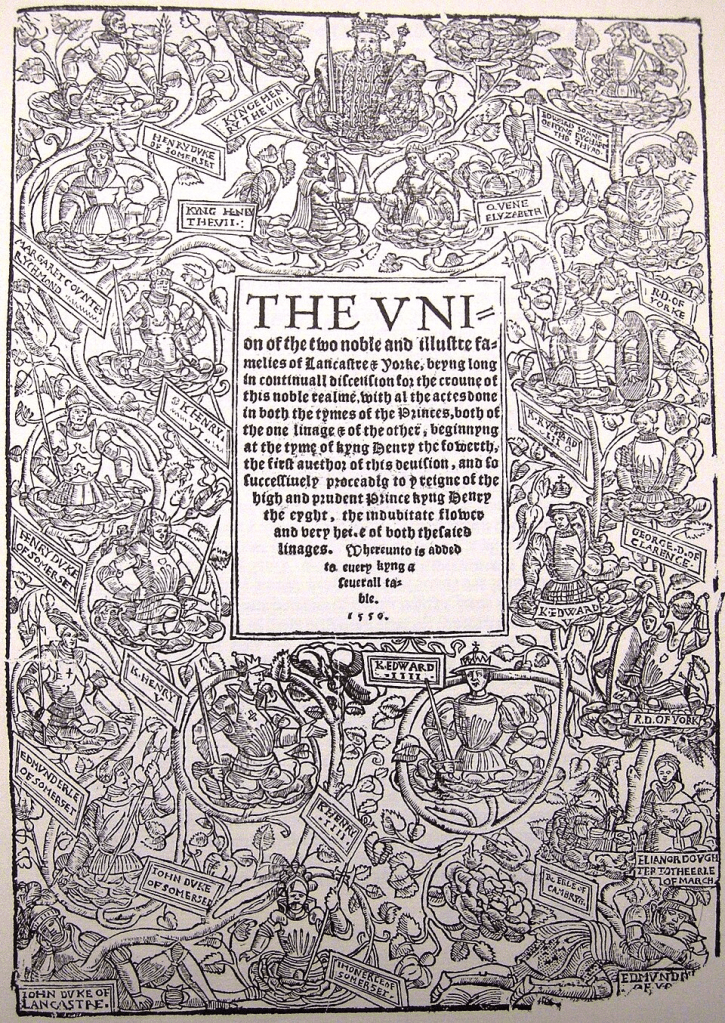
The union of the two noble and illustre famelies of Lancastre & Yorke, beeyng long in continual discension for the croune of this noble realme, with all the actes done in bothe the tymes of the princes, bothe of the one linage and of the other, beginnyng at the tyme of Kyng Henry the Fowerth, the first aucthor of this devision, and so successively proceadyng to the reigne of the high and prudent prince Kyng Henry the Eight, the undubitate flower and very heire of both the sayd linages.
The frontispiece of the second edition of the book, published in 1550, turned this idea visual, representing the York and Lancaster family trees as a pair of briar roses. At the top, Henry VIII appears in majesty at the junction of both vines.
Still earlier, in 1486, the Croyland Chronicle presents the following verse:¹²
Anno milleno, C. quater, quater atque viceno,
Adjunctis quinque, cum lux Sextilis adesset
Duplex undena, dentes Apri stupuerunt,
Et vindex albae, rosa rubra refulget in ore.On the 22nd day of August, 1485, the tusks of the boar were blunted, and the red rose, avenger of the white, shines upon us.
I’ve previously noted the boar was Richard III’s personal device. The white rose was similarly a badge of the Yorkists, beginning with Edmund of Langley, the first Duke of York, in the late fourteenth century. According to historian George Goodwin, there is considerable evidence of its use on:¹³
[B]anners, coats-of-arms, jewellery, stained glass, seals, coins, and paintings.
The red rose as a symbol of the House of Lancaster, however, is a different case. There is literally not a single firm contemporary use of it as an emblem before the Battle of Bosworth Field. Even the term Lancastrian is applied retroactively—Shakespeare never uses it. This in turn was incorporated into the Tudor rose, superimposing a white rose on a red one, when Henry married one of Woodville’s children, Elizabeth of York. Both emblems were retrospective propaganda, neatly packaging the bloody civil wars as justly resolved and presenting a continuity of the Lancastrians with a dynastic claim to the throne of England equal to that of Henry’s wife, which their union further strengthened.
The author of the Croyland Chronicle’s Second Continuation seems to have quaffed deeply of the Tudor Kool-Aid, often criticising Richard III and referring to Henry in glowing terms like:¹⁴
Principem hunc novum […] cœpit laudari ab omnibus tanquam Angelus de cœlo missus, per quem Deus dignaretur visitare plebem suam, & liberare eam de malis quibus hactenus afflicta est supra modum
This new prince […] began to be praised by all as an angel sent from heaven through whom God had deigned to visit his people and set them free from the evils which had hitherto afflicted them beyond measure.
And again, the Bard latched onto these same ideas, having Henry Tudor promise in his final speech in Richard III:¹⁵
[…] We will unite the white rose and the red.
Smile heaven upon this fair conjunction,
That long have frown’d upon their enmity!
The White Queen takes this all one step further, taking all the revisionist mythology and symbolism embodied in Carroll and Shakespeare’s works and reapplying it—ahistorically—to the original events.
As Gregory is dealing in historical fiction, she must bend to audience expectations. I’ve navigated those waters repeatedly myself, building Rome with a 500-year premature amphitheater. Even Shakespeare is guilty of this: the Temple Garden—which, while it did exist in Richard Plantaganet’s time, was only an orchard—wasn’t redesigned as a formal garden until 1591, to include a terrace, walkways, and probably roses.
Read subsequent articles in the DeDisneyfication series
Part 8: Guerrillas and the “Jungle”
Part 9A: Through a Magic Mirror Marred
Part 9A Addendum: The Woods “Over the Wall”
Part 9B: The Sum of its Versions
Part 9C: The “Snow White” Studio
Read previous articles in the DeDisneyfication series
Part 1: Straightening out “Hunchback”
Part 2 Addendum B: Your Western Wuxia Is Weak
Part 3A: “Hercules”: Myths and Mistakes
Part 3B: Doing Hera’s Work on “Hercules”
Part 4: Tale As Old As Agriculture
Part 4 Addendum: The Enchanted and the Postmodern
Part 5: Putting “Pocahontas” to Rest
Part 5 Addendum: Powhatan’s Mantle
Part 7A: The Wrong Rabbit Hole
Part 7A Addendum A: Curious Curation
Part 7A Addendum B: “Alice” in Revolt
Part 7A Addendum C: How “Alice” Grew Big in Japan
Notes
- Diane Baker Mason, “The White Queen, by Philippa Gregory”, The Globe and Mail, September 2009.
- Episode 1, “In Love With the King”, The White Queen, 2013.
- Ibid, Episode 3, “The Storm”, 2013.
- William Shakespeare, 2 Henry VI, 1.3.122–23, 1591.
- Episode 1, The White Queen, 2013.
- Shakespeare, 1 Henry VI, 2.3.25–33, ca. 1591.
- Ibid, 124–128.
- Shakespeare, Richard II, 5.1.8, 1595.
- Shakespeare, 1 Henry IV, 1.3.180, ca. 1597.
- Shakespeare, 3 Henry VI, 2.5.96–102, 1591.
- Edward Hall, The Union of the Two Noble and Illustre Families of Lancastre and Yorke (often called Hall’s Chronicle), 1548.
- Anonymous, possibly John Russell, Alia Continuatio (Second Continuation), Rerum anglicarum scriptorum Veterum Tom. I. Quorum Ingulfus nunc primum integer, cæteri nunc primum prodeunt (aka Croyland Chronicle), 1486. I used the William Fulman edition of 1684. Note the date—22nd of August, 1485—is phrased poetically; literally it’s “one thousand, 100 times four (=1400), four times 20 (=80), and five, when the light of the sixth month (August) was present, twice 11 (=22).”
- George Goodwin, Fatal Colours: Towton 1461—England’s Most Brutal Battle, 2012.
- Anonymous, 1486.
- Shakespeare, Richard III, 5.5.20–22, ca. 1592–1594.
 Deru Kugi