An intricate solution to an ancient enigma (Sator Square, Part 3)
Part 2 cleared the theoretical graveyard—Harpocrates, Nativity shepherds, boustrophedon readings, the Pater Noster anagram. What all those theories had in common was direction of travel: they started with a meaning and worked backward to the square, forcing arepo to behave, ignoring the chronology, making the geometry serve the conclusion.
The discovery of the Sator Square in Pompeii set a terminus ante quem of 79 CE, making it pretty clear it’s not Christian in origin. Other solutions were put forward, more or less far-fetched, involving overlaying a Templar cross on the figure, as well as several other patterns. Other religious contexts were also suggested, including Mithraism. I won’t go into this except to say this cult was even more of a newcomer than Christianity to the Roman world, with the earliest literary references dating to around 80 CE. A Templar origin is absurdly anachronistic.
What follows moves the other way. The square has properties—mathematical, structural, linguistic—and those properties point somewhere specific.
Dr. Nicolas Vinel’s contribution is the most historically grounded of the origin theories. Jewish communities were demonstrably present in Pompeii. But notice what Vinel actually demonstrates: an early—perhaps the earliest recoverable—act of reception. He shows us someone who could have looked at the square and seen a Judaic recognition code. He does not show us someone who put this code there. The square does not need a Jewish author to read as a code, any more than it needs a Christian author to read as Christological. Its power lies precisely in needing no author at all. Vinel has not found the origin. He has found the first reader.
Inscriptions and graffiti confirm Jewish individuals in the city—traders and freedmen, mostly. The broader Campania region had substantial Jewish settlement: Puteoli, a major port just west along the Bay of Naples, had Jewish merchants operating for generations, and Pompey’s conquest of Judea in 61 BCE had brought prisoners and slaves into the Italian south, many of whom eventually settled there.
The decades before Vesuvius erupted were not quiet ones for these communities. Emperor Claudius expelled Jews from Rome around 49 CE, pushing diaspora populations into exactly the kind of provincial cities where the Sator square has been found. Acts records it:¹
There he met a Jew named Aquila, a native of Pontus, who had recently come from Italy with his wife Priscilla, because Claudius had ordered all Jews to leave Rome.
Suetonius confirms it:²
Iudaeos impulsore Chresto assidue tumultuantis Roma expulit.
Since the Jews constantly made disturbances at the instigation of Chrestus, [Claudius] expelled them from Rome.
Then came the Jewish-Roman War (66–73 CE), ending with the destruction of the Temple. Pompeii’s end in 79 CE came nine years after Jerusalem’s.
In this context—expulsion, war, catastrophe, individuals scattered in a foreign city without an organized religious center—a recognition signal makes a different kind of sense. Not a declaration of faith. A handshake in a hostile room.
Vinel, if not the originator of the Judaic interpretation of the Square, certainly ties it up with a bow, and his work is the main source of what I’m relating here.³ I’ll note also what’s compelling is this is not a single solution, but a web of correspondences that so completely covers every aspect of the Square.

The first such element relates to the size and shape of the Square, which corresponds to the bronze altar Moses is instructed to build in Exodus:⁴
“And you shall make the altar of acacia wood, five cubits long and five cubits wide; the altar shall be square, and its height shall be three cubits. And you shall make its horns on its four corners; its horns shall be of one piece with it, and you shall overlay it with bronze.”
In Joshua, the important symbolic function of this altar is described thus:⁵
“[The altar is] a witness between us that YHWH [is] God.”
Thus, simply by its 5×5 size and shape, the Square is a representation of this altar in plan, itself a symbol of the Jewish Diaspora and faith in their God.
The next part of the solution involves a transformation of the square based on its underlying sequence of. This moves the 5×5 of numbers in order into a new configuration thus:

Essentially, two rotations are performed: the central cross is rotated clockwise 45 degrees, and the diagonal cross is also rotated the same direction, but the numbers alternate rather than maintaining their positions, with the other numbers falling fairly easily into place after that.
As I’ve implied in the title to this article, the fact a rotation is performed, and the solution uses the proper rotas-first form of the square, means the first line gives a clue to this solution.
Now we are looking at a figure known as a magic square: In a magic square, a figure whose discovery easily predates the Square, the numbers in each row and column, as well as the diagonals, add up to the same number. In the 5×5 version, this number is 65, the center remains 13, and in each of the two concentric squares adding a number with the one across from it adds up to 26.
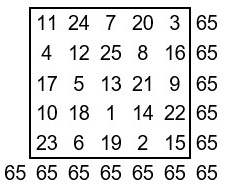
The numbers 13, 26, and 65 are numerical representations of the divine name in the gematria, a system that assigns numerical values to words. Though it was originally Assyro–Babylonian–Greek, its use in Jewish mysticism has a long and well-known history.
Using this system, 13 is אֶחָד (ehad) “One”, and indeed, there is but one ⟨N⟩—in the center where all things begin. 26 is the numerical value of the Tetragrammaton, the four letters transliterating the name of God, i.e. YHWH. At some point, people decided that saying YHWH aloud was not cool—think the repeated stonings in Monty Python’s Life of Brian (1979)—and אֲדֹנָי (Adonai) was used in its place. 65 is the gematric value of Adonai.
Now, while it is true there are many, many names of God, these, particularly the last two, are very important ones. 13 also corresponds to ⟨N⟩, in yet another way, as it is the 13th letter of both the Greek and Latin alphabets. Note it is not contended the letters simply correspond to the numerical values of the magic square, but the magic square is important to transforming the square.
When we move from the numbers back to the letters, the result of the transformation is a set of rows and columns, each of which is its own palindrome, and the central tenet cross remains, but on a diagonal.
T O P O T
A E R E A
R S N S R
A E R E A
T O P O T
The fact this transformation yields this result is compelling in itself, but there’s more: Now there appear not only the words, but a picture also of the bronze altar of the temple: now we see it in profile, where its biblical dimensions are 5×3, and it is made up of the Latin words:

ARA AEREA
altar of bronze
The tenet’s ⟨T⟩s at the corners also correspond to the biblical instructions for the altar’s construction as the “horns on its four corners”,⁶ where the physical shape of the ⟨T⟩ is suggestive of this description. Furthermore, as the holiest part of the altar, there is a tradition of grabbing these horns as a sort of sanctuary, such that in the Vulgate version of Kings it says of אֲדֹנִיָּה (Adonijah), a servant of Solomon fearful of being put to death:⁷
[…] tenuit cornu altaris.
[…] he […] took hold of the horns of the altar.
The cryptogram’s use of ⟨T⟩ to represent these horns as well as tying in the word tenet as what one does with them can only be called extremely clever—here, tenuit is simply an inflected form of tenet. Also, though I am aware the Vulgate did not yet exist, having pointed it out in the previous part, I am not engaging in an anachronism, as this is a simple one-word correspondence between Hebrew and Latin.
Furthermore, and working off the same aerea we’ve already seen, is a reference to the prophylactic symbol of the brazen snake created by Moses to cure those poisoned by real ones:

SERPENS AEREA
snake of bronze
And, as with the previously revealed words, the word serpens describes what it is with its shape, tracing a snaky path. Additionally, it is “lifted up” just as the snake it represents was on a pole. The corresponding bible passage from Numbers is:⁸
And the Lord said to him: Make a brazen serpent, and set it up for a sign: whosoever being struck shall look on it, shall live. Moses therefore made a brazen serpent, and set it up for a sign: which when they that were bitten looked upon, they were healed.

Finally, both the double ara aerea and the double serpens in the square, rather than simply being palindromes, continue forever. They share their first and last letters and read in an unending circle—the opposite of the ungodly, as described in Solomonic wisdom:⁹
[A]fter our end there is no returning: for it is fast sealed, so that no man cometh again.
The square succeeded beyond any reasonable intention. Without a key, every receiver could furnish their own. Medieval practitioners would find a childbirth charm; others would find the name of God.
This is why the square “goes ’round” so easily—why it rolls out of Pompeii and into Coptic Egypt, Nubia, medieval Iceland, without losing power along the way. It travels without its meaning intact, because the meaning was never the cargo. The form is the cargo, and the form is legible as sacred without being legible as specific. We will see in the final part of this series just how little of the “meaning” you can strip away before the square stops working: the answer, startlingly, is almost all of it.
This article is part of the Sator Square series
Notes
- Acts 18:2:2, ca. 50–52, New International Version, 1973
- Gaius Suetonius Tranquillus, Diuus Claudius 25.4, De vita Caesarum (On the Life of the Caesars), 121 CE.
- Nicolas Vinel, “The Hidden Judaism of the Sator Square in Pompeii”, Revue de l’histoire des religions, April 2006.
- Exod. 27:1, New American Standard Bible (NASB), 1977.
- Josh. 22:34, Literal Standard Version (LSV), 2020.
- Exod. 27:1, New King James Bible (NKJV), 1982.
- Reges 1:51, Biblia Sacra Vulgata (VULGATE), 405, my translation and emphasis.
- Num. 21:8–9, Douay-Rheims Bible, 1609.
- Wis. 2:5, King James Version (KJV), 1611.


Amazing read!
Sorry to ask a completely unrelated question.
As I was reading I couldn’t stop to think that you would be perfect for helping me find a name for this idea I have… or maybe suggest me some sources of websites where perhaps I can keep on searching.
I’m breaking my head looking for an ancient catchy name for a world where the gods have vanished.
LikeLiked by 1 person
Off the top of my head, Ἄθεος (Atheos), related to atheist, and one of whose meanings is “abandoned by the gods”.
LikeLike
Thats a very good name off the top of your head, it could work. Thank you.
And apologies for contacting you through this platform I could not find your email anywhere.
LikeLiked by 1 person