How I deciphered an indecipherable inscription (Solving the Sword, Part 1)
My Facebook memories tell me an article appeared in the British Library’s Medieval Manuscripts blog roughly a year ago, with the language-nerd-clickbait title, “Help Us Decipher This Inscription”.¹ I bit and was far from disappointed.
What was presented was a sword bearing a mysterious inscription:

The item in question was found in the River Witham, Lincolnshire, in July 1825, and was presented to the Royal Archaeological Institute by the registrar to the Bishop of Lincoln.
The rest of the known information was as follows:
A double-edged sword, 13th century, possibly of German manufacture but discovered in England in the 19th century.
And finally, this:
An intriguing feature of this sword is an as yet indecipherable inscription, found along one of its edges and inlaid in gold wire. It has been speculated that this is a religious invocation, since the language is unknown. Here’s what the inscription seems to read:
+NDXOXCHWDRGHDXORVI+
As an amateur historian, I’d call my knowledge spotty: I know a lot about a few specific times and places, but I have definite blind spots as well. And codebreaking, which is essentially what this comes down to? I’ve dabbled in it and certainly have done my fair share of crosswords. As for the languages of Medieval Europe, one would need to decipher this, I know a bit, and enough about the etymological drift of words from Latin and the Germanic languages. I acknowledge a much greater than passing knowledge of the weapons and warfare of the Middle Ages due to a number of factors.
In any case, something about this particular challenge seemed to be right up my alley. I had also recently returned from a family trip to Europe full of such relics, and perhaps flushed from that experience, I decided I’d give this riddle of steel a shot.
So to work. First, it is more than safe to assume this sword belonged to an aristocrat. An inscribed sword in the hands of a man at arms would make little sense. He would be unlikely to be able to read it, let alone have any use for such fripperies. He’d have been most likely to pick out the gold wire and sell it instead of seeing such wealth squandered in this way. Meanwhile, among the elite, inscribed swords were very much in vogue.
Next, the inscription is extremely likely to be in Latin. Much as English is today, Latin was at that time a lingua franca, or international language. Typically, Latin inscriptions, even going back to Roman times, are initialisms. SPQR is a well-known example, meaning:
S[enatus] P[opulus]q[ue] [R]omanus
The Senate and People of Rome
One can also see here, this is not a strict initialism—the ⟨q⟩ appears mid-word. And in fact, initialism and abbreviations appear mixed together in many inscriptions from the period in question, which obviously increases the challenge—these letters might stand for nearly anything.
The time and location of the sword places it in Medieval Christendom when religious and martial zeal went hand in hand, and so sword inscriptions tended to be invocations. These are generally marked by a cross appearing at least at the beginning and often also at the end, just as this one is. Such crosses, often with T-shaped crossbars, have religious and heraldic significance as a cross potent or Jerusalem cross. There are also a few better known inscription/ initialisms; DIC, NED, and SDX:
- D[ominus] I[esus] C[hristus]: Lord Jesus Christ
- N[omen] E[ternum] D[ei]: In the name of eternal God
- S[anctus] D[ominus] X[ristus]: Holy Lord Christ
As can be seen above ⟨Χ⟩, the Greek letter chi can be used, as can Latin ⟨C⟩ for Christ. ⟨X⟩ also forms a cross, and so doubles down on the symbolism.²
For the purpose of deciphering, elements of the inscription have to be relatively common dicta latina, not just any possible formulae with the pattern of the initialisms: If people couldn’t understand your sword inscription relatively easily, it would defeat the purpose. Also, if the codebreaker is just making things up, the chances of being correct rapidly decline.
Like any good codebreaker, I looked for an irregularity as a chink in the armor to exploit—a way in. It was the ⟨W⟩.
Latin contained the sound /w/, but spelled it with the letter ⟨v⟩. This ⟨v⟩ did double duty in fact, for both consonantal /w/ and vocalic /u/. In writings conservative of Latin orthography, one sees the occasional MVSEVM. On the other hand, some have used ⟨u⟩ in order to give Classical Latin its proper phonetic values, as in ueni, uidi, uici.
The letter ⟨w⟩ is a relatively recent innovation. The consonantal form of the Latin ⟨v⟩ had shifted in its pronunciation by the Medieval period, leaving the Germanic /w/ sound unrepresented in the alphabet. For a while, the runic form ⟨ƿ⟩, known as wynn was borrowed, but it’s too similar both to ⟨p⟩ and to ⟨þ⟩ (called thorn with the phonetic value /θ/ or /ð/, which was also soon dropped in favor of ⟨th⟩), so eventually, ⟨uu⟩ or ⟨vv⟩ came to be used, which soon were ligatured together, and ultimately became our modern ⟨w⟩.³ In fact, its very name reflects this origin—a doubling of ⟨u⟩.
Because of all this, it is very clear the inscription’s ⟨W⟩ cannot stand for a Latin word. So what word is this? Generally, what people want to write on swords is their name. One such is:⁴
ERICVSDXCNERICSDX
Which can be analyzed as:
ERICVS D[v]X C NERIC[v]S D[v]X
Duke Ericus (C) of Närke (Duke)
The ⟨C⟩ here is interpreted as a chrismon—a symbol for Christ. Inscriptions using both ⟨C⟩ and ⟨X⟩ for this purpose are known. I’ll note there is some oddness with the repetition of the word dux, but other inscriptions bear out this interpretation.
Looking across the names common to the European aristocracy of the time, there is one that jumps out as both non-Latin and quite popular: it’s clear to me this name is some form of William. The name is of Germanic origin and particularly favored since the Norman conquest of England. But which William? As I have selected it because of its popularity, among the rolls of the nobility, there is many a William, Wilhelm, Wellëm, Wilhelmus, Willelmus, and Willem to choose from, so I needed a way to narrow the field.
Looking back at the example of Ericus’ sword, what appears together with the aristocrat’s name is his title. I needed to find a style, in the sense of the proper address of a noble, matching this pattern. After poring at some length over the various Williams of the period, one seemed to finally fit the bill (yes, I did): Willem II of Holland.
Why did he stand out? First of all, his title is count, so in Latin his name and title would be rendered as:
C[omes] H[ollandia] W[illelmus]
And so matching the beginning of the middle section of the inscription:
+NDXOXCHWDRGHDXORVI+
So why not choose his grandfather, Willem I of Holland? Well, it turns out Willem II also became King of Germany when Frederick II was excommunicated, and for whatever reason, the southern Belgian region of Hainault was also thrown into the bargain. So that gives us:
+NDXOXCHWDRGHDXORVI+
C[omes] H[ollandia] W[illelmus,] R[ex] G[ermania et] H[ainault]
Promising, but what about the ⟨D⟩s? Well, in the religion-obsessed Middle Ages, it’s an odds-on bet ⟨D⟩ = some form of deus. And in fact, noble styles commonly use it. I interpret this as:
C[omes] H[ollandia] W[illelmus] D[ei gratia,] R[ex] G[ermania et] H[ainault] D[ei nutu]
Count of Holland Willem by the grace of God, King of Germany and Hainault by the will of God
This not only neatly fills out this middle section, this is a very common style of form, and also reflects the way in which he received his titles: “by the grace of God” meaning he was born into this role, and “by the will of God” reflecting he came into this role later in his life. The dei nutu phrasing is used in a roughly contemporary legal argument as to whether a Parisian college was entitled to collect rent on the marketplaces and mill-houses of Rouen under Henry V of England. They make it clear Normandy was his by right of conquest, not by inheritance, with the phrase:⁵
[…] Divino Nutu, Ducatum nostrum Normanniae, & alias Partes in Regno Franciae Nobis subjectas, Conquisivimus.
[…] by divine Providence, our aforesaid Duchy and other parts of the Realm of France are subject, by Conquest.
I consider this section solved.
Turning to the initial section, now we have confirmed the inscription is in Latin and of a Christian character, it’s very easy to understand this as the very common invocation inscription initialism:
[in] N[omine] D[omini]
In the name of God
The XOX following this, similar to the chrismon used on Ericus’s sword, is a symbol, also sometimes appearing as OXO, for the Holy Trinity.
The final section is more difficult, but the clue to it comes from Willem’s German kingship. In the words of Professor Henry Jones (Senior), “I shuddenly remembered my Charlemagne.” Ever since his rule and adoption of Roman traditions, one hymn in particular became nearly synonymous with the emperor: Laudes Regiæ—“Praises of the King”.⁶ The first six words in particular, Christus vincit! Christus regnat! Christus imperat! (“Christ conquers! Christ reigns! Christ commands!”) became Charlemagne’s battle cry, and were repeated often among the kings of Europe.
The use of this hymn is fantastically self-serving for the kings of Christendom. It closely associates their own temporal kingships with the spiritual kingship of Christ—the divine right of kings delivered in six words. So it’s not just a common motto, it is essentially THE dictum latinum among these kings. Here, for example, is an Écu á la Couronne:
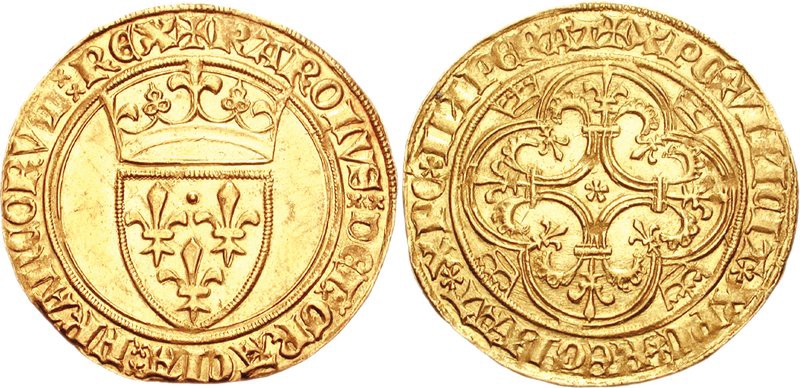
The coin was issued by Holy Roman Emperor (HRE) Charles VI in 1384. The obverse bears the legend:
KAROLUS FRANCORUM DEI GRACIA REX
Charles by the grace of God, king of France
And on the reverse:
XP[iσto]C V[in]CIT X[Piσto]C R[egn]AT XP[iσto]C I[n]PERAT
In fact, numismatics in the Christian Middle Ages has much in common with the sword inscriptions of the day, and both are quite similar to noble seals: names, titles, and invocations make up much of the matter. We can already see the similarity of the style given here and the one I have interpreted for the sword. Finally, Willem is technically the anti-king. He was raised to this position by political powers in opposition to HRE Frederick II, so it is important to establish his legitimacy, which is exactly the purpose of this phrase. For all these reasons, I am on very firm ground in interpreting the last part of the inscription as:
X[piσt]O[σ] R[egnat! Xpiσtoσ] V[incit! Xpiσtoσ] I[mperat!]
Christ conquers! Christ reigns! Christ commands!
The XO form for Christ is somewhat uncommon—Christus is the Latin form, but an initial ⟨X⟩ is frequently used, and as it is the Greek form, ⟨O⟩ goes along with it, and in fact the Écu á la Couronne also uses the Greek form, though a different one.⁷ I also feel the inscriber might have liked the symmetry with the OXO earlier in the inscription. This makes the full inscription:
[in] N[omine] D[omini] (patris et filii et spiritus sancti)
C[omes] H[ollandia] W[illelmus,] R[ex] G[ermania et] H[ainault]
X[piσt]O[σ] R[egnat! Xpiσtoσ] V[incit! Xpiσtoσ] I[mperat!]
So all together in English we have:
In the Name of the Lord; of the Father and of the Son, and of the Holy Ghost
Count of Holland Willem by the grace of God, King of Germany and Hainault by the will of God
Christ reigns! Christ conquers! Christ commands!
In summary, I think this sword was made for Willem II’s coronation as the King of Germany and Hainault, proclaiming his new title and the divine legitimacy of his office. Obviously, my explanation fits well with its German manufacture as well. I also have some ideas as to how the sword of a ruler from the Low Countries of the Continent ended up in a river in England, which I will discuss in upcoming articles. But the pieces I have presented here fit together solidly. I’d have liked to submit my solution to the British Library, but they had received such overwhelming response, comments were closed.
Read subsequent articles in the Solving the Sword series
Notes
- Julian Harrison,“Help Us Decipher This Inscription”, British Library Medieval manuscripts blog, 2015.
- Greek was also the language of the earliest Bibles in the West, with the Latin Vulgate appearing much later. Latin ⟨I⟩ of course corresponds to English ⟨J⟩.
- ⟨þ⟩ is called thorn with the phonetic value /θ/ or /ð/, which was also soon dropped in favor of ⟨th⟩. Analogous to the creation of ⟨w⟩ as a ligature of two letters becoming its own ghapheme is German ⟨ß⟩ (known as Eszett or scharfes S) joining the letters ⟨s⟩ and ⟨z⟩.
- Karlstad Sword, Värmlands Museum. Närke is a province in Sweden.
- “Pro Canonicis de Poissy” (“For the Canons of Poissy”) 16 Dec 1421, 10:161, in Rymer’s Foedera, ed. Thomas Rymer, 1739-1745. Emphasis mine.
- Also known as Laudes Imperiale, “Praises of the Emperor”, in Charlemagne’s case.
- XPC is XP[iσto]Σ, where Greek ⟨Σ⟩ is rendered as Latin ⟨C⟩.








 Deru Kugi