Disney’s Live-Action “Little Mermaid” Answers Its Own Question (DeDisneyfication Part 10, Addendum)
Four years ago, I asked a question.
Disney had cast Halle Bailey as Ariel in their live-action Little Mermaid (2023, LALM), and the backlash was predictable, and predictably wrong.
The real question was whether Disney would use Bailey’s casting to engage with the layers of subtext the story has been accumulating since Andersen—queer longing, bodily wrongness, the outsider who trades everything for admission to a world that will never fully accept her—or whether it would be tokenism in an otherwise complete rehash.
So I watched the live-action LALM. It was fine.
Bailey is good. Her Ariel is less ditzy than Jodi Benson’s, a bit more self-possessed, though still buying some of Scuttle’s (Awkwafina) explanations of artifacts from the human world. The songs are mostly intact. The beats land where they’re supposed to land. If you liked the original Little Mermaid (1989, OLM) and wanted to see it again with better water effects, this might be for you.
It did not engage with Andersen’s subtext. It did not engage with Ashman’s subtext. It did not engage with any of the layers of meaning I excavated. Of course not.
What it did instead was create another.
Before discussing this, it’s worth noting the merest whisper of realization in OLM of what Andersen put into his story was erased in LALM. According to professor of film studies Niall Richardson:¹
[T]he 2023 remake is, arguably, less progressive in queer representation than the original. Although Melissa McCarthy has spoken of how her performance of Ursula was inspired by drag queen aesthetics, she is clearly not a drag queen but a middle-class, heterosexual, cis woman. Unlike the 1989 Ursula, with her deep voice and touchy-feely tentacles, McCarthy’s sea witch is definitely not lesbian coded. Also, missing from the 2023 “Poor Unfortunate Souls” is the moment when Ursula mocks heteronormativity. The lyrics still reference a love-starved couple but there is no illustration of them. Therefore, Ursula’s queer critique of heteronormative romance and gendered standards of beauty is lost.
LALM’s most consequential choice is neither its casting nor its script. Oddly, it’s the art direction. OLM’s human world is a vaguely Mediterranean fairy-tale kingdom—white cliffs, a palace, no particular century. LALM relocates the story to the colonial Caribbean.
This is never stated outright. But it doesn’t need to be. The architecture is colonial. The marketplace is Caribbean. The population is multiethnic in the specific way that Caribbean port towns were—which is to say, in a way that is explicable, and the explanation is the Atlantic slave trade.
I assume the basis for this recontextualization comes in the person of OLM’s Sebastian (Samuel E. Wright), together with his Oscar- and Grammy-winning song, “Under the Sea”. Sebastian is clearly black-coded, with stereotypically thick lips and a Trinidadian accent. The song is calypso/ reggae, complete with steel drums.
LALM’s production walks through the door the song and crustacean opened without looking. The first consequence is color-blind casting.
In theory, the practice of casting without regard to an actor’s race, ethnicity, or skin color is freeing. In practice, it’s more complicated. As Richardson notes:²
The spectator is placed in a confusing position given that they are expected not to see skin colour as significant yet recognise the casting as representing multicultural diversity.
This is not a new critique. August Wilson called color-blind casting:³
[A]n aberrant idea that has never had any validity other than as a tool of the Cultural Imperialist who views their American Culture, rooted in the icons of European Culture, as beyond reproach in its perfection.
His argument was not about exclusion but about erasure:⁴
Many whites say, “Oh, I don’t see color.” We want you to see us. We are black and beautiful. […] We come from a long line of honorable people with complex codes of ethics and social discourse who devised myths and systems of cosmology and systems of economics, who were themselves part of a long social and political history. We are not ashamed and do not need you to be ashamed for us.
Thus, the refusal to see race is itself a racial act—it strips the specificity from bodies, whether LALM’s script acknowledges it or not.
Sociologist Eduardo Bonilla-Silva has a name for the broader phenomenon: color-blind racism. His framework identifies the central paradox—how racial inequality persists in a society where almost no one considers themselves racist, commenting:⁵
[T]oday racial practices operate in a “now you see it, now you don’t” fashion.
He elaborates the mechanism as a set of rhetorical frames that explain away racial disparity through non-racial language: choice, preference, culture, progress.
Race is rendered unspeakable not because it has ceased to matter but because acknowledging it has become socially impermissible. The result, as Bonilla-Silva puts it, is a “racism without racists”.⁶
LALM is a case study for this. The Caribbean setting is populated with racial diversity—indeed, it foregrounds it. But the diversity is untethered from the history that produced it. Nobody in this 18th-century Caribbean port is enslaved, colonised, or displaced. No one’s presence requires explanation.
I could not put this aside during my viewing. Finding the complete absence of any mention of it in the “Critical Response” section of the film’s Wikipedia article,⁷ I wondered if it was just me being overly critical, but then I remembered that never happens.
Then I found Marcus Ryder’s article on LALM. He celebrates Bailey’s casting in the title role, but identifies the same issue I did:⁸
The film is set in the Caribbean in the 18th century. It does not specify exactly when, but judging from the ships, clothes and other references it is during a time of African chattel slavery. And yet there is not a single direct reference to slavery and the islanders live in racial harmony.
His view of this is dim:⁹
Setting the fantastical story in this time and place is literally the equivalent of setting a love story between Jew and Gentile in 1940 Germany and ignoring the Jewish holocaust. Or possibly more accurately setting it in a slave plantation in America’s antebellum south and pretending the enslaved Africans were happy.
His second analogy actually lives in a different—now forever-vaulted—Disney offering, Song of the South.
Ryder’s proposed fix is intriguing: repositioning the story to post-1804 Haiti, where the constitution explicitly rejected racial categories.¹⁰ But I’m more interested in what is produced by the choice, as made.
In fact, Richardson’s analysis of OLM finds a racial layer already baked in—Ursula as a Reagan-era welfare queen, “Under the Sea” as racialized spectacle, the land/ sea hierarchy mapping onto a white/ nonwhite one. As he puts it:¹¹
In representing Ariel as determined to flee Mer society to be part of life on land, the film legitimates a white supremacist narrative in which (white) land society is deemed preferable and superior to multiethnic Mer life.
These are problems a remake could theoretically address.
LALM’s solution renders color “devoid of socio-political significance”:¹²
[G]iven that the film has coded race as a mere aesthetic of colour, then the ideology of this sequence is obfuscated. The [marketplace dance] sequence’s tourist gaze is merely marvelling at the colourful, rather than raced, Caribbean market. It is also significant that this gaze, suggesting uncertainty and fear, resumes the standard editing of reverse field cuts only when the white Jodi Benson (who voiced Ariel in the 1989 version) makes a cameo appearance. The change in cinematography denotes that Ariel now feels less uneasy with the exotic market but this only happens when she encounters the very reassuring (and, for the spectator, nostalgic) image of this lovely, white woman.
Richardson also identifies the “passing into white society” narrative implicitly but doesn’t develop it. He sees the racial hierarchy, sees Ariel moving from multiethnic sea to white land—but stops short of asking what that means when the mermaid is also Black.
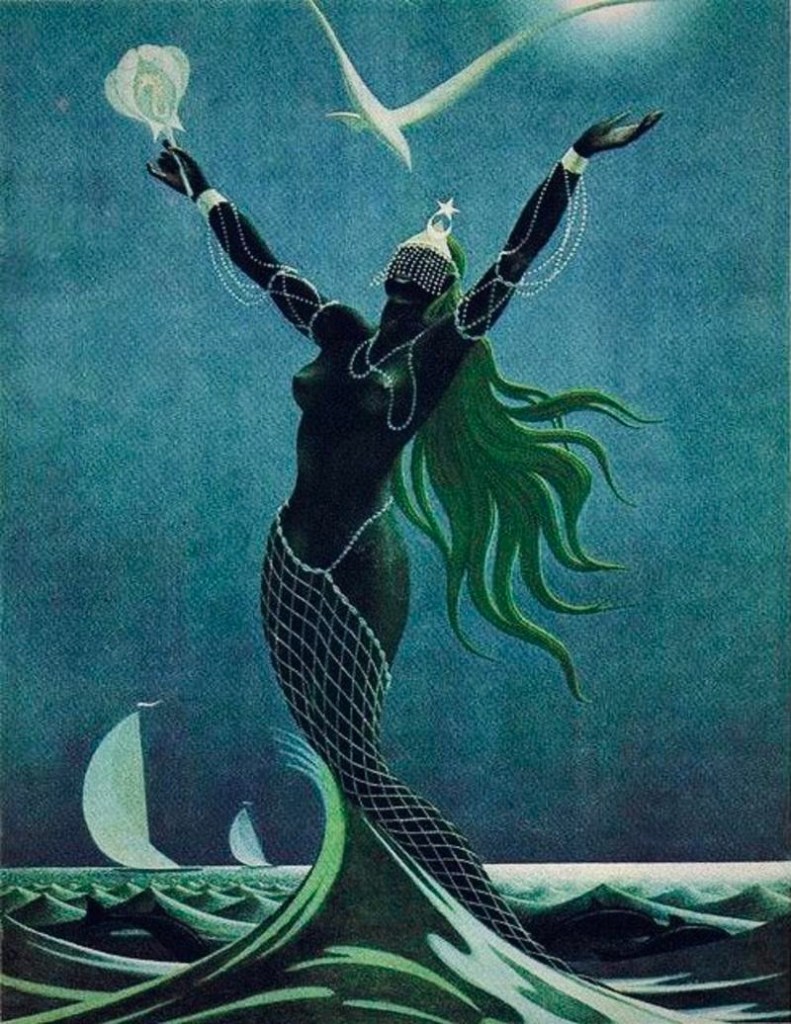
In OLM, the metaphor operates at the level of species—havfrue, half-woman, less-than. But relocate that story to the colonial Caribbean, cast a Black woman as the creature who transforms her body to join a white-dominated society, and a second reading arises, whether the film intends it or not. The metaphor is no longer only species. It can also be read as race.
The film actually needs this not to be true. But the art direction does its work. When a Black woman’s body transforms to gain access to a world coded as white-dominated and colonial, the story is no longer about a girl who wants legs. It is about passing. And the half-state—half-mermaid, half-human, never fully either—maps onto the lived experience of mixed-race existence in a slave society with a precision the film cannot afford to acknowledge.
The racial order LALM’s setting erases produced mixed-race bodies with an unbearable evidentiary weight. Frederick Douglass understood this with a clarity that burned. His own body—the mixed-race child of an enslaved woman and her white enslaver—was itself an argument. As he puts it:¹³
[I]t is […] plain that a very different-looking class of people are springing up at the south, and are now held in slavery, from those originally brought to this country from Africa […]. [T]housands are ushered into the world, annually, who, like myself, owe their existence to white fathers, and those fathers most frequently their own masters.
And more succinctly:¹⁴
[T]he slaveholder, in cases not a few, sustains to his slaves the double relation of master and father.
Every mixed-race person in the antebellum South was evidence the racial binary was a fiction, that the categories on which the entire system of slavery depended did not hold. His body dismantled the theory by existing.
Ariel’s body, in this setting, could make the same argument. A creature who is half one thing and half another, whose existence disproves the categories—that is what mermaids have always been, and that is what Douglass weaponized. The half-state is the oldest and most radical thing about the mermaid myth.
But the film needs Ariel’s transformation to be a happy ending. She gets the prince, she gets the legs, she gets to stay. Less-than becomes enough. Which means the film can’t allow the metaphor to activate—if it does, getting to stay in colonial Caribbean society means passing, means erasure, means becoming white enough. The happy ending is an assimilation narrative the film doesn’t know it’s telling.
So Disney’s answer to my question from four years ago is worse than I expected. Tokenism is at least legible—it knows what it’s doing and chooses not to do more. What LALM does is use a setting so freighted with history it transforms the story, then pretends that transformation hasn’t occurred.
This article is a part of the Dedisneyfication series, and an addendum to “The Little Less-Than”
Notes
- Niall Richardson, “Part of Whose World? How The Little Mermaid (2023) Attempts to Revise the Racist Tropes of the 1989 Animated Film Musical”, Alphaville: Journal of Film and Screen Media, 2024.
- Ibid., citing Christine Geraghty, “Casting for the Public Good: BAME Casting in British Film and Television in the 2010s”, Adaptation, 2021, which, unfortunately, I could not consult.
- August Wilson, “The Ground on Which I Stand.” American Theatre, September 1996.
- Ibid.
- Eduardo Bonilla-Silva, Racism without Racists: Color-Blind Racism and the Persistence of Racial Inequality in America, 2003.
- Ibid.
- “The Little Mermaid (2023 film); Critical Response”, Wikipedia, retrieved August 2026.
- Marcus Ryder, “Disney’s The Little Mermaid, Caribbean Slavery, and Telling the Truth to Children” Black On White TV (website), May, 2023.
- Ibid.
- Ibid.
- Richardson, 2024.
- Ibid.
- Frederick Douglass, Narrative of the Life of Frederick Douglass, an American Slave, 1845.
- Ibid.

