Mesopotamian ritual grammar and the defixio (Defixiones, Part 8 Addendum; Continuity of Magic from East to West, Part 6 Addendum)
By the mid-to-late eighth century BCE, lead had already become a practical writing surface in Anatolia. Hieroglyphic Luwian strips from Kululu record personal names and towns, commodities, and census material;¹ a strip from Yassıhöyük (modern Kırşehir, Türkiye) carries an administrative letter from a man named Muwatalli to his overlord, Tuwati.² But none of these is a curse.
Thus, writing on lead appears hundreds of years before the Graeco-Roman use of thin, folded sheets of the material to bind an enemy. In this sense, the defixio—curse tablet—isn’t a sudden innovation, but a slow evolution.
Although I’ve argued a general east-west direction for many magical practices in the ancient world, I can’t claim an unbroken line from Ancient Southwest Asia (ASWA) to Greece for the curse tablet as such. Its is a history of converging possibilities: writing made durable by burial, foldable and concealable metal sheets, names of those targeted for punishment by supernatural powers. The defixio simply joins these into a single act.
I’ll trace a more diffuse inheritance here: materials, acts of deposition, and ways of imagining written words as able to outlast, conceal, bind, or destroy. These possibilities could travel, be adapted, or arise again in contact zones without necessarily preserving a single unbroken ritual lineage.
A story of Mesopotamian foundation deposits is given in my earlier article, The Nail of Babylon: clay cones and pegs of divine and royal figures, inscriptions pressed into new buildings, all working to make a temple builder’s claim permanent beneath its walls. This earlier tradition establishes the point of departure.
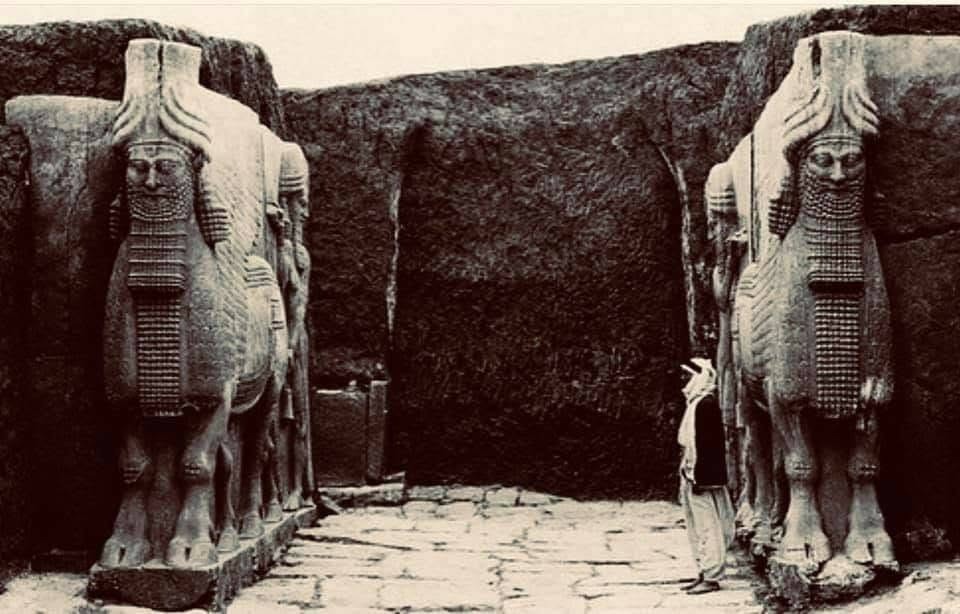
Writing was deposited in the earth, made to outlast the writer. It could even carry threats against anyone who undid what had been made, as we see in this inscription of Sargon II:³
𒊭𒅁𒋃𒋡𒋾𒅀𒌑𒅘𒅗𒊒𒈠𒁍𒌦𒈾𒉌𒅀𒌑𒆤𒄷𒌑
𒊻𒍮𒋥𒂊𒍢𒊒𒌑𒌑𒊓𒆪𒈠𒋛𒈠𒋾𒅀𒌑𒉺𒀾𒃻𒂅𒀭𒌍𒀭𒌓
𒀭𒅎𒅇𒀭𒎌𒀀𒈨𒊮𒁉𒋙𒈬𒋙𒆰𒋙𒄿𒈾𒆳𒇸𒄣𒌓𒈠
𒄿𒈾𒆠𒋫𒇽𒉽𒋙𒇷𒊺𒅆𒁍𒍑𒅗𒎌(As for) the one who alters the work of my hands, mutilates my features (on a relief), obliterates the reliefs that I have engraved, or effaces my own representation(s), may the gods Sîn, Šamaš, Adad, and the great gods who dwell there remove his name (and) his descendant(s) from the land and make him live in bondage under his enemy.
The royal world’s writing went to different places. An anathema like this one could stand openly on a monumental guardian, warning the living at a threshold; a foundation deposit could hide a royal claim beneath the building itself. Together they establish two traditions later curse tablets fuse: writing as protection, and writing entrusted to the earth.
Long before lead curse tablets, Mesopotamian ritual texts paired spoken formulae with acts of sympathetic destruction: a hostile force smashed like a pot, a victim’s figurine sunk in water or thrown into fire, an enemy’s image buried in the ground and pierced with thorns.
By the 13th–11th centuries BCE, the Middle Assyrian anti-witchcraft tradition already imagines a victim’s suffering as reversible:⁴
[…] kišpīša ruḫêša saḫārim-ma ṣabātīša kaššāpi
u [kaššāpti][…] that her witchcraft (and) her sorcery turn (back)—be it warlock or witch, [who bewitched him]—and seize her, to bind warlock and [witch]
Later, in the early first millennium BCE, the Maqlû Akkadian incantation series makes the constraining grammar still more explicit:⁵
akassikunuši akammikunuši anamdinkunuši
ana Gira qāmê qālî kāsî
kāšidu ša kaššapātiI bind you, I tie you up, I give you over, to Girra, who burns, incinerates, binds, overpowers and seizes the sorceress.
This language begins to sound uncannily close to the defixio.
Curse tablets did not invent the logic by which words could bind a future body. Across ASWA, oaths and treaties made that logic public: stipulated conditions, divine witnesses, and a threatened consequence if the conditions were broken. As Anne Marie Kitz puts it, oaths are “a form of conditional self-cursing”.⁶ The oath-taker does not merely promise obedience; he places himself within the reach of a punishment already named.
Hittite treaty formulae make the structure unusually visible. In the treaty of Šuppiluliuma I and Huqqana, the king declares:⁷
kāšatta kūs uddār linkiya kattan tehun nukán kedani uddanī 1-LI-IM DINGIR.MEŠ tuliya halziwen
I have now placed these words under oath for you, and I have summoned the Thousand Gods to assembly in this matter.
The gods are not decorative witnesses. They guarantee the words, judge their breach, and become agents of the sanction.
Elsewhere, oath and treaty rituals could give the threatened future a material shape. In the Sefire treaty, wax and clay (among others) are used analogically for what should happen to the perjurer, likely accompanied by Assyrian priests physically burning wax figurines and throwing clay shapes into water:⁸
kī ša ṣalmu ša iškūri ina išāti iššarrapūni ša ṭīdi ina mê immahhahūni i[ī] hanni’e Iānkunu ina girra liqmû ina mê luṭabbû
Just as an image of wax is burnt in the fire and one of clay dissolved in water, (so) may your figure be burnt in the fire and sunk in water!
Hittite military oaths likewise place wax and sheep fat in the swearers’ hands, whence they are cast into flame: as the materials melt and separate, so should the oath-breaker.⁹ The curse is thus at once conditional speech and enacted prognosis.
Biblical covenantal curses also belong within this wider ritual grammar. The force of Deuteronomy’s blessings and maledictions lies in a widely attested architecture, made public and conditional: if Israel breaks the command, YHWH will enforce the consequences. Deut 28 begins with 14 lines on blessings to be had from obeying the Lord, then continues with another 54 curses for disobedience. It’s far too lengthy to reproduce here, but I’ll provide a sample:¹⁰
The Lord will strike you with wasting disease, with fever and inflammation, with scorching heat and drought, with blight and mildew, which will plague you until you perish. The sky over your head will be bronze, the ground beneath you iron. The Lord will turn the rain of your country into dust and powder; it will come down from the skies until you are destroyed.
The defixio narrows and redirects this apparatus. Its writer is not binding himself to a public compact, but requesting supernatural constraint of an opponent. Yet condition, divine enforcement, and materialized act still grow from the same root. A lead curse tablet preserves the confidence that the proper words addressed to the proper authority can hold someone fast.
The material used for an inscription is also important. Before a foundation tablet could dedicate a city to its patron gods, it already carried a history, a nature, and a force.
Mesopotamian texts reflect how:¹¹
In the mythological context of the heroic epic Lugal-e, after defeating the primordial being Asakku, the god Ninurta fashions the mountains from the vanquished foe and determines the destiny of every stone. Some stones are cursed, while others are endowed with positive attributes, each receiving its specific place and role in the world. The myth illustrates that stones were not viewed merely as inanimate matter but were considered to possess specific powers and qualities that dictated their function.
The point is not that every material had one fixed symbolic meaning. Rather:¹²
That substance and function were not clearly separated in the Mesopotamian conception is also demonstrated by the lexical list ur₅-ra = ḫubullu XVI, serially reproduced from the Old Babylonian period onward: this “dictionary of the material world,” organized by subject groups, makes no clear distinction between different types of stone and the objects made from them.
In such a world, a foundation deposit was not simply a cache of durable media. To place named substances beneath a temple was to recruit their particular destinies into the building’s future: permanence, splendor, protection.
Sargon’s foundation deposit is therefore not a set of duplicate texts in increasingly precious materials. It is a material assembly, each substance bringing its own force to the work of making a city—and a dynasty—last.
This deposit shows the breadth of this material repertoire: versions of his text were written on gold, silver, copper, lead, and magnesite. An inscription referencing it adds even more:¹³
𒄿𒉻𒋾𒋡𒍮𒇻𒇻
𒂊𒇷𒆬𒄀𒆬𒌓𒍏𒉌𒋝𒋾𒎎𒎌𒄭𒁉𒅖𒋾
𒆳𒄩𒈠𒉌I placed its limestone masonry on top of (foundation deposits of) gold, silver, copper, precious stones, (and) pieces (of aromatic woods) from Mount Amanus.
So, we see lead was already one voice in a chorus of substances. But it wasn’t yet the defining body of a curse.
The Anatolian strips show lead made into flexible documents rather than monumental inscriptions. Later, in the late eighth century BCE, Hieroglyphic Luwian documents from Aššur show rolled lead strips being used for correspondence: a message could be folded shut for transport. Their contents are not evidence of cursing, but lead could be written on, rolled, and delivered.
This is still not a line of descent to the defixio. It’s another grouping of possibilities. A curse gives writing hostile force by making words act upon a named person. A foundation tablet gives it permanence through burial. The properties of the material used give it ritual significance. A rolled letter gives it secrecy by folding. The defixio marshals these properties into a single object.
The earliest known Greek κατάδεσµοι (katadesmoi) appear at Selinunte around 500 BCE, at the western edge of Sicily. This does not make the tablets “Carthaginian,” nor does it establish an eastern origin for them. But Selinunte was never sealed within a purely Greek world: Phoenician and Punic communities were nearby trading partners, rivals, and political forces, and Carthage would capture the city in 409 BCE. The curse tablet emerges from soil already worked over by more than one civilization.
Moreover, these curse tablets do not appear to show the birth of a technology. One Selinunte curse, dating to the early fifth–late sixth centuries BCE, neglects to even state the act it wishes to perform:¹⁴
The tongue of Eucles and the tongue of Aristophanis and the tongue of Angeilis and the tongue of Alciphron and the tongue of Hagestratos. The tongues of the advocates of Eucles and Aristophanis.
Its target is revealing. These are not anonymous enemies, but the named litigants and their supporters. The tablet belongs beside the law court as well as the grave: a written list of opponents, redirected from civic procedure toward powers the court could not command.
The binding verb is absent. So are gods, voces magicae, and the elaborate instructions that later curse tablets accumulate. Yet the author evidently expected the sheet to work.
The tablet was placed in a tomb, where its power seems to have rested in the conjunction of lead, the names of people, and the occupant’s miasma. Its persuasive analogy was so familiar it required no explanation: write the dangerous organ, give it to the grave, and those named are bound.
Selinunte can’t prove a Mesopotamian genealogy. But it does suggest by the time Greek curse tablets enter the archaeological record, the ritual grammar was already old enough to be compressed into a list of names and tongues.
Even the names under which we group these objects can mislead. Katadesmos and defixio sound like stable Greek and Roman ritual genres—in fact, even though tablets in Greek make up the majority, they are often termed defixiones. But the early tablets do not consistently call themselves either:¹⁵
In the rare cases when the spells refer to themselves, they use “prayer,” or simply “the lead” […] two examples refer to themselves as letters. […] What there is suggests a fluidity of terminology: Plato, for example, uses two different terms, κατάδεσµος and κατάδεσις. Latin literary evidence provides a more consistent terminology, preferring devotiones, but Latin epigraphic terminology remains varied. Defixio is rarely found in Latin curse tablets, which offer, instead, a range of other terms, including donatio “dedication,” execratio “curse,” devotio “dedication/curse/spell,” commonitorium “memorandum” and petitio “petition.”
A lead tablet placed among the dead may belong to a Greek-speaking world without representing a practice born neatly within it. Many curses clearly belong to the Roman context, but are written in Greek as the language of magic. The object’s ritual grammar—its material, destination, and persuasive logic—may have older roots than the vocabulary later used to classify it.
By the late sixth century BCE, Greek curse tablets appear as thin lead sheets, often folded and deposited in graves, wells, sanctuaries, and other places imagined to be in reach of chthonian powers.
These were not interchangeable supernatural addresses. A grave asked for the mediation of the dead; a sacred spring or sanctuary placed it directly in the hands of a god. The destination helped specify not only where the tablet went, but who—or what—the writer imagined would receive it.
They are not simply Mesopotamian curses in a different form factor, nor can we safely call them a direct import from ASWA. The evidence does not permit such a straight road.
What matters is the ritual sequence the sheet permitted: writing, folding, concealment, deposition. Lead was not neutral stationery, but neither did any single physical quality explain the practice. Its surface allowed a curse to become durable but unseen, fixed in place but directed elsewhere.
Esther Eidinow notes:¹⁶
[L]ead was used for other kinds of records and correspondence: it was cheap and plentiful.
Eidinow’s practical point is not wrong, but ordinary circulation did not make it ritually empty. At Bath, a stamped imperial lead ingot was deposited in the Sacred Spring, deep axe marks suggesting deliberate ritual damage.¹⁷ Lead could be standardized material of mines, transport, and public works—and still become an offering when deposited in the right way and place.
The Punic tablet from Carthage makes the material logic of the metal explicit:¹⁸
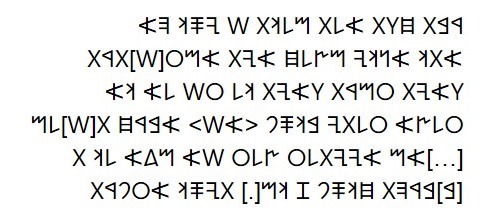
Lady Ḥawwat, Goddess, Queen who causes (things) to be poured out! May I, Maṣliḥ, make ʾEmʿaštart melt, and ʿMrt(?) and all which is hers, because she has rejoiced at my expense about the money that I have lost completely(?). (and may I/you cause to melt) every person who rejoices at my expense about the loss of this money, just as the lead is poured out.
The petitioner does not use lead merely as a surface for words. The material’s transformation becomes the argument addressed to the divine power: let the enemies melt as this lead does.
The properties of lead suit it to this and other analogies—useless, cold, stiff, sinking, etc.
Here, the older Mesopotamian logic of sympathetic destruction finds a new medium. The written curse does not merely describe the desired harm; its own substance helps enact the comparison.
By the time of the Roman Empire, the tablet itself could also be a kind of prepared form. A small group of first-century BCE Roman defixiones contains nearly identical curses in the same hand, differentiated chiefly by their intended victims’ names. Alessandro Papini notes:¹⁹
This may indicate that the curses were prepared in advance by a “professional magician”, and that some spaces were deliberately left blank to be filled in later at the request of the client.
The evidence does not uncover a magical shop stocked with blank tablets; it reveals something subtler: a repeatable ritual text, waiting for a grievance to give it a name.
Other deposition-site finds make the division of labor visible without necessarily proving a retail trade. At Bath, several tablets have the petitioner’s or victim’s name written in a hand distinct from the main formula.²⁰ The curse could thus arrive partly composed, its fixed language already carrying the force of tradition, while the customer supplied the small, dangerous particulars. The formula is the vessel; the name is the poison.
The Mediterranean defixio didn’t inherit the whole ritual intact, nor can its development be reduced to an eastern import. It gathered several comparable possibilities into a single technology: Lead gave it a body upon which a private grievance could be written, folded, entrusted to chthonian powers beyond the petitioner’s reach, via deposition in a grave, spring, or sanctuary, and left to do its work in the dark.
This article is part of the Defixiones series and the Continuity of Magic from East to West series.
Notes
- Scott Stripling, Gershon Galil, Ivana Kumpova, Jaroslav Valach, Pieter Gert van der Veen & Daniel Vavrik, “‘You are Cursed by the God YHW:’ an early Hebrew inscription from Mt. Ebal”, Heritage Science, 2023. In case you’re wondering why I didn’t cite this apparent early curse tablet, I was dubious of it when it was published, as was a subsequent refutation.
- Rukiye Akdoğan & J. David Hawkins, “The Kırşehir Letter: A New Hieroglyphic Luwian Text on a Lead Strip”, Akgün Süel (ed.), Proceedings of the 7th International Congress of Hittitology, Çorum 25-31 August 2008, 2010.
- RINAP 2, Sargon II 009, 103–106 Neo-Assyrian inscription on a human-headed bull colossus, 𒂦𒈗𒁺 (Dur-Šarrukin; modern Khorsabad, دور شروكين), describing the city’s creation, 721–705 BCE, cuneiform and translation via Oracc (Open Richly Annotated Cuneiform Corpus—website).
- Text 8.3, quoted in Tzvi Abusch and Daniel Schwemer, Corpus of Mesopotamian Anti-Witchcraft Rituals, 2016.
- Tablet IV, lines 8–11, ca. early first millennium BCE, translated in Abusch, The Witchcraft Series Maqlû, 2016.
- Anne Marie Kitz, “An Oath, Its Curse and Anointing Ritual”, Journal of the American Oriental Society, 2004.
- Treaty of Šuppiluliuma I and Huqqana (CTH 42), 14th century BCE.
- Vassal Treaties of Esarhaddon (VTE) 608-11, 672 BCE.
- Hittite Military Oath, CTH 427, KBo VI 34++ i 47′–ii 4, ca. 1500 BCE, Jared L. Miller (trans.), Royal Hittite Instructions and Related Administrative Texts, 2013.
- Deut. 28, 22–24, 7th–5th centuries BCE, NIV trans., 1978.
- Julia Müller-Klieser, “Augensteine im 3. und frühen 2. Jahrtausend v. Chr.: Eine Funktionsanalyse”, Materiality of Writing in Early Mesopotamia, Thomas E. Balke and Christina Tsouparopoulou (eds.), 2016, my translation.
- Ibid.
- RINAP 2, Sargon II 009, 54–56.
- SGD 95 = CT 49, Selinunte litigation curse, ca. early fifth–late sixth centuries BCE; cited in Ogden. I couldn’t find the original text.
- Esther Eidinow, “Binding Spells on Tablets and Papyri”, A Guide to the Study of Ancient Magic, David Frankfurter (ed.), 2019.
- Ibid.
- Barry Cunliffe, Excavations in Bath 1950–1975, 1979.
- KAI 89, transliteration and translation from C. A. Faraone, B. Garnand and C. López‐Ruiz, “Micah’s Mother (Judg. 17:1–4) and a Curse from Carthage (KAI 89): Canaanite Precedents for Greek and Latin Curses against Thieves?”, Journal of Near Eastern Studies, 2005.
- Alessandro Papini, “On the interaction between vowel confusions (<e> for /i/ and <o> for /u/) and lexical stress in Latin inscriptions from Rome (ca. 119 BCE–ca. 600 CE): A preliminary study”, Acta Antiqua Academiae Scientiarum Hungaricae, 2024, discussing the so-called Johns Hopkins Tabellae Defixionum: CIL I² 2520a, Plotius Tablet; CIL I² 2520b, Avonia Tablet; CIL I² 2520c, Maxima Vesonia Tablet; CIL I² 2520d, Aquila Tablet; CIL I² 2520e, Anonymous Male Tablet. The provenance for these is missing (bought from a dealer), but the findspot is likely Rome, and the date is ca. 100 BCE.
- Stuart McKie, Social Significance of Curse Tablets in the North-Western Provinces of the Roman Empire, 2017.

