How “Over the Garden Wall” built Disney’s machine and set it on fire (DeDisneyfication, Part 9A, Addendum B)
In my previous article, I explored the monomythic tropes in the TV miniseries Over the Garden Wall (OtGW). But there’s a lot more in there.
There’s also a flood of pop culture references. I’ve already mentioned The Wizard of Oz; we also see Richard Scary’s children’s books, The Night of the Hunter, The Little Rascals, Alice in Wonderland, Shirley Temple, and many more. In fact, the series begins with one. Before a word of dialogue is spoken, we see Chapter 1’s title: “The Old Grist Mill”.¹
This refers to the medium of animation, as many others do—Betty Boop, Flip the Frog, and Cab Calloway’s “Minnie the Moocher” cartoon also make appearances. The chapter title’s reference is to Disney’s Oscar-winning proof of concept for Snow White: The Old Mill.
This Silly Symphony was the first to use the multiplane camera. Every technique Disney developed in its making—depth of field, realistic motion, dramatic lighting—fed directly into their first feature film, released six weeks later. The Old Mill was where Disney learned to process raw visual material into product. A literal mill.
But OtGW’s references aren’t decorative nostalgia; they’re an anatomy of animation becoming an extraction machine. So why the grist? The addition of this word invokes the idiom “grist for the mill”—material, experience, or information that can be used to one’s advantage.
In OtGW‘s mill, though, the material isn’t grain. Instead, the Woodsman (Christopher Lloyd) gathers a certain kind of wood and makes it into oil here. As he says:²
The beast cannot be mollified… he stalks like the night. He sings like the four winds. He is the death of hope. He steals their children….
And further:
I grind the horrid Edelwood trees into oil to keep this lantern lit.
This is the frame story of The Unknown, within which all the other episodes are set, such that the full mechanism isn’t revealed until the end.
We learn the Beast (Samuel Ramey) lures lost children deeper into The Unknown until they give in to despair. When hope dies, they transform into Edelwood trees, rooted to the place they surrendered. The Woodsman—a grieving father who believes his daughter’s soul is preserved inside the Beast’s lantern—chops the Edelwood, grinds it into oil, and feeds it to the lantern’s flame. The flame sustains what the Woodsman thinks is his daughter’s spirit. It actually holds the soul of the Beast.³
This mechanism seems unnecessarily elaborate for a folklore-inspired tale where cruelty is generally a given—why doesn’t the Beast just chase kids down and consume their bodies or souls?
Because the Beast’s operation is not predation. It is industry. There is a supply chain. There is a labor force. There is a product.
Here’s the economy OtGW presents:
- Raw material: Human souls, specifically children’s
- Conversion process: Despair turns them into Edelwood trees.
- Labor: The Woodsman, motivated by a false promise.
- Product: The wood is ground into oil to fuel the lantern’s flame.
- Beneficiary: The Beast, whose soul the lantern actually contains.
This machinery holds a mirror to Disney. What do they do with folklore? They take stories that belong to oral traditions, to cultures, to people—and apply an extractive process, turning them into products.
Their raw material is Andersen, Perrault, the Brothers Grimm, One Thousand and One Nights, Norse mythology, Polynesian navigation myths. They take in a living story, strip its vital ambiguity and darkness and output a version optimized for revenue. They claim to honor and preserve these tales, but Disney does something stranger and, in mass culture, more powerful: they become the gate through which audiences encounter them. When someone says The Little Mermaid, they mean Ariel. The havfrue has become Edelwood.
This is the argument this series has been making across 25 entries. Naturally, I’m a bit jealous: I’ve drowned the topic in words, while they turned Disney’s primary medium against it with a diabolically sharp metaphor.
Even the Beast’s name is a reference. He isn’t the Devil, despite the overtones. He’s la Bête—the Beast of Beauty and the Beast, one of Disney’s most iconic adaptations. The show reclaims the fairy-tale monster for what extraction actually looks like: not something love redeems, but something that needs you to believe love requires keeping the machine running.
Many, including myself, have noted the Dantean parallels in OtGW. The poet organized his Hell as concentric circles of deepening sin, and the miniseries does something structurally similar. Each episode is a station in a descent. The sins begin cosmetic and end structural, the machine’s workings becoming more intimate as the boys travel further in. Let’s take a walk through those circles.
“Hard Times at the Huskin’ Bee” isn’t a pastoral alternative to the mill; it’s an image of the live-action Disney remake. Pottsfield’s citizens are skeletons reclothed in straw and pumpkin shells: dead structures given appealing new exteriors and sent back into the world.⁴
An animated film, already complete in its own medium, is dressed in photorealism and returned to the market promising renewed life. The new body isn’t ugly—that’s what makes the image bite. Meticulously crafted, richly textured, full of movement—and still a second skin over something whose life has already been spent. The husks don’t conceal the skeletons; they make us stare harder at the uncanny valley between a living character and its convincing imitation.
“Hard times” names the creative condition behind the ritual. When a studio can’t or won’t generate new ideas, it returns to its previous successes to harvest again. The huskin’ bee makes that repetition literal: collective labor disguised as a cheerful festival, its product not renewal but recurrence. Pottsfield is the refurbishment department: an afterlife of familiar forms, dressed in new but empty costumes.
It’s important to note the first creature Wirt and Greg encounter is a giant turkey, head on the table as if offering it to be chopped. In the language of the film biz, a “giant turkey” is a spectacular flop. So this town of dead properties opens with an enormous failure, presenting its neck to the blade. The turkeys pulling carts complete the image—they are the gravy train: failed productions still generating revenue, hauling product through a festival of recurrence.
The earnest little project of Miss Langtree (Janet Klein) in “Schooltown Follies” is to teach animals to count and spell—to make them legible by human standards. But the animals remain stubbornly animal. When her father, Mr. Langtree (Sam Marin) sees the project faltering, he turns to its one asset with exchange-value: the instruments. He confiscates them to sell to fund the school, converting what works into capital to sustain what doesn’t.⁵
Greg steals the instruments back, and the animals put on a benefit concert. The school is saved. On the surface, it’s Little Rascals business: children outsmart adults, the community rallies, everyone is charmed. But the concert succeeds precisely because it abandons the civilizing project for spectacle. The animals don’t read or spell; they make music, and an audience pays to watch.
This is a Silly Symphony.
Disney’s Silly Symphonies didn’t make animals literate or human in any important way. They made them move to music. The benefit concert repeats the discovery: literacy fails; performance succeeds. The school is funded not by what the animals learn but by what people enjoy watching them do.
The episode treats this as a happy ending, which is what gives it teeth. The animals escape one form of anthropomorphism—civilization—only to enter another: spectacle. The latter is the one that pays. Animation’s peculiar power lies not in civilizing its material, but in discovering what it can do when set to music.
This episode too tells a small version of its story. You reduce yourself to spectacle to earn money and get stuck that way. The suit becomes the career.
As Wirt (Elijah Wood) and Greg (Collin Dean) journey toward Adelaide (John Cleese), they find a tavern whose inhabitants insist every stranger be recognizable. The various patrons sing their songs, including the Highwayman (Jerron “Blind Boy” Paxton):⁶
If you cross my path,
I’ll knock you out
Drag you off the road
Steal your shoes from off your feet
I’m the Highway man
And I make ends meet. (drags finger across throat)
This is the villain song—a staple of Disney films—stripped of pizzazz. Despite the song’s frank menace, it is applauded because what matters is it fits a category. Nobody in the tavern has a name. The Tavern Keeper (Audrey Wasilewski), the Highwayman, the Butcher, the Baker—they are their functions. This is classification’s real cost: not that it misreads you, but that it replaces you.
Wirt is written off as simple until he can be named and given a part: first the young lover, then the pilgrim. The tavern sorts people into usable story-shapes. The tavern doesn’t ask who he is. It asks what he’s useful for—what kind of character the system can cast him as. Once he sings the right song, he belongs.
When the Tavern Keeper argues birds are bad luck, Beatrice counters they’re good luck—but the proprietress says she doesn’t want any kind of luck at all. The tavern doesn’t gamble; it wants engineered outcomes. And the patrons maintain whoever holds the Dark Lantern is the Beast—making the lantern not a possession but a transferable office.
The tavern is the intake desk for the economy the mill completes. Stories that arrive nuanced and personal are classified: romance, villainy, melancholy, comic relief.
The tavern’s sign only says “DL”, which the Chapter’s title suggests we read as Dark Lantern—but the dead horse painted there tells another tale. The two stars on the sign can only reference the rating system. Worse than Pottsfield’s resurrection of their back catalog, here, they beat a dead horse. DL, I think, is Disney Laboratory, the production meeting where the wild tale is reduced to a form the system can control.⁷
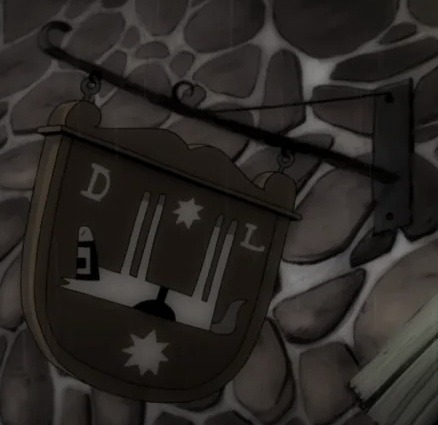
And lantern itself reaches back before animation’s industrial history. The lanterna magica was an early image projector. The Dark Lantern becomes more than a place in the Beast’s supply chain—it is a projection apparatus, casting folktale into the familiar silhouettes Disney knows how to sell. Dark as in sinister, but also dark as in empty: a projector with nothing of its own to show.
The show builds a second extraction economy, played as farce when we meet Quincy Endicott (John Cleese), who lives in a mansion so sprawling he’s lost inside it. He has servants, rooms beyond counting, a fortune built on tea—and no one to share it with. He believes a beautiful woman haunts the empty wing of his house and has fallen in love with this ghost.⁸
Tea is hardly an innocent commodity. It’s one of the great colonial extraction products—the British Empire’s tea trade ran on Indian and Chinese labor, on plantation economies, on a supply chain as long and deliberately obscured as the Beast’s. Neither is it by accident Endicott is English-coded, as many Disney villains are. In a heated moment, he even acknowledges his misdeeds:⁹
Do you know what I did for this money—the things these filthy hands have done to make this money?!
But the episode’s real argument is about what extraction does to its beneficiary. The Beast’s economy has a clear victim—the lost children who become Edelwood. Endicott’s economy has produced something subtler: a man so surrounded by surplus he has no relationship to any of it. His mansion has become the dark wood. He wanders its corridors the way the lost wander The Unknown, and the thing he loves most—the woman in the portrait—is something he can only experience as absence.
The ghost turns out to be Margueritte Grey (Bebe Neuwirth)—not a spirit but a living woman, and Endicott’s business competitor, whose own mansion is physically connected to his. She was never dead, never trapped, never preserved in the amber of his wealth. She was next door, running her own extraction operation.
That physical connection between rival mansions is worth pressing on. Disney’s growth has followed the same architecture: Pixar, Marvel, Lucasfilm, Fox—each an independent operation, each with its own stories, now structurally fused to the larger house. What was a competitor becomes a wing you wander through, half-forgetting it was ever someone else’s.
The structural rhyme with the series’ finale is unmistakable. The Woodsman’s daughter was never in the lantern—she was home all along. Endicott’s beloved was never a ghost—she was in the next house all along. In both cases, the extraction economy convinced someone that the thing they loved was sealed inside the product of their labor. In both cases, the thing they loved was alive and separate, untouched by the machine. Liberation comes not from rescuing what was lost but from recognizing it was never captured.
In the episode’s coda, after performing the invaluable service of hunting down the “ghost” and reuniting two lonely magnates, Greg’s reward is two pennies to “start your fortune”, and Fred (Fred Stoller) proudly becomes “an official tea horse”. Unfortunately, the real Tea Horse Road (茶马古道, Chamagudao) ran over 1000 miles of mountain passes between Sichuan and Tibet with human and equine porters hauling loads as heavy as 300 pounds, wearing only straw sandals and rags. Many never returned.
Endicott might as well have told them, “We can’t pay you, but think of the (death by) exposure”. As they leave the horse even shills for his new master:¹⁰
Don’t forget to buy Endicott Brand tea!
We are deep now. The circles outside the Charonic crossing of “Lullaby in Frogland” cataloged what Disney does to material—resurrecting dead properties, converting culture into spectacle, classifying stories into marketable shapes, absorbing competitors into the architecture of the House of Mouse. The inner circle asks what Disney does to people.
Beatrice (Melanie Lynskey) presents Adelaide as someone who can help Wirt and Greg find their way home. They find instead she captures children and, as she says:¹¹
Once I fill their heads with wool, they’ll become just like little sheep and follow my every command.
But Adelaide is a spider. Her house is hung with yarn like webbing; she catches the children by pulling a thread and entangling them in it. Wool becomes yarn; yarn catches children; wool in their heads makes them sheep. The loop closes on itself: sheep become the tool for making more sheep.
This is a different architecture from the Beast’s. The Beast is an industry: supply chain, labor force, raw material, refined product. Adelaide is a web. He needs a woodsman, a mill, a lantern, a song; she needs patience and a place that feels safe to enter. Both are predators, but they model different economies of extraction—the factory floor and the spare room with the nice curtains.
Nor is she an independent power. Adelaide’s apparent autonomy is one of the story’s little disguises. She occupies a stage in the Beast’s chain. The spider has a landlord.
The wool-stuffed children aren’t softened stories, but softened audiences. The production loop—sheep into wool into yarn into children into wool into sheep—describes what happens to the consumer who enters the Disney ecosystem and stays. You watch; you absorb; the vocabulary of your imagination is gradually replaced with Disney’s until the films you remember, the songs you hum, the stories you reach for when you comfort a child are Disney’s. The wool goes in so gently it feels like growing up.
This is a circle Dante would have recognized: not the sin of cruelty, but of counterfeited love—a home that’s a web, a belonging that’s a surrender, a fandom that has become the walls of the room you can’t imagine leaving.
The show names the trap in Disney’s own medium—not argument, but song:¹²
Dancing in a swirl,
Of golden memories,
The loveliest lies of all.
A trap that looks like a trap catches no one. The lies must be a lovely thing—golden, warm—or the wool would never go in at all.
After riding the showboat, the frogs happily burrow under the mud to hibernate—voluntary stasis, burying yourself with a smile and calling it rest. Adelaide’s is the same burial at scale: perpetual adolescence, the audience that stops growing because the lullaby never ends.
The Disney parallel is not simply that adaptations smooth over difficult material. It is that smoothing can arrive as hospitality. A story enters carrying its own teeth—its darkness, its resistance to simplification—and is invited somewhere warm. The wool goes in gently. Compliance feels like comfort. The story is made followable, but forgets what it is like to bite.
The Woodsman is the figure who lets abstraction become an economy. The Beast doesn’t hide the work. He only misnames its beneficiary. In that lie, the show finds the mechanism that links its episodes: a system can make extraction feel like care when it persuades the worker that the product contains the thing he loves.
Disney’s adaptations eclipse rather than annihilate their sources. It’s still a powerful form of cultural processing: the original need not be destroyed if the brand can become the only path most people can see.
This is why the finale lands. Wirt doesn’t defeat the Beast through strength, and the Woodsman doesn’t rescue his daughter through more labor. The ending turns on recognition. Wirt sees what the lantern actually holds; the Woodsman understands what his work has actually fed.¹³
The point isn’t that one can un-grind the Edelwood. Processing leaves marks; cultural dominance can’t be wished away. The point is narrower and more useful: stop mistaking the lantern for what it claims to preserve. The stories were never inside the brand. What was inside the brand was the brand.
Between the mill of the first episode and the extinguished lantern of the last, the series builds a complete model of how living material is made legible, softened, staged, separated, processed, and fed back into a system that calls its own survival love. As in Inferno, the way out is the same as the way through: you keep walking until you see the architecture from below, then climb.
It never needs to name Disney. It borrows Disney’s machinery—its musical animals, its warm and ingenious surfaces—and lets us watch the machine reveal its hunger.
The loveliest thing can still be a lie.
This article is part of the Snow White miniseries within the DeDisneyfication series.
Notes
- Chapter 1, “The Old Grist Mill”, OtGW, 2014.
- Ibid.
- Chapter 8, “Babes in the Wood” and Chapter 10, “The Unknown”, OtGW, 2014.
- Chapter 2, “Hard Times at the Huskin’ Bee”, OtGW, 2014.
- Chapter 3, “Schooltown Follies”, OtGW, 2014.
- Chapter 4, “Songs of the Dark Lantern”, OtGW, 2014, Jerron “Blind Boy” Paxton and Pendleton Ward, lyrics; The Blasting Company, music; Paxton, performance, “The Highwayman”, OtGW (Original Television Soundtrack).
- Disney is fond of D-[x] branding—D23, D+—collapsing whatever follows the D into a function code. I have some personal experience with this habit, having consulted for a Disney division called Disney Learning, known internally as “D Learning”. They were building an MMORPG with educational gameplay covertly embedded in it—a system designed, like Adelaide’s wool, to happen without the learner noticing. We recommended against the name—D Learning sounds like “de-learning”, which is to say, unlearning. An institution designed to make education invisible had accidentally named itself after the process of forgetting. They were not the first. Disney Interactive Entertainment, shortened to DIE—its own quiet prophecy for a division that kept getting shuttered and resurrected. A tavern that covertly classifies everyone who enters, operating under a sign that reads DL, fits the pattern uncomfortably well.
- Chapter 5, “Mad Love”, OtGW, 2014.
- Ibid.
- Ibid.
- Chapter 6, “Lullaby in Frogland”, OtGW, 2014.
- Chapter 10, “The Unknown”, OtGW, 2014, Brandon Armstrong, Joshua Kaufman, Justin Rubenstein, Patrick McHale, lyrics; McHale, music; Jack Jones, performance, “Into the Unknown”, OtGW (Original Television Soundtrack).
- Chapter 10, “The Unknown”, OtGW, 2014.

