Nolan’s “Odyssey” and the end of the Bronze Age (Late Bronze Age Collapse, Part 1 Addendum)
What Christopher Nolan actually built in The Odyssey deserves closer attention than it’s gotten. It’s not merely set at the end of the Bronze Age. It is haunted by the knowledge the age is ending.
In the second part of this series, I mocked the pseudo-scientific world-war-zero hype the Institute for Luwian Studies built up over an inscription seemingly conscious of the end of the Bronze Age. But as Eric Cline, the archaeologist whose work has given the Late Bronze Age Collapse (LBAC) its modern popular shape, says:¹
Of course, it’s ridiculous and far too self-aware. It would be like somebody in the Middle Ages announcing, “The Renaissance has begun!” But while the dialogue may be silly, it’s also quite correct.
The film has the visible furniture of heroic civilization: palaces, kings, ships, bronze weapons, names that survive. But the continuity supporting those things has already frayed. Trade routes have vanished. The sea is no longer simply the road joining one rich world to another; it is a route of flight, raid, hunger, and rumor, plagued by unfavorable winds and frequent storms.
Troy has fallen, but its fall belongs to something larger. Odysseus (Matt Damon) does not return from an old war into a stable order. He returns through the ruins of the order the war is a part of.
That is why Nolan’s handling of the LBAC feels more consequential than archaeological atmosphere. The film appears to draw on the grammar of Cline’s 1177 B.C.: a tightly interdependent world subjected not to one decisive blow, but to pressures that reinforce one another—war, disrupted trade, political failure, migration, and environmental stress.² No one cause need explain the end of the age. The frightening fact is that a system which depends upon every connection holding has no graceful way to fail.
Cline watched the film and recognized his framework on screen, telling GW Today:³
I was certain Nolan had read my books!
Cline can’t confirm contact with the production, but sees his thesis rendered as spectacle and finds it sound. The influence is legible to its source but unacknowledged, which may say more about Nolan’s research method—absorb the scholarship, dissolve the citation—than any formal credit would.
Nolan makes the systemic fragility of the LBA visible. His Mediterranean washes shores of snow and desert, landscapes that make the heroic world feel ecologically strange and geographically unmoored.
These images do not, by themselves, prove the film is depicting a specific LBA climatic event—they can be seen as serving the older, fabulous geography of The Odyssey. But besides the vanished trade routes, they establish a world in which even weather and seasons no longer behave as reliable background conditions. The world is not simply at war. Its routes, environments, and expectations have become unreliable.
The film’s Sea Peoples thread gives the consciousness of the collapse its sharpest moral turn. The historical record is fragmentary, but it does not safely exclude the Greeks from the LBAC’s violence. Hittite documents refer to Ahhiyawa, widely connected with the Mycenaean Greek world, and the Tawagalawa Letter recalls conflict over Wilusa, likely Troy (Ilium).⁴ Egyptian inscriptions name the Eqwesh (jḳwš)—perhaps also referring to the Achaeans (Ἀχαιοί),⁵ though the identification remains disputed.
Comporting with this, Nolan’s Greeks figure not as a civilization standing against collapse, but as a force of destruction.⁶
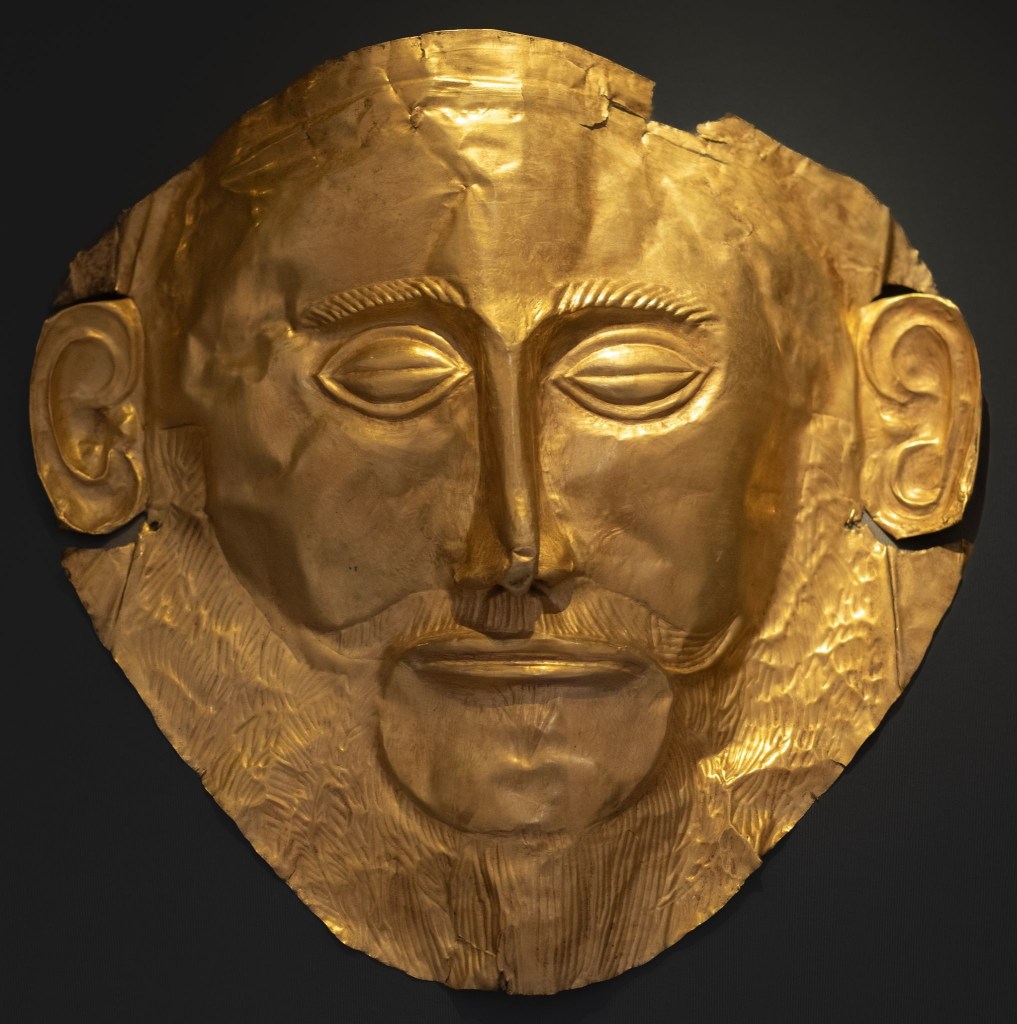
Jackie Murray identifies Nolan’s decisive alteration:⁷
Nolan makes his Odyssey more relatable to today’s audience by shifting the moral emphasis of the story away from revenge and glory to the accountability and psychological impact of waging an essentially unjust war.
Her last phrase names more than the brutality of Troy’s fall. Nolan makes Helen’s (Lupita Nyong’o) departure the casus belli Agamemnon (Benny Safdie) needs to gather the Greek kings. But beneath the language of injured honor lies a richer prize: Troy’s wealth, its trade, its power. The war is sold as a rescue and conducted as conquest. That’s why Odysseus’s guilt reaches beyond the Horse. He has not merely devised a deceptive tactic; he has helped do the work of imperial appetite.
The Trojan Horse therefore becomes more than a brilliant stratagem. It’s the mechanism by which Odysseus learns a momentary victory can poison the world it’s meant to defend.
Nolan’s heroic age is therefore not simply a world killed by barbarism. It is a civilization overextended by its own prestige systems—its honor, conquest, extraction, and revenge—until those systems become indistinguishable from the forces destroying it. Odysseus remains extraordinary because he can survive the wreckage.
Homer already gave Odysseus’s victory a shadow. When the Phaeacian singer recounts the Horse, the poem relates:⁸
[…] αὐτὰρ Ὀδυσσεὺς
τήκετο, δάκρυ δ᾽ ἔδευεν ὑπὸ βλεφάροισι παρειάς.
ὡς δὲ γυνὴ κλαίῃσι φίλον πόσιν ἀμφιπεσοῦσα,
ὅς τε ἑῆς πρόσθεν πόλιος λαῶν τε πέσῃσιν,
ἄστεϊ καὶ τεκέεσσιν ἀμύνων νηλεὲς ἦμαρ […].[…] but Ulysses was overcome as he heard [the Phaeacian singer], and his cheeks were wet with tears. He wept as a woman weeps when she throws herself on the body of her husband who has fallen before his own city and people, fighting bravely in defence of his home and children. […].
This does not make Homer’s Odysseus the same as Nolan’s guilt-stricken veteran, but both keep triumph and trauma in the same frame. Nolan takes that latent wound and makes it the machinery of the plot. What Homer planted, Virgil made explicit, labeling Odysseus dirus — detestable, and scelerum inventor — contriver of evil deeds. Nolan dramatizes the Roman poet’s judgement as psychological fact.⁹
While the film’s Odysseus becomes psychologically legible to a modern audience, the divine pressures and densely social world of Homer recede. Yet that narrowing is also what enables Nolan to perform his reversal of the homecoming story. The man returning to restore Ithaca has helped make restoration impossible everywhere.
The political resonance lies less in a one-to-one contemporary allegory than in the structure of self-undermining. Open, ordered systems depend on reciprocity. Hospitality, law, trade, and public speech all work because their participants accept obligations as well as protections. When people treat those protections only as weapons—when they use trust as cover, rules as loopholes, and openness as a means of capture—the order is nourishing the thing hollowing it out.
The film finds this danger at both Troy and Ithaca. The Trojan Horse turns ritual trust into a path to destruction. The suitors’ offense is not simply that they are unwelcome outsiders; they are Ithaca’s own elite, consuming a household under the protections of Zeus’ Law. In both cases, an institution becomes vulnerable because it assumes good-faith participation.
That vulnerability extends not only to how the tradition is dramatized, but how it’s discussed. Contemporary arguments about the Western canon tend to share an unexamined assumption: that Homer belongs to a civilization in the way a flag belongs to a nation—property to be claimed or repudiated.
As Tyler Norris observes:¹⁰
The Odyssey may be the most pro-Western civilization film Hollywood has made in decades—not because it flatters the Greeks, but because it understands civilization as a moral achievement rather than an ethnic possession.
Nolan understands the source material contains both grandeur and indictment. A tradition that survives by containing its own critique is not an inheritance to defend or dismantle—it’s an argument still in progress.
The danger is not openness itself. It is people— domestic opportunists and hostile external powers alike — who regard the norms making openness possible as merely instrumental. A democracy, like a household, can’t survive if the people invoking its rights reject the reciprocal limits that give those rights meaning.
The slaughter of the suitors recasts the Cyclops episode in the architecture of homecoming. Polyphemus (Bill Irwin) seals Odysseus and his men inside his cave to consume them one by one; Odysseus closes the doors of his hall around the suitors and kills them all in turn. The victim in the earlier scene chooses the monster’s tactic.
The difference is morally decisive, though not morally cleansing. Odysseus’s men enter the Cyclops’ cave uninvited, help themselves to his stores, and light a fire before their host returns — guests who have already become trespassers. The suitors convert Odysseus’s hospitality into occupation and spoil. Yet his restoration of order can’t be called innocent: the man who helped himself to a stranger’s cheese reclaims his house as host, jailer, and executioner.
The film’s most melancholy idea may be the story of this ending will have to be sung because writing itself is about to disappear. Here Nolan gives The Odyssey a new reflexive force. Homeric poetry has always been a form of survival: a story carried through shipwrecks, disguises, false reports, and years of absence until it finds its audience. But in this version, oral transmission isn’t simply antique texture. It’s the last medium that can carry this story once the palace’s custodians and writing system are gone.
LBA writing wasn’t universal literacy; it was specialized infrastructure, bound to courts, administration, inventories, tributes, and networks that supported scribes. If the institutions disappear, writing can disappear with them.
A song is more precarious in one sense—dependent on bodies, memories, occasions — but it can travel without the palace. It can be held by many people at once. As one history professor-viewer notes:¹¹
[N]o one was writing poetry in Linear B to begin with […]. And beyond Greece, hieroglyphics and cuneiform survived the collapse just fine, as did the primordial Sinaitic alphabet. But it is probably not a coincidence that Greek myth set the sack of Troy, a succession crisis at Mycenae (and Ithaca), and the general end of the heroic age right at the point when archaeology and epigraphy suggest things were going badly across the board, from Greece to Assyria.
That distinction makes Nolan’s contemporary anxiety legible. He makes films whose scale, duration, and theatrical materiality ask an audience to sustain collective attention. The Odyssey can be read as a wager cinema still possesses a custodial function comparable to its source: not merely to circulate content, but to carry difficult inheritances across time.
The worry is not that stories will cease. Moving images now circulate more abundantly than ever. It is that the habits, institutions, and public spaces able to receive a long story in common may be thinning. But the theater I attended was full even after the film had been out for two months.
This isn’t an argument short-form video has abolished art, nor that every three-hour large-format film is an act of cultural resistance. It’s an argument about forms of attention. A culture can preserve an infinite stream of fragments and still lose the capacity to gather around a demanding narrative long enough for it to alter memory.
Homer doesn’t leave Ithaca in the blood-feud Odysseus creates. In the poem’s final movement, Athena compels a peace: the violence is arrested, household and kingdom are restored together.
Nolan withholds that settlement — it’s not merely elided, the film’s handling of divinity renders it structurally impossible. Whether Zendaya’s figure is Athena or the murdered Trojan she also portrays remains unresolved; as such, she doesn’t possess the kind of authority Homer’s ending requires.
Where Homer’s Telemachus fights beside his father, N olan’s keeps his son out of the slaughter . This spares him the guilt—a sacrifice that also denies him the authority that violence confers in Homer’s world. Odysseus and Penelope sail west, making sacrifices for the dead, fleeing the world to which they no longer belong.
Therefore, what Telemachus inherits isn’t a restored kingdom but consequences: a throne, a stain he didn’t earn, and a civilization already in collapse. Dante’s Ulysses, who couldn’t stop voyaging,¹² and Tennyson’s, who leaves the sceptre to his son and sails for the unknown,¹³ echo faintly here.
That motif—what the father’s violence bequeaths to the child who did not choose it—connects The Odyssey to Tenet. In that film, ecological catastrophe produces a future that judges the present as an enemy: damaged inheritance becomes a reason to destroy one’s own past.
Nolan’s boustrophedonic timeline makes causation itself feel unstable, with people inhabiting consequences they can’t fully see. Where Tenet made that unease a puzzle-box mechanism, The Odyssey grounds it in recognizable human costs.
That is Nolan’s dark tribute to Homer. The poem isn’t the calmly preserved monument of a heroic world. It’s the surviving instrument of a world that couldn’t save itself.
And perhaps that’s his final warning: survival isn’t the same thing as continuity. A story may outlive the palace. It can’t bring the palace back.
This story is part of the Late Bronze Age Collapse series
Notes
- John DiConsiglio, “Faculty Flicks: At ‘The Odyssey’ with Classics’ Eric Cline”, GW Today, September 2026.
- Eric Cline, 1177 B.C.: The Year Civilization Collapsed, 2014.
- DiConsiglio, 2026.
- CTH 181; the Tawagalawa letter, attributed variously to Hattusili III or Muwatalli II, mid-13th century BCE.
- KRI IV 2.12-14, The Great Karnak Inscription of Merneptah, ca. 1208 BCE.
- NAMA 624; Mask from Grave Circle A, Grave V, mid-16th century BCE.
- Bert Gambini, “‘Nolan’s Odyssey is not historically accurate, but neither was Homer’s,’ says UB researcher”, University at Buffalo News Center, July 28, 2026.
- Ὀδύσσεια (The Odyssey) 8.521–25, ca. eighth–sixth century BCE, A.T. Murray, PH.D. (trans.), 1919.
- Publius Vergilius Maro (Virgil), Aeneis (The Aeneid) 2.261, 2.164, 19 BCE.
- Tyler Norris (@tylerhnorris), Twitter, July 19, 2026.
- Michael Taylor, “Blog: Bronze Age Collapse on the Silver Screen: Thoughts on Christopher Nolan’s The Odyssey.”, SCS Blog, August 2026.
- Dante Alighieri, Inf. 26.94–100, Divina Commedia, ca. 1308–21, Allen Mandelbaum (trans.), 2004:
[…] né dolcezza di figlio, né la pieta / del vecchio padre, né ’l debito amore / lo qual dovea Penelopè far lieta, /vincer potero dentro a me l’ardore / ch’i’ ebbi a divenir del mondo esperto / e de li vizi umani e del valore; / ma misi me per l’alto mare aperto […].
[…] neither my fondness for my son nor pity/ for my old father nor the love I owed / Penelope, which would have gladdened her, / was able to defeat in me the longing / I had to gain experience of the world / and of the vices and the worth of men. / Therefore, I set out on the open sea […]. - Alfred, Lord Tennyson, “Ulysses” 56–61, 1833:
[…] Come, my friends, / ’T is not too late to seek a newer world./ Push off, and sitting well in order smite / The sounding furrows; for my purpose holds / To sail beyond the sunset, and the baths / Of all the western stars, until I die.

