The Chthonian Connection

Things come clear in the netherworld (Continuity of Magic from East to West, Part 4B)

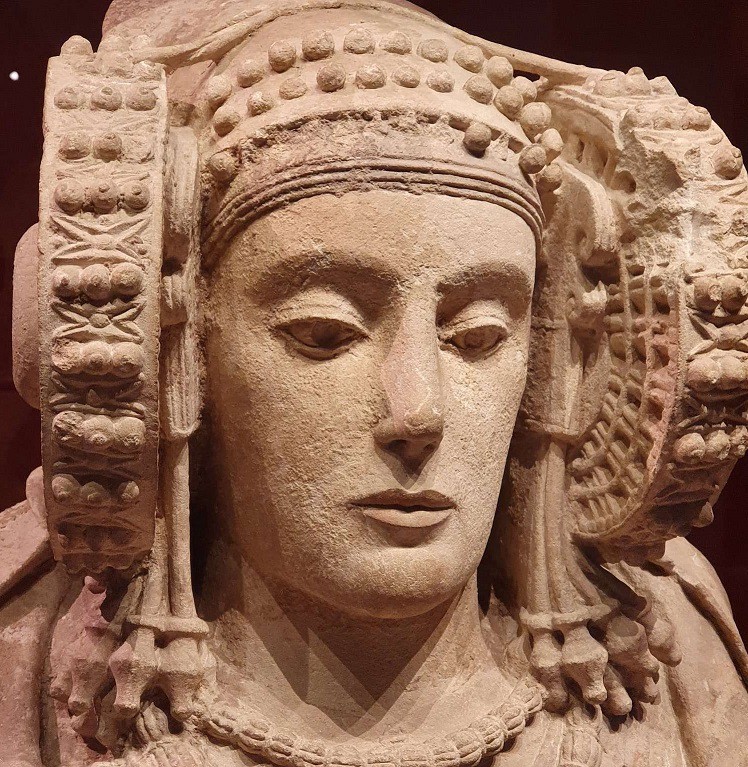
Recently, I visited the Museo Arqueológico Nacional in Madrid (MAN), the jewel of whose collection is the gorgeous fourth-century BCE Lady of Elche (Dama de Elche). This limestone sculpture bears stylistic elements clearly drawn from Phoenician models in elements such as the zig-zagging folds of her clothing. She shares details like necklace pendants with another fourth century statue, the Lady of Baza (Dama de Baza) and while the Lady of Elche is a bust today, she is thought to have originally been seated like her sister. Both are believed to represent the Phoenician goddess 𐤕𐤍𐤕 (Tanit):¹

Carthaginian influence manifested on the Lady of Baza’s spiritual purpose. Her winged throne alludes to a goddess, as does the pigeon she holds in her left hand. Scholars believe these avian symbols refer to the Phoenician deity Tanit.

The Lady of Elche was declared a forgery nearly immediately upon its discovery at the turn of the last century, a notion based entirely on bad science. How could its form, style, and sophistication have been possible in Iberia until the advent of Hellenism or Roman expansion into the region? Despite these hypotheses persisting until quite recently, actual science has found nothing to support them, instead affirming a date around the latter half of the fifth to first half of the fourth century BCE based on extensive analysis of contextual artifacts, sculptural technique, and pigments, to name a few.²

The MAN’s Protohistory section contains various other artifacts bearing the clear stamp of the culture of the Ancient Near East (ANE). In particular, the Mausoleum of Pozo Moro, dating near the end of the sixth century BCE, from a necropolis in the modern province of Albacete, 125 miles inland from the Mediterranean coast, shows strong Hittite and Syrian influences during this clearly orientalizing period in Iberian art.

Of course, I had already known there was considerable Phoenician presence in the area, centered in Qart Hadasht (𐤒𐤓𐤕•𐤇𐤃𐤔𐤕, “new city”—the same as the better-known Carthage, and later known pleonastically as Cartago Nova, modern Cartagena), but I hadn’t expected the physical evidence to be quite so clear and conclusive as it is typically downplayed, even in the MAN’s name for this section — why not simply Early History? In any case, this, the other items I’ve mentioned, and many others in the MAN, act as still further links between the ANE and Western Europe, specifically relating to myth and magic.

Turning more specifically to the connections between Mesopotamia and Ancient Greece, in both cultures, magic is associated strongly with the netherworld. For example, their respective goddesses of witchcraft are distinctly chthonian and dwell in the land of the dead. This is quite clear for Eresh’k’ikala (𒀭𒊩𒆠𒃲) as queen of the underworld, but slightly less so in the case of Hekate (Ἑκάτη) as she has a great deal of power over many realms. Orphic hymns feature Hekate with various motifs in keeping with her underworld role:³

[…] τυμβιδίην, ψυχαῖς νεκύων μέτα βακχεύουσαν […]
νυκτερίην, σκυλακῖτιν, ἀμαιμάκετον βασίλειαν […].

[…] Celebrating funerals among the spirits of the dead […]
nocturnal, protectress of dogs, unyielding dominion […].

In Greek myth, Persephone (Περσεφονη) journeys to the underworld where she eats pomegranate seeds and so must return for a quarter of the year. This etiological tale of the seasons is well known, but significant elements link it to the ANE. It should be noted that the familiar version is highly bowdlerized; the original being Haides (Ἁιδης) forcefully abducts and rapes Persephone, and only when her mother, Demeter (Δημήτηρ), threatens the world with famine is she allowed to return.

There is quite a similar Mesopotamian tale involving Eresh’k’ikala but with some roles reversed: Nerkal (𒀭𒄊𒀕𒃲), the god of war, visits and is seduced by the queen of the underworld and lies with her for seven nights, and so must return for half the year thereafter, explaining, apparently, why wars were fought seasonally.

In both cases, we’re talking about forbidden fruit; Nerkal and Persephone are both warned beforehand to abstain but are nonetheless tempted. Hekate additionally plays a part in several versions of the latter’s tale, carrying a torch to help search for the lost goddess, and indeed, she, Demeter, and Persephone share several attributes and aspects.

Additionally, while there is some debate about the etymology of the name of Persephone’s mother, Demeter, most agree it’s some form of “Earth Mother”, so she’s also a chthonian goddess—making her daughter’s abduction somewhat redundant. Eresh’k’ikala means “Queen of the Great Earth”; a close parallel.

Continuing on the etymological thread, especially as relates to magic and medicine—closely interrelated concepts in ancient times—one of Papa’s (𒀭𒁀𒌑) epithets is Atsukallat’u (𒀀𒍪𒃲), “great healer”, as that’s one of her main roles as a deity. Asklepios’ (Ἀσκληπιός) name is etymologically uncertain, but seems related to an epithet for Apollon (Απολλων), his father, used on the Cycladic island of Anaphe (Ανάφη) near Thera (Θήρα), Asgelatos (Ασγελατος), which seems quite close to the Sumerian goddess’ name but with a gendered ending added. There is also a more direct connection to the Graeco-Roman world: Eresh’k’ikala’s name commonly occurs in Greek defixiones and papyri (as Ερεσχιγαλ—Ereskhigal) synonymously with Hekate, its form transcribed so closely coincidental homonymy is extremely unlikely.

As for the netherworld itself, in the Graeco-Roman context we see various mortals visiting Haides: Theseus (Θησεύς), Pirithous (Πειρίθοος), Herakles (Ἡρακλῆς), Orpheus (Ὀρφεύς) and Odysseus (Ὀδυσσεύς) all traveled there, as did Aenaeas, each passing through one of the various “mouths” located in the mortal realm. So too in ancient Mesopotamia there was a physical location, or gate, specifically in the city best known by its Akkadian name, Uruk (𒌷𒀕, Sumerian Unu, which sits in modern Iraq near ٱلسَّمَاوَة—Samawah), through which mortals, or at any rate, heroic ones like Enk’itu (𒂗𒆠𒆕), could enter the netherworld. In both cases, however, special actions needed to be performed to get there, and it was even more difficult to return.

Continuing the trip to the netherworld, the well known Greek myth has Charon (Χαρων) ferry the dead across the rivers Styx (Στύξ) and Acheron (Ἀχέρων) to the land of the dead, but one Babylonian tale carries a close corollary:⁴

“Enlil and Ninlil: Birth of the Moon-God” […] tells how Enlil himself, the most powerful of the Sumerian gods and the chief of the Sumerian pantheon, was banished to the Nether World and followed thither by his wife Ninlil. This myth [… includes…] the Sumerian belief that there was a “man-devouring” river which had to be crossed by the dead, as well as a boatman who ferried them across to their destination […].

Although none of the rivers in the Greek underworld carries this exact meaning, all are similarly dismal or threatening:

  • Acheron: possibly “stream of woe”
  • Cocytus (Κωκυτός): “lamentation”
  • Lethe (Λήθη): “forgetfulness”
  • Phlegethon (Φλεγέθων): “fiery”
  • Styx: “gloomy”

The generally unpleasant vibe of the netherworld is another point of agreement:⁵

By and large, the Sumerians were dominated by the conviction that in death the emasculated spirit descended to a dark and dreary beyond where “life” at best was but a dismal, wretched reflection of life in earth [sic].

Compare this to Hesiod’s (Ἡσίοδος) hymn to Hermes (Ἑρμῆς):⁶

“For I will take and cast you into dusky Tartarus [Τάρταρος i.e., Haides] and awful hopeless darkness, and neither your mother nor your father shall free you or bring you up again to the light, but you will wander under the earth and be the leader amongst little folk [i.e., ghosts of infants and children].”

One of the more important aspects of the state of the dead in the ANE’s netherworld tradition is:⁷

Though “dead” the deceased could in some unexplained manner be in sympathetic contact with the world above, could suffer anguish and humiliation, and cry out against the undependable gods.

I’ve already extensively covered the fact such sympathy is essential to the character of Graeco-Roman magic generally, as well as in the specific case of necromancy and black magic, so I won’t belabor it here.

In both traditions, the dead can also become somewhat demonic, especially if they have been slain in battle or haven’t been properly buried, and so cause sickness and other calamities to befall those in the mortal realm. In the ANE, such a being is termed a kitim or et’emmu (𒄇, in Sumerian and Akkadian respectively), and the incantation texts make consistent reference to this concept:⁸

When the spirit of a dead person has taken possession of a man,” or “the hand of a spirit of the dead,” then exorcism is due. The sick person believes himself to feel this grip, and he prays: “If it is the spirit of a member of my family or my household or the spirit of one slain in battle or a wandering spirit […].”

Besides borrowing the Sumerian term kalla (𒋼𒇲) for a type of demonic revenant as gello (Γελλώ), there is also a Greek term for the wrath caused by the mistreated dead: menima (μήνιμα). This appears quite early in the literature and is referenced by Plato and Homer, who allude to those killed in battle, left unburied, or victims of old, uncleansed wrongdoings, which then manifest great suffering. In particular, in The Iliad, when Achilles makes it clear to Hector he plans to defile his corpse, the dying hero retorts:⁹

φράζεο νῦν, μή τοί τι θεῶν μήνιμα γένωμαι
ἤματι τῷ ὅτε κέν σε Πάρις καὶ Φοῖβος Ἀπόλλων
ἐσθλὸν ἐόντ᾽ ὀλέσωσιν ἐνὶ Σκαιῇσι πύλῃσιν.

[L]ook to it that I bring not heaven’s anger upon you on the day when Paris and Phoebus Apollo, valiant though you be, shall slay you at the Scaean gates.

Plato, on the other hand, tells of itinerant seers who can remove the curses caused by such wrongdoings of ancestors, which he terms παλαιῶν μηνιμάτων, (palaion menimaton, “ancient wrath”).¹⁰ And so, the dead were therefore to be appeased through ritual in both cultures, and as Walter Burkert notes, “in very similar ways”:¹¹

[T]hrough various kinds of libation: “water, beer, roasted corn, milk, honey, cream, oil” in Mesopotamia; “milk, honey, water, wine, and oil” in Aeschylus [Αἰσχύλος]. Even more peculiar is the importance of pure water as an offering to the dead: “cool water,” “pure water.”

When it comes to actual magic, again, I’ve already established the connections quite thoroughly, both as to black magic, where poppet-based ANE rites of annihilation clearly prefigure Graeco-Roman defixiones, and closely related traditions of haruspicy. Burkert also presents compelling evidence as to the consistent use of persuasive analogies relating to oaths across various locations:¹²

From the eighth century we have a relevant Aramaic text, the treaty text of Sfire [near modern Aleppo, Syria…]. This is an international contract concluded by solemn oaths and curses; in this context it is said: “As this wax is consumed by fire, thus… (N.N.) shall be consumed by fire.” In the seventh century the same formula appears in a contract made between the Assyrian king Esarhaddon and his vassals; much earlier it is found in a Hittite soldiers’ oath. It corresponds to the oath of the Cyreneans [an ancient Greek colony near modern شحات (Shahhat), Libya] as set out in their foundation decree, transmitted through a fourth-century inscription […]. “They formed wax images and burned them while praying that anyone who did not keep the oath but flouted it might melt and flow away like the images.”

The objection might be made some of the features of the lands of the dead, the state of those who dwell there, and their ritual appeasement are widespread or even universal ideas. Certainly China has its 餓鬼 (èguǐ, “hungry ghosts”) who must be appeased with offerings, the Norse underworld is bordered by the Slidr, a river of swords, and the Shinto (神道) afterlife, Yomi (黄泉), is a gloomy underground realm, just to grab a few corollaries from various cultures.

Still, the compelling aspects of the commonalities between the traditions of the ANE and Ancient Graeco-Roman world are both the large number of points of agreement, as well as the specificity of the details in which they agree. The direction of this influence can also be seen to be clearly East-West, especially as the Assyrians, with whom lasting contact with the Greeks comes, inherit many of these concepts from the Akkadians and Sumerians before them. Finally, as Burket concludes of the orientalizing period in general:¹³

[I]n the period at about the middle of the eighth century, when direct contact had been established between the Assyrians and the Greeks, Greek culture must have been much less self-conscious and therefore much more malleable and open to foreign influence than it became in subsequent generations.


Read subsequent articles in The Continuity of Magic from East to West series

Part 5: Hellenism, Schmellenism

Part 6: Myth and Magic in the Cultural Koiné

Part 7: Lux Orientis

Part 8: No Ewoks, Only the Dead


Read previous articles in The Continuity of Magic from East to West series

Part 1: The Griffin and the Phoenix

Part 2A: Hark, a Haruspex!

Part 2B: Go West, Young Mantis

Part 3A: Coda Etrusca

Part 3B: Devoted More Than All Others

Part 4A: Romancing the Hellenes


Notes

  1. Benjamin Collado, “This 2,400-year-old statue reveals insights into ancient Spain”, National Geographic History Magazine, November 2020.
  2. M. P. Luxán, J. L. Prada & F. Dorrego. “Dama de Elche: Pigments, surface coating and stone of the sculpture”, Materials and Structures, April 2005.
  3. Εὐχη προς Μουσαῖον (“Prayer for Musaeus”) 51 & 53 , this section is sometimes called Εις Εκάτην (“To Hekate”), Ορφικοί ύμνοι (Orphic Hymns), ca. second or third century, my translation. I hope I got it right.
  4. Samuel Noah Kramer, “Death and Nether World According to the Sumerian Literary Texts”, Iraq, Vol. 22, 2014.
  5. Ibid.
  6. Hesiod, Homeric Hymns and Homerica, Hugh G. Evelyn-White trans., 1964.
  7. Kramer, 2014.
  8. Walter Burkert, The Orientalizing Revolution: Near Eastern Influence on Greek Culture in the Early Archaic Age, 1992.
  9. Homer, Iliad 21.358-60, Samuel Butler trans., 1888, emphasis mine.
  10. Plato, Φαῖδρος (Phaedrus) 244d–e, ca. 370 BCE.
  11. Burkert, 1992.
  12. Ibid.
  13. Ibid.

Romancing the Hellenes

Ideological protectionism and revising history (Continuity of Magic from East to West, Part 4A/ Logic of Lies, Part 4)

Ladies and gentlemen, it seems I have been the victim of a conspiracy. Given the current climate of public discourse, I’m sure you’re assuming I’m referring to a conspiracy theory, but I can assure you this is quite real. We’re talking long-term behavior of institutions, not any false-flag-pizza-shop-basement-pedophilia-ring bullshit here.

If you’ll remember, this entire series was kicked off because I had taken for granted because of the on-its-face obviousness magical practice in the ancient world flowed from the Ancient Near East (ANE) to the Graeco-Roman world. When I went looking for citations to that effect, however, I was stymied and could only find either classical ones or scattered recent ones.

I then did some direct comparisons and follow-up research myself to see whether I was barking up the right tree. Doing so, I was able to put together a few compelling cases, but I also eventually ran across Walter Burkert’s The Orientalizing Revolution.¹ This work not only presents the kind of evidence I was looking for, it also lays out the reasons I was running into such difficulties.

There was an ancient idea of an East-West divide beginning with the Trojan– and then Persian wars, and continuing to this day, summed up thus:²

Orientalism is structured by an opposition between East and West in which the West is associated with individual freedom and dynamism, and the East with institutional despotism and stagnancy.

However, Burkert says the reason this false narrative has continued to be propagated is:³

To a large extent […] the result of an intellectual development which began more than two centuries ago and took root especially in Germany. Increasing specialization of scholarship converged with ideological protectionism, and both constructed an image of a pure, classical Greece in splendid isolation.

If this information, and particularly the phrase “ideological protectionism” sends horripilations down your spine, welcome and read on.

As I noted above, beginning in the late 18th century the European scientific communities in the areas of philology, classics, archaeology, and related fields increasingly became focused on the idea of a “pure, self-contained Hellenism which makes its miraculous appearance with Homer”,⁴ and insecure about, and increasingly hostile toward the discoveries steadily chipping away at it. According to Burkert, these included the decipherment of cuneiform and hieroglyphic writing, and the discovery of Mycenaean civilization and the Orientalizing Period in Greek culture (mid-eighth–mid-seventh centuries BCE).

This links the trend with the romantic nationalism, irrational pseudoscience, and essentially antisemitic movements afoot in Europe in this timeframe. Take for example that, just as the Bronze Age Collapse did, the fact the so-called Pythagorean theorem was known in ancient Babylon made headlines a couple of years ago, whereas Otto Neugebauer had already discovered the fact in the 1920s.

Neugebauer was an Austrian who was already an outsider as his focus was the history of science and who was forced to emigrate when he refused to sign an oath of loyalty to Adolf Hitler’s government, and was therefore blackballed by the scientific community in his homeland. His adoptive country, the US, was less interested in identifying Ancient Greece as its sole cultural wellspring, so Neugebauer was able to win great acclaim and several prestigious awards in his field.

Although there is a kernel of truth in Raiders of the Lost Ark—the Nazis were obsessed with the occult, and did attempt to search for legendary items—it’s unlikely they would have gone looking for a Semitic artifact of any sort regardless of the power it supposedly held. By contrast, their search for the Holy Grail is a matter of historical fact, led by Otto Rahn and sponsored by Heinrich Himmler.

Rahn was an author of just the type of material then in vogue with the leadership of the Reich, which wove the Grail and the Templars into German nationalist mythology.

This trend in scientific circles to ignore evidence, particularly when related to anything from the ANE, aligns uncoincidentally with Jewish people being granted full legal equality in many areas of Europe. Again around the 1770s:⁵

[W]ith Johann Joachim Winckelmann, a new concept of classicism, one with rather pagan tendencies, asserted itself and came to attract high regard. Second, beginning with the work of Johann Gottfried Herder, the ideology of romantic nationalism developed, which held literature and spiritual culture to be intimately connected with an individual people, tribe, or race. Origins and organic development rather than reciprocal cultural influences became the key to understanding.

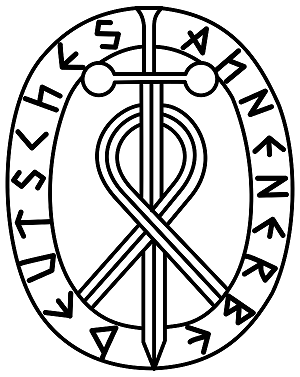
Another of Himmler’s pet projects was a think tank called Ahnenerbe (meaning “ancestral heritage”) whose official mission was “to promote the science of ancient intellectual history” but which was actually engaged using pseudoscience to create propaganda.

Increasingly, archaeological digs and expeditions were taken over by government-sponsored groups, more particularly SS groups, and still more particularly, Ahnenerbe, bent on finding evidence to back up Hitler’s theories of Aryan descent and genetic superiority. Their logo, shown below, also contains pseudo Greek/ runic letters and the unfortunate use of the Norse Odal rune in the center.

Another data point for this troubled time in the sciences is The Myth of the Twentieth Century. This book—a major bestseller under the Reich alongside Mein Kampf—was penned by Alfred Rosenberg, a prominent ideologue of the Nazi Party to create a myth, specifically:⁶

[T]he myth of blood, which under the sign of the swastika unchains the racial world-revolution. It is the awakening of the race-soul, which after long sleep victoriously ends the race chaos.

So again we have an “interpretation of history”, essentially promulgating Nordicist Aryanism and blaming everyone else, particularly Jews, for all the world’s ills.

Turning back to the period of “pure Hellenism”, it was, naturally enough, particularly present in Germany beginning around the turn-of-the-last century. For example, even though he denounced Nietsche’s Birth of Tragedy (Die Geburt der Tragödie) as anti-scientific, in 1884 German classical philologist Ulrich von Wilamowitz-Moellendorff’s scornfully assessed ancient Eastern culture thus:⁷

The peoples and states of the Semites and the Egyptians which had been decaying for centuries and which, in spite of the antiquity of their culture, were unable to contribute anything to the Hellenes other than a few manual skills, costumes, and implements of bad taste, antiquated ornaments, repulsive fetishes for even more repulsive fake divinities.

Fast forward to today and the effects of this systematic rejection of fact still linger:⁸

[E]xpert archaeologists […] sometimes appear to feel uncomfortable about this fact and indeed advise against using the expression “the orientalizing period.” The foreign elements remain subject to a policy of containment: There is hardly a standard textbook that has oriental and Greek objects depicted side by side; many of the oriental finds in the great Greek sanctuaries have long remained—and some still remain—unpublished.

In a few sentences, Burkert lays out what the physical evidence shows regarding the relevant peoples and locations during the period in question:⁹

Greek merchants are present in Al Mina on the Orontes estuary [near modern Samandağ on the southern coast of modern Turkey] from the end of the ninth century; from there the connections reach to North Syria, to Urartu [in eastern Anatolia], and along the shortest caravan route to Mesopotamia. In approximately the same period the Greeks are in evidence at Tarsos [Tarsus, south-central Turkey] and somewhat later at Tell Sukas [near modern Jableh (جَبْلَةٌ), Syria]. There are also Greek finds from Rash-al-Basid (Poseidonia [رأس البسيط‎, also in Syria]), Tell Tainat [also on the southern coast of Turkey], Tyre [صور, Lebanon], and Hama [حَمَاة‎, Syria]. Connections go to nearby Cyprus [Κύπρος], but above all to Euboea [Εύβοια, a large island just off the Greek mainland], where excavations at Lefkandi [Λευκαντί] have brought to light relics of a relatively affluent community in the tenth and ninth centuries which was open to trade with the East. In the eighth century Eretria along with Chalkis [Ερέτρια and Χαλκίς, both cities of Euboea] reached its peak; but Athens [Αθήνα] was not negligible either. From Chalkis the Greeks reached the West even before the middle of the eighth century, as can be seen from the settlement of traders and craftsmen discovered at Pithekoussai-Ischia [Πιθηκοῦσαι, an island in the Tyrrhenian Sea, near Naples]. Here, too, the trade in ores was crucial, above all with the Etruscans; the Phoenician route via Cyprus to Carthage and then to Sardinia had to compete with that of the Greeks from Euboea via Ithaca [Ἰθάκη] to Pithekoussai. It is in connection with these routes that the first examples of Greek script appear, in Euboea, Naxos [Νάξος, the largest island of the Cyclades], Pithekoussai, and Athens.

The motivation for this contact, as the above passage implies, was trade, specifically in metals. The Royal Road, a major trade route running between the Assyrian and Akkadian capitals of Ash’shur (𒀸𒋩) and Nineveh (𒌷𒉌𒉡𒀀) to Sardis on the west coast of modern Turkey—an area inhabited by culturally Greek peoples—was already well established by the seventh century BCE. This road would become better known during the Persian Empire, and still later was to become the westernmost leg of the Silk Road.

If nothing else, all this is helpful in confirming I’m not crazy. The proofs offered by Burkert include some of the very ones I identified earlier. With this established, I can return to the magico-religious evidence which Burkert also points to in this incredible book.


Read subsequent articles in the Continuity of Magic from East to West series

Part 4B: The Chthonian Connection

Part 5: Hellenism, Schmellenism

Part 6: Myth and Magic in the Cultural Koiné

Part 7: Lux Orientis

Part 8: No Ewoks, Only the Dead


Read subsequent articles in the Logic of Lies series

Part 5: Descent into the Absurd

Part 5 Addendum: The Ironclad Test Oath and Why It Doesn’t Work


Read previous articles in the Continuity of Magic from East to West series

Part 1: The Griffin and the Phoenix

Part 2A: Hark, a Haruspex!

Part 2B: Go West, Young Mantis

Part 3A: Coda Etrusca

Part 3B: Devoted More Than All Others


Read previous articles in the Logic of Lies series

Part 1: The Fakes that Launched a Thousand Ships

Part 2: It’s Fascinating What One Can Deduce about a Man Just by Knowing his Name

Part 3: The Luwian Menace

Part 3 Addendum: Fruit from a Poisonous Pseudoarchaeological Tree


Notes

  1. Walter Burkert, The Orientalizing Revolution: Near Eastern Influence on Greek Culture in the Early Archaic Age, 1992.
  2. Dimitris Nakassis, “The Mycenaeans in Greek History: Orientalism and Master Narratives”, British School at Athens, Upper House Seminar, February 2016.
  3. Burkert, 1992.
  4. Ibid.
  5. Ibid.
  6. Alfred Rosenberg, The Myth of the Twentieth Century (Der Mythus des zwanzigsten Jahrhunderts), 1930.
  7. Ulrich von Wilamowitz-Moellendorff, Homeric Investigations (Homerische Untersuchungen), 1884, quoted in Burkert, 1992.
  8. Burkert, 1992.
  9. Ibid.

Pompeii and Pigs

An exhibit and an inscription

One recent weekend, my family and I jumped on a train to Oxford, more specifically, the Ashmolean Museum. I’ve mentioned the place previously and described it to my son as the British Museum’s quirkier cousin.

The draw on this day was an exhibition in which I was quite interested: “Last Supper in Pompeii”. It told the story of Roman food and drink culture.

In Gods & Heroes (G&H), we provided players with delicious food and drinks, such as:

  • Caecubum: Caecuban wine, known as the finest in the ancient world, produced on a coastal plain of Latium.
  • Locustum Elixam: boiled lobster.
  • Lucanicae: Lucanian sausages. This people of the Southern Italic Peninsula apparently produced excellent cased ground meats.
  • Posca: a drink made of vinegar, water, and herbs, somewhat like modern shrub.
  • Ptisanarium: a barley drink similar to horchata—odd because the Spanish word comes ultimately from Latin hordeum, “barley”, though our word tisane, meaning a medicinal drink, comes from ptisanarium.

I cribbed many of the foods from the first century CE cookbook attributed to Caelius Apicius, De re coquinaria (On the Subject of Cooking). It’s the oldest such surviving from Europe, and also formed an important cornerstone of the Ashmolean exhibit, with many descriptions of its dishes as well as corresponding cookware appearing.

One particularly surprising item was related to a dish from the book, glires—dormice, either stuffed with pork, pine nuts, and spices and baked, or roasted and dipped in honey, a taste apparently handed down from the Etruscans.

I was very much aware of the dish; it was one of those on offer in G&H. But I hadn’t heard of the glirarium, a terracotta jar in which the live rodents were kept and given loads of walnuts, chestnuts, and acorns. The jar had air holes, but was impossible for them to climb out of and kept dark so they would think it was time to hibernate and stuff themselves, similar to the process the modern French use to fatten up ortolan buntings, their forbidden songbird delicacy.

Something else caught my eye as well, mostly because it was so cute: a small bronze votive figurine of a chubby piglet. This was clearly the same type of ex-voto I’ve described previously. The Ashmolean placed it within a section about the atrium of the Roman home, specifically in the lararium.

I did not think it would have appeared there in ancient times (though it was linked thematically with artifacts that would). In the examples I had previously seen, such an item would be placed in a shrine of the god to which it was dedicated, in this case, Hercules (and it also hails from Herculaneum, where there must’ve been at least one important one), with its form a likely reference to the Erymanthian Boar (aper Erymanthius), the capture of which made up his fourth labor.

The piglet bears an inscription, as such items invariably do:

HER•VOE•M•L•

The exhibition’s description of the item, which struck me as incorrect, rendered this as:

HERculi VOEsius Marci Libertus

To Hercules from Voesius, Freedman of Marcus

Looking into other sources, I found something entirely different, but with which I also did not entirely agree:¹

HERculi VOt(E)um (solvit) Merito Libens

To Hercules, (he) fulfills? (his vow) willingly and deservedly

My own rendering splits the difference:

HERculi VOEsius votum solvit Merito Libens

To Hercules, Voesius (fulfills his vow) willingly and deservedly

How did I reach this conclusion?

Let’s begin with the problems with the Ashmolean’s version. The formulae for this type of religio-magical inscription are, naturally, quite important. If the inscription was from a secular setting and read simply VOE M L, I’d be fully on board with their interpretation of it as an extended name, and in such ⟨M⟩ is always Marcus. On a votive, however, the VSLM formula is ubiquitous, and reading this as a further shortening of this initialism seems on steadier ground. Additionally, though the piglet is not large, the workmanship is quite lovely, so I’d think it beyond the means of a freedman.

As for the other interpretation, the EDCS relies on the VSLM formula a bit too much. Latin not only contains no form of vōtum inflected or otherwise with voe in it, there’s no word of any kind with that cluster of letters, so instead they’re positing an odd abbreviation. Furthermore, the ⟨S⟩ for solvit is still missing. More compelling still is that the name of the vow-keeper would also be missing in this version, and names are clearly of major importance: the simplest defixio (curse tablet) is a Nixonesque list of the names of those being cursed, for example. Hercules needs to know that it is Voesius who has repaid him.

Of course, all this is my opinion, and for that matter, based on rather limited information. I feel certain this figurine represents the mythic boar, though. Rather than being docile, this little guy has his head raised proudly with an anthropomorphic, intelligent, and defiant gaze. The beast was also one of the few Hercules captured alive and King Eurystheus of Tiryns, who ordered the labors, had to beg him to take the fearsome creature away. As such, the Erymanthian boar was the symbol of an untameable spirit of the wilderness.


Read the addendum to this article

Addendum: Public Sausages, Private Votives


Notes

  1.  EDCS-11500339, Epigraphik-Datenbank Clauss/ Slaby (EDCS), ca. 1–79 CE.

Kato’s Comeuppance

Tarantino swipes at the Lee myth (Mythmaking in the Martial Arts, Part 5 Addendum A)

I recently decided some of my longer addenda were actually stories of their own, and easier to find, track, etc., if broken out as such, especially since my addenda seem prone to sprouting addenda of their own. To anyone who has already seen them and has thus been gulled into clicking an article you have already seen, whatever, no bigs—in fact, why not give it another read? You might find something you missed last time.

This one I’ve chosen to start with has gained new currency, perhaps, by the referenced film’s recent bagging of a pair of gold statues at the annual self-congratulation party Hollywood likes to throw itself.

A couple of things came up for me while watching Quentin Tarantino’s Once Upon a Time in Hollywood, some relating to the Manson murders, some to Bruce Lee, and some, surprisingly, to both. The first was the generally declining Hollywood system of the late ’60s and the growing focus on lowering budgets, including the Spaghetti Western, which main character Rick Dalton (Leonardo DiCaprio) initially resists, but eventually performs in. As I’ve noted, this paralleled the rise of the kung fu genre.

Then El Coyote. This is a great Mexican-American place I try to visit whenever I’m in LA for their huge, tasty plates and margaritas. And I knew it was a longtime fixture of the area but had no idea it’s actually approaching its 90th anniversary. Nor did I know Sharon Tate and her pals ate there the night before they were gruesomely murdered. With industry events like E3, my work with Disney, and my abortive partnership with David Lynch, among others, I’ve been to El Coyote many times, memories of which have a newly acquired spookiness.

Next I found out Jay Sebring, who “discovered” Lee was also Tate’s boyfriend until she met Roman Polanski during the filming of Fearless Vampire Killers. She and Polanski later married, but Sebring remained her close friend. Perhaps he was even the hookup for Lee as “Karate Advisor”, specifically for Tate’s scene in The Wrecking Crew, which also appears in the Tarantino movie. Sebring was with Tate when the Mason “family” came to her house and was also killed.

There’s a weird twist here not covered in the Tarantino film, and which, let me be clear, I give zero credence: some, including Polanski, believed Lee responsible for Tate’s death. The link is paper thin and I only mention it for context. Polanski was a student of Lee’s and they saw each other the day afterwards, at which time Lee mentioned he had lost his glasses. One clue left at the Tate-Polanski home was an unidentified pair of specs.

Finally, let’s get to the Bruce Lee scene, as you might’ve known I would. The scene includes Lee (Mike Moh) idolizing Muhammad Ali and making claims about how a fight between them would go, which provokes derision from fictional stuntman Cliff Booth (Brad Pitt), and a subsequent three-round martial contest, which is interrupted before it can be resolved.

Of course, I’ve discussed Lee’s Ali obsession, as well as his loudmouthed braggadocio. The Ali stuff is well known and even appears on film, while the latter aspect of Lee’s personality can easily be gleaned from the swagger he projects in his interviews, borne out by the firsthand statement from a coworker, “No one liked him […]”.¹

Cliff’s scoffing at Lee’s boastfulness mirrors comments from IRL stuntman Gene LeBell, and the action plays out as he suggests it would in a fight between Lee and someone larger: “You’d grab him and [throw him] out the window”.²

The format of the combat suggested by the film’s Lee is additionally reminiscent of that between Lee and Vic Moore at the 1967 Long Beach tournament.³

I can’t imagine Tarantino has read this series, but it seems clear he drew from some of the same sources I did for his portrayal of Lee. And clearly Tarantino had previously been a fanboy, dressing the Bride (Uma Thurman) in a black-and-yellow tracksuit and Onitsukas in 2003’s Kill Bill: Volume 1, a clear homage to Lee’s outfit in Game of Death, so something more recent must have caused his crisis of faith.

Tarantino also engages in some anachronism; presenting a fully fledged groovy Lee complete with the chicken noises that were to become his signature, but in the period depicted he wasn’t remotely a star, just a minor actor playing a sidekick on a soon-to-tank small-screen supeshow—far closer to the square early Lee of his first screen test.

Devotees of St. Lee were naturally upset by the film’s sacrilegious portrayal as were legacy owners Linda Lee Cadwell and Shannon Lee, the latter quickly and predictably responding:⁴

“ […] he was picked on [by the film] in the way that he was picked on in life by white Hollywood.”

Still, even this controversy serves to renew interest in Lee, just as films about how rotten the movie biz is ultimately serve only to expand its myth.


Read subsequent articles in the Mythmaking in the Martial Arts series

Part 5 Addendum B: The Row over “Hollywood” Continues


Read previous articles in the Mythmaking in the Martial Arts series

Part 1: The Bruce Lie

Part 2: Enter the Tycoon

Part 3: Fists of Flim-Flam

Part 4: Urban Lee

Part 5: The Littlest Dragon


Notes

  1. Paisley Rekdal, The Night My Mother Met Bruce Lee: Observations on Not Fitting In, 2000.
  2. I Am Bruce Lee, 2012.
  3. GrandMaster Vic Moore: The Man That Fought ’Em ALL!!!, 2013.
  4. Christi Carras, “Quentin Tarantino says, ‘Bruce Lee was kind of an arrogant guy’”, Los Angeles Times, August 2019.

The Little Less-Than

Unruly merbodies (DeDisneyfication, Part 10)

Suddenly, the same people who have so far been very accepting of Disney’s remakes are up in arms, tweeting things like:

Leave classic Disney movies in peace!

Sorry but I won’t watch this, it simply doesn’t make any sense.

Boycotting this disgrace.

Does this mean they’ve finally wised up to the fact their childhood memories are being crassly commoditized by a company expert in maximizing ROI and not so much in creating excellent entertainment experiences? Is it because they’ve figured out the original animated movies, however flawed, are still superior, or the original works they are based on remain better?

Nope, it’s because of white fragility. You see, a woman of color, Halle Bailey, was cast in the lead role, stoking outrage and giving rise to the hashtag “not my Ariel” because the actress is not white skinned as the character was in the animated film.

The Little Mermaid originally came out in 1989. The film marked the start of the Disney Renaissance, breathing life back into the animated musical genre, languishing since the 1967 release of The Jungle Book or earlier, according to some.

By contrast, the gravy train Disney is currently riding has them remaking every one of even their most modestly successful animated movies. One presumes this is partly due to a descending cost curve in CG, allowing “lifelike” effects to be cheaply inserted into these films.

Another angle is Disney’s copyrights to the animated works are running out, or already have run out in some countries, such as Canada. Remaking them with some minor changes to characters and plot points effectively resets the clock. As cultural works, these remakes are unneeded and tend to make them infinitely worse.

I suppose, along with my other media ethe, there’s a relevant one I arrived at partially in my own medium and partly from my days as an art student—the level of visual stylization should match the level of realism being presented in the rest of an experience.

The well-known Magritte painting The Treachery of Images (La trahison des images) depicts a pipe together with the words, “Ceci n’est pas une pipe.”—“This is not a pipe.” The work caused quite a stir in its day, but is entirely correct. Indeed, other fields have developed related dicta such as “the map is not the territory” and the “word is not the thing”.

Each case involves a metaphorical representation of reality via a medium of communication. When someone refers to abstract art, they are splitting hairs: all art is abstract, only the degree of abstraction varies. Even if you want to create something realistic, it is inherently not reality, but a level of abstraction, or stylization—just one relatively close to reality.

Let’s take Moby-Dick.¹ The work is strongly based in reality, and Herman Melville even served as a green hand on a whaling ship; the literary equivalent of method acting. The story is also based in part on the factual story of the doomed voyage of the Essex, a ship sunk by a whale.

Still, Melville is selecting the elements to include and exclude—the specific members of the crew, the vengeance-obsessed Ahab, the white whale. In short, he has still created the world of the Pequod, one based in the reality of his time, and a specific realm of pursuit. Even the supernaturally powerful titular cetacean drew on a historic albino sperm whale called Mocha Dick. But Melville has marshaled them all together to tell his story.

For contrast, I give you Flatland:² there is a kind of reality portrayed, but central to the work is the visualization of a two-dimensional world peopled by geometric figures. All the rules of this world, essentially a thought experiment, have to be developed by the author and explained to the reader—almost nothing can be taken for granted.

In the Disney-Pixar film, The Incredibles, the inconsistent level of stylization bothered me—super-realistic fire and wet hair were admirable technical achievements, but did not belong in the highly retro-stylized world of Metroville. So much more so portraying a fairy-tale reality in vivid, lifelike detail. This also bothers me about the whole MCU and is also why Spider-Man: Into the Spider-Verse is a standout among supeflicks—the visuals are perfectly matched to the themes. Whereas watching Christopher Walken’s voice emerge from a not-quite photoreal orangutan to sing “I Wan’na Be Like You” is a quick trip to uncanny valley.³

There is, in any case, a veritable flood of these live-action remakes. So many, multiple films are currently in theatrical release, which likely says something about their quality—I can’t be bothered to watch them myself.  The Little Mermaid has gained particular attention because of the casting of a POC in the title role.

In the past, Disney was notorious for their racist and sexist on-screen portrayals, as well as various other regressive tropes. True, they were “of the time” and other animation studios, and indeed, film studios generally, were just as bad, sometimes even worse. But lately, Disney has attempted to erase their checkered past, launching a charm offensive of inclusion with such entries as Moana and The Princess and the Frog.

Lest we imagine there’s some type of woke social consciousness behind this effort, Screen Rant contributor Kayleigh Donaldson reminds us the move is “just good business”:⁴

[Bailey] has the perfect youthful warmth that Ariel needs, as well as that spark of inquisitiveness. As evidenced by her work under Chloe x Halle, she certainly has the vocal range required to sing those Alan Menken songs […]. Bailey has an enthusiastic and young fanbase, and such things are most certainly taken into consideration in casting projects of this size. In many ways, she’s the full package.

Nonetheless, those complaining on social media have consulted the source, as one can only imagine they never previously had, declaring as the work is by Hans Christian Andersen, a Dane, Ariel should similarly be Danish, ergo white. Which is actually wildly off the mark: While our term, mermaid, means a “young woman of the sea”, the Danish term is havfrue, which means “half-woman”. And indeed these creatures are portrayed as less-than human in the tale, as they lack immortal souls. So quibbling about the color of her skin, eyes, and hair is absurd; she is racially nonhuman.

Rather than being woke, it’s potentially problematic given similar ideas held about POCs in the past. As Lori Yamato, professor of comparative literature notes:⁵

[T]he mermaid as a being complete in herself is not an option […]; as a mermaid, she is primarily seen as half-human rather than full-mermaid.

The idea of this supernatural creature came early and was widespread, appearing on every human-inhabited continent, together with an ancient intuition human life originated in the sea. The first clearly focused version is the Sumerian K’ulianna (𒆪𒇷𒀭𒈾, “fish-woman”), one of the seven hero-monsters slain by Ninurt’a (𒀭𒊩𒌆𒅁) in his pursuit of Imtuku (𒀭𒅎𒂂), and appearing in the art of the area as early as the Old Babylonian period (ca. 1830–1531 BCE). From there it was borrowed, as things often were, by the Greeks and the West generally, acquiring some properties of the birdlike but shore-dwelling Siren (Σειρήν), along the way, including enchanting vocal stylings.

The operative ur-water sprite for Andersen’s version seems to have been Melusine, a legendary figure prevalent in northwestern France and the Low Countries, who seems to actually spring from yet a different Graeco-Roman tradition; nymphs (νύμφἡ), specifically Naiads (Ναϊάδες). Melusine was linked to the House of Luxembourg, the Counts of Anjou, and so also the House of Plantagenet, and the French House of Lusignan as a kind of fertility and prosperity deity, though, as I’ve previously noted of these creatures:⁶

They both exemplify the native innocence of the healthy (and often local) countryside and yet uneasily recall the dangers of its ungovernable wildness; they represent nature as the true expression of divine beauty accompanied by unknowable depths.

Moving on to the Andersen story, in addition to its sentimentalism and Christian moralizing, many see it as antifeminist, with the female protagonist giving up her voice, symbolic of her free will and agency, in order to become attractive to a man. Additionally, the cruelty, always present in folktales, is unnecessarily amped up; there’s no magic in how the sea witch takes the mermaid’s voice, for example—she cuts out her tongue. Financial Times arts critic and Andersen biographer, Jackie Wullschlager notes the story,⁷

[…] shows Andersen enjoying the Mermaid’s suffering and offering an oppressive mix of self-sacrifice, silence, and expiation as ideals of female behavior.

Quoting Andersen’s work directly, the sea witch’s deal in particular embodies this sadism:⁸

I will mix you a potion. Drink it tomorrow morning before the sun rises, while you are sitting on the beach. Your tail will divide and shrink, until it becomes what human beings call ‘‘pretty legs.’’ It will hurt; it will feel as if a sword were going through your body. All who see you will say that you are the most beautiful child they have ever seen. You will walk more gracefully than any dancer; but every time your foot touches the ground, it will feel as though you were walking on knives so sharp that your blood must flow. If you are willing to suffer all this, then I can help you.

The Disney film is often seen as turning the tale into a postfeminist text. The elements cited are its focus on the individual, and in particular, the body as the locus of power, as well as the presence of consumerist and heteronormative value systems. The evidence they present for this is not uncompelling; in brief, the world is run by patriarchies, women are either good (Ariel and her sisters), and therefore resemble Barbie, or evil (Ursula the sea witch), and therefore old, fat, and ugly. Finally, the tale centers on a makeover to render the heroine acceptable to the man she desires. Of the sea witch’s place in this matrix, communications and women studies professor, Laura Sells says:⁹

Ursula is the female symbolic encoded in patriarchal language as grotesque and monstrous; she represents the monstrosity of feminine power.

However, significant in both cases is the human world is really the goal and not the prince at all. In fact, a clear subtext in the Andersen work, and arguably the Disney one as well, has given it enduring appeal for social outsiders and specifically LGBTQ+ audiences. Nor is this accidental, as Wullschlager informs us:¹⁰

As the drama of the suffering of a social outsider and an unrequited lover who cannot express his or her passion, [“The Little Mermaid”] is still poignant. This is certainly how Andersen identified with the tale, allying himself in his bisexuality to the mermaid’s sense of being a different species from humankind.

Andersen’s sexual orientation is well-documented, as LGBTQ+ historian Sacha Coward notes:¹¹

Hans was a bi-romantic man; he fell in love with both men and women, and we can see this from his diaries. [H]e wrote [“The Little Mermaid”] after being rejected by […] a man called Edvard Collin. Therefore, the writing […] starts to gain a clear queer symbolism even in its origins.

In addition to his many crushes on both women and men—all unrequited—Andersen had a poor physical self-image, and it seems “The Little Mermaid” in particular expressed his curiosities and anxieties about sexuality. If you look back on the passage I’ve already quoted about the mermaid being transformed, it reflects the lengths to which someone who feels they are occupying the wrong body is willing to go to remedy the situation.

It’s also important to note the mermaid does not get the man, whereupon cries so hard she melts into foam. Afterwards, she enters a purgatorial state as a daughter of the air, an invisible and ethereal being who might finally earn a soul after suffering, enduring, and doing good deeds for 300 years.

Deepening his identification with the mermaid, Andersen too devoted himself to godly works, writing:¹²

Almægtige Gud! dig alene har jeg, Du styre min Skjæbne, jeg maa hengive mig Dig!

Almighty God, you alone have I, you govern my destiny, I must devote myself to you!

Over in the Disney version, this subtext also appears, many say, because of the work of the excellent contributions of songwriter Harold Ashman, a gay man who tragically died of complications from AIDS not long after the Disney film’s release. The studio dedicated their next film, of which Ashman also was a key part, 1991’s Beauty and the Beast, thus:¹³

To our friend Howard, who gave a mermaid her voice and a beast his soul, we will be forever grateful.
Howard Ashman
1950-1991

Many see “Part of Your World” as expressing the longings of a closeted homosexual. “Under the Sea” also fits into this interpretation as Leland Spencer, professor of communication studies, relates:¹⁴ ¹⁵

Sebastian believes that Ariel’s identity is essentially connected to the body in which she was born. Sebastian’s musical admonition is a normalizing discourse that officially sanctions particular performances as appropriate or acceptable. His comparison frames the ocean as superior to the land, but also a more fitting place for Ariel. As a mermaid, she should be happy in the ocean. The song asks what more Ariel could be looking for, but Sebastian is not interested in an answer. The implication of the rhetorical question is that she need not look elsewhere because she belongs in the sea and could never be satisfied anywhere else.

It’s also worth noting Ursula’s appearance was inspired by the drag queen Divine.

Finally, The Shape of Water did an admirable job of turning subtext into text and subverting many of the unfortunate tropes of the mermaid story. Its art direction was fantastic as well, and yes, live action was the best choice for the film.

If, in similar fashion, Disney’s casting of Bailey as Ariel signals their live-action remake of The Little Mermaid will come directly at some of the deeper themes embedded in the original film, or even some of the still more difficult ones in Andersen’s work, then I salute them. But not so much if, as I predict, it’s just tokenism in an otherwise complete rehash.


Read subsequent articles in the DeDisneyfication series

Part 11: Batmouse 3D

Part 12: Mork & Scheherazade


Read previous articles in the DeDisneyfication series

Part 1: Straightening out “Hunchback”

Part 2: Making Over “Mulan”

Part 2 Addendum B: Your Western Wuxia Is Weak

Part 3A: “Hercules”: Myths and Mistakes

Part 3B: Doing Hera’s Work

Part 4: “Belle” Epoch

Part 4 Addendum: The Enchanted and the Postmodern

Part 5: Putting “Pocahontas” to Rest

Part 5 Addendum: Powhatan’s Mantle

Part 6: Trouble with “Tarzan”

Part 7A: The Wrong Rabbit Hole

Part 7A Addendum A: Curious Curation

Part 7A Addendum B: “Alice” in Revolt

Part 7A Addendum C: How “Alice” Grew Big in Japan

Part 7B: Alice’s Adventures in the Cousins War

Part 8: Guerrillas and the “Jungle”

Part 9A: Through a Magic Mirror Marred

Part 9A Addendum: The Woods “Over the Wall”

Part 9B: The Sum of its Versions

Part 9C: The “Snow White” Studio

Part 9D: Snowhaus


Notes

  1. Herman Melville, Moby-Dick; or, The Whale, 1891.
  2. Edwin Abbot Abbot, Flatland: A Romance of Many Dimensions, 1884.
  3. Robert B. Sherman and Richard M. Sherman, “I Wan’na Be Like You (The Monkey Song)”, The Jungle Book, 1967.
  4. Kayleigh Donaldson, “The Little Mermaid’s Ridiculous Casting Backlash Explained”, Screen Rant, July 2019.
  5. Lori Yamato, “Surgical Humanization in H. C. Andersen’s ‘The Little Mermaid”, Marvels & Tales, 2017.
  6. Hedlund, “Malefic Traditional”, Deru Kugi, February 2018.
  7. Jackie Wullschlager, Hans Christian Andersen: The Life of a Storyteller, 2000.
  8. Laura Sells, “Where Do the Mermaids Stand? Voice and Body in The Little Mermaid”, From Mouse to Mermaid: The Politics of Film, Gender, and Culture, 1995.
  9. Wullschlager, 2000.
  10. Hans Christian Andersen, “Den lille havfrue”, (“The Little Mermaid”), Eventyr, fortalte for Børn. Første Samling. Tredie Hefte (Fairy Tales Told for Children. First Collection. Third Booklet), 1837, English version from The Complete Fairytales and Stories, E. C. Haugaard trans., 1974.
  11. Sacha Coward, “Mermaids”, Queer as Folklore, Museum of London, March 2021.
  12. Andersen, August 1836 diary entry, quoted in Johan de Mylius, H.C. Andersens liv. Dag for dag, 1998.
  13. Beauty and the Beast, 1991.
  14. Howard Ashman and Alan Menken, “Part of Your World”, Under the Sea”, The Little Mermaid: Original Motion Picture Soundtrack, 1989.
  15. Leland G. Spencer, “Performing Transgender Identity in The Little Mermaid: From Andersen to Disney”, Communication Studies, 2013.

Coda Etrusca

A forgotten culture’s lasting influence (Continuity of Magic from East to West, Part 3A)

I’ve already done the research and writing regarding my hypothesis as to how magic moved from the Ancient Near East to the West, but I’m compelled to dwell a bit longer on the Etruscans. My reason is simple: I find them fascinating.

As with many things relating to the ancient world, my first real encounter with them was during the production of Gods & Heroes. For the game, we included the culture, but because of our timeline at roughly 230 BCE, it had been on the decline for nearly 300 years. Therefore, we presented necropoleis, phantoms, demons, and a few ragged bands of Etruscans still managing to live at the margins of the burgeoning Republic of Rome.

I also wrote and directed voiceover in Etruscan. This was a meaty side project for me. I had worked with Michael Weiss, professor of Indo-European languages from Cornell, to get a timeline-appropriate script in Latin, Greek, Gaulish, Oscan, and some other fun regional languages, but he balked when I asked about Etruscan. Per my MO, this was a challenge-accepted moment and when I showed him what I’d come up with, he had to doff his hat. Here are a few samples:¹

snuia cenwa tsini
Many blessings upon you.

temiasi
For the temple!

icita rumakharasi
Thus to the Romans!

Handily, when the design team would come up with names for characters or places in the language, I could suggest they use the adjectival form of a word or tell them which genitive ending was appropriate to affix.

Structurally, the language is quite interesting, with agglutinative word endings as are found in Turkic languages and Japanese, together with inflections as we see in most European languages—most have one or the other, not both. There’s also a heavy stress on the initial syllables of words that led to a loss of word-internal vowels, or their replacement by sonorants or aspirates, though they seem to have been re-established later.

It also seems strangely forward looking, with features that were to emerge later in European languages: the ⟨q⟩ we see as a form of /k/ that must be followed by ⟨u⟩—likely due to an excess inventory of letters representing the /k/ sound, the /t͡s/ sound for ⟨z⟩ we see in German and Italian, among others, and separate letterforms for ⟨u⟩ and ⟨v⟩.

Gods & Heroes used the Etruscan alphabet in the gameworld as well. It’s a form of Old Italic and a close relative of Greek. This means it’s quite readable even though it runs from right to left, or earlier in boustrophedon. It’s actually the forerunner of our own Latin alphabet, as well as having moved north where it evolved into Elder Futhark. Rendered in the Etruscan script, the above phrases would look like this:

𐌉𐌍𐌉𐌆 𐌀𐌅𐌍𐌄𐌂 𐌀𐌉𐌖𐌍𐌔

𐌉𐌔𐌀𐌉𐌌𐌕

𐌉𐌔𐌀𐌓𐌀𐌗𐌀𐌌𐌖𐌓 𐌀𐌕𐌉𐌂𐌉

The reasons Weiss had such doubts about the possibility of working in Etruscan are manifold: not only is it a long-dead language, but it’s also difficult to reconstruct as it has few relatives—in fact the Tyrsenian group to which it belongs is a hypothetical one—and finally the corpus of the language is quite limited, with even scanter ones for others in the group such as Rhaetian and Lemnian.

There are various theories about the origins of the language and people, some agreeing with what I’ve previously discussed; Asia Minor, and others that they either predate the Indo-Europeans and may have related instead to Minoans and Lemnians or associating them with the Pelasgians, ancestors of the Greeks. In any case there was something of a sprachbund between the language and Greek and later Latin which ultimately confounds us etymologically as it’s often difficult to trace which language was the originator and which the borrower of any given word.

Nonetheless, many words and names we still use in English to this day descend from Etruscan. Basically, things in Latin that don’t obviously trace from Ancient Greek or Proto-Indo-European, and even some that do, are likely to come from this mysterious language. Some examples are:

  • April: from 𐌄𐌓𐌉𐌐𐌀 (Apire) via Latin Aprīlis, from Ancient Greek Ἀφροδίτη (Aphrodite) via 𐌖𐌓𐌐𐌀 (Apru)
  • atrium: from 𐌄𐌓𐌈𐌉𐌀 (ait’re) “sky”
  • mundane: from 𐌈𐌖𐌌 (mut’) “world” via Latin mundus
  • palate: 𐌖𐌕𐌀𐌋𐌀𐌚 (falatu) “sky” via Latin palatum
  • person: from 𐌖𐌔𐌓𐌄𐌘 (p’ersu) “masked individual; actor” via Latin persona

Even the word Rome seems to derive from the Etruscan gens 𐌀𐌌𐌖𐌓 (Ruma), seemingly meaning “teat”, and so perhaps linking to the origin myth of the twins suckled by a she-wolf.

A moderately educated Roman during the early Republic would have known Etruscan and Greek as well as their native Latin. Greek was the language of learning to some extent, but also because of their extensive colonial presence in the southern Italic Peninsula and Sicily, known as Magna Graecia. They’d know the first language not only because of proximity—so close, the shore of the Tiber directly across from Rome was formerly called Ripa Etrusca, “the Etruscan Bank” (modern Trastevere)—but also because the Republic was established only after the overthrow of the Tarquins (𐌀𐌍𐌗𐌓𐌀𐌕, Tarchna, which was also the name of an important Etruscan city), an Etruscan succession that took over at the end of the Roman Kingdom period (753–509 BCE).

It’s important to note all the Roman Kings are semi-legendary, beginning with Romulus, who founded the city with his brother Remus, who he of course later slew. Generally, as their reigns are unnaturally long, it is agreed these kings likely represent a greater number of individual rulers who have been conflated to focus on those deemed most important. The kings were elected by the Senate rather than being dynastic and the failure of this system under the Tarquins, who skipped the voting part, is what led to the crisis in kingship and abolition of monarchical rule until Julius Caesar’s Civil War (49–45 BCE).

Along with the language, several other things typically thought of as Roman were introduced under the Tarquins. These included clothing such as the toga praetexta—white with a broad purple border, the paludamentum; a cape worn by military commanders, and the trabea; a typically red or purple overgarment, as well other accouterments like senatorial rings, phalerae; military awards, the tuba; not our modern one, but a long, straight horn, the kingly scepter, the curule chair, and even the fasces. Note none of the preceding terms are italicized as we still use them in English.

Important edifices also date from the Tarquins’ reign: the city’s first defensive wall, the Cloaca Maxima, the Circus Maximus, and the Capitoline’s temple to Jupiter Optimus Maximus.

Regarding the gods, most think of those of Rome as being borrowed from the Greeks, but many are actually Etruscan versions of those gods and still others are actually native Etruscan gods only later syncretized with Greek ones. Still others seem to have been natively Roman, such as Jupiter, though his other name, Jove, seems to match the known Etruscan “anti-Jove” 𐌄𐌅𐌉𐌄𐌅 (Weiwe, Latin Veiovis). The first group includes:

  • Apollo: from Ἀπόλλων via 𐌖𐌋𐌐𐌀 (Aplu)
  • Hercules: from Ἡρακλῆς via 𐌄𐌋𐌂𐌓𐌄𐌇 (Hercle)

And a few in the second group are:

  • Juno: 𐌉𐌍𐌖 (Uni)
  • Minerva: 𐌀𐌅𐌓𐌍𐌄𐌌 (Menrwa)
  • Mercury: 𐌗𐌓𐌄𐌌 (*Merkh) from an epithet of 𐌔𐌌𐌓𐌖𐌕 (Turms) in his role as the god of trade, and incidentally also the origin of the English word merchant.
  • Neptune: 𐌔𐌍𐌖𐌈𐌄𐌍 (Net’uns)
  • Saturn: 𐌄𐌓𐌕𐌀𐌔 (Satre)

And, as we already have seen, the Etruscan divinatory arts were also adopted wholesale by the Romans together with Etruscans as practitioners thereof. In Part 3B, I’ll wrap up with a more in-depth discussion of these.


Read subsequent articles in The Continuity of Magic from East to West series

Part 3B: Devoted More Than All Others

Part 4A: Romancing the Hellenes

Part 4B: The Chthonian Connection

Part 5: Hellenism, Schmellenism

Part 6: Myth and Magic in the Cultural Koiné

Part 7: Lux Orientis

Part 8: No Ewoks, Only the Dead


Read previous articles in The Continuity of Magic from East to West series

Part 1: The Griffin and the Phoenix

Part 2A: Hark, a Haruspex!

Part 2B: Go West, Young Mantis


Notes

  1. As usual, I’m using a nonstandard Romanization to describe the language. I’ve aimed for easy readability and pronunciation, eschewing letters like ⟨χ⟩, ⟨φ⟩, and ⟨θ⟩, as well as slightly more familiar ones such as ⟨ś⟩, ⟨v⟩, and ⟨z⟩, as well as the use of digraphs like ⟨ch⟩, ⟨ph⟩, and ⟨th⟩, which also mislead as these are all aspirated in Etruscan, and not English /tʃ/, /f/, and /θ/. So ⟨kh⟩ is used for 𐌗 (⟨χ⟩)/ 𐌇𐌂(⟨ch⟩) with the value /kʰ/, ⟨p’⟩ is used for 𐌘 (⟨φ⟩)/⟨ph⟩ with the value /pʰ/, ⟨sh⟩ is used for 𐌑 (⟨ś⟩) with the value /ʃ/, ⟨t’⟩ is used for 𐌈 (⟨θ⟩)/⟨th⟩ with the value /tʰ/. I’ve used ⟨u⟩ to represent 𐌖 (⟨v⟩), whose value is /u/, while ⟨w⟩ represents 𐌅 (others sometimes render as ⟨v⟩) with the value /w/, and ⟨ts⟩ represents 𐌆 (⟨z⟩) with the value /t͡s/. As I’ve alluded to above, the letters 𐌂 (⟨c⟩), 𐌊 (⟨k⟩), and 𐌒 (⟨q⟩) all have the value, /k/, but I’ve let this peculiarity stand. I’ve also put in conjectural vowels in parentheses where the original orthography omits them. Finally, it’s also worth noting, as with any dead language, no one really knows exactly what Etruscan sounded like—the map is not the territory, except in the case of the 1:1 map of the empire.

Go West, Young Mantis

Hepatoscopy in Greece and Rome (Continuity of Magic from East to West, Part 2B)

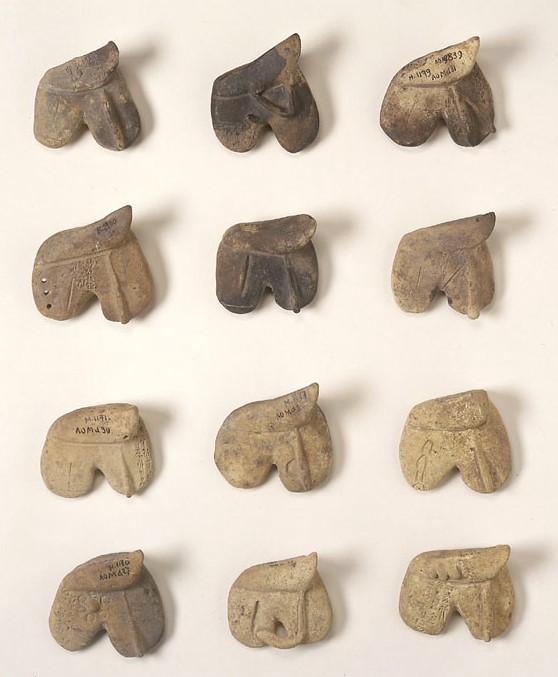
Divination using the innards of various sacrificed animals was done on a massive scale in the Ancient Near East (ANE). Huge numbers of clay models of sheep livers—on which these praxes particularly focus—and libraries packed with the corresponding omina, among many other things, attest this.The fact our English words for the praxis, hepatoscopy and haruspicy were handed down to us from Greek and Latin, respectively, shows these cultures also had some familiarity with the practice. I’ve noted haruspex was the Latin term for the priest-practitioner, while in Ancient Greece it was a μάντις (mantis), whence of course the insect—thus “praying mantis” is pleonastic—but also all the -mancies, via the verbal form, μαντεία (manteía).

That the art was widespread is clear, but the serious ick factor of fishing around in a pile of steaming viscera to learn the will of the gods is pretty high. Given the general esteem in the West for these mother cultures, this has led to a downplaying, if not full-on expungement of the gory details. Historian and archaeologist Sir William Reginald Halliday, writing near the turn of the last century, certainly fits this pattern, saying:¹

To attempt to classify or to enumerate exhaustively [divination using sacrificed animals’] almost unlimited possibilities of variation is a difficult and unprofitable task. Of the most important of them, however, extispication or the examination of entrails, something must be said. Into great detail or the discussion of technicalities it will fortunately be unnecessary to go.

Nonetheless, as a more recent scholar, Derek Collins, notes of the centrality of these rites Halliday so begrudges discussing:²

Next to the Delphic oracle, the most important form of divination in classical Greece was extispicy.

Indeed, the importance of the rite can be gauged by the fact it was also part of the preparation for a consultation with the famous oracle. Additionally, just as in the Ezekiel passage about Nabû-kudurri-usur I quoted in the previous Part, divination was most commonly performed before and during military campaigns where it was termed in Greek σφάγιον (sphágion, “sacrifice”), governing weighty issues such as when to begin a march, who was to command, etc.

Halliday also notes some form of extispicy has sprung up among many far-flung peoples, trying again to trivialize these rites within Greek culture as well as to cast doubt on their origins.³ But there is neither Greek literature nor iconography, let alone physical evidence, to support an autochthonous origin of the practice.

Rather, it’s entirely absent before 700 BCE when it appears in the final version of the Homeric epics, while older strata are devoid of such mentions. Art presents seers examining the liver from about 530 BCE and not until following the Persian Wars (499–449 BCE) does literature feature it as the dominant form of divination. Let’s recall that in 700 BCE, we’re only 100 years past the Greek Dark Age, and that date is important for another reason, as we’ll see later.

When Halliday finally manages to hold his nose long enough to discuss other possible origins of extispicy, he still attempts to downplay it, terming it a “sub-rite”:⁴

The Greeks themselves assigned the origin of extispication as of augury to mythical figures, to Delphos son of Poseidon, to Prometheus, to Sisyphos or Orpheus; and among the peoples supposed by antiquity to have invented the art are Etruscans, Egyptians, Cyprians, Cilicians, or Chaldeans.

The abovementioned Titan as the source of the art figures in Prometheus Bound as a gift given to the mortals along with fire, which again reinforces its importance:⁵

[] σπλάγχνων τε λειότητα, καί χροιν τίνα
ἔχουσ᾽ ἂν εἴη δαίμοσιν προς ἡδονην
χολή, λοβοῦ τε ποικίλην εὐμορφίαν.

[…] the smoothness of animal entrails, what color the gallbladder must have to please the gods, and the dappled symmetry of the liver lobe.

Modern archaeology has fully debunked Herodotus’ supposedly historical claim extispicy originated in Egypt and moved thence to Greece,⁶ as there is no attestation in Egypt prior to the Hellenistic period.

As to the tradition pointing to Cilicia and Cyprus, the priest clan of the Tamiradae at Paphos claimed to have brought the art with them from Cilicia, and to have passed it on to the Cinyradae. This last term refers to the chief priests there, who were actually of Phoenician rather than Greek origin, and so ultimately trace back to the source I’ve suggested. Collins concludes:⁷

[E]xtispicy originated in Mesopotamia among Babylonians and Assyrians, from where it moved west to the Hittites in Asia Minor and from there to Greece.

So despite some confusion remaining in Halliday’s work near the turn of the last century as to where Graeco-Roman augury came from, Collins delivers the above statement as being “commonly accepted” as of a decade ago. Furthermore, many of the same terms of art are used in the East and West, with many of those in Ancient Greek appearing to be almost direct translations from Akkadian, referring to features of the liver, such as the “gate”, “head”, “path”, and “river”.

Turning to Rome, the practice enjoyed similar ubiquity such that in the late Republican era, Cicero wrote:⁸

extis enim omnes fere utuntur
nearly everyone uses entrails in divination

Indeed, while in the Mesopotamian practice, sheep were mainly used, though oxen and goats also sometimes provided the wiggly material, in the West the practice was extended to sacred chickens, and even the guts of frogs and dogs could be consulted on occasion.

As to Latin literature, Vergil mentions a famous seer, Asilas:⁹

[…] ille hominum divomque interpres Asilas,
cui pecudum fibrae, caeli cui sidera parent
et linguae volucrum et praesagi fulminis ignes […].

[…] Asilas, interpreter between gods and men, whom the victims’ entrails obey, and the stars of heaven, the tongues of birds, and prophetic lightning fires […].

He’s talking about the Etruscans, whose Disciplina Etrusca contains these things and more: haruspicy, divination via the stars (astrologia), interpretation of bird cries (linguae volucrum), and lightning (fulguratura). Note the Etruscan language and literature around these praxes are largely lost, and now known only through Latin sources, just as with the above terms. Etruscan, Hellenistic, and Roman archaeology specialist Nancy de Grummond notes:¹⁰

Etruscan ritual […] was informed by a constant preoccupation with fate and destiny, and centered on attempts to learn the will of the gods and somehow to affect their decisions and thus the outcome of human affairs. The well-known Etruscan science of haruspication, involving the scrutiny and interpretation of the entrails of a sacrificial animal, epitomizes Etruscan praxis […].

Sounding familiar? Now we can return to the liver model from Piacenza about which I’ll come clean: I’ve misled you slightly. While it is in fact “relating to the Roman culture” as I said, it’s actually Etruscan, as that was the dominant culture on the Italic peninsula during Rome’s formative years and therefore a huge cultural donor—the Greek influence was to come later. What struck me about the liver models naturally did not escape the notice of scholars:¹¹

The correspondence between Etruscan and Assyrian hepatoscopy became evident as soon as the Etruscan bronze liver found at Piacenza was compared with the Assyrian clay model of a liver in the British Museum […].

And as in the Near East, this liver model isn’t unique in the Etruscan world—there are others in both bronze and terracotta, the Piacenza Liver is just an excellent example, which is unique in that it also attempts to correlate omens in the liver and the sky. I’ve also sneakily held back a bit of Collins’ tracing of the art from East to West:¹²

In the case of liver divination, the only exception to [the] pattern is that some of the technical information concerning the manufacture of model livers for instruction seems to have bypassed the Greek mainland and flowed by way of Lydia to Etruria.

However, it seems he’s actually gotten it wrong. Remember when I said the date of 700 BCE when hepatoscopy entered Ancient Greek literature was important? It’s the Orientalizing period of Etruscan history:¹³

[T]he internal tradition of the Etruscan disciplinae goes back to the seventh century […]—that is, to precisely that period whose glory is reflected in so many oriental imports.

Collins should have cast a still wider net as it seems the entire art bypassed Greece, caught on in Etruria, and then doubled back from there. This can be seen from various linguistic traces: First, there is vacillation between ⟨i⟩ and ⟨u⟩ in the second syllable of haruspex, as seen in Latin attestations of (h)arispex and in its close cousin, Faliscan’s 𐌇𐌀𐌓𐌉𐌔𐌐[𐌄𐌗] (harisp[ex]). This ties in with a feature of the Etruscan language; its emphasis on the initial syllable meant other vowels, especially in the second syllable, were often lost, as seen in the shift from AG Ἡρακλῆς (Herakles) to Latin’s (and its descendants’) Hercules because of the Etruscan intermediary 𐌄𐌋𐌂𐌓𐌄𐌇 (Hercle). This term of possible Etruscan origin was also borrowed into Hellenistic Greek as άρούσπηκα (harouspeka) while no Latin forms of the Greek words exist. Even the exonym for the Etruscans the Greeks invented and we still use a form of—Tusci—may derive from θυοσκόος (thyoskóos), “sacrifice-diviner”. The Etruscans’ name for themselves was 𐌀𐌍𐌔𐌀𐌓 (rasna), which just means “people” as many autonyms do.

The source I’m quoting above, The Orientalizing Revolution, backs up at least this aspect of my hypothesis much of Western magic stems from the Near East and I plan to read it further to see what else it reveals. The final verdict reached on this topic in the book is this:¹⁴

[T]o build a system specifically on the slaughter of sheep, to manufacture demonstration models of sheep livers from clay and metal and to provide them with inscriptions for the sake of explanation, is something peculiar found precisely along the corridor from the Euphrates via Syria and Cyprus to Etruria. It can even be shown that both the Assyrian and the Etruscan models diverge from nature in a similar way; that is, they are derived not directly from observation but from common traditional lore.

And, at least in Rome, the art continued to be Etruscan long after their hegemony of the area had elapsed; the art was passed from father to son. Thus, when the Romans refer to haruspices, they essentially mean this group of Etruscan specialists who continued to officiate in Rome.


Read subsequent articles in the Continuity of Magic from East to West series

Part 3A: Coda Etrusca

Part 3B: Devoted More Than All Others

Part 4A: Romancing the Hellenes

Part 4B: Chthonian Connection

Part 5: Hellenism, Schmellenism

Part 6: Myth and Magic in the Cultural Koiné

Part 7: Lux Orientis

Part 8: No Ewoks, Only the Dead


Read previous articles in the Continuity of Magic from East to West series

Part 1: The Griffin and the Phoenix

Part 2A: Hark, a Haruspex!


Notes

  1. W. R. Halliday, Greek Divination: A Study of its Methods and Principles, 1913.
  2. Derek Collins, “Mapping the Entrails: The Practice of Greek Hepatoscopy”, The American Journal of Philology, 2008.
  3. Halliday, 1913.
  4. Ibid, 1913. By calling it a “sub-rite” he’s insinuating animal sacrifice is the main rite, with hepatoscopy being an adjunct thereto—contrary to all evidence.
  5. Αἰσχύλος (Aeschylus) (?), Προμηθευς Δεσμώτης (Prometheus Bound), 493–495, ca. 479–424 BCE. I’ve used M. L. West’s 1990 translation, finding no fault with it. Also, this site doesn’t support all the Ancient Greek accents and breathing marks—my apologies to any readers interested in those details.
  6. Collins, 2008.
  7. Marcus Tullius Cicero, De Divinatione (Concerning Divination), I.10, 44 BCE.
  8. Ἡρόδοτος (Herodotus), Ἱστορίαι (Histories), 2.57.3, ca. 430 BCE.
  9. Pūblius Vergilius Marō (Vergil), Aeneis (Aeneid), X.175, 29–19 BCE. Using H. Rushton Fairclough’s 1918 just fine translation.
  10. Nancy de Grummond, “Etruscan Religion”, The Cambridge History of Religions in the Ancient World, 2013.
  11. Walter Burkert, The Orientalizing Revolution: Near Eastern Influence on Greek Culture in the Early Archaic Age, 1995.
  12. Collins, 2008.
  13. Burkert, 1995.
  14. Ibid.

Hark, a Haruspex!

Looking in the liver (Continuity of Magic from East to West, Part 2A)

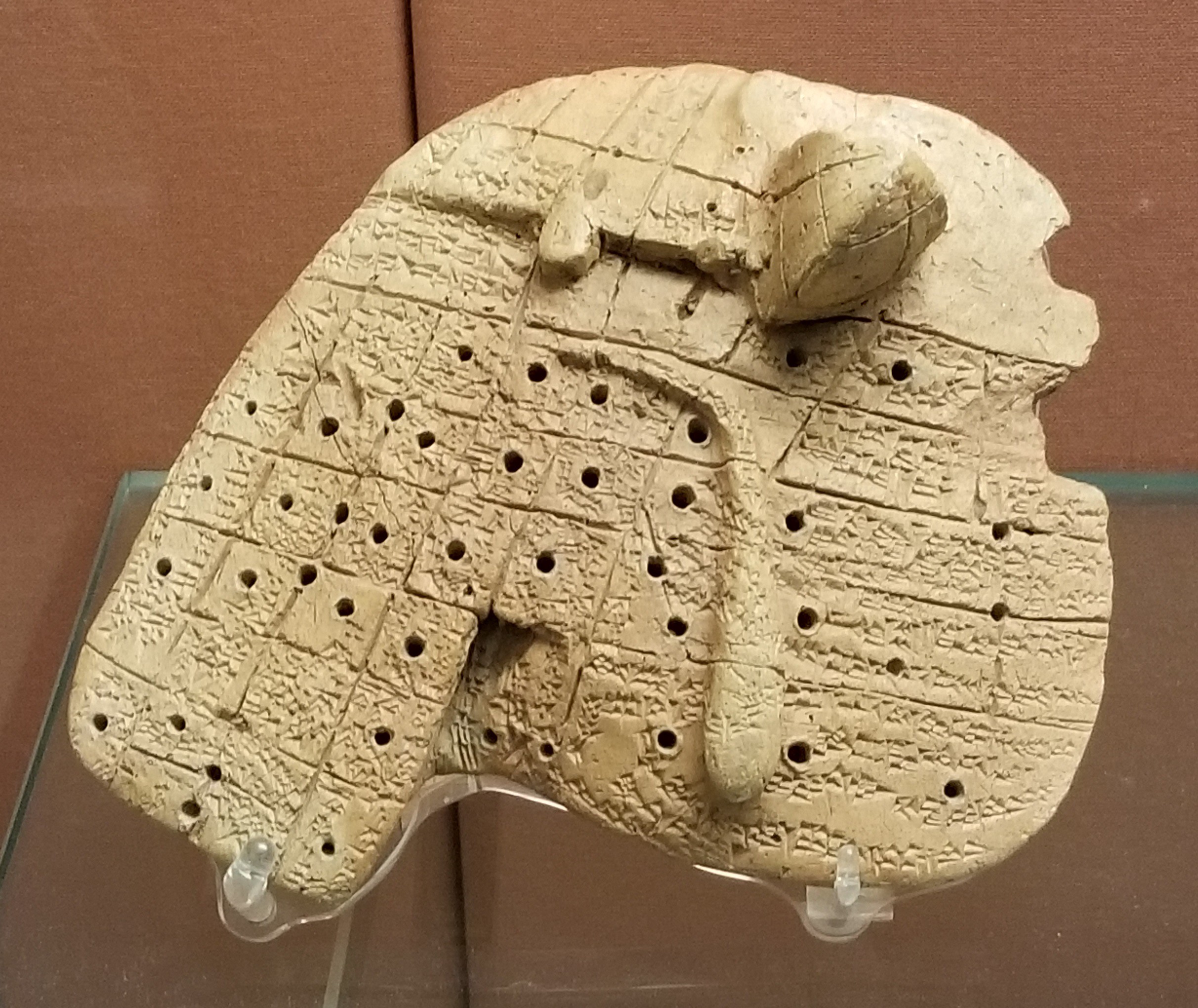
There’s an odd-looking artifact in the Near Eastern section of the British Museum. Made of baked clay, it’s part anatomy lesson and part Battleship grid. Its plaque tells us it’s The Liver Tablet, dated between 1900 and 1600 BCE and found in Sippar (modern Tell Abu Habbah, central Iraq), and describes it thus:¹

Inscribed model of a sheep’s liver probably used for instructing pupils; each box describes the implications of a blemish appearing at that position.

And just what might those implications be? We’re talking here about divination—attempting to foresee the future—the mysterious -mancies ancient magic is riddled with. In this case, it’s hepatomancy, itself is a type of haruspicy. The first term derives from the Greek words for “liver” (ἧπαρ, hêpar) and “divination” (μαντεία), and the second from an archaic Latin word for “entrails” (haru) and the Latin word “to observe” (speciō). Still more terms referring to the same arts appear, and as they will come up later, it’s best to introduce them as well; hepatoscopy (hêpar + σκοπία, skopiá “to examine”) and extispicy (exta, “entrails” + speciō), respectively synonyms of the first pair.

The Brit’s liver tablet turns out to be far from unique, with hundreds of similar ones excavated from sites like Mari (in modern eastern-central Syria) and Hazor (north-eastern Israel), with some 36 found at Ḫattuša (central Turkey) alone.

And of course the reason this object caught my eye is there is a rather famous one that’s quite similar relating to the Roman culture, known as the Liver of Piacenza for the northern Italian province in which it was found, more on which later.

Returning to the ancient Near East (ANE), although several terms for various priests and priestesses are attested, there are a few for this specific religious office, including Sumerian mash’shukitki (𒈧𒋗𒁍𒁍), which came to be expressed in Akkadian as bārû (𒀀𒍪). In the ANE, hepatomancy is thought to be the oldest of the divinatory arts, predating even writing. As professor of ANE studies, Beate Pongratz-Leisten notes:²

While no omen reports have been transmitted from the early periods, Early Dynastic profession lists and numerous administrative tablets from Ebla [in modern northwest Syria] point to the practice of extispicy performed during the third millennium BCE.

The specially trained priests would inspect the liver and lungs of a sacrificial sheep for omens. Much as the heart is today, the liver was regarded as the seat of emotions, especially desire, and even life and the soul, and so received particular emphasis in auguries. As a side note, in antiquity Cupid/ Ἔρως’s arrows targeted neither the victim’s heart nor liver but their eyes—they were that shallow.

Moreover, although anything animate or inanimate could be used by the gods to express their will as to human affairs or indeed cosmic truths, the stars and the liver were thought of as particularly favored media. Professor of religious and classical studies Alan Lenzi notes:³

[Mesopotamian s]cholars’ references to the celestial phenomena as “heavenly writing” (šiṭir šamê) or “writing of the firmament” (šiṭir burūmê), and the categorization of the liver as the “tablet of the gods” (-uppi ša ilī), are indicative of this perspective.

As to the method of this divination, the size, shape, and color of the organ were considered, but marks and the locations in which they appeared were of particular importance. Just as the museum’s label notes, the liver tablet and many like it essentially directed the student to the omen indicated by a mark at a given location.

Prior to all of this, the priest would have a specific question to which the answer was being sought, generally regarding the important actions a ruler was planning to take, in order to gauge both the general cosmic favorability and the possible repercussions. The priest then:⁴

[…] used judicial terminology, asking the sun god Šamaš “to judge the case” (dīna diānu) and “put truth” (kitta šakānu) into the entrails of the sheep.

As this suggests, such auguries mainly pertained to royalty, and as the sheep you possessed essentially equated to your wealth and social status, the extravagance of consulting their innards was also necessarily restricted to the elite. For example, the archive at Ebla, in the northwest of modern Syria, one of the largest from the time and region (mid-third millennium BCE) contained lists of sheep so used, which:⁵

[…] reveal that it was practiced on a large scale on behalf of the court, but also point to the king’s sponsorship and patronage of the craft.

The latter was true to such an extent the seals of these priests beginning in the Old Babylonian period (ca. 1830 BCE) reflected their position in direct relation to the kings they served. One, named Asqudum from the kingdom of Mari, for example, reads:⁶

Zimri-Lim, appointed by the god Dagan; Asqudum, the diviner

Zimri-Lim, is of course, the king he served.

Furthermore, the Book of Ezekiel characterizes Nebuchadnezzar II (𒀭𒀝𒆪𒁺𒌨𒊑𒋀) of the Neo-Babylonian Empire as personally performing hepatomancy among other divinatory arts:⁷

For the king of Babylon stood at the parting of the way, at the head of the two ways, to use divination: he made his arrows bright, he consulted with images, he looked in the liver.

A few things are worth noting here: First, the crossroads is the locus of the oracle, a liminal space in several traditions. The Greek Ἑκάτη (Hekátē) was the goddess of the crossroads and of witchcraft, and the Roman Diana took on these aspects under the epithet Trivia, meaning “triple way”, or crossroads. Ἑρμῆς (Hermes) was also a liminal figure, not only as messenger between gods and mortals, but in his role as ψυχοπομπός (psychopomp), leading the souls of the departed to Ἁιδης (Haides). For this reason, he is another god of the crossroads, under the epithet, Τρικεφαλος (Trikephalos, “3-headed”). This idea of road intersections as magical spaces was passed down even to relatively modern times, as bluesman Robert Jordan was reputed to have traded his soul to the devil for his guitar skills in the 1920s.

Second, the arrows are actually “shaken” rather than “made bright”—other translations render it this way. That is, they are cast as lots. This is another form of divination known as cleromancy.

Finally, the images mentioned are graven ones—idols known as teraphim (תְּרָפִים), “household gods”. All of this was to decide whether to invade Jerusalem, for which apparently the king received a resounding yes from the gods.

From the time divinatory material begins to appear in writing, royal and temple libraries show it to be quite important, often housing large collections. An example of the importance of such documents can be seen in King Ashurbanipal’s archive, where over a quarter of the tablets were divinatory.

These royal associations extended to the omens themselves because of their relationship to historical events, i.e., this mark appeared when king X did Y, and so presenting either dire or propitious tidings based on the outcome. Things like:⁸

a-mu-ut Na-ra-am-(d)Sîn sá A-pí-sá-al Il-qá-é

Omen of Naram-Sin who conquered Apishal.

and

a-mu-ut ú-hu-ra-im si12 I-bí-(d)Sîn ba-taq? ma-ti-šu i-ba-al-ki-li-šu

Omen of diminishment of Ibbi-Sin against whom a fraction of his country made a revolt.

Naram-Sîn and Ibbi-Sîn being kings of the Akkadian (ca. 2334–2154 BCE) and Ur III (ca. 2112–2004 BCE) periods, respectively.

Eventually, and somewhat predictably, it became aspirational to appear in these omens as a paradigmatic and historiographic ruler, also uncoincidentally increasing one’s prestige and political power. Ashurbanipal, for example, sought to insert himself into the company of kings like Sargon and Naram-Sîn of Akkad, as is recorded in a letter from a diviner asking how the king would like his omens to be written, running in part:⁹

[Omen for Assurbani]pal, mighty king, reverent prince, of whom (it is said) Ištar (walks) at the side of his a[rmy] cut off [the head of Teumman, king of Ela]m in the midst of battle and the son of Bēl-iqīsha […]-tuk of the Elamite they hung around his neck, and Assurbanipal [went to Nineve]h, his royal residence. They were exulting joyfully and performed music, the messenger? of Ummanigash, king of Elam, he killed in front of Assurbanipal, king of the universe, and he sat on his throne. Assurbanipal, king of the universe, at the command of […] Tammarītu, king of Elam, together with his magnates rolled before him [in?] Nineveh, his royal residence. [whom Assur and] Ištar love and lead with their full content, and Tammarītu who had plotted for help of Šamaš-šum-ukīn, he himself, the diviner and his magnates went and kissed his feet, Tammarītu and the diviner accused each other in front of him.

[If… the right and left side of the station are […] it is the omen of Assurbanipal, king of the universe, (of whom it is said) that Šamaš and Ištar walk at the side of his army and killed (his enemies) in the midst of battle and effected their defeat.

[If…] in the lift of the head of the right lung there is a sign/omen (predicting) the annihilation of the army, it is an omen of Šamaš-šum-ukīn, [the treacherous brother, who] fought against the army of Assurbanipal, the beloved of the great gods, (but) was defeated.

I’ve covered the prevalence of this form of divination in the ANE, next time more about its presence in Western magic and ritual.

Coincidentally, the Brit’s exhibition, “I am Ashurbanipal: king of the world, king of Assyria‎”, was really what I went there to see but alas, it was the final weekend of its run, it was sold out, and I didn’t get to see it so I did this instead.


Read subsequent articles in the Continuity of Magic from East to West series

Part 2B: Go West, Young Mantis

Part 3A: Coda Etrusca

Part 3B: Devoted More Than All Others

Part 4A: Romancing the Hellenes

Part 4B: The Chthonian Connection

Part 5: Hellenism, Schmellenism

Part 6: Myth and Magic in the Cultural Koiné

Part 7: Lux Orientis

Part 8: No Ewoks, Only the Dead


Read previous articles in the Continuity of Magic from East to West series

Part 1: The Griffin and the Phoenix


Notes

  1. Object 92668, The Liver Tablet, British Museum, ca. 1900–1600 BCE.
  2. Beate Pongratz-Leisten, “The King at the Crossroads between Divination and Cosmology”, Divination, Politics, and Ancient Near Eastern Empires, Alan Lenzi & Jonathan Stökl, eds., 2014.
  3. Alan Lenzi, “Revisiting Biblical Prophecy, Revealed Knowledge Pertaining to Ritual, and Secrecy in Light of Ancient Mesopotamian Prophetic Texts”, Divination, Politics, and Ancient Near Eastern Empires, Alan Lenzi & Jonathan Stökl, eds., 2014.
  4. Pongratz-Leisten, 2014.
  5. Ibid.
  6. Dominique Charpin, “Patron and Client: Zimri-Lim and Asqudum the Diviner,” The Oxford Handbook of Cuneiform Culture, 2011.
  7. Ezek. 21:21, King James Version (KJV), 1611.
  8. RA 35, nos. 3 and 6, quoted in Pongratz-Leisten, 2014.
  9. RM 2, 455, quoted in ibid.

The Griffin and the Phoenix

The migratory patterns of mythical beasts (Continuity of Magic from East to West, Part 1)

A handy thing about living in London is I can go to the British Museum. San Francisco’s Legion of Honor is decidedly minor league by comparison, really doing a fair job only as a historical cross-section of Western painting, with wunderkammer-style collections of anything else, including their selection of ancient artifacts. The British has more of this stuff than they can even display properly.

To this point, my research has mainly been done online, a painstaking, time-consuming, and often frustrating affair. Additionally, my access to WorldCat via my son’s university is shortly to end, making things considerably worse. Indeed, the UofM seems to have noticed I’m trying to use their service from a different country and now refuses requests except from my phone, a less-than-ideal device for such purposes.

There are drawbacks to the museum to be sure: the relevant artifacts might be displayed based on contexts entirely dissimilar to what one has in mind, and of course, there are tourists from which at least the dark corners of the internet remain free. They really only came to the museum to take selfies in the great hall to give their friends some form of cultural FOMO, but hey, now they’ve come all this way, they might as well play it out a bit, in case someone asks them about it, so they can repeat hazily understood facts about the Rosetta Stone, e.g., but assuring everyone, “such history—it was amazing!” Basically, they clutter the halls, each with a sense the items on display must be important but unsure why. When one of them stops, they all stop, assuming something particularly noteworthy has been spotted by a member of the herd.

Then there are the guides. One was trying to explain cuneiform to his group in one of the Assyrian galleries and started out well, saying it had been invented by the Sumerians, but then took a sharp left turn, saying it was an alphabet and the Assyrians who supplanted the Sumerians used the script to write their own language. I uttered a series of three NOs, each a bit louder than the last before I could stop myself.¹ I’m sure it was passed off as a mild attack of Tourette’s, but for the rest of my visit, I wondered if there was someone I should report him to.

Anyway, if, for example, I want to establish a continuity of ritual practice between the magic of the ancient Near East and the Graeco-Roman sphere, I can simply stroll through a few galleries—dodging tourists—in order to do so. The process is simple: I look in the Mesopotamian or Egyptian galleries for items I recognize, more or less, from the ancient West, and moreover can also view items from this last area if need be. So on we go.

The griffin is tricky, as one of the earliest recognizable images comes from Crete, specifically the royal palace complex at Knossos, causing people to associate it with Greek culture. And indeed, the Bronze Age Greeks drew significantly from the Minoans, including at least their mode of dress, the buon fresco technique, and the Linear B script. Maybe the Mycenaeans also borrowed the bird-creature along with many other things, but we don’t know because of the Late Bronze Age Collapse.

We encounter similar chimerae in Mesopotamia, including some versions of Imtuku/ Anzû (𒀭𒅎𒂂), whence also the Ziz (זיז) generally with more birdlike properties, and the Ala/ Lamassu/ Šēdu (𒀭𒆗), with a lion or bull’s body, eagle’s wings, and a human face, which components also flowed into Jewish lore as the four living creatures drawing the chariot of God and thence to each of the Christian Gospels and their writers, who sometime reassemble à la Voltron to form the mighty Tetramorph.

Strong examples of the griffin in bronze appear in Rhodes, which, while traditionally Greek is closer to Asia Minor than it is to the mainland, with its name possibly stemming from the Phoenician word for snake, 𐤓𐤏𐤃‎𐤄 (possibly eroʿod—the script is an abjad, so we can only guess at the vowels), since the island was apparently once quite infested with the ² Extremely near cousins of these griffins also turn up in Etruria, so similar indeed they form part of the hypothesis of the Anatolian origin of the Etruscans.

The phoenix‌ has a name which in itself is etymologically inextricable from Phoenicia, as both once referred to the color purple. Mycenaean attests both po-ni-ke (probably p’onikes) meaning the creature and po-ni-ki-ja (p’onikia) meaning the color.³ As expected, because of the extensive trade network and the moderate sprachbund so formed, these words are as migratory as the gray heron the Egyptians may have based a phoenix-like idea on, originating in the word bnw (maybe bennu—another abjad here). Thence, conjecture runs, it was borrowed by the Minoans, and from them by the Mycenaeans.

Meanwhile, the ethnonym—and really it’s an exonym coined by the Greeks in the eighth century BCE as people generally identified with their city, e.g., those near Tyre were Tyrians—is attributed also via Minoan to a different Egyptian word, fnḫw (fenekhu), referring to woodcutters, as their lumber came from Canaan, i.e., the famed cedars of Lebanon.

However, Dutch history of religion scholar Roelof van den Broek expresses some doubt:⁴

It is clear that there are certain parallels and relationships between the benu and the phoenix, but it is not possible to demonstrate that the Classical views were based on Egyptian, as some others have assumed. […] there are no indications that these notions [of the rebirth of the soul] developed from Egyptian conceptions, even though it has been assumed by some Egyptologists and others as well. It is at least equally probable that this symbolism developed spontaneously from the Classical phoenix myth.

He continues in a more etymological vein thus:

The name of the phoenix has also been considered to be derived from that of the benu, which has been taken as evidence of the Egyptian origin of the Classical myth. Sethe and Spiegelberg, followed by many others, have argued that the Egyptian word benu should be pronounced *boin or *boine, on the basis of the fact that it is written as bjn-w. The name φοῖνιξ is therefore considered to be only a Greek version of the Egyptian term for the benu. Several serious objections to this conclusion can be put forward […].

Unfortunately, in rather meta fashion, my limited ability to access this book online meant I could only find out what a few of these objections were. All I could find was the Google Book, which hides significant portions of the text presumably to protect the copyright, even though the book is nullibiquitous for purchase. I trudge on nonetheless.

There is a near homophony of the Mycenaean words p’onikes and p’onikia, such that the latter appears simply to be the genitive form of the first, linking the two terms so deeply either the mythical fowl’s plumage becomes reddish purple to match the dye of that color originating in Phoenicia, or vice versa. There’s another confounding homonym in this cluster, po-ni-ki-jo (p’onikios) which appears just a masculine-gendered variant of p’onikia, but means a date palm, whose Latin name remains Phoenix dactylifera. There are yet more meanings in Ancient Greek, which at least seems clearer as it refers to a guitar-like instrument of the Phoenicians, and the letters of the Phoenician alphabet are called Φοινικηια (Phoinikeia) by Herotodus (Ἡρόδοτος).

Various theories of which sense is the primary one abound, based on authorities such as Isidore of Seville, who says the bird is named for the color,⁵ and Ovid, who says the name came from “the Assyrians”, meaning the Phoenicians,⁶ and Lactantius, who says exactly the reverse,⁷ although this last pair agree the palm is named for the bird, as it nests in said tree, while the Spaniard says the palm is named for the bird because they share a long lifespan, an idea Dionysius, Bishop of Alexandria also puts forth.⁸ Ultimately, it seems the name of a fabulous creature must be the original sense, coming to Mycenaean from a Semitic source and moreover covering both the bird and the griffin, which then was extended to the land, the color, the palm, and the musical instrument. And indeed, these creatures both appear in Minoan art. A French language review of the van den Broek book—one of the few traces I could find of it—reflects he agrees:⁹

Le Po-ni-ke mycénien, l’oiseau de Phénicie, serait alors une espèce de griffon, d’origine sémitique.

The Mycenaean Po-ni-ke, the bird of Phoenicia, would then be a species of griffin, of Semitic origin.

Van den Broek also concludes the name of the bird has to have been transferred to the palm rather than the other way around, perhaps because both had the aspect of long life, also bringing the idea of victory symbolized by the palm frond into the complex and resulting in depictions of the bird perched in a palm tree.

Neither van den Broek, nor anyone else I can discover, points to an actual origin for the word and it seems to have been lost to the ages. I’ll be bold and suggest Sumerian as the source. Though a language isolate, many Sumerian words have come down to us, via Semitic languages, such as our word ass (the animal), which may be ultimately from Sumerian 𒀲 (an’she).

The specific word I’d cite is piring (𒊊). The literal meaning is “lion”, but also “bull”, or “wild bull”, and indeed as there is a tendency in the language to group felines and canines together, we should add “dog” to these. Animal, wild, and dangerous seems the proper cluster of associations. Furthermore, it’s used in several descriptions of the 11 chaos monsters birthed by the dragon goddess Namma (𒀭𒇉, better known by her Akkadian name, 𒀭𒋾𒊩𒆳, Tiamat) to avenge the slaying of her consort, Aptsu (𒍪 𒀊):

piring iki ushumkal
lion with the face of the Ushumkal (Great Dragon)

piring iki mush’khush
lion with the face of the Mush’khush (Furious Snake)

piring mush’khush ap’shaka luka
lion, the Mush’khush that lives in the center of the sea

These creatures are chimerae, their natures embodying the primordial chaos their mother represents: dragons like those mentioned above, a bull-man, a scorpion-man, a fish-man, one with a lion’s head and bird’s feet (clearly griffin territory), and even a lion-man named Uritim (𒌨𒅂), “Raging Lion” (which uses the sign for dog).

The transformation to p’onikes is explicable, though there is no smoking gun for the direction I propose: the Sumerian consonant ⟨ŋ⟩, with the value /ŋ/ (essentially /ng/, as I’ve rendered it above) does not exist in Linear B, and so the word might’ve been syllabized as pi-ri-ni-gi. Eventual and common decay of the tapped /r/ and a shift in the first vowel takes us to po-ni-gi. Alternation from /g/ to /k/, and a standard Greek third declension ending take us the rest of the way.

So, while concepts tended to wander across the ancient world, their general East-to-West direction eventually becomes clear.


Read subsequent articles in the Continuity of Magic from East to West series

Part 2A: Hark, a Haruspex!

Part 2B: Go West, Young Mantis

Part 3A: Coda Etrusca

Part 3B: Devoted More Than All Others

Part 4A: Romancing the Hellenes

Part 4B: The Chthonian Connection

Part 5: Hellenism, Schmellenism

Part 6: Myth and Magic in the Cultural Koiné

Part 7: Lux Orientis

Part 8: No Ewoks, Only the Dead


Notes

  1. The correct answers are: logographic/ syllabic script, Akkadians, and Akkadian. Perhaps Irving Finkel is the proper authority?
  2. “Rhodes, island, Greece”, Encyclopedia Britannica (online), retrieved March 2019.
  3. ⟨p(h)⟩, later expressed by ⟨φ⟩ and with the phonetic value /f/, seems to have been said in Mycenaean Greek as /pʰ/; an aspirated /p/, which I’ve rendered as ⟨p’⟩. ⟨p⟩ in Sumerian is sometimes aspirated, and I’ve rendered it the same way.
  4. Roel van den Broek, The Myth of the Phoenix according to Classical and Early Christian Traditions, 1972.
  5. Isidore of Seville, Etymologiae (The Etymologies), ca. 600–625.
  6. Publius Ovidius Naso, Metamorphoses 15:391–417, 8 CE.
  7. Caecilius Firmianus Lactantius (attributed), “De ave phoenice” (“On the Phoenix Bird”), possibly early sixth century.
  8. Διονύσιος Ἀλεξανδρείας (Dionysius of Alexandria), Περὶ Φύσεως (On Nature) frg. 3, ca. mid-third century.
  9. Marcel Detienne, “Van den Broek (R.) ‘The Myth of the Phoenix according to Classical and Early Christian Traditions’”, Archives de Sciences Sociales des Religions, 1973.

The Littlest Dragon

The irresistible mess of Shaolin (Mythmaking in the Martial Arts, Part 5)

Unless you live in a media-impenetrable cave, you have an image in your head of what kung fu looks like. And unless you’ve delved extensively into martial arts esoterica, Northern Sil Lum (北少林, Běishàolín, BSL hereafter) is the kung fu you’re thinking of: low stances, fluid transitions, circular blocks, rapid and long-range attacks that include leaping and spinning kicks.

It is one of the oldest, best known, most widely practiced, and most influential of the martial arts. Many of the martial arts of Korea, Japan, and Southeast Asia trace their lineages to BSL. Under its better-known Mandarin reading, Shaolin, it appears in the titles of a pile of films; from a quick perusal:

  • 2 Champions of Shaolin (《少林與武當》)
  • The 36th Chamber of Shaolin (《少林三十六房》)
  • Abbot of Shaolin (《少林英雄榜》)
  • American Shaolin
  • Bruce and the Shaolin Bronzemen (《神龍猛虎》)
  • Executioners from Shaolin (《洪熙官》)
  • Five Shaolin Masters (《少林五祖》)
  • Invincible Shaolin (《南少林與北少林》)
  • Kids From Shaolin (《少林小子》)
  • Martial Arts of Shaolin (《南北少林》)
  • The New Legend of Shaolin (《洪熙官之少林五祖》)
  • The Real Shaolin
  • Shaolin (《新少林寺》)
  • Shaolin and Wu Tang (《少林與武當》)
  • Shaolin Daredevils (《雜技亡命隊》)
  • Shaolin Dolemite
  • Shaolin Drunkard (《天師撞邪》)
  • The Shaolin Drunken Monk (《螳螂醉八拳》)
  • Shaolin Girl (《少林少女》)
  • Shaolin Handlock (《十字鎖喉手》)
  • Shaolin Plot (《四大門派》)
  • Shaolin Popey (? 《笑林小子》)
  • Shaolin Prince (《少林傳人》)
  • Shaolin Rescuers (《街市英雄》)
  • Shaolin Soccer (《少林足球》)
  • Shaolin Temple (《少林寺》 1976)
  • Shaolin Temple (《少林寺》 1982)
  • Shaolin Traitorous (《大太監》)
  • Shaolin vs. Evil Dead (《少林殭屍》)
  • Shaolin vs. Lama (《少林鬥喇嘛》)
  • Shaolin vs. Ninja (《中華丈夫》)
  • Shaolin Warrior (《少林殺戒》)
  • Shaolin Wooden Men (《少林木人巷》)
  • Snake & Crane Arts of Shaolin (《蛇鶴八步》)
  • The South Shaolin Master (《南拳王》)
  • Young Master of Shaolin (《少年英雄方世玉》)

Those are just ones using the term Shaolin in their English titles, though glancing at the Hanzi will tell you the term was often applied where it did not appear in the original, reflecting how well known it had become. Also worth noting is the list contains both Bruceploitation titles such as Bruce and the Shaolin Bronzemen, and blaxsploitation crossovers like Shaolin Dolemite. In any case, some of these Shaolin films starred the greats of martial arts cinema: Jackie Chan (陳港生), Jet Li (李阳中), Gordon Liu (劉家輝), Cheng Pei-pei (郑佩佩), and Donnie Yen (甄子丹).

This highly influential, well-developed, and effective style was what Wong Jia Man had been studying for 15 years, completing the full course, and teaching for another year prior to his fight with Bruce Lee.

Prior to 1964, Bruce Lee’s main martial art was Wing Chun (詠春). While it has appeared in a few movies, it is the opposite of BSL in many ways: a short-range style with the elbows held close to the sides; its movements stress economy and directness with few kicks, kept low to maintain balance. Wing Chun also places the practitioner in almost constant contact with their opponent, an element which suited it well to Lee because of his severe nearsightedness.

And yet, from the time Lee was discovered by Hollywood, through the remainder of his career, he was a classic kung fu actor: Even in his screen test for Number One Son (a scrapped project meant to be the adventures of the scion of Charlie Chan), he performs Hung Ga (洪家) forms—Shaolin, but a Southern version, uncoincidentally linked to Wong Fei Hung, a popular figure in Hong Kong film. Although none of Lee’s films bore the actual term, he played a Shaolin monk in his most famous film, Enter the Dragon (《龍爭虎鬥》), and can be seen therein performing a BSL form. Clearly, sometime after 1964, he had added these moves to his repertoire.

Most argue Lee’s trip back to Hong Kong at the end of that year was made to desperately try to actually learn to fight after, if not being defeated by Wong, at least not having done as well as he’d have liked. I disagree. I believe he used the trip to learn some flashy moves—Wing Chun is decidedly not that—and to get some publicity photos taken with Yip Man in order to build better martial arts cred, which Lee was also sorely lacking, for the martial arts film career he desired.

I discount the former notion because I think it’s absurd to  he beat Wong easily but needed to change everything about his fighting style. Even those who say Lee lost play into the myth he was any kind of serious fighter. Finally, the trip was not even Lee’s idea: his father died, and he returned for the funeral¹—anything else he did while there was simply opportunistic. Nonetheless, let’s dwell on this bit of hype.

Linda Lee confirms Bruce’s ’64 style was essentially Wing Chun, as well as relating the “crisis” that occurred after the fight:²

It did not take him long to realize that the basis of his fighting art, the Wing Chun style, was insufficient. It laid too much stress on hand techniques, had very few kicking techniques and was, essentially, partial.

Most reputable martial artists and historians who actually know about Lee’s life say what was actually “partial” was Lee’s training, not Wing Chun—or, for that matter, any of the other martial arts he was to later superficially study. This is what his decrial of the “classical mess” of the traditional martial arts was all about: sour grapes.

There is scuttlebutt within the martial arts community, and as such impossible to confirm, Lee sought but was refused training from one of Wong’s BSL teachers, Grandmaster Jianfeng Ma (馬劍風). This doesn’t necessarily argue for Lee trying to repair his technique—as I’ve mentioned, the style is attractive, and it’s equally possible he’d simply liked the look of some of Wong’s moves, especially given he didn’t remotely have time to study anything thoroughly, and had Hollywood clearly in his sights.

And I can’t fault Lee for that as it drew me in as well: though it is not the intent of BSL, it looks awesome. When I studied it my teachers would always complain about the way I did it, saying I had watched too many movies (I had). I could sense these moves were the ones I had seen in films, and couldn’t help but strike those poses and give it that punctuation.

One of my favorites to this day is the whirlwind kick (旋風腳, xuanfengjiao). It’s a spinning, jumping deal, and you slap the sole of your foot at the kick’s peak—as my fencing coach would say, “trash with splash”. In Wushu (武術) which also incorporates the move, we’d sometimes run into it to give the spin more velocity. When really showing off, I’d launch it off a step or low ledge to put greater height into it.

Perhaps because it’s so easy to get caught up in the visuals, there are those who, along with Lee, will discount BSL as just for show and not practical, and many martial arts can indeed be thus criticized as bullshido. But not this one: Peter Ralston, taught by Wong, was the first non-Asian to win the Full-Contact Martial Arts World Tournament in the Republic of China in 1978. “Full contact”—that’s practical; “world tournament”—that means bring any style from anywhere: we’re talking about the forerunner of mixed martial art fighting here.

As for Lee, the system he created, Jeet Kune Do, was largely plagiarized from various other martial arts, particularly Western fencing and Jack Dempsey’s book on boxing, of course, with some of those cool BSL kicks thrown in. His posthumous book even failed to replace the word “blade” with “fist” when cribbing from sources on fencing. He himself never competed, and the fighting system has produced no noteworthy champions.

If you think Bruce learned martial arts after going to Hollywood, when do you think he had time? He was shooting films, making appearances, giving private lessons to his new, exclusive LA clientele, and traveling back and forth to East Asia. If you look at his filmography, 1970 is the only letup, during which he was presumably pitching The Warrior, and upon failing that, deciding to seek greener pastures in the Hong Kong film biz. In the period after The Green Hornet tanked, when he was scrounging for roles, Cadwell says he was reading and writing a lot and philosophizing about martial arts. But Nancy Kwan, who he worked with on The Wrecking Crew, tells a different story:³

Bruce had a plan that he was going to become a big gungfu martial arts movie star.

Clearly he was lifting and doing some martial arts study, but both mainly in an effort to look good on screen. The 2020 film, Be Water, shows a lot of footage of Bruce “training”, which is clearly choreography and filmed because he wants to see if it looks good. Again, I can only report on the rumblings from the martial arts community where Lee’s rep was he was fast, but ultimately had no power.

Nonetheless, in I Am Bruce Lee, they seem to have goaded interviewees into speculating on Lee’s prowess as if he were a fighter, but with mixed results. Professional boxer Ray ‘Boom Boom’ Mancini seems to have taken it fairly seriously:⁴

Bruce Lee was so quick, so smooth, you know, but the one thing that negates speed on a fighter is pressure, and I’m a pressure fighter. And when you get close then you know, Bruce would be trying to bring knees and high head kicks, and I’d get in there and I’d be, you know, throwing uppercuts and trying to bring the elbow across, and I’m sure he’d be trying to counter me, so you know, I’m left bobbing and weaving inside. It would have been a good time.

Ed O’Neill, of Married with Children fame, but also a black belt in Brazilian Jiu-Jitsu also appears, noting:⁵

Ray [Mancini] was good to the body, and then eventually he’d get that hook on you, you know. Bruce wouldn’t know how to stop it. Why? Because he never did it.

Mickey Rourke, on the other hand, cut right to the chase:⁶

The bigger guy, equally trained, is always going to beat the littler guy.

And Gene LeBell put a still finer point on it:⁷

People say, “was he the toughest man that ever lived?” He was 130–135 pounds. You’d grab him and uh, you know—sfft—out the window.

And later:

If they said Bruce Lee could have beat Chuck Norris, I’d say how much do you want to bet? I got a fistful of greenbacks in my pocket.

Of these, I’d note only LeBell actually knew Lee while the others are engaging in wild speculation, and as is typically done, conflating his onscreen persona with real life. I honestly give some credit to I Am Bruce Lee’s filmmakers for presenting these dissenting points of view alongside those buying into the myths.

Norris himself was even asked if he and Lee ever really fought:⁸

No  […]. I fought professionally and […] Bruce was very, very good, but he never fought in the ring. There’s a big difference […] kicking the bag and getting in the ring and having someone kicking back at you—a whole different story.Lee adherents, of course, decry this as grandstanding on Norris’ part,. But given the canonization of Lee is so well known, wouldn’t it make more sense to just say, “yeah, he was a badass and I beat the crap out of him” instead?

I’ll conclude this series here; I’ve dwelled far longer than intended on the topic, but as I researched it, I found there were a lot of layers to peel away. I’ll  note I’m pretty far from hating Lee: Although I don’t accept him as Martial Arts Jesus, I have, and still do, find him an inspirational figure, if only for his will to power. My own history in martial arts was also dilettantish as a perusal of the list I’ve studied will hint. Nonetheless, he was one of the filmic greats who drove me to that study. Even in my medium, games, the level structure he created in Game of Death (《死亡遊戲》) remains highly influential.

I will leave you with one final fun fact: Lee was part Jewish. In this year’s Bruce Lee: A Life, Matthew Polly traced Lee’s maternal ancestry to Mozes Hartog Bosman, the son of a kosher butcher from Rotterdam, and the film star’s great-grandfather. Bosman’s six sons went on to become the richest men in Hong Kong. One of these, Ho Kom Tong (何甘棠), had a remarkable 30 children, one of whom was Grace Ho (何愛瑜), Lee’s mother. An article in Jewish webzine Forward puts forth the delightful notion the success of Lee, his grandfather and granduncles, might have been “due to their yidishe kops”.⁹


Read subsequent articles in the Mythmaking in the Martial Arts series

Part 5 Addendum A: Kato’s Comeuppance

Part 5 Addendum B: The Row over “Hollywood” Continues


Read previous articles in the Mythmaking in the Martial Arts series

Part 1: The Bruce Lie

Part 2: Enter the Tycoon

Part 3: Fists of Flim-Flam

Part 4: Urban Lee


Notes

  1. Cadwell confirms this in the film Be Water, 2020.
  2. Linda Lee Cadwell, Bruce Lee: The Only Man I Knew, 1975. There’s also video evidence of this in Be Water.
  3.  Be Water.
  4. I Am Bruce Lee, 2012.
  5. Ibid.
  6. Ibid.
  7. Ibid.
  8. Late Night with Conan O’Brien, February 1995.
  9. Seth Rogovoy, “Wait, Bruce Lee Was Jewish?” Forward, June, 2018.