The Curses of Aquae Sulis

A reexamination of the defixio (Defixiones, Part 1)

While visiting Bath, we went to the Roman ruins there. To be frank, my expectations were not high; at street level, the town center is all gray Palladian orderliness built around an insect-in-amber Gothic abbey. Neither does the museum’s entrance offer much promise, feeling like the sleek modern update of a Victorian hotel lobby. But then you step into a secret garden.

You arrive abruptly on a balcony overlooking the Great Bath. Generally, the largest pool in a Roman bath is the natatio (“swimming pool”), which is typically neither as large as Bath’s nor heated, where this one is fed with water from the hot spring, so it is simply designated the Great Bath. Then, as I described of another in situ archaeological museum, you proceed downward through the strata of history, viewing the excavations of the site, together with displays of the artifacts found there.

There were some elements I had not seen before, showing the intermingling of Roman culture and that of the native Celtic Britons. Being familiar with some of the other materials in no way dimmed my enthusiasm. In fact, they told the story of just how much of their way of life the Romans brought with them even to this distant outpost of their empire, as well as how modern in many ways these people were.

As to this last point in particular, there was a lead ingot which had all the characteristics we associate with such an object; a bricklike shape with trapezoidal sides, a standard weight, a raised edge at the top of the casting to show it was whole. This is similar to what is done with coins—if material was scraped off, this raised area is visibly uneven, allowing such thefts to be detected. And it bears an inscription telling us under whose authority it was cast. Each ingot weighs 155 pounds and reads:¹

IMP[eratoris] HADRIANI AUG[usti]
[property of] Emperor Hadrian Augustus

And on the topic of this metal, and unexpectedly, I learned the collection of defixiones at Bath is actually one of the largest yet found, and definitely one of the largest and most important in the archaeology of Roman Britain.

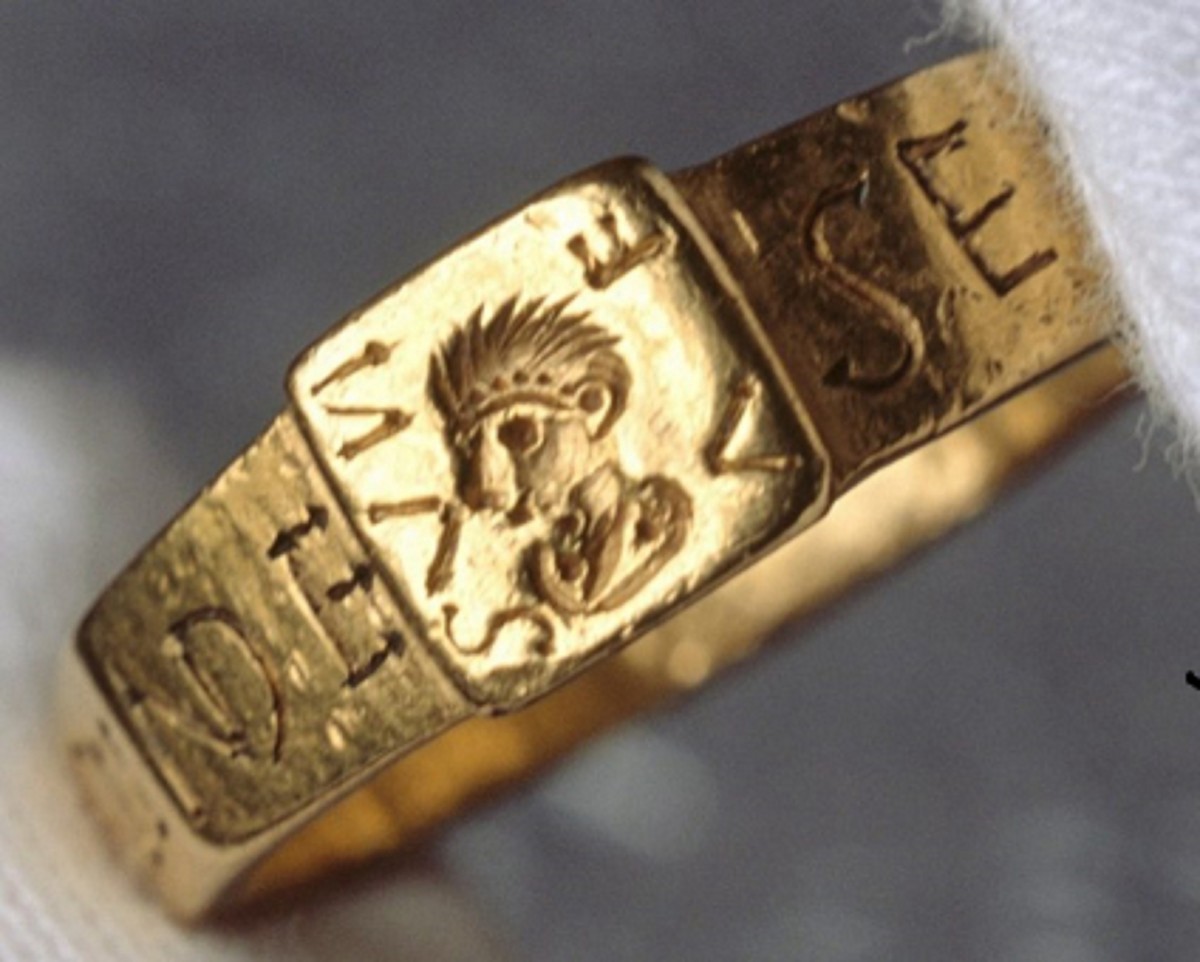
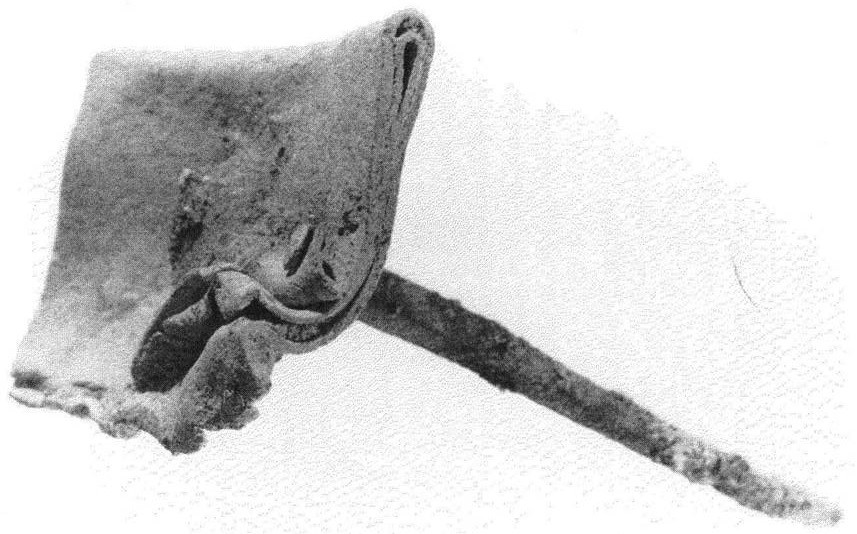
Defixiones, sometimes called curse tablets, are sheets of lead varying in size, with the smallest around 1×1¾ inches and the largest 4¾×10¼ inches (roughly 2.5×4.4/ 12.1×26.1 cm). These sheets were typically inscribed and sometimes drawn on, then folded or crumpled, sometimes with a lock of hair or other component enclosed within, and sometimes pierced with nails.

The most common place to find them in this state is buried in graves or tombs, which is one reason I would not have expected to see them in the thermae and associated temple at Aquae Sulis—the name for the Roman walled town where modern Bath now stands—which did not contain a necropolis or any other such structure. But, as I learned, wells and pools were another place in which defixiones could be deposited—basically as places proximal to the chthonic powers such bodies of water were thought portals to.

As with many things relating to Mediterranean antiquity, I ran across the defixio researching Gods & Heroes. I implemented them as a consumable item from which a player could cast a variety of debuffs on their enemies.

Before deciding this, I read many books, both from the actual traditions and modern archaeological texts. The second category in particular continues to grow: some 1600 separate items identifiable as defixiones have been discovered so far, and there is a great deal of continuing scholarship on the topic.

Furthermore, the materials I read focused mainly on the corpus of defixiones from the Italian Peninsula during the Republic, while these artifacts appeared across the Greco-Roman World, from Africa to the Rhineland, for the entire millennium between the fifth centuries BCE and CE.

In short, it was a great opportunity to return to the topic.

Looking backwards a bit, the continuity from Greek κατάδεσμοι (katadesmoi) is clear. Plato describes them thus:²

ἐάν τέ τινα ἐχθρὸν πημῆναι ἐθέλῃ, μετὰ σμικρῶν δαπανῶν ὁμοίως δίκαιον ἀδίκῳ βλάψει ἐπαγωγαῖς τισιν καὶ καταδέσμοις, τοὺς θεούς, ὥς φασιν, πείθοντές σφισιν ὑπηρετεῖν.

[I]f a man wishes to harm an enemy, at slight cost he will be enabled to injure just and unjust alike, since they are masters of spells and enchantments that constrain the gods to serve their end.

Matthew Dickie examines the attitudes of Tacitus toward various forms of magic shown in his Annals, finding:³

Tacitus conspicuously does not like foreign cults. Yet his disdain for foreign religious practice significantly does not extend to the cults of the Greeks; they are treated with respect and are not dismissed as externae superstitiones as are Egyptian rites and the religious practices of the Celts, Germans, Jews and Christians.

In fact, many of the earliest Roman defixiones continued to be written in Greek, seemingly as part of the ritual until eventually Latin came to dominate.

Winding the clock back still further, there is a clear mutual influence between Egyptian and Greek magic rituals. Friedhelm Hoffmann notes,⁴

The late Egyptian magical papyri show also signs of contact with Greek magic, which in turn was influenced by Egyptian magic.

So much so papyri, written, as the name implies, on the expensive material imported from Egypt, became all but synonymous with magic spells in Greek culture.

The Egyptians also had a tradition bearing similarities to that of the curse tablet; the execration text. These texts also seem to have worked by analogy, being written on items of clay or stone, sometimes even figures of bound captives, which were destroyed and buried.⁵

Moreover, we find as soon as there is written language, it is used for magical formulae, some apotropaic, but just as often meant to harm others. In Sumerian, one particularly cold curse runs:⁶

Namt’il nikkikkani khena
May life be his illness!

In any case, the Greeks and then the Romans widely adopted these practices. Pliny discusses the magic arts, but devotes a full chapter to “The Origin of the Magic Art”, in which he decries its ubiquity, as well as the frauds its practitioners perform, concluding:⁷

natam primum e medicina nemo dubitabit ac specie salutari inrepsisse velut altiorem sanctioremque medicinam, ita blandissimis desideratissimisque promissis addidisse vires religionis, ad quas maxime etiam nunc caligat humanum genus, atque, ut hoc quoque successerit, miscuisse artes mathematicas, nullo non avido futura de sese sciendi atque ea e caelo verissime peti credente. ita possessis hominum sensibus triplici vinculo in tantum fastigii adolevit, ut hodieque etiam in magna parte gentium praevaleat et in oriente regum regibus imperet.

That it first originated in medicine, no one entertains a doubt; or that, under the plausible guise of promoting health, it insinuated itself among mankind, as a higher and more holy branch of the medical art. Then, in the next place, to promises the most seductive and the most flattering, it has added all the resources of religion, a subject upon which, at the present day, man is still entirely in the dark. Last of all, to complete its universal sway, it has incorporated with itself the astrological art; there being no man who is not desirous to know his future destiny, or who is not ready to believe that this knowledge may with the greatest certainty be obtained, by observing the face of the heavens. The senses of men being thus enthralled by a three-fold bond, the art of magic has attained an influence so mighty, that at the present day even, it holds sway throughout a great part of the world, and rules the kings of kings in the East.

That’s the background and tradition against which the defixio is set—the tradition is so pervasive the power to “bind and loose” given to Saint Peter according to Matthew can only be understood in this context.⁸


Addendum

I had been looking for, but failing to find, a good citation showing Greek magical practices incorporated those of the Near East to a large extent, which I knew to be the case. I finally found one in Gordon and Simón’s Introduction to Magical Practice in the Latin West:

In the late Republic, individuals such as the Pythagorean Nigidius Figulus (pr. 58 BCE), who almost certainly studied abroad, had access to a range of Greek occultic sources, themselves mediating material from Babylonia and Egypt.

It seems to be a well enough known fact it is simply taken for granted.


Read subsequent articles in the Defixiones series

Part 2: Malefic Traditional

Part 3: Sympathy for Sauron

Part 4: Bargaining with the Gods

Part 5: Secundina’s Beef

Part 6: More Than Money Can Buy

Part 7: The Punic Curse Trail

Part 8: Hellenism, Schmellenism

Part 9: The Celtic Undercurrents of Bath


Notes

  1. Roman Inscriptions of Britain (RIB), RIB 2404.14, 117–38 CE.
  2. Πλάτων (Plato), Πολιτεία (Republic), 2.364c, ca. 375 BCE, my emphasis. Paul Shorey’s 1969 translation. Κατάδεσμοι is translated as “enchantments”, while the other term translated here as “spells” is ἐπαγωγαῖς.
  3. Matthew Dickie, “Magic in the Roman Historians”, in Magical Practice in the Latin West, Papers from the International Conference Held at the University of Zaragoza, 30 Sept.–1 Oct. 2005, Richard Gordon & Francisco Marco Simón, eds., 2010. The Publius Cornelius Tacitus work referred to is Ab Excessu divi Augusti Historiarum Libri (“Books of History from the Death of the Divine Augustus”), ?–116 CE, commonly referred to as Annales because of its year-by-year structure.
  4. Friedhelm Hoffmann, “Part I, Antiquity”, The Cambridge History of Magic and Witchcraft in the West: From Antiquity to the Present, David J. Collins, S. J., ed., 2015.
  5. Ibid.
  6. Neo-Sumerian Texts, Urnammu no. 28, ii 13–14., cited in Graham Cunningham, Deliver Me from Evil: Mesopotamian Incantations, 2500-1500 BC, 1997.
  7. Gaius Plinius Secundus (Pliny the Elder), Naturalis Historia (Natural History), 30.1, 77–79 CE. John Bostock’s translation, 1855.
  8. Seon Yong Kim, “Ancient Binding Spells, Amulets and Matt 16.18–19: Revisiting August Dell’s Proposal a Century Later”, New Testament Studies, 2016.
  9. Gordon & Simón, “Introduction”, Gordon & Simón, eds., 2010.

The Gift of the Metacyclosynchrotron

Finding tradition in revolution

It is impossible to conceal my delight in describing the PDF coming originally from the pen of signore professore dottore Umberto Eco, and now available for download via JSTOR. Reconstructed from notes once thought lost and written during his stint as a guest lecturer at Colombia’s School of the Arts discussing postcolonial film theory, it is the first posthumous publication of what one hopes and imagines will become numerous from such a prolific and dearly missed writer. For those who, like me, fetishize actual books of paper, we can only pray some independent publisher such as McSweeney’s or Little, Brown will produce such an edition.

As Eco himself has said, “Now, everyone is a writer, but who will read them?” The phenomenon he describes is essentially an escalation of the postmodern dilemma via the multitude of texts emanating from around the globe via the internet. Under these conditions which democratize the ability to write and publish, and with the accompanying proliferation of texts, there is also a corresponding erosion of textual authority, as well as a reduction in the credibility readers can attach to any given text, even including an inability to determine a work’s authenticity.

Nonetheless, tanquam ex ungue leonem—after having thoroughly absorbed this book, it’s difficult to believe its provenance could ever have been in any serious doubt.

The work follows Foucault’s Pendulum (Il pendolo di Foucault)—and follows it not just in a chronological sense. Eco pursues the same major themes of his earlier book in this new work, The Da Vinci Code.

Much like Jorge Luis Borges, an author both admired and often emulated by Eco, he delivers the plot in an almost offhand manner within Pendulum:

Jesus was not crucified, and for that reason the Templars denied the Crucifix. The legend of Joseph of Arimathea covers a deeper truth: Jesus, not the Grail, landed in France, among the cabalists of Provence. Jesus is the metaphor of the King of the World, the true founder of the Rosicrucians. And who landed with Jesus? His wife. In the Gospels why aren’t we told who was married at Cana? It was the wedding of Jesus, and it was a wedding that could not be discussed, because the bride was a public sinner, Mary Magdalene.

Unlike Borges, however, and much to our edification and enjoyment, Eco returns in this second novel to do full justice to the themes only touched on previously.

Even the choice of titles for these two works bears some discussion. If Foucault’s Pendulum was ambivalent and vacillating, the disaster-prone experiment of an obscure academician, The Da Vinci Code has been collated and made manifest as a complete and coherent system—and quite as masterfully as the titular Renaissance polymath (and of course the author thus identifies himself with Leonardo, since, as a semiotician, he is a master of signs and hidden meanings—in short, codes). And though the unraveling of the code is the matter of the book, this is done in due course, revealing all its glory.

In the light of this concluding installment of the tale of the hidden elect, we see the sidereal day which is taken by a Foucault Pendulum to complete its full rotation at the Pole (thus demonstrating the very earth’s rotational movement) become the timeline within which Robert and Sofie must penetrate the mystery of the forces secretly governing the world.

Pendulum and Da Vinci begin in nearly the same place: each in a Parisian museum—the Musée des Arts et Métiers and the Musée du Louvre, respectively. In the first, it is evening, and Casaubon is looking for a place to conceal himself until after its closing, while in the second, the museum has already closed, and it is night with Saunière running for his life.

In both cases, the perspective is of one in mortal peril. And in fact, in both cases, they are killed—implicitly just beyond its close in the first novel, and explicitly followed through on at the beginning of the next. Though he manages to flee the museum, Casaubon can’t throw off the evil forces pursuing him, and Saunière, too, bows to the inevitable, turning his own death into the first of many clues.

The lush descriptions opening both books can also be seen as complementary as well; from the first:

The copper sphere gave off pale, shifting glints as it was struck by the last rays of the sun that came through the great stained-glass windows.

The imagery is continued in the second; the sinister chiaroscuro reflecting the coming descent into a world of dark conundra and omnipresent danger:

A telephone was ringing in the darkness—a tinny, unfamiliar ring. He fumbled for the bedside lamp and turned it on. Squinting at his surroundings he saw a plush Renaissance bedroom with Louis XVI furniture, hand-frescoed walls, and a colossal mahogany four-poster bed.

In particular, the transformation of ordinary things into threatening ones is echoed: In the case of the first, the pendulum: “bird’s head, spear’s tip, obverse helmet” And in the second, more subtly, the “unfamiliar” phone, the too-large bed, looming as if to fall upon and crush Robert. In general, there is a refining of the language; its descriptions are less overt, its symbolism more powerful and pure.

As Casaubon attempts to fight off his feelings of trepidation in Pendulum, we get his internal dialogue:

You know what museums are, no one’s ever been devoured by the Mona Lisa—an androgynous Medusa only for esthetes—and you are even less likely to be devoured by Watt’s engine, a bugbear only for Ossianic and Neo-Gothic gentlemen, a pathetic compromise, really, between function and Corinthian elegance, handle and capital, boiler and column, wheel and tympanum.

Which, in addition to setting up a series of images of the neutered objects on display, also prefigures the imagery of Da Vinci, in which it is revealed this same painting is actually the artist’s own self portrait, with its ambivalent gender reflecting the sacred union of male and female, its title an anagram pointing to the gods and goddesses of Ancient Egypt.

Once the museum has closed, Casaubon considers sleeping since he will have to wait several hours but discards the idea as too dangerous—or does he? What if he does sleep and then awakens as Langdon? It’s a trope Eco explores in The Cemetery of Prague (Il cimitero di Praga, also set in Paris), wherein there is an implication Simone Simonini’s memory gaps, taken together with entries in his diary by the mysterious Abbé Dalla Piccola, mean he sometimes wakes up in a different persona.

A similar motif of another self also appears in The Island of the Day Before (L’isola del giorno prima), wherein Roberto becomes obsessed with the notional existence of his evil doppelgänger, Ferrante.

The timeline of the two novels bears out this reading: Casaubon tells us, “The Masters would not come until close to midnight.” And in Da Vinci, Langdon awakens close by, shortly after midnight, when the last of the sénéchaux has been murdered.

Nonetheless, it is important to recall while it is natural to identify Robert Langdon as a resurrection (or more accurately, renaissance, as we shall see) of Pendulum’s narrator, especially since he even styles himself a “private eye of learning”, Belbo is the tale’s real hero, who, together with Diotallevi has already been destroyed by the keepers of the plan at the opening of the book, and whose clues Casaubon subsequently follows to his own doom. That torch clearly passes from Jacopo Belbo to Jacques Saunière in Da Vinci, in his role as the keeper and revealer of secrets.

Again, as with Borges, Eco borrows the trappings of genre fiction—in the case of this diptych, the thriller—in order to subvert it, as well as to raise deeper issues as a self-declared “public intellectual”. Here, two of the most inflammatory scholarly and social issues of our time: the feminist/ post-feminist challenge to patriarchal authority; and the textual construction of meaning and value.

His first novel, The Name of the Rose (Il nome della rosa), too, is parodical and indeed deconstructive of genre fiction, with William of Baskerville being a clear reference, if not recontextualization, of Sherlock Holmes as a 12th-century scholastic. Some have cited passages such as the following one as discrediting Eco’s authorship of Da Vinci because of their supposed literary ineptitude, but reread, it is deliberate:

Captain Bezu Fache carried himself like an angry ox, with his wide shoulders thrown back and his chin tucked hard into his chest. His dark hair was slicked back with oil, accentuating an arrow-like widow’s peak that divided his jutting brow and preceded him like the prow of a battleship. As he advanced, his dark eyes seemed to scorch the earth before him, radiating a fiery clarity that forecast his reputation for unblinking severity in all matters.

In addition to being a clearly absurd sendup of the tropes and stylistic foibles of the genre he’s playing in, it is also a clear echo of Belbo’s writing in his play-within-a-play novel in Pendulum. Indeed, Da Vinci might be intended to be construed as that novel, which contains similar imagery:

Rodin, speaking in this way, becomes fearsome. All the bloodthirsty ambition, all the execrable sacrilege that had smoldered in the breasts of the Renaissance popes, now appears on the brow of this son of Loyola. I see clearly: an insatiable thirst for power stirs his impure blood, a burning sweat soaks him, a nauseating vapor spreads around him.

Eco’s selection of an American protagonist, at first somewhat jarring, fits with the location the book was written in, as well as his fascination with the culture of the New World which he documented in his essay collection, Travels in Hyperreality (Il costume di casa).

Then of course we have the time Robert is awakened: given as 12:32 AM, the first three numbers imply a simple sequence—the first code of the book—the second 2 is clearly really 2 × 2: 4, thus completing the sequence 1, 2, 3, 4. Not only is this the Pythagorean Tetractys, well known to Eco, that symbol is also used to describe the pendulum at the beginning of the earlier book (emphasis mine):

[…] the singularity of the point of suspension, the duality of the plane’s dimensions, the triadic beginning of π, the secret quadratic nature of the root […].

But while I have thus far focused on the continuity between the two books, there is also a seismic shift worth noting: Casaubon’s is the point of view of a cynical academic who sees all religion as a turning away from the Enlightenment values in which he believes and toward irrationality. Da Vinci’s Langdon, while steeped in similar ivory-tower ideals and scepticisms, sees the defeat of Christianity and return to the primal religion of the Sacred Feminine as both just and desirable. The perspective of the first novel is made clear in this passage:

[…] in an enormous case in the rear, life-size and three-dimensional, a lion attacked by a serpent. The apparent reason for this piece was its medium, that it was made entirely of glass; but there had to be a deeper reason. Where had I seen this figure before? Then I remembered that the Demiurge, Yaldabaoth, the first Archon, odious creation of Sophia, who was responsible for the world and its fatal flaw, had the form of a serpent and of a lion, and that his eyes cast fire.

Striking in particular is the transformation from a dreadful and ancient Sophia, imperfect creator of an imperfect world, to her namesake in the second book, Sophie, who embodies the lineage of Christ as well as the Sacred Feminine.

Where the first novel selects some of the tropes of the Romantic embrace of the anti-patriarchal, such as the kabbalah and alchemy, in addition to searching farther afield into Afro-Cuban mysticism unsullied by Europeans, the second taps into a different vein, one explored by many writers—two in particular emulated by Eco: Shelley and Hugo—Gnosticism, a tradition that largely managed to avoid subsumption by Christianity.

Both novels are interrogations of Christianity via elements of Romantic literature, driven principally by the perceived complicity of the Church with the injustices and depredations of early industrial society. They succeed in isolating the fundamentally theological and symbolic nature of the contest, echoing recent Romantic theory in their restatements of the centrality of religious conflict to the literary mode’s rhetoric.

In Da Vinci, however, Eco raises a tripartite claim: primordial human religions featured a Goddess, their societies were matriarchal, and the Sacred Feminine remains instinctual among all people. Further, because of the presence of these underlying elements at odds with our supposed values, our culture has been, and remains, in continuous conflict and crisis, and may remain so until we fully understand these essential truths and work to properly reconcile the human and the divine.

When Tokyō Moved West

How the megapolis got its modern shape (Taishō, Part 2B)

Among many other changes ushered in by the Taishō era (大正時代, 1912–26), increasing industrialization caused a huge shift of Japan’s population away from rural areas and into urban centers. None more so than Tokyō itself, which naturally needed to expand to accommodate the influx of people, and changed to assume much of the form we recognize today. The growth also shifted traditional centers within the city toward the west, continuing into the postwar growth of areas such as Shibuya (渋谷) and Shinjuku (新宿).

While Nihombashi (日本橋) had been the center of commerce in the Edo era and remained so through the Meiji period (江戸時代, 1603–1868 and 明治, 1868–1912), with the sudden and massive growth in Taishō, other areas naturally began to sprout as well.

While the centers for other activities moved into new areas, retail sales remained largely in Nihombashi, in particular at massive new department stores such as Mitsukoshi (三越) and Shirokiya (白木屋). The former store still has its main branch in Nihombashi, while the latter’s setbacks due to the Great Kantō Earthquake (関東大地震, Kantō dai-jishin, 1923) and war were less recoverable, though it still has a few stores, including its headquarters in Honolulu. But Marunouchi (丸の内) and Ginza (銀座) blossomed as districts for business and pleasure, respectively.

Marunouchi, a district I mentioned in Part 2A as the location for the first biru, was a small move—essentially from one side of Tokyō Station to the other. Nihombashi sits just to the east of the station, while Marunouchi grew just to its west. The area, a filled-in portion of Tokyō Bay, had been purchased from the Meiji government in 1890 by the Mitsubishi company (三菱), being known for a while as the Mitsubishi Meadow (三菱ヶ原, Mitsubishigahara). The name Marunouchi attests the area’s origin as part of the castle’s fortifications, as it means “within the circle” (i.e., of walls).

Things began to change in Taishō, and in addition to headquartering their own company there, Mitsubishi began to develop the area for other businesses as well. In particular, the major banks moved in. The Tokyō Station building I discussed previously was notably built on the Marunouchi side of the station. The Mitsubishi group still owns much of the area today, and Japan’s top three banks remain headquartered there. Marunouchi also presents a stark contrast between old and new, with the moat separating a feudal stronghold from the skyscrapers of one of the largest business districts in the world.

Nearly due south of Marunouchi, what was to become Ginza was a neighborhood of tightly packed wooden buildings, much like the rest of the Edo-period city. What cleared the way for the area’s growth in the new era, was not a grand plan, like the Haussmannization of Paris, but a fire.

Fires were all too common among the Edo buildings, because of their crowding as well as the building —mainly wood and paper. Smallish blazes were so common there was a saying: “Fires and fights are the flowers of Edo”.¹ But in 1872, a large one gutted most of Ginza. The Meiji government saw an upside to this and decided to rebuild the area as a Westernized model of modernization, which came to be known as the “Bricktown” (煉瓦街, Rengagai).

The main planner of the Ginza Bricktown was expatriate Irish architect Thomas Waters, who had somehow managed to build a career in Japan even before Japan’s opening to the West. By the time of his work in Ginza he was employed as Surveyor-General and foreign advisor to the Meiji Government. Nonetheless, by 1878, he fell prey to souring attitudes toward foreign designers and left seeking better fortunes elsewhere.

Waters did see the Bricktown through to its completion in 1875, but it was hardly a smashing success. The Georgian-style buildings were an impressive sight, were ill-suited to the humid environment of Japan, tending to be quite damp and prone to mildew. This meant few people were willing to pay the high asking prices, and many of the buildings stood empty.

The broad main thoroughfare of  Ginza Dōri (銀座通り), initially mainly for foot traffic, was restructured to include streetcar and automobile traffic as well. This was essentially a road-building pilot for the country, and it was decided Nicolson pavement would be used, consisting of wooden blocks with asphalt in the interstices, commonly used in Europe from the mid-19th century. Such a road was obviously cheap to construct, as well as being hard wearing, softer on the feet of both pedestrians and horses, as well as reducing the noise of hooves and in city centers.

But the new road didn’t work out well either. The wooden surface was already obsolescent for reasons the Japanese were soon to discover: when it rained—as it frequently does in Japan—the blocks floated away, and when it was hot, the asphalt melted.² Also, while the areas for pedestrians and vehicles were clearly delineated by the willows the district came to be known for, cars and trolleys vied for right of way in a street without lanes marked out for each. In the end, the street caught fire, thus bookending Taishō Ginza between conflagrations.

The new brick buildings did provide a decent amount of fire resistance and the blaze only seems to have affected the street, which was replaced with a more conventional one afterwards. As for the willows, even though they remain strongly associated with the area—there is still an annual willow celebration in Ginza—a typhoon had severely damaged them even before the street fire, and they were replaced with hardier ginkgos.

The Tokyō subway, now so central to the city’s identity, also began, if not in Ginza proper, with the Ginza Line (Ginza-sen, 銀座線). It was the result of a 1914 visit to London by businessman Hayakawa Noritsugu (早川 徳次). He saw the need for a system like the Underground, which was to become the first subway in East Asia.

At its 1927 opening, the subway was only the portion of the modern Ginza line stretching from Ueno (上野) to Asakusa (浅草). It was too short to be useful, falling well short of its aim to run through Ginza and end at Shimbashi (新橋), which had a station already serviced by other trains, making it a sensible terminus.

Nonetheless, the novelty of the subway seems to have won out, as people would wait sometimes as long as two hours to travel along the five minutes of track. Just as the city itself, the line continued to extend westward, and its modern terminus is now Shibuya.

This tale of the difficulties in getting around in the rapidly swelling city is far from unique. Tanizaki Junichirō wrote of the poor state of the roads, and related the following of the overburdened streetcar system:³

For the general populace there was no means of transport but the streetcar. Car after car would come by full and leave people waiting at stops. At rush hour the press was murderous. Hungry and tired, the office worker and the laborer, in a hurry to get home, would push their way aboard a car already hopelessly full, each one for himself, paying no attention to the attempts of the conductor to keep order […]. The crowds, a black mountain outside a streetcar would push and shove and shout […]. They put up with it because they were Japanese, I heard it said, but if a European or American city were subjected to such things for even a day there would be rioting.

The crowding he refers to meshes with the modern image of the city, but seems to have been still worse; there is an orderliness and etiquette involved in ridership today even under extreme conditions. Obasan seem the sole exception—they routinely throw elbows and stamp on insteps to get to the coveted seats beside train doors. The phenomenon inspired the term obatarian (オバタリアン), a punning portmanteau of おば (oba, “middle-aged woman”) and the Japanese title, 『バタリアン』(Batarian, kanaized from battalion), of the 1985 film The Return of the Living Dead.

By the late Meiji period, the Ginza began to come into its own with the advent of bazaars in the area. The forerunners of modern department stores, these large, multi-story buildings housed a large number of small shops selling goods such as toys, stationery, and books. By 1902 there were seven such bazaars in Ginza.

The other element cementing the status of Ginza in Taishō was the opening of Café Printemps in 1911. A painter named Matsuyama Shozo (松山 省三), returning from studying abroad in Paris, wanted to reproduce the atmosphere of the cafés of the French capital. He succeeded; people from the art world, such as painters and poets, as well as others who had been abroad, came there to socialize. The café was quickly followed by imitators like Café Paulista, Café Lion, Café Tiger, etc.

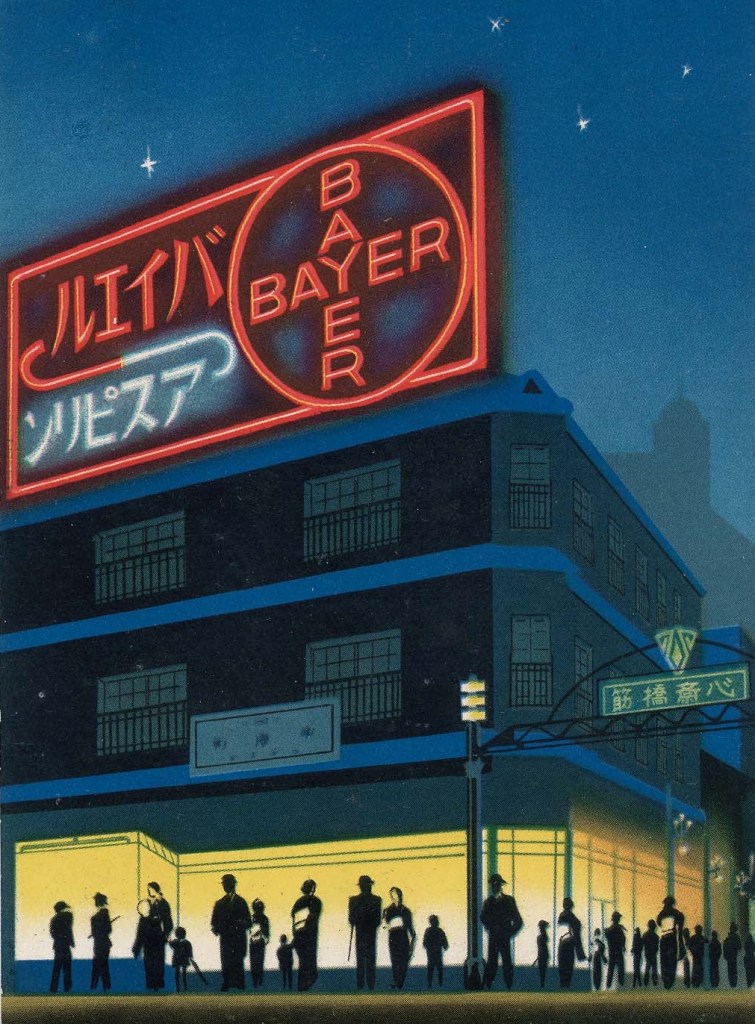
In short, Ginza became what is known as a sakariba. Made up of the words 盛り (sakari) “height” and 場 (ba) “place”, it might be directly translated as “amusement quarter”. Even this term was changing in Taishō, moving toward its modern meaning as a place with crowds, neon lights, and dozens of small drinking establishments.

The Edo-period origins of the sakariba were actually of three types: open outdoor spaces where people could gather in times of disaster along riverbanks, etc. and which in good times could be used by vendors and those offering attractions; areas outside of temples, where similar activities occurred, such as Asakusa; and red-light districts such as Yoshiwara (吉原). Ginza was the first of a new breed, according to Japanese studies professor Sepp Linhart:⁴

Ginza’s rise to preeminence […] mirrors the shift from entertainment catering to the old Tokugawa middle class of small businessmen and artisans to the new middle class of salaried white collar workers and professionals.

In Kurosawa Akira’s (黒澤明) 1949 film, Stray Dog (『野良犬』), the sakariba is the seedy underworld into which rookie homicide detective, Murakami (村上刑事; played by Mifune Toshiro, 三船敏郎), must blend if he is to find his stolen gun.

While it may seem strange, the crowdedness of these areas is part of the allure for the Japanese:⁵

What for many Europeans may be something quite unpleasant, seems to be for Japanese an enjoyable setting. Many Japanese […] simply cannot fall into a relaxed, leisurely mood if a sakariba is not full of people. They are disappointed if too few people are there […].

Japanese sociologist Ikei Nozomu even coined the term zatto no miryoku—“fascination of the crowd” (雑踏の魅力) to describe this element of the appeal of the sakariba.⁶

In any case, the emergence of the busy aspect of these districts seems to correspond to Ginza’s rise: Trendy shopfronts and innumerable cafes came to characterize the area, but, as previously noted, Ginza wasn’t really a retail center, it was one for window shopping and idling. Mobo and Moga flocked to the area, but mostly just to see and be seen—to be part of the crowd.

The activity was so specific to these people and this area, it was called gimbura (銀ブラ): “wasting time in Ginza”, derived from Ginza and ぶらぶら (burabura) “wandering aimlessly”. Fashionable attire was part of the gimbura scene, and single men could remove the awkwardness of strolling alone by hiring a “walking stick girl” (ステッキ ガール, sutekki gāru) to accompany them for two yen.

Even in the days of the 1918 Rice Riots (米騒動, kome sōdō), Nagai Kafū (永井 荷風, the pseudonym of Japanese writer Nagai Sōkichi, 永井 壮吉) detected a certain air of leisureliness among the dissidents in Ginza:⁷

I heard later that the rioting always occurred in the cool of evening. There was a good moon every evening during those days. Hearing that the rioters gathered menacingly before the houses of the wealthy when the evening had turned cool and the moon had come up, I could not put down a feeling that there was something easy and comfortable about it all. It went on for five or six days and then things returned to normal. On the night of the return to normal, it rained.

As Tanizaki noted with some bitterness of the era, “Old Japan had been left behind and new Japan had not yet come.”⁸ Many of the forms we associate with Tokyō as well as Japan emerged during Taishō, but as we have seen, many were only rough prototypes. The earthquake, economic depression, and WWII would ruin the chances for some of them to reach maturity, but others would eventually come to define modern Japan.


Read subsequent articles in the Taishō series

Part 3A: Asakusa Movies

Part 3B: Asakusa Opera

Part 4: The Mysteries of Zūja-Go

Part 5: How “Alice” Grew Big in Japan


Read previous articles in the Taishō series

Part 1: Japan’s Turbulent Taishō

Part 2A: Epochal Architecture


Notes

  1. In Japanese the saying runs: 火事と喧嘩は江戸の華, (kaji to kenka wa Edo no hana).
  2. There were other issues with Nicolson pavement as well: it could be quite slippery when wet or icy, the blocks tended to rot, and when moisture seeped in, the blocks would swell, causing the surface to buckle. Susceptibility to fire could be dealt with by treating the blocks with creosote, but it’s a toxic chemical with a significant unpleasant smell.
  3. 谷崎 潤一郎 (Tanizaki Junichirō), 『摂陽 随筆』(“Setsuyō Essay”), 1935, quoted in Edward Seidensticker, Low City, High City: Tokyo from Edo to the Earthquake: How the Shogun’s Ancient Capital Became a Great Modern City, 1867–1923, 1983, which I have consulted throughout.
  4. Sepp Linhart, “Sakariba: zone of ‘evaporation’ between work and home?”, Interpreting Japanese Society: Anthropological Approaches, Joy Hendry, ed., 1998.
  5. Ibid.
  6. 池井 望 (Ikei Nozomu), 「盛 り場行 動. 論-空 間 と娯楽」 (“Behavioral Theory of the Sakariba: Theory Space and Entertainment”), 1973.
  7. 永井 荷風 (Nagai Kafū), 「花火」 (Hanabi, “Fireworks”), 1919, quoted in Seidensticker, 1983.
  8. Tanizaki, 1935, quoted in Seidensticker, 1983.

Tokyo’s Epoch-Defining Architecture

Rapidly changing attitudes toward Western design (Taishō, Part 2A)

The Taishō period (大正時代, 1912–26) was a time of unprecedented urban expansion in Japan. By the middle of the era, Tokyo (東京) would take on the shape recognizable in the modern city, one completely different from the feudal city some older denizens would have recalled. Called Edo (江戸) during the Tokugawa Shogunate (徳川幕府, Tokugawa Bakufu, 1600–1868), the city was renamed and made Japan’s capital after the Meiji Restoration (明治維新, Meiji Ishin, 1868).

Already by the time of the Great Kantō Earthquake (関東大地震, Kantō dai-jishin, 1923), the population of the city alone was well over two million, and if we consider the suburban areas of the prefecture, the number rises to nearly four million. Underscoring the shift from rural to urban, as of the 1920 census, more than half the city’s residents had not been not born there.¹

Along with these changes in population, an architectural Westernization also occurred, initially in a strictly literal way during Meiji, but soon coming to take on a distinctly Japanese flavor.

Japanese culture’s ability to take outside influences, adapt them, and integrate them has come to be emblematic. This reputation reached its peak together with the nation’s economic dominance in the ’80s, particularly regarding their manufacturing sector.

The phenomenon was by no means new; their more regional borrowings such as the adoption of Chinese Hanzi as kanji (both 漢字), and from which their other scripts, hiragana (平仮名) and katakana (片仮名) also ultimately derive is an early example. Kanji and Hanzi are closely related systems of ideographic writing, while hiragana is the main syllabary for Japanese and katakana is a syllabary generally reserved for words of foreign (other than Chinese) origin. While this certainly enriched the Japanese language, it also created one of the most Byzantine writing systems ever.

For a more era-appropriate example, there is a whole category of food known as yoshoku (洋食), translating as “Western food”. According to an article in the Japan Times

But what it really means is European dishes as interpreted and assimilated by Japanese chefs over a century ago, at the time when foreign foods—and chief among them meat dishes—were being discovered for the first time.

A corollary term, yōkan (洋館), came into being at this same time, meaning “Western-style buildings”, but just as with the culinary term, it referred to the Japanese version of European architecture, focused particularly on the Meiji and Taishō eras. After Taishō, it’s simply referred to as kindai kenchiku (近代建築), “modern architecture”.

The move from wholesale borrowing to adaptation can be seen in changing attitudes toward Western architecture between Meiji and Taishō. In Meiji, Japan didn’t wait passively for Western ideas to arrive on its shores, it sought them voraciously, sending hundreds of scholars, diplomats, businessmen, etc. abroad to be schooled in the most modern thinking available. The Iwakura Mission (岩倉使節団, Iwakura Shisetsudan) was one particularly large and well-known venture, with over 100 individuals participating in a three-year (1871–1873) tour of the United States and Europe. The main objectives of the mission were to begin renegotiation of treaties with these powers, as well as making a thorough study of the modern industrial, political, military, and educational systems in the countries visited. Foreign experts were also invited to Japan to share their knowledge, and these factors together spurred Japan’s industrial revolution.

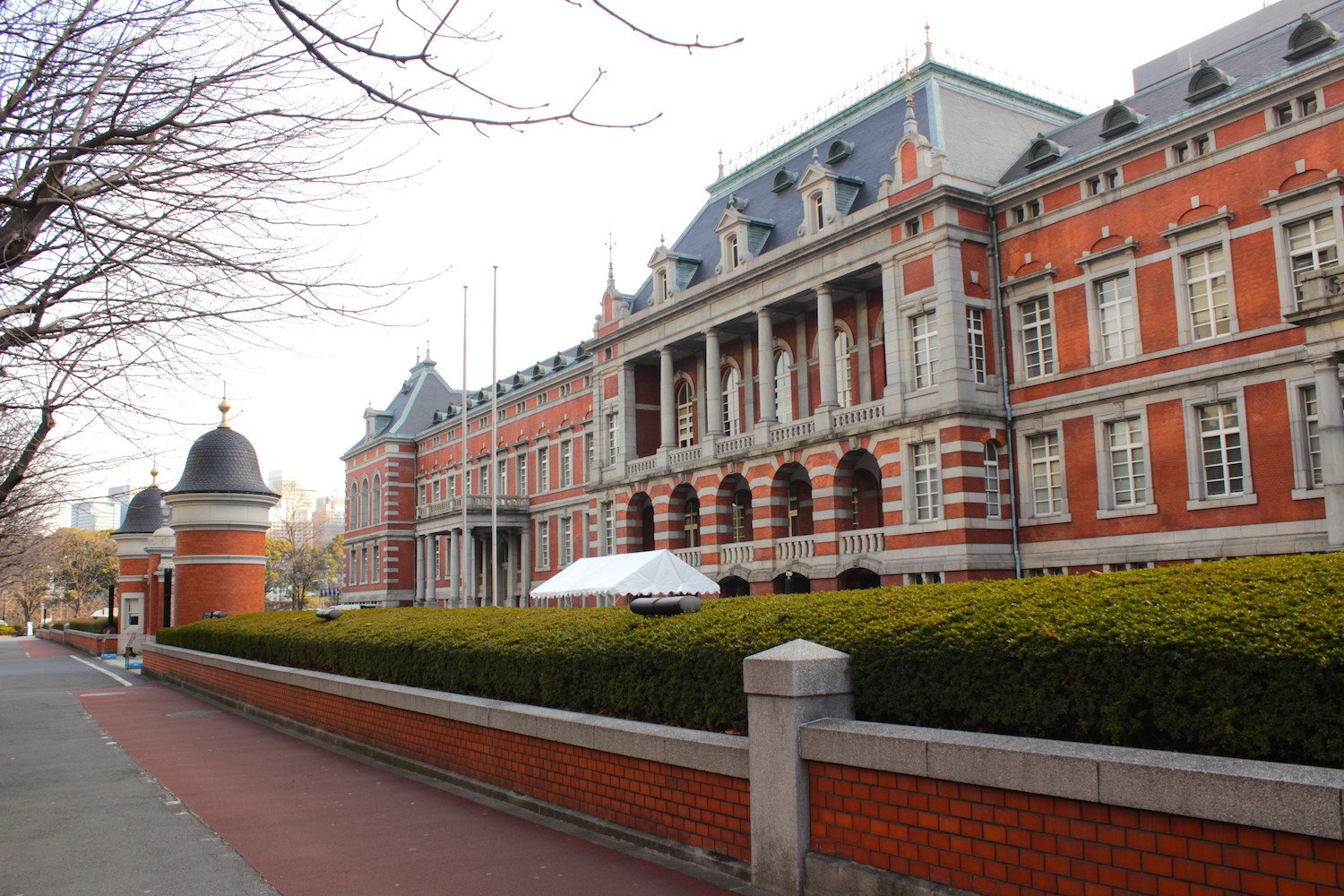
Architecture was far from an exception, and many Western-style constructions sprang up across the country. A still-extant red-brick neoclassical example is Tokyo’s Ministry of Justice Building (Hōmushōhonkan 法務省本館, now with 旧, “old” appended, Hōmushōkyūhonkan, as it is no longer in primary use). Already an architect of note for some 20 years in his native Germany, Wilhelm Böckmann was invited in 1886 by the Meiji government to rebuild Tokyo into a modern capital. A year later, he had his partner, Hermann Ende, join him, and together they designed the Ministry of Justice.

But the expatriate pair’s plans for a Japanese branch office together with a grand Hausmannesque redesign of Tokyo fell through, partly because of the massive budgetary requirements, but still more so because of a growing backlash against Western architects. Even design icon Frank Lloyd Wright, whose Imperial Hotel (teikoku hoteru, 帝国ホテル) was to be a fixture of Tokyo from Taishō until its demolition in the ’60s, returned home rather than remaining to see it completed.

Although the building and its architect are much more fondly thought of by the Japanese today, Western-style buildings as interpreted and designed by Japanese architects were already taking over. An excellent example is Tokyo’s Central Station (中央停車場, Chūō teishaba, now known simply as Tokyo Station, 東京駅, Tōkyō-Eki), a building still in use today. Another neoclassical edifice, it was designed by Tatsuno Kingo and Kasai Manji (辰野 金吾, 葛西 萬司), the former had studied in Europe and designed the Bank of Japan headquarters building in Tokyo (Nippon Ginkō, 日本銀行, also still in use) in 1890.

After some delays caused by the First Sino-Japanese War and the Russo-Japanese War, the station was finally opened in 1914. Though it shares several features with the Böckmann-Ende design both in terms of style and materials, the two stand in stark contrast: The Ministry of Justice Building would look at home in any European capital of the day, while Tatsuno’s design is unmistakably Japanese, intended as, and remaining to some extent, a national symbol.

Also in the Marunouchi (丸の内) area where Tokyo Station sits, the Marine Insurance Building, completed in 1917, was the first building to be designated a biru (ビル). Short for the kanaized English word “building” (birudingu, ビルディング), the word has come to describe most office buildings in Japan. Although much more restrained in terms of ornamentation, the Marine Insurance Building facade shows the progression of the Japanese-Western style toward an Art-Deco sleekness and consolidation of details into geometrical shapes.

The use of the term biru is an interesting linguistic point as well: Foreign words, and in particular English ones, were borrowed into Japanese at an unprecedented rate at this time. Some of these words, apart from mobo and moga, which I’ve already remarked on, include mama and papa, which came to nearly supplant the native terms. But again, words derived from foreign ones but so altered by Japanese usage as to be nearly unrecognizable, include rumpen and saboru. In Japanese, ルンペン, meaning “loafer”, comes from German Lumpenproletariat and サボる, “to skip” (work or class), comes from French sabotage, respectively. The latter is interestingly written in mixed kana with -ru appended in hiragana to turn the borrowed, abbreviated word into a Japanese verb.

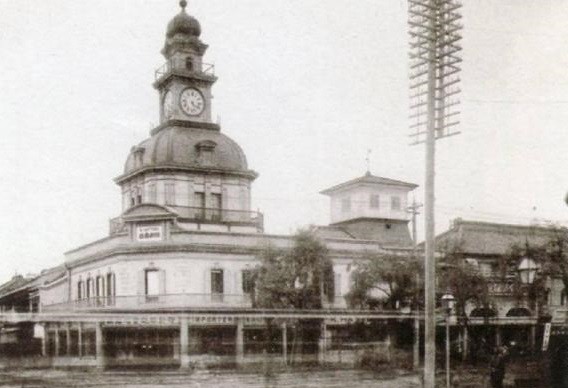
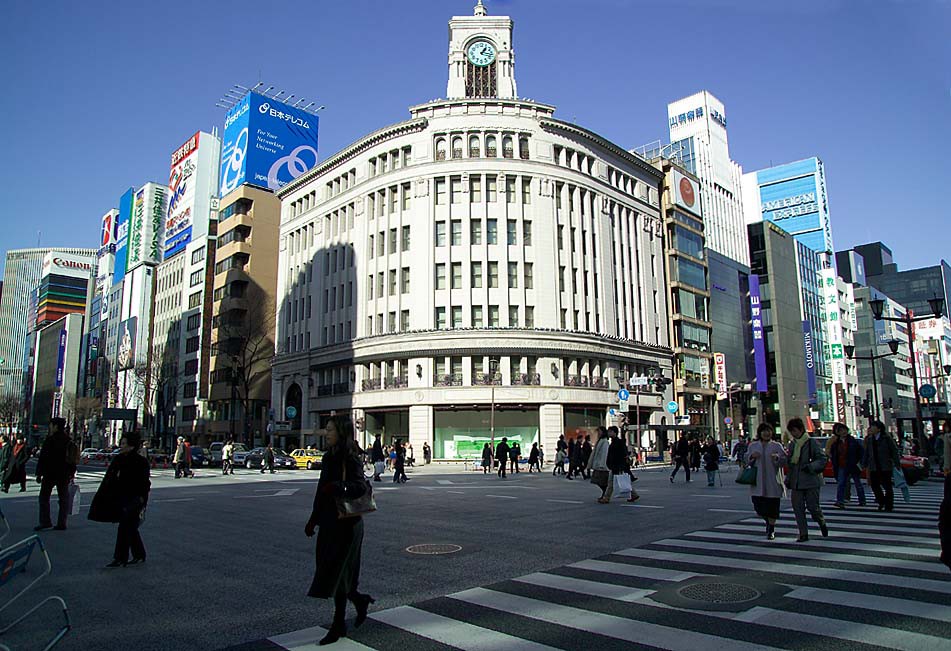
The Ginza Wako building (銀座和光) provides an excellent example of the epochal sweep from Edo village to Taishō modernity: watchmaker Hattori Kintarō (服部 金太郎) identified the location of the wooden Asano Newspaper building (朝野新聞社屋, Chōyashinbunshaoku) as ideal for his new shop, commanding a central crossing of Ginza for his new shop. Incidentally, Hattori’s business was to evolve into an internationally well-known one: Seiko. He purchased and razed the old structure, replacing it with a Europeanized one, incorporating a clock tower in 1894.

The Hattori Watch Shop (服部時計店, Hattoritokeiten) was in turn destroyed to make way for the current building, which houses the evolution of another of Hattori’s ventures, a department store now known as Wako (株式). This building is iconic of modern Tokyo; a Taishō Deco-neoclassical structure made of concrete and steel designed by Watanabe Jin (渡辺 仁), also incorporating a clock tower.


Read subsequent articles in the Taishō series

Part 2B: When Tokyo Moved West

Part 3A: Asakusa Movies

Part 3B: Asakusa Opera

Part 4: The Mysteries of Zūja-Go

Part 5: How “Alice” Grew Big in Japan


Read previous articles in the Taishō series

Part 1: Japan’s Turbulent Taishō


Notes

  1. Edward Seidensticker, Low City, High City: Tokyo from Edo to the Earthquake: How the Shogun’s Ancient Capital Became a Great Modern City, 1867–1923, 1983, which I’ve drawn from throughout.
  2. Robbie Swinnerton, “Toyoken: Narisawa’s take on ‘yoshoku’ cuisine”, Japan Times, 2014, emphasis mine.

The Luwian Menace

The sudden sensationalism of the second millennium BCE (Logic of Lies, Part 3/ Late Bronze Age Collapse, Part 3)

Who knew the Late Bronze Age Collapse (LBAC) would suddenly blow up on social media? A few weeks ago, articles began appearing in my Facebook feed from a variety of sources. The first was from Atlas Obscura, a site whose stories I have enjoyed in the past:¹

A Centuries-Old Frieze, Newly Deciphered, Tells the Story of the End of the Bronze Age

This immediately struck me as wrong on several levels. First it should be millennia-, (roughly 3200 years) not “centuries-old”, and why is it “newly deciphered” rather than discovered, and then there is not a story of “the End of the Bronze Age” but many of them across a large geographical area, and finally there’s an implication the inscribers of the frieze somehow knew they had been living in the Bronze Age—this is it, guys; tomorrow we switch to iron.

The article itself is more circumspect, noting there is controversy about some claims made by Institute for Luwian Studies president, Eberhard Zangger, including the possibility of forgery.

As many of these articles note, villagers in Beyköy, Turkey, dug up the original frieze upon which this text was inscribed in 1878. It seems to have already been broken into chunks. Georges Perrot carefully transcribed everything, even though he did not know the language, before the villagers used the original pieces in the foundation of a mosque. Perrot’s notes were lost, but a supposed copy of a copy was found.

The story was rapidly echoed around the internet on sites running the gamut from tabloids to “legitimate” mainstream press to scientific journals:

  • Mysterious civilization of Sea Peoples were wiped out by world war zero 3,000 years ago (Daily Mail)
  • Archaeologists decipher 3,200-year-old stone telling of invasion of mysterious sea people (The Independent)
  • Entire Civilization of Sea Peoples May Have Been Wiped Out in World War Zero, Archaeologists Say (Inquisitr)
  • Devastating World War ZERO destroyed ancient Mediterranean civilisations and plunged Europe into a dark age (The Mirror)
  • World War Zero brought down mystery civilization of sea people (New Scientist)
  • Luwian hieroglyphic inscription explains the end of the Bronze Age (Phys.org)
  • Scientists proclaim a new civilization in the Aegean Bronze Age (Popular Archaeology)
  • 3200 Jahre alte Hieroglyphen könnten das Rätsel um den Untergang der Imperien im östlichen Mittelmeer lösen (Der Spiegel, “3200-year-old hieroglyphs could solve the puzzle of the downfall of the empires of the eastern Mediterranean”)

Despite the lurid headlines, all the articles I’ve seen contain the necessary disclaimers if you actually read them, though buried in the late paragraphs.

To quickly clear the air, World War Zero is an absurd claim. People in Shang Dynasty China (商朝, ca. 1600 BCE–ca. 1045 BCE), for example, not only were completely uninvolved in any warfare in the region, they were entirely unlikely to have been aware of the calamities of the LBAC, or for that matter, even the existence of these civilizations. At most, the area involved in the LBAC stretched from modern Italy to Afghanistan, and the large nations needed for such a conflict were also not warring against each other, but fending off the raiding Sea Peoples, who, as the name suggests, did not constitute a nation at all, but several ragtag migrating groups.²

As to the Luwians, just looking into the name, we see it in Mycenaean Greek in the toponym ru-wa-ni-jo (Λυϝανίος/ Luwanios), which shows a genitive ending, so it is “land of the Luwians”. However, it is generally accepted Luwian is a language, and never spoken of either in that language, or those used nearby as a people, and so this name is effectively “land where Luwian is spoken”. Luwian was widely spoken in Anatolia, and indeed within the Hittite kingdom, particularly in the capital, Ḫattuša. The language was closely related to Hittite as a fellow member of the Anatolian branch of Indo-European, and the hieroglyphic script was commonly used on Hittite political monuments. And far from being known by only a few, the language is well documented. It’s also worth noting no serious scholars of the language are on board with Zangger.

Fred Woudhuizen, the Luwian language specialist of the group, also tried to connect it to Etruscan, even though most agree the latter language to not even be Indo-European. The Institute also claimed to have deciphered the Phaistos Disc, which serious scholars have found indecipherable without additional data from other sources. The many and varied proposed solutions have been labeled as classic examples of pseudoarchaeology.

That’s the main items debunked, but James Mellaart, in whose notes the copy of the transcription that was eventually translated was found, is definitely worth a bit of discussion as well. In what is now known as the Dorak Affair, Mellaart, through a highly suspicious set of events, presented extensive sketches and notes of what he claimed to be a group of antiquities from the Yortan culture, the so-called “Dorak Treasure”, to the British Institute of Archaeology.

None of the details, however, could be verified—the address in Izmir where he supposedly viewed the items did not correspond to the residence he said he visited. Subsequently, Turkish authorities came to believe he was party to smuggling the treasure he had described, permanently banning Mellaart from the country.

The treasure likely never existed and was simply a hoax perpetrated by Mellaart and his wife, though others insist the CIA was involved. In any case, Mellaart had to issue a public apology, and his reputation as a serious archaeologist was forever marred.

Although incorrect as to Metal and the Fonz, Chuck Klosterman was prescient about the news media. He describes how,³

It’s not that the truth is being ignored; it’s just that the truth is inevitably combined with a bunch of crap that’s supposed to make news stories unbiased and credible, but really just makes them longer and less clear.

And since then, there has been a natural escalation of the trend, such that articles can make exaggerated and sensationalist claims, then include far past the TL; DR limit the information this “news” is widely disputed. They have thus tricked you into clicking, told you a bunch of useless nonsense, and then, as an afterthought, let you know they have wasted your time.

The other interesting thing about the rapid spread of misinformation is the growing field of churnalism. Most of these articles don’t even bother to appear original—they simply repeat the story, and the outlets the stories appear in don’t create content—they simply aggregate it. The New Scientist article appears to have been the original.⁴

None of these articles says anything different from one another—they all contain some version of the same information in a longer or shorter format. Even the Zangger quotes they use seem to come from a press release, or at most a quick perusal of the Institute’s website, rather than real interviews or research.

Maybe the worst part about this sensationalist rumormongering is it’s the second time around for the Institute’s far-fetched claims. All the same information, barring the suspicious inscription, is old news—there was already a flurry of shallow reportage back in May 2016. And it was thoroughly debunked by serious scholars back then, but no one let that stop them.

My version of the article would have gone something like this:

Fringe Scientists Advance Dubious Smoking Gun for LBAC

Legitimate community gives emphatic thumbs down

Eberhard Zangger has a story for you. It’s an epic one, with invasions, counterinvasions, and civil wars. Egyptians, Babylonians, Hittites, Minoans, Trojans, Greeks, and more are caught up in its immense sweep.

But no matter how grand and appealing this tale is, very little is given in the way of actual evidence, and indeed, it flies in the face of what is generally accepted in the field.

And while the very nature of science is that conventional wisdom must yield to new evidence, what the Institute for Luwian Studies offers is quite slim: an inscription of dubious provenance, rather than hard archaeological data.

Homer’s tales of the Trojan War, which also figure into Zangger’s theory, do not constitute fact (and similarly, the accepted view is they contain only a kernel of truth—the Mycenaean Greeks seemingly did engage in conflicts with Trojans in western Anatolia), and until corresponding evidence comes to light (as the ruins of Troy did), they remain merely stories.

Furthermore, the inscription comprising the linchpin of the theory is yet to be revealed. In a move more Barnumesque than befitting the scientific community’s gravitas, the Institute for Luwian Studies is actually only teasing a December unveiling.

The Institute for Luwian Studies’ first salvo came in May 2016: Zangger went wide with a sensationalist “World War Zero” angle together with zero evidence, but said he expected to find it using boots-on-the-ground archaeological digs in the region. Even if this effort had gone forward, despite the shoddy science of trying to make evidence fit a theory, that’s not what transpired.

Instead, an unnamed person sifting through the notes of a discredited archaeologist came forward with a possible forgery purporting to be a copy of a copy of a transcribed no-longer extant Luwian inscription, which just happened to be the puzzle piece Zangger needed to prove what he has been arguing.

Although it seems reasonable to wait and see what information is put forward in December, it is also worth noting this PR campaign also involves a Zangger book launch, so I’d recommend taking all this as just one step removed from a claim of ancient aliens.


Read subsequent articles in the Logic of Lies series

Part 3 Addendum: Fruit from a Poisonous Pseudoarchaeological Tree

Part 4: Romancing the Hellenes

Part 5: Descent into the Absurd

Part 5 Addendum: The Ironclad Test Oath and Why It Doesn’t Work


Read subsequent articles in the Late Bronze Age Collapse series

Part 3 Addendum: Fruit from a Poisonous Pseudoarchaeological Tree


Read previous articles in the Logic of Lies series

Part 1: The Fakes that Launched a Thousand Ships

Part 2: It’s Fascinating What One Can Deduce about a Man Just by Knowing his Name


Read previous articles in the Late Bronze Age Collapse series

Part 1: Apocalypse BC

Part 2: Whither the Wanax


Notes

  1. Natasha Frost, “A Centuries-Old Frieze, Newly Deciphered, Tells the Story of the End of the Bronze Age”, Atlas Obscura, October 2017.
  2. I’m paraphrasing Eric Cline, “World War Zero or Zero World War?”, Rogue Classicism, May 2016.
  3. Chuck Klosterman, Sex, Drugs and Cocoa Puffs, 2003.
  4. Colin Barras, “World War Zero brought down mystery civilisation of ‘sea people’”, New Scientist, May 2016.

10 Reasons I’m Leaving Medium

You won’t believe number 7!

This article and its Addendum might seem somewhat strange to include here on my site, but they contain some of the journey that eventually led me here, and I have referred to them elsewhere, so having everything in one place makes sense.

I decided I wanted to write articles in the spring of 2016. I asked around among my friends and heard Ghost was the new hotness. And Ghost was pretty good as far as the actual articles. My pal Julius set up a sweet template for me, so everything looked good. And they supported footnotes, which I am a pretty hardcore user of, and which Medium still does not.¹

But by February of this year, the lack of community on Ghost bothered me. It might have been because of Facebook. Facebook had by then hit rock bottom, where it still lives: advertisements for stuff I will never want, lame quizzes, clickbait articles, and idiotic political opinions now make up most of my feed.²

And those community features Ghost lacked Medium offered. When I posted an article, people could like it, highlight passages, and/ or leave responses. Those things were good—like the things you could do on Facebook sort of, but in an environment with just a bit more weight, where 10-minute reads might actually get read.

Community is the wrong word. Facebook provides some sense of that, but it’s designed for relatively superficial exchanges—I don’t mean that as a dig, it just is—and I felt the things I wanted to talk about were not necessarily appropriate to the forum, and indeed, would alienate some significant portion of my social graph.³

What I was looking for was more what I would term intellectual exchange. Facebook seems more oriented either to validation or to argument. I don’t want either of those things; my articles often involve criticism, and I’m happy to take what I dish out. I do a lot of research on many arcane topics, and try to be thorough, but that doesn’t mean I’m right.

Anyway, I moved my earlier articles over from Ghost to Medium, and started posting new ones.

There were problems from the start. Some of my Facebook followers’ browsers crashed when they clicked the links to my Medium articles. The way images appeared (or didn’t) in the feeds was a mystery, and Facebook posts also did not play nice with them.⁴

Nonetheless, new people—people I did not know, and so were under no obligation to—followed me. There were likes as well, and after a while, became a Top Writer in Culture. Not long after, I also became a Top Writer in History. My follows gained momentum.

But then a funny thing happened. Back in September my follows completely flatlined and have remained flatlined since. This struck me as suspicious because it happened exactly at 1.2K. I checked my profile to see if I’d fallen off the Top Writers lists; I hadn’t. I begrudgingly became a member of Medium, hoping to be unblocked; there was zero effect.

Image for post

Now, I’ll cop to the fact that follows might not be the most important metric to track, and indeed, my recent series on Bruce Lee spiked other stats like reads and applause (the latter a lame recent replacement for likes). But this flatline means to me Mr. Medium is not a fan of the content I’ve been adding to the site. What they’re trying to “curate” is something else entirely.

Now, I have always—please rest assured—understood my articles are nobody’s flavor of the month, but there has clearly been a shift in how content is being served to Medium users. It might be some nameless, faceless “editors”, but my money’s on AI; an algorithm spoon-feeding tasty garbage into waiting mouths.

It turns out even before I joined Medium, back in January, there had been a shift in the company, announced by CEO Ev Williams, together with major layoffs. The mission-statementy core of this piece, one some applauded and others picked apart in the responses, was this:⁵

We believe people who write and share ideas should be rewarded on their ability to enlighten and inform, not simply their ability to attract a few seconds of attention.

Though I agree wholeheartedly with the last part of this credo, the use of the term rewarded is what jumps out to me. As I’ve already suggested, reward, at least in the financial sense clearly meant here, was never my aim. Further, there are several implications to their goal:

  1. Rewarding writers really means rewarding Medium—money changes hands and we’ll take our cut.
  2. Medium doesn’t want to do anything crass like have ads, so instead we’ll curate content, and put the stuff we think people will shell out for behind a paywall.
  3. Since paywall content is what drives our revenue, that’s what we’ll promote—everyone else can suck it!
  4. We have no idea what’s good even though we track stats like category Top Writers; everyone likes linkbait listicles, right?

They weren’t even very efficient at ruining their platform for anyone looking for anything enlightening or informative: it took nearly nine months to roll out these exciting changes, but they are definitely in full effect now.

Image for post

In addition to limiting the discoverability of my content, I’ve also seen it in what they serve me—regardless of the kinds of people I follow, or what I’ve liked, applauded, highlighted, or responded to, I get Drake. I have nothing against Drake, but neither do I have anything for him.⁶ I vaguely know who he is and am 100% not intrigued to know any more.

Turning back to what I’m looking for, Reddit, particularly /r/badhistory, has been scratching my community/intellectual exchange itch lately.⁷ Anyway, my friends and family have preferred to respond on Facebook.

So, the TL; DR is:

Congratulations, Medium; you went from being pretty cool to worse than Facebook in only a few months.

I remain committed to writing these articles, but they need a new home. I wish I had seen Williams’ message before I joined, since the red flags it raised were so clear. If you’ve followed me here, I thank you, and I’ll let you know where I land. Maybe I’ll move back to Ghost.


Read the addenda to this article

OK Medium, I’m Back


Notes

  1. As you can tell from this article. Obviously there are footnotes, but hyperlinking to them and then back to where you were in the article is what’s missing. There is a way to do it in Medium, but it’s impossibly arduous.
  2. Of course, some of you are still fighting the good fight on FB, for which I thank you.
  3. The number of people following links to my articles bears out this premise.
  4. The way pics in articles are chosen for headlines, focus points selected, etc. in Medium is pretty fussy and arcane. Update: this has been fixed somewhat. Then Facebook ignores all that, peers into the links you post, and randomly chooses pics. Sometimes they let you choose among them, but typically not.
  5. Ev Williams, “Renewing Medium’s focus”, The Medium Blog, January 2017.
  6. It was Drake’s birthday, apparently (as well as mine).
  7. /r/Norse has some very smart contributors, but the questions posted sadly mainly involve how do I write this in runes so I can get a tattoo and check out my sweet runic tattoo, bro. Update: Reddit decided to ruin their platform too.

Fists of Flim-Flam

The “accidental” action star (Mythmaking in the Martial Arts, Part 3)

Linda Lee Cadwell: When Bruce did the demonstration in 1964, before he had even come back to Oakland, where we lived at the time, I had received a phone call from William Dozier’s office.

Shannon Lee: Jay Sebring, the famous hairstylist, happened to see my father at the Long Beach Internationals, and he cut the hair of William Dozier, and he said, “Oh my God! You’ve got to see this guy—he’s amazing!”

Cadwell: When Bruce came home, I said to him, “You need to call this guy back: William Dozier. He’s a producer in Hollywood and he wants to see you.” That was the first inkling that, “Wow, I might be able to do something in Hollywood!” He never had any intention of going into show business. His passion was his martial arts, so he had a school in Seattle and a second school in Oakland. His plan was to open many, many schools all over the country.

I Am Bruce Lee is the most recent filmic hagiography of the deceased actor.¹ It’s conveniently available for free viewing on YouTube if you can stomach what’s essentially an hour-and-a-half infomercial for the Lee brand. His daughter and current mogul of his brand, Shannon Lee, was the executive producer, as well as appearing in front of the camera as an ostensible interviewee, along with her mother and co-beneficiary of the Bruce Lee estate, Cadwell. Their lines are scripted and well-rehearsed, and as can be seen above, Lee even attests events she was not only not present for, they took place some five years prior to her birth.

They want you to believe Bruce Lee becoming an action star was an accident.

To do this, first forget he grew up around show folk, including his father. Set aside his appearance in 21 films by 1964, as well as an unknown amount of Chinese opera, the main arena of his father’s fame. Ignore his having starred in The Orphan (《人海孤鴻》) pretty recently to the above events at 18. Pretend he wasn’t a child star whose body of work some have equated to Mickey Rooney’s.

To be clear, Lee was already a successful actor, and if he hadn’t had to leave Hong Kong under threat of arrest, he’d very likely have continued his career there.

I’ll relate yet another version of that story: gang challenge fights often took place on rooftops, and someone fell off, which may or may not have been Lee’s fault.² But if Lee could really have been connected to an actual death, it’s hard to believe he could ever have returned to Hong Kong.

Although its standing has no doubt been buoyed by his later fame, The Orphan, Lee’s last non-action film, is ranked among Hong Kong cinema’s top 100 films of all time.³

In the US, however, he was not well connected—film had yet to become as transnational as it is today. He knew he would need a gimmick to get noticed. Surveying the pop culture landscape as an astute player, he may have considered using his ability as a dancer, but kung fu (武術) was a much richer vein.

In the US Lee found himself in direct exposure to Asian martial arts had long since ceased being novel—in fact, it was both mainstream and commonplace. Already in 1945’s Blood on the Sun, James Cagney had played an American reporter working in Japan who, despite uncovering his host country’s sinister plot to conquer the world, has gone native, enjoying the pleasures of the baths (お風呂), as well as being a skilled judoka (柔道家). The Tanaka Memorial (田中上奏文 Tanaka Jōsōbun) around which the film’s plot revolves, is actually a thoroughly debunked forgery which nonetheless acted as a casus belli in the vein of The Protocols of the Elders of Zion.

The film climaxes with a three-minute fight scene between Cagney’s Nick Condon and the villainous Captain Oshima (John Halloran) complete with judo throws, karate chops and kicks, and even some holds we would eventually see Lee use on screen. Far from a footnote, the film’s box office was $3.4M—a tidy sum for the day—and it also took home an Oscar.⁴ ⁵ More recently, the film has fallen out of favor because of its propagandistically anti-Japanese themes and use of yellowface.

Other prominent stars used Asian martial arts on screen throughout the ’40s and ’50s, including Edmund O’Brien and Spencer Tracy. Judo and karate dojos (道場) had sprung up across the US. Finally, Hong Kong’s long-standing wuxia and emerging kung fu genres of film were slowly finding audiences beyond America’s Chinatowns. Wuxia (武俠), meaning “martial heroes”, being a more fantasy-oriented genre of action film, often employing wire work and visual effects, in contrast to the more “realistic” aesthetic of the kung fu genre.

The Wong Fei-hung (黃飛鴻) serials, in particular, were standbys. Established in the late ’40s, they had already run to at least 59 films by the time of Lee’s arrival in the US. There would eventually be 119 films about this Cantonese folk hero, featuring huge stars like Jet Li (李连杰), Jackie Chan (房仕龍), and Sammo Hung (洪金寶) in the role.

And so, when Lee moved to Seattle and worked as a busboy, the revisionists will tell you he taught his coworkers kung fu in the alley behind the restaurant. However, a firsthand account from one of those people reflects something different:⁶

“I knew [Bruce Lee],” my mother tells me. “I worked with him in a restaurant when I was in high school.”

“Really?” This is now officially the only cool thing about her. “What was he like?”

“I don’t remember. No one liked him though. All that kung fu stuff; it looked ridiculous. Like a parody.”

Those who worked with Lee were a captive audience to his bid to parlay his showmanship and scant knowledge of martial arts into a career as an action star, but it seems they were not fans.

At Jun Fan Gung Fu (振藩武術; lit. “Bruce Lee Kung Fu”), he emphasized exhibitions and demos, in which he and his students often performed. His purpose was to get noticed—not necessarily to get more students for his kwoon (館—Cantonese for a kung fu school; 馆, guan in Mandarin), but more to gain notoriety—press mentions, photographs, whatever could help him with his real goal. It was during one such demonstration at a local high school he met his future wife.

That his sights were set on forging a new acting career is evidenced by his concurrently majoring in drama at the University of Washington. His majoring in philosophy is yet another myth.

It’s no accident Lee was discovered at Ed Parker’s tournament; first, Lee and a few of his kwoon buddies had been running up and down the Coast like a kung-fu garage band. Second, Lee and Parker—though the latter initially disliked Lee as a showoff—turned out to be kindred spirits. Never intending to compete, Lee was instead Parker’s special guest. Though Lee’s heirs have tried since to change the narrative, in a 1971 interview, he’s pretty clear about his level of dedication to the martial arts:⁷

Just about the time I discovered that I didn’t really want to teach self-defence for the rest of my life, I went to the Long Beach International Karate Tournament and got myself discovered by Hollywood.

One of Lee’s original students, Leroy Garcia, also confirms this:⁸

[O]nce he found, “God, I can make money doing this”, all the original people [in Lee’s school] just dropped out. Looking back on it, Bruce always had an agenda—he was a product now, not a friend and a teacher.

Let’s discuss Parker, cut from much the same cloth as Lee: information about his martial arts training is vague, but he somehow goes from being a brown belt to an instructor at his own school. By the early ’60s, he bills himself as a “grandmaster” taking advantage of the American public’s lack of knowledge about martial arts in order to inflate his image.

Though he started teaching kenpo (拳法) in Provo, Utah, he opened a branch in Pasadena and moved there to be close to Hollywood opportunities: high-profile clientele, action choreography, and, ideally, onscreen appearances.

He cashed in his dubious claims to martial arts expertise for a moderately successful Hollywood career, mainly as a stuntman, with notable appearances in Kill the Golden Goose, and a few of Blake Edwards’ Pink Panther films. He was still better known as Elvis Presley’s karate teacher and bodyguard.

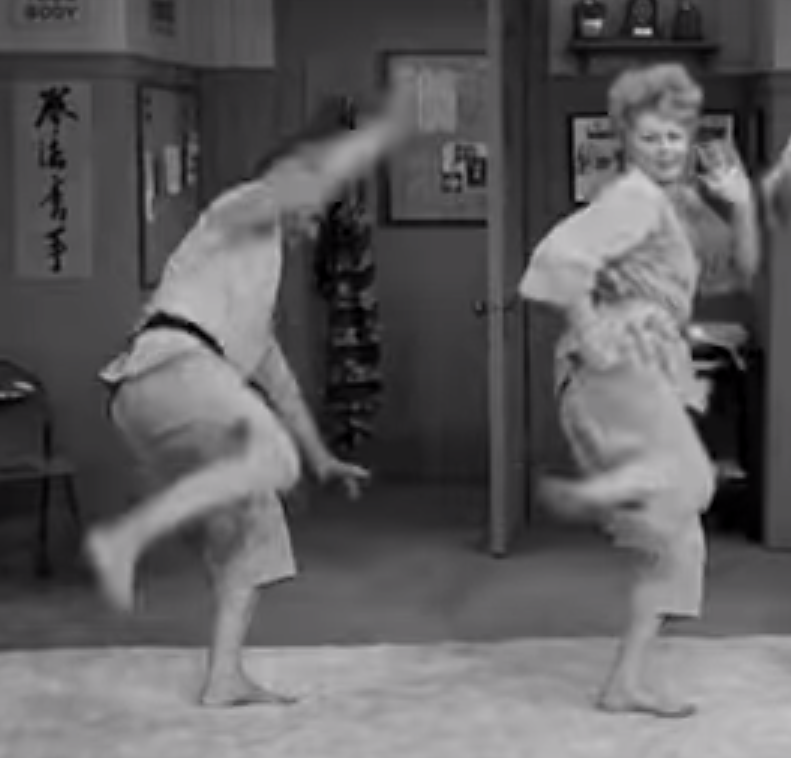
That his claims were overblown can easily be seen in his appearance on The Lucy Show a year prior to his eponymous tournament: he is repeatedly off balance, his arms flailing and generally lacking coordination. Although the show is a comedy, he is meant to be an impressive, skillful karate instructor, not a buffoon.⁹

Even in later performances, similar features can be seen; in an appearance on Chilean TV in the ’80s, he even falls over during a finishing move.¹⁰

Furthermore, it is an open secret his 1975 book, Secrets of Chinese Karate, actually comprised the technical knowledge of James Wing Woo, with Parker handling the writing, but which he then seized all credit for. Woo gave up trying to remedy the situation, instead building up a successful school with a dedicated following.¹¹

Parker’s First International World Karate Tournament, like much in the shady, nascent martial arts world of the time, was mainly a way of legitimizing and promoting himself. It also took place in Long Beach, a venue conveniently close to Hollywood.

Parker had wide coattails, helping along many martial artists in establishing their own schools, and though Lee’s case was slightly different, he still seemed a willing accomplice. He even lent Lee one of his own students for his demonstrations: Dan Inosanto, who was to become a major player in the creation and perpetuation of the Lee myth.

Many Lee bios conflate his appearance at the 1964 tournament with that at the 1967 one, including I Am Bruce Lee. When Gene LeBell reports in the film, “they treated [Lee] like a god”.¹² He is clearly referring to his appearance at the latter event, wherein he was something of a conquering hero, already having appeared as Kato on The Green Hornet.

In ’64, it would have been more, to quote Chris Rock, “Nobody knows my name; nobody’s glad I came.” The footage is easy to disentangle: the first tournament is the one shot in black and white, while the color footage is from ’67.

Again quoting LeBell in the same film:¹³

He did these things so realistically that people didn’t know if it was show business or the real McCoy.

It’s clear which one LeBell thinks it was—I’m honestly surprised his whole interview didn’t end up on the cutting room floor. Another martial artist-stuntman-actor, LeBell knew Lee (and Parker) well, working with him extensively on The Green Hornet.

At the tournament, Lee “sparred” with a well-rehearsed Inosanto and performed some spectacular parlor tricks; the one-inch and six-inch punch, again with an accomplice to sell their power by staggering backwards no matter how lightly they were struck (Taky Kimura and James Lee both attended with Lee, but it’s unclear which took part in this demonstration).

Another thing that appears again and again in these films is Lee’s “unstoppable punch”. Even though it’s from the 1967 tournament, let’s look into it: Lee, LLC says there were eight attempts, and the hapless karateka (空手家) on the receiving end failed to block even one.¹⁴

That karateka was Vic Moore, an authentic martial artist who had already won a world championship in 1966 and would rack up three more in 1968, 1969, and 1970, even defeating legendary Bill “Superfoot” Wallace in the last one, and he tells the story entirely differently.

According to Moore, there were supposed to be only two attempted punches by Lee, directed at his chest. Moore says he easily blocked both, and the footage the films use is from when he is smiling into the crowd after these blocks. Then, Lee surprises him, going for the head rather than the chest, as well as punching from out of range.

Looking at the footage, it’s easy to verify Moore’s claims: in the first frame, above, Lee’s punch is already at full extension, about a foot and a half shy of Moore’s face. You can also see Moore is looking up and to the left of Lee into the crowd—no one with any experience faces a punch with their chin up like that, and Moore was clearly experienced.

In the second frame, Lee has landed on his front foot with his arm already retracted. You can see Moore’s block in motion (and his chin come down) despite being caught off guard as well.

In short, Lee’s punch was never blockable because it was never in range.

Those responsible for polishing Lee’s legacy show this same footage over and over with different levels of zoom and tinting as if it were a series of punches, rather than a single cheap shot that never could have landed. Moore also claims he challenged Lee to attempt to block his punches, and the actor missed on both attempts.¹⁵

In any case, despite Cadwell’s claims, the effect of Lee’s appearance at the 1964 International World Karate Tournament had exactly the effect he had calculated—getting a call from Hollywood. Cadwell contradicts her own statement:¹⁶

Bruce insisted it was no real surprise to him. He’d anticipated something like this since appearing at the Long Beach Tournament.

Even without a solid deal, the Lees shuttered the kwoons in Seattle and Oakland—the schools that were supposedly his passion, that he had supposedly fought for and won the right to teach at—and moved to LA. But Bruce Lee the action star was born.


Read subsequent articles in the Mythmaking in the Martial Arts series

Part 4: Urban Lee

Part 5: The Littlest Dragon

Part 5 Addendum A: Kato’s Comeuppance

Part 5 Addendum B: The Row over “Hollywood” Continues


Read previous articles in the Mythmaking in the Martial Arts series

Part 1: The Bruce Lie

Part 2: Enter the Tycoon


Notes

  1. Pete McCormack (dir.), I Am Bruce Lee, 2012.
  2. Norman Borine, King Dragon: The World of Bruce Lee, 2008.
  3. The Best 100 Chinese Motion Pictures, Hong Kong Film Awards, 2009. 
  4. Tino Balio, United Artists: The Company Built by the Stars, 2009.
  5. Best Production Design, Black and White, 18th Academy Awards, 1945.
  6. Paisley Rekdal, The Night My Mother Met Bruce Lee: Observations on Not Fitting In, 2000.
  7. Daniel Moss, “Bruce Lee: the big boss and the $3 million man”, South China Morning Post, 1971.
  8. Bao Nguyen (dir.), Be Water, 2020.
  9. Jack Donohue (dir.), “Lucy and Viv Learn Judo”, The Lucy Show, Feb 1963.
  10. Mauricio Beltrán, SGM Ed Parker en Chile, February 2011.
  11. Dejan Djurdjevic, “What did Ed Parker study?”, The Way of Least Resistance, 2014.
  12. I Am Bruce Lee, 2012.
  13. Ibid.
  14. Ibid.
  15. GrandMaster Vic Moore: The Man That Fought ’Em ALL!!!, 2013.
  16. Borine, 2008.

Enter the Tycoon

Building the brand of Bruce (Mythmaking in the Martial Arts, Part 2)

Back in 1995, in the early days of the internet, a guy named Martin Eng created a website with the domain name brucelee.com. The site displayed,¹

[P]hotos of Bruce Lee, a chronology of his life, images of various martial arts paraphernalia used by him, a list of movies that feature him, and text from a book authored by him.

Eng claimed fair use, saying it was a non-commercial site, which included the following disclaimer:²

With due respect to Bruce and his family, and fellow fans. This is a non-profit web site. The fans’ products aren’t for sale if there are any, and I receive no financial benefits before, now and whatsoever.

Eng was a minor local celebrity himself for a time, the owner of the Russian Hill home where MTV’s The Real World was set in 1994, he also was a candidate in San Francisco’s 1999 mayoral race as part of the “hyena pack” attempting to unseat Willie Brown, the lion in the scenario. A tech-savvy entrepreneur, Eng once owned as many as 1,400 domain names, including asians.com.

Setting his notoriety aside, Eng might seem like a basic domain troll, but his interest in Lee seems to have been genuine; he is listed in the credits as a photo scanner for a series of unauthorized biographies of the film star, written by Sid Campbell and Greglon Lee.³

In 2005, Eng was sued by a company called Concord Moon LP. This entity was described in legal documents thus:⁴

Linda Lee Cadwell, the widow of Bruce Lee, and Shannon Lee Keasler, the daughter of Bruce Lee, are the legitimate heirs of Bruce Lee and the principals of Complainant Concord Moon LP.

The case was a slam dunk as so many others from those days were—it was clear mass registrations such as Eng had performed were specifically intended to usurp the trademarks others had legitimate claims to during the Wild West of the nascent internet, either hoping to be paid off to release them or to profit directly from their use. Eng’s claim his site was “non-commercial” didn’t hold water, since even though he didn’t sell anything on his site, it linked via ads to ones that did.⁵

Eng seems not to have been particularly harmed by the loss, nor by the destruction by fire of the massive house on Lombard Street Puck’s roommates booted him out of. His internet domains and real estate holdings rendered him permanently far more than well off. The house has since been rebuilt, as I’m sure you’ll be pleased and relieved to learn. Oh, and Puck ended up doing jail time, much to absolutely no one’s surprise.

Lee’s heirs have engaged in legal disputes with many others. Another of the entities they control, Bruce Lee Enterprises, won a well-publicized suit in 2010 against A.V.E.L.A., Inc. (the Art and Vintage Entertainment Licensing Agency), that “licensed” images of Bruce without actual authorization for T-shirts also involving Marc Ecko Enterprises—a “global fashion and lifestyle company”, according to their company profile on Bloomberg, behind such clothing brands as Eckō Unltd., Avirex, and Zoo York—who produced the shirts, and Target and Urban Outfitters, who sold them. The legal wrangling did determine A.V.E.L.A.’s claim the images they were licensing out were of the personas Lee portrayed in films, rather than images of him, per se, held no water.

Bruce Lee began the first of the businesses intended to control his brand in 1971 in partnership with Raymond Chow’s (鄒文懐): Concord Production Inc. (協和電影公司). Although Linda sold Bruce’s share of the company to Chow in 1976, she and her children, Brandon Lee and Shannon Lee (later Keasler) retained all rights to the deceased icon under California code Section 3344.1, as well as continuing to use the “Concord” name. The law confers on the immediate family the rights of a person,

[W]hose name, voice, signature, photograph, or likeness has commercial value at the time of his or her death.

Over the years, there has been a hard-to-trace web of entities run by Cadwell, and later by Keasler. Here are those I was able to identify:

  • Concord Moon, LP
  • Concord Moon Management, LLC
  • Bruce Lee Holdings, LLC
  • Bruce Lee Educational Foundation
  • The Bruce Lee Family Company
  • Bruce Lee, LLC
  • LeeWay Media Group
  • Bruce Lee Entertainment
  • Bruce Lee Beverage (Bruce Tea)
  • Bruce Lee Foundation

Let me put in here I support the rights of Lee’s heirs to profit from his stardom, no matter how ghoulish or crass their efforts—seriously, Bruce Tea? But if you were shocked about my revelations in Part 1, you should know the effort to build up and proliferate the legend of Bruce Lee massive—one going far beyond his legitimate heirs, with many people seeing his status as a cultural icon as an opportunity to cash in, including the creation of a new sub-genre of film: Bruceploitation. A portmanteau of Bruce and exploitation, these generally low-budget films starred “Lee-alikes” and were in their heyday 1974–1981.

There have been several biopics over the years, and it’s important to understand these are not thoughtful documentaries executed by disinterested parties, but ways of establishing as fact a great many things reflecting well on Lee but simply untrue and denying the reverse. Even a quick perusal will turn up many inconsistencies, contradictions, whole-cloth manufacturing of material, and a persistent conflation of Lee’s onscreen personae with reality. This last element is particularly interesting given its similarity to the gambit the Lees sued A.V.E.L.A. over.

Although Dragon: The Bruce Lee Story (1993) is the clearest example of these, being based on Cadwell’s book Bruce Lee: The Man Only I Knew, there is a direct involvement by Lee’s heirs in other efforts, which escalated to the level of media carpet bombing in the early ’90s and shows no signs of letting up.

In the list below, in addition to pointing out work by Cadwell, Keasler, and deceased family member, Brandon Lee, I’ve also noted the involvement of John Little, who seems to have been the group’s go-to writer, Taky Kimura, student, longtime friend, and still board member of the Bruce Lee Foundation, and Dan Inosanto, another longtime student and friend, but who seems to have recently fallen from favor:

  • Little Dragon (upcoming): Keasler—producer, writer
  • The Bruce Lee Project (upcoming): Keasler—executive producer
  • Conspiracy (2015): Little—interviewee as Bruce Lee’s biographer
  • Bruce Lee: Die Faust Hollywoods (Bruce Lee: the Faust of Hollywood, German documentary, 2015): Inosanto—interviewee
  • I Am Bruce Lee (2012): Cadwell—interviewee; Keasler—executive producer, interviewee; Lee—archival footage; Inosanto—interviewee
  • How Bruce Lee Changed the World (2009): Keasler—executive producer, interviewee; Kimura—interviewee
  • Bruce Lee: In Pursuit of the Dragon (2009): Little—director, producer, interviewee
  • The Legend of Bruce Lee (2008): Keasler—executive producer
  • Blood and Steel: Making ‘Enter the Dragon’ (2004): Cadwell—archival footage
  • The Unbeatable Bruce Lee (2001): Lee—archival footage
  • Reflections on ‘The Little Dragon’ (2001): Inosanto—archival footage
  • Bruce Lee: A Warrior’s Journey (2000): Cadwell—interviewee; Little—director, producer, writer, voice; Kimura—interviewee; Inosanto—archival footage
  • The Story (documentary about Game of Death, 2000): Little—director, producer, narrator; Inosanto—archival footage
  • The Lees: Action Speaks Louder (1999): Cadwell—interviewee; Keasler—interviewee; Lee —archival footage; Kimura—interviewee; Little—interviewee; Inosanto—interviewee
  • Bruce Lee: The Legend Lives On (1999): Cadwell—archival footage; Lee—interviewee; Kimura—interviewee
  • Bruce Lee: In His Own Words (1998): Cadwell—archival footage, special thanks; Keasler—archival footage; Lee—archival footage; Little—director, producer, musical arrangement
  • Bruce Lee: The Path of the Dragon (1998): Keasler—interviewee; Lee—archival footage; Kimura—interviewee; Inosanto—interviewee
  • Masters of the Martial Arts Presented by Wesley Snipes (1998): Keasler—interviewee; Little—interviewee
  • Bruce Lee’s Jeet Kune Do (1995): Cadwell—special thanks; Lee—narrator, interviewee; Kimura—interviewee, thanks; Inosanto—narrator, interviewee, special thanks
  • Bruce Lee—Martial Arts Master (1994): Lee—interviewee; Kimura—interviewee
  • Bruce Lee: The Immortal Dragon (1994): Cadwell—interviewee, special thanks; Keasler—interviewee, special thanks; Lee—archival footage; Little—interviewee; Kimura—interviewee; Inosanto—interviewee
  • Dragon: The Bruce Lee Story (1993): Keasler—actress, performer: “California Dreamin’”
  • The Curse of the Dragon (1993): Cadwell—interviewee; Keasler—interviewee; Lee—interviewee; Inosanto—interviewee
  • Death by Misadventure: The Mysterious Life of Bruce Lee (1993): Lee—interviewee
  • Bruce Lee, the Legend (1984): Cadwell—interviewee, Keasler—archival footage; Lee—archival footage; Kimura—interviewee; Inosanto—archival footage
  • Bruce Lee: The Man and the Legend (1973): Cadwell—interviewee; Keasler—interviewee; Lee—interviewee; Kimura—interviewee; Inosanto—archival footage

Another person who frequently appears in these docupics is Kareem Abdul-Jabbar, but he seems to do so quite genuinely as a close friend and former student, and only in the role of an interviewee on those topics—after all, he has his own tremendous successes to manage.

On top of all the films, there have been many books penned by the various members of this group, Little was also the longtime Associate Publisher of Bruce Lee Magazine, and Keasler a writer on the recent comic book series Bruce Lee: the Dragon Rises. The most important of the books, apart from Cadwell’s bio, which I’ve already mentioned, are Tao of Jeet Kune Do (1975), which Cadwell and Inosanto also helped to edit, and another Cadwell-backed effort, Bruce Lee’s Fighting Method (1978). Additionally, there is the so-called Bruce Lee Library, all of which Little wrote using a variety of materials from the Lees:

  • Vol. 1—Words of the Dragon—Interviews, 1958–1973 (1997)
  • Vol. 2—The Tao of Gung Fu—A Study in the Way of Chinese Martial Arts (1997)
  • Vol. 3—Jeet Kune Do—Bruce Lee’s Commentaries on the Martial Way (1997)
  • Vol. 4—The Art of Expressing the Human Body (1997)
  • Vol. 5—Letters of the Dragon—Correspondence, 1958–1973 (1997)
  • Bruce Lee Artist of Life (1999)
  • Bruce Lee Words From A Master (1999)
  • Bruce Lee Striking Thoughts (1999)
  • Bruce Lee: A Warrior’s Journey (1999)

In short, there is an almost absurd amount of media about Bruce Lee—the number of authorized works alone is staggering, and there are still more unauthorized ones, especially if Bruceploitation is considered. Compared to this, Lee’s actual body of work was a single, fairly basic and largely plagiarized book (Chinese Gung-Fu: The Philosophical Art of Self Defense, 1963), four and a half films, one season of The Green Hornet, and a few bit parts on other US films and TV shows.

The image of Bruce Lee you have in your mind is a product, a brand. One carefully honed and refined to continue to be relevant and maintain its financial value, so media placements are worth paying for and merchandise continues to be sold. And they’ve done quite well: the Lee brand continues to pull down $5–10M yearly—impressive considering their golden goose has been gone for 45 years.

All this is why what you know about Bruce Lee is what Bruce Lee, LLC wants you to know about Bruce Lee.


Read subsequent articles in the Mythmaking in the Martial Arts series

Part 3: Fists of Flim-Flam

Part 4: Urban Lee

Part 5: The Littlest Dragon

Part 5 Addendum A: Katos Comeuppance

Part 5 Addendum B: The Row over “Hollywood” Continues


Read previous articles in the Mythmaking in the Martial Arts series

Part 1: The Bruce Lie


Notes

  1. National Arbitration Forum, The Heirs of Bruce Lee and Concord Moon LP v. Martin Eng, August 2005.
  2. Ibid.
  3. The series consists of Greglon Lee and Sid Campbell, The Dragon and the Tiger, Volume 1: The Birth of Bruce Lee’s Jeet Kune Do, 2003; Lee and Campbell, The Dragon and the Tiger, Volume 2: The Untold Story of Jun Fan Gung-fu and James Yimm Lee, 2005; and Lee and Campbell, Remembering the Master: Bruce Lee, James Yimm Lee, and the Creation of Jeet Kune Do, 2006.
  4. The Heirs of Bruce Lee and Concord Moon LP v. Martin Eng, 2005. 
  5. Ibid.

The Bruce Lie

Showdown in Oaktown (Mythmaking in the martial arts, Part 1)

[A]ll wars are fought twice, the first time on the battlefield, the second time in memory.¹

Late in 1964, in a small martial arts studio in Oakland, with few eyewitnesses, Bruce Lee (李振藩) lost a fight to Wong Chia Man (黃澤民—in all printed accounts I have seen, his name is given as Wong Jack Man, but those who knew him used the name I have given here) and ever since Lee and his heirs have been fighting to change the the memory of the encounter.² Wong responded by asking for a rematch with more people to judge the outcome, but the Lees chose the fight they could win instead.

So for over half a century, Bruce, and after him, his wife, Linda Lee Cadwell, and his daughter, Shannon Lee Keasler, have used their money and influence and his stardom and celebrity to feed the public lies about what happened.

Birth of the Dragon at least purported to present a balanced view of events; Wong’s portrayal in the officially endorsed biopic Dragon: The Bruce Lee Story was absurdly one dimensional, as was Linda’s version of events in other accounts. I heard from a friend who was a student of Wong’s when the film was released the Sifu would say, “I am the monster,” referring to the shadowy Demon of Fate stalking Lee in the film. Unfortunately, the new film scored a solid 21% on Rotten Tomatoes, and the plot was nonsense with a coat of whitewash, so I’ve opted to skip it—after the fight, they team up to battle a crime boss?

Instead, let’s begin with the events leading up to the fight. Cadwell claims,³

It became an unwritten law that the art should be taught only to Chinese. Bruce considered such thinking completely outmoded and when it was argued that white men, if taught the secrets, would use the art to injure the Chinese, he pointed out that if a white man really wanted to injure a Chinese, there were plenty of other ways he could do it. ‘After all, he’s bigger.’ However, Bruce soon found that at first his views were not shared by some members of the Chinese community in San Francisco, particularly those in martial arts circles.

She goes on to state Wong’s pupils were all strictly pure Chinese.

That this is pure bullshit I can proclaim from personal knowledge: Peter Ralston, the Caucasian who taught me, was an early student at The Chinese Physical Culture Association (精武體育㑹—精武体育会, Jing Mo Tai Yook Woey).⁴ And I’ve run across many other non-Chinese students of Wong’s; he remained a central figure in the martial arts community of the Bay Area for 45 years. To give her the benefit of the doubt, the story could have been what Bruce told Linda, but it’s still categorically false.

Even Wong has admitted early on, his students were mainly Chinese, but rather than the result of exclusionary policies, it was because while interest in the Chinese martial arts had already begun to spread, the Japanese martial arts such as Judo (柔道) and Karate (空手) were best known to Westerners at this time and also because of his school’s location within the enclave of Chinatown. The fact is borne out by the tales Ralston would relate of how he would join the other students in making fun of any “white barbarians” who visited the school.

Lee already had a school in Seattle, but that was the small time. San Francisco was the epicenter of Asian martial arts in the US, with its large and diverse population of Asians and an interest in Eastern philosophies the Beat Poets had rekindled, which was to fully flower in the Summer of Love. So Lee left Seattle in the hands of one of his students and opened another school on Broadway in Oakland and tried to gain recognition.

His opportunity came in late August of ’64, when Hong Kong starlet Diana Chang Chung-wen (張仲文), came to the US to promote her latest film, Between Tears and Smiles (《故都春夢》). Lee, presumably connected via the Hong Kong movie scene, acted as her escort. When her film was screened in the Sun Sing Theater in San Francisco’s Chinatown, he took the opportunity to try to make a name for himself and his kung fu school. This included, by most accounts, some incendiary words about more traditional schools, and an open challenge to come fight him.

His loudmouthed braggadocio did get the attention of the leaders of the local martial arts community, who settled on Wong, another newcomer, as the guy to shut Lee up. The choice made a lot of sense: both were 23 and they,⁵

[…] shared a symmetry between them: the quiet ascetic and the boisterous showman, traditional against modern, San Francisco vs. Oakland, Northern Shaolin against Southern.

And this seems a good point to fill in some backstory.

Lee was born in 1940 in San Francisco’s Chinatown. His father was an actor in Chinese opera and film, and his mother was a half-Caucasian from a wealthy Hong Kong family. They returned to Hong Kong, and Bruce became a child actor because of his father’s connections. His was a family of wealth and privilege, with two maids and a chauffeur.

The mythmaking stretches back to Lee’s high school days, when he was clearly a troublemaker, starting a gang called The Eight Tigers of Junction Road (八虎聯合道), getting kicked out of La Salle College for his poor academic record as well as behavioral difficulties, and switching to St. Francis Xavier’s College—both high schools despite their names—which he also didn’t finish.

In 1957, Lee began studying Wing Chun (詠春), which he promptly began using in street fights. His parents sent him to the US in order to keep him out of jail, though there is a thin and likely apocryphal claim that he had beaten up the son of a powerful Triad and fled to avoid retaliation (there are many other such tales). His brother’s recollection makes no mention of any specific incident:⁶

The police detective came and he says “Excuse me Mr. Lee, your son is really fighting bad in school. If he gets into just one more fight I might have to put him in jail.”

In any case, he finally completed his high school education in Seattle. Despite him and others in his coterie claiming he majored in philosophy at the University of Washington, he was a drama major and a dropout at that.

And even though he had received only two years of training in some combination of Western boxing, Wing Chun, and Wu style Tai Chi Chuan (吳氏太極拳) at best, Bruce decided he knew enough not only to open a school, but to name it after himself in 1959: the Lee Jun Fan Gung Fu Institute. I say “at best” because he was a full-time student, a cha-cha dance champion, and appeared in film roles—20 by the time he was 18, so when did he have time to study martial arts? The famous master of his Wing Chun school, Yip Man (葉問), is known to have not considered Lee a serious student.

What Lee taught was his own version of Wing Chun. It’s difficult for me to think of his school as anything but disreputable—he was simply not qualified. I think a good characterization of Lee is a flim-flam artist cashing in on the martial arts craze then sweeping the US.

He was not some savant who combined a deep study of philosophy with day-and-night martial arts discipline; he was a high-school and then college student, who also worked as a waiter at a Chinese restaurant. But just as he knew enough to become a street bully in Hong Kong, he knew enough to pass himself off as a martial arts instructor in Seattle.

He had not yet started engaging in a rigorous physical regime, which was to include a great deal of weightlifting. The flashy moves of the martial arts showman were far in the future. It’s noteworthy because of the citizenship conferred by being born in the US, he was drafted to serve in the Vietnam War in 1963 but was passed over 4F because of his congenitally poor eyesight. You can see the earpiece of his glasses, which he could not be without, protruding from his suit jacket pocket in the picture with Chung-wen. In his second Hong Kong action film, Fist of Fury (《精武門》), he wore his real glasses as part of his onscreen costume. This is the central problem of the Lee-Wong fight: the revisionists want to place the myth of Lee there, as well as turning the clock back—way back—on that legend.

Turning to Wong, he was born in Taishan (新寧, in the province of Kwantung (廣東), formerly Romanized as Canton, not far from Hong Kong). in 1941, and raised in a very different way. Unlike Lee, he began his training in the martial arts at the age of eight, learning Northern Sil Lum Chuan (北少林拳) from Yim Shan Wu (嚴尚武), the top disciple of Gu Ruzhang (顧汝章). The origins of this style come from the famous Shaolin Temple in Henan (河南), in the person of Monk Zhao Yuan (朝元 和尚), a member of the Ming (大明) royal family who became a monk when they were overthrown by the Qing (大清) in 1644. Sil Lum is the Cantonese rendering of the more familiar Shaolin. As with my previous article about martial arts, I apologize for the combination of Mandarin and Cantonese, as well as the sometimes odd Romanizations; I’m using these terms as I learned them.

After distinguishing himself in his studies, Wong went on to be taught personally by a cadre of Great Grandmasters. Dedicated study for 15 years with these martial arts luminaries allowed him to finally become the first person to complete the Northern Shaolin program of studies since WW2.

In martial arts schools, rather than diplomas, the images of the masters who make up that school’s lineage hang on the walls. It is from the pictures at Cheng Hsin (中心), Ralston’s Oakland school I know Wong and Gu. Gu was a distinguished student himself, sent south to spread the art in Canton, and famed for his powerful Iron Palm (铁掌功) technique. All this is the martial arts heritage Wong represented when he came to San Francisco Chinatown in 1964.

Lee was actually discriminated against because he was one quarter Caucasian; other students of Yip Man refused to train with him. But this was pretty far from the mission of Jing Mo, founded by Huo Yuanjia (霍元甲), and portrayed by Jet Li (李阳中) in Fearless (《霍元甲》—note the Chinese title for the film is simply the name of this famous martial artist). One of the main goals of Jing Mo was to spread the Chinese martial arts both within China as well as internationally, and to do away with the secrecy and insularity prevalent in the past.

Ironically, Lee played a fictitious student of Huo’s, named Chen Zhen (陳真), in his 1972 film Fist of Fury. But for anyone who knows anything about the history of the Chinese martial arts, the Lees’ attempt to tar Wong with a brush of race-based exclusionism holds zero water.

If you’re thinking things aren’t looking so great for Bruce Lee about now, I agree. And that night in the Fall of 1964 did not go well for him either, which I’ll dig into in subsequent articles.


Read subsequent articles in the Mythmaking in the Martial Arts series

Part 2: Enter the Tycoon

Part 3: Fists of Flim-Flam

Part 4: Urban Lee

Part 5: The Littlest Dragon

Part 5 Addendum A: Kato’s Comeuppance

Part 5 Addendum B: The Row over “Hollywood” Continues


Notes

  1. Viet Thanh Nguyen, Nothing Ever Dies: Vietnam and the Memory of War, 2016.
  2. Michael Dorgan, “Bruce Lee’s Toughest Fight”, Official Karate, July, 1980.
  3. Linda Lee Cadwell, Bruce Lee: The Man Only I Knew, 1975.
  4. Wong chose an idiosyncratic version of this name, which typically ends with 會 including a character in Jing Mo, that was beyond my ability to decipher in the image of his school, which reads right to left
  5. Charles Russo, “Bruce Lee Vs. Wong Jack Man: Fact, Fiction And The Birth Of The Dragon”, Fightland Blog, 2016.
  6. Bruce Lee: the immortal Dragon, 2002.

Whither the Wanax?

Contributing factors in the Late Bronze Age Collapse (Late Bronze Age Collapse, Part 2)

An oft-bypassed attraction among the hill towns of Tuscany is the Museo archeologico nazionale di Siena. One enters  via the 12th-century hospital of Santa Maria della Scala—itself an interesting attraction as one of the oldest still-extant such facilities. Then, proceeding down a series of irregular stairs and ramps beneath the ediface, you arrive in Roman classical antiquity.

And so it goes, as you travel downwards, you also travel backwards in time, through Etruscan passages and artifacts, all the way down and back to the Villanovan period (ca. 900–720 BCE). The very word Tuscany derives ultimately from the name of the pre-Roman people who once dwelt in the region.

You may have noticed my reference to Troy VII in Part 1. This nomenclature is used by archaeologists to designate a specific stratum of ruins. These are similar in effect to geological strata where there are repeated periods of deposition, but with human habitation the cycles are much more rapid. These sequences generally reflect repeated destruction and rebuilding on the same site.

The pattern is widespread, especially among Late Bronze Age (LBA) civilizations. The siting of the city still has all the advantages it was originally chosen for, indeed more, as it is now higher, as it sits on a pile of rubble, which also doubles as a convenient quarry, so it is rebuilt on the same spot. It’s immaterial what the manner of destruction was—earthquake, fire, famine, warfare, etc. Much as the King of Swamp Castle (Michael Palin) says of his home in Monty Python and the Holy Grail,

Other kings said I was daft to build a castle on a swamp, but I built it all the same, just to show ‘em! It sank into the swamp, so I built a second one. That sank into the swamp. So I built a third. That burned down, fell over, and then it sank into the swamp. But the fourth one stayed up!

Although Swamp Castle’s is a more compressed timeline, when an LBA city was brought down by some calamity, there was not only rebuilding, but improvement—the civilization would learn from its mistakes, put forth greater efforts, and often return better than ever.

For a more recent example, in 64 AD, the Great Fire of Rome blazed for six full days, reducing 10 of its 14 districts, or 70% of the city to smoking rubble. Though Nero was blamed for the blaze by many, he was actually away at Antium when the fire broke out. In any case, the Romans rebuilt, changing the opus incertum building method out for opus reticulatum because they found concrete buildings faced with brick as used in the latter were more resistant to flame. Opus incertum was another faced-concrete method, but used stone for the purpose. At high temperatures, the Romans found, stone burns, while brick does not.

And this is what’s remarkable about the Late Bronze Age Collapse (LBAC); there is no recovery from the calamities cities typically take (more or less) in their stride.

Taking another example of urban resilience, one of the earliest demographers, John Graunt studied the population statistics of London in 1663, concluding:¹

Let the mortality be what it will, this city repairs itself within two years.

Which is to say, despite London’s background death rate being much higher than in the countryside, to say nothing of its frequent outbreaks of plague, actual dips in population were quite temporary. By contrast, in the LBAC according to Jack Davis:²

The area of the Mycenaean kingdom of Pylos remained, as a whole in fact, severely depopulated for nearly a millennium.

Another thing I mentioned previously was the flourishing international communication of the LBA. In order for this to be carried out, scribes needed to be multilingual, but at least in the Near East of the time, Akkadian spread from Anatolia to Western Syria, Western Iran, the Levant, Egypt and Cyprus. It’s no accident the peak of Akkadian’s use as an LBA lingua franca corresponded to trade in the region from 1600 to 1200 BCE.

And along with trade, diplomatic communication was also carried out in Akkadian. Many tablets found in Amarna, Egypt from the rule of Akhenaten (ca. 1353–1336 BCE) contain correspondence from other royal courts including Cyprus, Elamite Iran, the Hittite Empire, the Mitanni, the Assyrians, the Kassites, as well as many smaller kingdoms of the Levant, and even as far as the Persian Gulf.

While it was extremely useful in this role of communication across many cultures in the Near East, the language itself had some significant flaws: The writing system of Akkadian is actually a borrowing itself, from Sumerian, which is both the oldest known written language and a language isolate. For Akkadian, this was a recipe for a highly complex system and also a defective script.

One issue was there were many homophones. For example, the simple, one-syllable word ku (written ⟨gu⟩) could mean nine different things: bird, cord, eat, entirety, force, neck, legume, square, or voice, and this was far from uncommon. The way these words were represented somewhat helped to sort out which meaning was intended:³

Remember, I said “somewhat”—actually, you can see many of these are written in exactly the same way, and the sign for “eat” and “square” is that for “voice” with another element inserted, and the one for “bird”, is essentially similar to that for “entirety”, “force”, “neck”, and “legume”, but with a second, unpronounced symbol added. Of these examples, only the sign for “cord” is truly unique.

Coming at it from the other direction is no better; the “voice” version of ku was also used to write k’ak, “mouth”, and tsu, “tooth”. And indeed, there were often many ways to write a single word; below are the many ways in which ngesh’kana, meaning “pestle” could be written, and it’s far from a unique case:

Consider for a moment the challenges involved in deciphering this language. The syllabogram ngesh, which appears as the first sign in each version of the word above, was also used as a determinative—an unpronounced ideogram meaning “tree” and signifying something made of wood. Essentially, for every symbol, you’d have to decide if it was an ideogram or syllabogram, what word is being indicated, and how—or whether—to pronounce it.

Add to this the fact this system was then adopted to represent Akkadian, a Semitic language unrelated to Sumerian, and cuneiform goes from being a complicated script to a complicated, defective script. I mentioned Sumerian was a language isolate, which means it has no known linguistic relatives, though there have been many attempts to link it to others.

Defective script is a technical linguistics term meaning the written signs used do not adequately represent the language as spoken. Many of the written elements changed in order to represent the phonetic values of Akkadian, for which a syllabary was ill suited.

Looking back at Sumerian ku, the homophony disappears in Akkadian: while “cord” is , “eat” is akālu, “entirety” is nagbu, “force” is emūqu, “neck” is kishādu, “voice” is rigmu, while “bird”, “legume”, and “square” have vanished. Not that Akkadian has no words for these things, but they did not use ones based on the various forms of ku.

Add to this the fact several other languages in the region adopted cuneiform, including Amorite, Eblaite, Elamite, Hattic, Hittite, Hurrian, Luwian, and Urartian, and the scribe also has to determine which of these several languages they are reading ahead of the tricky process of decipherment. The Amarna letters also are remarkable for the fact the Akkadian used is heavily flavored with the local language, with many “Canaanisms” appearing in the texts. That is, the Canaanite language proper did not exist yet, but the texts show some of the elements that would come to characterize the language—this is its proto language.

Furthermore, many of these kingdoms, notably Egypt, had entirely different languages and scripts they used domestically. Egyptian hieroglyphics and hieratic script date from 3200 BCE, making the fact the Amarna Letters were written in cuneiform Akkadian an interesting discovery confirming its use as a lingua franca in the region. The biblical confusion of tongues starts not to seem like much of an exaggeration. In fact, the story seems ultimately to come from the Sumerian epic, Enmerkar and the Lord of Aratta, in which Enki is featured as the confuser of languages.

This level of complexity led to another thing I referred to in Part 1: a professional scribal class. It would have been nearly impossible for anyone not trained from a young age to gain literacy. Few rulers, and indeed few at court in these kingdoms, would have understood the writing, and, outside of its home territory of Assyria and Babylonia, the Akkadian language itself.

Mineralogical examination of the actual tablets from Amarna shows their preparation was a painstaking process, including the use of various materials from Nile marls, whose inferior clay could blur incised signs, to Esna shales, with a much better texture as well as a pleasing buff color.⁴ This too would have been a duty of the scribes, as well as carefully refreshing such tablets once made so they could be used again. The tablets were generally not fired, so they could be reused—the baked clay tablets we have were often inadvertently exposed to high heat.

While the use of different materials might seem to show a process of improvement, the dating of these items shows the opposite. It seems with the expansion of regional diplomacy and trade, to say nothing of the steles and other monuments demanding the attention of scribes, the ability to train skilled scribes was being outstripped by the need for them.

So when the alphabetic writing systems of Phoenician, Aramaic, and Greek arrived, together with materials like lampblack ink and papyrus, their adoption was rapid. With only 22 letters (or 24 in Greek), scribes suddenly could learn to read and write in the space of months instead of years. Aramaic and Greek, both developments of Phoenician (along with many others) were to become respectively the lingua franca of the Near East and the Mediterranean.

The central bargain an agrarian civilization makes is specialization; rather than everyone being involved in food production, someone can make something those who are farming want but have no time for, let’s say shoes, and then they can barter shoes for food. Writing first came into being as a way of recording these transactions.

Eventually, there are many specialists of different kinds. As long as food is plentiful, the system continues to work. However, when there is famine, workers in some of the less useful trades just become mouths to feed.

If you’re a scribe, even in dire times, your king needs you; if there is famine, you write letters to other rulers asking for grain, if there is invasion, you write letters asking for troops. But what happens when ties to other kingdoms are broken, and such letters receive no answer? What use then is a scribe, or for that matter, a king?

Kingship is essentially a fictitious role. There is typically nothing either genetically superior about them (the opposite is often true) nor does their training endow them with unique abilities—warfare and diplomacy would be learned, but more specialized generals and chamberlains would know them better, and as already noted, rulers would depend on scribes for reading and writing. Generally, it is because of a connection by lineage to some figure in the past kingship is conferred.

Divine associations are often made, either as to descent or at least blessing, as I’ve discussed, and enshrined particularly in the West’s doctrine of the divine right of kings, and in the East, in the Mandate of Heaven. The web of contacts among rulers also serves to mutually legitimize kings—kings acknowledge each other and will communicate only among themselves.

But in the LBA, these elites lost the international framework and the diplomatic contacts that had supported them. Couple this with famine, foreign invasion, and likely increased taxes to deal with these issues, and you have a recipe for revolt—the fiction of the king’s legitimacy comes to an end.

And the kings, and indeed emperors, in the LBA ruled supreme. Trade too was not what we think of even in the ancient model with individuals or consortia purchasing goods at one port that are rare and valuable in the port of their destination, traveling there and trading the goods they have brought with them for ones that have rarity and value at their port of origin. Rather, there was no “trade” at all, but a system of “gift-giving” among rulers. Such expeditions traveled under the direction and authority of the kings and instead of bills of lading, they were accompanied by letters describing both the gifts they were sending to their fellow monarchs and requesting the gifts they desired most to receive.

In Mycenaean Greek, this type of supreme ruler is embodied in the word wa-na-ka:

Mycenaean Greek was written in Linear B, another ideographic/ syllabographic system, which could only represent the language defectively. The word appears in Homeric Greek as ϝάναξ, acting as a bridge from the Linear B written form to the proper transliteration. That transliteration is wanax and meant “king”, “overlord”, or “leader”, but most properly, “high king”, and appears to have been common in the LBA, and in the Homeric epics intended to represent those times. But it completely disappears in the Dark Ages and afterward. As Early Greece-focused archaeologist, Josho Brouwers notes:⁵

[A]fter the Bronze Age, the term basileus [βασιλεύς] ascends in importance while the wanax of old disappears, and is only preserved in Homer in standard phrases like anax andron (“lord of the people”, i.e. Agamemnon), and reserved to denote deities.

In short, it seems the empires and kingdoms of the LBA got too big too quickly: Assyria ruled its home territory in modern-day Iraq, as well as vassal states around the whole Persian Gulf, the Hittites controlled almost all of Anatolia, while the Mycenaean Greeks controlled the rest of Anatolia (part of the west coast) as well as the Greek mainland and islands, and Egypt, largest of all, comprised the whole Nile River Valley, with vassal states covering the Levant, Cyprus, Eastern Libya, and Nubia.

These vast nations proved unwieldy, stretching the limits of both infrastructure and communications, and the failure of any of these states had a magnified effect on the others, all of which were fairly tightly interconnected in terms of the prestige of their kings as well as the prosperity of their people.

During and after the Dark Ages, nearly every Greek city-state did away with hereditary monarchical offices, opting instead for either democracy or oligarchy. Sparta was a notable exception, having two hereditary kings, but the redundancy was an important element there. Additionally, Iron Age city-states (ca. 1200–700 BCE) were much more modestly sized.

Together with the breakdown of trade networks, the invasions of the “Sea Peoples”, the famines, and unavailability of copper I presented in Part 1, as well as the strain expansion placed on these kingdoms, and particularly the scribal class, and the over-concentration of power with the rulers I’ve discussed here are all part of the “perfect storm” that precipitated the LBAC.


Read subsequent articles in the Late Bronze Age Collapse series

Part 3: The Luwian Menace

Part 3 Addendum: Fruit from a Poisonous Pseudoarchaeological Tree


Read previous articles in the Late Bronze Age Collapse series

Part 1: Apocalypse BCE


Notes

  1. John Graunt, Natural and Political Observations Made upon the Bills of Mortality, 1663.
  2. Jack Davis, “Pylos”, The Oxford Handbook of the Bronze Age Aegean, Eric H. Cline, ed., 2010.
  3. In modern Sumerian transcription, subscripted numbers indicate the different symbols with which a syllable is written, while superscripted words represent unpronounced pictograms.
  4. Goren, Finkelstein, and Na’aman, “Mineralogical and Chemical Study of the Amarna Tablets”, Near Eastern Archaeology, 2002.
  5. Josho Brouwers, reply to “In the Bronze Age Mediterranean, states such as Hattusa, Egypt, Assyria, et alia are described as unified, unitary monarchies….” r/AskHistorians, Reddit, 2020.