Coprophony

The side of Mozart most prefer to forget

I’ve been a fan of Mozart for some time, and in particular his Requiem in D minor, a piece that gets used frequently in soundtracks, with the best and worst uses of the “Dies Irae” section of the “Sequentia”, for example, being respectively during Nightcrawler’s (Alan Cumming) attempted assassination of the POTUS in X2, and a Macy’s One Day Sale television ad. I laughed out loud every time I saw the early ’90s commercial—I’ve always wondered if the ad guys were pranking the suits or didn’t understand the ominous overtones this commercial would hold for the cognoscenti—actually, it’s pretty ominous even if you don’t understand the words. If the irony is deliberate, it might actually be the best use. As soon as films had music, Mozart was in them, and the trend shows no signs of slowing.

Opera snobs disdain the Austrian composer as overly facile, with his music’s repeated film appearances providing additional damning proofs, but it’s difficult to express the depths of my uncaring. I find him thoroughly masterful: “Lacrymosa” sounds like lamentation, “Dies Irae” sounds apocalyptic, and “Confutatis” sounds like damnation.

My associations with the work run so deep, I have only to hear a word like salvage to set me off singing “Rex Tremendae Majestatis”. The line “qui salvandos salvas gratis” being the tie in.

You can imagine how it went when I worked with a guy named Rex; it was never “hey Rex”, it was “Reeeeeeeeeeeeeeeeeeeeeeeex!” The music is soaring, majestic, transcendent.

Furthermore, I’m in good company—Søren Kierkegaard said of the composer:¹

Udødelige Mozart! Dig hvem jeg skylder Alt, hvem jeg skylder, at jeg tabte min Forstand, at min Sjæl forbausedes, at jeg forfærdedes i mit inderste Væsen, Dig hvem jeg skylder, at jeg ikke gik Livet igjennem uden at Noget var istand til at ryste mig, Dig hvem jeg takker for, at jeg ikke døde uden at have elsket […].

Immortal Mozart, to you I owe everything; to you I owe that I lost my mind, that my soul was amazed, that I was terrified to my innermost being; to you I owe that I did not go through life without something being able to shake me; to you I owe not dying without having loved […].

And more succinct, but not lesser praise was given by Albert Einstein

Mozart’s music is so pure and beautiful that I see it as a reflection of the inner beauty of the universe.

Given all this, imagine my surprise when I recently learned of Mozart’s work, “Leck mir den Arsch fein recht schön sauber”, K. 233. The title translates to “Lick my Ass Nice and Clean”.

While it seems quite rude to our ears, leck mich im arsch is a standard vulgarism in German; a closer English equivalent of would be “kiss my ass”. Nonetheless, it seems in glaring contrast to his masses and operas.

Still, the work was far from singular, as his catalog also includes:

  • “Leck mich im Arsch”, K. 231: the same idea as above.
  • “Bei der Hitz im Sommer eß ich”, K. 234: contains references to farting.
  • “Gehn wir im Prater, gehn wir in d’ Hetz”, K. 558: wherein he says the Prater, a public park in Vienna, is “full of shit”.
  • “Difficile lectu”, K. 559: nonsense Latin disguising another ass-licking lyric.
  • “O du eselhafter Peierl”, K. 560a: “Oh you asinine Peyerl” is the translated title.
  • “Bona nox!”, K. 561: The extended title translates as “Good Night, You Are a Real Ox”, and it only gets worse from there.

As its chronological Köchelverzeichnis number shows, “Leck mich im Arsch” actually predates the first-mentioned one. Also note that a pair of these, “Leck mir den Arsch fein recht schön sauber” and “Bei der Hitz im Sommer eß ich”, have been reclassified as not being Mozart’s original compositions but merely his words set to works by Wenzel Trnka.

Also, “O du eselhafter Peierl” refers to Johann Nepomuk Peyerl, a tenor-baritone with whom Mozart worked frequently, and whose strong Bavarian accent made the puns in “Difficile lectu” work. The two pieces were intended to be sung together, with this second one making fun of Peyerl, who would have just sung the other one.

And then there are his letters. Benjamin Simkins compiled the following list of 40 items of scatological correspondence:³

  • Leopold Mozart (father): 20 letters
  • Constanze Mozart (wife): 6 letters
  • Maria Anna Thekla Mozart (cousin): 6 letters
  • Nannerl Mozart (sister): 4 letters
  • Maria Anna Mozart (mother): 1 letter
  • Mother and sister jointly: 1 letter
  • Abbé Bullinger (friend): 1 letter
  • Kapellmeister Stoll (friend): 1 letter

The central falsification of the film Amadeus is well known: Salieri destroying his fellow composer, which was taken from a vague rumor, made explicit in Alexander Pushkin’s play, Mozart and Salieri.⁴ The two were actually on good terms; Salieri was a fan and had Mozart give his son music lessons.

Still, based on his letters, it’s easy to picture the composer as Tom Hulce portrays him, of whom Antonio Salieri (F. Murray Abraham) says:⁵

That was Mozart. That! That giggling, dirty-minded creature I had just seen […]!

I’ll note I intend neither to bowdlerize Mozart’s words nor to catalog his every off-color remark; there are those who have done both already. My aim is to understand the context of such materials.

I have not seen the play Amadeus, but Peter Shaffer penned both it and the film, so I imagine they bear a strong similarity. When Margaret Thatcher went to see the play, dining afterwards with director Peter Hall, the following is recorded of her reaction:⁶

She did not look happy.

“I think it is disgraceful that the National Theater shows Mozart uttering such obscenities, […] a composer of such elegant and wonderful music.”

“But Prime Minister,” he protested, “it is actual fact that he did talk like that. He used four-letter words.”

“It is not possible,” she responded, “not from someone who could create works of such beauty.”

“But Prime Minister, I can assure you that this was the case. Mozart’s own letters confirm it.”

Well, what did Maggie know? In the same article, she is also quoted as talking of “van Gogh’s Chrysanthemums”. It does tell us the group involved with the play was well informed by thorough research, and the play and film reflect this knowledge.

While I was surprised to find this out about Mozart, unlike Thatcher, I didn’t find it incompatible with his other works; rather, it serves to humanize him and make me like and appreciate him still more. And in fact, if you listen to them—many are available through the wonders of the internet—these are lovely songs. Mainly, they are choral canons (regarded in Mozart’s day as a highly refined technique, which seems to be why he enjoyed putting base lyrics into the form) and build to impressively layered crescendi.

Of course, I am far from the first to become aware of this side of the composer, and there have been a variety of theories advanced as to what’s behind it. These begin, as far as I can determine, with Austrian author Stefan Zweig, who put forth the idea Mozart was mentally ill.

Zweig was a huge collector of memorabilia relating to his fellow Viennese, as well as being buddies with Sigmund Freud, whom he presented with the materials he had amassed and asked for a diagnosis:⁷

These nine letters […] throw a psychologically very remarkable light on his erotic nature, which, more so than any other important man, has elements of infantilism and coprophilia.

However, Freud apparently had no interest in pursuing the case.

This, of course, did nothing to slow the flood of theories: Simkins, an endocrinologist, compiled his list of letters attempting to make a case for Tourette syndrome. Others suggested OCD. None of these diagnoses makes the remotest bit of sense, as apart from his use of “dirty” language, no other symptoms of these disorders are present.

Mozart’s “sudden” death is often also brought in to support diagnoses as well. Very little was known in the 18th century about the prevention and treatment of disease; things like this happened all the time.

The problem with both Thatcher and Zweig (among others) is they are applying their own cultural norms to the composer. The repressive prudery of the Victorian Era (1837–1901) is to blame in the former case, and judging by the portrayal of Vienna in The World of Yesterday: Memories of a European (Die Welt von Gestern: Erinnerungen eines Europäers) the trend was hardly confined to Great Britain.⁸

Zweig and his wife committed suicide immediately following the completion of this autobiographical work, making him either an excellent judge of mental illness or a terrible one. And the problem with Simkins and his ilk is a more modern one of wanting to apply a label to a phenomenon they see as “abnormal”.

However, as I’ve already noted, they’re peering through an inappropriate cultural lens. Many of the correspondents in the letters cited earlier respond in kind, and use similar language in conversing with Wolfgang, as well as amongst each other. Mozart’s mother, Anna Maria, in particular, seems to have had very similar sensibilities to her son’s, signing off in a 1777 letter to Leopold once:⁹

Adio ben mio, leb gesund
Reck’ den arsch zum mund.
Ich winsch ein guete nacht
Scheiss ins beth das Kracht.

Farewell love, to you God’s grace,
Reach your ass up to your face.
I wish you a lovely night,
Shit your bed with all your might.

It shares some lyrics of 1788’s “Bona nox!”, so it’s unclear where it originated.

And it also seems this wasn’t just a familial phenomenon as scatological texts have also been found for other “important men” from this time and place, such as Johann Wolfgang von Goethe,¹⁰ Heinrich Heine, and even Martin Luther, key figure of the Protestant Reformation.

Finally Michael Haydn, a fellow Salzburger and close colleague of Mozart’s, wrote his own rude canon, “Scheiß nieder, armer Sünder”, which in English is “Shit Quick, Poor Sinner”.¹¹ This is telling as, per the suggestion in Amadeus, Salzburg was a more provincial and proper town compared to the giddy carnival atmosphere of Vienna, the wealthy seat of the Imperial court.

Haydn’s lyric reminds me inescapably of a graffito found several places in Pompeii:¹²

CACATOR CAVE MALU[M]

Shitter, beware evil!

At any rate, contemporaries found nothing rude, off-putting or “dirty-minded” about Mozart at all, with celebrated composer and court Kapellmeister, Johann Adolph Hasse, saying of him:¹³

The boy is moreover, handsome, vivacious, graceful, and full of good manners; and knowing him, it is difficult to avoid loving him.

Still, the letters seem to have been seen as at least somewhat inappropriate. His widow, Constanze, sent some to a biographer, saying they were “in bad taste”, but she still thought they contained some of his personality and cleverness.¹⁴

Leopold too seems to have wanted to use Wolfgang’s letters to write his own biography, admonishing him not only to carefully preserve and inventory them, but to keep them clean and proper for the purpose as well.

A disappointed Leopold wrote to chastise his seemingly wayward son, thus:¹⁵

[N]ow it rests entirely with you to raise yourself by degrees to one of the highest positions ever attained by any musician. This is a duty you owe to a kind Providence in return for the remarkable talents with which He has gifted you; and it depends wholly on your own good sense and good conduct, whether you become a commonplace artist whom the world will forget, or a celebrated Capellmeister, of whom posterity will read hereafter in books […].

Mozart’s pal Haydn defended him to Leopold, saying:¹⁶

Before God and as an honest man, I tell you that your son is the greatest composer known to me either in person or by name […].

Amadeus puts a quite similar speech into Salieri’s mouth. But Haydn’s praise was to no avail—the arguments between Leopold and Wolfgang were not a singular event, but continued on and off for years. Wounded by his father’s willingness to believe the worst of him, Wolfgang responded:¹⁷

[W]hen you ascribe [my actions] to negligence, thoughtlessness, and indolence, I can only regret your having such an opinion of me, and from my heart grieve that you so little know your son.

But apart from the scatology, Emily Anderson, editor of a book of his letters, says he revealed himself in this second medium as no other composer has done:¹⁸

Mozart’s letters bear comparison with those of the great letter writers of the world.

Here’s an example that showcases his quick mind and sense of play:¹⁹

Ich habe dero mir so werthes schreiben richtig erhalten falten, und daraus ersehen drehen, daß der H: vetter retter, die fr: baaß has, und sie wie, recht wohl auf sind hind; wir sind auch gott lob und danck recht gesund hund. […] sie schreiben noch ferners, ja, sie lassen sich heraus, sie geben sich blos, sie lassen sich verlauten, sie machen mir zu wissen, sie erklären sich, sie deüten mir an, sie benachrichtigen mir, sie machen mir kund, sie geben deütlich am tage, sie verlangen, sie begehren, sie wünschen, sie wollen, sie mögen, sie befehlen, daß ich ihnen auch mein Portrait schicken soll schroll. Eh bien, ich werde es ihnen gewis schicken schlicken.

I now rightly hold fold your most worthy writing, and from it have learned turned that uncle gruntle, aunt flaunt, and you view, are far quite well; we too, praise and thank God, are in most sound hound health. […] You write further, yes, you let it out, you send forth, you let it be announced, you make me understand, you explain yourself, you imply to me, you notify me, you make it known to me, you make it clear as day, you demand, you desire, you wish, you want, you would like, you command that I, too, will mill send you my Portrait. Eh bien, I shall certainly mail scale it.

This exuberant rhyming, punning, and burst of synonymy is far from irrelevant to Mozart’s work as a composer: his works would often establish a basic key whence a series of chromatic fireworks would then spring, besieging and seizing the ear with a rising tumult of harmonies, variations, and clashing tonalities.

In the 18th century, musicians needed the ability to engage in complex musical games; reversed themes, mirrored fugues, and musical palindromes among them. The sense of play, scatology, and musical composition are all present when Mozart describes a fugue he improvised and then played “arschling” (“ass-wise”—we might say “ass-backwards”). In order for this type of rarely attempted composition to work, the harmonies have to be entirely perfect.

Even (or perhaps especially) in his non-choral works, his abilities shine through. Music scholar Jeremy Siepmann says of him:²⁰

His great concertos are in many ways like operas without words, alive with sparkling dialogues, dramatic confrontations, psychological insights and unforgettable characterizations.

In the end, the stark contrast of the flights of intellect and scatology in Mozart’s letters represents an act of rebellion against his father and posterity. He knows his letters are being carefully monitored and collected as material for his biography, yet gleefully includes material he knows is viewed as inappropriate, with his father being far and away the largest recipient of such letters—as many as all the others combined—when he knows Leopold does not approve.

He’s not forgetting himself; it’s a deliberate strategy to avoid the creation of a falsely stately public persona. Mozart thinks his excellence in his day job should be enough, even though his letters ‌display his mastery in this other form. To borrow again from Amadeus, he does not want to present himself among a group of inaccessible luminaries, who are:²¹

[P]eople so lofty they sound as if they shit marble!


Notes

  1. Søren Kierkegaard (pseudonymously as Victor Eremita), Enten – Eller (Either/Or), 1843, my translation.
  2. As recalled by Peter Bucky, The Private Albert Einstein, 1933.
  3. Benjamin Simkins, “Mozart’s scatological disorder”, British Medical Journal, 1992.
  4. Александр Пушкин (Alexander Pushkin), «Моцарт и Сальери» (Mozart and Salieri), 1830.
  5. Amadeus, 1984.
  6. David Lister, “She may not have known it, but even Thatcher was not immune to art’s capacity to challenge”, The Independent, April 2013.
  7. David Schroeder, Mozart in Revolt: Strategies of Resistance, Mischief, and Deception, 1999.
  8. Stefan Zweig, Die Welt von Gestern: Erinnerungen eines Europäers (The World of Yesterday: Memories of a European), 1942.
  9. 209a, Wolfgang Amadeus Mozart, Briefe und Aufzeichnungen: Gesamtausgabe (Letters and Notes: Complete Edition), Wilhelm A. Bauer and Otto Erich Deutsch, eds., 1962, my translation, which I made rhyme as the original.
  10. Thomas Mann said regarding Goethe, “Music is a demonic realm…. Music is calculated order and chaos-breeding irrationality at once, rich in conjuring, incantatory gestures, in magic of numbers, the most unrealistic and yet the most impassioned of arts, mystical and abstract. If Faust is to be the representative of the German soul, he would have to be musical, for the relation of the German to the world is abstract and mystical, that is, musical…” in “Germany and the Germans.” address delivered in Coolidge Auditorium, May 1945.
  11. KV Appendix C 10.13, before 1800.
  12. CIL IV 3832, from a lararium wall painting of Isis Fortuna, Epigraphik-Datenbank Clauss/ Slaby (EDCS), (etc.) before 79 CE.
  13. H. C. Landon Roberts, The Mozart Compendium: A Guide to Mozart’s Life and Music, 1990.
  14. Hermann Albert, W. A. Mozart, Stewart Spencer, trans., 2008.
  15. 93, Mozart, The Letters of Wolfgang Amadeus Mozart (1769-1791), Lady Wallace, trans., 1886. 
  16. 523, The Letters of Mozart and His Family, Emily Anderson, ed., 1937.
  17. 80, Mozart, 1886.
  18. Anderson, 1937.
  19. Mozart, Mozarts Briefe (Mozarts Letters), Albert Leitzmann, ed., 1924, my translation.
  20. Jeremy Siepmann, Life and Works: Wolfgang Amadeus Mozart, 2002.
  21. Amadeus, 1984.

The Limits of “Revisionist History”

Led astray by love for the late bloomer (Gladwellocalypse, Part 1)

Concluding not too long ago, I wrote a series of articles commenting on Old Masters and Young Geniuses.¹ At the beginning, I was thinking about how the types the author, David Galenson, theorized applied to my own medium of video games. But as I read further, I began to question the whole notion he was laying out. As he extended from painters to those working in other media, his taxonomy of creator styles seemed weaker and weaker to me, until I ultimately decided he was on one hand recapitulating the classical and romantic aesthetics established long ago, and on the other trafficking in codswallop.

So why did I invest so much time and thought into something I ended up feeling this way about? Well, sometimes understanding a different point of view can be useful and other times it can turn out there’s nothing to be gained. I’ve read—and sometimes stopped reading—plenty of books over the years I’ve disagreed with.

This time, just as when I turned away from political satire, I’ll tell you, it’s Malcolm Gladwell’s fault.

However, unlike that incident, this is not a positive event where my eyes were opened, as is often my experience of reading his works and sources. Instead, it was a letdown. I’ve been reading him since The Tipping Point,² and have typically enjoyed his fresh perspective, interesting research, and engaging writing style. But this was a definite slip up, and I set out to trace the reasons for it.

The piece in which I learned about the book was the “Hallelujah” episode of his podcast, Revisionist History (RevHist),³ mainly about music. More specifically, it was about the constant remixes certain “Cézanney” musicians have done, most notably Leonard Cohen, and his many variations of the song the piece takes its title from, “Hallelujah”.⁴

But unlike the book review⁵ referenced in “The Satire Paradox”,⁶ which crammed massive depth into a relatively concise piece, Galenson waxed prolix, with dozens of charts and deep dives into specific aspects of his theory with which I happen to disagree. So in a bang-for-the-buck analysis alone, score one for the London Review of Books.

So why did Gladwell repeat and endorse Galenson’s ideas? I set out to learn, and here’s what I found:

Interviewer Brian Lamb asks him which of his pieces he’d spent the most time on. Gladwell has a ready answer:⁷

There’s a piece in What the Dog Saw called “Late Bloomers”,⁸ which took three years to get into the magazine. […] I read this book by an economist from Chicago named David Galenson in which—I thought was so fascinating—in which he talked about how genius comes in two very different forms: he talked about the conceptual innovator, who is the person who has the big bold idea, and he talked about the experimental innovator, who is the person who succeeds—createsthrough trial and error. And the conceptual innovator is the prodigy, right? And the person who works through trial and error is the late bloomer.

And I loved this idea so much because he was dignifying the late bloomer. Which I thought—there was something wonderful in there, but I had a devil of a time finding the right stories to illustrate that point. Because I like—when I have an academic argument—I like to find narratives that complete it. And it just was really hard to find the right ones. But sometimes you have to be persistent.

That time around, he found Ben Fountain for his late bloomer, and his prodigy was Jonathan Safran Foer. I’ll reserve judgment here as I haven’t read the piece, but since Gladwell reopened the subject, I can only deduce he was not satisfied.

In retrospect, the first red flag should have been the title of Galenson’s book. Gladwell, like myself, is not a fan of the term genius as too charged: unattainable and alienating. And it’s a concept he’s already refuted himself.

Second, Galenson is, as Gladwell notes, an economist. He is a complete outsider to the field of art history, and looking for a yardstick with which to measure a group of people he has no real understanding of.

I am a fan of Freakonomics, the work of University of Chicago economist Steven Levitt and New York Times journalist Stephen J. Dubner, just as Gladwell is. The pair seem to be thorough in their research and careful to establish causal relationships rather than correlations. But beyond their work, economics has been reviled throughout its history, with Victorian historian Thomas Carlyle dubbing it “the dismal science” already in the 19th century.⁹ And as Mark Twain claims Benjamin Disraeli said on the topic:¹⁰

There are three kinds of lies: lies, damned lies, and statistics.

Actually, Disraeli never said it; it’s been ‌attributed to Twain himself, but clearly predates either of these uses. Misquotes and poorly attributed quotes strangely have become a minor theme of this article. Certainly, there have been advances in economics but having professional insight into how big data is mined and interpreted—also one of the main tools the Freakonomics guys bring into play—I can tell you mistakes are common, and scrutiny often uncovers mistaken assumptions.

Back to the topic of so-called geniuses, I’d say, using an argument I learned from Gladwell, these prodigies are explained by the “10,000-Hour Rule” he cites repeatedly in Outliers.¹¹ Their supposed precociousness actually relates tautologically to the fact they started early, Mozart being a notable example. Meanwhile, “late-blooming” artists like Cézanne fit better under the heading of perfectionists like Rick Barry in another RevHist article, “The Big Man Can’t Shoot”.¹²

And in the end, it’s a false dilemma. Talking on the level of creator styles, and definitely setting aside the notion of genius, I could be placed by Galenson into the former category: I obsessively played and made games as a child, and discovered D&D as an excellent sandbox in which to explore storytelling, worldbuilding, how games could be improved or not through rules changes, etc. By the second half of high school, I was thinking about how to parlay that work into a career, and other opportunities lacking, created one myself, running a game at a local community center. From there, getting into video games was a much easier step, and games I’ve worked on have the critical acclaim and awards to show a healthy success trajectory.

But I also might be called a late bloomer. Even though I started early, my first real successes didn’t come until I was nearly 30. And even those I lucked into: I always had big ideas, always tried to execute the best game I could, but a project’s scope and genre, whether it used an IP or was original, the skill sets and abilities of the team, the limitations of the tools or platform, how the game was marketed, if we could get it on the shelves in time for Christmas shopping, all were factors over which I had zero to limited control. The Christmas-shopping timing for games has proven a fallacy since the bad old days of games. Also, shelves are a metaphor rather than a reality today.

And that’s the biggest fallacy both Galenson and Gladwell engage in: success is not a meritocracy. The Impressionists broke away from the Salon just when the bourgeoisie became wealthy enough to afford art, and their scenes of natural beauty were just the sort of stuff that appealed to the tastes of these buyers. The official art exhibition of the Académie des Beaux-Arts in Paris was the most important art event in the Western world from 1748 to 1890, taking place annually or biennially. The Impressionists tired of trying to produce works of the scale and style the Académie preferred and so held their own exhibition.

Vereinigung Bildender Künstler Österreichs, better known as Vienna Secession, similarly broke from the Gesellschaft bildender Künstler Österreichs (Association of Austrian Artists) of the official Künstlerhaus, and similar movements occurred across Europe. If we recontextualize the Dadaists into that position, they’d have been an art history footnote at best. As their provocation is directed at the “serious art world” and the middle classes, it’s doubtful they’d have made any friends at all.

The current buzzword encapsulating this notion is market fit. Its suggestion is before you create your magnum opus, you consider for a moment who the audience for said work might be. Woody Allen’s famous quip:

80 percent of success is showing up.

Also contains the same idea: being in the right place at the right time trumps a lot of cleverness, skill, or what have you. This is unfortunately one of those quotes for which there are various versions. It seems to have been attributed to Allen, and later claimed by him… which I guess proves the point.

The opposing point of view is summed up in the slightly paraphrased Field of Dreams line:¹³

If you build it, they will come.

The actual quote is “… he will come.” This is a very American, manifest-destiny, build-a-better mousetrap, will-to-power myth. And furthermore, it’s far from a benign one. It’s the one Randian asshats pat themselves on the back with: their success proves their worthiness, setting aside the silver spoon they’ve gummed since birth, and all the breaks they’ve had along the way, and people who are unsuccessful just didn’t have the bootstrapping grit they should have, and so exist only to be vilified, exploited, or ignored.

Despite my hyperbolic title, this is not an article about how Malcolm Gladwell is a hack who’s wrong about everything, and who you’d do well in the future to avoid reading, let alone citing. (Update: or is he?) This piece is about that one time Gladwell got it wrong. I submit people have built careers out of being wrong most of the time, and being well-intentioned, but not quite having your point nailed once in a while is exceptional.

Mainly, it’s important to understand how personal biases play into our errors. This is a case where Gladwell hasn’t found the research to back up his value for the late bloomer, and lacking that, hasn’t found a narrative to go along with it. As someone who (I hope) continues to grow intellectually and as a creator, I hope he finds them.


Read subsequent articles in the Gladwellocalypse series

Part 2: The Unfit “King”

Part 2 Addendum: Gladwell’s Golf Guff Gets Grief

Part 3: Descent into the Absurd

Part 4: The Immaculate Miscegenation


Notes

  1. David Galenson, Old Masters and Young Geniuses: The Two Life Cycles of Artistic Creativity, 2007.
  2. Malcolm Gladwell, The Tipping Point: How Little Things Can Make a Big Difference, 2000.
  3. Gladwell, “Hallelujah”, Revisionist History, June 2016.
  4. Leonard Cohen, “Hallelujah”, Various Positions, 1984.
  5. Jonathan Coe, “Sinking Giggling into the Sea”, London Review of Books, July 2013.
  6. Gladwell, “The Satire Paradox”, Revisionist History, August 2016.
  7. “Malcolm Gladwell”, Q&A, C-SPAN, November 2009.
  8. Gladwell, “Late Bloomers”, What the Dog Saw: And Other Adventures, 2009.
  9. Thomas Carlyle, “Occasional Discourse on the Negro Question”, 1849.
  10. Mark Twain, “Chapters from My Autobiography”, North American Review, 1907.
  11. Gladwell, Outliers: The Story of Success, 2008.
  12. Gladwell, “The Big Man Can’t Shoot”, Revisionist History, June 2016.
  13. Field of Dreams, 1989.

Promiscuous Creators, Promiscuous Audiences

The rewards of ecumenical book juggling

When I recently mentioned I typically read multiple books simultaneously, I almost said it was a bad habit; I almost apologized for it. But in fact, I’ve always done it, sometimes returning to books I’ve begun reading years later, and non, je ne regrette rien.

For one thing, there are lots of reasons to stop reading books, some books you’re not ready for, and need to put off and read something else. Sometimes you find another book you want to read immediately, so it jumps the queue, and the rest of the list gets pushed back.

I started reading Prague in Black and Gold probably in 2002, and finished it a few months ago. As my fencing coach says when I or other members of the club miss a few sessions, “Life happens.” I was absolutely sure I wanted to read this book, and enjoyed it when I did, but other things just took me away from it for over a decade.

Sorry, not sorry.

For another thing, form is a concern: some books work great with Kindle on my phone, others, particularly ones with lots of illustrations need to be hard copies, and others still are very large and heavy, which precludes me from reading them anywhere other than home. This point alone means I’m probably actively reading at least three books at any given time.

And reading multiple books at once can be rewarding as well, when the books begin to talk to one another. Reading Jorge Luis BorgesOn Writing at the same time as Old Masters and Young Geniuses reminded me the classical and romantic aesthetics might actually be the wheel David Galenson was attempting to reinvent in the latter book.

And while simultaneity is fun, just running into unexpected references, differing points of view, and even contradictions, is illuminating regardless: In the Land of Invented Languages which I am reading now is colliding with Borges’ “The Analytical Language of John Wilkins” (“El Idioma Analítico de John Wilkins”) from whenever I read it last. Umberto Eco’s The Search for the Perfect Language (La ricerca della lingua perfetta nella cultura europea) also covers some of the same ground as In the Land of Invented Languages. The Borges and Eco overlaps are a surprise—I was expecting more on Klingon….

While I am aware the common factor is me, and so this might sound nearly tautological, I actually don’t think it is.

For one thing, I try to mix things up. I try to choose not only dissimilar books to read simultaneously, but when I finish a book, I try to choose a new one that’s also different from it. There are, naturally, some authors I cycle back to, but I try to give new and different ones a chance as well.

So obviously if I read Eco, I can expect to encounter Borges, Doctor Mirabilis Roger Bacon, The fake letter of Prester John, and various heresies that seem minor now but would result in a trip to the stake in the 13th century. But I enjoy reading him because unexpected things also come up like Candomblé in Foucault’s Pendulum (Il pendolo di Foucault), Schtroumpfs (Smurfs) in Kant and the Platypus (Kant e l’ornitorinco), or the difficulties inherent in using hotel room fridges in “How to Travel with a Salmon” (“Come viaggiare con un salmone”).

A little while back, I was reading Eco’s History of Beauty and Complicated Game: Inside the Songs of XTC simultaneously and both were discussing Futurism. Discussing the title of the album Drums and Wires, XTC frontman and primary songwriter Andy Partridge says:¹

We were going to call the album Boom Dada Boom. I’d been reading about the Futurists, I’d been reading Dadaism, because I liked the mischievous nature of it […].

One of the reasons I’ve long been a fan of XTC, is Partridge, the interviewee in the book. He’s a bit more thoughtful than most musicians: I’d go so far as to call him an artist. He has thoughts not just about his music, but about videos, and album covers stemming from knowledge in movements in art, literature, film, and various other cultural phenomena.

Partridge brings up Futurism again in discussing the song “Roads Girdle the Globe”:²

I was reading a lot about the Futurists at the time—you know, the Italian art movement? The sort of thing they would write would be in praise of speed, and motorcars, and machines. I think there were big dollops of that in there as well—so, the lyrics are quasi-Futurist.

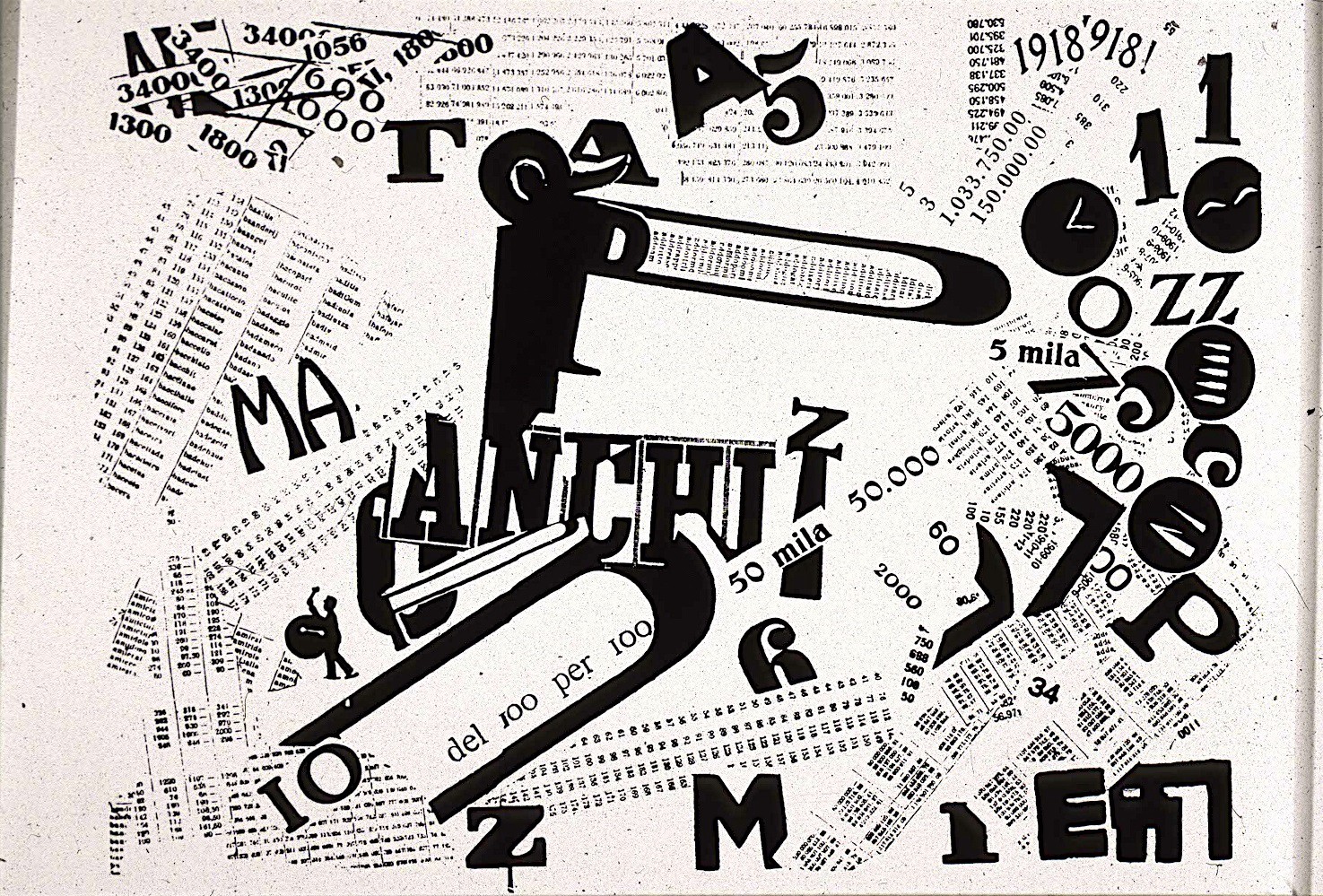
And Eco’s book is not just about “beauty” either—I’ve said the “real” title should be History of Aesthetic Culture in the West: he discusses movements in the fine arts as well as those in literature, philosophy, architecture, decorative arts, fashion, etc. and how they bear on one another. He discusses the views of Filippo Tommaso Emilio Marinetti, one of the main figures in Futurism:³

At the beginning of the twentieth century, the time was ripe for the futurist exaltation of speed and, after having called for the murder of moonlight because it was useless poetic garbage, Marinetti went so far as to state that a racing car was more beautiful than the Nike of Samothrace.

And while it might seem unrelated, this violent and iconoclastic art movement is very relevant to XTC in the late ’70s, when a similar one was occurring in music. Partridge himself coined the now-ubiquitous term “Punk Wars” to describe the anti-aesthetic that branded intelligent lyrics “insincere” and musical proficiency “self-indulgent”, and he’s thinking here about which side he’s on.

The song’s lyrics include:⁴

Hail mother motor
Hail piston rotor
Hail wheel

And later:

Your iron, oil, and steel
Your sacred three

Lines replacing old-timey religion with the worship of the automobile, which fit well with Futurism’s tenets, and might’ve easily found a place among the Warboys of Mad Max: Fury Road. But in the end, Partridge doesn’t endorse Marinetti: he’s satirizing both Futurism and the idea having cars everywhere is a good idea, and just the fact his message has that much nuance is also anti-punk.

Turning back to Marinetti, it’s important to note that the avant-garde, regardless of time, place, or medium, deals in provocation. They deliberately go against the grain of whatever the dominant forces in their medium are in order to trigger a response. Eco describes it thus:⁵

[T]he avant-garde has provocatively flouted all aesthetic canons respected until now. Art is no longer interested in providing an image of natural Beauty, nor does it aim to procure the pleasure ensuing from the contemplation of harmonious forms. On the contrary, its aim is to teach us to interpret the world through different eyes, to enjoy a return to archaic or esoteric models, the universe of dreams or the fantasies of the mentally ill, the visions provoked by drugs, the rediscovery of material, the startling re-presentation of everyday objects in improbable contexts, and subconscious drives.

And despite some of the crazy ideas of the Futurists, the concept of the beauty of the machine, not a part of the aesthetic of Marinetti’s time, has today become firmly embedded in our culture. This means the notion is effectively an expansion of the definition of art, which, in the end, is a good thing.

The specific worship of the internal combustion engine, and in particular automobiles maybe less so, and part of what Partridge is satirizing, but it was the future then—if he were alive today, Marinetti would doubtless be wondering where our personal spacecraft are:⁶

We must steal from the stars the secret of their amazing, incomprehensible speed. So let’s take part in the great celestial battles; let’s tackle the star-shells fired by invisible cannons; let’s compete against the star known as 1830 Groombridge, which flies at 241 kilometers per second, and against Arcturus, which flies at 430 kilometers per second.

People among the literati, academicians, philosophers, who don’t have their heads up their own asses have known for some time so-called low culture matters. Works like Eco’s Faith in Fakes: Travels in Hyperreality (Il costume di casa), and Barthes’ Mythologies (another convergence from my reading list) are not “slumming it” by looking into matters like pro wrestling or (non-Nietzschean) Superman. Rather than being dismissive of pop culture because of its very popularity, they seek instead to analyze its widespread appeal. In this interplay of cultural forms, from Roy Lichtenstein’s appropriations of pulp pages of comics onto canvases hanging in museums to Takashi Murakami’s “Superflat” concept, it’s important to recognize there is just one ecosystem.

Then we come to games. Games remain largely narrow and self-referential, and some even say, anti-intellectual. One idea is games are entertainment and not art, but those who hold this view are just as ridiculous as those who look down on games as puerilia.

Even in Hollywood, arguably even more dumbed-down than games, there at least used to be some recognition of this, with one example coming from the documentary Hitchcock/Truffaut, which discusses at length the false duality of artist and entertainer.

It makes sense to me operating only at the poles of what is really a continuum is extremely limiting and, ultimately, boring, both for creators and audiences. Many of my favorite things contain elements of both. Even watching this movie about how Truffaut’s book, also titled Hitchcock/Truffaut, cemented Hitch’s status as an artist, many of the clips from his films made me laugh out loud, and yet these entertainments gave me still greater respect for his artistry.


Notes

  1. Andy Partridge and Todd Bernhardt, Complicated Game: Inside the Songs of XTC, 2016.
  2. Ibid.
  3. Umberto Eco,
  4. Storia della bellezza (History of Beauty), 2004.
  5. Andy Partridge, “Roads Girdle the Globe”, Drums and Wires, XTC, 1979.
  6. Eco, 2004.
  7. Filippo Tommaso Emilio Marinetti, quoted in ibid.

How “Les Misérables” Sent Me to the Emergency Room

(Re)-creating Hugo’s Chope

A few years ago, I ran across Italo Calvino’s essay “Why Read the Classics?” The author has long been among my favorites, and I generally read anything of his I can find. One element of this piece was his idea of rereading books:¹

[T]o read a great book for the first time in one’s maturity is an extraordinary pleasure, different from (though one cannot say greater or lesser than) the pleasure of having read it in one’s youth. Youth brings to reading, as to any other experience, a particular flavor and a particular sense of importance, whereas in maturity one appreciates (or ought to appreciate) many more details and levels and meanings.

Jorge Luis Borges, another of my favorite writers, had similar ideas, which he summed up rather pithily thus:²

[R]ereading, not reading, is what counts.

When Borges wrote this, he meant in reading a well-known book, say The Count of Monte Cristo, even if it is the first time you have done so, you already know about it. The story is so famous, so much referenced by other books, directly or indirectly, in effect, you are actually rereading it. But he also meant it more literally—a great work bears rereading, and he is well known to have repeatedly read the works of Poe, Stevenson, and Kipling, among many others.

At about the same time I read Calvino’s essay, there was a thing going around on Facebook asking you to list “10 Life-Changing Books”. Mine were:

10. Ulysses, James Joyce
9. The Epic of Gilgamesh
8. Collected Fiction, Jorge Luis Borges
7. The Divine Comedy, Dante Alighieri
6. The 13 Clocks, James Thurber
5. Les Misérables, Victor Hugo
4. The Monkey King, Wu Cheng’en
3. The Masks of God, Joseph Campbell
2. Norse Gods and Giants, Ingri & Edgar Parin d’Aulaire
1. Foucault’s Pendulum, Umberto Eco

I’ve done pieces relating to nearly all of them without referring to the list, because it was so true. The cut, which was quite painful to do—so many great books—only just missed Calvino. I’d have chosen The Nonexistent Knight and The Cloven Viscount (Il cavaliere inesistente and Il visconte dimezzato, really two short novels published in a single volume) as my favorite work of his. All these I had reread, at least in part, and many of them several times, with the exception of Les Misérables, which suddenly stood out as something I should do. And so I did.

Certainly it isn’t a quick or an easy read. The book contains five volumes and a number of appendices, with my copy running to some 1,232 pages. It covers religion, politics, philosophy, history, and ethics, as well as the epic tale for which these elements form the backdrop.

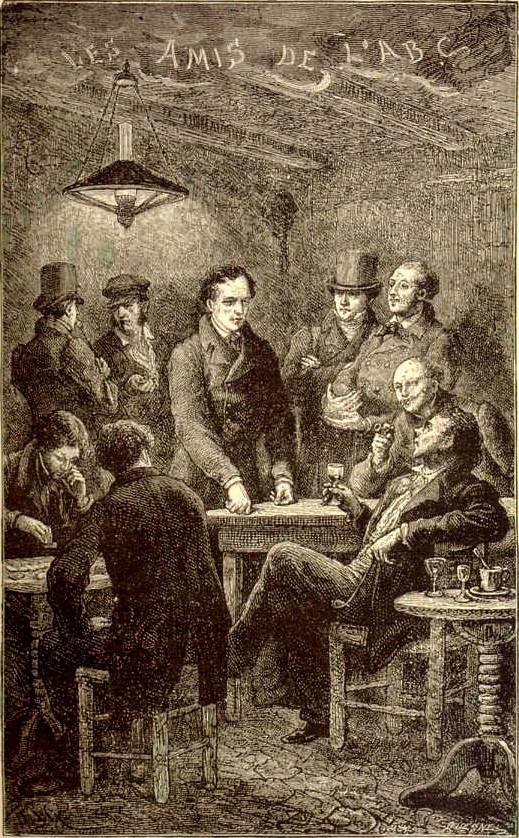
Nearing the revolution at the climax of the book, we meet a group of republican students who have dubbed themselves Les Amis de l’ABC (Friends of the ABC). The group’s leader is Enjolras, and drawn to him, a misanthrope named Grantaire is also a member. As they are waiting for the hour of the revolution to arrive, they are drinking. Most of them, in true French fashion, consume red wine, but not Grantaire:³

But by midday, Grantaire had gone beyond wine, that moderate source of dreaming. To the serious drinker wine is only an appetizer. In this matter of insobriety there is black as well as white magic, and wine is of the latter kind. Grantaire was an adventurous drinker. The black approach of real drunkenness, far from appalling, allured him. He had deserted the wine-bottle and gone on to the chope, the bottomless pit. Having neither opium nor hashish on hand, and wanting to befog his mind, he had recourse to that terrible mixture of eau-de-vie, stout and absinthe, which so utterly drugs the spirit. Those three ingredients are a dead weight on the soul, three darknesses in which the butterfly life of the mind is drowned; they create a vapor, tenuous yet with the membranous substance of a bat’s wing, in which three furies lurk—Nightmare, Night, and Death, hovering over the slumbering Psyche.

This drink is not given a proper name by Hugo; chope simply means “mug”. My comment when I read this passage was, “Wow, I have to try this.” For one thing, absinthe:

In high school, I did a massive paper on For Whom the Bell Tolls. The subject was forced on me, and I found the book intensely dull. Perhaps I should put something of Ernest Hemingway’s on my list of books to (re-)read, but I’m not sure my opinion would change. In any case, I’m not sure how, when, or where I ran across a passage from Papa’s The Garden of Eden, but it fetishizes absinthe rather well. I didn’t actually read the book, as I was still actively avoiding its author when it was posthumously published  (and I still am). I remember this passage and literally nothing else about it:⁴

[The waiter] came over now holding a glass and an ordinary Pernod bottle and a small narrow-lipped pitcher of water. There were lumps of ice in the water. “Pour Monsieur aussi?” he asked.

“Yes,” the young man said. “Please.”

The waiter poured their high glasses half full of the off-yellow liquid and started to pour the water slowly into the girl’s glass. But the young man said, “I’ll do it,” and the waiter took the bottle away. He seemed relieved to be taking it away and the young man poured the water in a very thin stream and the girl watched the absinthe cloud opalescently. It felt warm as her fingers held the glass and then as it lost the yellow cast and began to look milky it cooled sharply and the young man let the water fall in a drop at a time.

“Why does it have to go in so slowly?” the girl asked.

“It breaks up and goes to pieces if the water pours in too fast,” he explained. “Then it’s flat and worthless. There ought to be a glass on top with ice and just a little hole for the water to drip. But everybody would know what it was then.”

“I had to drink up fast before because two G.N.’s were in,” the girl said.

“G.N.’s?”

“Whatyoumacallits nationals. In khaki with bicycles and black leather pistol holsters. I had to engulp the evidence.”

“Engulp?”

“Sorry. Once I engulped it I can’t say it.”

“You want to be careful about absinthe.”

The elements that struck me were: 1. It’s illegal—if the Gendarmerie nationale catches you with it, you’re in trouble. 2. It involves a ritual of adding water and watching the color change. 3. It’s delicate, if you do it wrong you’ll ruin it. 4. It’s dangerous—you shouldn’t drink it too quickly. I should also note the booze referred to is the Pernod Fils practically synonymous with absinthe, not the Pernod anise liqueur created when absinthe was banned.

Sometime in the ’90s it started being manufactured in Europe again, and though the ban was lifted in the US much later, I discovered I could get it shipped here. It arrived in boxes labeled “printed material” that sloshed when you shook them. Since then I graduated past flaming sugar cubes to ice water, and to cocktails like Sazerac, Corpse Reviver №2, and my favorite, the Green Beast.

Stout, of course, is also excellent: on a trip to Kerry with my brother and his Princeton crew buddies, we’d learned to ask, “How’s the Guinness?” We’d sip the dark, cool, frothy stuff if the reply was positive and resort to the not entirely disagreeable and apparently less finicky alternative of Smithwick’s if not.

Eau de vie, I’ll admit, I had to look up. I had a vague idea of what it was, but found it’s essentially a highly distilled brandy, generally made from fruit other than grapes. Its role in the recipe is not to impart any kind of flavor but simply to booze it up, so a decent vodka would have the same effect. In fact, the definitions of vodka and eau de vie overlap, such that essentially anything fermented and distilled to 80 proof is vodka, hence Cîroc (made from grapes) is an example of an eau de vie vodka.

I looked around for a recipe and came up empty: all the searches simply pointed back to the Hugo passage. I checked it in French, revealing nothing new. So I looked at beertails for something similar.

Most beertails are… lame. Apart from the classic Snakebite, most of them involve watering down beer, which was the opposite of what I was trying to do. Snakebite is simply equal parts hard cider and beer. Shandy is a more typical beertail: beer and a citrus soda. Then I found Hangman’s Blood.

Like Grantaire’s drink, Hangman’s Blood was a literary one, described by Richard Hughes in his novel, A High Wind in Jamaica.⁵

[Captain Jonsen] went on board, and mixed several gallons of the potion known in alcoholic circles as Hangman’s Blood (which is compounded of rum, gin, brandy, and porter). Innocent (merely beery) as it looks, refreshing as it tastes, it has the property of increasing rather than allaying thirst, and so once it has made a breach, soon demolishes the whole fort.

It sounds awful—like something we’d have made in high school by skimming from 10 different bottles of booze with the idea that our parents wouldn’t know. I tried Hangman’s Blood—for science—it’s surprisingly not terrible. And here, the evil captain is using it to make people drunk so he can take advantage of them at an auction—Hughes even goes so far as to use the word “poison” to refer to it.

And yet Anthony Burgess seems to have sworn by the drink. In the ’60s, William S. Burroughs seems to have been Burgess’ frequent drinking buddy—quite possibly members of the “alcoholic circles” Hughes mentions. He recorded the recipe as:⁶

Into a pint glass, doubles of the following are poured: gin, whisky, rum, port and brandy. A small bottle of stout is added and the whole topped up with champagne… It tastes very smooth, induces a somewhat metaphysical elation, and rarely leaves a hangover.

Boiling it all down, here’s the recipe:

Ingredients

  • 1 2/3 ounces gin
  • 1 2/3 ounces whiskey
  • 1 2/3 ounces rum
  • 1 2/3 ounces port
  • 1 2/3 ounces brandy
  • 6 ½ ounces Guinness Extra Stout
  • 4 ounces Champagne

Directions

  • Pour all the liquors into an Imperial pint glass.
  • Add the stout.
  • Add the champagne.

Based on this information, I took a stab at the formulation, fiddled with the results a bit and so created, or recreated, the abyssal drink of Les Misérables. I began drinking them and inflicted them on all my friends. Since it didn’t have a real name, I dubbed it La Chope Hugo.

The recipe runs thus:

Ingredients

  • 12 ounces stout
  • 2 ounces eau de vie
  • 1 ounce absinthe

Directions

  • Pour cold stout into a chilled glass
  • Pour eau de vie and absinthe into a cocktail shaker with ice. Shake until chilled. Strain into glass over stout.

While I have provided these recipes here, please understand this is not to say I recommend you make, or worse yet, imbibe them. Please recall for a moment the title of this piece, and also the words of Hemingway—a man who literally drank himself to death. OK, technically Hemingway used a shotgun to off himself because of his ill health, but his damaged liver and unwillingness/ inability to stop drinking was a major factor. And technically, these are the words of a character in his book, but it appears to be more or less autobiographical:

You want to be careful about absinthe.

Goddamn right and the Chope absolutely will drown the butterfly life of your mind.


Notes

  1. Italo Calvino, “Why Read the Classics?”, The New York Review of Books, 1986.
  2. Jorge Luis Borges, “Utopia of a Tired Man” (“Utopia de un hombre que esta cansado”), English version published in The New Yorker, 1975.
  3. Victor Hugo, Les Misérables, 1862, this is from the Norman Denny translation, 1976.
  4. Ernest Hemingway, The Garden of Eden, 1986.
  5. Richard Hughes, A High Wind in Jamaica, 1929.
  6. Anthony Burgess, “Yin and Bitters”, Manchester Guardian Weekly, November 1966.

Alice’s Adventures in the Cousins War

History in the “Looking Glass” (DeDisneyfication, Part 7B)

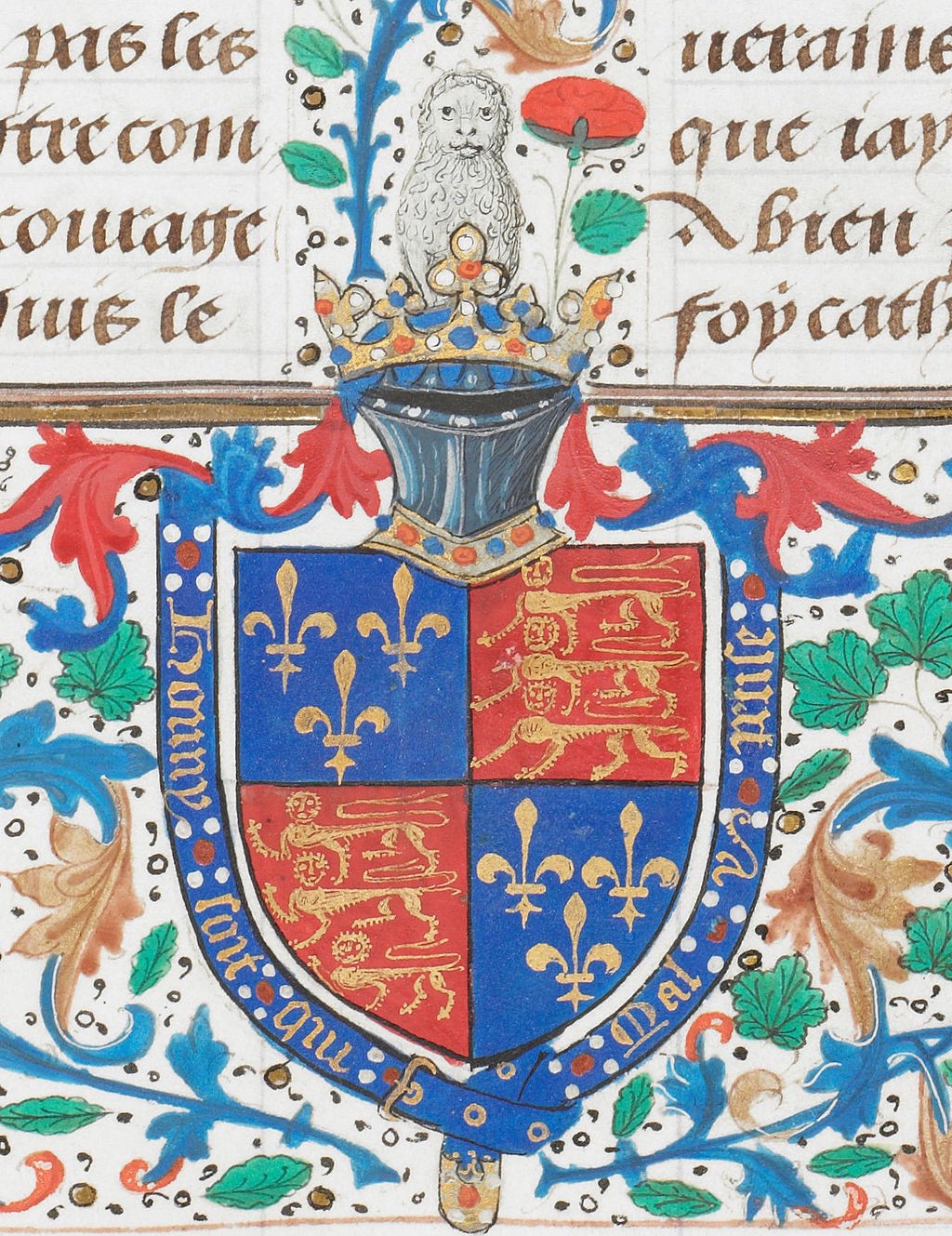
Among its Victorian allusions, wordplay, mathematical tidbits, and card-game and chess references, the consistent symbolism throughout Lewis Carrol’s Alice’s Adventures in Wonderland (AiW) and Through the Looking-Glass, and What Alice Found There (TLG) is of the Wars of the Roses. Immediately the presence of White and Red parties calls to mind the Yorks and Lancasters, but the scene of the royal gardeners repainting white roses red removes all doubt:¹

‘[…] this here ought to have been a red rose-tree, and we put a white one in by mistake; and if the Queen was to find it out, we should all have our heads cut off, you know.’

This gets at my main quarrel with Disney’s version of Alice, and indeed, their version of almost anything: there’s simply too much to fit into a neat 75-minute package. The language, imagery, and nearly everything brilliant in the original novels gets cut down so much it becomes a Best of Alice clip show.

This is exacerbated by the fact Disney condenses both Alice books into a single film—something Carroll himself prohibited when his works were first staged. I’ll just follow the single thread I’ve already pointed out—how Carroll’s works relate to the Wars of the Roses—to illustrate how much Disney is leaving out.

A major source of Carroll’s knowledge of the Wars of the Roses seems to have been William Shakespeare, one specific example being 3 Henry VI, in which Margaret of Anjou, who is the Red Queen, AKA the Queen of Hearts, calls for the execution of the Duke of York, saying:²

Off with the crown, and, with the crown, his head […]

And again,³

Off with his head, and set it on York gates […]

Shakespeare is not one to repeat himself, so if he has Margaret saying this twice, it seems to us she must say it all the time, which Carroll naturally has her do. Once this is clear, the other pieces also fall easily into place. The main beheading the Queen is calling for is the Knave’s, so he therefore corresponds to the Duke of York.

The Red King then must be Henry VI, who was known as a bad ruler because of his mental instability and unresponsiveness to the chaos of the wars. When the Queen demands Alice’s head:⁴

The King laid his hand upon her arm, and timidly said ‘Consider, my dear: she is only a child!’

And after the croquet game, wherein the Queen orders still more executions,⁵

As they walked off together, Alice heard the King say in a low voice, to the company generally, ‘You are all pardoned.’

While this seems reasonable to us (and to Alice), it reflects his timid and ineffectual rule, because of which the affairs of his reign were essentially run by Margaret. And, as Tweedles Dee and Dum note, everything—everyone exists because the Red King is asleep and dreaming it:⁶

‘Why, you’re only a sort of thing in his dream!’

‘If that there King was to wake,’ added Tweedledum, ‘you’d go out—bang!—just like a candle!’

‘I shouldn’t!’ Alice exclaimed indignantly. ‘Besides, if I’m only a sort of thing in his dream, what are you, I should like to know?’

‘Ditto’ said Tweedledum.

‘Ditto, ditto’ cried Tweedledee.

All this is to reiterate the wars are occurring because of Henry VI’s failure to attend to the kingship of his nation—he’s sleeping through it.

The Duchess also appears in both Shakespeare and Carroll as well: In 2 Henry VI, Margaret gives Eleanor, Duchess of Gloucester “a box on the ear”, to which she responds, referring to herself in the third person,⁷

[…] She shall not strike Dame Eleanor unrevenged.

So what occurs in Alice seems to be the promised comeuppance, though it does not go unpunished either:⁸

[…] said Alice: ‘—where’s the Duchess?’

‘Hush! Hush!’ said the Rabbit in a low, hurried tone. […] ‘She’s under sentence of execution.’

‘What for?’ said Alice. […]

‘She boxed the Queen’s ears—’ the Rabbit began.

As the Duchess is depicted taking care of a baby (badly), one would assume it to be her own child, but it is not. Instead, it is Richard III, with the link being it is on him the dukedom of Eleanor’s husband is settled after his demise. Hence her mistreatment of him, as they are from opposing sides in the wars. And furthermore, the baby turns into a pig:⁹

The baby grunted again, and Alice looked very anxiously into its face to see what was the matter with it. There could be no doubt that it had a very turn-up nose, much more like a snout than a real nose; also its eyes were getting extremely small for a baby […]. ‘If you’re going to turn into a pig, my dear,’ said Alice, seriously, ‘I’ll have nothing more to do with you. Mind now!’ […] it grunted again, so violently, that she looked down into its face in some alarm. This time there could be no mistake about it: it was neither more nor less than a pig […].

And Richard is well known to have adopted the white boar as his personal device, as well as becoming somewhat inhuman and greedy for power. A similar heraldic reference occurs when the White Queen (Elizabeth Woodville) comes to resemble a sheep—it matches with a version of her husband, Edward IV’s arms.

In TLG, the White and Red Knights fight over Alice, as to whether she is the Red Knight’s prisoner or the White Knight has rescued her:¹⁰

‘I wonder, now, what the Rules of Battle are,’ [Alice] said to herself, as she watched the fight, timidly peeping out from her hiding-place: ‘one Rule seems to be, that if one Knight hits the other, he knocks him off his horse, and if he misses, he tumbles off himself […].’

This is a clear allusion to the many reversals of the Wars of the Roses. It is a comical, chessboard reflection of the Game of Thrones episode name-cum-tagline, “You Win or You Die”. The show, it has already been pointed out, is the Wars of the Roses with a thin veneer of fantasy fiction, with Starks for Yorks, and Lannisters for Lancasters, etc.

Humpty Dumpty, in the rhyme the character is based on as well as his conversation with Alice, seems to clearly represent Richard Neville, 16th Earl of Warwick. Such things are not uncommon, as another such rhyme, “The Grand Old Duke of York”, attests:

Oh, The grand old Duke of York,
He had ten thousand men;
He marched them up to the top of the hill,
And he marched them down again.

It has as one of its candidates another figure from this same war, the Duke of York, who I’ve already mentioned, and who was defeated at the Battle of Wakefield. There are other candidates, to be sure, and as these verses come initially from an oral tradition, tracking down the original intent can be decidedly tricky. There are various theories on the meaning of the rhyme “Humpty Dumpty”, including the idea it was originally meant to be a riddle, as the word egg is nowhere contained in it, and might have been its answer before it became so well known.

Whether or not it is historically true, the words of “Humpty Dumpty” seem to correspond to both the words of Shakespeare regarding the Earl, as well as the egg-man’s role in TLG. As to Humpty’s position prior to the battle, in 3 Henry VI, a parlay is sounded by Edward’s besieging forces at Coventry and the Earl appears:¹¹

Gloucester: See how the surly Warwick mans the wall!

And not just literally, but also historically, he was a “fence sitter”: as “the Kingmaker” he switched sides between the Yorkists and Lancastrians, and indeed deposed and enthroned rulers in order to increase his own power. History now takes a more ambivalent stance on Warwick; I’m describing the view both Shakespeare and Carroll share here. Ditto for Richard III. Carroll’s description of him seems to match his role:¹²

Humpty Dumpty was sitting with his legs crossed, like a Turk, on the top of a high wall—such a narrow one that Alice quite wondered how he could keep his balance […].

His being an egg can also be seen as reflecting the delicacy of his situation. The discussion between Humpty and Alice is a battle of words, covering semantics and pragmatics in its course, and also continuing to echo the parley (and the ensuing fight) between Warwick and Edward.

When Edward informs Warrick the king he is backing, Henry VI, has been imprisoned, Gloucester chimes in with a playing-card themed taunt was sure to have found favor with Carroll:¹³

Gloucester: Alas, that Warwick had no more forecast,
But, whiles he thought to steal the single ten,
The king was slily finger’d from the deck!
You left poor Henry at the Bishop’s palace,
And, ten to one, you’ll meet him in the Tower.

Humpty asks Alice what her name means, and she wonders whether a name must mean something, whereupon he replies:¹⁴

‘Of course it must,’ Humpty Dumpty said with a short laugh: ‘my name means the shape I am—and a good handsome shape it is, too.

The Kingmaker’s name’s resemblance to his nature is a well-known and oft-used pun, one I first heard in a Beyond the Fringe Shakespearean sendup:¹⁵

Peter: […] Thus fly we now, as oft with Phoebus did
Fair Asterope, unto proud Flanders Court.
Where is the warlike Warwick
Like to the mole that sat on Hector’s brow
Fair set for England, and for war!

The earliest use I could find was in Edmund Spenser’s works, but it’s not easy to research…. Shakespeare certainly used it in 1 Henry VI.

Next, Alice asks why Humpty Dumpty is alone, which is his situation in the play as well—he is in Coventry awaiting the arrival of Oxford, Somerset, Montague and Clarence, who never come. Then she asks him if he wouldn’t be safer on the ground than on the wall—again a reflection of the Shakespearean parlay:¹⁶

King Edward IV: Now, Warwick, wilt thou ope the city gates,
Speak gentle words and humbly bend thy knee,
Call Edward king and at his hands beg mercy?
And he shall pardon thee these outrages.

Back in Alice, Humpty counters:¹⁷

Why, if ever I did fall off—which there’s no chance of—but If I did—’ Here he pursed his lips and looked so solemn and grand that Alice could hardly help laughing. ‘If I did fall,’ he went on, ‘the King has promised me—with his very own mouth—to—to—’

Alice completes the line for him:

‘To send all his horses and all his men,’ […].

Which, as we’ve already seen, is a vain hope. Humpty is disturbed she knows about the king’s promise, and accuses her of spying, to which she replies it is in a book, to which he responds:

‘Ah, well! They may write such things in a book,’ Humpty Dumpty said in a calmer tone. ‘That’s what you call a History of England, that is.

And of course the play is one of Shakespeare’s English Histories. Next, the subject of Alice’s age is raised, which she says is seven years and six months, to which Humpty replies rather threateningly,

‘ […] With proper assistance, you might have left off at seven.’

Although the correspondence is inexact (adding 10), I believe this to be a reference to John Clifford, 9th Baron de Clifford’s slaying of the 17-year-old Edmund, Earl of Rutland, son of the Duke of York, at the Battle of Wakefield.

The subject turns to Humpty’s cravat, which Alice mistakes for a belt, and after the awkwardness arising is past, we find out:

‘[…] It’s a present from the White King and Queen. There now!’

We can easily fit the pieces and see this represents the chain of office of chancellor conferred, along with a heap of other titles, following Edward IV’s ascension to the throne, by him and Elizabeth Woodville.

And this in turn means Iris, the White Pawn-Princess Alice is standing in for as “too young to play”, is Edward V, with the gender swap seemingly based on a pun on his and his brother’s imprisonment as the Princes in the Tower. We see her first high on a table—imprisoned in the Tower—out of reach of her parents, and knocked over—deposed….¹⁸

All the correspondences provided here might seem like overinterpretations, and there are such, including those positing Charles Lutwidge Dodgson, Carroll’s real self, a strait-laced professor of mathematics and clergyman in the sleepy town of Oxford, was hopped up on opium, but I know I’m not alone in finding at least some of them, and I feel instead I’m just scratching the surface. With the proper resources, a book could well be written.


Read subsequent articles in the DeDisneyfication series

Part 8: Guerrillas and the “Jungle”

Part 9A: Through a Magic Mirror Marred

Part 9A Addendum: The Woods “Over the Wall”

Part 9B: The Sum of its Versions

Part 9C: The “Snow White” Studio

Part 9D: Snowhaus

Part 10: The Little Less-Than

Part 11: Batmouse 3D

Part 12: Mork & Scheherazade


Read previous articles in the DeDisneyfication series

Part 1: Straightening out “Hunchback”

Part 2: Making over “Mulan”

Part 2 Addendum B: Your Western Wuxia Is Weak

Part 3A: “Hercules”: Myths and Mistakes

Part 3B: Doing Hera’s Work

Part 4: “Belle” Epoch

Part 4 Addendum: The Enchanted and the Postmodern

Part 5: Putting “Pocahontas” to Rest

Part 5 Addendum: Powhatan’s Mantle

Part 6: Trouble with “Tarzan”

Part 7A: The Wrong Rabbit Hole

Part 7A Addendum A: Curious Curation

Part 7A Addendum B: “Alice” in Revolt

Part 7A Addendum C: How “Alice” Grew Big in Japan


Notes

  1. Lewis Carroll, Alice’s Adventures in Wonderland, 1865.
  2. William Shakespeare, 3 Henry VI, 1.4.108, 1591.
  3. Ibid, line 185.
  4. Carroll, 1865.
  5. Ibid.
  6. Ibid.
  7. William Shakespeare, 2 Henry VI, 1.3.151, 1591.
  8. Carroll, 1865.
  9. Ibid.
  10. Lewis Carroll, Through the Looking-Glass, and What Alice Found There, 1871.
  11. 3 Henry VI, 5.1.18.
  12. Carroll, 1871.
  13. 3 Henry VI, 42-46.
  14. Carroll, 1871.
  15. Alan Bennett, Dudley Moore, Peter Cook, and Jonathan Miller, “So That’s the Way You Like It”, Beyond the Fringe, 1960, emphasis mine.
  16. 3 Henry VI, 5.1.21-24.
  17. Carroll, 1871.
  18. Ibid.

The Wrong Rabbit Hole

“Alice” astray (DeDisneyfication, Part 7A)

In 1951, Disney Animation Studios released Alice in Wonderland to lukewarm response. The offering was overshadowed by the earlier Cinderella (1950), which had been boffo at the BO and racked up a trio of Oscar noms to boot,¹ making Alice quite the shabby younger stepsister.

Though far from a disaster, it has to have felt like one to the Disney shop after betting big and winning on Cinderella—if the film had failed, the studio, already heavily in debt, would likely have been shuttered. Walt seems to have been something of a gambler, as this is a common refrain throughout his career.Even though earlier films like Pinocchio, Fantasia, and Bambi had bombed initially, they would soon come to be recognized as classics, with multiple theatrical rereleases. But not Alice.

Alice was just not very good. Walt put the failure down to the titular character, saying she had no “warmth”.² I can’t say I disagree with Disney’s assessment—in order to avoid narration, his Alice (Kathryn Beaumont) talks a lot more than she does in Lewis Carroll’s books, dialogue which lacks purposefulness as well, and makes us question her motives. The studio’s reductivism also makes an appearance—Alice follows the White Rabbit (Bill Thompson), hoping he’s going to a party, rather than due to simple human curiosity and impulsiveness in the original.

In fact, there’s very little preamble to the book’s adventures: Alice is almost immediately thrown into a strange world. This effectively makes her an easily relatable cipher—we’re right there with her, just as lost and confused. Or in my case, slightly more so, with a linguistic disadvantage in understanding what I’d later come to recognize as the idiom of roughly a century previous and halfway around the planet.

As to the Disney film, Walt’s comment could simply be expanded to the whole of it: nearly none of the characters are interesting, endearing, or appealing. Events from both Carroll books are thrown together into a nonsensical jumble, the songs are mainly mediocre boildowns of the original fantastic poetry—like many, I can recite much of Carroll’s poetry by heart—and its quirky charms replaced with over-the-top wackiness.

One of the animators, Ward Kimball, characterized what he saw as the central problem with the production thus:³

[I]t suffered from too many cooks—directors. Here was a case of five directors each trying to top the other guy and make his sequence the biggest and craziest in the show. This had a self-canceling effect on the final product.

And this makes complete sense to what one experiences when watching it—it’s flat, with no structure, no buildup, no lulls; just a series of pointlessly bizarre incidents.

Turning to Rotten Tomatoes, its Critic’s Consensus unexpectedly nails it:⁴

A good introduction to Lewis Carroll’s classic […]

Yep. If you already have read it, this film will add nothing to your life, but if you haven’t, we can only hope you are inspired to.

My precocious hipsterism having been discussed previously, of course, I knew the books well in advance of seeing the Disney version, so I immediately disliked it.

While I had a similar experience watching Willy Wonka & the Chocolate Factory, that film had a glimmer I couldn’t ignore—mainly coming from Gene Wilder’s charismatic performance. And while the songs were changed, they too were generally improvements, particularly Veruca Salt’s (Julie Dawn Cole) show-stealing number.

 One critic summed up my feelings about Disney’s Alice nicely:⁵

In Mr. Disney’s Alice there is a blind incapacity to understand that a literary masterwork cannot be improved by the introduction of shiny little tunes, and touches more suited to a flea circus than to a major imaginative effort. […] a dreadful mockery of the classic.

Alice did grow on some people, though—specifically freaks and heads. The film experienced a renaissance among those who decided it was an awesome film to watch while stoned. Jefferson Airplane’s “White Rabbit” was a paean to the heaviness of this trip for the tie-dyed, face-painted counterculture of the ’60s.⁶

I know my dislike of Disney’s Alice might seem part of the media integrity ethos I’ve already put forth, but I’d like to demonstrate I’m not an ideologue but an admirer of good art: Certainly there’s a lot to overcome here—Carroll is a skillful writer and storyteller, and, in Shakespearean fashion, an enricher of the English lexicon, either creating or changing the meanings of such terms as:

  • chortle
  • Bandersnatch
  • borogove
  • frabjous
  • frumious
  • galumph
  • Jabberwock
  • jabberwocky
  • looking glass
  • mimsy
  • portmanteau
  • rabbit hole
  • slithy
  • Snark
  • snicker-snack
  • tulgey
  • Tweedle-dee & Tweedle-dum
  • unbirthday
  • vorpal
  • wonderland

All these can now be found in English dictionaries. But the original books have another kicker: Sir John Tenniel’s amazingly rich and detailed illustrations.

There are literally scores of works based on these books—Alice fitting again with Disney’s risk-averse pattern—with the first films appearing already in 1903 and while I haven’t exactly sought them out, there are a few worthy of praise.

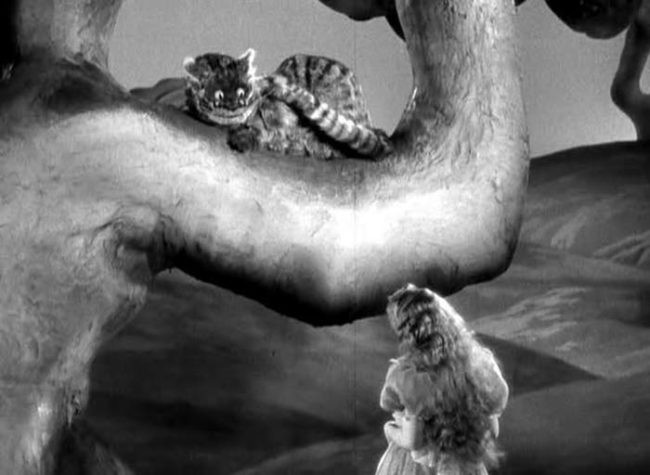
An excellent film adaptation incorporating both Alice books much more successfully than Disney’s version was the black-and-white Alice in Wonderland of 1933. In fact, Walt Disney’s plan for his own version of the works predated this film, stretching back to some shorts using mixed live action and animation a decade earlier.

This mixed format was what he planned for his own feature film, for which he licensed the Tenniel illustrations, and identified box-office draw Mary Pickford as the lead in 1932. But when he heard Paramount had their own version in the works, he shelved it in favor of Snow White.

The 1933 Alice features many stars of the day, including W. C. Fields, Edna May Oliver, Cary Grant, Gary Cooper, and others, all in makeup and costumery so heavy the credits feature images of them beside their characters so the audiences can sort out who is who.

The practical effects in general are incredible—and not just for their day, when much of the language of the field was being created. One scene in which Alice (Charlotte Henry) flies down a flight of stairs, around a corner, then through the door and down the house’s front walk is particularly impressive. Another one that has stuck with me for the many years since I first saw it was the glowing, disembodied face of the Cheshire Cat (Richard Arlen).

The art direction leans heavily on Tenniel, but because it’s beyond their grasp, and the film is pre-Code, some scenes are grotesque and even disturbing. Perhaps for this reason, the film was a massive flop at the box office, so much so the entire genre of live-action children’s fantasy was avoided until 1939’s Wizard of Oz proved it could be successful.

A more recent version was the also largely overlooked Alice Through the Looking Glass TV movie from BBC 4. Again it had a stellar cast featuring Ian Holm, Penelope Wilton, Ian Richardson, Siân Phillips, and Steve Coogan, as well as Kate Beckinsale in the lead role. The film, in somewhat retro fashion, focuses on practical effects over modern VFX as well.⁷

Furthermore, the dialogue in the looking-glass world is nearly verbatim, well-delivered by its cast, and even a scene omitted from the original publication, “A Wasp in a Wig”, is restored. It also closes with “Alice’s Poem”, a haunting verse spelling out the full name of Carroll’s muse as an acrostic through the initial letters of each line.⁸ ⁹

Best by far is Holmes’ performance as the White Knight, as well as the titular “Aged Aged Man” in the poem the knight recites, which has always been a favorite of mine: full of genuine melancholy and also genuine absurdity. It is presented as a black-and-white film with scratches on the frames and scratchy sound as well, and irises to black when it’s over—a tribute to the early filmic versions of Alice.

To me, it’s slightly marred by Beckinsale, portrayed as being the mother of a child of around Alice’s age, but then stepping into the role herself, donning a pinafore and proclaiming herself to be seven-and-a-half years old. Still, Henry was 19 in 1933’s Alice, so Beckinsale’s not much older here at 25, and it’s typical of Hollywood to have an actress play someone younger.

My favorite, however, is Walt Kelly’s “A Report from Lewis Carroll’s Alice’s Adventures in Wonderland: Who Stole the Tarts?”.¹⁰

Apart from incorporating the characters from his Pogo comic strip, the work is straightforward with Carroll’s full text appearing as captions to Kelly’s brilliant illustrations. Kelly counts Tenniel as one of his main artistic influences and shows an excellent grasp of the material.

There is also some recontextualization involved in the presentation: Pogo often commented on politics and culture, leading to it being criticized and even censored in more conservative publications. Kelly considered himself a newspaperman and refused to compromise his principles. This piece was published in 1954 during the Army-McCarthy hearings as a commentary on those Kafkaesque proceedings.

As Jorge Luis Borges notes of Kafka, his oeuvre seems unprecedented until you look around.¹¹ Carroll’s tart trial is just a more satirical version of Kafka’s The Trial (Der Process). Simple J. Malarkey was added to the regular strip as Wiley Katt’s even creepier cousin, and a clear reference to Senator Joseph McCarthy. He appears here as the King of Hearts, who leads the trial’s proceedings.

Funnily, Kelly had worked for the other Walt: from 1935 to 1941, he was an animator with credits on Pinocchio, Dumbo, and Fantasia. Disney’s recommendation is essentially what allowed Kelly to start his own strip. One can only wonder how Alice might have turned out if he had taken part.

One I can get behind even less than the 1951 version is the Tim Burton-Disney live-action remake of 2010. Where most have sought to represent Carroll’s vision as well as they could, Burton’s is a reimagining, where characters with familiar names and traits are thrown into a setting seeming to borrow more heavily on The Chronicles of Narnia. The “literary masterwork cannot be improved” quote is relevant again here.

Burton might well have a better imagination than many in Hollywood, but when it comes to Lewis Carroll, in the words of the Red Queen:¹²

‘[I]t takes all the running you can do, to keep in the same place.’


Read subsequent articles in the DeDisneyfication series

Part 7A Addendum A: Curious Curation

Part 7A Addendum B: “Alice” in Revolt

Part 7A Addendum C: How “Alice” Grew Big in Japan

Part 7B: Alice’s Adventures in the Cousins War

Part 8: Guerrillas and the “Jungle”

Part 9A: Through a Magic Mirror Marred

Part 9A Addendum: The Woods “Over the Wall”

Part 9B: The Sum of its Versions

Part 9C: The “Snow White” Studio

Part 9D: Snowhaus

Part 10: The Little Less-Than

Part 11: Batmouse 3D

Part 12: Mork & Scheherazade

Read previous articles in the DeDisneyfication series

Part 1: Straightening out “Hunchback”

Part 2: Making over “Mulan”

Part 2 Addendum B: Your Western Wuxia Is Weak

Part 3A: “Hercules”: Myths and Mistakes

Part 3B: Doing Hera’s Work

Part 4: “Belle” Epoch

Part 4 Addendum: The Enchanted and the Postmodern

Part 5: Putting “Pocahontas” to Rest

Part 5 Addendum: Powhatan’s Mantle

Part 6: Trouble with “Tarzan”


Notes

  1. Best Scoring of a Musical Picture, Best Sound Recording, and Best Original Song (“Bibbidi-Bobbidi-Boo”), 24th Academy Awards, 1951.
  2. John Reid, Films Famous, Fanciful, Frolicsome & Fantastic, 2006.
  3. Leonard Maltin, The Disney films, 1973.
  4. “Alice in Wonderland”, Rotten Tomatoes , retrieved March 2017.
  5. New Yorker, quoted in Maltin, 1973.
  6. Grace Slick, “White Rabbit”, Jefferson Airplane, Surrealistic Pillow, 1966.
  7. Alice Through the Looking Glass, 1998.
  8. Lewis Carroll, “The Wasp In A Wig”, 1977.
  9. Carroll, “Alice’s poem”, Through the Looking-Glass, and What Alice Found There, 1871.
  10. Walt Kelly, “A Report from Lewis Carroll’s Alice’s Adventures in Wonderland: Who Stole the Tarts?”, The Pogo Stepmother Goose, 1954.
  11. Jorge Luis Borges, “Kafka y sus precursores” (“Kafka and His Precursors”), collected in Otras inquisiciones, 1952, and in English in Labyrinths: Selected Stories & Other Writings, James E. Irby, Donald A. Yates, John M. Fein, Harriet de Onís, Julian Palley, Dudley Fitts, L.A. Murillo, trans., 1962.
  12. Carroll, 1871.

A Child’s Garden of Tessellae

The far-reaching symbolism of the tetractys (Tetractys, Part 2)

In addition to a more-than-passing familiarity with Pythagoras (Πῡθαγόρᾱς) and mysticism in the ancient Mediterranean world, I am also well versed in hexagons. You might be asking why I say hexagons when the tetractys is triangular. Well, the lattice for the equilateral triangle and the hexagon are the same—as a regular hexagon is made up of six equilateral triangles and the lattice points for both define a hexagonal nucleus; put another way, a hexagon is a truncated triangle—and the Pythagorean symbol is just a discrete set of points within this lattice:

I know the pattern well. It was one you’d get by staring at the tessellae of a midcentury bathroom floor—a favorite activity of mine. When you move out from the basic tile, you get a triangle, then a rose; a hex made of seven hexes (i.e. six corners and a center).

This rose was also the shape of Honeycomb cereal, which I would painstakingly nibble to make stars, triangles, individual cells. From the hex rose, if you add three corners, you’re back to a triangle, another three and a flower with more pronounced petals, or what I’d later come to know as a Star of David.

When I was seven, I unknowingly encountered the tetractys at a friend’s cub scout meeting, made of 10 pennies and presented together with the fiction it was a squadron of jets in formation needing to reverse course and resume the same formation while only changing the positions of three planes. To me, the pennies were simply inexact representations of the hexagons I loved to play with, so of course I knew what to do.

It appeared in other places too, bowling alleys, real honeycombs, cut paper snowflakes, Chinese Checkers, rock candy, chicken wire, the quartz crystals in my brother’s rock collection. Of these, the tenpins pattern and the colored corners of the Chinese Checkers board are true examples of the tetractys, as is the baryon decuplet (the Chinese Checkers field can be thought of as another set of six tetractys pointing inward and defining a hexagon). And when I got into strategy board games, there were those bathroom tiles again, now overlaying terrain maps. And then there were Japanese decorative motifs where the hexagon represents a scute from a tortoise’s carapace (亀甲, kikkō).

And now Eco tells me this is a sacred symbol of the Pythagoreans:¹

The Tetraktys is the symbolic figure by which Pythagoreans swore their oaths, and it represents a perfect and exemplary reduction of the numerical to the spatial and of the arithmetical to the geometrical. Each side of this triangle is formed by four points and at its center there stands a sole point, unity, from which all other numbers are generated.

Unity is one of Pythagoras’ influential principles of numbers, in this case, the number one. It also represents deity, which has no parts. That is, it is indivisible. It also echoes the “one” at the center of the Adonai Square, and, indeed, that figure is related to this one via the dissemination of Pythagorean ideas throughout the Mediterranean, so much so the tetractys emblazoned with the Tetragrammaton has become a kabbalist symbol as well. In addition, one is the origin of all things, as Eco mentions. Each of the three corners can also be thought of as representing this same unity, which allows us to overlay the upsilon (Υ, ὖ ψιλόν). This letter is known as the Pythagorean or Samian letter (Samian as Pythagoras hailed from the island of Samos, Σάμος), symbolizing the branching path leading to earthly or divine wisdom—the path begins (at whichever corner) and branches at the center point:

The influential principles continue, counting across the rows, where two is diversity, and therefore disorder, the principle of strife and all evil. This should not be mistaken for in any way being about race, or anything else like that, but reflected as in the Berber saying, “A devil takes one and makes two; a saint takes two and makes one.” The next row is three, which is perfect harmony, or the union of unity and diversity. Both principles reflect again the upsilon symbology. One can see the image below, LeonardoDaVinci’s representation of a “tetrahedron with empty planes” in perspective, closely resembles the upsilon tetractys. This set of numbers makes up the triangle itself and also symbolizes the Pythagorean idea of a threefold god: the beginning, middle, and end of all things. This older concept of a divine trinity can also be seen in the Hindu Trimūrti, wherein there is a triad of deities, Brahma the creator, Vishnu the preserver, and Shiva the destroyer, all ultimately aspects of a single avatar, Dattatreya. Furthermore, the soul has three vehicles: the ethereal, which is luminous and celestial, in which the soul resides in a state of bliss in the stars; the luminous, which suffers the punishment of sin after death; and between those two, the terrestrial, which is the vehicle it occupies on this earth.

The final line of the tetractys is four—Eco continues:²

Four thus becomes synonymous with strength, justice and solidity; the triangle formed by the series of four numbers is and remains a symbol of perfect equality.

As an influential principle, four represents perfection, also expressed as cosmos. One of the ideas most central to the symbol is the sum of these first four numbers is ten (1 + 2 + 3 + 4 = 10), the basis of all numbers. Four is also the first square (2 × 2 = 4).

These rows further represented geometrical ideas as points: the first row, being a single point, has zero dimensions. The second is a pair of points defining a line, the third is a plane—a two-dimensional figure requiring three points. The fourth line of four points creates the simplest solid: a tetrahedron, and the tetrahedron is the essential form of the caltrop in this site’s icon. These four lines further symbolize the four classical elements: fire, air, water, and earth, and therefore a whole series of associations: the four seasons, the four cardinal directions, the set of simple bodies (tetrahedron, octahedron, icosahedron, cube), the ages of man, etc. Also note the ancient symbols for the elements were a set of triangles and inverted triangles.

Further, the rows can be read musically as ratios: 1:1—the fundamental, 2:1—the octave, 3:2—the fifth, and 4:3—the fourth. These are the basic intervals of the Pythagorean scales and also form the basis of the concept of the music of the spheres. Also known as musica universalis, this is the idea the proportions and movements of celestial bodies create a kind of divine mathematical harmony—not, as is often mistakenly thought, literal, audible music.

Turning again to Eco:³

The sum of the points that form the triangle is the number ten, and with the first ten numbers all possible numbers can be expressed. If number is the essence of the universe, then the Tetraktys (or decade) represents a condensation of all universal wisdom, all numbers, and all possible numerical operations.

And this echoes the Aristotle (Ἀριστοτέλης) quote from Part 1, of which, we can be sure, Eco was aware.

The tetractys has found its way into art and architecture down through the ages, some even claim it to be the basis of the Masonic symbol depicted on the reverse of the Great Seal of the United States: an incomplete pyramid surmounted by the Eye of Providence. It also forms the basis of a layout for Tarot card readings, as well as a syllabic poetic form. The syllabic values for the lines are 1, 2, 3, 4, 10. Here’s an example penned by Ray Stebbing, the form’s creator:⁴

Your
fury
confuses
us all greatly.
Volatile, big-bodied tots are selfish.

I’ll leave you with one final fun fact: in the gematria, the value of the word τετρακτύς yields the value 1,234.


Read previous articles in the Tetractys series

Part 1: Eco, Pythagoras, and the Mystic


Notes

  1. Umberto Eco’s History of Beauty (Storia della bellezza), 2004.
  2. Ibid.
  3. Ibid.
  4. Ray Stebbing, “Mantrum”, date unknown.

Eco, Pythagoras, and the Mystic

Signore professore dottore schools me on Ancient Greek symbols (Tetractys, Part 1)

In reading Umberto Eco’s History of Beauty, I came across a symbol I hadn’t before.¹ First, a bit about the book itself: it is exactly similar in structure to The Book of Legendary Lands (Storia delle terre e dei luoghi leggendari), actually making up a trilogy with On Ugliness (Storia della bruttezza) being the final member. The book presents various concepts of beauty chronologically, with contemporary images and quotes illustrating each. I’d say it has a great deal more depth than the other books in the series, and often connects movements across art, architecture, philosophy, and religion.

When I attended the School of the Art Institute of Chicago, I was fortunate to have had an art history lecturer named Robert Loescher whose knowledge was immense and presentation style both humorous and thought provoking. Unfortunately, being a teenager, I was chronically sleep deprived, the lectures immediately followed lunch, and the newly renovated auditorium featured comfortable chairs and dim lighting better to show the slides. All of this meant I’d often suddenly jolt awake sometime in the middle of many lectures having missed an unknown number of pearls of wisdom and kicking myself. Worse, the sketchbook all my notes were in went missing some time ago, so I can only rely on my fallible mental software.

Even though art history is not the field Eco is best known for, he manages to surpass even this excellent lecturer. And it’s great to have the information in a book, so if I fall asleep, I won’t miss anything, and unlike my vanished sketchbook, this one can sit safe in my library to be referred to again and again. My only criticism, similar to what I said of Eco’s other book, is further breakdown of the images would be awesome, but I can also understand how this could increase the scope excessively, something like a full-scale map.² And I can simply have recourse to the internets if I want to know how Hans Holbein the Younger rendered the anamorphic skull in The Ambassadors.

Back to the original point: I’ve run across many things of which I was previously unaware in this book, but one I would have supposed I would have known was a symbol called the tetractys.

And why do I think I should already have known about the tetractys? Because it was a symbol of Pythagoras (Πυθαγόρας), who, while best known today for his supposed creation of the eponymous theorem (it is clear the Babylonians were aware of the mathematical relationships among the three sides of a right triangle, and other cultures also discovered it independently, but tradition assigns the first written proof to Pythagoras), was actually best known in antiquity as a thaumaturge (θαυματουργός)—a miracle worker.

And because of this, I had already researched him heavily for the creation of the Mystic class in Gods & Heroes.

Therefore, I had already learned of his near-mythic status in this regard, how he eschewed property, sharing all in common with his brethren instead, and how he espoused vegetarianism for ethical reasons. He also posited a heliocentric astronomical model well in advance of Copernicus.

This intertwining of mathematics and mysticism might seem strange, but Aristotle (Ἀριστοτέλης) made some sense of it in his Metaphysics (τα μετα τα φυσικά):³

[…] τούτων οἱ καλούμενοι Πυθαγόρειοι τῶν μαθημάτων ἁψάμενοι πρῶτοι ταῦτά τε προήγαγον, καὶ ἐντραφέντες ἐν αὐτοῖς τὰς τούτων ἀρχὰς τῶν ὄντων ἀρχὰς ᾠήθησαν εἶναι πάντων. ἐπεὶ δὲ τούτων οἱ ἀριθμοὶ φύσει πρῶτοι, ἐν δὲ τούτοις ἐδόκουν θεωρεῖν ὁμοιώματα πολλὰ τοῖς οὖσι καὶ γιγνομένοις, μᾶλλον ἢ ἐν πυρὶ καὶ γῇ καὶ ὕδατι, ὅτι τὸ μὲν τοιονδὶ τῶν ἀριθμῶν πάθος δικαιοσύνη τὸ δὲ τοιονδὶ ψυχή τε καὶ νοῦς ἕτερον δὲ καιρὸς καὶ τῶν ἄλλων ὡς εἰπεῖν ἕκαστον ὁμοίως, ἔτι δὲ τῶν ἁρμονιῶν ἐν ἀριθμοῖς ὁρῶντες τὰ πάθη καὶ τοὺς λόγους, ἐπεὶ δὴ τὰ μὲν ἄλλα τοῖς ἀριθμοῖς ἐφαίνοντο τὴν φύσιν ἀφωμοιῶσθαι πᾶσαν, οἱ δ᾽ ἀριθμοὶ πάσης τῆς φύσεως πρῶτοι, τὰ τῶν ἀριθμῶν στοιχεῖα τῶν ὄντων στοιχεῖα πάντων ὑπέλαβον εἶναι, καὶ τὸν ὅλον οὐρανὸν ἁρμονίαν εἶναι καὶ ἀριθμόν […].

[…] the so-called Pythagoreans applied themselves to mathematics, and were the first to develop this science; and through studying it they came to believe that its principles are the principles of everything. And since numbers are by nature first among these principles, and they fancied that they could detect in numbers[…] many analogues of what is and comes into being […] and since they saw further that the properties and ratios of the musical scales are based on numbers […] it seemed clear that all other things have their whole nature modelled upon numbers, and that numbers are the ultimate things in the whole physical universe, they assumed the elements of numbers to be the elements of everything, and the whole universe to be a proportion1 or number.

Aristotle uses the phrase “so-called” here, as he doesn’t think Pythagoras to have been a real person.

The prodigies ascribed to Pythagoras were many and varied, the best known being his golden thigh, his use of hypnotism, his claim he could write on the moon, at least one instance of bilocation, his possession of the Golden Arrow of Abaris (Ἄβαρις), as well as his doctrine of transmigration, regarding which he:⁴

[…] maintained that he distinctly recollected having occupied other human forms before his birth at Samos [Σάμος]: (1) He was Æthalides [Αἰθαλδης], son of Mercury; (2) Euphorbos [Εὔφορβος] the Phrygian [Φρυγος], son of Panthoos [Πανθοος], in which form he ran Patroclos [Πάτροκλος] through with a lance, leaving Hector [Ἕκτωρ] to dispatch the hateful friend of Achilles [Ἀχιλλεύς]; (3) Hermotimos [Ἑρμότιμος], the prophet of Clazomenae [Κλαζομεναί]; and; (4) a fisherman. To prove his Phrygian existence he was taken to the temple of Hera [Ἥρα], in Argos [Ἄργος], and asked to point out the shield of the son of Panthoos, which he did without hesitation.

For a bit more detail on these prodigies: having a golden thigh might seem an odd miracle, but it essentially meant he was part immortal. The same trope is at work in the tale of Pelops (Πέλοψ), who, after being hacked to bits and offered to the gods in a stew by his father, Tantalos (Τάνταλος), was put back together, and returned to life with an ivory shoulder. Bilocation means he was seen simultaneously by two different people in two far distant places. And the Arrow of Abaris allowed one to ride through the air, become invisible, cure diseases, and give oracles.

Quoting myself from a developer diary I wrote about the Mystic in Gods & Heroes:⁵

This Roman tradition of “sorcery” centered around a couple of things—mastery of time and space, nature control, various healing arts including uses of medicines, and cursing, generally associated with necromancy.

One can see see apart from the dark magic at the list’s end, and which I drew from other sources, these fit well with the tale of Pythagoras. For dark magic, I drew on traditions across the ancient Mediterranean, best known from the use of defixiones (Greek κατάδεσμοί), which invoke the aid of underworld gods to act against a subject. The skills available to the class included some clearly influenced by these ideas as well, including:

  • Acquired Immunity
  • Cleanse
  • Mesmerize
  • Hypnotize
  • Persuasion
  • Insubstantiality
  • Transmigration
  • Summon Shade

Of these, the last is slightly less clear in referring to Pythagoras’ feat of bilocation, but is essentially a dark form thereof, just as there were negative forms of other abilities, such as Miasma in opposition to Cleanse. The application of the word mesmerize is a bit awkward as it is named after German physician, Franz Anton Mesmer (1734–1815). Regardless, the “animal magnetism” described by Mesmer matches well with the descriptions of Pythagoras’ dominion over beasts and birds by the power of his voice and touch.

In any case, the tetractys is a simple-seeming symbol, but which has a ton of depth. There are different versions of the figure, but the basic version looks like this:

A discussion of its manifold meanings will have to wait for Part 2.


Read the other article in the Tetractys series

Part 2: A Child’s Garden of Tessellae


Notes

1.

  1. Umberto Eco, Storia della bellezza (History of Beauty), 2004.
  2. The reference is to Eco’s essay, “On the Impossibility of Drawing a Map of the Empire on a Scale of 1 to 1” (“Dell’impossibilità di costruire la carta dell’impero 1 a 1”), collected in How to Travel with a Salmon & Other Essays, a partial translation of Il secondo diario minimo, 1994.
  3. Ἀριστοτέλης (Aristotle), τα μετα τα φυσικά (Metaphysics), 1.985b.24–986a.1, mid- to late-fourth century BCE.
  4. Ebenezer Cobham Brewer, Dictionary of Phrase and Fable, 1870.
  5. Stieg Hedlund, “On the Serendipitous Convergence of Gameplay and Reality or How the Healer Became the Mystic”, Gods & Heroes Dev Diaries, April 2005.

Closing the Circle

An economist’s “new approach recapitulates long-extant modes (Creator Styles, Part 3)

Continuing through David Galenson’s Old Masters and Young Geniuses,¹ he goes over what he sees as a continuation of the pattern he theorizes through more media apart from painting, which he started with. While interesting, it’s also something of a dry read, filled out as it is with charts and statistics. Specifically, he covers poetry, literature, and film direction. And this last one provides a much closer corollary to the medium I work in, videogames. He also touches briefly on architects and economists, and posits these same types might apply to all fields of intellectual activities.

In order to discuss film, he conveniently skips over the fact he accepts auteurism wholesale. This value system was popularized in the ’40s and ’50s by Cahiers du cinéma and, in particular, François Truffaut, who wrote for the film journal. Since then it has found application in both film and in games. Wikipedia defines it as positing:²

[A] singular artist who controls all aspects of a collaborative creative work, a person equivalent to the author of a novel or a play.

What Galenson utterly omits to mention is there is significant criticism of this idea in both media. Indeed, few people today, especially in games, accept the notion all the achievements in this type of work are attributable to one individual. And I say this is as a game designer—a role typically benefiting from auteur theory.

I don’t think it’s either fair or true. I always try to promote the contributions of my coworkers when interviews attempt to focus on my role. My belief has always been the whole, at least, should be greater than the sum of its parts, and working with smart, creative people who can improve on one another’s ideas is one of the dynamics that continues to attract me to this field of endeavor. If holism is not occurring, it’s a red flag for me. Additionally, as many in this business have, I have had my name struck from credits, and indeed, have worked at companies in which individual credits were never given. These practices simply suck; if nothing else, games should learn from the standardized and guaranteed credits in Hollywood.

Furthermore, Galenson has focused all along on artists’ critical reception and, in the case of film directors, monetary success in evaluating them and which category they belong to. But not only is criticism inherently subjective, it can also be fickle, so these criteria are flawed ones. Just take a look at the ratings for some of your favorite movies on Rotten Tomatoes if you want to see: 1. audiences and critics don’t always agree, and 2. you are likely to not agree with either of them.

As I have learned through the hard knocks of my own career, there’s many a slip ’twixt the cup and the lip—lots of factors are beyond a creator’s control even if they are somehow the auteur of a work: patronage, changing audience tastes, and in our modern era marketing, user acquisition costs, and a dozen other things.

Just one such factor in the timing of a creator’s success in their field, which Galenson himself points out, is the complexity involved in an activity:³

[The] Abstract Expressionists dominated the advanced art world of the late 1940s and early ’50s with visual works that were highly complex, and generally required long periods of apprenticeship from important contributors.

However, he notes conceptual dudes come along and change things:⁴

Within a brief span of time, however, in the late 1950s Jasper Johns and Robert Rauschenberg created new conceptual forms of art that were much less complex, and could be assimilated much more quickly, with very brief required apprenticeships. Thus the contributions of Frank Stella, Andy Warhol, Roy Lichtenstein, and many others who followed Johns and Rauschenberg were highly conceptual, and were generally made much earlier in their careers than those of Jackson Pollock, Willem de Kooning, Mark Rothko, and the other important Abstract Expressionists.

And with this, he expands his taxonomy of his two types, to include:⁵

Aesthetic Experimenter

  • Inductive
  • Empirical
  • Discover methods during process
  • Continue to improve over a long career
  • Anti-intellectual
  • Value audience reception (commercial success)
  • Do not show themselves in a work
  • Add content to media

Conceptual Innovator

  • Deductive
  • Theoretical
  • Plan everything, then execute
  • Peak young (run out of things to say)
  • Intellectual
  • Self-pleasing (about their own ideas, not the audience)
  • Autobiographical
  • Change and simplify media

And here, some ideas he ascribes to his types begin to sound familiar. The types of translations of poetry expounded by Jorge Luis Borges in his “Two Ways to Translate”, I’ve previously covered, we recall, were Classical:⁶

The classical way of thinking is interested only in the work of art, never the artist. The classics believe in absolute perfection and seek it out. They despise localisms, oddities, contingencies.

And Romantic:⁷

Romantics never seek the work of art, but rather the man himself. […] That reverence for the I, for the irreplaceable human difference that is any I, justifies literal translations.

Based on Galenson’s expanded descriptions of his two types, it seems clear Aesthetic Experimenter and Classicist are synonymous, as are Conceptual Innovator and Romanticist.

Furthermore, the dyad of artistic values Borges refers to, just like the one Galenson proposes, permeates all creative endeavors. And indeed, as Galenson suggests of his categories, these might apply across intellectual activities. So ultimately, the categories presented in Old Masters and Young Geniuses don’t appear to be new, but simply restate these long extant ones.

Arguably, the categories Borges uses are both too value-laden with respect to the terminology employed and less well-known in modernity. The only value Galenson seems to add then is a discussion of the relative ages of creators belonging to one or the other group as related to their successes in their chosen field. And, as related previously, a great deal of statistical data intended to prove out these categorizations.

But again, I think this boils down to a commonplace: there is a certain brash reductiveness required of the Romantic point of view that nearly directly implies youth—or at least makes this approach appealing to younger creators.

In the end, Galenson concludes to be successful, ambition and aptitude are more important than the concerns of method. Here we finally agree, and indeed, being aware of these styles and changing one’s approach as needed might be still more important.


Read previous articles in the Creator Styles series

Part 1: Passing on Picasso

Part 2: The Role of the Ear-Lopper


Notes

  1. David Galenson, Old Masters and Young Geniuses: The Two Life Cycles of Artistic Creativity, 2007.
  2. “Auteur”, Wikipedia, retrieved February 2017.
  3. Galenson, 2007.
  4. Ibid.
  5. Adapted from Ibid.
  6. Jorge Luis Borges, “Two Ways to Translate” (“Las dos maneras de traducir”), 1926, collected in English in On Writing, Suzanne Jill Levine, ed., 2010.
  7. Ibid.

And the Rotas Go ’Round

The intricate solution to an ancient enigma (Sator Square, Part 2)

The discovery of the Sator Square in Pompeii set a terminus ante quem of 79 CE, making it pretty clear it wasn’t Christian in origin. Other solutions were put forward, more or less far-fetched, involving overlaying a Templar cross on the figure, as well as several other patterns. Other religious contexts were also suggested, including Mithraism. I won’t go into this except to say this cult was even more of a newcomer than Christianity to the Roman world, with the earliest literary references dating to around 80 CE. A Templar origin is absurdly anachronistic.

But the one that seems best thought out and most satisfying is one saying the Square is Judaic in origin. Rome had conquered the area of Judea in 63 BCE, eventually coming to rule it directly as a province. As with any Roman conquest, subsequently these people would have come to the Roman homelands, both as slaves and free people. There is also significant evidence of a Jewish presence in Pompeii, and while this community was not large, it gets past the test where any supposed Christian origin falls down. Indeed, there being a small community—one expelled from the Roman nation on two separate occasions—also makes sense to the necessity of this coded message.

Dr. Nicolas Vinel, if not the originator of the Judaic interpretation of the Square, certainly appears to have tied it up with a bow, and his work is the main source of what I’m relating here.¹ I’ll note also what convinces me is this is not a single solution, but a kind of web of correspondences that so completely covers every aspect of the Square even if some part of it weren’t true, there would still be a lot right.

The first such element relates to the size and shape of the Square, which corresponds to the bronze altar Moses is instructed to build in Exodus:²

“And you shall make the altar of acacia wood, five cubits long and five cubits wide; the altar shall be square, and its height shall be three cubits. And you shall make its horns on its four corners; its horns shall be of one piece with it, and you shall overlay it with bronze.”

In Joshua, the important symbolic function of this altar is described thus:³

“[The altar is] a witness between us that YHWH [is] God.”

Thus, simply by its 5×5 size and shape, the Square is a representation of this altar in plan, itself a symbol of the Jewish Diaspora and faith in their God.

The next part of the solution involves a transformation of the square based on its underlying numbers. This moves the 5×5 of numbers in order into a new configuration thus:

Essentially, two rotations are performed: the central cross is rotated clockwise 45 degrees, and the diagonal cross is also rotated the same direction, but the numbers alternate rather than maintaining their positions, with the other numbers falling fairly easily into place after that.

As I’ve implied in the title to this article, the fact a rotation is performed, and the solution uses the proper rotas-first form of the square allows the first line to give a clue to its solution.

Now we are looking at a figure known as a magic square: In a magic square, a figure whose discovery easily predates the Square, the numbers in each row and column, as well as the diagonals, add up to the same number. In the 5×5 version, this number is 65, the center remains 13, and in each of the two concentric squares adding a number with the one across from it adds up to 26.

The numbers 13, 26, and 65 are numerical representations of the divine name in the gematria, a system that assigns numerical values to words. Though it was originally AssyroBabylonianGreek, its use in Jewish mysticism has a long and well-known history. Using this system, 13 is אֶחָד (ehad) “One”, and indeed, there is but one ⟨N⟩—in the center where all things begin. 26 is the numerical value of the Tetragrammaton, the four letters transliterating the name of God, i.e. YHWH. At some point, people decided that saying YHWH aloud was not cool—think the repeated stonings in Monty Python’s Life of Brian (1979)—and אֲדֹנָי (Adonai) was used in its place. 65 is the gematric value of Adonai. Now, while it is true there are many, many names of God, these, particularly the last two, are very important ones. 13 also corresponds to ⟨N⟩, in yet another way, as it is the 13th letter of both the Greek and Latin alphabets. Note it is not contended the letters simply correspond to the numerical values of the magic square, but the magic square is important to transforming the square.

When we move from the numbers back to the letters, the result of the transformation is a set of rows and columns, each of which is its own palindrome, and the central tenet cross remains, but on a diagonal.

T O P O T
A E R E A
R S N S R
A E R E A
T O P O T

The fact this transformation yields this result is compelling in itself, but there’s more: Now there appears not only the words, but a picture also of the bronze altar of the temple: now we see it in profile, where its dimensions are 5×3, and it is made up of the Latin words:

ARA AEREA

altar of bronze

The tenet’s ⟨T⟩s at the corners also correspond to the biblical instructions for the altar’s construction as the “horns on its four corners”,⁴ where the physical shape of the ⟨T⟩ is suggestive of this description. Furthermore, as the holiest part of the altar, there is a tradition of grabbing these horns as a sort of sanctuary, such that in the Vulgate version of Kings it says of אֲדֹנִיָּה‎ (Adonijah), a servant of Solomon fearful of being put to death:⁵

[…] tenuit cornu altaris.

[…] he […] took hold of the horns of the altar.

The cryptogram’s use of ⟨T⟩ to represent these horns as well as tying in the word tenet as what one does with them can only be called extremely clever—here, tenuit is simply an inflected form of tenet. Also, though I am aware the Vulgate did not yet exist, having pointed it out in the previous part, I am not engaging in an anachronism, as this is a simple one-word correspondence between Hebrew and Latin.

Furthermore, and working off the same aerea we’ve already seen, is a reference to the prophylactic symbol of the brazen snake created by Moses to cure those poisoned by real ones:

SERPENS AEREA

snake of bronze

And, as with the previously revealed words, the word serpens describes what it is with its shape, tracing a snaky path. Additionally, it is “lifted up” just as the snake it represents was on a pole. The corresponding bible passage from Numbers is:⁶

And the Lord said to him: Make a brazen serpent, and set it up for a sign: whosoever being struck shall look on it, shall live. Moses therefore made a brazen serpent, and set it up for a sign: which when they that were bitten looked upon, they were healed.

Finally, both the double ara aerea and the double serpens in the square, rather than simply being palindromes, continue forever. They share their first and last letters and read in an unending circle—the opposite of the ungodly, as described in Solomonic wisdom:⁷

[A]fter our end there is no returning: for it is fast sealed, so that no man cometh again.

There is still more evidence provided by the inscriptions that accompany one of the Pompeiian Squares, but it’s beyond the scope of the cryptogram itself, so I won’t discuss it here.


Read subsequent articles in the Sator Square series

Addendum: Loosening “Tenet”’s Hold


Read previous articles in the Sator Square series

Part 1: Attempted Unravelings

Part 1 Addendum A: Blessings Through Sator

Part 1 Addendum B: Acrostic as Microcosm


Notes

  1. Nicolas Vinel, “The Hidden Judaism of the Sator Square in Pompeii”, Revue de l’histoire des religions, April 2006.
  2. Exod. 27:1, New American Standard Bible (NASB), 1977.
  3. Josh. 22:34, Literal Standard Version (LSV), 2020.
  4. Exod. 27:1, New King James Bible (NKJV), 1982.
  5. Reges 1:51, Biblia Sacra Vulgata (VULGATE), 405, my translation and emphasis.
  6. Num. 21:8–9, Douay-Rheims Bible, 1609.
  7. Wis. 2:5, King James Version (KJV), 1611.