Coda Etrusca

A forgotten culture’s lasting influence (Continuity of Magic from East to West, Part 3A)

I’ve already done the research and writing regarding my hypothesis as to how magic moved from the Ancient Near East to the West, but I’m compelled to dwell a bit longer on the Etruscans. My reason is simple: I find them fascinating.

As with many things relating to the ancient world, my first real encounter with them was during the production of Gods & Heroes. For the game, we included the culture, but because of our timeline at roughly 230 BCE, it had been on the decline for nearly 300 years. Therefore, we presented necropoleis, phantoms, demons, and a few ragged bands of Etruscans still managing to live at the margins of the burgeoning Republic of Rome.

I also wrote and directed voiceover in Etruscan. This was a meaty side project for me. I had worked with Michael Weiss, professor of Indo-European languages from Cornell, to get a timeline-appropriate script in Latin, Greek, Gaulish, Oscan, and some other fun regional languages, but he balked when I asked about Etruscan. Per my MO, this was a challenge-accepted moment and when I showed him what I’d come up with, he had to doff his hat. Here are a few samples:¹

snuia cenwa tsini
Many blessings upon you.

temiasi
For the temple!

icita rumakharasi
Thus to the Romans!

Handily, when the design team would come up with names for characters or places in the language, I could suggest they use the adjectival form of a word or tell them which genitive ending was appropriate to affix.

Structurally, the language is quite interesting, with agglutinative word endings as are found in Turkic languages and Japanese, together with inflections as we see in most European languages—most have one or the other, not both. There’s also a heavy stress on the initial syllables of words that led to a loss of word-internal vowels, or their replacement by sonorants or aspirates, though they seem to have been re-established later.

It also seems strangely forward looking, with features that were to emerge later in European languages: the ⟨q⟩ we see as a form of /k/ that must be followed by ⟨u⟩—likely due to an excess inventory of letters representing the /k/ sound, the /t͡s/ sound for ⟨z⟩ we see in German and Italian, among others, and separate letterforms for ⟨u⟩ and ⟨v⟩.

Gods & Heroes used the Etruscan alphabet in the gameworld as well. It’s a form of Old Italic and a close relative of Greek. This means it’s quite readable even though it runs from right to left, or earlier in boustrophedon. It’s actually the forerunner of our own Latin alphabet, as well as having moved north where it evolved into Elder Futhark. Rendered in the Etruscan script, the above phrases would look like this:

𐌉𐌍𐌉𐌆 𐌀𐌅𐌍𐌄𐌂 𐌀𐌉𐌖𐌍𐌔

𐌉𐌔𐌀𐌉𐌌𐌕

𐌉𐌔𐌀𐌓𐌀𐌗𐌀𐌌𐌖𐌓 𐌀𐌕𐌉𐌂𐌉

The reasons Weiss had such doubts about the possibility of working in Etruscan are manifold: not only is it a long-dead language, but it’s also difficult to reconstruct as it has few relatives—in fact the Tyrsenian group to which it belongs is a hypothetical one—and finally the corpus of the language is quite limited, with even scanter ones for others in the group such as Rhaetian and Lemnian.

There are various theories about the origins of the language and people, some agreeing with what I’ve previously discussed; Asia Minor, and others that they either predate the Indo-Europeans and may have related instead to Minoans and Lemnians or associating them with the Pelasgians, ancestors of the Greeks. In any case there was something of a sprachbund between the language and Greek and later Latin which ultimately confounds us etymologically as it’s often difficult to trace which language was the originator and which the borrower of any given word.

Nonetheless, many words and names we still use in English to this day descend from Etruscan. Basically, things in Latin that don’t obviously trace from Ancient Greek or Proto-Indo-European, and even some that do, are likely to come from this mysterious language. Some examples are:

  • April: from 𐌄𐌓𐌉𐌐𐌀 (Apire) via Latin Aprīlis, from Ancient Greek Ἀφροδίτη (Aphrodite) via 𐌖𐌓𐌐𐌀 (Apru)
  • atrium: from 𐌄𐌓𐌈𐌉𐌀 (ait’re) “sky”
  • mundane: from 𐌈𐌖𐌌 (mut’) “world” via Latin mundus
  • palate: 𐌖𐌕𐌀𐌋𐌀𐌚 (falatu) “sky” via Latin palatum
  • person: from 𐌖𐌔𐌓𐌄𐌘 (p’ersu) “masked individual; actor” via Latin persona

Even the word Rome seems to derive from the Etruscan gens 𐌀𐌌𐌖𐌓 (Ruma), seemingly meaning “teat”, and so perhaps linking to the origin myth of the twins suckled by a she-wolf.

A moderately educated Roman during the early Republic would have known Etruscan and Greek as well as their native Latin. Greek was the language of learning to some extent, but also because of their extensive colonial presence in the southern Italic Peninsula and Sicily, known as Magna Graecia. They’d know the first language not only because of proximity—so close, the shore of the Tiber directly across from Rome was formerly called Ripa Etrusca, “the Etruscan Bank” (modern Trastevere)—but also because the Republic was established only after the overthrow of the Tarquins (𐌀𐌍𐌗𐌓𐌀𐌕, Tarchna, which was also the name of an important Etruscan city), an Etruscan succession that took over at the end of the Roman Kingdom period (753–509 BCE).

It’s important to note all the Roman Kings are semi-legendary, beginning with Romulus, who founded the city with his brother Remus, who he of course later slew. Generally, as their reigns are unnaturally long, it is agreed these kings likely represent a greater number of individual rulers who have been conflated to focus on those deemed most important. The kings were elected by the Senate rather than being dynastic and the failure of this system under the Tarquins, who skipped the voting part, is what led to the crisis in kingship and abolition of monarchical rule until Julius Caesar’s Civil War (49–45 BCE).

Along with the language, several other things typically thought of as Roman were introduced under the Tarquins. These included clothing such as the toga praetexta—white with a broad purple border, the paludamentum; a cape worn by military commanders, and the trabea; a typically red or purple overgarment, as well other accouterments like senatorial rings, phalerae; military awards, the tuba; not our modern one, but a long, straight horn, the kingly scepter, the curule chair, and even the fasces. Note none of the preceding terms are italicized as we still use them in English.

Important edifices also date from the Tarquins’ reign: the city’s first defensive wall, the Cloaca Maxima, the Circus Maximus, and the Capitoline’s temple to Jupiter Optimus Maximus.

Regarding the gods, most think of those of Rome as being borrowed from the Greeks, but many are actually Etruscan versions of those gods and still others are actually native Etruscan gods only later syncretized with Greek ones. Still others seem to have been natively Roman, such as Jupiter, though his other name, Jove, seems to match the known Etruscan “anti-Jove” 𐌄𐌅𐌉𐌄𐌅 (Weiwe, Latin Veiovis). The first group includes:

  • Apollo: from Ἀπόλλων via 𐌖𐌋𐌐𐌀 (Aplu)
  • Hercules: from Ἡρακλῆς via 𐌄𐌋𐌂𐌓𐌄𐌇 (Hercle)

And a few in the second group are:

  • Juno: 𐌉𐌍𐌖 (Uni)
  • Minerva: 𐌀𐌅𐌓𐌍𐌄𐌌 (Menrwa)
  • Mercury: 𐌗𐌓𐌄𐌌 (*Merkh) from an epithet of 𐌔𐌌𐌓𐌖𐌕 (Turms) in his role as the god of trade, and incidentally also the origin of the English word merchant.
  • Neptune: 𐌔𐌍𐌖𐌈𐌄𐌍 (Net’uns)
  • Saturn: 𐌄𐌓𐌕𐌀𐌔 (Satre)

And, as we already have seen, the Etruscan divinatory arts were also adopted wholesale by the Romans together with Etruscans as practitioners thereof. In Part 3B, I’ll wrap up with a more in-depth discussion of these.


Read subsequent articles in The Continuity of Magic from East to West series

Part 3B: Devoted More Than All Others

Part 4A: Romancing the Hellenes

Part 4B: The Chthonian Connection

Part 5: Hellenism, Schmellenism

Part 6: Myth and Magic in the Cultural Koiné

Part 7: Lux Orientis

Part 8: No Ewoks, Only the Dead


Read previous articles in The Continuity of Magic from East to West series

Part 1: The Griffin and the Phoenix

Part 2A: Hark, a Haruspex!

Part 2B: Go West, Young Mantis


Notes

  1. As usual, I’m using a nonstandard Romanization to describe the language. I’ve aimed for easy readability and pronunciation, eschewing letters like ⟨χ⟩, ⟨φ⟩, and ⟨θ⟩, as well as slightly more familiar ones such as ⟨ś⟩, ⟨v⟩, and ⟨z⟩, as well as the use of digraphs like ⟨ch⟩, ⟨ph⟩, and ⟨th⟩, which also mislead as these are all aspirated in Etruscan, and not English /tʃ/, /f/, and /θ/. So ⟨kh⟩ is used for 𐌗 (⟨χ⟩)/ 𐌇𐌂(⟨ch⟩) with the value /kʰ/, ⟨p’⟩ is used for 𐌘 (⟨φ⟩)/⟨ph⟩ with the value /pʰ/, ⟨sh⟩ is used for 𐌑 (⟨ś⟩) with the value /ʃ/, ⟨t’⟩ is used for 𐌈 (⟨θ⟩)/⟨th⟩ with the value /tʰ/. I’ve used ⟨u⟩ to represent 𐌖 (⟨v⟩), whose value is /u/, while ⟨w⟩ represents 𐌅 (others sometimes render as ⟨v⟩) with the value /w/, and ⟨ts⟩ represents 𐌆 (⟨z⟩) with the value /t͡s/. As I’ve alluded to above, the letters 𐌂 (⟨c⟩), 𐌊 (⟨k⟩), and 𐌒 (⟨q⟩) all have the value, /k/, but I’ve let this peculiarity stand. I’ve also put in conjectural vowels in parentheses where the original orthography omits them. Finally, it’s also worth noting, as with any dead language, no one really knows exactly what Etruscan sounded like—the map is not the territory, except in the case of the 1:1 map of the empire.

Go West, Young Mantis

Hepatoscopy in Greece and Rome (Continuity of Magic from East to West, Part 2B)

Divination using the innards of various sacrificed animals was done on a massive scale in the Ancient Near East (ANE). Huge numbers of clay models of sheep livers—on which these praxes particularly focus—and libraries packed with the corresponding omina, among many other things, attest this.The fact our English words for the praxis, hepatoscopy and haruspicy were handed down to us from Greek and Latin, respectively, shows these cultures also had some familiarity with the practice. I’ve noted haruspex was the Latin term for the priest-practitioner, while in Ancient Greece it was a μάντις (mantis), whence of course the insect—thus “praying mantis” is pleonastic—but also all the -mancies, via the verbal form, μαντεία (manteía).

That the art was widespread is clear, but the serious ick factor of fishing around in a pile of steaming viscera to learn the will of the gods is pretty high. Given the general esteem in the West for these mother cultures, this has led to a downplaying, if not full-on expungement of the gory details. Historian and archaeologist Sir William Reginald Halliday, writing near the turn of the last century, certainly fits this pattern, saying:¹

To attempt to classify or to enumerate exhaustively [divination using sacrificed animals’] almost unlimited possibilities of variation is a difficult and unprofitable task. Of the most important of them, however, extispication or the examination of entrails, something must be said. Into great detail or the discussion of technicalities it will fortunately be unnecessary to go.

Nonetheless, as a more recent scholar, Derek Collins, notes of the centrality of these rites Halliday so begrudges discussing:²

Next to the Delphic oracle, the most important form of divination in classical Greece was extispicy.

Indeed, the importance of the rite can be gauged by the fact it was also part of the preparation for a consultation with the famous oracle. Additionally, just as in the Ezekiel passage about Nabû-kudurri-usur I quoted in the previous Part, divination was most commonly performed before and during military campaigns where it was termed in Greek σφάγιον (sphágion, “sacrifice”), governing weighty issues such as when to begin a march, who was to command, etc.

Halliday also notes some form of extispicy has sprung up among many far-flung peoples, trying again to trivialize these rites within Greek culture as well as to cast doubt on their origins.³ But there is neither Greek literature nor iconography, let alone physical evidence, to support an autochthonous origin of the practice.

Rather, it’s entirely absent before 700 BCE when it appears in the final version of the Homeric epics, while older strata are devoid of such mentions. Art presents seers examining the liver from about 530 BCE and not until following the Persian Wars (499–449 BCE) does literature feature it as the dominant form of divination. Let’s recall that in 700 BCE, we’re only 100 years past the Greek Dark Age, and that date is important for another reason, as we’ll see later.

When Halliday finally manages to hold his nose long enough to discuss other possible origins of extispicy, he still attempts to downplay it, terming it a “sub-rite”:⁴

The Greeks themselves assigned the origin of extispication as of augury to mythical figures, to Delphos son of Poseidon, to Prometheus, to Sisyphos or Orpheus; and among the peoples supposed by antiquity to have invented the art are Etruscans, Egyptians, Cyprians, Cilicians, or Chaldeans.

The abovementioned Titan as the source of the art figures in Prometheus Bound as a gift given to the mortals along with fire, which again reinforces its importance:⁵

[] σπλάγχνων τε λειότητα, καί χροιν τίνα
ἔχουσ᾽ ἂν εἴη δαίμοσιν προς ἡδονην
χολή, λοβοῦ τε ποικίλην εὐμορφίαν.

[…] the smoothness of animal entrails, what color the gallbladder must have to please the gods, and the dappled symmetry of the liver lobe.

Modern archaeology has fully debunked Herodotus’ supposedly historical claim extispicy originated in Egypt and moved thence to Greece,⁶ as there is no attestation in Egypt prior to the Hellenistic period.

As to the tradition pointing to Cilicia and Cyprus, the priest clan of the Tamiradae at Paphos claimed to have brought the art with them from Cilicia, and to have passed it on to the Cinyradae. This last term refers to the chief priests there, who were actually of Phoenician rather than Greek origin, and so ultimately trace back to the source I’ve suggested. Collins concludes:⁷

[E]xtispicy originated in Mesopotamia among Babylonians and Assyrians, from where it moved west to the Hittites in Asia Minor and from there to Greece.

So despite some confusion remaining in Halliday’s work near the turn of the last century as to where Graeco-Roman augury came from, Collins delivers the above statement as being “commonly accepted” as of a decade ago. Furthermore, many of the same terms of art are used in the East and West, with many of those in Ancient Greek appearing to be almost direct translations from Akkadian, referring to features of the liver, such as the “gate”, “head”, “path”, and “river”.

Turning to Rome, the practice enjoyed similar ubiquity such that in the late Republican era, Cicero wrote:⁸

extis enim omnes fere utuntur
nearly everyone uses entrails in divination

Indeed, while in the Mesopotamian practice, sheep were mainly used, though oxen and goats also sometimes provided the wiggly material, in the West the practice was extended to sacred chickens, and even the guts of frogs and dogs could be consulted on occasion.

As to Latin literature, Vergil mentions a famous seer, Asilas:⁹

[…] ille hominum divomque interpres Asilas,
cui pecudum fibrae, caeli cui sidera parent
et linguae volucrum et praesagi fulminis ignes […].

[…] Asilas, interpreter between gods and men, whom the victims’ entrails obey, and the stars of heaven, the tongues of birds, and prophetic lightning fires […].

He’s talking about the Etruscans, whose Disciplina Etrusca contains these things and more: haruspicy, divination via the stars (astrologia), interpretation of bird cries (linguae volucrum), and lightning (fulguratura). Note the Etruscan language and literature around these praxes are largely lost, and now known only through Latin sources, just as with the above terms. Etruscan, Hellenistic, and Roman archaeology specialist Nancy de Grummond notes:¹⁰

Etruscan ritual […] was informed by a constant preoccupation with fate and destiny, and centered on attempts to learn the will of the gods and somehow to affect their decisions and thus the outcome of human affairs. The well-known Etruscan science of haruspication, involving the scrutiny and interpretation of the entrails of a sacrificial animal, epitomizes Etruscan praxis […].

Sounding familiar? Now we can return to the liver model from Piacenza about which I’ll come clean: I’ve misled you slightly. While it is in fact “relating to the Roman culture” as I said, it’s actually Etruscan, as that was the dominant culture on the Italic peninsula during Rome’s formative years and therefore a huge cultural donor—the Greek influence was to come later. What struck me about the liver models naturally did not escape the notice of scholars:¹¹

The correspondence between Etruscan and Assyrian hepatoscopy became evident as soon as the Etruscan bronze liver found at Piacenza was compared with the Assyrian clay model of a liver in the British Museum […].

And as in the Near East, this liver model isn’t unique in the Etruscan world—there are others in both bronze and terracotta, the Piacenza Liver is just an excellent example, which is unique in that it also attempts to correlate omens in the liver and the sky. I’ve also sneakily held back a bit of Collins’ tracing of the art from East to West:¹²

In the case of liver divination, the only exception to [the] pattern is that some of the technical information concerning the manufacture of model livers for instruction seems to have bypassed the Greek mainland and flowed by way of Lydia to Etruria.

However, it seems he’s actually gotten it wrong. Remember when I said the date of 700 BCE when hepatoscopy entered Ancient Greek literature was important? It’s the Orientalizing period of Etruscan history:¹³

[T]he internal tradition of the Etruscan disciplinae goes back to the seventh century […]—that is, to precisely that period whose glory is reflected in so many oriental imports.

Collins should have cast a still wider net as it seems the entire art bypassed Greece, caught on in Etruria, and then doubled back from there. This can be seen from various linguistic traces: First, there is vacillation between ⟨i⟩ and ⟨u⟩ in the second syllable of haruspex, as seen in Latin attestations of (h)arispex and in its close cousin, Faliscan’s 𐌇𐌀𐌓𐌉𐌔𐌐[𐌄𐌗] (harisp[ex]). This ties in with a feature of the Etruscan language; its emphasis on the initial syllable meant other vowels, especially in the second syllable, were often lost, as seen in the shift from AG Ἡρακλῆς (Herakles) to Latin’s (and its descendants’) Hercules because of the Etruscan intermediary 𐌄𐌋𐌂𐌓𐌄𐌇 (Hercle). This term of possible Etruscan origin was also borrowed into Hellenistic Greek as άρούσπηκα (harouspeka) while no Latin forms of the Greek words exist. Even the exonym for the Etruscans the Greeks invented and we still use a form of—Tusci—may derive from θυοσκόος (thyoskóos), “sacrifice-diviner”. The Etruscans’ name for themselves was 𐌀𐌍𐌔𐌀𐌓 (rasna), which just means “people” as many autonyms do.

The source I’m quoting above, The Orientalizing Revolution, backs up at least this aspect of my hypothesis much of Western magic stems from the Near East and I plan to read it further to see what else it reveals. The final verdict reached on this topic in the book is this:¹⁴

[T]o build a system specifically on the slaughter of sheep, to manufacture demonstration models of sheep livers from clay and metal and to provide them with inscriptions for the sake of explanation, is something peculiar found precisely along the corridor from the Euphrates via Syria and Cyprus to Etruria. It can even be shown that both the Assyrian and the Etruscan models diverge from nature in a similar way; that is, they are derived not directly from observation but from common traditional lore.

And, at least in Rome, the art continued to be Etruscan long after their hegemony of the area had elapsed; the art was passed from father to son. Thus, when the Romans refer to haruspices, they essentially mean this group of Etruscan specialists who continued to officiate in Rome.


Read subsequent articles in the Continuity of Magic from East to West series

Part 3A: Coda Etrusca

Part 3B: Devoted More Than All Others

Part 4A: Romancing the Hellenes

Part 4B: Chthonian Connection

Part 5: Hellenism, Schmellenism

Part 6: Myth and Magic in the Cultural Koiné

Part 7: Lux Orientis

Part 8: No Ewoks, Only the Dead


Read previous articles in the Continuity of Magic from East to West series

Part 1: The Griffin and the Phoenix

Part 2A: Hark, a Haruspex!


Notes

  1. W. R. Halliday, Greek Divination: A Study of its Methods and Principles, 1913.
  2. Derek Collins, “Mapping the Entrails: The Practice of Greek Hepatoscopy”, The American Journal of Philology, 2008.
  3. Halliday, 1913.
  4. Ibid, 1913. By calling it a “sub-rite” he’s insinuating animal sacrifice is the main rite, with hepatoscopy being an adjunct thereto—contrary to all evidence.
  5. Αἰσχύλος (Aeschylus) (?), Προμηθευς Δεσμώτης (Prometheus Bound), 493–495, ca. 479–424 BCE. I’ve used M. L. West’s 1990 translation, finding no fault with it. Also, this site doesn’t support all the Ancient Greek accents and breathing marks—my apologies to any readers interested in those details.
  6. Collins, 2008.
  7. Marcus Tullius Cicero, De Divinatione (Concerning Divination), I.10, 44 BCE.
  8. Ἡρόδοτος (Herodotus), Ἱστορίαι (Histories), 2.57.3, ca. 430 BCE.
  9. Pūblius Vergilius Marō (Vergil), Aeneis (Aeneid), X.175, 29–19 BCE. Using H. Rushton Fairclough’s 1918 just fine translation.
  10. Nancy de Grummond, “Etruscan Religion”, The Cambridge History of Religions in the Ancient World, 2013.
  11. Walter Burkert, The Orientalizing Revolution: Near Eastern Influence on Greek Culture in the Early Archaic Age, 1995.
  12. Collins, 2008.
  13. Burkert, 1995.
  14. Ibid.

Hark, a Haruspex!

Looking in the liver (Continuity of Magic from East to West, Part 2A)

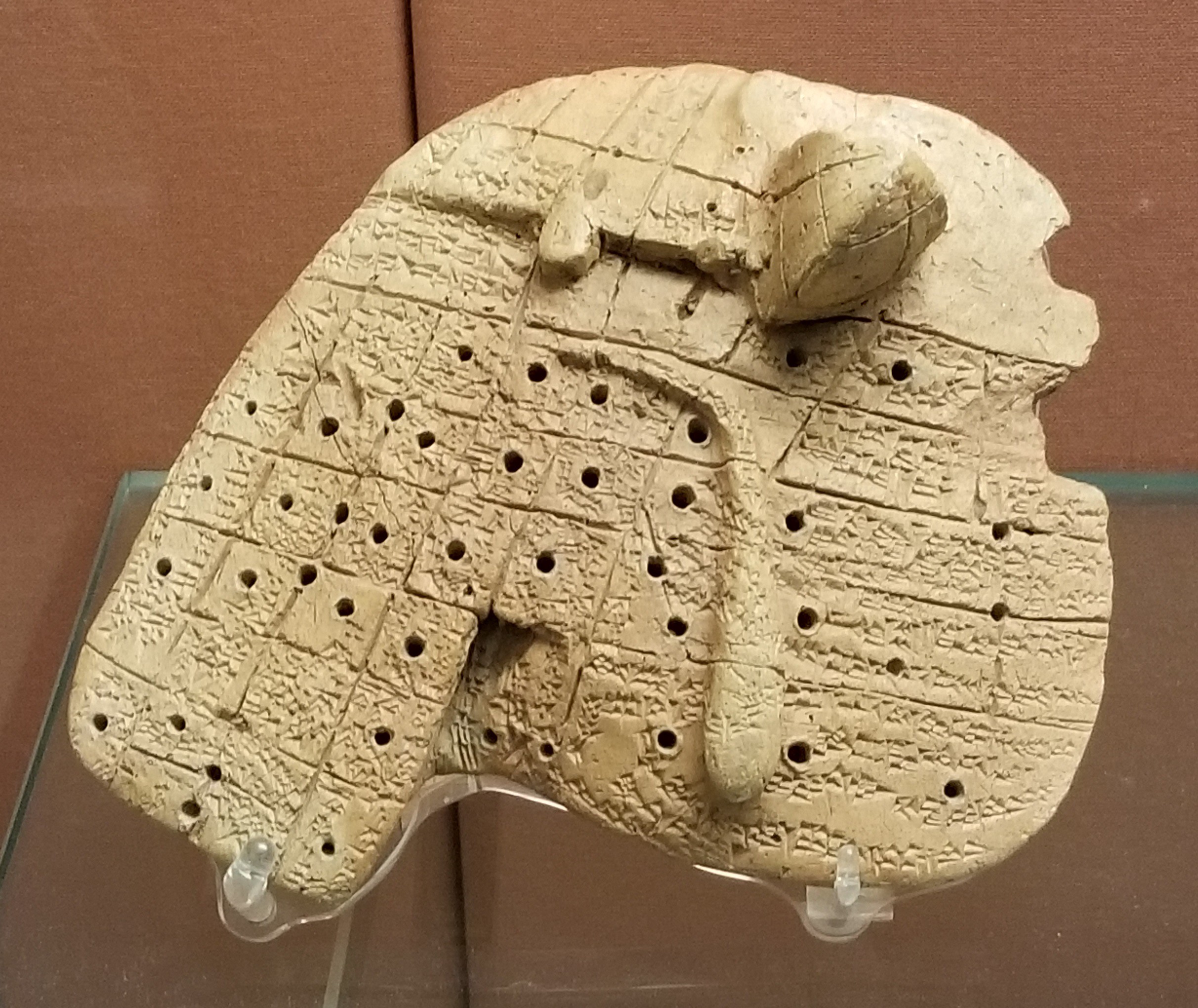
There’s an odd-looking artifact in the Near Eastern section of the British Museum. Made of baked clay, it’s part anatomy lesson and part Battleship grid. Its plaque tells us it’s The Liver Tablet, dated between 1900 and 1600 BCE and found in Sippar (modern Tell Abu Habbah, central Iraq), and describes it thus:¹

Inscribed model of a sheep’s liver probably used for instructing pupils; each box describes the implications of a blemish appearing at that position.

And just what might those implications be? We’re talking here about divination—attempting to foresee the future—the mysterious -mancies ancient magic is riddled with. In this case, it’s hepatomancy, itself is a type of haruspicy. The first term derives from the Greek words for “liver” (ἧπαρ, hêpar) and “divination” (μαντεία), and the second from an archaic Latin word for “entrails” (haru) and the Latin word “to observe” (speciō). Still more terms referring to the same arts appear, and as they will come up later, it’s best to introduce them as well; hepatoscopy (hêpar + σκοπία, skopiá “to examine”) and extispicy (exta, “entrails” + speciō), respectively synonyms of the first pair.

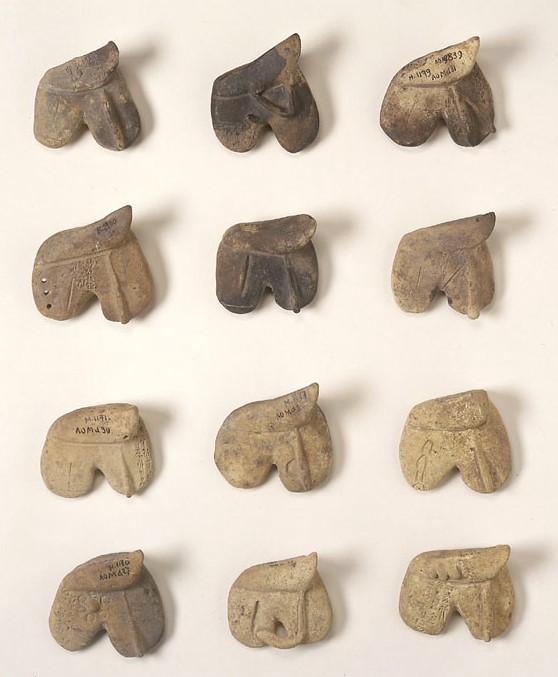
The Brit’s liver tablet turns out to be far from unique, with hundreds of similar ones excavated from sites like Mari (in modern eastern-central Syria) and Hazor (north-eastern Israel), with some 36 found at Ḫattuša (central Turkey) alone.

And of course the reason this object caught my eye is there is a rather famous one that’s quite similar relating to the Roman culture, known as the Liver of Piacenza for the northern Italian province in which it was found, more on which later.

Returning to the ancient Near East (ANE), although several terms for various priests and priestesses are attested, there are a few for this specific religious office, including Sumerian mash’shukitki (𒈧𒋗𒁍𒁍), which came to be expressed in Akkadian as bārû (𒀀𒍪). In the ANE, hepatomancy is thought to be the oldest of the divinatory arts, predating even writing. As professor of ANE studies, Beate Pongratz-Leisten notes:²

While no omen reports have been transmitted from the early periods, Early Dynastic profession lists and numerous administrative tablets from Ebla [in modern northwest Syria] point to the practice of extispicy performed during the third millennium BCE.

The specially trained priests would inspect the liver and lungs of a sacrificial sheep for omens. Much as the heart is today, the liver was regarded as the seat of emotions, especially desire, and even life and the soul, and so received particular emphasis in auguries. As a side note, in antiquity Cupid/ Ἔρως’s arrows targeted neither the victim’s heart nor liver but their eyes—they were that shallow.

Moreover, although anything animate or inanimate could be used by the gods to express their will as to human affairs or indeed cosmic truths, the stars and the liver were thought of as particularly favored media. Professor of religious and classical studies Alan Lenzi notes:³

[Mesopotamian s]cholars’ references to the celestial phenomena as “heavenly writing” (šiṭir šamê) or “writing of the firmament” (šiṭir burūmê), and the categorization of the liver as the “tablet of the gods” (-uppi ša ilī), are indicative of this perspective.

As to the method of this divination, the size, shape, and color of the organ were considered, but marks and the locations in which they appeared were of particular importance. Just as the museum’s label notes, the liver tablet and many like it essentially directed the student to the omen indicated by a mark at a given location.

Prior to all of this, the priest would have a specific question to which the answer was being sought, generally regarding the important actions a ruler was planning to take, in order to gauge both the general cosmic favorability and the possible repercussions. The priest then:⁴

[…] used judicial terminology, asking the sun god Šamaš “to judge the case” (dīna diānu) and “put truth” (kitta šakānu) into the entrails of the sheep.

As this suggests, such auguries mainly pertained to royalty, and as the sheep you possessed essentially equated to your wealth and social status, the extravagance of consulting their innards was also necessarily restricted to the elite. For example, the archive at Ebla, in the northwest of modern Syria, one of the largest from the time and region (mid-third millennium BCE) contained lists of sheep so used, which:⁵

[…] reveal that it was practiced on a large scale on behalf of the court, but also point to the king’s sponsorship and patronage of the craft.

The latter was true to such an extent the seals of these priests beginning in the Old Babylonian period (ca. 1830 BCE) reflected their position in direct relation to the kings they served. One, named Asqudum from the kingdom of Mari, for example, reads:⁶

Zimri-Lim, appointed by the god Dagan; Asqudum, the diviner

Zimri-Lim, is of course, the king he served.

Furthermore, the Book of Ezekiel characterizes Nebuchadnezzar II (𒀭𒀝𒆪𒁺𒌨𒊑𒋀) of the Neo-Babylonian Empire as personally performing hepatomancy among other divinatory arts:⁷

For the king of Babylon stood at the parting of the way, at the head of the two ways, to use divination: he made his arrows bright, he consulted with images, he looked in the liver.

A few things are worth noting here: First, the crossroads is the locus of the oracle, a liminal space in several traditions. The Greek Ἑκάτη (Hekátē) was the goddess of the crossroads and of witchcraft, and the Roman Diana took on these aspects under the epithet Trivia, meaning “triple way”, or crossroads. Ἑρμῆς (Hermes) was also a liminal figure, not only as messenger between gods and mortals, but in his role as ψυχοπομπός (psychopomp), leading the souls of the departed to Ἁιδης (Haides). For this reason, he is another god of the crossroads, under the epithet, Τρικεφαλος (Trikephalos, “3-headed”). This idea of road intersections as magical spaces was passed down even to relatively modern times, as bluesman Robert Jordan was reputed to have traded his soul to the devil for his guitar skills in the 1920s.

Second, the arrows are actually “shaken” rather than “made bright”—other translations render it this way. That is, they are cast as lots. This is another form of divination known as cleromancy.

Finally, the images mentioned are graven ones—idols known as teraphim (תְּרָפִים), “household gods”. All of this was to decide whether to invade Jerusalem, for which apparently the king received a resounding yes from the gods.

From the time divinatory material begins to appear in writing, royal and temple libraries show it to be quite important, often housing large collections. An example of the importance of such documents can be seen in King Ashurbanipal’s archive, where over a quarter of the tablets were divinatory.

These royal associations extended to the omens themselves because of their relationship to historical events, i.e., this mark appeared when king X did Y, and so presenting either dire or propitious tidings based on the outcome. Things like:⁸

a-mu-ut Na-ra-am-(d)Sîn sá A-pí-sá-al Il-qá-é

Omen of Naram-Sin who conquered Apishal.

and

a-mu-ut ú-hu-ra-im si12 I-bí-(d)Sîn ba-taq? ma-ti-šu i-ba-al-ki-li-šu

Omen of diminishment of Ibbi-Sin against whom a fraction of his country made a revolt.

Naram-Sîn and Ibbi-Sîn being kings of the Akkadian (ca. 2334–2154 BCE) and Ur III (ca. 2112–2004 BCE) periods, respectively.

Eventually, and somewhat predictably, it became aspirational to appear in these omens as a paradigmatic and historiographic ruler, also uncoincidentally increasing one’s prestige and political power. Ashurbanipal, for example, sought to insert himself into the company of kings like Sargon and Naram-Sîn of Akkad, as is recorded in a letter from a diviner asking how the king would like his omens to be written, running in part:⁹

[Omen for Assurbani]pal, mighty king, reverent prince, of whom (it is said) Ištar (walks) at the side of his a[rmy] cut off [the head of Teumman, king of Ela]m in the midst of battle and the son of Bēl-iqīsha […]-tuk of the Elamite they hung around his neck, and Assurbanipal [went to Nineve]h, his royal residence. They were exulting joyfully and performed music, the messenger? of Ummanigash, king of Elam, he killed in front of Assurbanipal, king of the universe, and he sat on his throne. Assurbanipal, king of the universe, at the command of […] Tammarītu, king of Elam, together with his magnates rolled before him [in?] Nineveh, his royal residence. [whom Assur and] Ištar love and lead with their full content, and Tammarītu who had plotted for help of Šamaš-šum-ukīn, he himself, the diviner and his magnates went and kissed his feet, Tammarītu and the diviner accused each other in front of him.

[If… the right and left side of the station are […] it is the omen of Assurbanipal, king of the universe, (of whom it is said) that Šamaš and Ištar walk at the side of his army and killed (his enemies) in the midst of battle and effected their defeat.

[If…] in the lift of the head of the right lung there is a sign/omen (predicting) the annihilation of the army, it is an omen of Šamaš-šum-ukīn, [the treacherous brother, who] fought against the army of Assurbanipal, the beloved of the great gods, (but) was defeated.

I’ve covered the prevalence of this form of divination in the ANE, next time more about its presence in Western magic and ritual.

Coincidentally, the Brit’s exhibition, “I am Ashurbanipal: king of the world, king of Assyria‎”, was really what I went there to see but alas, it was the final weekend of its run, it was sold out, and I didn’t get to see it so I did this instead.


Read subsequent articles in the Continuity of Magic from East to West series

Part 2B: Go West, Young Mantis

Part 3A: Coda Etrusca

Part 3B: Devoted More Than All Others

Part 4A: Romancing the Hellenes

Part 4B: The Chthonian Connection

Part 5: Hellenism, Schmellenism

Part 6: Myth and Magic in the Cultural Koiné

Part 7: Lux Orientis

Part 8: No Ewoks, Only the Dead


Read previous articles in the Continuity of Magic from East to West series

Part 1: The Griffin and the Phoenix


Notes

  1. Object 92668, The Liver Tablet, British Museum, ca. 1900–1600 BCE.
  2. Beate Pongratz-Leisten, “The King at the Crossroads between Divination and Cosmology”, Divination, Politics, and Ancient Near Eastern Empires, Alan Lenzi & Jonathan Stökl, eds., 2014.
  3. Alan Lenzi, “Revisiting Biblical Prophecy, Revealed Knowledge Pertaining to Ritual, and Secrecy in Light of Ancient Mesopotamian Prophetic Texts”, Divination, Politics, and Ancient Near Eastern Empires, Alan Lenzi & Jonathan Stökl, eds., 2014.
  4. Pongratz-Leisten, 2014.
  5. Ibid.
  6. Dominique Charpin, “Patron and Client: Zimri-Lim and Asqudum the Diviner,” The Oxford Handbook of Cuneiform Culture, 2011.
  7. Ezek. 21:21, King James Version (KJV), 1611.
  8. RA 35, nos. 3 and 6, quoted in Pongratz-Leisten, 2014.
  9. RM 2, 455, quoted in ibid.

The Griffin and the Phoenix

The migratory patterns of mythical beasts (Continuity of Magic from East to West, Part 1)

A handy thing about living in London is I can go to the British Museum. San Francisco’s Legion of Honor is decidedly minor league by comparison, really doing a fair job only as a historical cross-section of Western painting, with wunderkammer-style collections of anything else, including their selection of ancient artifacts. The British has more of this stuff than they can even display properly.

To this point, my research has mainly been done online, a painstaking, time-consuming, and often frustrating affair. Additionally, my access to WorldCat via my son’s university is shortly to end, making things considerably worse. Indeed, the UofM seems to have noticed I’m trying to use their service from a different country and now refuses requests except from my phone, a less-than-ideal device for such purposes.

There are drawbacks to the museum to be sure: the relevant artifacts might be displayed based on contexts entirely dissimilar to what one has in mind, and of course, there are tourists from which at least the dark corners of the internet remain free. They really only came to the museum to take selfies in the great hall to give their friends some form of cultural FOMO, but hey, now they’ve come all this way, they might as well play it out a bit, in case someone asks them about it, so they can repeat hazily understood facts about the Rosetta Stone, e.g., but assuring everyone, “such history—it was amazing!” Basically, they clutter the halls, each with a sense the items on display must be important but unsure why. When one of them stops, they all stop, assuming something particularly noteworthy has been spotted by a member of the herd.

Then there are the guides. One was trying to explain cuneiform to his group in one of the Assyrian galleries and started out well, saying it had been invented by the Sumerians, but then took a sharp left turn, saying it was an alphabet and the Assyrians who supplanted the Sumerians used the script to write their own language. I uttered a series of three NOs, each a bit louder than the last before I could stop myself.¹ I’m sure it was passed off as a mild attack of Tourette’s, but for the rest of my visit, I wondered if there was someone I should report him to.

Anyway, if, for example, I want to establish a continuity of ritual practice between the magic of the ancient Near East and the Graeco-Roman sphere, I can simply stroll through a few galleries—dodging tourists—in order to do so. The process is simple: I look in the Mesopotamian or Egyptian galleries for items I recognize, more or less, from the ancient West, and moreover can also view items from this last area if need be. So on we go.

The griffin is tricky, as one of the earliest recognizable images comes from Crete, specifically the royal palace complex at Knossos, causing people to associate it with Greek culture. And indeed, the Bronze Age Greeks drew significantly from the Minoans, including at least their mode of dress, the buon fresco technique, and the Linear B script. Maybe the Mycenaeans also borrowed the bird-creature along with many other things, but we don’t know because of the Late Bronze Age Collapse.

We encounter similar chimerae in Mesopotamia, including some versions of Imtuku/ Anzû (𒀭𒅎𒂂), whence also the Ziz (זיז) generally with more birdlike properties, and the Ala/ Lamassu/ Šēdu (𒀭𒆗), with a lion or bull’s body, eagle’s wings, and a human face, which components also flowed into Jewish lore as the four living creatures drawing the chariot of God and thence to each of the Christian Gospels and their writers, who sometime reassemble à la Voltron to form the mighty Tetramorph.

Strong examples of the griffin in bronze appear in Rhodes, which, while traditionally Greek is closer to Asia Minor than it is to the mainland, with its name possibly stemming from the Phoenician word for snake, 𐤓𐤏𐤃‎𐤄 (possibly eroʿod—the script is an abjad, so we can only guess at the vowels), since the island was apparently once quite infested with the ² Extremely near cousins of these griffins also turn up in Etruria, so similar indeed they form part of the hypothesis of the Anatolian origin of the Etruscans.

The phoenix‌ has a name which in itself is etymologically inextricable from Phoenicia, as both once referred to the color purple. Mycenaean attests both po-ni-ke (probably p’onikes) meaning the creature and po-ni-ki-ja (p’onikia) meaning the color.³ As expected, because of the extensive trade network and the moderate sprachbund so formed, these words are as migratory as the gray heron the Egyptians may have based a phoenix-like idea on, originating in the word bnw (maybe bennu—another abjad here). Thence, conjecture runs, it was borrowed by the Minoans, and from them by the Mycenaeans.

Meanwhile, the ethnonym—and really it’s an exonym coined by the Greeks in the eighth century BCE as people generally identified with their city, e.g., those near Tyre were Tyrians—is attributed also via Minoan to a different Egyptian word, fnḫw (fenekhu), referring to woodcutters, as their lumber came from Canaan, i.e., the famed cedars of Lebanon.

However, Dutch history of religion scholar Roelof van den Broek expresses some doubt:⁴

It is clear that there are certain parallels and relationships between the benu and the phoenix, but it is not possible to demonstrate that the Classical views were based on Egyptian, as some others have assumed. […] there are no indications that these notions [of the rebirth of the soul] developed from Egyptian conceptions, even though it has been assumed by some Egyptologists and others as well. It is at least equally probable that this symbolism developed spontaneously from the Classical phoenix myth.

He continues in a more etymological vein thus:

The name of the phoenix has also been considered to be derived from that of the benu, which has been taken as evidence of the Egyptian origin of the Classical myth. Sethe and Spiegelberg, followed by many others, have argued that the Egyptian word benu should be pronounced *boin or *boine, on the basis of the fact that it is written as bjn-w. The name φοῖνιξ is therefore considered to be only a Greek version of the Egyptian term for the benu. Several serious objections to this conclusion can be put forward […].

Unfortunately, in rather meta fashion, my limited ability to access this book online meant I could only find out what a few of these objections were. All I could find was the Google Book, which hides significant portions of the text presumably to protect the copyright, even though the book is nullibiquitous for purchase. I trudge on nonetheless.

There is a near homophony of the Mycenaean words p’onikes and p’onikia, such that the latter appears simply to be the genitive form of the first, linking the two terms so deeply either the mythical fowl’s plumage becomes reddish purple to match the dye of that color originating in Phoenicia, or vice versa. There’s another confounding homonym in this cluster, po-ni-ki-jo (p’onikios) which appears just a masculine-gendered variant of p’onikia, but means a date palm, whose Latin name remains Phoenix dactylifera. There are yet more meanings in Ancient Greek, which at least seems clearer as it refers to a guitar-like instrument of the Phoenicians, and the letters of the Phoenician alphabet are called Φοινικηια (Phoinikeia) by Herotodus (Ἡρόδοτος).

Various theories of which sense is the primary one abound, based on authorities such as Isidore of Seville, who says the bird is named for the color,⁵ and Ovid, who says the name came from “the Assyrians”, meaning the Phoenicians,⁶ and Lactantius, who says exactly the reverse,⁷ although this last pair agree the palm is named for the bird, as it nests in said tree, while the Spaniard says the palm is named for the bird because they share a long lifespan, an idea Dionysius, Bishop of Alexandria also puts forth.⁸ Ultimately, it seems the name of a fabulous creature must be the original sense, coming to Mycenaean from a Semitic source and moreover covering both the bird and the griffin, which then was extended to the land, the color, the palm, and the musical instrument. And indeed, these creatures both appear in Minoan art. A French language review of the van den Broek book—one of the few traces I could find of it—reflects he agrees:⁹

Le Po-ni-ke mycénien, l’oiseau de Phénicie, serait alors une espèce de griffon, d’origine sémitique.

The Mycenaean Po-ni-ke, the bird of Phoenicia, would then be a species of griffin, of Semitic origin.

Van den Broek also concludes the name of the bird has to have been transferred to the palm rather than the other way around, perhaps because both had the aspect of long life, also bringing the idea of victory symbolized by the palm frond into the complex and resulting in depictions of the bird perched in a palm tree.

Neither van den Broek, nor anyone else I can discover, points to an actual origin for the word and it seems to have been lost to the ages. I’ll be bold and suggest Sumerian as the source. Though a language isolate, many Sumerian words have come down to us, via Semitic languages, such as our word ass (the animal), which may be ultimately from Sumerian 𒀲 (an’she).

The specific word I’d cite is piring (𒊊). The literal meaning is “lion”, but also “bull”, or “wild bull”, and indeed as there is a tendency in the language to group felines and canines together, we should add “dog” to these. Animal, wild, and dangerous seems the proper cluster of associations. Furthermore, it’s used in several descriptions of the 11 chaos monsters birthed by the dragon goddess Namma (𒀭𒇉, better known by her Akkadian name, 𒀭𒋾𒊩𒆳, Tiamat) to avenge the slaying of her consort, Aptsu (𒍪 𒀊):

piring iki ushumkal
lion with the face of the Ushumkal (Great Dragon)

piring iki mush’khush
lion with the face of the Mush’khush (Furious Snake)

piring mush’khush ap’shaka luka
lion, the Mush’khush that lives in the center of the sea

These creatures are chimerae, their natures embodying the primordial chaos their mother represents: dragons like those mentioned above, a bull-man, a scorpion-man, a fish-man, one with a lion’s head and bird’s feet (clearly griffin territory), and even a lion-man named Uritim (𒌨𒅂), “Raging Lion” (which uses the sign for dog).

The transformation to p’onikes is explicable, though there is no smoking gun for the direction I propose: the Sumerian consonant ⟨ŋ⟩, with the value /ŋ/ (essentially /ng/, as I’ve rendered it above) does not exist in Linear B, and so the word might’ve been syllabized as pi-ri-ni-gi. Eventual and common decay of the tapped /r/ and a shift in the first vowel takes us to po-ni-gi. Alternation from /g/ to /k/, and a standard Greek third declension ending take us the rest of the way.

So, while concepts tended to wander across the ancient world, their general East-to-West direction eventually becomes clear.


Read subsequent articles in the Continuity of Magic from East to West series

Part 2A: Hark, a Haruspex!

Part 2B: Go West, Young Mantis

Part 3A: Coda Etrusca

Part 3B: Devoted More Than All Others

Part 4A: Romancing the Hellenes

Part 4B: The Chthonian Connection

Part 5: Hellenism, Schmellenism

Part 6: Myth and Magic in the Cultural Koiné

Part 7: Lux Orientis

Part 8: No Ewoks, Only the Dead


Notes

  1. The correct answers are: logographic/ syllabic script, Akkadians, and Akkadian. Perhaps Irving Finkel is the proper authority?
  2. “Rhodes, island, Greece”, Encyclopedia Britannica (online), retrieved March 2019.
  3. ⟨p(h)⟩, later expressed by ⟨φ⟩ and with the phonetic value /f/, seems to have been said in Mycenaean Greek as /pʰ/; an aspirated /p/, which I’ve rendered as ⟨p’⟩. ⟨p⟩ in Sumerian is sometimes aspirated, and I’ve rendered it the same way.
  4. Roel van den Broek, The Myth of the Phoenix according to Classical and Early Christian Traditions, 1972.
  5. Isidore of Seville, Etymologiae (The Etymologies), ca. 600–625.
  6. Publius Ovidius Naso, Metamorphoses 15:391–417, 8 CE.
  7. Caecilius Firmianus Lactantius (attributed), “De ave phoenice” (“On the Phoenix Bird”), possibly early sixth century.
  8. Διονύσιος Ἀλεξανδρείας (Dionysius of Alexandria), Περὶ Φύσεως (On Nature) frg. 3, ca. mid-third century.
  9. Marcel Detienne, “Van den Broek (R.) ‘The Myth of the Phoenix according to Classical and Early Christian Traditions’”, Archives de Sciences Sociales des Religions, 1973.

The Littlest Dragon

The irresistible mess of Shaolin (Mythmaking in the Martial Arts, Part 5)

Unless you live in a media-impenetrable cave, you have an image in your head of what kung fu looks like. And unless you’ve delved extensively into martial arts esoterica, Northern Sil Lum (北少林, Běishàolín, BSL hereafter) is the kung fu you’re thinking of: low stances, fluid transitions, circular blocks, rapid and long-range attacks that include leaping and spinning kicks.

It is one of the oldest, best known, most widely practiced, and most influential of the martial arts. Many of the martial arts of Korea, Japan, and Southeast Asia trace their lineages to BSL. Under its better-known Mandarin reading, Shaolin, it appears in the titles of a pile of films; from a quick perusal:

  • 2 Champions of Shaolin (《少林與武當》)
  • The 36th Chamber of Shaolin (《少林三十六房》)
  • Abbot of Shaolin (《少林英雄榜》)
  • American Shaolin
  • Bruce and the Shaolin Bronzemen (《神龍猛虎》)
  • Executioners from Shaolin (《洪熙官》)
  • Five Shaolin Masters (《少林五祖》)
  • Invincible Shaolin (《南少林與北少林》)
  • Kids From Shaolin (《少林小子》)
  • Martial Arts of Shaolin (《南北少林》)
  • The New Legend of Shaolin (《洪熙官之少林五祖》)
  • The Real Shaolin
  • Shaolin (《新少林寺》)
  • Shaolin and Wu Tang (《少林與武當》)
  • Shaolin Daredevils (《雜技亡命隊》)
  • Shaolin Dolemite
  • Shaolin Drunkard (《天師撞邪》)
  • The Shaolin Drunken Monk (《螳螂醉八拳》)
  • Shaolin Girl (《少林少女》)
  • Shaolin Handlock (《十字鎖喉手》)
  • Shaolin Plot (《四大門派》)
  • Shaolin Popey (? 《笑林小子》)
  • Shaolin Prince (《少林傳人》)
  • Shaolin Rescuers (《街市英雄》)
  • Shaolin Soccer (《少林足球》)
  • Shaolin Temple (《少林寺》 1976)
  • Shaolin Temple (《少林寺》 1982)
  • Shaolin Traitorous (《大太監》)
  • Shaolin vs. Evil Dead (《少林殭屍》)
  • Shaolin vs. Lama (《少林鬥喇嘛》)
  • Shaolin vs. Ninja (《中華丈夫》)
  • Shaolin Warrior (《少林殺戒》)
  • Shaolin Wooden Men (《少林木人巷》)
  • Snake & Crane Arts of Shaolin (《蛇鶴八步》)
  • The South Shaolin Master (《南拳王》)
  • Young Master of Shaolin (《少年英雄方世玉》)

Those are just ones using the term Shaolin in their English titles, though glancing at the Hanzi will tell you the term was often applied where it did not appear in the original, reflecting how well known it had become. Also worth noting is the list contains both Bruceploitation titles such as Bruce and the Shaolin Bronzemen, and blaxsploitation crossovers like Shaolin Dolemite. In any case, some of these Shaolin films starred the greats of martial arts cinema: Jackie Chan (陳港生), Jet Li (李阳中), Gordon Liu (劉家輝), Cheng Pei-pei (郑佩佩), and Donnie Yen (甄子丹).

This highly influential, well-developed, and effective style was what Wong Jia Man had been studying for 15 years, completing the full course, and teaching for another year prior to his fight with Bruce Lee.

Prior to 1964, Bruce Lee’s main martial art was Wing Chun (詠春). While it has appeared in a few movies, it is the opposite of BSL in many ways: a short-range style with the elbows held close to the sides; its movements stress economy and directness with few kicks, kept low to maintain balance. Wing Chun also places the practitioner in almost constant contact with their opponent, an element which suited it well to Lee because of his severe nearsightedness.

And yet, from the time Lee was discovered by Hollywood, through the remainder of his career, he was a classic kung fu actor: Even in his screen test for Number One Son (a scrapped project meant to be the adventures of the scion of Charlie Chan), he performs Hung Ga (洪家) forms—Shaolin, but a Southern version, uncoincidentally linked to Wong Fei Hung, a popular figure in Hong Kong film. Although none of Lee’s films bore the actual term, he played a Shaolin monk in his most famous film, Enter the Dragon (《龍爭虎鬥》), and can be seen therein performing a BSL form. Clearly, sometime after 1964, he had added these moves to his repertoire.

Most argue Lee’s trip back to Hong Kong at the end of that year was made to desperately try to actually learn to fight after, if not being defeated by Wong, at least not having done as well as he’d have liked. I disagree. I believe he used the trip to learn some flashy moves—Wing Chun is decidedly not that—and to get some publicity photos taken with Yip Man in order to build better martial arts cred, which Lee was also sorely lacking, for the martial arts film career he desired.

I discount the former notion because I think it’s absurd to  he beat Wong easily but needed to change everything about his fighting style. Even those who say Lee lost play into the myth he was any kind of serious fighter. Finally, the trip was not even Lee’s idea: his father died, and he returned for the funeral¹—anything else he did while there was simply opportunistic. Nonetheless, let’s dwell on this bit of hype.

Linda Lee confirms Bruce’s ’64 style was essentially Wing Chun, as well as relating the “crisis” that occurred after the fight:²

It did not take him long to realize that the basis of his fighting art, the Wing Chun style, was insufficient. It laid too much stress on hand techniques, had very few kicking techniques and was, essentially, partial.

Most reputable martial artists and historians who actually know about Lee’s life say what was actually “partial” was Lee’s training, not Wing Chun—or, for that matter, any of the other martial arts he was to later superficially study. This is what his decrial of the “classical mess” of the traditional martial arts was all about: sour grapes.

There is scuttlebutt within the martial arts community, and as such impossible to confirm, Lee sought but was refused training from one of Wong’s BSL teachers, Grandmaster Jianfeng Ma (馬劍風). This doesn’t necessarily argue for Lee trying to repair his technique—as I’ve mentioned, the style is attractive, and it’s equally possible he’d simply liked the look of some of Wong’s moves, especially given he didn’t remotely have time to study anything thoroughly, and had Hollywood clearly in his sights.

And I can’t fault Lee for that as it drew me in as well: though it is not the intent of BSL, it looks awesome. When I studied it my teachers would always complain about the way I did it, saying I had watched too many movies (I had). I could sense these moves were the ones I had seen in films, and couldn’t help but strike those poses and give it that punctuation.

One of my favorites to this day is the whirlwind kick (旋風腳, xuanfengjiao). It’s a spinning, jumping deal, and you slap the sole of your foot at the kick’s peak—as my fencing coach would say, “trash with splash”. In Wushu (武術) which also incorporates the move, we’d sometimes run into it to give the spin more velocity. When really showing off, I’d launch it off a step or low ledge to put greater height into it.

Perhaps because it’s so easy to get caught up in the visuals, there are those who, along with Lee, will discount BSL as just for show and not practical, and many martial arts can indeed be thus criticized as bullshido. But not this one: Peter Ralston, taught by Wong, was the first non-Asian to win the Full-Contact Martial Arts World Tournament in the Republic of China in 1978. “Full contact”—that’s practical; “world tournament”—that means bring any style from anywhere: we’re talking about the forerunner of mixed martial art fighting here.

As for Lee, the system he created, Jeet Kune Do, was largely plagiarized from various other martial arts, particularly Western fencing and Jack Dempsey’s book on boxing, of course, with some of those cool BSL kicks thrown in. His posthumous book even failed to replace the word “blade” with “fist” when cribbing from sources on fencing. He himself never competed, and the fighting system has produced no noteworthy champions.

If you think Bruce learned martial arts after going to Hollywood, when do you think he had time? He was shooting films, making appearances, giving private lessons to his new, exclusive LA clientele, and traveling back and forth to East Asia. If you look at his filmography, 1970 is the only letup, during which he was presumably pitching The Warrior, and upon failing that, deciding to seek greener pastures in the Hong Kong film biz. In the period after The Green Hornet tanked, when he was scrounging for roles, Cadwell says he was reading and writing a lot and philosophizing about martial arts. But Nancy Kwan, who he worked with on The Wrecking Crew, tells a different story:³

Bruce had a plan that he was going to become a big gungfu martial arts movie star.

Clearly he was lifting and doing some martial arts study, but both mainly in an effort to look good on screen. The 2020 film, Be Water, shows a lot of footage of Bruce “training”, which is clearly choreography and filmed because he wants to see if it looks good. Again, I can only report on the rumblings from the martial arts community where Lee’s rep was he was fast, but ultimately had no power.

Nonetheless, in I Am Bruce Lee, they seem to have goaded interviewees into speculating on Lee’s prowess as if he were a fighter, but with mixed results. Professional boxer Ray ‘Boom Boom’ Mancini seems to have taken it fairly seriously:⁴

Bruce Lee was so quick, so smooth, you know, but the one thing that negates speed on a fighter is pressure, and I’m a pressure fighter. And when you get close then you know, Bruce would be trying to bring knees and high head kicks, and I’d get in there and I’d be, you know, throwing uppercuts and trying to bring the elbow across, and I’m sure he’d be trying to counter me, so you know, I’m left bobbing and weaving inside. It would have been a good time.

Ed O’Neill, of Married with Children fame, but also a black belt in Brazilian Jiu-Jitsu also appears, noting:⁵

Ray [Mancini] was good to the body, and then eventually he’d get that hook on you, you know. Bruce wouldn’t know how to stop it. Why? Because he never did it.

Mickey Rourke, on the other hand, cut right to the chase:⁶

The bigger guy, equally trained, is always going to beat the littler guy.

And Gene LeBell put a still finer point on it:⁷

People say, “was he the toughest man that ever lived?” He was 130–135 pounds. You’d grab him and uh, you know—sfft—out the window.

And later:

If they said Bruce Lee could have beat Chuck Norris, I’d say how much do you want to bet? I got a fistful of greenbacks in my pocket.

Of these, I’d note only LeBell actually knew Lee while the others are engaging in wild speculation, and as is typically done, conflating his onscreen persona with real life. I honestly give some credit to I Am Bruce Lee’s filmmakers for presenting these dissenting points of view alongside those buying into the myths.

Norris himself was even asked if he and Lee ever really fought:⁸

No  […]. I fought professionally and […] Bruce was very, very good, but he never fought in the ring. There’s a big difference […] kicking the bag and getting in the ring and having someone kicking back at you—a whole different story.Lee adherents, of course, decry this as grandstanding on Norris’ part,. But given the canonization of Lee is so well known, wouldn’t it make more sense to just say, “yeah, he was a badass and I beat the crap out of him” instead?

I’ll conclude this series here; I’ve dwelled far longer than intended on the topic, but as I researched it, I found there were a lot of layers to peel away. I’ll  note I’m pretty far from hating Lee: Although I don’t accept him as Martial Arts Jesus, I have, and still do, find him an inspirational figure, if only for his will to power. My own history in martial arts was also dilettantish as a perusal of the list I’ve studied will hint. Nonetheless, he was one of the filmic greats who drove me to that study. Even in my medium, games, the level structure he created in Game of Death (《死亡遊戲》) remains highly influential.

I will leave you with one final fun fact: Lee was part Jewish. In this year’s Bruce Lee: A Life, Matthew Polly traced Lee’s maternal ancestry to Mozes Hartog Bosman, the son of a kosher butcher from Rotterdam, and the film star’s great-grandfather. Bosman’s six sons went on to become the richest men in Hong Kong. One of these, Ho Kom Tong (何甘棠), had a remarkable 30 children, one of whom was Grace Ho (何愛瑜), Lee’s mother. An article in Jewish webzine Forward puts forth the delightful notion the success of Lee, his grandfather and granduncles, might have been “due to their yidishe kops”.⁹


Read subsequent articles in the Mythmaking in the Martial Arts series

Part 5 Addendum A: Kato’s Comeuppance

Part 5 Addendum B: The Row over “Hollywood” Continues


Read previous articles in the Mythmaking in the Martial Arts series

Part 1: The Bruce Lie

Part 2: Enter the Tycoon

Part 3: Fists of Flim-Flam

Part 4: Urban Lee


Notes

  1. Cadwell confirms this in the film Be Water, 2020.
  2. Linda Lee Cadwell, Bruce Lee: The Only Man I Knew, 1975. There’s also video evidence of this in Be Water.
  3.  Be Water.
  4. I Am Bruce Lee, 2012.
  5. Ibid.
  6. Ibid.
  7. Ibid.
  8. Late Night with Conan O’Brien, February 1995.
  9. Seth Rogovoy, “Wait, Bruce Lee Was Jewish?” Forward, June, 2018.

The Punic Curse Trail

Seeking the defixio’s Near Eastern origins (Defixiones, Part 7)

The first known example of a lead curse tablet (defixio) pleading for justice for a crime against the supplicant is not from the far-flung provinces of Rome, nor is it from Rome, nor is it from Rome proper, it’s not even Greek, it’s from Carthage (Punic 𐤒𐤓𐤕•𐤇𐤃𐤔𐤕, Qart-Khadasht). The text runs thus:¹

Lady Ḥawwat, Goddess, Queen who causes (things) to be poured out! May I, Maṣliḥ, make ʾEmʿaštart melt, and ʿMrt(?) and all which is hers, because she has rejoiced at my expense about the money that I have lost completely(?). (and may I/you cause to melt) every person who rejoices at my expense about the loss of this money, just as the lead is poured out.

Let’s establish the bona fides of the specimen: It is a sheet of lead, inscribed with a prayer in Punic, which was rolled up and deposited into a tomb in a Carthaginian necropolis near the coastal area of Dermech in modern Tunis.

The deity called upon is the “Goddess, Queen” Khawwat¹ (𐤇𐤅𐤕‬), an epithet of Tanit (𐤕𐤍𐤕), the head of the Phoenician pantheon together with her consort Baʿal (𐤁𐤏𐤋). Although no fire or melting were involved the defixio’s deposition, the rhetoric focuses on “melting” and “pouring out”, presumably referring to a simple method for creating a lead sheet—pouring molten lead onto a hard, flat surface, such as a stone—as the analogy for the punishment of wrongdoers.

Overall, it’s quite familiar, with the only slightly odd feature being the supplicant, Matslikh,² has lost money, but rather than seeking justice for the theft, he asks those rejoicing in his loss be punished—a prayer for deliverance from schadenfreude.

Now to the dating of this object, which is less clear: it is often ascribed to the third century BCE, making it quite early in the context of curse tablets generally. However, first, the necropolis the defixio was excavated from dates to the seventh–sixth centuries, and second, the dating is based on the idea the Greek tradition had to have preceded it. The data here are admittedly scarce, and their interpretation is uncertain, as Christopher Faraone et al. note:³

[Classical scholar William Sherwood] Fox, on the one hand, suggests [… a] “Semitic” influence on the Greek materials, whereas much of the scholarship on the Carthaginian curse assumes or argues for the reverse, namely, that the Greek tradition of binding spells was being imitated or adapted by the author of the Punic tablet.

It seems clear choosing a date based on the idea this tablet was made in imitation of Greek models is bad science, so I’d definitely lean towards an earlier one. Furthermore, the practice of cursing via a necropolis requires the defixio be depositied in the tomb of one untimely dead, and if somehow the knowledge of such a tomb survived for three hundred years, one would imagine a massive trove of defixiones would have been discovered at the spot. Even this assumes deposition of three hundred years of detritus would not have completely effaced the tomb or even the entire complex.

If—as I think should be done—we move the date of the curse tablet toward the active dates of the necropolis, it goes from being the first known plea for justice to perhaps the first known defixio, full stop. Of course, the ancient Near East (ANE) was generally seen as the source of many of Greece’s wisdom traditions, so why wouldn’t the practice first appear in that same context?

Faraone et al. posit a biblical passage in the Book of Judges is a reference to the use of curse tablets among the Canaanites in the ninth century, which, if true, would easily predate any known in the West.⁴

There was a man in the hill country of Ephraim [אֶפְרָיִם] whose name was Micah [מִיכָה].

He said to his mother, “The eleven hundred (pieces) of silver that were taken from you, about which you uttered a curse and even spoke it in my hearing—the silver is in my possession; it was I who took it.” And his mother said, “May my son be blessed to Yahweh [יהוה]!”

Then he returned the eleven hundred (pieces) of silver to his mother; and his mother said, “I have indeed consecrated the silver to Yahweh from my hand for my son, to make an idol of cast metal. So now I return it to you.”

So when he had returned the money to his mother, his mother took two hundred (pieces) of silver, and gave it to the smith, who made it into an idol of cast metal; and it was deposited there in the house of Micah.

Although no actual curse tablet is mentioned, the ritual elements sound entirely familiar: in Graeco-Roman terms, there is a curse and a vow made and when the lost money is recovered, an ex voto offering is to be made of the promised silver—we’ve just substituted Mercury with Yahweh here. Percentagewise, the amount donated by Mikha’s mother is low, but 200 pieces of silver seems quite a substantial sum, especially given it’s enough to cast into an idol.

It’s also worth noting Judges describes a series of incidents of the unfaithfulness of the Israelites to their God, Yahweh, with whom they are supposed to have a covenant. This is expressed in several ways in this passage, as both theft and witchcraft (although, I’ll note of the latter, conflictingly) are clearly proscribed by Mosaic Law, as is the making of idols. Indeed, there is a formulaic pro-monarchical criticism repeated throughout the book, just as it is immediately after this tale:⁵

In those days there was no king in Israel; all the people did what was right in their own eyes.

Another related theme in Judges is the conquest of the land of Canaan (Punic 𐤊𐤍𐤏𐤍, Hebrew כְּנָעַן‬), and the settlement among the local people by the Israelites. The term Canaanite lumps together several settled and nomadic pastoral groups of the ancient southern Levant, but the main coastal group who continued to identify themselves using the endonym in North Africa were the Phoenicians, better known as the Carthaginians. The implication in the book is by mixing with the Canaanites, the Israelites are coming into contact with and being subverted by the non-Judaic traditions holding sway in the region before their arrival.

If we take the Judges passage as referring to this same set of cursing beliefs, it means we’re effectively winding the clock all the way back to at least the Late Bronze Age Collapse, corresponding closely with the beginning of the Greek Dark Age, a time during which the culture was illiterate, ultimately borrowing the Phoenician alphabet some 200 years after its creation to return to writing the Greek language. Why would we not think the defixio was another borrowing by the nascent Greek culture from the wise ANE?

The Phoenicians would also be in much closer contact with the generally acknowledged sources of the mystical tradition flowing eventually into the Graeco-Roman world. In particular, Sumerian texts show a feature relevant to what we see later in sympathetic magic in the West: formulae of analogy accompanied by ritual.

All the way back in the Sargonic Period (ca. 2334–2154 BCE) we have incantations such as this one that “applies an analogy of pot-breaking to a daimon”:⁶

tukkats’tsakin khekats’kats

May it be smashed to bits like a pot!

There is a clear implication the act of smashing a pot is to be performed as a ritual together with the prayer, and there are many such.

Remaining in the Mesopotamian milieu, another tradition of the same descent is evidenced in the numerous texts against witchcraft from the Middle Assyrian Empire (1392–934 BCE). These are quite consistent, typically beginning with a diagnosis, which also includes information about how the initial curse may have been performed:⁷

šumma amēlu kišpī epšūšu lū ṣalm[ūšu
ina m]ê temrū lū ṣalmūšu ana gulgullisic
amēlūti paqd[ū … ] […]

If witchcraft has been performed against a man, (if) either figurin[es of him] have been sunk [in wat]er […] or figurines of him have been thrown into fire, or figurines of him have been bu[ried] in the ground […]

We have seen poppets are part of the Western tradition, and the descriptions here of how they will have been treated match closely with what we know about defixiones as well: sunk into water, as at the springs at Aquae Sulis and Parioli, thrown into fire as at Mainz and Uley or buried in the ground as at various Necropoleis including the one at Dermech.

Another text more poetically describes such a figurine as having been “handed over to Eresh’k’ikal (𒀭𒊩𒆠𒃲, Queen of the Underworld) in dilapidated places,” also referring to burial, but connecting more directly to the idea of a tomb. Significantly, this goddess would later be syncretized with the Greek goddess of witchcraft, Hekate (Ἑκάτη). Other places of deposition are also given, the most colorful being “the sewage opening of the city-wall”.⁸

Next, instructions are given, with their purpose being:⁹

kišpīša ruḫêša saḫārim-ma ṣabātīša kaššāpi
u [kaššāpti]


that her witchcraft (and) her sorcery turn (back)—be it warlock or witch, [who bewitched him]—and seize her, to bind warlock and [witch]

Note those terms of seizing and binding, so closely intertwined with curse magic in the West, as well as the remarkable similarity to the common formula in Roman prayers for justice targeting a victim, “whether man or woman.”

The undoing of the curse is then described—essentially exchanging figurines of the cursed person with those who have cursed them. A final remarkable element in this tradition is the piercing of figurines:¹⁰

TA.ÀM ṣilli gišimmari tutakkapšunūte

You pierce them three times each with the thorn of a date palm.

It seems date palm thorns would eventually come to be replaced by iron nails, being a much more readily available item in Iron Age Europe. Moreover, just as coins were to become a substitute for defixiones, defixiones themselves seem to have actually been substitute figurines. Just as there was a transition between curse tablets and coins placed in lamps in the shrine of Anna Perenna, in that same shrine there were poppets placed within inscribed lead containers, which I’d guess belonged to an earlier tradition, also simplified over time.

Considering all this, locating the source of the defixio tradition in Greece seems increasingly doubtful. Not only were its days as the powerhouse of the Mediterranean still centuries in the future, the ANE was steeped in millennia-old mysticism, an impressionable young culture would have found pretty compelling.


Read subsequent articles in the Defixiones series

Part 8: Hellenism, Schmellenism

Part 9: The Celtic Undercurrents of Bath


Read previous articles in the Defixiones series

Part 1: The Curses of Aquae Sulis

Part 2: Malefic Traditional

Part 3: Sympathy for Sauron

Part 4: Bargaining with the Gods

Part 5: Secundina’s Beef

Part 6: More Than Money Can Buy


Notes

  1. KAI 89, transliteration and translation from C. A. Faraone, B. Garnand and C. López‐Ruiz, “Micah’s Mother (Judg. 17:1–4) and a Curse from Carthage (KAI 89): Canaanite Precedents for Greek and Latin Curses against Thieves?”, Journal of Near Eastern Studies, 2005. Punic is read from right to left, as many Semitic languages.
  2. The phonetic value ⟨ḥ⟩ is a “hard H” (/ħ/) often rendered, as I have here, as ⟨kh⟩.
  3. Faraone, et al., 2005.
  4. Ibid; the passage referred to is Judg. 17:1–6.
  5. Judg. 21:25, NLT, 1996.
  6. Text 62, Graham Cunningham, Deliver Me from Evil: Mesopotamian Incantations, 2500–1500 BC, 1997. I’ve used my own transliteration and translation. This formula seems to have remained popular, appearing within the later texts here as well.
  7. Text 8.7.2, quoted in Tzvi Abusch and Daniel Schwemer, Corpus of Mesopotamian Anti-Witchcraft Rituals, 2016.
  8. Text 8.3, quoted in ibid.
  9. Ibid.
  10. Text 8.7.2, quoted in ibid.

More Than Money Can Buy

Honor culture and the cost of a curse (Defixiones, Part 6)

One of the many defixiones—lead curse tablets—found at the site of Aquae Sulis (modern Bath) is from Docilianus. It’s famed for its Roman majuscules inscribed in a fine hand, though the text is fairly generic:¹

Docilianus Bruceri deae sanctissimae Suli devoveo eum qui caracellam meam involaverit si vir si femina si servus si liber ut […] dea Sulis maximo letum adigat nec ei somnum permittat nec natos nec nascentes donec caracallam ad templum sui numinis pertulerit.

Docilianus (son) of Brucerus to the most holy goddess Sulis. I curse him who has stolen my hooded cloak, whether man or woman, whether slave or free, that the goddess Sulis may afflict him with maximum death, and not allow him sleep or children now and in the future, until he has brought my hooded cloak to the temple of her divinity.

One wonders what “maximum death” might refer to, but this and others from Roman Britain are of a different character from more typical ones seeking to preventatively injure or constrain the target. By contrast, here:²

The overwhelming majority of curse tablets discovered […] were reactionary: an act or wrong had been done to the author and through the use of defixiones they sought to redress the matter.

Aquae Sulis in particular, is the find site for so many of this type of curse tablet; many theories were spawned about the reasons behind this:³

[T]he majority of thefts would have occurred at the baths, and at the hands of bathhouse thieves (fures balnearii), hence the large number of outer garments and coins lost. […] On the other hand, the loss may be due to careless and suspicious patrons of the baths misplacing such items, like rings, and instantly suspecting thieves.

The latter hypothesis is borne out by the fact many incised gems found in the drain of the baths seem to have been lost when the adhesives with which they had been attached to rings were softened by the hot water, and appear among the “stolen” items complained of in the tablets.

Still, the fact many of the defixiones from Aquae Sulis demand revenge for the thefts of only a few coins or inexpensive property stands in contrast to Uley, where:⁴

[T]he claims are of much greater value, with the greatest amount being of 100,000 denarii.

So of course, the Aquae Sulis curse tablets raised speculation, such as:⁵

[T]he majority of supplications were from individuals of a lower social standing, the victim not being able to afford a slave of his own, or to even pay one to mind his belongings while in the baths.

Or:⁶

[A]fter the discovery of a theft while at the baths, the making of such incantations on curse tablets may have been a convenient method of exacting revenge at the height of the victim’s frustration.

But these are both unfounded. As we have seen, there is clearly a monetary component above and beyond that of the tablet itself. Rather, the cheapness of the defixio itself merely means there is a very low minimum threshold of value. The low value of the lead sheet itself may have led to this element of the curse being discarded over time—as I’ve mentioned before, Aquae Sulis’ hoard of 12,000 coins attests this shift. Marina Pirinamonte cites the general decline in literacy as a reason for this, but as some defixiones are entirely pictorial, there are clearly other factors at work.

An additional issue is the settlement at Uley was rural and wealthy. Furthermore, the god worshiped there was Mercury Silvanus, syncretized with an unknown Celtic god, but perhaps similar to Moltinus, as the images of the deity here are notable for their horns. In any case, Mercury, as a god of commerce, cattle, and silver, would tend to have higher-class followers.

Sulis Minerva seems to have been less choosy—the baths were open to the public in a larger, urban setting. The goddess herself, with a Celtic name relating to the ideas of sight and light (cf. Old Irish súil, “eye”, Proto-Celtic *sūlos, “sun”), was perhaps a good choice to detect a thief, even of something small.

Returning to the curses, many describe the amount of money given to the god, typically some portion of the value of what was stolen, with one third being the lowest I’ve seen, for example, in this quite businesslike message from Saturnina found at Uley, who may have been in the cloth trade:⁷

commonitorium deo
Mercurio Satur-
nina muliere de lintia-
mine quod amisit ut il-
le qui ho[c] circumvenit non
ante laxetur nissi quand[o]
res s(upra)dictas ad fanum s(upra)d[ic]
turn attul[e]rit si vir si [m]u-
lier si servus si liber
deo s(upra)dicto 
tertiam
partem
 [d]onat ita ut
exsigat istas res quae
s(upra)s(crip)ta sunt […].

A memorandum to the god Mercury from Saturnina, a woman, concerning the linen cloth which she has lost. (She asks) that he who has stolen it should not have rest until he brings the aforesaid property to the aforesaid temple, whether man or woman, whether slave or free. She gives a third part to the aforesaid god on condition that he exact this property which has been written above […].

The full value is also given sometimes, which seems strange, as, in effect, the curser is still losing that value.

In some cases, such as Basilia’s, which I presented in Part 4 or the one above, it seems the donation is to be made only if the property is recovered—in effect an ex voto. However, I think the evidence points in another direction: Just as Saturnina’s does, the word donat is nearly formulaically used in defixiones, to be technical, the third-person singular present active indicative of dōnō, meaning “I give”. All of this means the best translation of donat is simply “(he/ she) gives”, leaving it unclear whether the action has been or will be done.

Another curse from Uley, it runs thus:⁸

Biccus dat M-
ercurio quidquid
pe(r)d(id)it si vir si m-
ascel ne meiat
ne cacet ne loqua-
tur ne dormiat
n[e] vigilet nec s[a]-
[l]utem nec sa-
nitatem ne-
ss[i] in templo
Mercurii per-
tulerit ne co(n)-
scientiam de
pederat ness[i]
me interceden-
te

Biccus gives Mercury whatever he has lost (that the thief), whether man or male (sic), may not urinate nor defecate nor speak nor sleep nor stay awake nor [have] well-being or health, unless he brings (it) in the temple of Mercury; nor gain consciousness (sic) of (it) unless with my intervention.

The only conditions made here seem to relate to the would-be victim rather than to the god or what is given to him. As we saw in Part 2, coins were placed within lamps, apparently as a substitute for defixiones, indicating the ritual and monetary offerings were commonly given at the same time. Looked at in this light, the conditions seem only to reflect what is being asked for in exchange for the value being given.

Taken together, this would mean after losing some property the supplicant would cast a curse and give the god they were entreating to intervene even more money, which, especially given some items were misplaced and not stolen at all, seems a case of throwing good money after bad: Even if their property was returned, which was far from certain, they might still be out the same amount, and as much as double if not. Nonetheless, it seems the injustice suffered was more the point than the monetary value lost.

In order to illustrate the concept at work here, we’ll have to examine another of the constellation of terms relating to value in the Graeco-Roman world, in this case timé (τιμή), which also means “honor”. In The Iliad, it was the timé Agamemnon took from him that sent Achilles to his tent, allowing the Trojans the upper hand in the war for a time.

Achilles argues with Agamemnon, largely as to the few riches he receives for “fighting himself weary” (ἐπεί κε κάμω πολεμίζων), with his final statement summing up the issue:⁹

νῦν δ᾽ εἶμι Φθίην δ᾽, ἐπεὶ ἦ πολὺ φέρτερόν ἐστιν
οἴκαδ᾽ ἴμεν σὺν νηυσὶ κορωνίσιν, οὐδέ σ᾽ ὀΐω
ἐνθάδ᾽ 
ἄτιμος ἐὼν ἄφενος καὶ πλοῦτον ἀφύξειν.

Now I will go back to Phthia, since it is far better to return home with my beaked ships, nor do I intend while I am here dishonored to pile up riches and wealth for you.

It’s very relatable 3000 years later; who hasn’t had a boss like that? But note Achilles’ use of the term ἄτιμος (atimos), indicating clearly his honor has been taken, also forming a parallel to riches and wealth. I won’t gloss over the rather brutal fact the timé being discussed is a human being: Briseis (Βρισηΐς), a Trojan princess whom the Greeks abducted and enslaved as a concubine.

Regardless, Achilles has what he feels is a legitimate grievance, and appeals to the gods for justice. Since his mother, Thetis (Θέτις), is a goddess, he doesn’t need to resort to the use of a defixio, but the language he uses is not dissimilar and again, the concept of timé is raised as central:¹⁰

μῆτερ ἐπεί μ᾽ ἔτεκές γε μινυνθάδιόν περ ἐόντα,
τιμήν πέρ μοι ὄφελλεν Ὀλύμπιος ἐγγυαλίξαι
Ζεὺς ὑψιβρεμέτης […].

Mother, since you bore me, though to so brief a span of life, honor surely ought the Olympian to have given into my hands, Zeus who thunders on high […].

Note there is a touch of dysphemia here: Achilles mentions his own disastrous fate, and lays the ultimate blame for Agamemnon’s failure to accord him honor at Zeus’ door. This is indeed part of the formula; Zeus owes him value, and so should act on his behalf. And the god does as he is asked: things turn quite badly against the Greeks, and even when Agamemnon eventually tries to coax Achilles back by meeting the demands he originally made, he refuses them. Clearly, the material value is less important than the injury to his timé. Only his rage when his cousin/ lover Patroclus (Πάτροκλος) is killed brings him back into the war.

While the Romano-Britons perhaps latched onto a particular aspect of the religio-magical tradition of defixiones, it seems clear despite the continuing worship of their local deities syncretized with or alongside those of Rome, the major elements of the practice remained very much intact.

This continuity extends from ancient Near East cursing praxes, which eventually came to be expressed as inscribed lead sheets. These, in turn, developed a distinct culture that spread right across the Graeco-Roman world, including a consistent set of analogies for sympathetic magic, rhetoric used to address the gods, and the exchange of value between gods and mortals. The fact honor is set above pragmatic concerns seems to be yet another piece of this tradition  spanning the whole region.


Read subsequent articles in the Defixiones series

Part 7: The Punic Curse Trail

Part 8: Hellenism Schmellenism


Read previous articles in the Defixiones series

Part 1: The Curses of Aquae Sulis

Part 2: Malefic Traditional

Part 3: Sympathy for Sauron

Part 4: Bargaining with the Gods

Part 5: Secundina’s Beef


Notes

  1. Tab. Sul. 10.
  2. Geoff W. Adams, “The Social and Cultural Implications of Curse Tablets [Defixiones] in Britain and on the Continent”, Studia Humaniora Tartuensia, 2006.
  3. Ibid, though Adams attributes the notion to Tomlin, Tabellae Sulis: Roman inscribed tablets of tin and lead from the sacred spring at Bath, 1988.
  4. Ibid.
  5. Ibid.
  6. Ibid.
  7. Uley 2, emphasis mine.
  8. Uley 4.
  9. The Iliad, Book 1, 168–71, A.T. Murray, trans., 1924, emphasis mine.
  10. Ibid, Book 1, 352–4, emphasis mine.

The Mysteries of Zūja-Go

The slang of Tokyo’s underbelly (Argots, Part 4/ Taishō, Part 4)

While researching the Asakusa (浅草) amusement district, popular during the Taishō period (大正時代, 1912–26), I ran across a curious term: acharaka (アチャラカ). It’s not a proper Japanese word at all, but describes a particular type of satirical comedy. Miriam Silverberg discusses it thus:¹

The derivation of the word acharaka has its own irony, for, like the Cockney and language of the down-and-out in Asakusa, it makes use of wordplay. Acharaka is a vernacular abbreviation of the phrase achira kara [あちら から], which means “from over there.” And the words “over there” referred to over across the ocean, from Euro-America.

What was this “vernacular”, I wondered—a cryptolect? Was there really a corollary to Cockney rhyming slang in Asakusa? This potential dovetailing of my interests was tantalizing. The research was difficult; there were many roadblocks, such as poorly informed and -written Wikipedia articles in foreign languages. But with luck, perseverance, and quite a bit of humility, I am able to present the story of zūja-go (ズージャ語), an argot from Taishō Japan.

Just as Silverberg did, Cockney argots are frequently referenced in connection with that of Taishō Tōkyō. In particular, though lacking the global reach of rhyming slang, the spread and continued use of the Japanese cryptolect were otherwise similar. Junko Itō, et al. tell us:²

An argot […] known as zuuja-go, “jazz language, jazzese”, is widely used in Japanese jazz circles, from where it has spread to wider parts of the entertainment industry […].

That’s right, like Takurazuka, it has somehow survived from Taishō to now. The name zūja-go itself uses the argot term for “jazz”, as I’ll explain later, plus the Japanese for “language”, (語, go). Certainly, terms for musical instruments and other elements of the jazz scene are central to the argot, but the inclusion in the lexicon of terms for things like karaoke and personal computer attest its modern usage. The scholarly article continues, discussing how zūja-go works:³

The essence of the argot formation can be understood as analyzing words in two parts and switching their order […] The point of [zūja-go], the “fun of the game,” lies in a characteristic distortion of the input through reversal and further modifications.

The operative Cockney corollary here is one called back slang. As related by Silverberg, Wada Nobuyoshi made something of an ethnography of the down and out in Asakusa, in which:⁴

He points out that the hawker made use of linguistic reversal as one means of forging new, secret words. (One common example is the word enkō [エンコー], which is the reversal and abbreviation of the syllables comprising kōen [公園, “park”], the insider slang for Asakusa Park. The hawker language was thus not unlike Cockney, because of its consciousness of class base, and because of its use of the back-slang terms that reversed syllables in order to make a political point. It was, of course, also Japan-specific—a product of the modern years with a Japanese linguistic and social history.

The hawker is a figure at the margin of society. They are sellers of small goods, typically dodgy if not actually contraband. They need a patter, a shtick, to attract notice and move merchandise, often quickly before the authorities arrive. The Cockney type is well realized in Lock, Stock and Two Smoking Barrels character, Bacon (Jason Statham), selling jewelry “handmade in Italy, hand stolen in Stepney”, together with a shill, only to be interrupted by the “cozzers” (police). Here’s just part of his sales banter:⁵

It’s no good standing out there like one o’clock half-struck. […] These are not stolen, they just haven’t been paid for. And we can’t get them again—they’ve changed the bloody locks. […] It’s no good coming back later when I’ve sold out: “too late, too late!” will be the cry when the man with the bargains has passed you by. If you got no money on you now, you’ll be crying tears as big as October cabbages.

As for Cockney back slang, it essentially pronounces the phonological elements of a word in reverse. It’s similar to Pig Latin in the idea of reversal, but takes it further. The ludling yields results such as:

  • kayfabe: be fake
  • moniker: eke-name
  • pennif: from finnip, five-pound note, extended to any note
  • slop: from pols, police
  • yob: boy

I’ll note apart from moniker, which is etymologically dubious, yob, and kayfabe—an entry from American pro wrestling—none of these seems to have stuck. On the other hand, pennif and slop are noteworthy because, like the more impenetrable terms in rhyming slang, they layer back-slanging atop extant slang terms.

Zūja-go’s method of reversal sits somewhere between Pig Latin and back slang: it works with the syllabic nature of the language and flips those units. As with so many argots, there is a basic level using native Japanese words and performing a straightforward syllabic swap, as in terms like:

  • bukei (ブケイ): police inspector, from keibu (警部)
  • domoko (ドモコ): child, from kodomo (子供)
  • gaikichi (ガイキチ): crazy, from kichigai (気狂い)
  • suiya (スイヤ): cheap, from yasui (安い)
  • suriku (スリク): drugs, from kusuri (薬)

Then, of course, there are words borrowed from other languages. Foreign languages during the interwar period were quite prestigious, and especially so among devotees of the modern scene. “Ain’t That the Latest!”, a song from 1930, reflects the mixture of alienation and admiration foreign languages engendered at the time:⁶

見てもわからぬ舶来トオキイ
わかる顔して見るつらさ
なまじ断髪洋装の手前
隣の外人をちょいと真似て
お茶を濁した苦笑い
オヤ尖端的だわね

The foreign talkie I don’t understand when I watch,
The bitterness of trying to look like I understand,
In front of the halfheartedly bobbed hair and Western clothing.
I imitate the foreigner sitting next to me a little,
The bitter laugh of one who fakes his way through.
Ain’t that the latest!

Certainly, these qualities were emulated in the argot, which added a layer of both cool and obfuscation—and certainly, the simple act of kanaization can make these words unfamiliar even to speakers of the languages they’re borrowed from—with terms like:

  • dammo (ダンモ): modern, modan (モダン)
  • hīkō (ヒーコー): coffee, kōhī (コーヒー)
  • kompaso (コンパソ): personal computer, pasokon (パソコン)
  • okekara (オケカラ): karaoke (カラオケ)
  • shītaku (シータク): taxi, takushī (タクシー)

Note some already add further layers because of the terms they derive from: karaoke mixes the Japanese kara (空) meaning “empty” with a shortening of English orchestra, while pasokon is an abbreviation of both its English elements. Also in kompaso and dammo, we see a sound change occur as /n/ before a labial consonant (/b/, /m/, or /p/) shifts to /m/.

Other changes of this last type concern in vowel length, again fitting with Japanese’s typical patterns and making the argot words more wordlike, and hard consonants, a trickier one to explain: Orthographically, hard consonants are expressed by placing a character called a sokuon (促音) before the syllabic script element or kana (仮名) it affects. It is expressed as a small version of the kana tsu (つ/ ッ). As the sokuon and the subsequent kana are in different syllables, when argot terms are formed, there are essentially two options: applying it to a different consonant or simply pronouncing it as tsu. /n/ can also be a syllable on its own, and some reversals make this happen. Words evidencing each strategy are sampled below.

Change in vowel length:

  • zūja (ズージャ): jazz, jazu (ジャズ)
  • kūkya (クーキャ): audience, from kyaku (客)
  • rāko (ラーコ): cola, kōra (コーラ)
  • sharukoma (シャルコマ): commercial, komāsharu (コマーシャル)
  • mīno (ミーノ): to drink, from nomi (飲み)

Sokuon applied to a different consonant:

  • katte (カッテ): roll, from the sushi type tekka (-maki: 鉄火)
  • pakka (パッカ): water imp, kappa (河童)

Sokuon read as tsu:

  • kotsuya (コツヤ): guy, from yakko (奴)
  • kuribitsu (クリビツ): surprised, from bikkuri (びっくり)
  • patsura (パツラ): trumpet, from rappa (喇叭)
  • pīhatsu (ピーハツ): happy, happī (ハッピー)
  • totsuba (トツバ): bat, batto (バット)

Syllabic /n/:

  • mpa (ンパ): bread, from Portuguese pãopan (パン)
  • mpata (ンパタ): pattern, patān (パターン)
  • nto (ント): tone, tōn (トーン)

Then of course there are many that don’t fit the rules of the ludling, and therefore in effect better fitting the rules of an argot: sunite (スニテ, “tennis”), we might expect to be realized as either nisute or suteni, but the ni stays firmly in the middle. Yanopi (ヤノピ, “piano”) gains a /y/ present nowhere in English or Japanese. And bontoro (ボーントロ “trombone”) has clearly misplaced an /n/.

Shortenings, which indeed are the central matter of yet another Japanese argot, appear in terms like gishu (ギシュ, “socialist”) coming from the final syllables of shakaishugi (社会主義). Returning to acharaka, I’ve already given its derivation from achira kara, which Silverberg characterizes as an abbreviation, but we can see it’s not so simple: the argot flips the second word’s syllables, while in the first word, ir is dropped from the middle.

The next level of metamorphosis has to do with the Chinese characters—kanji—words are often made up of. When the positions of these are altered, so are their readings. Some examples include:

  • patsuichi (パツイチ): one shot, from ippatsu (一発)
  • kogaku (コガック): school, from gakko (学校)

If not for the kanji readings here, we might expect patsuitsu and kogatsu. But a still more extreme case is the term for the Ueno (上野) district, already represented by the simple argot term, Noue (ノウエ), but with its kanji reversed to 野上, changes its reading to Nogami.

Finally, we have terms such as inbenshon (インベンション), meaning “piss”, which layers a translingual pun over the ludling’s transformation: shonben, the Gunma dialect (群馬弁) pronunciation of 小便, to benshon (ベンション), which, with the addition of an initial in-, resembles the kanaized English invention. As we’ve seen repeatedly in argots, puns are commonly employed, and the attractiveness of terms I’ve already mentioned, such as suriku and kompaso, comes from their resemblance to English words “slick” and “compass”.

The one I’ll end on is eburiuīku (エブリウイーク), the kanaization of the English phrase every week, which refers to shaomai (燒賣), the delicious dumpling. To get there, we take the Japanese name of the dim sum (點心) treat, shūmai (シューマイ) and flip it to maishū (マイシュー), a homophone of which is 毎週, translating into English as “every week”. Handily, the argot term also reminds you of how often you should eat shaomai.


Addendum

Circling back to the Japanese Wikipedia article for zūja-go recently, I found their documentation of the argot had expanded, including an entertaining way of expressing numbers using musical notes.⁷ The fact the argot was originally used in the demimonde of jazz musicians fits together with this delightfully. The pronunciations are based on the German note names and pronunciations of letters in the C major scale, thus:

  • tsē (ツェー): 1, from C
  • (デー): 2, from D
  • ē (エー): 3, from E
  • efu (エフ): 4, from F
  • (ゲー): 5, from G
  • ā (アー): 6 from A
  • (ハー): 7 from H
  • tābu (ターブ): 8, from octave, okutābu (オクターブ)
  • nain (ナイン): 9 from ninth, nainsu (ナインス)

Argot’s (and Taishō’s) thirst for the foreign can be seen here through the extra-obtuse use of both Western musical notation and German pronunciation. We can combine the set as normal Japanese numbers to get values like:

  • tābujūā (ターブ十アー): 86
  • dēsengēhyaku (デー千ゲー百): 2500
  • hājūēman (ハー十エー万): 730,000

Also included was the information there has been a decline of the argot. Apparently, it saw frequent use by various performers in the ’80s. This meant broad audiences were exposed to the vocabulary. As I’ve noted, this tends to work against an argot’s effectiveness, losing the important connivance function. Now zūja-go terms fall under the heading of “Industry Jargon of the Bubble Era” (「バブル時代の業界用語」). The result of all this has been:⁸

[…] 隠語の意味合いが無くなってしまい […].

[…] the meaning behind the argot has disappeared […].

Certainly, in the US, there is a longstanding trend of commoditizing AAVE mirroring this type of appropriation.The use of zūja-go in this context fits the classic definition of pastiche I quoted elsewhere:⁹

Pastiche is, like parody, the imitation of a particular or unique style, the wearing of a stylistic mask, speech in a dead language: but it is a neutral practice of such mimicry, without parody’s ulterior motive, without the satirical impulse, without laughter, without that still latent feeling that there exists something normal compared with which what is being imitated is rather comic. Pastiche is a blank parody, parody that has lost its sense of humor […].

It’s a fitting bookend to this series, as I began it with a museum exhibition from the Bubble era (1986–1991) looking back on the 1920s in Japan. As the exhibition’s catalog noted:¹⁰

The period was in some ways analogous to our own […].  “The 1920’s in Japan” [sic] tries to illuminate the age by looking at the art it produced.

As I noted, however, Japan in the time of the Bubble was marked by superficiality and consumerism. It seems retrospectively obvious cultural artifacts from an era with real depth would be revived, but used and understood on a skin-deep level. 


Read subsequent articles in the Taishō series

Part 5: How “Alice” Grew Big in Japan

Part 6: Jazz: Agent of Cultural Transformation


Read previous articles in the Taishō series

Part 1: Japan’s Turbulent Taishō

Part 2A: Epochal Architecture

Part 2B: When Tokyo Moved West

Part 3A: Asakusa Movies

Part 3B: Asakusa Opera


Read previous articles in the Argots series

Part 1A: The Slang of Empyrea’s Automata

Part 1B: Canargy: a Cant How-To

Part 2A: Serious and Playful Cryptolects

Part 2B: Me Talk Pretty Ludling

Part 3: Rhyming and Stealing


Notes

  1. Miriam Silverberg, Erotic Grotesque Nonsense: The Mass Culture of Japanese Modern Times, 2007.
  2. Junko Itō, Yoshihisa Kitagawa and Armin Mester, “Prosodic Faithfulness and Correspondence: Evidence from a Japanese Argot”, Journal of East Asian Linguistics, 1996.
  3. Ibid.
  4. Wada Nobuyoshi (和田 信義) from Silverberg, 2007. I was unable to find the original work, so we’ll have to trust her.
  5. Guy Ritchie, Lock, Stock and Two Smoking Barrels, 1998.
  6. 松竹蒲田音楽部 (Shochiku Kamata Music Club) lyrics, 「尖端的だわね」 (“Ain’t That the Latest!”, Sentanteki Dawane), 1930.
  7. 「ズージャ語」 (“Zūja-Go”), 『ウィキペディア』 (Wikipedia), retrieved April 2023.
  8. Ibid.
  9. Fredric Jameson, “Postmodernism and Consumer Society”, The Cultural Turn: Selected Writings on the Postmodern, 1983–1998, 1983.
  10. Catalog, 「1920年代日本展」(“The 1920’s in Japan”), 東京都美術館 (Tōkyō Metropolitan Art Museum), 1988.

Rhyming and Stealing

The spread of a London ludling (Argots, Part 3)

When discussing argots, the conversation must inevitably turn to rhyming slang. In this series I’ve already mentioned it a few times, so let’s take a closer look. No one knows exactly when or how it started, but it seems in London of the 19th century, some folks needed a cryptolect. In order to create one, they used the playful mechanism of rhyme. The OED’s earliest entry comes from 1846: aunt joanna, meaning “piano”.

That another early term round the houses is rhymed with (and so used to mean) “trousers” also tells us the prevailing accent of the region is non-rhotic. This is a characteristic of many accents of England, but in the area in question the dominant accent is so strongly associated with the argot it is often termed Cockney rhyming slang, though, as we shall see, there are other varieties. Cockney, though sometimes used to describe all Londoners, is distinctly working class and particularly of the city’s East End: it’s the dialect of Eliza Doolittle and Michael Caine.

As I’ve shown in previous articles, the line between ludling and argot is fluid, with ludlings sometimes moving into argotic territory and back again. The border between the two is intelligibility to outsiders. Even with her childhood ludling, idig, Jessica Weiss recalls,¹

[…] creating variations of idig at the neighborhood pool, making it even more impossible for boys and teachers to understand.

If Weiss succeeded in this effort, her ludling would have become increasingly argotic.

There is often a kind of layering based on the need for covertness. This is the case with 86, which I’ve mentioned previously. It combines a borrowing from another language, normalizes the spelling into English, then passes it through the filter of rhyming slang in order to assign the word the meaning, “cancel”.

Indeed, rhyming slang, which I’ve raised a few times as being clearly ludic, can turn quickly from a game to something quite devious. At the base level, it’s straightforward: take a word you want to indicate, rhyme a phrase with it, then substitute the phrase with word. This gives you terms such as:

  • plates of meat: feet
  • sorrowful tale: jail
  • trouble and strife: wife

This is easy to decipher; the substitute phrases not only rhyme with the word they indicate, but are linked semantically. If you weren’t in on the game, you still might puzzle out the meaning, especially given contextual clues. If you hear someone’s in a sorrowful tale, for example, you might at least start thinking in the right direction.

At the next level, there’s no semantic relationship to follow, only the rhyme. Some examples are:

  • apples and pears: stairs
  • butcher’s hook: look
  • loaf of bread: head

One could still hope to get some information from context. Consider “I went up the apples and pears” versus “the apples and pears are over there”. In the second one, someone could really be talking about fruit, but in the first, the preposition up lets you know the phrase is not being used in a standard way, and then thinking about things one goes up, you might very well hit upon stairs.

The rhyme still acts as a bridge to the meaning, but a further level removes that bridge. As Professor of English Simon Horobin notes:²

The tendency for slang to be altered in speech, and for speakers to omit the second, rhyming, component, can make such terms particularly opaque to an outsider.

When this shortening is performed, we are left with:

  • bubble: Greek
  • raspberry: fart
  • tea: thief

The redacted rhymes being respectively and squeak, tart, and leaf. Suddenly it gets pretty hard—you have to guess what completes the phrase as well as what it rhymes with. Here are some I’ve previously mentioned, so you can also see how their connections attenuate:

  • aunt: piano
  • round: trousers
  • plates: feet
  • sorrowful: jail
  • trouble: wife
  • apples: stairs
  • butcher’s: look
  • loaf: head

One imagines using 80 or even eight to mean “cancel” could have been another trick in this game. A similar case to 86 appears in:

  • dukes: hands

Together with 86 and raspberry (often shortened to razz), dukes is one of only a few words commonly used in American English derived from rhyming slang. It’s exclusively used in the context of telling someone to prepare to fight in the phrase, “put up your dukes.” Because this association was so strong, the word was also verbed, through a standard process of our language to simply mean “fight”, as in duke it out.

So how did we get from hand to duke? Forks had already been used as a slang term for hands via a fairly obvious analogy, then rhyming slang added duke of York to the mix. Which is also confusing, because duke has also been used to mean “walk” using the same rhyme or “cork”, “chalk”, or even an actual fork. Note non-rhotacism at work again for some of these.

Furthermore, there are other dukes, meaning:

  • bent or rent (of Kent)
  • nose (of Montrose)
  • rain (of Spain)

And duke is far from alone in this; bottle is a similarly troublesome example, carrying a large range of meanings:

  • ass (and glass)
  • bowler (of cola)
  • bum (i.e., ass; of rum)
  • copper (i.e., policeman; and stopper)
  • daughter (of porter)
  • ear (of beer)
  • horse (of sauce)
  • shop (of pop)
  • two (of glue)
  • watch (of scotch)

The other way around, laugh can be expressed using:

  • bird (bath)
  • bubble (bath)
  • cow’s (calf)
  • bobble (-hat and scarf), also wooly (-hat and scarf), hat (and scarf)
  • jimmy (Giraffe)
  • rory (McGrath)
  • steffi (Graf)
  • tin (bath)
  • turkish (bath)

The rhymes here ending in ⟨-th⟩ (/θ/), show how some dialects of English are losing that sound. Those dialects are moving from voiced and voiceless dental non-sibilant fricatives (/ð/ and /θ/) toward voiced and voiceless labiodental fricatives (/v/ and /f/).

I’ll note this is only a moderately large group of synonyms; if I were to list the terms for say money or drunk, for example, they could easily become articles of their own. At any rate, one can see how byzantine the argot is, with current or passé words or words more or less acceptable among different groups.

You might also have noticed some references in this last group are distinctly non-19th century. Indeed, the lexicon continues to expand, with “popney”, focusing on slang deriving from the names of famous people, including.

  • becks (i.e., David Beckham and Posh Spice): dosh (money)
  • calvin (Klein): wine
  • scooby (Doo): clue

Some traditionalists don’t approve of such coinages, deriding the new slang as “mockney”. There are distinct regional versions throughout England and Northern Ireland, reflecting local terms and rhymes, as bacon (sarnie, slang for “sandwich”): “Pakistani” does for some Northern English dialects. There is also a New Zealand branch and an Australian one that gives us its own terms, like:

  • apples (and rice): nice
  • kanga (roo): screw (i.e., prison warder)
  • noah (-’s ark): shark

86 appears to reflect a rhyming slang culture in America. No one knows exactly where the term sprang up, but the possible etymologies seem to focus on New York City: some suggest it came from Delmonico’s Restaurant, and was the item number of their house steak, which they’d frequently run out of, and others say it was the address of the front entrance to a famous speakeasy called Chumley’s, and would be shouted to let patrons know they should flee out the back door. Neither holds up to scrutiny, and one of the OED’s example sentences tells us the word,³

[…] among habitues has as many etymons as Homer had home-places, such probably being boozed up ex cathedra.

So why do so few rhyming slang terms remain in American English? Perhaps I’m overestimating how thriving the culture was and there was never a lexicon deeper than the few remnants I’ve pointed out. Or maybe the cryptolect was so deep and impenetrable it evaded detection, let alone being recorded. I like to think there are dimly lit corners of America where a marginalized culture still communicates below mainstream society’s radar using an argot rooted in rhyming slang.


Addendum

As many of you know, alongside my work in games, I’ve often delved into narrative fiction, exploring worldbuilding, dialogue, and more. I’ve also continued to have the pleasure of wearing my editor’s hat for Mariah Torsney’s Roseleigh, a captivating historical fiction novel. I previously wrote a guest post for her blog about the Irish language and its relation to the country’s struggle for independence. Her book also uses rhyming slang, dovetailing neatly with this article.


Read subsequent articles in The Argots series

Part 4: The Mysteries of Zūja-Go


Read previous articles in The Argots series

Part 1A: The Slang of Empyrea’s Automata

Part 1B: Canargy: a Cant How-To

Part 2A: Serious and Playful Cryptolects

Part 2B: Me Talk Pretty Ludling


Notes

  1. “The Secret Linguistic Life of Girls: Why Girls Speak Gibberish”, Schwa Fire, Jessica Weiss, 2015.
  2. “Only Fools and Horses in the OED”, Oxford Dictionary blogs, 2018.
  3. Peter Tamony, Americanisms: Content and Continuum, 1964, quoted in in “eighty-six”, OED.

Me Talk Pretty Ludling

Linguistic adventures in girl world (Argots, Part 2B)

When I was in the second grade, Zoom burst onto the children’s educational television scene like an excessively energetic preteen through a giant paper logo. Although my parents subscribed to the belief television rotted the mind, meaning we didn’t have one, I was able to catch Zoom from time to time, in the homes of friends or family not TV Amish. Nonetheless, there must’ve been some type of adult supervision or who’d have watched PBS instead of Batman? As the show was educational and I was in the target demo (seven–12-year-olds) they’d sometimes show it at school, and even PBS was better than classwork.

Running for six seasons, the show featured a diverse cast of rugby-shirted, precocious showbiz kids relentlessly dancing, singing, being wacky, shallowly discussing the serious topics of the day, and presenting activities for you to do yourself—games, arts & crafts, and recipes. I was to learn much later the show was inspired by Rowan and Martin’s Laugh-In, so the general zaniness, camera tricks, and running gags all were borrowed from that context. There was no script; presumably they simply loaded the “Zoomers” up with caffeinated drinks and unleashed their hijinks on the hapless viewing public.

The Fannee Doolee word game, the sung Boston zip code in the address to the show’s letters department (02134), Bernadette’s signature butterfly arm move, and Ubbi Dubbi are the main pop-culture residue of the show, with the last being a ludling already then known to me as Double Dutch. The girl culture of my school adored all these things. They pushed for activities from the show to be done in class, they flashed the Bernadette, and they spoke fluent Ubbi Dubbi.

Although my interest in languages was even then in effect, I was not entertained by this ludling. As I mentioned, I already knew it, as well as Pig Latin and a pretty unusable one called Triple Chinese. I could, but preferred not to engage in Ubbi Dubbi. Nonetheless, we come here to an interesting element of ludlings: they are typically created and used by girls.

Of course, simply by their nature as games, ludlings appeal to a younger audience. But the value of a secret language also appeals to the group as Meredith Doran explains:¹

Language is one of the cheapest tools available to kids. You don’t have money or power, but you’ve got words.

As for why these cryptolects come from the mouths of young women in particular, Jessica Weiss, a writer who tackled the topic, says:²

[G]irls are drawn to […] ludlings, because using them builds social bonds. Though girls aren’t threatened in the same way as others who use secret languages, like prostitutes or criminals, using gibberish creates a sense of exclusivity and power for girls at a time when they are otherwise inherently powerless.

Exploring a different phenomenon, the recent appearance of a paragoge, or “exclamatory syllable”, in utterances like fine-uhstop-uh, etc., linguist John McWhorter attempts to pin down the distribution of its usage:³

[…] I have heard this primarily in, to use the technical term for the dialect, white girl.

He is partially joking, but attributes the utterance to younger women “of all shades” speaking mainstream American. He finds it not to appear in black English, among older speakers, or men. This brings these threads together, as McWhorter notes:⁴

It’s an example of the fact that when language changes it tends to be women who lead the change.

One illustrative example he presents is the change in English verbs in the third-person present from endings in -eth to -s:⁵

So Henry VIII, writes to Anne Boleyn, 1528, “Written with the hand of him which desireth as much to be yours as you do to have him.” […] Then Queen Elizabeth, to whom he was related quite directly, 1591, writes, “My deare brother, As ther is naught that bredes”—not breedeth — bredes more for-thinking repentance and agrived thoughtes than good turnes to harme the giuers ayde,” […].

As bona fides at least of my acceptance of linguistic innovation, if not being a white girl, I -uh! I’ve done it for so long, in fact, I have no idea when or whence I picked it up. Though I do remember detecting a need for it as early as 1980, and making some (unsuccessful) experimental utterances, I do not flatter myself that I originated it; I’m definitely not a girl-culture influencer.

So is the fact of my gender the reason I didn’t gravitate to the pop-cultural whirling dervish of Zoom and its Ubbi Dubbi? Nope; it was something else. Certainly I was not a great conversationalist—some might call me laconic now, but I was frequently taken for a mute in my youth. Language as a game and tool for me focused instead on a branch concerned with rebuses, ciphers, and puns.

Furthermore, my objection to all the ludlings of my youth was an aesthetic one: the sounds inserted by them, /ʌb/, /eɪ/, and /ɒŋ/ (in Ubbi Dubbi, Pig Latin and Triple Chinese, respectively), are ugly to my ear, and so much more so when you hear them repeated throughout sentences or within words. Consider Ubbi Dubbi versus Matteänglisch: the latter doubles each vowel sound and infixes a /b/, a very similar process. But taking the word interesting as an example yields the pair:

  • ʌbintʌberʌbestʌbing
  • ibinteberebestibing

Perhaps if Zoom had brought Matteänglisch—naturally renamed something cutesy—to the American small screen in the early ’70s I’d have been more ibinteberebestebed in zoom-ah-zooming with the girls.


Read subsequent articles in the Argots series

Part 3: Rhyming and Stealing

Part 4: The Mysteries of Zūja-Go


Read previous articles in the Argots series

Part 1A: The Slang of Empyrea’s Automata

Part 1B: Canargy: a Cant How-To

Part 2A: Serious and Playful Cryptolects


Notes

  1. Quoted in “The Secret Linguistic Life of Girls: Why Girls Speak Gibberish”, Schwa Fire, Jessica Weiss, 2015.
  2. Ibid.
  3. John McWhorter, “No-Uh! On the rise of an exclamatory syllable in English”, Lexicon Valley, Episode 130, 2018.
  4. Ibid.
  5. Ibid.