Indelible Women

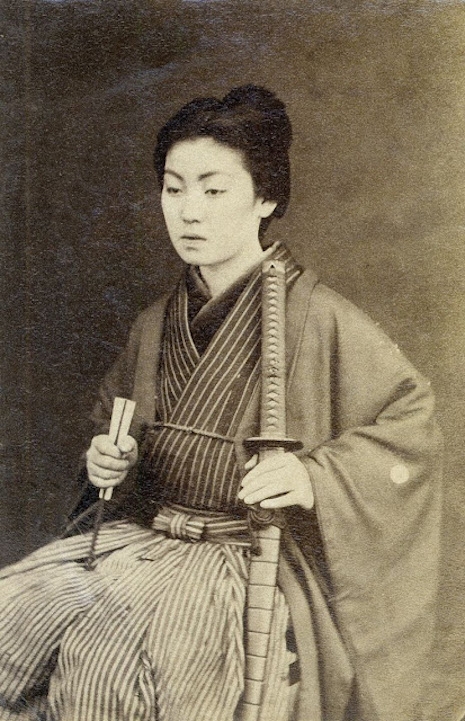
The female warrior in Japan

Often correspondents make me aware of articles they feel I’d be interested in. This was the case a while back when Vice featured one about Japanese women warriors. It’s definitely a topic I’m interested in and the actual information about the historical women warriors was pretty good, though it wasn’t anything I hadn’t seen before.

I did, however, take issue with the central argument of the piece, which right from the title, is these figures were “Erased from History”.¹ The claim both sensationalist and self-serving, of course, as the writer, Christobel Hastings, makes herself the discoverer of this lost information.

When did this erasure take place and by whom? I wondered, thinking immediately of the well-known exploits of Tomoe Gozen (巴 御前), among many others. The article seems to offer multiple theories: during the Tokugawa bakufu (徳川幕府, 1600–1868), the Meiji era (明治時代, 1868–1912), or by Westerners coming into contact with the culture.

Let’s look at these claims one at a time, beginning with the Tokugawa or Edo period (江戸時代). In the article, Hastings states:²

The advent of the Edo Period at the beginning of the 17th century brought a huge shift to the status of women in Japanese society. During these years, the dominant Neo-Confucian philosophy [宋明理學] and burgeoning marriage market heralded a radical change for the onna-bugeisha [女武芸者], whose status as fearsome warriors stood in stark opposition to the new order of peace, political stability, and rigid social convention.

The Edo period marked a shift for everyone in Japanese society. In particular, the historically landed samurai class (侍), were dispossessed and their property handed over to their feudal lords, the daimyō (大名). This left three options open to samurai, the first, and most unappealing one, was to become peasants, the second to become rōnin (浪人), which also meant leaving the country as it was at peace, or finally to find roles as paid retainers of the daimyō; essentially as aristocratic bureaucrats and administrators. In short, there was no place in Japan for warriors of any type, although of course these changes would have landed harder on onna-bugeisha.

Rulers at the end of the warring states period (戦国時代, Sengoku Jidai 1467–1615) sought to curtail the excesses of the warrior class in general, with both Oda Nobunaga (織田 信長) and his former retainer who came into power after him, Toyotomi Hideyoshi (豐臣 秀吉), conducting sword hunts (刀狩, katanagari) late in the 18th century—immediately prior to the ascendancy of the Tokugawa. The countryside was scoured and weapons confiscated under these edicts in order to prevent others from coming into power by force of arms, as these two just had done.

As to Confucian thought being a factor, paradoxically, it had come to Japan in the form of the ritsuryō (律令) system, which contained both administrative and criminal codes, well before the time Hastings suggests, during the Asuka period (飛鳥時代, late sixth century–710). Moreover, the system’s collapse during Japan’s medieval period—again immediately prior to Tokugawa rule—is what actually ushered in widespread patriarchy across Japan. Before these changes in the social order, for example, it was the norm for a man to marry into a woman’s family instead of the other way around.

Additionally, even as male-led family structures became the norm, exceptions could naturally be made among the aristocratic samurai class. A pair of letters sent by Toyotomi recently came to light, which were sent to his allies, the Munakata (宗像) clan, whose male head, Ujisada (氏貞) had recently died:³

Both letters were addressed to Saikaku [才鶴], showing that Hideyoshi acknowledged Ujisada’s wife as head of the Munakata clan.

In any case, as we saw with Huā Mùlán (花 木蘭), when Confucianism encountered the woman warrior where they wanted to see a devoted wife and mother, rather than “erasing” her, they simply altered the narrative to better fit their social dictates.

Hastings’ claims about the naginata (薙刀), a polearm with a sword-like blade, also struck me as odd:⁴

Martial arts training, therefore, was a means for a woman to practice servitude towards the men of the household, and cultivate an ordered, domesticated life free of the energies of war.

I was unable to find any support for this bizarre claim, but she attributed it to an article by Ellis Amdur, a martial arts instructor who does not provide any source for his information in his decidedly unscholarly work.⁵ The naginata was used ubiquitously in feudal Japan by samurai, ‌warrior monks known as sōhei (僧兵), as well as ashigaru (足軽)—general infantry, for entirely practical purposes: the weapon features the cutting prowess of the sword together with the longer range of a polearm, which also allows better ability to block and greater leverage in attacks.

Regardless, if the erasure of warrior women was supposed to have been effected during the rule of the Tokugawa, Hastings herself contradicts it by opening the piece recounting the deeds of Nakano Takeko (中野 竹子) who fought in the Boshin War (戊辰戦争) in 1868, one of the conflicts leading up to the Meiji Restoration (明治維新) later the same year and long past the reforms of the Edo period.

But let’s talk about the Meiji period in case this is when women warriors are meant to have been disappeared. The government actually outlawed all samurai, male and female, also making Nakano one of the last if not the last of this warrior class—that’s right, the last samurai may have been a female one, and sure as hell not Tom Cruise. Again, this woman warrior being active during the Meiji era flies in the face of Hastings’ claims as to any erasures having taken place during that time.

As for Westerners effecting an erasure of warrior women, Hastings presents no support for the idea. Such an effacement of a culture’s history would be rather unlikely to affect a people’s own views and as I’ve discussed in other articles, already during the Meiji era, foreign influence was being pushed back on, which became quite thorough during the subsequent Taishō era (大正時代, 1912–1926).

Nonetheless, as Hastings suggests, Westerners have fetishized Japanese women essentially from their first sight of them, with French naval officer Pierre Loti writing a nearly autobiographical account of an affair he had with Kane Kiku (金菊) when he was stationed in Nagasaki (長崎) in the summer of 1885.⁶ The work was highly successful, running to 25 editions in five years, and inspiring several other works, including Giacomo Puccini’s 1904 opera Madama Butterfly. Loti summed up his exoticist and reductive view as, “France for food, Japan for wives.”⁷

Writer Lafcadio Hearn, although also from the West (Greek-Irish by way of the US), settled in Japan, was married, had a family, and became a teacher. Understanding the culture on a much deeper level, he commented:⁸

Of course Loti is very unjust to the Japanese woman, and has not yet even learned that to understand the beauty of another race so remote as the Japanese, requires both time and study. It does not strike a European at the first glance. He knows also nothing about their morals or manners, and his divinations are all wrong on these subjects.

And so finally, there is a thread of truth here: I doubt you’ll hear much about Japan’s warrior women in a history class outside of the country unless you get in pretty deep. I may indeed have stumbled onto the germ of Hastings’ article, whence I conjecture an editor asking for its claims to be more far-reaching. It should probably have been something like:

Hey, Uneducated Roundeye, You Probably Haven’t Heard of Japan’s Warrior Women

Which actually would have been a good bet, but means this article is not directed at me. Not only did I live and work in Japan for several years, certainly researching history extensively while working on many of the highly accurate games based in Japan’s past my employer, Kōei (光栄) was famous for, but I also acted as research assistant for my wife when she produced a set of books about the nation’s history and culture as part of her master’s degree. She also went on to work at the US Japan Institute, with professor Mitsuko Saito Duerr, a noted expert in Japanese women’s studies.

As Hearn did, my wife and I came to understand Japanese culture on a deeper level, including the fact that while it appears patriarchal, the apron strings are strong, as writer Kaori Shoji notes:⁹

On the surface, Japan is entrenched in a fukenshakai (父権社会, patriarchal society), but if the nation’s women were to quit their chores en masse, the damage would be far more serious than any earthquake. This is probably why the kanji characters for state (国家, kokka) consist of kuni (, country) and ie (, house) and finances are often called daidokorojijyō (台所事情, kitchen circumstances).

This is why, for example, banks and insurance companies always target women in their advertising: with few exceptions, they are the financial decision makers of the household.

Another point of access to the Japanese traditions of the woman warrior for me was ukiyo-e (浮世絵), an art form I’ve been a fan of for quite a long time. Edo Japan being a closed society, there was a high degree of regulation and censorship of the arts, and even sumptuary laws dictating what the burgeoning merchant class could wear. As to art, even in the somewhat more open culture of late 19th century Britain, Leopold I of Belgium warned his niece, Queen Victoria:¹⁰

[D]ealings with artists, for instance, require great prudence; they are acquainted with all classes of society, and for that very reason dangerous.

Ukiyo-e was especially troubling as it was an art clamored for by the masses: beautiful, vividly colored works that, as they were prints, could be reproduced in vast numbers and sold cheaply. The Tokugawa government went from outright bans and punishment of artists to dictating everything down to the sizes of paper that could be used and heavy censorship of themes, content, and representations thereof. Artists were required to produce smaller scale black-and-white proofs of the works they intended to create and submit them for approval before they could proceed. The final prints feature government stamps showing they had been officially authorized. And there are many, many prints of female warriors.

So these woodblock prints tell a different story—they made it past the careful censorship of the Tokugawa administration, so they can’t have been controversial, and were included in series about warriors (musha-e 武者絵) rather than beauties (bijin-ga 美人画)—another extremely popular theme. We can only conclude the artists and the government wanted to celebrate their badassery without regard to gender.

And also, it seems without regard to origin: legendary warriors from China and Korea also appear in prints. When I worked on Bandit Kings of Ancient China,¹¹ a game based on the Chinese classic, Water Margin,¹² I created a black-and-white splash page image based on a woodblock print by Tsukioka Yoshitoshi (月岡 芳年), one of my favorite artists of all time. The image is of one of the main characters (and one of the most colorful ones), Lu Zhishen (魯智深, Japanese Rochishen), who is in the process of smashing the guardian statues of his own monastery, ’cause he’s drunk and crazy.

Later, while I was still working at Kōei, I visited Aomori (青森), at the northern end of Honshu (本州), Japan’s main island, for the Nebuta festival (ねぶた祭り), which presents heroic figures in colorful floats made of paper and lit from within. The imagery is closely connected with ukiyo-e both thematically and visually, and indeed some of the merch sold there was two-dimensional art. I selected a noren (暖簾) featuring Gu Dasao (顧大嫂, Japanese Kodaisō), somewhat personal to me from having worked on Bandit Kings, in which she appears. Her image adorned the doorway to our kitchen for many years and I regretted not knowing there were awesome ukiyo-e of this warrior woman such as this one by Utagawa Kuniyoshi (歌川国芳) when I was working on the game.


Notes

  1. Christobel Hastings, “How Onna-Bugeisha, Feudal Japan’s Women Samurai, Were Erased From History”, Vice, 2018.
  2. Ibid.
  3. Kunihiko Imai, “Hideyoshi acknowledged woman as head of samurai clan”, Asahi Shimbun, 2019. Note there’s a weird tradition of using the leader’s given name.
  4. Hastings, 2018.
  5. Ellis Amdur, “Women Warriors of Japan, The Role of the Arms-Bearing Women in Japanese History”, 2002.
  6. Pierre Loti, Madame Chrysanthème,1887.
  7. Ibid.
  8. Lafcadio Hearn, Letters, 1893–1894.
  9. Kaori Shoji, “Nadeshiko—adorable till they die”, The Japan Times, 2013.
  10. The Letters of Queen Victoria: A Selection from Her Majesty’s Correspondence Between the Years 1837 and 1861, 1907. The quote has appeared lately in a slightly pithier form and with various incorrect attributions.
  11. 『水滸伝・天命の誓い』 (Suikoden: Tenmei no Chikai—“Water Margin: oath of destiny”—Bandit Kings of Ancient China), Koei, 1989.
  12. 施耐庵 (Shī Nài’ān), 《水浒传》 (Shuǐhǔ Zhuàn, Water Margin), possibly mid-14th century.

Those Frumious Jaws

The self-aware failure of Black Mirror: Bandersnatch (Interactive Storytelling, Part 2)

Hardly one not to be late to a party, I noted the existence of Black Mirror: Bandersnatch (BM:B) more than a year ago, but only recently bothered to watch it. Gamedev circles were abuzz when it came out late in 2018—not only was it an interactive narrative, but it concerned the early history of gamemaking—so I was often asked if I had seen it and/ or told I should.

In brief, the story, written by series creator Charlie Brooker, concerns a young developer named Stefan Butler (Fionn Whitehead), working on a game incorporating interactive story elements in 1984. The protagonist’s psychological issues stemming from the death of his mother and deadline pressure from the company he’s working for propel the tale’s action.

Game nerds, naturally enough, gravitated towards discussion of where and how the story branched, and the number of endings there were. My focus was more on if or how the piece improved or expanded the form. Sadly, I can’t say it did.

Present was the foldback, the device I’ve mentioned before as a means of ending up with the same result while giving the appearance of choice. Ben Allen described the player experience of this in Radio Times

In some cases, we arrived at the exact same scene, just with different options.

Additionally, in our playthrough, some choices were repeatedly pointed to, which felt rather more like being led somewhere than choosing your own adventure. I believe it is the combination of foldbacks and forced decisions to which the NYT review refers, saying:²

[I]t’s the “decisions” masquerading as free will that are really frustrating.

Many reviewers and acquaintances alike pointed to the first few branches of the tale, which are quite innocuous and almost definitely inconsequential. The NYT piece reports:³

The minute choices you get to make, like which album he listens to, read as eye roll-worthy contrivances only a small child would get excited about.

As to the endings, Hollywood Reporter contributor, Jackie Strause says:⁴

[…] Brooker and Jones are clear as to not “prescribe” one ending over the others, especially because they couldn’t agree on what exactly defines one.

But this is BS; the ending where you have Stefan take his meds and the game is delivered on time as a commercial flop is clearly a bad ending, which also sends the swell metamessage it’s OK for artists to sacrifice their personal health and well-being to produce superior entertainment experiences. Even a rather effusive review from David Sims of The Atlantic finally notes the serious shortcoming of the endings:⁵

Through the various branches I found, I never got to an ending of “Bandersnatch” that felt truly happy or fulfilling, though I’m sure one exists; the best (and last) one I arrived at was, at least, somewhat peaceful and touching, if a little mournful.

The tone of Black Mirror itself might be what’s at work here and no good ending is intended, but as I noted in Part 1, bad endings are a common feature of the format. I “played” BM:B with my family and, as nearly everyone has at least a passing understanding of the form, we played it safe, routinely choosing whichever path seemed least likely to result in disaster. I’ve mentioned this aspect of the form as a way the branches are reduced, but it also acts as yet another way the form preempts choice—interesting or humorous options often are left unexplored. Atlas Obscura contributor Sara Laskow noted of another interactive narrative, Journey under the Sea:⁶

This book is particularly tough on readers. One analysis found that more than 75 percent of the endings are unfavorable or deadly.

Even apart from this unpleasant feature, the more general ways these works break the rules of traditional storytelling are not surprising and delightful but off-putting. What is lost is the reader’s ability to anticipate what will happen and either have those expectations gratified or thwarted by the author. Back in 1995, The Economist dedicated a lengthy editorial to the form, offering various criticisms, including the following mirroring mine:⁷

The snag with most electronic stories is that they tamper with the foundation of narrative structure. When stories wobble and change with our whim, they lose their believability, and with it our willingness to care. […]. But what the typical reader wants to know is: which is the right word to click on? Which path generates the closest thing to a satisfying linear story, the sort that life, experience and thousands of years of story-telling have taught us to expect? For every path taken, there is the path not taken. In frustration, we re-read the story, trying to exhaust all the possibilities in the search for the satisfying tale that surely must lie somewhere within.

So, if you take BM:B on the superficial level of an interactive narrative, it is a failure in all the usual ways such vehicles are. However, this film is self aware, saving it as art to an extent—as I already pointed out above, Brooker understands and subverts the expectations of someone playing it safe by giving them a mediocre ending for their trouble. The insignificant choices, such as which breakfast cereal Stefan should eat, the lack of real choice, including foldbacks and repeats, are there deliberately.”

Brooker is attempting to comment on the form rather than simply using it as a gimmick, as several critics have noted; Stefan even says, “Free will is an illusion.” The problem is, as I found viewing Hot Fuzz, the standard tropes are so goofy it’s hard to satirize them through exaggeration.

Right from the start, BM:B is self-referential, beginning with interactive narrative: the game Stefan is making is the same form as the film, and the game is based on a book that’s one too. Bandersnatch was also the title of a real game project from the period which not only failed to launch after being heavily hyped, but bankrupted the developer, Imagine Software. This is alluded to directly in BM:B with a cover of classic gaming mag Crash carrying news of the company’s closure. Finally, there is a scene in the film where Stefan can turn down the opportunity to make his game, mirroring the way Brooker and EP Annabel Jones initially turned down Netflix’ offer to make an interactive film. In both cases, they decide to do it anyway, but on their own terms.⁸

File:New-alice-bandersnatch.png

Another obvious Bandersnatch connection is to the Lewis Carroll creature. It appears in Through the Looking Glass in the famous nonsense poem “Jabberwocky”:⁹

“Beware the Jabberwock, my son!
the jaws that bite, the claws that catch!
Beware the Jubjub bird, and shun
The frumious Bandersnatch!”

The creature appears again in The Hunting of the Snark in greater detail,¹⁰ but the point in BM:B is multiple realities, such as the Looking Glass world of the Alice book. The film even contains a scene in which Stefan literally goes through a mirror, just as Alice does after conjecturing as to the existence of this other reality:¹¹

And certainly the glass was beginning to melt away, just like a bright silvery mist. […]. In another moment Alice was through the glass, and had jumped lightly down into the Looking-glass room.

Another such notion present in Carroll’s work is everything and everyone exists in the Red King’s dream and would disappear if he were to wake. Other references fly thick and fast in the film: to Philip K. Dick’s Ubik, with psychic spies in a world where the shape of reality shifts,¹² and Katsuhiro Otomo’s Akira, where powerful psychics cause people to be sucked into other dimensions.¹³

These allusions manifest in the film as theories held by different characters as to the nature of the reality they inhabit. One other is explored; that of a massive government conspiracy, which is present in both these last works, but particularly in Dick’s. This author got a little crazy, or at least obsessive himself, even attempting to kill his third wife, and in BM:B, some paths have Stefan murder his father. 

There’s also an awkwardness interactive narratives create with the separation between you, the player, and the character you are playing. This structure denies immersion in the role, as you telling them what to do is essentially a deus ex machina. A sampling of the dialogue between played and player points out this failing:¹⁴

  • “That’s not on fire.”
  • “That doesn’t need to be kept fresh.”
  • “Pick up the moon! Are you nuts?”

Again BM:B explores this space, with Stefan questioning and resisting your choices if they don’t seem natural to him, and therefore also criticizing you as a player. Eventually, he speaks directly to you, asking if someone is there and demanding to know who it is. In the film’s world, Stefan’s sense of an entity outside telling him what to do is seen as part of his growing psychosis, though we as the audience know at least on this score he’s perfectly sane.

Another element referring to the nature of interactive narrative is “the glyph”, essentially an upside-down squared-off ⟨Y⟩ Stefan obsessively draws in the film. This represents the branching structure, just as the Samian letter does, with a single path bifurcating to a pair leading to either virtue or vice. And as I’ve previously noted, the repeated branching needed in interactive narrative leads to the Lernian Hydra’s madness of geometric progression.

But all this impressive self-awareness fails to yield a good work of art. There’s high irony in the fact the film’s bad ending—Stefan’s safe production of a mediocre game—is the fate shared by BM:B itself, which received a tepid 72% Tomatometer score compared to the series’ overall 83% (update: it’s also aged poorly, dropping to 56%).¹⁵

I know my views on this type of storytelling risk cries of “treason”. Interactivity is an important element of games, which would seem on its face to suit it to the realization of interactive narrative. My goal in games is to give players meaningful choices supported by continued, engaging gameplay, so false choice is a huge pet peeve of mine as it runs directly counter to that. Interactive narrative regularly—some would say inherently—engages in false choices. Literature remains the main realm in which I’ve seen a possibility space created within a narrative for the reader to explore. Tellingly, although its setting and structure come from games, most of the references in BM:B are not to games but to print.

Umberto Eco codified and espoused what he termed the “open work” (opera aperta), based on the reading experiences he had enjoyed most, together with some postmodernist semiotic theories. In his works on the topic, he declares a “closed work”, one limiting the reader’s understanding to a single, unambiguous, linear interpretation is the least rewarding one—which I’ll note is essentially what interactive fictions do, but with bad storytelling and false choices along the way to make things even worse. By contrast, an open work creates an interplay between work and audience where infinite readings are possible.¹⁶

Eco’s starting point seems to have been James Joyce’s Finnegans Wake,¹⁷ which he describes thus:¹⁸

[Finnegans Wake] constitutes the most terrifying document of formal instability and semantic ambiguity that we possess.

I must confess to have washed out on a full reading of this book, but as with many games, I’d argue it’s not about getting to the end, but the journey. The difficulties in reading the book are down to the words themselves, many of which are invented. Take one of my favorite passages:¹⁹

Which we all like. Rain. When we sleep. Drops. But wait until our sleeping. Drain. Sdops.

The basic level of meaning here is, “we all like rain when we sleep, but wait until our sleeping stops.” but the breakup of the sentences is poetry—evoking the interruptive quality of the raindrops, whose sound intrudes on the meaning of the words themselves with the word sdops, which then also links to the Italian word sdoppiare, “to split in two”, and so on.

Eco sees such fields of possibility even within single words within Finnegans Wake, such as “meandertale”, which he discusses at length as to how it can be a pun on “Neanderthal” which appears nowhere in the text:²⁰

Our experiment thus has two senses: first, to see if, from a point outside Joyce’s linguistic universe, we can enter into the universe; then, departing from a point internal to that universe, to see whether or not we can connect, through multiple and continuous pathways, as in a garden where the paths fork, all the other points.

The reference to Jorge Luis Borges’ “The Garden of Forking Paths” is not accidental here as Eco was a fan of his works as well and for similar reasons.²¹ So here Eco is saying Joyce’s work is a successful realization of Borges’ concept of expanding possibilities in book form, and I agree.

Still, the qualities Eco sets forth for the creation of an open work are available to any medium; they are:²²

  • Dynamism
  • Indefiniteness
  • Ambiguity
  • Indeterminacy
  • Defamiliarization
  • Suggestiveness

I’m quite keen to produce a work in games incorporating these elements in order to build an active interplay between the audience and the work, generating meaning in constantly shifting ways, as Eco describes. But such a work would almost necessarily not be a commercial one, and unfortunately I need to earn a living.


Read subsequent articles in the Interactive Storytelling series

Part 3: Adventure Game Hijinx and Deconstruction

Part 3 Addendum: More Genre Coffin Nails


Read the previous article in the Interactive Storytelling series

Part 1: Lizzie’s Game


Notes

  1. Ben Allen, “How many endings does Black Mirror’s interactive film Bandersnatch have?”, Radio Times, July 2018.
  2. Aisha Harris, Margaret Lyons and Maureen Ryan, “‘Bandersnatch’ Has Many Paths, but Do Any of Them Add Up to Anything?”, NYT, January 2019.
  3. Ibid.
  4. Jackie Strause, “‘Black Mirror’s’ Interactive Film: How to Navigate ‘Bandersnatch’”, The Hollywood Reporter, December 2018.
  5. David Sims, “The Branching Horrors of Black Mirror’s ‘Bandersnatch’”, The Atlantic, December 2018.
  6. Sara Laskow, “These Maps Reveal the Hidden Structures of ‘Choose Your Own Adventure’ Books”, Atlas Obscura, June 2017.
  7. “Multimedia feature: Interactive fiction. But is it story-telling?”, The Economist, November 1995.
  8. Lewis Carroll, Through the Looking Glass, 1871.
  9. Ibid.
  10. Carroll, The Hunting of the Snark, 1876.
  11. Carroll, 1871.
  12. Philip K. Dick, Ubik, 1969.
  13. 大友 克洋 (Katsuhiro Otomo), 『AKIRA』 (Akira), 1982–1990.
  14. The first quote is from Grim Fandango, 1998, and the other two from Escape from Monkey Island, 1997.
  15. “Black Mirror: Bandersnatch”, Rotten Tomatoes (website), retrieved June 2020, and again in May 2025.
  16. Umberto Eco, Opera Aperta (The Open Work), 1962.
  17. James Joyce, Finnegans Wake, 1939.
  18. Eco, The Limits of Interpretation, 1990.
  19. Joyce, 1939.
  20. Eco, 1990; emphasis mine.
  21. Borges, “El jardín de senderos que se bifurcan” (“The Garden of Forking Paths”), 1941.
  22. Eco, 1962.

Hellenism, Schmellenism

Judaism’s rich curse traditions (Defixiones, Part 8/ Continuity of Magic from East to West, Part 5)

I hand over to you angels of disquiet who stand upon the fourth step, the life and the soul and the spirit of [name] son of [name] so that you may tie him in chains of iron and bind him to a bronze yoke. Do not give sleep, nor slumber, nor drowsiness to his eyelids; let him weep and cry like a woman at childbirth, and do not permit any (other) man to release him (from this spell).

I ran across this striking example of a curse to be inscribed on “a strip of lead pipe”.¹ The formula and physical form seem consistent with a defixio (lead curse tablet). In this series of articles, we’ve explored ancient Europe, the ancient Near East (ANE) and North Africa, but this example bears looking into and takes us further in the direction begun in the previous Part.

The source might be a bit controversial as the actual manuscript is dated quite late—from the late third century to early fourth CE. Still this text, the Sefer HaRazim (ספר הרזים‎, “Book of Secrets”, SHR hereafter), purports itself to be much older, having been given to Noah by Raziel (רזיאל‎), the “Angel of Mysteries”. Eventually it was passed down to Solomon (שלמה), renowned for his wisdom and mystical powers. Some see SHR as belonging to Hellenistic Judaism, while others see it as merely heretical. 

Nonetheless, I will attempt to establish here cursing is deeply ingrained in Judaic tradition, including some of the specific elements related to the defixio, as well as a continuity with the ANE praxes, which are ultimately the wellspring for this type of magic. This is to say even granting the influence of Hellenism on some of the specific content of the SHR, since Greek magic was based on ANE models, it would have easily resonated with people who had already long since been influenced by those same sources.

Genizah Manuscripts - Faculty of Divinity 50 Treasures

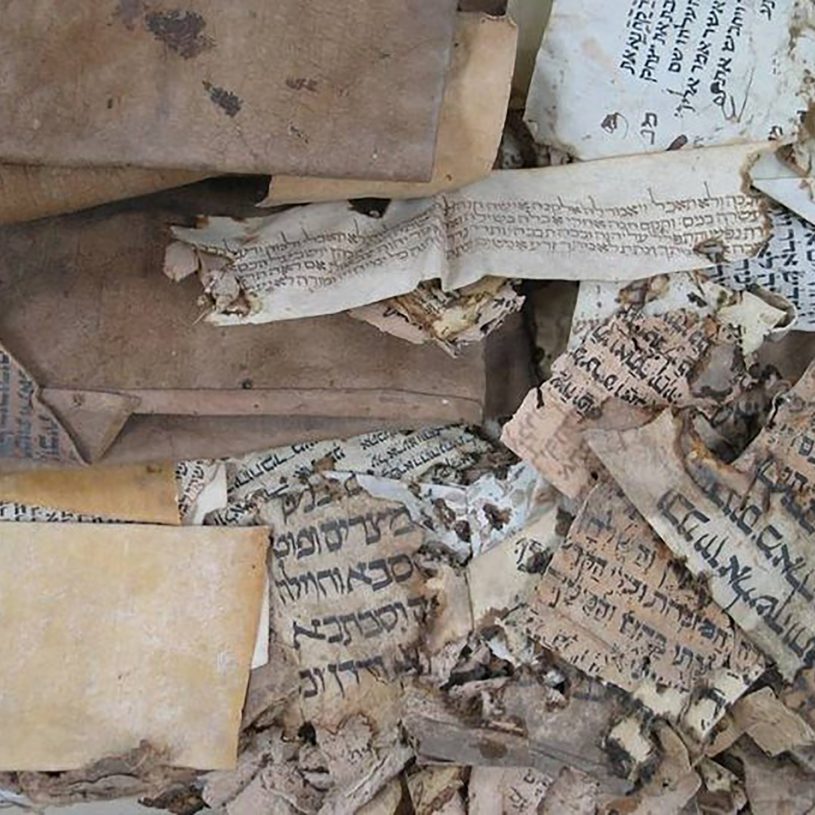
First a bit more about the source: the SHR was pieced together by Jewish scholar Mordecai Margalioth from a group of fragmentary manuscripts known as the Cairo Geniza in the mid-’60s. A geniza (גְּנִיזָה) is a storeroom of damaged sacred texts awaiting ritual burial. The dating is uncertain as much of the Geniza is still more recent, leading some to push for a still later date for the SHR, but there is no indication this book was original and not copied from still earlier versions. In fact, similar to a book of recipes, it was likely collecting previously extant scattered folklore and magical information into one cohesive treatise. And as we’ve seen, there is a general Western bias toward moving dates later for ANE materials.

There is actually some doubt about the entire concept of Hellenistic Judaism—implying a joining of Greek mysticism with Jewish religious tradition—as relates various texts, including SHR

Sefer HaRazim cannot be dismissed as mere magic and superstition. Nor can evidence […] hitherto considered to be “pagan,” be ignored, especially where the documents are shot through and through with Judaic allusions and possess little or no pagan references.

By contrast, actual Hellenistic Judaism comes from figures like Philo of Alexandria (Φίλων, AKA יְדִידְיָה, Yedidia). His works represent the height of syncretization between Greek philosophies, particularly Pythagoreanism and Stoicism, with the Torah. Historian David Miano notes some elements emblematic of Philo are:³

[T]he idea that the first man, Adam, was a transcendent being with superhuman qualities and mystical descriptions of the ascent of the soul through celestial spheres.

The bit of biblical evidence for cursing I provided in Part 7 was really aimed at establishing the practice among the Canaanites whose land the Israelites had moved into in the Book of Judges, adopting some of their customs. In short, I was looking at it as an outlier and didn’t expect to find a rich tradition within Judaism proper. But I was wrong—it’s everywhere—so I’ll end up quoting myself a bit here. As an example of how curse-laden the religious canon is, most of Deuteronomy 28 is taken up with imprecations against those failing to obey God.

One important element of cursing both in the Graeco-Roman world and in the ANE is that of the dead mediating help from (the) god(s): I’ve laid out the practice of depositing defixiones in necropoleis and, as we saw in the previous Part, Assyrian texts present remedies for when one’s figurine has been “handed over to Eresh’k’ikala (𒀭𒊩𒆠𒃲, Queen of the Underworld) in dilapidated places,” which is to say tombs, where one who is dead performs this mediative function.⁴

While this may seem to some to be at odds with Judeo-Christian values, it’s actually been there since way before Christendom’s reliquaries of saints’ body parts. The tomb of Rachel at the north entrance to Bethlehem has been a place of pilgrimage from ancient times—i.e., before Israel was subjugated by the Neo-Assyrians in 722 BCE—to this very day, with barren women visiting to pray directly to the matriarch to grant them progeny. David, Maimonides, and Rabbi Simeon Bar Yochai, apparently also fall into this category. Such a deceased matriarch or patriarch is:⁵

[…] privy to the requests of supplicants and himself has, as it were, the ear of the deity. That the deceased constitutes an active intermediary, rather than a passive instrument of communication, seems evident in that prayer may be addressed to the deceased rather than to a divine being. More properly put, the deceased has become a divine being in some serious sense, and therefore like God or an angel, may be efficaciously beseeched in prayer.

Another divine agency to which the petitioner can appeal are angels, as can be seen in the formula from SHR. This might seem strange at first blush, but as professor of Jewish studies Philip S. Alexander notes:⁶

[A]ngels, shockingly, function like demons […] there is no moral dimension to the ill that they are required to inflict.

Again, this is not at all out of line; the distinction between angels and demons is a fairly recent one in the Judeo-Christian milieu, likely entering post-biblical Judaism under the influence of Zoroastrianism—which sees the world as a battleground between the forces of good and evil—and transforming them into the semi-divine benevolent beings familiar to us today. The word itself comes down to us from Mycenaean Greek a-ke-ro (probably angelos, similar to Modern Greek) simply meaning “messenger”, probably via a Semitic loanword with a related meaning, ’engirtā (𐡀𐡍‬𐡂𐡓𐡕‬𐡀‎ “message”). The term demon in fact has similarly ambivalent origins, coming from Ancient Greek δαίμων (daimon) simply meaning a deity.

As we can see from the SHR formula we started with, one cursed is “handed over” to these angels who are meant to cause physical harm. Of one such group of angels, the SHR reports:⁷

There is no mercy in them but they (wish) only to take revenge and to punish him who is delivered into their hands.

Persuasive analogy is another key element of sympathetic magic, one seen everywhere in the Graeco-Roman context, as well as in the ANE, for which I provided an example in the previous Part from the third millennium BCE:⁸

tukkats’tsakin khekats’kats

May it be smashed to bits like a pot!

Which would also have had the supplicant physically break a pot.

Not only are such persuasive analogies part and parcel of Judaic cursing, as we can already detect in the SHR one, but this exact analogy is also present in the Book of Jeremiah, with the titular prophet being told by God to, “Get a potter’s earthen bottle and go to the valley of the son of Hinnom,” and:⁹

Then shalt thou break the bottle in the sight of the men that go with thee, and shalt say unto them: Thus saith the LORD of hosts: Even so will I break this people and this city, as one breaketh a potter’s vessel, that cannot be made whole again.

Here the divine agent is the divine agent, God himself:¹⁰

Whilst divine agency features in many curses (especially in Tanakh), in imprecatory cursing, God is explicitly addressed through prayer as the one who will inflict physical suffering in the form of a curse upon another.

The SHR also carries on the pot-breaking tradition, prescribing a rite using “unfired pottery vessels” which are to be broken:¹¹

[A]ccept from my hand at this time that which I throw to you, to affect N son of N, to break his bones, to crush all his limbs, and to shatter his conceited power, as these pottery vessels are broken. And may there be no recovery for him just as there is no repair for these pottery vessels.

Lest you think there’s still a significant difference in character between Biblical curses and the ones from this text on black magic in spite of the similar themes and rhetoric applied to both, let’s get down and dirty. Here is one from Psalm 109. The psalmist is falsely accused by his enemies, who seek to have him tried and put to death. He begins with a direct address, “O God, whom I praise, do not remain silent”, asking for vengeance against those who have wronged him. The subsequent text resonates with the plea for justice type of defixio, where quite explicit and exaggerated punishments are called for. Further, reversals appear as well as various other persuasive analogies:¹²

Let his days be few;
Let another take his charge.
Let his children be fatherless,
And his wife a widow.
Let his children be vagabonds, and beg;
And let them seek their bread out of their desolate places.
Let the creditor distrain all that he hath;
And let strangers make spoil of his labor.
Let there be none to extend kindness unto him;
Neither let there be any to be gracious unto his fatherless children.
Let his posterity be cut off;
In the generation following let their name be blotted out.
Let the iniquity of his fathers be brought to remembrance unto the LORD;
And let not the sin of his mother be blotted out.
Let them be before the LORD continually,
That He may cut off the memory of them from the earth.
Because that he remembered not to do kindness,
But persecuted the poor and needy man,
And the broken in heart he was ready to slay.
Yea, he loved cursing, and it came unto him;
And he delighted not in blessing, and it is far from him.
He clothed himself also with cursing as with his raiment,
And it is come into his inward parts like water,
And like oil into his bones.

It ends with a sort of ex-voto oath, telling what the psalmist undertakes to perform if the aid he asks is given: “With my mouth I will greatly extol the LORD; in the great throng I will praise him.” 

In general, biblical scholars are clearly uncomfortable with these passages and attempt to dismiss them in various ways—these things are not meant literally, they belong to magic and not religion, the curses are actually those of the psalmist’s enemies—but their objections ring false. Here’s another quite explicit curse formula taken from the Qumran version of Deuteronomy:¹³

They shall begin to speak and shall say: “Accursed are you for all your wicked, blameworthy deeds. May God hand you over to terror by the hand of all those carrying out acts of vengeance. May he bring upon you destruction without mercy, according to the darkness of your deeds, and sentenced to the gloom of everlasting fire. May God not be merciful when you entreat him. May he not forgive by purifying your iniquities. May he lift the countenance of his anger to avenge himself on you, and may there be no peace for you by the mouth of those who intercede.”

Just to put a fine point on it, let’s date the sections of the Bible we’re looking at here: Jeremiah’s ministry was active from around 626-587 BCE and the eponymous book of the Hebrew Bible was set down soon afterward—at the latest by the end of the same century. The last of the Psalms likely come from the post-Exilic period, that is the fifth century BCE, so the one quoted above would be some time before then.

Finally, Deuteronomy, meant to be authored by Moses, is generally agreed to date from between the seventh and fifth centuries BCE, with the actual Qumran manuscript coming from somewhere between the last two centuries BCE and the first century CE, but almost necessarily drawing on earlier material. Meanwhile, the period of Hellenism is 323–31 BCE, so only the Qumran Deuteronomy and the Geniza SHR have actual overlap. Also, despite Graeco-Roman curses presenting numerous, colorful persuasive analogies, I haven’t seen pot-smashing appear except in the ANE and the examples above.

So while there may have been some Hellenizing influence on the SHR, it seems the Judaic curse tradition was already present, much of it drawn directly from the same culture that influenced those Western praxes. This is likely why, assuming there were any Greek materials introduced, they would have resonated with those clearly already in existence among Jewish mystics, found favor, and been incorporated into the SHR.

As to the idea the SHR is a heretical text, according to professor of Jewish thought and folklore, Yuval Harari, it seems to have been quite popular in Judaism and beyond….¹⁴

[…] during the Byzantine period [395–1453] and the subsequent centuries. Near the turn of the millennium it was mentioned by Karaite leaders as a paradigm of the “Rabbanite books of magic.” It was repeatedly copied in both Europe and the Muslim world and was partially embedded in the most influential magic compilation Book of the Angel Razi’el.

So those wishing to denounce the SHR today are really just trying to rewrite history.


Read subsequent articles in the Defixiones series

Part 9: The Celtic Undercurrents at Bath


Read previous articles in the Defixiones series

Part 1: The Curses of Aquae Sulis

Part 2: Malefic Traditional

Part 3: Sympathy for Sauron

Part 4: Bargaining with the Gods

Part 5: Secundina’s Beef

Part 6: More Than Money Can Buy

Part 7: The Punic Curse Trail


Read subsequent articles in the Continuity of Magic from East to West series

Part 6: Myth and Magic in the Cultural Koiné

Part 7: Lux Orientis

Part 8: No Ewoks, Only the Dead


Read previous articles in the Continuity of Magic from East to West series

Part 1: The Griffin and the Phoenix

Part 2A: Hark, a Haruspex!

Part 2B: Go West, Young Mantis

Part 3A: Coda Etrusca

Part 3B: Devoted More Than All Others

Part 4A: Romancing the Hellenes

Part 4B: The Chthonian Connection


Notes

  1. Michael A. Morgan, Sefer HaRazim: The Book of Mysteries, 1983.
  2. Jack Lightstone, “Christian Anti-Judaism in its Judaic Mirror: The Judaic Context of Early Christianity Revised”, Anti-Judaism in Early Christianity, Volume 2: Separation and Polemic, Peter Richardson, David M. Granskou, Stephen G. Wilson eds., 1986.
  3. David Miano, “Who was Hermes Trismegistus? The Hermetica Explained”, World of Antiquity, April 2021.
  4. Text 34, Graham Cunningham, Deliver Me from Evil: Mesopotamian Incantations, 2500–1500 BC, 1997.
  5. Lightstone, 1986.
  6. Philip S. Alexander, “Sefer Ha-Razim and the Problem of Black Magic in Early Judaism”, Magic in the Biblical World: From the Rod of Aaron to the Ring of Solomon, T. E. Klutz, ed., 2004.
  7. Morgan, 1983.
  8. Text 62, Cunningham, 1997. I have used my own transliteration and translation.
  9. Jeremiah 191-15, The Holy Scriptures According to the Masoretic Text, a New Translation, Jewish Publication Society (JPS Tanakh), 1917.
  10. David Raymond Smith, “‘Hand this man over to Satan’: Curse, Exclusion and Salvation in 1 Corinthians 5”, 2005.
  11. Morgan, 1983.
  12. Psalm 109, JPS Tanakh.
  13. 4Q11:1-6, Dead Sea Scrolls.
  14. Yuval Harari, “Sefer ha-Razim (the Book of Mysteries) (Jewish magical text)”, The Encyclopedia of Ancient History, Roger S. Bagnall, Kai Brodersen, Craige B. Champion, Andrew Erskine, and Sabine R. Huebner, eds., 2012. Not anthropologist and historian Yuval Noah Harari—this is a different guy.

Devoted More Than All Others

The Etruscan affinity for esotericism (Continuity of Magic from East to West, Part 3B)

I’ve remarked already on the sparsity of Etruscan inscriptions, but might’ve given the wrong impression. There are actually thousands, although many are quite short—limited to just names of people or places. I related in Part 3A the script is closely related to Greek and also quite close to Phoenician, the ancestor of both alphabets. The presence of Etruscan 𐌎 modeled on Phoenician 𐤎 which only appears in later Greek as Ξ, and the reading direction suggest direct transmission from Phoenician. Still, Euboean Greeks (Εὐβοῆς) were present on the Italic Peninsula at the same time (at least by circa 700 BCE)¹ so there certainly could have been multiple influences. At any rate, because the Etruscan script is easily read and our understanding of the lexicon has improved greatly in recent years, most of these inscriptions can be understood, with only the longest ones presenting some difficulties especially from the occasional hapax legomena, and even those can be guessed at from the context.

One of the best known of these comes from the Pyrgi tablets, which are important as a key to the Etruscan language and evidence of direct contact between this people and the Phoenicians. The artifact comprises three gold tablets and a fourth fragmentary bronze one, with the third of the gold ones inscribed in both languages. It comes from the Tyrrhenian coast where the port for the southern Etruscan town of 𐌀𐌓𐌔𐌉𐌀𐌊 (Kaisra, L. Caere; for whatever reason, we only know the Latinized form of the Greek name of the port, Πύργοι) once stood. The tablets record the dedication in around 500 BCE of a shrine to a syncretized 𐤏𐤔𐤕𐤓𐤕-𐌉𐌍𐌖 (Uni-ʿAshtart) by Kaisra’s king, 𐌔𐌀𐌍𐌀𐌉𐌋𐌄𐌅 𐌄𐌉𐌓𐌀𐌚𐌄𐌈 (T’efarie Welianas). ʿAshtart is an extension of the Sumerian Inanna (𒈹), “Queen of Heaven”, whom the Assyrians called Ishtar.

The alliance of the two peoples is shown by one of the most important events in the reign of Ἱέρων Α (Heiron I) of Syracuse (Συρακοῦσαι): the defeat of an Etruscan-Phoenician fleet at the battle of Κύμη (L. Cumae) in 474 BCE. The Syracusan tyrant commissioned Πίνδαρος (Pindar) to compose an epinician ode—his first Pythian Ode—recounting this deed and we have an Etruscan helmet inscribed in Greek and dedicated as a votive at the sanctuary at Ὀλυμπία (Olympia) for another attestation.

What is both remarkable and handy for my subject is the overwhelming majority of Etruscan texts were of a religious nature. As Livy put it in his History of Rome

[…] gens itaque ante omnes alias eo magis dedita religionibus, quod excelleret arte colendi eas […]. 

[The Etruscans were] a nation which was devoted more than all others to religious practices, because it excelled in the art of cultivating them […]. 

Because of how influential the Etruscan culture was on the Romans’, it can be quite difficult to disentangle the two. Nonetheless, Roman writers such as Livy and Cicero tell us about the things they borrowed from their neighbors, including that these people had a rather vast and detailed body of writing codifying their religious rites; texts referred to in Latin as the Etrusca disciplina. Although they are mostly lost, their names as rendered into Latin and general contents are known:

  • Libri Fulgurales: divination from lightning
  • Libri Haruspicini: divination from animal entrails
  • Libri Rituales:
    • Libri Acherontici: the afterlife
    • Libri Fatales: founding cities and sacred places
    • Libri Ostentaria: interpreting prodigies

There were also the Libri Tagetici and the Libri Vegoici, which included the revelations of the prophet Tarkhies (𐌔𐌄𐌉𐌗𐌓𐌀𐌕, L. Tages) and the prophetess Wecu (𐌖𐌂𐌄𐌅, L. Vegoia) respectively. Finally, according to one fourth century Latin writer, Maurus Servius Honoratus, there was yet another set discussing animal gods.

Tarkhies is a particularly important legendary figure, who is said to have emerged from a plow furrow resembling an infant, but with adult features. He proclaimed his doctrine to a large assembly of leaders of the Etruscan people. This event occurred in Tarkhna (𐌀𐌍𐌗𐌓𐌀𐌕, modern Tarquinia) one of the oldest and largest of the civilization’s cities, whose name may also derive from the prophet’s. 

Although the actual disciplina is elusive, there have been advances in study and newly unearthed artifacts have illuminated the period in which the books were originally set down and propagated. First, this time has been identified as beginning in the 9th and extending to the seventh century BCE, and many of the details about the disciplina are confirmed by secondary evidence.

Furthermore, as I have discussed, the art of haruspicy in particular is both a major element of Etruscan mysticism as well as a strong connection to the Mesopotamian origins of such practices across the ancient Mediterranean and indeed Europe generally. Just to return briefly to the etymological connections, Greek τέρᾰτᾰ, “signs, omens, portents” of uncertain origin in dictionaries, seems quite close to Akkadian têrtu, meaning “divine instruction” which was used specifically to refer to liver reading, also connecting to the name 𐌀𐌉𐌔𐌄𐌓𐌄𐌕 (Teresia), meaning “that from beyond”, found in Etruscan, and also in Greek as Τειρεσίας (typically Romanized as Tiresias), a long-lived blind Theban (Θηβαῖος) soothsayer of myth.

cuneiform DI.RI.DA
têrtu: “divine instruction”

Again, it’s hard to separate the Roman practices from the Etruscan ones as haruspices were fully integrated into the cultic practices of the former, but those rites seem to have been of clearly Etruscan origin. Despite a few fourth century prohibitions, this form of divination continued on into Late Antiquity (third–eighth centuries CE). Indeed, the influence can be seen in Greece, where some of the Etruscan elaborations of the technical science appear in their rituals as well.

As I mentioned previously, the main reason the art seems to have remained Etruscan even after the culture’s absorption is it was passed from father to son. This is explicitly described in many Roman sources, including repeated references by Cicero and explicitly by Tacitus, thus:³

[P]rimoresque Etruriae… retinuisse scientiam et in familias propagasse […].

Noble Etruscans retained this knowledge and passed it down to their families […].

And here we come to one of those rare but important pieces of the corpus of the Etruscan language. It’s also a primary source on the timeline of liver divination in Etruria: the third century sarcophagus of Laris Pulenas, (𐌔𐌀𐌍𐌄𐌋𐌖𐌐 𐌔𐌉𐌓𐌋) also from Tarkhna. Typically, these sarcophagi bear little more than the name of the deceased, but the sculpted image of this one includes Laris holding an inscribed volumen (scroll), with nine lines discussing his lineage, accomplishments, and offices.⁴

akg-images -

The operative lines here are the opening ones:

Laris Pulenas, son of Larce, grandson of Lart’, grandson of Welt’ur, great grandson of Pule Laris Creice […] he wrote this book of haruspicy.

In Etruscan art, the practice is represented from circa 450–400 BCE, with images of famous prophets appearing in the mid-fourth century and realia, such as liver models in the third and second centuries. Images on the backs of mirrors are common, such as the one I included in Part 2B, depicting the mythic soothsayer 𐌔𐌀𐌗𐌋𐌀𐌗 (Khalkhas, L. Calchas) in a characteristic pose with his left foot resting on a rock, holding the liver in his left hand and examining it with his right. Again, it’s clear this strong continuity reflects a practice that has to have existed from the Archaic period (600–480 BCE) and have become progressively more widespread.

The inscription on Laris Pulenas’ sarcophagus also matches entirely with the idea of the heredity of divinatory art among the Etruscans, which, taken together with the other evidence, can only lead one to conclude the art was well established and documented by the Etruscans at least as far back as the Roman Kingdom (753–509 BCE), making the Orientalizing period (ca. 730–580 BCE) seem still more probable as the point of its transmission from the ancient East.

Turning to the Ancient Near East (ANE), we also see a clear model for the hereditary tradition of esotericism in cuneiform documents:⁵

The secrets of ashipu-art, the knowing one shall show them to the knowing one; he who does not know does not see them; to your son whom you love, make him pronounce the name of god Asallukhi and god Ninurta, and show him.

This carries on into the Judaic tradition, a common occurrence as we have already seen. Such lineages are taken for granted to such an extent Amos feels he must point out his mystical abilities were not gained in this way:⁶

I was no prophet, neither was I a prophet’s son; but I was a herdsman, and a cultivator of sycamores: and Jehovah took me from following the flock, and said unto me, “Go, prophesy unto my people Israel.”

As to the other forms of divination rounding out the disciplina, they again follow on models clearly present in the ANE, where the close observation and interpretation of natural phenomena as a system of signs from which knowledgeable priests could understand the will of the gods.

One of the loci for the direct transmission of the arts from the Near East to both the Greeks and Etruscans is a mixed population of these two peoples and Phoenicians in a community on the island now known as Ischia, but known then as Πιθηκοῦσαι (Pithekousai) or 𐌄𐌌𐌉𐌓𐌀 (Arime) both deriving from their respective words for “monkey”—presumably there was a Phoenician word for the place as well but it is lost to us. This settlement began in the eighth century BCE and was home to as many as 10,000 people by 700.

File:Chimera d'arezzo, fi, 04.JPG

Votives point both forward as a common Graeco-Roman practice as well as back to those of the ANE. There is a large body of Etruscan anatomical votives, seemingly given at shrines in thanks for healing the corresponding part of the donor, as well as a variety of household goods. One sanctuary in Tarkhna held an axe head, a musical horn, and a round shield, the latter two of which were deliberately destroyed so they could only be used by the god. The Chimera of Arezzo (ca. 420–380 BCE, Etruscan 𐌌𐌉𐌕𐌉𐌓𐌀 Aritim) stands as one of the finest examples of the culture’s art, but also served this function, as it was found with other votive objects, and its right foreleg bears an inscription reading:⁷

𐌋𐌉𐌅𐌂𐌔𐌍𐌉𐌕
TINSCWIL
Offering of Tinia

𐌀𐌉𐌍𐌉𐌕 (Tinia) being the sky god at head of the Etruscan pantheon.

As for the chimera, we’ve seen already such beasts were favored in Mesopotamia and this one’s a doozy, which has a clear prototype from the Neo-Hittites in Carchemish dating from the ninth century BCE—instead of a goat’s head it incorporates a human one and it has wings, another common feature of ANE beasts. The rich and detailed demonology of the Etruscans also contains many winged creatures.

So it seems the magical traditions of the ANE found a receptive audience in the Etruscans, who continued to refine and codify these arts. These were later adopted by the Romans, and to some degree the Greeks as well, eventually spreading across much of Europe.


Read subsequent articles in The Continuity of Magic from East to West series

Part 4A: Romancing the Hellenes

Part 4B: The Chthonian Connection

Part 5: Hellenism, Schmellenism

Part 6: Myth and Magic in the Cultural Koiné

Part 7: Lux Orientis

Part 8: No Ewoks, Only the Dead


Read previous articles in The Continuity of Magic from East to West series

Part 1: The Griffin and the Phoenix

Part 2A: Hark, a Haruspex!

Part 2B: Go West, Young Mantis

Part 3A: Coda Etrusca


Notes

  1. This terminus ante quem comes in the form of an abecedarium from Marsiliana.
  2. Titus Livius, Ab Urbe Condita Libri (Books from the Founding of the City), 5.1.6, 27–9 BCE.
  3. Marcus Tullius Cicero, De Divinatione (Concerning Divination), 1.92, 44 BCE, Pro Caecina (For [Aulus] Caecina), sometime between 71 and 69 BCE, and Publius Cornelius Tacitus, Annales (Annals), 11.15, ca. 115–ca. 120 CE
  4. Corpus Inscriptionum Etruscarum, n.5430.
  5. Moshe Weinfeld, The Organizational Pattern and the Penal Code of the Qumran Sect, 1986.
  6. Amos 7:14. I’ve composited a few different versions for clarity.
  7. Museo Archeologico Nazionale, Florence, inv. 1.

Descent into the Absurd

Religio-Moral Exoticism (Logic of Lies, Part 5/ Gladwellocalypse, Part 3)

Some of Malcolm Gladwell’s critics say he’s a stupid person’s idea of a smart person. His enthusiasts refute that, one such describing his process of popularizing intellectual thought in his books and podcasts as:1

[U]nearthing material lying dormant in the rarefied realms of academic psychology, sociology and anthropology and shooting bolts of narrative electricity through it.

Even though it had been my intention to stop writing about Gladwell—and indeed, I had never intended this to be a series at all—the Gladwellocalypse was in full swing during this last season of Revisionist History (RevHist) to such a degree I couldn’t ignore it.

I still usually enjoy Gladwell; when he’s the interviewee on a show I might not normally tune in to, I will. There are several topics on which he can contribute reliably, such as the US’ broken system of higher education and he’s hardly ever dangerously uninformed, like many hosts of political satire programs.

At base, the type of criticism pushed back on here is one strongly rooted in elitism, specifically the notion that mere accessibility invalidates something as intellectually worthwhile. Gladwell himself notes that such popularization is literally what his process is about, with an added kiss-off to any such critics:2

If you’re in the business of translating ideas in the academic realm to a general audience, you have to simplify […]. If my books appear to a reader to be oversimplified, then you shouldn’t read them: you’re not the audience!

His work along these lines has led many to hail him as a “public intellectual”, but a different bearer of that same title, Umberto Eco, has also warned against the dumbing down of culture for capitalistic ends:3

The culture industry appeals to a generic mass of consumers (for the most part quite unaware of the complexities of specialized cultural life) by selling them ready-made effects, which it prescribes along with directions for their use and a list of the reactions they should provoke.

At a certain point when no sources are cited or incorrect information is given, the public intellectual becomes a pop intellectual.

One work directly relating to the Italian semiotician is The Da Vinci Code, widely known to have borrowed its plot and details from Eco and the sources he was satirizing in Foucault’s Pendulum (Il pendolo di Foucault). Dan Brown’s particular take on the popularization of material from the intellectual realm had some predictable consequences because of his lack of real research and careless use of unreliable sources. When these are unraveled, it’s a descent from bad to worse to dismal:4

[T]he legitimacy of the Priory of Sion history rests on a cache of clippings and pseudonymous documents that even the authors of Holy Blood, Holy Grail suggest were planted in the Bibliotheque Nationale by a man named Pierre Plantard. As early as the 1970’s, one of Plantard’s confederates had admitted to helping him fabricate the materials, including genealogical tables portraying Plantard as a descendant of the Merovingians (and, presumably, of Jesus Christ) and a list of the Priory’s past “grand masters.” This patently silly catalog of intellectual celebrities stars Botticelli, Isaac Newton, Jean Cocteau and, of course, Leonardo da Vinci—and it’s the same list Dan Brown trumpets, along with the alleged nine-century pedigree of the Priory, in the front matter for The Da Vinci Code, under the heading of “Fact. Plantard, it eventually came out, was an inveterate rascal with a criminal record for fraud and affiliations with wartime anti-Semitic and right-wing groups.

Eco is hardly heavy-handed on the score of morality, but as a former Aquinian scholar, his works are almost necessarily steeped in it. Simon Simonini, who creates the real-life hoax of The Protocols of the Elders of Zion in Eco’s The Cemetery of Prague, is clearly portrayed as an evil man perpetrating an evil deed.

While Eco portrays the scheme at the heart of Foucault’s Pendulum as a misguided game, Brown fully endorses a similar plot, portraying it as fact, and even winning some lawsuits arising from his work through use of the claim that history can’t be plagiarized. Although the content of the two works is similar, the intent is thus completely opposite: Where Eco’s is a postmodern look at the irrationality of the universal conspiracy theory, Brown’s is a post-ironic embrace of alternate facts.

Also, a bit of inaccessibility is neither here nor there to me; I’d never condemn anyone for being readable, but I’ll also do what it takes to get to the information I’m looking for, up to and including learning a smattering of dead languages. I enjoyed the weighty opening chapters of each book of Les Misérables as setting up important historical, political, and philosophical context before diving back into the melodrama. I appreciated the way the density of Joseph Campbell’s writing early in The Masks of God acts in a medium-is-the-message manner as an initiation into the mysteries therein revealed. I’m definitely not down with slogging through a bone-dry read with no payoff though and even when Gladwell is wrong, at least he’s still typically entertaining.

No, my critique is different. The tagline for the RevHist informs us it’s:⁵

[A] podcast about things overlooked and misunderstood.

But there are reasons some things have been forgotten and also reasons they should remain so. Or, in the case of casuistry, the topic on which Gladwell dwells for three full episodes, rather than needing to be rehabilitated as he attempts, it is precisely that type of history which should be studied so it might not be repeated.

In brief, casuistry is a process of reasoning which reached its height in the mid-16th to mid-17th centuries under the Jesuits. The term remains one almost universally used in a pejorative sense, which is indeed the history Gladwell is trying to revise.

I’m hesitant to dive into a diatribe about a religious group; my general attitude is live and let live, although I don’t partake. And I must also acknowledge that my point of view is decidedly Anglocentric. Therefore, all forms of Catholicism carry some amount of negativity to me, but there are plenty of other well-known reasons apart from that. It’s also important to note that Gladwell is not a Catholic either, and so seems to engage in a bit of religio-moral exoticism here.

So let’s turn the clock back to Elizabethan England (1558–1603). When the Religious Settlement put the capstone on the Reformation, Continental powers sent Jesuits to the island to sow dissent, up to and including assassinations and violent overthrow of the government.

One such was the Babington Plot, which saw Jesuit priest John Ballard recruit Anthony Babington into a French-backed plan to assassinate the queen, support a Spanish invasion of England, and finally place the Catholic Mary Queen of Scots on the throne in her stead. Double agents uncovered the scheme, which ended instead with 15 conspirators executed, including Mary herself.

A still more extreme plan was hatched during the reign of James I, which, had it been successful, would remain to this day the largest act of religious terrorism ever. The Gunpowder Plot, also known as the Jesuit Plot, would have blown up Parliament during the State Opening, killing not only King James and his close relatives but much of the aristocracy, the Privy Council, the senior members of the legal system, and the heads of the Church of England as well. By any estimation, England would have been plunged into chaos, and it’s likely its existence as an independent nation would have been at serious risk.

And the thing that allowed all this subterfuge, all this covert plotting and planning, was—you guessed it—casuistry. The specific fruit of the process at play here was termed mental reservation, or more simply, equivocation, or still more directly, lying. Lying was considered a serious sin to this point, but the Jesuits reasoned that where justice and truth came into conflict, justice had to trump truth, terming it a “lie of necessity”.

Casuistry additionally offered convenient justifications for other previously morally inexcusable but highly desirable acts, including usury, homicide, and regicide.

Mathematician, physicist, inventor, and philosopher Blaise Pascal derided and satirized the process, the TL;DR version of which is that casuistry could be used to justify just about anything.⁶ Indeed, the use of the process to wriggle out of any moral quandary rendered the term Jesuitic a synonym for cunning or deceitful.

Even contemporary Catholics broadly condemned the order, and specifically its deployment of casuistry: immediately upon his 1676 accession, Pope Innocent XI condemned 65 of the Jesuits’ propositions as “laxorum moralistarum” (lax moralities) and forbade their teaching on pain of excommunication, focusing especially on mental reservation.

Non-Catholics, especially in England, were still less pleased with the order and its works, with someone cited simply as “a recent English author” in 1845 commenting:⁷

[T]he Jesuit […] conceals his right name, hides his real object, contracts his brow and disowns his party, [he] is as contemptible as he is dangerous, and to be scorned as much as he is to be feared. […] The unblushing Infidel, the bold and reckless Atheist can be better met, and is a far less dangerous foe to Christianity, than the slippery, turning, vanishing, masking, equivocating Jesuit.

Gladwell digs into some of the controversial early modern uses of casuistry with Father James Keenan, a Jesuit theologian. Together they present these problems as straw men and fully endorse with a handwave the justifications that plunged the order into centuries of disrepute.⁸

In modernity, there has been a revival of casuistry based on the notion that it was not the process itself that was the problem, but its abuse. This is closely akin to the slogan, guns don’t kill people, people do. I’ve never understood how this has been used as pro-gun; yes, people are fallible, so giving them the means to act in drastic and irreversible ways is inherently a bad idea. A quite similar saying but with entirely the opposite intent is present in Japanese:

気違いに刃物
kichigai ni hamono
(don’t) give a knife to a crazy person

To their credit, in more recent years, the Jesuits have become more progressive than the Vatican on a variety of topics, including HIV/AIDS, homosexuality, and abortion. Gladwell brings up one such area, birth control,⁹ without establishing in any way that casuistry was at work in the narrative he spins. The other episodes misapply casuistry to topics having nothing to do with the order or its practices. He sums up the case he is trying to build for casuistry thus:¹⁰

St Ignatius Loyola […] gave his followers a set of moral instructions: to set aside principle, to descend into the particular, to listen closely. Why? Because only then can you fulfill one of the most important human obligations: to offer consolation to those who are suffering.

Thus Gladwell juxtaposes a stand on principle to a decision based on careful examination of the details. But this is some Cloud Cuckoo Land version of casuistry he has constructed for himself, not casuistry as was practiced in the early modern period when it was originally criticized and discarded, nor yet how it is practiced today.

Handily, the highest-ranking Jesuit is also the highest-ranking Catholic; Pope Francis. By all accounts he’s one of the most progressive and sympathetic pontiffs ever, but decries casuistry as seeking to establish general laws on the basis of exceptional cases.¹¹

This is how casuistry has repeatedly worked in actual practice: insurance for a 16th century merchant ship is “like another captain”¹² (how weaselly is that?) in that it seeks to keep the cargo safe, therefore usury is morally right in this case, and therefore usury is morally right in all cases—quod erat demonstrandum, hic et ubique.

Just as the news media help elect authoritarian populists by slanting coverage in their favor, sensationalism, in this case applied to the distorted popularization of an intellectual process, ultimately with a profit motive, seems to be what’s behind Gladwell’s search for ever more controversial claims. And I, in fact, might simply be feeding the troll here.


Read subsequent articles in the Logic of Lies series

Part 5 Addendum: The Ironclad Test Oath and Why It Doesn’t Work


Read subsequent articles in the Gladwellocalypse series

Part 4: The Immaculate Miscegenation


Read previous articles in the Logic of Lies series

Part 1: The Fakes that Launched a Thousand Ships

Part 2: It’s Fascinating What One Can Deduce about a Man Just by Knowing his Name

Part 3: The Luwian Menace

Part 3 Addendum: Fruit from a Poisonous Pseudoarchaeological Tree

Part 4: Romancing the Hellenes


Read previous articles in the Gladwellocalypse series

Part 1: The Limits of Revisionist History

Part 2: The Unfit “King”

Part 2 Addendum: Gladwell’s Golf Guff Gets Grief


Notes

  1. Ian Leslie, “Malcolm Gladwell Is Underrated”, I. M. H. O., September 2013.
  2. Oliver Burkeman, “Malcolm Gladwell: ‘If my books appear oversimplified, then you shouldn’t read them’”, The Guardian, September 2013.
  3. Umberto Eco, Opera Aperta (The Open Work), 1962.
  4. Laura Miller, “The Last Word: The Da Vinci Con”, The New York Times, February 2004.
  5. Revisionist History website.
  6. Blaise Pascal, Lettres provinciales (Provincial Letters), 1656–57.
  7. Alexander Duff, The Jesuits: Their Origin and Order, Morality and Practices, Suppression and Restoration, 1845.
  8. Malcolm Gladwell, “The Standard Case” (Casuistry part 1), Revisionist History, July 2019.
  9. Gladwell, “Dr. Rock’s Taxonomy” (Casuistry part 2), Revisionist History, July 2019.
  10. Gladwell, “Descend into the Particulars” (Casuistry part 3), Revisionist History, August 2019.
  11. Francis X. Rocca, “Pope to meet with sex abuse victims for first time in June”, Catholic News Service, May 2014.
  12. Gladwell, August 2019.

The Chthonian Connection

Things come clear in the netherworld (Continuity of Magic from East to West, Part 4B)

Recently, I visited the Museo Arqueológico Nacional in Madrid (MAN), the jewel of whose collection is the gorgeous fourth-century BCE Lady of Elche (Dama de Elche). This limestone sculpture bears stylistic elements clearly drawn from Phoenician models in elements such as the zig-zagging folds of her clothing. She shares details like necklace pendants with another fourth century statue, the Lady of Baza (Dama de Baza) and while the Lady of Elche is a bust today, she is thought to have originally been seated like her sister. Both are believed to represent the Phoenician goddess 𐤕𐤍𐤕 (Tanit):¹

Carthaginian influence manifested on the Lady of Baza’s spiritual purpose. Her winged throne alludes to a goddess, as does the pigeon she holds in her left hand. Scholars believe these avian symbols refer to the Phoenician deity Tanit.

The Lady of Elche was declared a forgery nearly immediately upon its discovery at the turn of the last century, a notion based entirely on bad science. How could its form, style, and sophistication have been possible in Iberia until the advent of Hellenism or Roman expansion into the region? Despite these hypotheses persisting until quite recently, actual science has found nothing to support them, instead affirming a date around the latter half of the fifth to first half of the fourth century BCE based on extensive analysis of contextual artifacts, sculptural technique, and pigments, to name a few.²

The MAN’s Protohistory section contains various other artifacts bearing the clear stamp of the culture of the Ancient Near East (ANE). In particular, the Mausoleum of Pozo Moro, dating near the end of the sixth century BCE, from a necropolis in the modern province of Albacete, 125 miles inland from the Mediterranean coast, shows strong Hittite and Syrian influences during this clearly orientalizing period in Iberian art.

Of course, I had already known there was considerable Phoenician presence in the area, centered in Qart Hadasht (𐤒𐤓𐤕•𐤇𐤃𐤔𐤕, “new city”—the same as the better-known Carthage, and later known pleonastically as Cartago Nova, modern Cartagena), but I hadn’t expected the physical evidence to be quite so clear and conclusive as it is typically downplayed, even in the MAN’s name for this section — why not simply Early History? In any case, this, the other items I’ve mentioned, and many others in the MAN, act as still further links between the ANE and Western Europe, specifically relating to myth and magic.

Turning more specifically to the connections between Mesopotamia and Ancient Greece, in both cultures, magic is associated strongly with the netherworld. For example, their respective goddesses of witchcraft are distinctly chthonian and dwell in the land of the dead. This is quite clear for Eresh’k’ikala (𒀭𒊩𒆠𒃲) as queen of the underworld, but slightly less so in the case of Hekate (Ἑκάτη) as she has a great deal of power over many realms. Orphic hymns feature Hekate with various motifs in keeping with her underworld role:³

[…] τυμβιδίην, ψυχαῖς νεκύων μέτα βακχεύουσαν […]
νυκτερίην, σκυλακῖτιν, ἀμαιμάκετον βασίλειαν […].

[…] Celebrating funerals among the spirits of the dead […]
nocturnal, protectress of dogs, unyielding dominion […].

In Greek myth, Persephone (Περσεφονη) journeys to the underworld where she eats pomegranate seeds and so must return for a quarter of the year. This etiological tale of the seasons is well known, but significant elements link it to the ANE. It should be noted that the familiar version is highly bowdlerized; the original being Haides (Ἁιδης) forcefully abducts and rapes Persephone, and only when her mother, Demeter (Δημήτηρ), threatens the world with famine is she allowed to return.

There is quite a similar Mesopotamian tale involving Eresh’k’ikala but with some roles reversed: Nerkal (𒀭𒄊𒀕𒃲), the god of war, visits and is seduced by the queen of the underworld and lies with her for seven nights, and so must return for half the year thereafter, explaining, apparently, why wars were fought seasonally.

In both cases, we’re talking about forbidden fruit; Nerkal and Persephone are both warned beforehand to abstain but are nonetheless tempted. Hekate additionally plays a part in several versions of the latter’s tale, carrying a torch to help search for the lost goddess, and indeed, she, Demeter, and Persephone share several attributes and aspects.

Additionally, while there is some debate about the etymology of the name of Persephone’s mother, Demeter, most agree it’s some form of “Earth Mother”, so she’s also a chthonian goddess—making her daughter’s abduction somewhat redundant. Eresh’k’ikala means “Queen of the Great Earth”; a close parallel.

Continuing on the etymological thread, especially as relates to magic and medicine—closely interrelated concepts in ancient times—one of Papa’s (𒀭𒁀𒌑) epithets is Atsukallat’u (𒀀𒍪𒃲), “great healer”, as that’s one of her main roles as a deity. Asklepios’ (Ἀσκληπιός) name is etymologically uncertain, but seems related to an epithet for Apollon (Απολλων), his father, used on the Cycladic island of Anaphe (Ανάφη) near Thera (Θήρα), Asgelatos (Ασγελατος), which seems quite close to the Sumerian goddess’ name but with a gendered ending added. There is also a more direct connection to the Graeco-Roman world: Eresh’k’ikala’s name commonly occurs in Greek defixiones and papyri (as Ερεσχιγαλ—Ereskhigal) synonymously with Hekate, its form transcribed so closely coincidental homonymy is extremely unlikely.

As for the netherworld itself, in the Graeco-Roman context we see various mortals visiting Haides: Theseus (Θησεύς), Pirithous (Πειρίθοος), Herakles (Ἡρακλῆς), Orpheus (Ὀρφεύς) and Odysseus (Ὀδυσσεύς) all traveled there, as did Aenaeas, each passing through one of the various “mouths” located in the mortal realm. So too in ancient Mesopotamia there was a physical location, or gate, specifically in the city best known by its Akkadian name, Uruk (𒌷𒀕, Sumerian Unu, which sits in modern Iraq near ٱلسَّمَاوَة—Samawah), through which mortals, or at any rate, heroic ones like Enk’itu (𒂗𒆠𒆕), could enter the netherworld. In both cases, however, special actions needed to be performed to get there, and it was even more difficult to return.

Continuing the trip to the netherworld, the well known Greek myth has Charon (Χαρων) ferry the dead across the rivers Styx (Στύξ) and Acheron (Ἀχέρων) to the land of the dead, but one Babylonian tale carries a close corollary:⁴

“Enlil and Ninlil: Birth of the Moon-God” […] tells how Enlil himself, the most powerful of the Sumerian gods and the chief of the Sumerian pantheon, was banished to the Nether World and followed thither by his wife Ninlil. This myth [… includes…] the Sumerian belief that there was a “man-devouring” river which had to be crossed by the dead, as well as a boatman who ferried them across to their destination […].

Although none of the rivers in the Greek underworld carries this exact meaning, all are similarly dismal or threatening:

  • Acheron: possibly “stream of woe”
  • Cocytus (Κωκυτός): “lamentation”
  • Lethe (Λήθη): “forgetfulness”
  • Phlegethon (Φλεγέθων): “fiery”
  • Styx: “gloomy”

The generally unpleasant vibe of the netherworld is another point of agreement:⁵

By and large, the Sumerians were dominated by the conviction that in death the emasculated spirit descended to a dark and dreary beyond where “life” at best was but a dismal, wretched reflection of life in earth [sic].

Compare this to Hesiod’s (Ἡσίοδος) hymn to Hermes (Ἑρμῆς):⁶

“For I will take and cast you into dusky Tartarus [Τάρταρος i.e., Haides] and awful hopeless darkness, and neither your mother nor your father shall free you or bring you up again to the light, but you will wander under the earth and be the leader amongst little folk [i.e., ghosts of infants and children].”

One of the more important aspects of the state of the dead in the ANE’s netherworld tradition is:⁷

Though “dead” the deceased could in some unexplained manner be in sympathetic contact with the world above, could suffer anguish and humiliation, and cry out against the undependable gods.

I’ve already extensively covered the fact such sympathy is essential to the character of Graeco-Roman magic generally, as well as in the specific case of necromancy and black magic, so I won’t belabor it here.

In both traditions, the dead can also become somewhat demonic, especially if they have been slain in battle or haven’t been properly buried, and so cause sickness and other calamities to befall those in the mortal realm. In the ANE, such a being is termed a kitim or et’emmu (𒄇, in Sumerian and Akkadian respectively), and the incantation texts make consistent reference to this concept:⁸

When the spirit of a dead person has taken possession of a man,” or “the hand of a spirit of the dead,” then exorcism is due. The sick person believes himself to feel this grip, and he prays: “If it is the spirit of a member of my family or my household or the spirit of one slain in battle or a wandering spirit […].”

Besides borrowing the Sumerian term kalla (𒋼𒇲) for a type of demonic revenant as gello (Γελλώ), there is also a Greek term for the wrath caused by the mistreated dead: menima (μήνιμα). This appears quite early in the literature and is referenced by Plato and Homer, who allude to those killed in battle, left unburied, or victims of old, uncleansed wrongdoings, which then manifest great suffering. In particular, in The Iliad, when Achilles makes it clear to Hector he plans to defile his corpse, the dying hero retorts:⁹

φράζεο νῦν, μή τοί τι θεῶν μήνιμα γένωμαι
ἤματι τῷ ὅτε κέν σε Πάρις καὶ Φοῖβος Ἀπόλλων
ἐσθλὸν ἐόντ᾽ ὀλέσωσιν ἐνὶ Σκαιῇσι πύλῃσιν.

[L]ook to it that I bring not heaven’s anger upon you on the day when Paris and Phoebus Apollo, valiant though you be, shall slay you at the Scaean gates.

Plato, on the other hand, tells of itinerant seers who can remove the curses caused by such wrongdoings of ancestors, which he terms παλαιῶν μηνιμάτων, (palaion menimaton, “ancient wrath”).¹⁰ And so, the dead were therefore to be appeased through ritual in both cultures, and as Walter Burkert notes, “in very similar ways”:¹¹

[T]hrough various kinds of libation: “water, beer, roasted corn, milk, honey, cream, oil” in Mesopotamia; “milk, honey, water, wine, and oil” in Aeschylus [Αἰσχύλος]. Even more peculiar is the importance of pure water as an offering to the dead: “cool water,” “pure water.”

When it comes to actual magic, again, I’ve already established the connections quite thoroughly, both as to black magic, where poppet-based ANE rites of annihilation clearly prefigure Graeco-Roman defixiones, and closely related traditions of haruspicy. Burkert also presents compelling evidence as to the consistent use of persuasive analogies relating to oaths across various locations:¹²

From the eighth century we have a relevant Aramaic text, the treaty text of Sfire [near modern Aleppo, Syria…]. This is an international contract concluded by solemn oaths and curses; in this context it is said: “As this wax is consumed by fire, thus… (N.N.) shall be consumed by fire.” In the seventh century the same formula appears in a contract made between the Assyrian king Esarhaddon and his vassals; much earlier it is found in a Hittite soldiers’ oath. It corresponds to the oath of the Cyreneans [an ancient Greek colony near modern شحات (Shahhat), Libya] as set out in their foundation decree, transmitted through a fourth-century inscription […]. “They formed wax images and burned them while praying that anyone who did not keep the oath but flouted it might melt and flow away like the images.”

The objection might be made some of the features of the lands of the dead, the state of those who dwell there, and their ritual appeasement are widespread or even universal ideas. Certainly China has its 餓鬼 (èguǐ, “hungry ghosts”) who must be appeased with offerings, the Norse underworld is bordered by the Slidr, a river of swords, and the Shinto (神道) afterlife, Yomi (黄泉), is a gloomy underground realm, just to grab a few corollaries from various cultures.

Still, the compelling aspects of the commonalities between the traditions of the ANE and Ancient Graeco-Roman world are both the large number of points of agreement, as well as the specificity of the details in which they agree. The direction of this influence can also be seen to be clearly East-West, especially as the Assyrians, with whom lasting contact with the Greeks comes, inherit many of these concepts from the Akkadians and Sumerians before them. Finally, as Burket concludes of the orientalizing period in general:¹³

[I]n the period at about the middle of the eighth century, when direct contact had been established between the Assyrians and the Greeks, Greek culture must have been much less self-conscious and therefore much more malleable and open to foreign influence than it became in subsequent generations.


Read subsequent articles in The Continuity of Magic from East to West series

Part 5: Hellenism, Schmellenism

Part 6: Myth and Magic in the Cultural Koiné

Part 7: Lux Orientis

Part 8: No Ewoks, Only the Dead


Read previous articles in The Continuity of Magic from East to West series

Part 1: The Griffin and the Phoenix

Part 2A: Hark, a Haruspex!

Part 2B: Go West, Young Mantis

Part 3A: Coda Etrusca

Part 3B: Devoted More Than All Others

Part 4A: Romancing the Hellenes


Notes

  1. Benjamin Collado, “This 2,400-year-old statue reveals insights into ancient Spain”, National Geographic History Magazine, November 2020.
  2. M. P. Luxán, J. L. Prada & F. Dorrego. “Dama de Elche: Pigments, surface coating and stone of the sculpture”, Materials and Structures, April 2005.
  3. Εὐχη προς Μουσαῖον (“Prayer for Musaeus”) 51 & 53 , this section is sometimes called Εις Εκάτην (“To Hekate”), Ορφικοί ύμνοι (Orphic Hymns), ca. second or third century, my translation. I hope I got it right.
  4. Samuel Noah Kramer, “Death and Nether World According to the Sumerian Literary Texts”, Iraq, Vol. 22, 2014.
  5. Ibid.
  6. Hesiod, Homeric Hymns and Homerica, Hugh G. Evelyn-White trans., 1964.
  7. Kramer, 2014.
  8. Walter Burkert, The Orientalizing Revolution: Near Eastern Influence on Greek Culture in the Early Archaic Age, 1992.
  9. Homer, Iliad 21.358-60, Samuel Butler trans., 1888, emphasis mine.
  10. Plato, Φαῖδρος (Phaedrus) 244d–e, ca. 370 BCE.
  11. Burkert, 1992.
  12. Ibid.
  13. Ibid.

Romancing the Hellenes

Ideological protectionism and revising history (Continuity of Magic from East to West, Part 4A/ Logic of Lies, Part 4)

Ladies and gentlemen, it seems I have been the victim of a conspiracy. Given the current climate of public discourse, I’m sure you’re assuming I’m referring to a conspiracy theory, but I can assure you this is quite real. We’re talking long-term behavior of institutions, not any false-flag-pizza-shop-basement-pedophilia-ring bullshit here.

If you’ll remember, this entire series was kicked off because I had taken for granted because of the on-its-face obviousness magical practice in the ancient world flowed from the Ancient Near East (ANE) to the Graeco-Roman world. When I went looking for citations to that effect, however, I was stymied and could only find either classical ones or scattered recent ones.

I then did some direct comparisons and follow-up research myself to see whether I was barking up the right tree. Doing so, I was able to put together a few compelling cases, but I also eventually ran across Walter Burkert’s The Orientalizing Revolution.¹ This work not only presents the kind of evidence I was looking for, it also lays out the reasons I was running into such difficulties.

There was an ancient idea of an East-West divide beginning with the Trojan– and then Persian wars, and continuing to this day, summed up thus:²

Orientalism is structured by an opposition between East and West in which the West is associated with individual freedom and dynamism, and the East with institutional despotism and stagnancy.

However, Burkert says the reason this false narrative has continued to be propagated is:³

To a large extent […] the result of an intellectual development which began more than two centuries ago and took root especially in Germany. Increasing specialization of scholarship converged with ideological protectionism, and both constructed an image of a pure, classical Greece in splendid isolation.

If this information, and particularly the phrase “ideological protectionism” sends horripilations down your spine, welcome and read on.

As I noted above, beginning in the late 18th century the European scientific communities in the areas of philology, classics, archaeology, and related fields increasingly became focused on the idea of a “pure, self-contained Hellenism which makes its miraculous appearance with Homer”,⁴ and insecure about, and increasingly hostile toward the discoveries steadily chipping away at it. According to Burkert, these included the decipherment of cuneiform and hieroglyphic writing, and the discovery of Mycenaean civilization and the Orientalizing Period in Greek culture (mid-eighth–mid-seventh centuries BCE).

This links the trend with the romantic nationalism, irrational pseudoscience, and essentially antisemitic movements afoot in Europe in this timeframe. Take for example that, just as the Bronze Age Collapse did, the fact the so-called Pythagorean theorem was known in ancient Babylon made headlines a couple of years ago, whereas Otto Neugebauer had already discovered the fact in the 1920s.

Neugebauer was an Austrian who was already an outsider as his focus was the history of science and who was forced to emigrate when he refused to sign an oath of loyalty to Adolf Hitler’s government, and was therefore blackballed by the scientific community in his homeland. His adoptive country, the US, was less interested in identifying Ancient Greece as its sole cultural wellspring, so Neugebauer was able to win great acclaim and several prestigious awards in his field.

Although there is a kernel of truth in Raiders of the Lost Ark—the Nazis were obsessed with the occult, and did attempt to search for legendary items—it’s unlikely they would have gone looking for a Semitic artifact of any sort regardless of the power it supposedly held. By contrast, their search for the Holy Grail is a matter of historical fact, led by Otto Rahn and sponsored by Heinrich Himmler.

Rahn was an author of just the type of material then in vogue with the leadership of the Reich, which wove the Grail and the Templars into German nationalist mythology.

This trend in scientific circles to ignore evidence, particularly when related to anything from the ANE, aligns uncoincidentally with Jewish people being granted full legal equality in many areas of Europe. Again around the 1770s:⁵

[W]ith Johann Joachim Winckelmann, a new concept of classicism, one with rather pagan tendencies, asserted itself and came to attract high regard. Second, beginning with the work of Johann Gottfried Herder, the ideology of romantic nationalism developed, which held literature and spiritual culture to be intimately connected with an individual people, tribe, or race. Origins and organic development rather than reciprocal cultural influences became the key to understanding.

Another of Himmler’s pet projects was a think tank called Ahnenerbe (meaning “ancestral heritage”) whose official mission was “to promote the science of ancient intellectual history” but which was actually engaged using pseudoscience to create propaganda.

Increasingly, archaeological digs and expeditions were taken over by government-sponsored groups, more particularly SS groups, and still more particularly, Ahnenerbe, bent on finding evidence to back up Hitler’s theories of Aryan descent and genetic superiority. Their logo, shown below, also contains pseudo Greek/ runic letters and the unfortunate use of the Norse Odal rune in the center.

Another data point for this troubled time in the sciences is The Myth of the Twentieth Century. This book—a major bestseller under the Reich alongside Mein Kampf—was penned by Alfred Rosenberg, a prominent ideologue of the Nazi Party to create a myth, specifically:⁶

[T]he myth of blood, which under the sign of the swastika unchains the racial world-revolution. It is the awakening of the race-soul, which after long sleep victoriously ends the race chaos.

So again we have an “interpretation of history”, essentially promulgating Nordicist Aryanism and blaming everyone else, particularly Jews, for all the world’s ills.

Turning back to the period of “pure Hellenism”, it was, naturally enough, particularly present in Germany beginning around the turn-of-the-last century. For example, even though he denounced Nietsche’s Birth of Tragedy (Die Geburt der Tragödie) as anti-scientific, in 1884 German classical philologist Ulrich von Wilamowitz-Moellendorff’s scornfully assessed ancient Eastern culture thus:⁷

The peoples and states of the Semites and the Egyptians which had been decaying for centuries and which, in spite of the antiquity of their culture, were unable to contribute anything to the Hellenes other than a few manual skills, costumes, and implements of bad taste, antiquated ornaments, repulsive fetishes for even more repulsive fake divinities.

Fast forward to today and the effects of this systematic rejection of fact still linger:⁸

[E]xpert archaeologists […] sometimes appear to feel uncomfortable about this fact and indeed advise against using the expression “the orientalizing period.” The foreign elements remain subject to a policy of containment: There is hardly a standard textbook that has oriental and Greek objects depicted side by side; many of the oriental finds in the great Greek sanctuaries have long remained—and some still remain—unpublished.

In a few sentences, Burkert lays out what the physical evidence shows regarding the relevant peoples and locations during the period in question:⁹

Greek merchants are present in Al Mina on the Orontes estuary [near modern Samandağ on the southern coast of modern Turkey] from the end of the ninth century; from there the connections reach to North Syria, to Urartu [in eastern Anatolia], and along the shortest caravan route to Mesopotamia. In approximately the same period the Greeks are in evidence at Tarsos [Tarsus, south-central Turkey] and somewhat later at Tell Sukas [near modern Jableh (جَبْلَةٌ), Syria]. There are also Greek finds from Rash-al-Basid (Poseidonia [رأس البسيط‎, also in Syria]), Tell Tainat [also on the southern coast of Turkey], Tyre [صور, Lebanon], and Hama [حَمَاة‎, Syria]. Connections go to nearby Cyprus [Κύπρος], but above all to Euboea [Εύβοια, a large island just off the Greek mainland], where excavations at Lefkandi [Λευκαντί] have brought to light relics of a relatively affluent community in the tenth and ninth centuries which was open to trade with the East. In the eighth century Eretria along with Chalkis [Ερέτρια and Χαλκίς, both cities of Euboea] reached its peak; but Athens [Αθήνα] was not negligible either. From Chalkis the Greeks reached the West even before the middle of the eighth century, as can be seen from the settlement of traders and craftsmen discovered at Pithekoussai-Ischia [Πιθηκοῦσαι, an island in the Tyrrhenian Sea, near Naples]. Here, too, the trade in ores was crucial, above all with the Etruscans; the Phoenician route via Cyprus to Carthage and then to Sardinia had to compete with that of the Greeks from Euboea via Ithaca [Ἰθάκη] to Pithekoussai. It is in connection with these routes that the first examples of Greek script appear, in Euboea, Naxos [Νάξος, the largest island of the Cyclades], Pithekoussai, and Athens.

The motivation for this contact, as the above passage implies, was trade, specifically in metals. The Royal Road, a major trade route running between the Assyrian and Akkadian capitals of Ash’shur (𒀸𒋩) and Nineveh (𒌷𒉌𒉡𒀀) to Sardis on the west coast of modern Turkey—an area inhabited by culturally Greek peoples—was already well established by the seventh century BCE. This road would become better known during the Persian Empire, and still later was to become the westernmost leg of the Silk Road.

If nothing else, all this is helpful in confirming I’m not crazy. The proofs offered by Burkert include some of the very ones I identified earlier. With this established, I can return to the magico-religious evidence which Burkert also points to in this incredible book.


Read subsequent articles in the Continuity of Magic from East to West series

Part 4B: The Chthonian Connection

Part 5: Hellenism, Schmellenism

Part 6: Myth and Magic in the Cultural Koiné

Part 7: Lux Orientis

Part 8: No Ewoks, Only the Dead


Read subsequent articles in the Logic of Lies series

Part 5: Descent into the Absurd

Part 5 Addendum: The Ironclad Test Oath and Why It Doesn’t Work


Read previous articles in the Continuity of Magic from East to West series

Part 1: The Griffin and the Phoenix

Part 2A: Hark, a Haruspex!

Part 2B: Go West, Young Mantis

Part 3A: Coda Etrusca

Part 3B: Devoted More Than All Others


Read previous articles in the Logic of Lies series

Part 1: The Fakes that Launched a Thousand Ships

Part 2: It’s Fascinating What One Can Deduce about a Man Just by Knowing his Name

Part 3: The Luwian Menace

Part 3 Addendum: Fruit from a Poisonous Pseudoarchaeological Tree


Notes

  1. Walter Burkert, The Orientalizing Revolution: Near Eastern Influence on Greek Culture in the Early Archaic Age, 1992.
  2. Dimitris Nakassis, “The Mycenaeans in Greek History: Orientalism and Master Narratives”, British School at Athens, Upper House Seminar, February 2016.
  3. Burkert, 1992.
  4. Ibid.
  5. Ibid.
  6. Alfred Rosenberg, The Myth of the Twentieth Century (Der Mythus des zwanzigsten Jahrhunderts), 1930.
  7. Ulrich von Wilamowitz-Moellendorff, Homeric Investigations (Homerische Untersuchungen), 1884, quoted in Burkert, 1992.
  8. Burkert, 1992.
  9. Ibid.

Pompeii and Pigs

An exhibit and an inscription

One recent weekend, my family and I jumped on a train to Oxford, more specifically, the Ashmolean Museum. I’ve mentioned the place previously and described it to my son as the British Museum’s quirkier cousin.

The draw on this day was an exhibition in which I was quite interested: “Last Supper in Pompeii”. It told the story of Roman food and drink culture.

In Gods & Heroes (G&H), we provided players with delicious food and drinks, such as:

  • Caecubum: Caecuban wine, known as the finest in the ancient world, produced on a coastal plain of Latium.
  • Locustum Elixam: boiled lobster.
  • Lucanicae: Lucanian sausages. This people of the Southern Italic Peninsula apparently produced excellent cased ground meats.
  • Posca: a drink made of vinegar, water, and herbs, somewhat like modern shrub.
  • Ptisanarium: a barley drink similar to horchata—odd because the Spanish word comes ultimately from Latin hordeum, “barley”, though our word tisane, meaning a medicinal drink, comes from ptisanarium.

I cribbed many of the foods from the first century CE cookbook attributed to Caelius Apicius, De re coquinaria (On the Subject of Cooking). It’s the oldest such surviving from Europe, and also formed an important cornerstone of the Ashmolean exhibit, with many descriptions of its dishes as well as corresponding cookware appearing.

One particularly surprising item was related to a dish from the book, glires—dormice, either stuffed with pork, pine nuts, and spices and baked, or roasted and dipped in honey, a taste apparently handed down from the Etruscans.

I was very much aware of the dish; it was one of those on offer in G&H. But I hadn’t heard of the glirarium, a terracotta jar in which the live rodents were kept and given loads of walnuts, chestnuts, and acorns. The jar had air holes, but was impossible for them to climb out of and kept dark so they would think it was time to hibernate and stuff themselves, similar to the process the modern French use to fatten up ortolan buntings, their forbidden songbird delicacy.

Something else caught my eye as well, mostly because it was so cute: a small bronze votive figurine of a chubby piglet. This was clearly the same type of ex-voto I’ve described previously. The Ashmolean placed it within a section about the atrium of the Roman home, specifically in the lararium.

I did not think it would have appeared there in ancient times (though it was linked thematically with artifacts that would). In the examples I had previously seen, such an item would be placed in a shrine of the god to which it was dedicated, in this case, Hercules (and it also hails from Herculaneum, where there must’ve been at least one important one), with its form a likely reference to the Erymanthian Boar (aper Erymanthius), the capture of which made up his fourth labor.

The piglet bears an inscription, as such items invariably do:

HER•VOE•M•L•

The exhibition’s description of the item, which struck me as incorrect, rendered this as:

HERculi VOEsius Marci Libertus

To Hercules from Voesius, Freedman of Marcus

Looking into other sources, I found something entirely different, but with which I also did not entirely agree:¹

HERculi VOt(E)um (solvit) Merito Libens

To Hercules, (he) fulfills? (his vow) willingly and deservedly

My own rendering splits the difference:

HERculi VOEsius votum solvit Merito Libens

To Hercules, Voesius (fulfills his vow) willingly and deservedly

How did I reach this conclusion?

Let’s begin with the problems with the Ashmolean’s version. The formulae for this type of religio-magical inscription are, naturally, quite important. If the inscription was from a secular setting and read simply VOE M L, I’d be fully on board with their interpretation of it as an extended name, and in such ⟨M⟩ is always Marcus. On a votive, however, the VSLM formula is ubiquitous, and reading this as a further shortening of this initialism seems on steadier ground. Additionally, though the piglet is not large, the workmanship is quite lovely, so I’d think it beyond the means of a freedman.

As for the other interpretation, the EDCS relies on the VSLM formula a bit too much. Latin not only contains no form of vōtum inflected or otherwise with voe in it, there’s no word of any kind with that cluster of letters, so instead they’re positing an odd abbreviation. Furthermore, the ⟨S⟩ for solvit is still missing. More compelling still is that the name of the vow-keeper would also be missing in this version, and names are clearly of major importance: the simplest defixio (curse tablet) is a Nixonesque list of the names of those being cursed, for example. Hercules needs to know that it is Voesius who has repaid him.

Of course, all this is my opinion, and for that matter, based on rather limited information. I feel certain this figurine represents the mythic boar, though. Rather than being docile, this little guy has his head raised proudly with an anthropomorphic, intelligent, and defiant gaze. The beast was also one of the few Hercules captured alive and King Eurystheus of Tiryns, who ordered the labors, had to beg him to take the fearsome creature away. As such, the Erymanthian boar was the symbol of an untameable spirit of the wilderness.


Read the addendum to this article

Addendum: Public Sausages, Private Votives


Notes

  1.  EDCS-11500339, Epigraphik-Datenbank Clauss/ Slaby (EDCS), ca. 1–79 CE.

Kato’s Comeuppance

Tarantino swipes at the Lee myth (Mythmaking in the Martial Arts, Part 5 Addendum A)

I recently decided some of my longer addenda were actually stories of their own, and easier to find, track, etc., if broken out as such, especially since my addenda seem prone to sprouting addenda of their own. To anyone who has already seen them and has thus been gulled into clicking an article you have already seen, whatever, no bigs—in fact, why not give it another read? You might find something you missed last time.

This one I’ve chosen to start with has gained new currency, perhaps, by the referenced film’s recent bagging of a pair of gold statues at the annual self-congratulation party Hollywood likes to throw itself.

A couple of things came up for me while watching Quentin Tarantino’s Once Upon a Time in Hollywood, some relating to the Manson murders, some to Bruce Lee, and some, surprisingly, to both. The first was the generally declining Hollywood system of the late ’60s and the growing focus on lowering budgets, including the Spaghetti Western, which main character Rick Dalton (Leonardo DiCaprio) initially resists, but eventually performs in. As I’ve noted, this paralleled the rise of the kung fu genre.

Then El Coyote. This is a great Mexican-American place I try to visit whenever I’m in LA for their huge, tasty plates and margaritas. And I knew it was a longtime fixture of the area but had no idea it’s actually approaching its 90th anniversary. Nor did I know Sharon Tate and her pals ate there the night before they were gruesomely murdered. With industry events like E3, my work with Disney, and my abortive partnership with David Lynch, among others, I’ve been to El Coyote many times, memories of which have a newly acquired spookiness.

Next I found out Jay Sebring, who “discovered” Lee was also Tate’s boyfriend until she met Roman Polanski during the filming of Fearless Vampire Killers. She and Polanski later married, but Sebring remained her close friend. Perhaps he was even the hookup for Lee as “Karate Advisor”, specifically for Tate’s scene in The Wrecking Crew, which also appears in the Tarantino movie. Sebring was with Tate when the Mason “family” came to her house and was also killed.

There’s a weird twist here not covered in the Tarantino film, and which, let me be clear, I give zero credence: some, including Polanski, believed Lee responsible for Tate’s death. The link is paper thin and I only mention it for context. Polanski was a student of Lee’s and they saw each other the day afterwards, at which time Lee mentioned he had lost his glasses. One clue left at the Tate-Polanski home was an unidentified pair of specs.

Finally, let’s get to the Bruce Lee scene, as you might’ve known I would. The scene includes Lee (Mike Moh) idolizing Muhammad Ali and making claims about how a fight between them would go, which provokes derision from fictional stuntman Cliff Booth (Brad Pitt), and a subsequent three-round martial contest, which is interrupted before it can be resolved.

Of course, I’ve discussed Lee’s Ali obsession, as well as his loudmouthed braggadocio. The Ali stuff is well known and even appears on film, while the latter aspect of Lee’s personality can easily be gleaned from the swagger he projects in his interviews, borne out by the firsthand statement from a coworker, “No one liked him […]”.¹

Cliff’s scoffing at Lee’s boastfulness mirrors comments from IRL stuntman Gene LeBell, and the action plays out as he suggests it would in a fight between Lee and someone larger: “You’d grab him and [throw him] out the window”.²

The format of the combat suggested by the film’s Lee is additionally reminiscent of that between Lee and Vic Moore at the 1967 Long Beach tournament.³

I can’t imagine Tarantino has read this series, but it seems clear he drew from some of the same sources I did for his portrayal of Lee. And clearly Tarantino had previously been a fanboy, dressing the Bride (Uma Thurman) in a black-and-yellow tracksuit and Onitsukas in 2003’s Kill Bill: Volume 1, a clear homage to Lee’s outfit in Game of Death, so something more recent must have caused his crisis of faith.

Tarantino also engages in some anachronism; presenting a fully fledged groovy Lee complete with the chicken noises that were to become his signature, but in the period depicted he wasn’t remotely a star, just a minor actor playing a sidekick on a soon-to-tank small-screen supeshow—far closer to the square early Lee of his first screen test.

Devotees of St. Lee were naturally upset by the film’s sacrilegious portrayal as were legacy owners Linda Lee Cadwell and Shannon Lee, the latter quickly and predictably responding:⁴

“ […] he was picked on [by the film] in the way that he was picked on in life by white Hollywood.”

Still, even this controversy serves to renew interest in Lee, just as films about how rotten the movie biz is ultimately serve only to expand its myth.


Read subsequent articles in the Mythmaking in the Martial Arts series

Part 5 Addendum B: The Row over “Hollywood” Continues


Read previous articles in the Mythmaking in the Martial Arts series

Part 1: The Bruce Lie

Part 2: Enter the Tycoon

Part 3: Fists of Flim-Flam

Part 4: Urban Lee

Part 5: The Littlest Dragon


Notes

  1. Paisley Rekdal, The Night My Mother Met Bruce Lee: Observations on Not Fitting In, 2000.
  2. I Am Bruce Lee, 2012.
  3. GrandMaster Vic Moore: The Man That Fought ’Em ALL!!!, 2013.
  4. Christi Carras, “Quentin Tarantino says, ‘Bruce Lee was kind of an arrogant guy’”, Los Angeles Times, August 2019.

The Little Less-Than

Unruly merbodies (DeDisneyfication, Part 10)

Suddenly, the same people who have so far been very accepting of Disney’s remakes are up in arms, tweeting things like:

Leave classic Disney movies in peace!

Sorry but I won’t watch this, it simply doesn’t make any sense.

Boycotting this disgrace.

Does this mean they’ve finally wised up to the fact their childhood memories are being crassly commoditized by a company expert in maximizing ROI and not so much in creating excellent entertainment experiences? Is it because they’ve figured out the original animated movies, however flawed, are still superior, or the original works they are based on remain better?

Nope, it’s because of white fragility. You see, a woman of color, Halle Bailey, was cast in the lead role, stoking outrage and giving rise to the hashtag “not my Ariel” because the actress is not white skinned as the character was in the animated film.

The Little Mermaid originally came out in 1989. The film marked the start of the Disney Renaissance, breathing life back into the animated musical genre, languishing since the 1967 release of The Jungle Book or earlier, according to some.

By contrast, the gravy train Disney is currently riding has them remaking every one of even their most modestly successful animated movies. One presumes this is partly due to a descending cost curve in CG, allowing “lifelike” effects to be cheaply inserted into these films.

Another angle is Disney’s copyrights to the animated works are running out, or already have run out in some countries, such as Canada. Remaking them with some minor changes to characters and plot points effectively resets the clock. As cultural works, these remakes are unneeded and tend to make them infinitely worse.

I suppose, along with my other media ethe, there’s a relevant one I arrived at partially in my own medium and partly from my days as an art student—the level of visual stylization should match the level of realism being presented in the rest of an experience.

The well-known Magritte painting The Treachery of Images (La trahison des images) depicts a pipe together with the words, “Ceci n’est pas une pipe.”—“This is not a pipe.” The work caused quite a stir in its day, but is entirely correct. Other fields have developed related dicta such as “the map is not the territory” and “the word is not the thing”.

Each case involves a metaphorical representation of reality via a medium of communication. When someone refers to abstract art, they are splitting hairs: all art is abstract, only the degree of abstraction varies. Even if you want to create something realistic, it is inherently not reality, but a level of abstraction, or stylization—just one relatively close to reality.

Let’s take Moby-Dick.¹ The work is strongly based in reality, and Herman Melville even served as a green hand on a whaling ship; the literary equivalent of method acting. The story is also based in part on the factual story of the doomed voyage of the Essex, a ship sunk by a whale.

Still, Melville is selecting the elements to include and exclude—the specific members of the crew, the vengeance-obsessed Ahab, the white whale. In short, he has still created the world of the Pequod, one based in the reality of his time, and a specific realm of pursuit. Even the supernaturally powerful titular cetacean drew on a historic albino sperm whale called Mocha Dick. But Melville has marshaled them all together to tell his tale.

For contrast, I give you Flatland:² there is a kind of reality portrayed, but central to the work is the visualization of a two-dimensional world peopled by geometric figures. All the rules of this world, essentially a thought experiment, have to be developed by the author and explained to the reader—almost nothing can be taken for granted.

In the Disney-Pixar film, The Incredibles, the inconsistent level of stylization bothered me—super-realistic fire and wet hair were admirable technical achievements, but did not belong in the highly retro-stylized world of Metroville.

So much more so portraying a fairy-tale reality in vivid, lifelike detail. This also bothers me about the whole MCU and is also why Spider-Man: Into the Spider-Verse is a standout among supeflicks—the visuals are perfectly matched to the themes. Whereas watching Christopher Walken’s voice emerge from a not-quite photoreal orangutan to sing “I Wan’na Be Like You” is a quick trip to uncanny valley.³

There is, in any case, a veritable flood of these live-action remakes. So many, multiple films are currently in theatrical release, which likely says something about their quality—I can’t be bothered to watch them myself. The Little Mermaid has gained particular attention because of the casting of a POC in the title role.

In the past, Disney was notorious for their racist and sexist on-screen portrayals, as well as various other regressive tropes. True, they were “of the time” and other animation studios, and film studios generally, were just as bad, sometimes even worse. But lately, Disney has attempted to erase their checkered past, launching a charm offensive of inclusion with such entries as Moana and The Princess and the Frog.

Lest we imagine there’s some type of woke social consciousness behind this effort, Screen Rant contributor Kayleigh Donaldson reminds us the move is “just good business”:⁴

[Bailey] has the perfect youthful warmth that Ariel needs, as well as that spark of inquisitiveness. As evidenced by her work under Chloe x Halle, she certainly has the vocal range required to sing those Alan Menken songs […]. Bailey has an enthusiastic and young fanbase, and such things are most certainly taken into consideration in casting projects of this size. In many ways, she’s the full package.

Nonetheless, those complaining on social media have consulted the source, as one can only imagine they never previously had, declaring as the work is by Hans Christian Andersen, a Dane, Ariel should similarly be Danish, ergo white.

This is actually wildly off the mark: While our term, mermaid, means a “young woman of the sea”, the Danish term is havfrue, which means “half-woman”. And these creatures are portrayed as less-than human in the tale, as they lack immortal souls. So quibbling about the color of her skin, eyes, and hair is absurd; she is racially nonhuman.

Rather than being woke, it’s potentially problematic given similar ideas held about POCs in the past. As Lori Yamato, professor of comparative literature notes:⁵

[T]he mermaid as a being complete in herself is not an option […]; as a mermaid, she is primarily seen as half-human rather than full-mermaid.

The idea of this supernatural creature came early and was widespread, appearing on every human-inhabited continent, together with an ancient intuition human life originated in the sea.

The first clearly focused version is the Sumerian K’ulianna (𒆪𒇷𒀭𒈾, “fish-woman”), one of the seven hero-monsters slain by Ninurt’a (𒀭𒊩𒌆𒅁) in his pursuit of Antsu (𒀭𒅎𒂂), and appearing in the art of the area as early as the Old Babylonian period (ca. 1830–1531 BCE).

From there it was borrowed, as things often were, by the Greeks and the West generally, acquiring some properties of the birdlike but shore-dwelling Siren (Σειρήν), along the way, including enchanting vocal stylings.

The operative ur-water sprite for Andersen’s version seems to have been Melusine, a legendary figure prevalent in northwestern France and the Low Countries, who seems to actually spring from yet a different Graeco-Roman tradition; nymphs (νύμφἡ), specifically Naiads (Ναϊάδες).

Melusine was linked to the House of Luxembourg, the Counts of Anjou, and so also the House of Plantagenet, and the French House of Lusignan as a kind of fertility and prosperity deity, though, as I’ve previously noted of nymphs:⁶

They both exemplify the native innocence of the healthy (and often local) countryside and yet uneasily recall the dangers of its ungovernable wildness; they represent nature as the true expression of divine beauty accompanied by unknowable depths.

Moving on to the Andersen story, in addition to its sentimentalism and Christian moralizing, many see it as antifeminist, with the female protagonist giving up her voice, symbolic of her free will and agency, in order to become attractive to a man.

Additionally, the cruelty, always present in folktales, is unnecessarily amped up; there’s no magic in how the sea witch takes the mermaid’s voice, for example—she cuts out her tongue. Financial Times arts critic and Andersen biographer, Jackie Wullschlager notes the story,⁷

[…] shows Andersen enjoying the Mermaid’s suffering and offering an oppressive mix of self-sacrifice, silence, and expiation as ideals of female behavior.

Quoting Andersen’s work directly, the sea witch’s deal in particular embodies this sadism:⁸

I will mix you a potion. Drink it tomorrow morning before the sun rises, while you are sitting on the beach. Your tail will divide and shrink, until it becomes what human beings call ‘‘pretty legs.’’ It will hurt; it will feel as if a sword were going through your body. All who see you will say that you are the most beautiful child they have ever seen. You will walk more gracefully than any dancer; but every time your foot touches the ground, it will feel as though you were walking on knives so sharp that your blood must flow. If you are willing to suffer all this, then I can help you.

The Disney film is often seen as turning the tale into a postfeminist text. The elements cited are its focus on the individual, and in particular, the body as the locus of power, as well as the presence of consumerist and heteronormative value systems.

The evidence they present for this is not uncompelling; in brief, the world is run by patriarchies, women are either good (Ariel and her sisters), and therefore resemble Barbie, or evil (Ursula the sea witch), and therefore old, fat, and ugly. Finally, the tale centers on a makeover to render the heroine acceptable to the man she desires. Of the sea witch’s place in this matrix, communications and women studies professor Laura Sells says:⁹

Ursula is the female symbolic encoded in patriarchal language as grotesque and monstrous; she represents the monstrosity of feminine power.

However, significant in both cases is the human world is really the goal and not the prince at all. In fact, a clear subtext in the Andersen work, and arguably the Disney one as well, has given it enduring appeal for social outsiders and specifically LGBTQ+ audiences. Nor is this accidental, as Wullschlager informs us:¹⁰

As the drama of the suffering of a social outsider and an unrequited lover who cannot express his or her passion, [“The Little Mermaid”] is still poignant. This is certainly how Andersen identified with the tale, allying himself in his bisexuality to the mermaid’s sense of being a different species from humankind.

Andersen’s sexual orientation is well-documented, as LGBTQ+ historian Sacha Coward notes:¹¹

Hans was a bi-romantic man; he fell in love with both men and women, and we can see this from his diaries. [H]e wrote [“The Little Mermaid”] after being rejected by […] a man called Edvard Collin. Therefore, the writing […] starts to gain a clear queer symbolism even in its origins.

In addition to his many crushes on both women and men—all unrequited—Andersen had a poor physical self-image, and it seems “The Little Mermaid” in particular expressed his curiosities and anxieties about sexuality. If you look back on the passage I’ve already quoted about the mermaid being transformed, it reflects the lengths to which someone who feels they are occupying the wrong body is willing to go to remedy the situation.

It’s also important to note the mermaid does not get the man, whereupon cries so hard she melts into foam. Afterwards, she enters a purgatorial state as a daughter of the air, an invisible and ethereal being who might finally earn a soul after suffering, enduring, and doing good deeds for 300 years.

Deepening his identification with the mermaid, Andersen too devoted himself to godly works, writing:¹²

Almægtige Gud! dig alene har jeg, Du styre min Skjæbne, jeg maa hengive mig Dig!

Almighty God, you alone have I, you govern my destiny, I must devote myself to you!

Over in the Disney version, this subtext also appears, many say, because of the excellent contributions of songwriter Harold Ashman, a gay man who tragically died of complications from AIDS not long after the Disney film’s release. The studio dedicated their next film, of which Ashman also was a key part, 1991’s Beauty and the Beast, thus:¹³

To our friend Howard, who gave a mermaid her voice and a beast his soul, we will be forever grateful.
Howard Ashman
1950-1991

Many see “Part of Your World” as expressing the longings of a closeted homosexual. “Under the Sea” also fits into this interpretation as Leland Spencer, professor of communication studies, relates:¹⁴ ¹⁵

Sebastian believes that Ariel’s identity is essentially connected to the body in which she was born. Sebastian’s musical admonition is a normalizing discourse that officially sanctions particular performances as appropriate or acceptable. His comparison frames the ocean as superior to the land, but also a more fitting place for Ariel. As a mermaid, she should be happy in the ocean. The song asks what more Ariel could be looking for, but Sebastian is not interested in an answer. The implication of the rhetorical question is that she need not look elsewhere because she belongs in the sea and could never be satisfied anywhere else.

It’s also worth noting Ursula’s appearance was inspired by the drag queen Divine.

Finally, The Shape of Water did an admirable job of turning subtext into text and subverting many of the unfortunate tropes of the mermaid story. Its art direction was fantastic as well, and yes, live action was the best choice for the film.

If, in similar fashion, Disney’s casting of Bailey as Ariel signals their live-action remake of The Little Mermaid will come directly at some of the deeper themes embedded in the original film, or even some of the still more difficult ones in Andersen’s work, then I salute them. But not so much if, as I predict, it’s just tokenism in an otherwise complete rehash.


Read subsequent articles in the DeDisneyfication series

Part 11: Batmouse 3D

Part 12: Mork & Scheherazade


Read previous articles in the DeDisneyfication series

Part 1: Straightening out “Hunchback”

Part 2: Making Over “Mulan”

Part 2 Addendum B: Your Western Wuxia Is Weak

Part 3A: “Hercules”: Myths and Mistakes

Part 3B: Doing Hera’s Work on “Hercules”

Part 4: Tale As Old As Agriculture

Part 4 Addendum: The Enchanted and the Postmodern

Part 5: Putting “Pocahontas” to Rest

Part 5 Addendum: Powhatan’s Mantle

Part 6: Trouble with “Tarzan”

Part 7A: The Wrong Rabbit Hole

Part 7A Addendum A: Curious Curation

Part 7A Addendum B: “Alice” in Revolt

Part 7A Addendum C: How “Alice” Grew Big in Japan

Part 7B: Alice’s Adventures in the Cousins’ War

Part 7B Addendum: Repainting the Roses

Part 8: Guerrillas and the “Jungle”

Part 9A: Through a Magic Mirror Marred

Part 9A Addendum: The Woods “Over the Wall”

Part 9B: The Sum of its Versions

Part 9C: The “Snow White” Studio

Part 9D: Snowhaus


Notes

  1. Herman Melville, Moby-Dick; or, The Whale, 1891.
  2. Edwin Abbot Abbot, Flatland: A Romance of Many Dimensions, 1884.
  3. Robert B. Sherman and Richard M. Sherman, “I Wan’na Be Like You (The Monkey Song)”, The Jungle Book, 1967.
  4. Kayleigh Donaldson, “The Little Mermaid’s Ridiculous Casting Backlash Explained”, Screen Rant, July 2019.
  5. Lori Yamato, “Surgical Humanization in H. C. Andersen’s ‘The Little Mermaid”, Marvels & Tales, 2017.
  6. Hedlund, “Malefic Traditional”, Deru Kugi, February 2018.
  7. Jackie Wullschlager, Hans Christian Andersen: The Life of a Storyteller, 2000.
  8. Laura Sells, “Where Do the Mermaids Stand? Voice and Body in The Little Mermaid”, From Mouse to Mermaid: The Politics of Film, Gender, and Culture, 1995.
  9. Wullschlager, 2000.
  10. Hans Christian Andersen, “Den lille havfrue”, (“The Little Mermaid”), Eventyr, fortalte for Børn. Første Samling. Tredie Hefte (Fairy Tales Told for Children. First Collection. Third Booklet), 1837, English version from The Complete Fairytales and Stories, E. C. Haugaard trans., 1974.
  11. Sacha Coward, “Mermaids”, Queer as Folklore, Museum of London, March 2021.
  12. Andersen, August 1836 diary entry, quoted in Johan de Mylius, H.C. Andersens liv. Dag for dag, 1998.
  13. Beauty and the Beast, 1991.
  14. Howard Ashman and Alan Menken, “Part of Your World”, Under the Sea”, The Little Mermaid: Original Motion Picture Soundtrack, 1989.
  15. Leland G. Spencer, “Performing Transgender Identity in The Little Mermaid: From Andersen to Disney”, Communication Studies, 2013.