How “Les Misérables” Sent Me to the Emergency Room

(Re)-creating Hugo’s Chope

A few years ago, I ran across Italo Calvino’s essay “Why Read the Classics?” The author has long been among my favorites, and I generally read anything of his I can find. One element of this piece was his idea of rereading books:¹

[T]o read a great book for the first time in one’s maturity is an extraordinary pleasure, different from (though one cannot say greater or lesser than) the pleasure of having read it in one’s youth. Youth brings to reading, as to any other experience, a particular flavor and a particular sense of importance, whereas in maturity one appreciates (or ought to appreciate) many more details and levels and meanings.

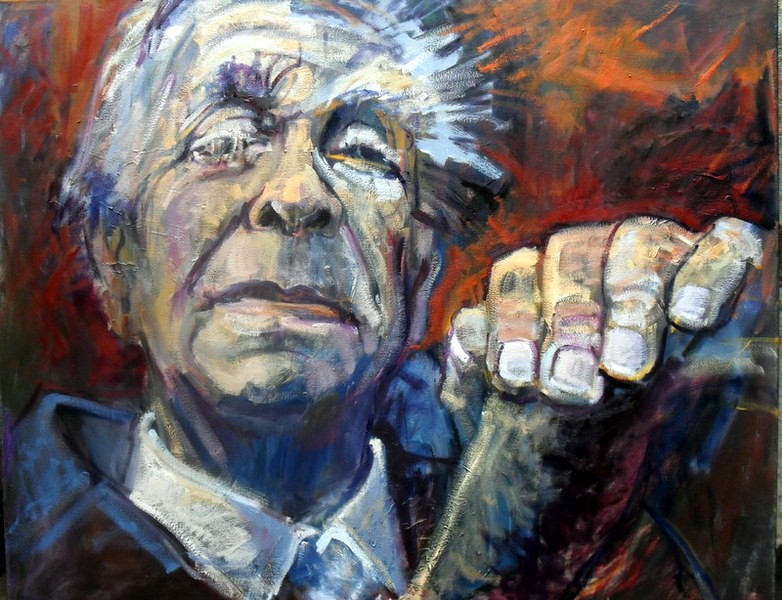
Jorge Luis Borges, another of my favorite writers, had similar ideas, which he summed up rather pithily thus:²

[R]ereading, not reading, is what counts.

When Borges wrote this, he meant in reading a well-known book, say The Count of Monte Cristo, even if it is the first time you have done so, you already know about it. The story is so famous, so much referenced by other books, directly or indirectly, in effect, you are actually rereading it. But he also meant it more literally—a great work bears rereading, and he is well known to have repeatedly read the works of Poe, Stevenson, and Kipling, among many others.

At about the same time I read Calvino’s essay, there was a thing going around on Facebook asking you to list “10 Life-Changing Books”. Mine were:

10. Ulysses, James Joyce
9. The Epic of Gilgamesh
8. Collected Fiction, Jorge Luis Borges
7. The Divine Comedy, Dante Alighieri
6. The 13 Clocks, James Thurber
5. Les Misérables, Victor Hugo
4. The Monkey King, Wu Cheng’en
3. The Masks of God, Joseph Campbell
2. Norse Gods and Giants, Ingri & Edgar Parin d’Aulaire
1. Foucault’s Pendulum, Umberto Eco

I’ve done pieces relating to nearly all of them without referring to the list, because it was so true. The cut, which was quite painful to do—so many great books—only just missed Calvino. I’d have chosen The Nonexistent Knight and The Cloven Viscount (Il cavaliere inesistente and Il visconte dimezzato, really two short novels published in a single volume) as my favorite work of his. All these I had reread, at least in part, and many of them several times, with the exception of Les Misérables, which suddenly stood out as something I should do. And so I did.

Certainly it isn’t a quick or an easy read. The book contains five volumes and a number of appendices, with my copy running to some 1,232 pages. It covers religion, politics, philosophy, history, and ethics, as well as the epic tale for which these elements form the backdrop.
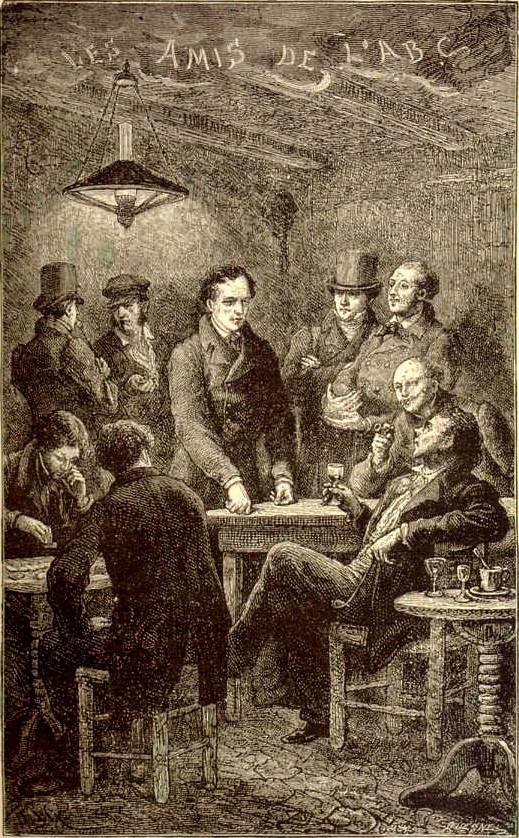
Nearing the revolution at the climax of the book, we meet a group of republican students who have dubbed themselves Les Amis de l’ABC (Friends of the ABC). The group’s leader is Enjolras, and drawn to him, a misanthrope named Grantaire is also a member. As they are waiting for the hour of the revolution to arrive, they are drinking. Most of them, in true French fashion, consume red wine, but not Grantaire:³

But by midday, Grantaire had gone beyond wine, that moderate source of dreaming. To the serious drinker wine is only an appetizer. In this matter of insobriety there is black as well as white magic, and wine is of the latter kind. Grantaire was an adventurous drinker. The black approach of real drunkenness, far from appalling, allured him. He had deserted the wine-bottle and gone on to the chope, the bottomless pit. Having neither opium nor hashish on hand, and wanting to befog his mind, he had recourse to that terrible mixture of eau-de-vie, stout and absinthe, which so utterly drugs the spirit. Those three ingredients are a dead weight on the soul, three darknesses in which the butterfly life of the mind is drowned; they create a vapor, tenuous yet with the membranous substance of a bat’s wing, in which three furies lurk—Nightmare, Night, and Death, hovering over the slumbering Psyche.

This drink is not given a proper name by Hugo; chope simply means “mug”. My comment when I read this passage was, “Wow, I have to try this.” For one thing, absinthe:

In high school, I did a massive paper on For Whom the Bell Tolls. The subject was forced on me, and I found the book intensely dull. Perhaps I should put something of Ernest Hemingway’s on my list of books to (re-)read, but I’m not sure my opinion would change. In any case, I’m not sure how, when, or where I ran across a passage from Papa’s The Garden of Eden, but it fetishizes absinthe rather well. I didn’t actually read the book, as I was still actively avoiding its author when it was posthumously published  (and I still am). I remember this passage and literally nothing else about it:⁴

[The waiter] came over now holding a glass and an ordinary Pernod bottle and a small narrow-lipped pitcher of water. There were lumps of ice in the water. “Pour Monsieur aussi?” he asked.

“Yes,” the young man said. “Please.”

The waiter poured their high glasses half full of the off-yellow liquid and started to pour the water slowly into the girl’s glass. But the young man said, “I’ll do it,” and the waiter took the bottle away. He seemed relieved to be taking it away and the young man poured the water in a very thin stream and the girl watched the absinthe cloud opalescently. It felt warm as her fingers held the glass and then as it lost the yellow cast and began to look milky it cooled sharply and the young man let the water fall in a drop at a time.

“Why does it have to go in so slowly?” the girl asked.

“It breaks up and goes to pieces if the water pours in too fast,” he explained. “Then it’s flat and worthless. There ought to be a glass on top with ice and just a little hole for the water to drip. But everybody would know what it was then.”

“I had to drink up fast before because two G.N.’s were in,” the girl said.

“G.N.’s?”

“Whatyoumacallits nationals. In khaki with bicycles and black leather pistol holsters. I had to engulp the evidence.”

“Engulp?”

“Sorry. Once I engulped it I can’t say it.”

“You want to be careful about absinthe.”

The elements that struck me were: 1. It’s illegal—if the Gendarmerie nationale catches you with it, you’re in trouble. 2. It involves a ritual of adding water and watching the color change. 3. It’s delicate, if you do it wrong you’ll ruin it. 4. It’s dangerous—you shouldn’t drink it too quickly. I should also note the booze referred to is the Pernod Fils practically synonymous with absinthe, not the Pernod anise liqueur created when absinthe was banned.

Sometime in the ’90s it started being manufactured in Europe again, and though the ban was lifted in the US much later, I discovered I could get it shipped here. It arrived in boxes labeled “printed material” that sloshed when you shook them. Since then I graduated past flaming sugar cubes to ice water, and to cocktails like Sazerac, Corpse Reviver №2, and my favorite, the Green Beast.

Stout, of course, is also excellent: on a trip to Kerry with my brother and his Princeton crew buddies, we’d learned to ask, “How’s the Guinness?” We’d sip the dark, cool, frothy stuff if the reply was positive and resort to the not entirely disagreeable and apparently less finicky alternative of Smithwick’s if not.

Eau de vie, I’ll admit, I had to look up. I had a vague idea of what it was, but found it’s essentially a highly distilled brandy, generally made from fruit other than grapes. Its role in the recipe is not to impart any kind of flavor but simply to booze it up, so a decent vodka would have the same effect. In fact, the definitions of vodka and eau de vie overlap, such that essentially anything fermented and distilled to 80 proof is vodka, hence Cîroc (made from grapes) is an example of an eau de vie vodka.

I looked around for a recipe and came up empty: all the searches simply pointed back to the Hugo passage. I checked it in French, revealing nothing new. So I looked at beertails for something similar.

Most beertails are… lame. Apart from the classic Snakebite, most of them involve watering down beer, which was the opposite of what I was trying to do. Snakebite is simply equal parts hard cider and beer. Shandy is a more typical beertail: beer and a citrus soda. Then I found Hangman’s Blood.

Like Grantaire’s drink, Hangman’s Blood was a literary one, described by Richard Hughes in his novel, A High Wind in Jamaica.⁵

[Captain Jonsen] went on board, and mixed several gallons of the potion known in alcoholic circles as Hangman’s Blood (which is compounded of rum, gin, brandy, and porter). Innocent (merely beery) as it looks, refreshing as it tastes, it has the property of increasing rather than allaying thirst, and so once it has made a breach, soon demolishes the whole fort.

It sounds awful—like something we’d have made in high school by skimming from 10 different bottles of booze with the idea that our parents wouldn’t know. I tried Hangman’s Blood—for science—it’s surprisingly not terrible. And here, the evil captain is using it to make people drunk so he can take advantage of them at an auction—Hughes even goes so far as to use the word “poison” to refer to it.

And yet Anthony Burgess seems to have sworn by the drink. In the ’60s, William S. Burroughs seems to have been Burgess’ frequent drinking buddy—quite possibly members of the “alcoholic circles” Hughes mentions. He recorded the recipe as:⁶

Into a pint glass, doubles of the following are poured: gin, whisky, rum, port and brandy. A small bottle of stout is added and the whole topped up with champagne… It tastes very smooth, induces a somewhat metaphysical elation, and rarely leaves a hangover.

Boiling it all down, here’s the recipe:

Ingredients

  • 1 2/3 ounces gin
  • 1 2/3 ounces whiskey
  • 1 2/3 ounces rum
  • 1 2/3 ounces port
  • 1 2/3 ounces brandy
  • 6 ½ ounces Guinness Extra Stout
  • 4 ounces Champagne

Directions

  • Pour all the liquors into an Imperial pint glass.
  • Add the stout.
  • Add the champagne.

Based on this information, I took a stab at the formulation, fiddled with the results a bit and so created, or recreated, the abyssal drink of Les Misérables. I began drinking them and inflicted them on all my friends. Since it didn’t have a real name, I dubbed it La Chope Hugo.

The recipe runs thus:

Ingredients

  • 12 ounces stout
  • 2 ounces eau de vie
  • 1 ounce absinthe

Directions

  • Pour cold stout into a chilled glass
  • Pour eau de vie and absinthe into a cocktail shaker with ice. Shake until chilled. Strain into glass over stout.

While I have provided these recipes here, please understand this is not to say I recommend you make, or worse yet, imbibe them. Please recall for a moment the title of this piece, and also the words of Hemingway—a man who literally drank himself to death. OK, technically Hemingway used a shotgun to off himself because of his ill health, but his damaged liver and unwillingness/ inability to stop drinking was a major factor. And technically, these are the words of a character in his book, but it appears to be more or less autobiographical:

You want to be careful about absinthe.

Goddamn right and the Chope absolutely will drown the butterfly life of your mind.


Notes

  1. Italo Calvino, “Why Read the Classics?”, The New York Review of Books, 1986.
  2. Jorge Luis Borges, “Utopia of a Tired Man” (“Utopia de un hombre que esta cansado”), English version published in The New Yorker, 1975.
  3. Victor Hugo, Les Misérables, 1862, this is from the Norman Denny translation, 1976.
  4. Ernest Hemingway, The Garden of Eden, 1986.
  5. Richard Hughes, A High Wind in Jamaica, 1929.
  6. Anthony Burgess, “Yin and Bitters”, Manchester Guardian Weekly, November 1966.
Alice’s Adventures in the Cousins’ War

History in the “Looking Glass” (DeDisneyfication, Part 7B)

Among its Victorian allusions, wordplay, mathematical tidbits, and card-game and chess references, the consistent symbolism throughout Lewis Carrol’s Alice’s Adventures in Wonderland (AiW) and Through the Looking-Glass, and What Alice Found There (TLG) is of the Wars of the Roses.

Immediately, the presence of White and Red parties calls to mind the Yorks and Lancasters, but the scene of the royal gardeners repainting white roses red removes all doubt:¹

‘[…] this here ought to have been a red rose-tree, and we put a white one in by mistake; and if the Queen was to find it out, we should all have our heads cut off, you know.’

This gets at my main quarrel with Disney’s version of Alice, and indeed, their version of almost anything: there’s simply too much to fit into a neat 75-minute package. The language, imagery, and nearly everything brilliant in the original novels gets cut down so much it becomes a Best of Alice clip show.

This is exacerbated by the fact Disney condenses both Alice books into a single film—something Carroll himself prohibited when his works were first staged. I’ll just follow the single thread I’ve already pointed out—how Carroll’s works relate to the Wars of the Roses—to illustrate how much Disney is leaving out.

A major source of Carroll’s knowledge of the topic seems to have been William Shakespeare, one specific example being 3 Henry VI, in which Margaret of Anjou, who is the Red Queen, AKA the Queen of Hearts, calls for the execution of the Duke of York, saying:²

Off with the crown, and, with the crown, his head […]

And again,³

Off with his head, and set it on York gates […]

Shakespeare is not one to repeat himself, so if he has Margaret saying this twice, it seems to us she must say it all the time, which Carroll naturally has her do. Once this is clear, the other pieces also fall easily into place. The main beheading the Queen is calling for is the Knave’s, so he therefore corresponds to the Duke of York.

The Red King then must be Henry VI, known as a bad ruler because of his mental instability and unresponsiveness to the chaos of the wars. When the Queen demands Alice’s head:⁴

The King laid his hand upon her arm, and timidly said ‘Consider, my dear: she is only a child!’

And after the croquet game, wherein the Queen orders still more executions,⁵

As they walked off together, Alice heard the King say in a low voice, to the company generally, ‘You are all pardoned.’

While this seems reasonable to us (and to Alice), it reflects his timid and ineffectual rule, because of which the affairs of his reign were essentially run by Margaret. And, as Tweedles Dee and Dum note, everything—everyone exists because the Red King is asleep and dreaming it:⁶

‘Why, you’re only a sort of thing in his dream!’

‘If that there King was to wake,’ added Tweedledum, ‘you’d go out—bang!—just like a candle!’

‘I shouldn’t!’ Alice exclaimed indignantly. ‘Besides, if I’m only a sort of thing in his dream, what are you, I should like to know?’

‘Ditto’ said Tweedledum.

‘Ditto, ditto’ cried Tweedledee.

All this is to reiterate the wars are occurring because of Henry VI’s failure to attend to the kingship of his nation—he’s sleeping through it.

The Duchess also appears in both Shakespeare and Carroll as well: In 2 Henry VI, Margaret gives Eleanor, Duchess of Gloucester “a box on the ear”, to which she responds, referring to herself in the third person,⁷

[…] She shall not strike Dame Eleanor unrevenged.

So what occurs in Alice seems to be the promised comeuppance, though it does not go unpunished either:⁸

[…] said Alice: ‘—where’s the Duchess?’

‘Hush! Hush!’ said the Rabbit in a low, hurried tone. […] ‘She’s under sentence of execution.’

‘What for?’ said Alice. […]

‘She boxed the Queen’s ears—’ the Rabbit began.

As the Duchess is depicted taking care of a baby (badly), one would assume it to be her own child, but it is not. Instead, it is Richard III, with the link being it is on him the dukedom of Eleanor’s husband is settled after his demise. Hence her mistreatment of him, as they are from opposing sides in the wars.

Furthermore, the baby turns into a pig:⁹

The baby grunted again, and Alice looked very anxiously into its face to see what was the matter with it. There could be no doubt that it had a very turn-up nose, much more like a snout than a real nose; also its eyes were getting extremely small for a baby […]. ‘If you’re going to turn into a pig, my dear,’ said Alice, seriously, ‘I’ll have nothing more to do with you. Mind now!’ […] it grunted again, so violently, that she looked down into its face in some alarm. This time there could be no mistake about it: it was neither more nor less than a pig […].

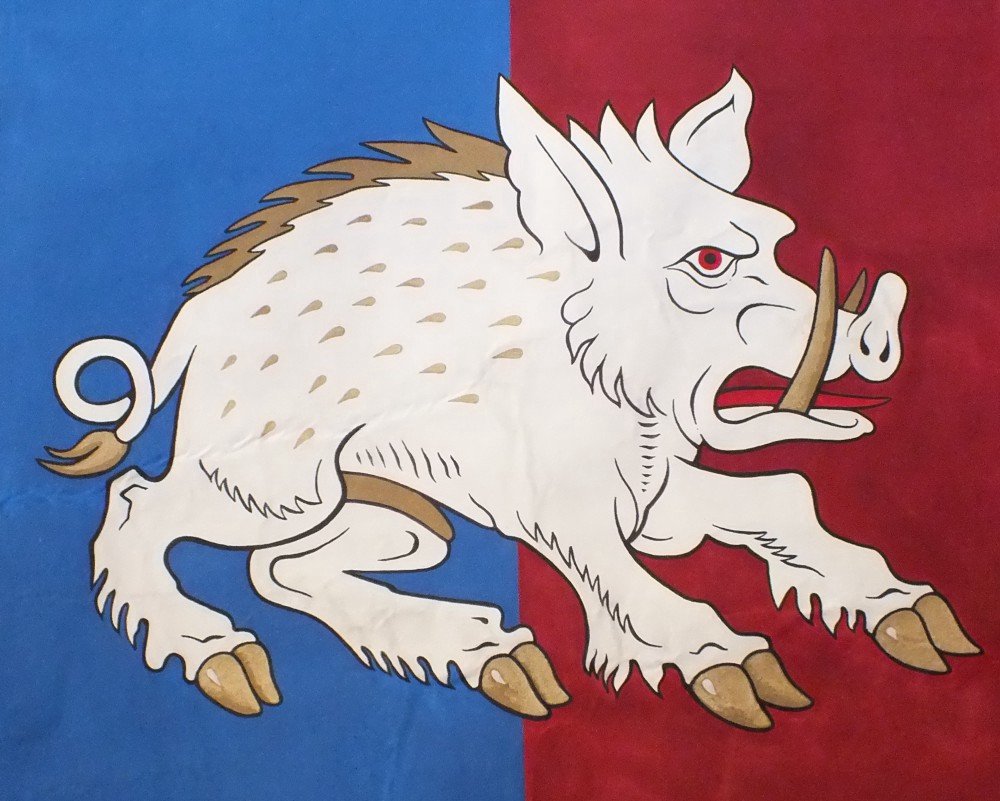
And Richard is well known to have adopted the white boar as his personal device, as well as becoming somewhat inhuman and greedy for power.

A similar heraldic reference occurs when the White Queen (Elizabeth Woodville) comes to resemble a sheep—it matches with a version of her husband, Edward IV’s arms.

In TLG, the White and Red Knights fight over Alice, as to whether she is the Red Knight’s prisoner or the White Knight has rescued her:¹⁰

‘I wonder, now, what the Rules of Battle are,’ [Alice] said to herself, as she watched the fight, timidly peeping out from her hiding-place: ‘one Rule seems to be, that if one Knight hits the other, he knocks him off his horse, and if he misses, he tumbles off himself […].’

This is a clear allusion to the many reversals of the Wars of the Roses. It is a comical, chessboard reflection of the Game of Thrones episode name-cum-tagline, “You Win or You Die”. The show, it has already been pointed out, is the Wars of the Roses with a thin veneer of fantasy fiction, with Starks for Yorks, and Lannisters for Lancasters, etc.

Humpty Dumpty, in the rhyme the character is based on as well as his conversation with Alice, seems to clearly represent Richard Neville, 16th Earl of Warwick. Such things are not uncommon, as another such rhyme, “The Grand Old Duke of York”, attests:

Oh, The grand old Duke of York,
He had ten thousand men;
He marched them up to the top of the hill,
And he marched them down again.

It has as one of its candidates another figure from this same war, the Duke of York, who I’ve already mentioned, and who was defeated at the Battle of Wakefield. There are other candidates, to be sure, and as these verses come initially from an oral tradition, tracking down the original intent can be decidedly tricky.

There are various theories on the meaning of the rhyme “Humpty Dumpty”, including the idea it was originally meant to be a riddle, as the word egg is nowhere contained in it, and might have been its answer before it became so well known.

Whether or not it is historically true, the words of “Humpty Dumpty” seem to correspond to both the words of Shakespeare regarding the Earl, as well as the egg-man’s role in TLG. As to Humpty’s position prior to the battle, in 3 Henry VI, a parlay is sounded by Edward’s besieging forces at Coventry and the Earl appears:¹¹

Gloucester: See how the surly Warwick mans the wall!

And not just literally, but also historically, he was a “fence sitter”: as “the Kingmaker” he switched sides between the Yorkists and Lancastrians, and indeed deposed and enthroned rulers in order to increase his own power.

Though history now takes a more ambivalent stance on Warwick, I’m describing the view both Shakespeare and Carroll share here. Ditto for Richard III. Carroll’s description of Warwick seems to match his role:¹²

Humpty Dumpty was sitting with his legs crossed, like a Turk, on the top of a high wall—such a narrow one that Alice quite wondered how he could keep his balance […].

His being an egg can also be seen as reflecting the delicacy of his situation.

The discussion between Humpty and Alice is a battle of words, covering semantics and pragmatics in its course, and also continuing to echo the parley (and the ensuing fight) between Warwick and Edward.

When Edward informs Warrick the king he is backing, Henry VI, has been imprisoned, Gloucester chimes in with a playing-card themed taunt was sure to have found favor with Carroll:¹³

Gloucester: Alas, that Warwick had no more forecast,
But, whiles he thought to steal the single ten,
The king was slily finger’d from the deck!
You left poor Henry at the Bishop’s palace,
And, ten to one, you’ll meet him in the Tower.

Humpty asks Alice what her name means, and she wonders whether a name must mean something, whereupon he replies:¹⁴

‘Of course it must,’ Humpty Dumpty said with a short laugh: ‘my name means the shape I am—and a good handsome shape it is, too.

The Kingmaker’s name’s resemblance to his nature is a well-known and oft-used pun, one I first heard in a Beyond the Fringe Shakespearean sendup:¹⁵

Peter: […] Thus fly we now, as oft with Phoebus did
Fair Asterope, unto proud Flanders Court.
Where is the warlike Warwick
Like to the mole that sat on Hector’s brow
Fair set for England, and for war!

This literary epithet was used, if not by Shakespeake himself, by an adjacent writer. Like the Bard, Michael Drayton wrote for Philip Henslowe at The Rose. In a poem relating the sufferings of Henry VI’s wife, he writes:¹⁶

Amongst themselves all places they divide,
And to be chancellor Sals’bury hath got,
He is the man must take the law to guide;
And Calais falls to warlike Warwick’s lot:
And not a man must look at these awry,
They make an act their acts to justify.

Next, Alice asks why Humpty Dumpty is alone, which is his situation in the play as well—he is in Coventry awaiting the arrival of Oxford, Somerset, Montague, and Clarence, who never come.

Then she asks him if he wouldn’t be safer on the ground than on the wall—again a reflection of the Shakespearean parlay:¹⁷

King Edward IV: Now, Warwick, wilt thou ope the city gates,
Speak gentle words and humbly bend thy knee,
Call Edward king and at his hands beg mercy?
And he shall pardon thee these outrages.

Back in Alice, Humpty counters:¹⁸

Why, if ever I did fall off—which there’s no chance of—but If I did—’ Here he pursed his lips and looked so solemn and grand that Alice could hardly help laughing. ‘If I did fall,’ he went on, ‘the King has promised me—with his very own mouth—to—to—’

Alice completes the line for him:

‘To send all his horses and all his men,’ […].

Which, as we’ve already seen, is a vain hope. Humpty is disturbed she knows about the king’s promise, and accuses her of spying, to which she says it is in a book, to which he responds:

‘Ah, well! They may write such things in a book,’ Humpty Dumpty said in a calmer tone. ‘That’s what you call a History of England, that is.

And of course the play is one of Shakespeare’s English Histories.

Next, the subject of Alice’s age is raised, which she says is seven years and six months, to which Humpty replies rather threateningly,

‘ […] With proper assistance, you might have left off at seven.’

Although the correspondence is inexact (adding 10), I believe this to be a reference to John Clifford, 9th Baron de Clifford’s slaying of the 17-year-old Edmund, Earl of Rutland, son of the Duke of York, at the Battle of Wakefield.

The subject turns to Humpty’s cravat, which Alice mistakes for a belt, and after the awkwardness arising is past, we learn:

‘[…] It’s a present from the White King and Queen. There now!’

We can easily fit the pieces and see this represents the chain of office of chancellor conferred, along with a heap of other titles, following Edward IV’s ascension to the throne, by him and his queen consort.

And this in turn means Iris, the White Pawn-Princess Alice is standing in for as “too young to play”, is Edward V, with the gender swap seemingly based on a pun on his and his brother’s imprisonment as the Princes in the Tower. We see her first high on a table—imprisoned in the Tower—out of reach of her parents, and knocked over—deposed….¹⁹

All the correspondences provided here might seem like overinterpretations, and there are such, including those positing Charles Lutwidge Dodgson, Carroll’s real self, a strait-laced professor of mathematics and clergyman in the sleepy town of Oxford, was hopped up on opium, but I know I’m not alone in finding at least some of them, and I feel instead I’m just scratching the surface.


Read subsequent articles in the DeDisneyfication series

Part 8: Guerrillas and the “Jungle”

Part 9A: Through a Magic Mirror Marred

Part 9A Addendum: The Woods “Over the Wall”

Part 9B: The Sum of its Versions

Part 9C: The “Snow White” Studio

Part 9D: Snowhaus

Part 10: The Little Less-Than

Part 11: Batmouse 3D

Part 12: Mork & Scheherazade


Read previous articles in the DeDisneyfication series

Part 1: Straightening out “Hunchback”

Part 2: Making over “Mulan”

Part 2 Addendum B: Your Western Wuxia Is Weak

Part 3A: “Hercules”: Myths and Mistakes

Part 3B: Doing Hera’s Work on “Hercules

Part 4: Tale As Old As Agriculture

Part 4 Addendum: The Enchanted and the Postmodern

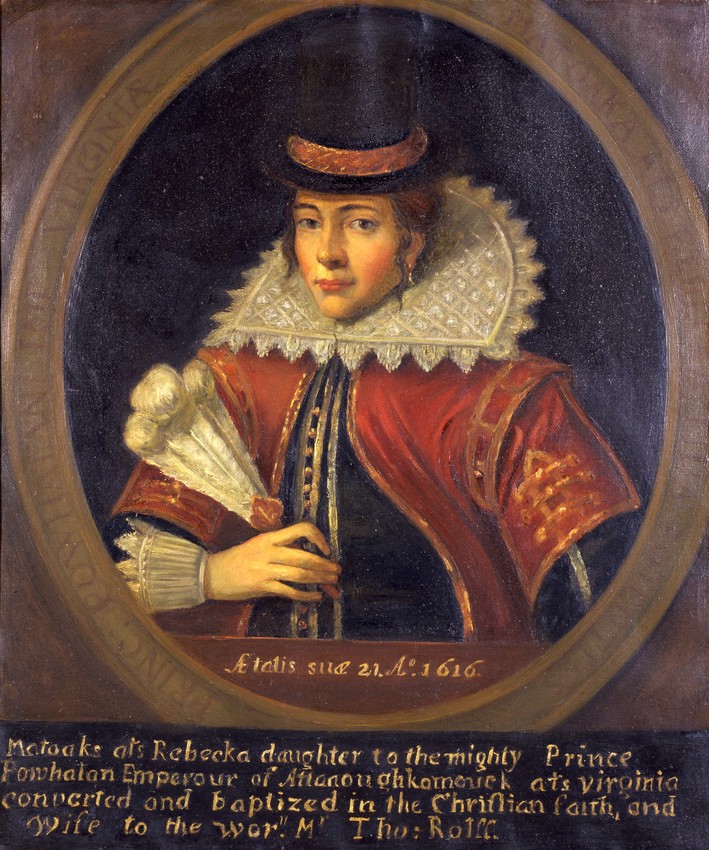
Part 5: Putting “Pocahontas” to Rest

Part 5 Addendum: Powhatan’s Mantle

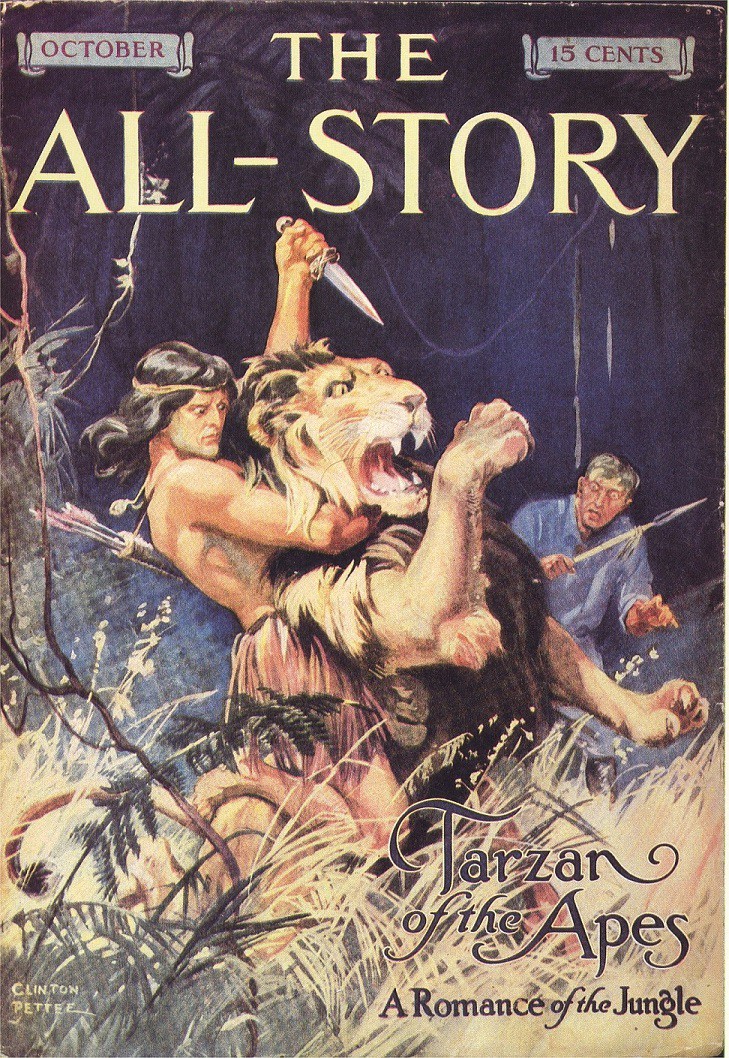
Part 6: Trouble with “Tarzan”

Part 7A: The Wrong Rabbit Hole

Part 7A Addendum A: Curious Curation

Part 7A Addendum B: “Alice” in Revolt

Part 7A Addendum C: How “Alice” Grew Big in Japan


Notes

  1. Lewis Carroll, Alice’s Adventures in Wonderland, 1865.
  2. William Shakespeare, 3 Henry VI, 1.4.108, 1591.
  3. Ibid, line 185.
  4. Carroll, 1865.
  5. Ibid.
  6. Ibid.
  7. William Shakespeare, 2 Henry VI, 1.3.151, 1591.
  8. Carroll, 1865.
  9. Ibid.
  10. Lewis Carroll, Through the Looking-Glass, and What Alice Found There, 1871.
  11. 3 Henry VI, 5.1.18.
  12. Carroll, 1871.
  13. 3 Henry VI, 42-46.
  14. Carroll, 1871.
  15. Alan Bennett, Dudley Moore, Peter Cook, and Jonathan Miller, “So That’s the Way You Like It”, Beyond the Fringe, 1960, emphasis mine.
  16. Michael Drayton, The Miseries of Queen Margaret, 1627.
  17. 3 Henry VI, 5.1.21-24.
  18. Carroll, 1871.
  19. Ibid.

The Wrong Rabbit Hole

“Alice” astray (DeDisneyfication, Part 7A)

In 1951, Disney Animation Studios released Alice in Wonderland to lukewarm response. The offering was overshadowed by the earlier Cinderella (1950), which had been boffo at the BO and racked up a trio of Oscar noms to boot,¹ making Alice quite the shabby younger stepsister.

Though far from a disaster, it has to have felt like one to the Disney shop after betting big and winning on Cinderella—if the film had failed, the studio, already heavily in debt, would likely have been shuttered. Walt seems to have been something of a gambler, as this is a common refrain throughout his career.Even though earlier films like Pinocchio, Fantasia, and Bambi had bombed initially, they would soon come to be recognized as classics, with multiple theatrical rereleases. But not Alice.

Alice was just not very good. Walt put the failure down to the titular character, saying she had no “warmth”.² I can’t say I disagree with Disney’s assessment—in order to avoid narration, his Alice (Kathryn Beaumont) talks a lot more than she does in Lewis Carroll’s books, dialogue which lacks purposefulness as well, and makes us question her motives. The studio’s reductivism also makes an appearance—Alice follows the White Rabbit (Bill Thompson), hoping he’s going to a party, rather than due to simple human curiosity and impulsiveness in the original.

In fact, there’s very little preamble to the book’s adventures: Alice is almost immediately thrown into a strange world. This effectively makes her an easily relatable cipher—we’re right there with her, just as lost and confused. Or in my case, slightly more so, with a linguistic disadvantage in understanding what I’d later come to recognize as the idiom of roughly a century previous and halfway around the planet.

As to the Disney film, Walt’s comment could simply be expanded to the whole of it: nearly none of the characters are interesting, endearing, or appealing. Events from both Carroll books are thrown together into a nonsensical jumble, the songs are mainly mediocre boildowns of the original fantastic poetry—like many, I can recite much of Carroll’s poetry by heart—and its quirky charms replaced with over-the-top wackiness.

One of the animators, Ward Kimball, characterized what he saw as the central problem with the production thus:³

[I]t suffered from too many cooks—directors. Here was a case of five directors each trying to top the other guy and make his sequence the biggest and craziest in the show. This had a self-canceling effect on the final product.

And this makes complete sense to what one experiences when watching it—it’s flat, with no structure, no buildup, no lulls; just a series of pointlessly bizarre incidents.

Turning to Rotten Tomatoes, its Critic’s Consensus unexpectedly nails it:⁴

A good introduction to Lewis Carroll’s classic […]

Yep. If you already have read it, this film will add nothing to your life, but if you haven’t, we can only hope you are inspired to.

My precocious hipsterism having been discussed previously, of course, I knew the books well in advance of seeing the Disney version, so I immediately disliked it.

While I had a similar experience watching Willy Wonka & the Chocolate Factory, that film had a glimmer I couldn’t ignore—mainly coming from Gene Wilder’s charismatic performance. And while the songs were changed, they too were generally improvements, particularly Veruca Salt’s (Julie Dawn Cole) show-stealing number.

 One critic summed up my feelings about Disney’s Alice nicely:⁵

In Mr. Disney’s Alice there is a blind incapacity to understand that a literary masterwork cannot be improved by the introduction of shiny little tunes, and touches more suited to a flea circus than to a major imaginative effort. […] a dreadful mockery of the classic.

Alice did grow on some people, though—specifically freaks and heads. The film experienced a renaissance among those who decided it was an awesome film to watch while stoned. Jefferson Airplane’s “White Rabbit” was a paean to the heaviness of this trip for the tie-dyed, face-painted counterculture of the ’60s.⁶

I know my dislike of Disney’s Alice might seem part of the media integrity ethos I’ve already put forth, but I’d like to demonstrate I’m not an ideologue but an admirer of good art: Certainly there’s a lot to overcome here—Carroll is a skillful writer and storyteller, and, in Shakespearean fashion, an enricher of the English lexicon, either creating or changing the meanings of such terms as:

  • chortle
  • Bandersnatch
  • borogove
  • frabjous
  • frumious
  • galumph
  • Jabberwock
  • jabberwocky
  • looking glass
  • mimsy
  • portmanteau
  • rabbit hole
  • slithy
  • Snark
  • snicker-snack
  • tulgey
  • Tweedle-dee & Tweedle-dum
  • unbirthday
  • vorpal
  • wonderland

All these can now be found in English dictionaries. But the original books have another kicker: Sir John Tenniel’s amazingly rich and detailed illustrations.

There are literally scores of works based on these books—Alice fitting again with Disney’s risk-averse pattern—with the first films appearing already in 1903 and while I haven’t exactly sought them out, there are a few worthy of praise.

An excellent film adaptation incorporating both Alice books much more successfully than Disney’s version was the black-and-white Alice in Wonderland of 1933. In fact, Walt Disney’s plan for his own version of the works predated this film, stretching back to some shorts using mixed live action and animation a decade earlier.

This mixed format was what he planned for his own feature film, for which he licensed the Tenniel illustrations, and identified box-office draw Mary Pickford as the lead in 1932. But when he heard Paramount had their own version in the works, he shelved it in favor of Snow White.

The 1933 Alice features many stars of the day, including W. C. Fields, Edna May Oliver, Cary Grant, Gary Cooper, and others, all in makeup and costumery so heavy the credits feature images of them beside their characters so the audiences can sort out who is who.

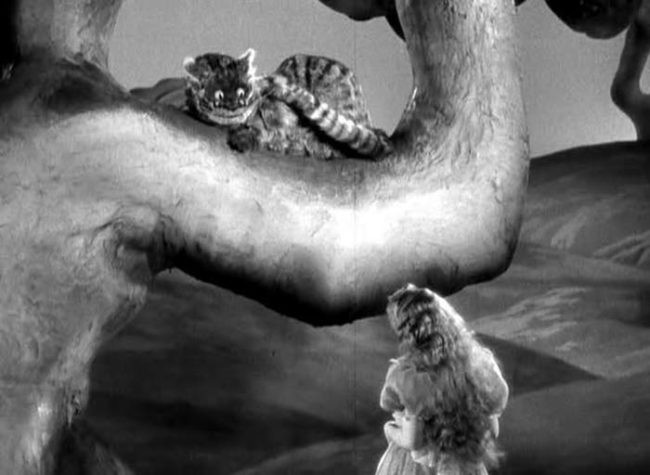
The practical effects in general are incredible—and not just for their day, when much of the language of the field was being created. One scene in which Alice (Charlotte Henry) flies down a flight of stairs, around a corner, then through the door and down the house’s front walk is particularly impressive. Another one that has stuck with me for the many years since I first saw it was the glowing, disembodied face of the Cheshire Cat (Richard Arlen).

The art direction leans heavily on Tenniel, but because it’s beyond their grasp, and the film is pre-Code, some scenes are grotesque and even disturbing. Perhaps for this reason, the film was a massive flop at the box office, so much so the entire genre of live-action children’s fantasy was avoided until 1939’s Wizard of Oz proved it could be successful.

A more recent version was the also largely overlooked Alice Through the Looking Glass TV movie from BBC 4. Again it had a stellar cast featuring Ian Holm, Penelope Wilton, Ian Richardson, Siân Phillips, and Steve Coogan, as well as Kate Beckinsale in the lead role. The film, in somewhat retro fashion, focuses on practical effects over modern VFX as well.⁷

Furthermore, the dialogue in the looking-glass world is nearly verbatim, well-delivered by its cast, and even a scene omitted from the original publication, “A Wasp in a Wig”, is restored. It also closes with “Alice’s Poem”, a haunting verse spelling out the full name of Carroll’s muse as an acrostic through the initial letters of each line.⁸ ⁹

Best by far is Holmes’ performance as the White Knight, as well as the titular “Aged Aged Man” in the poem the knight recites, which has always been a favorite of mine: full of genuine melancholy and also genuine absurdity. It is presented as a black-and-white film with scratches on the frames and scratchy sound as well, and irises to black when it’s over—a tribute to the early filmic versions of Alice.

To me, it’s slightly marred by Beckinsale, portrayed as being the mother of a child of around Alice’s age, but then stepping into the role herself, donning a pinafore and proclaiming herself to be seven-and-a-half years old. Still, Henry was 19 in 1933’s Alice, so Beckinsale’s not much older here at 25, and it’s typical of Hollywood to have an actress play someone younger.

My favorite, however, is Walt Kelly’s “A Report from Lewis Carroll’s Alice’s Adventures in Wonderland: Who Stole the Tarts?”.¹⁰

Apart from incorporating the characters from his Pogo comic strip, the work is straightforward with Carroll’s full text appearing as captions to Kelly’s brilliant illustrations. Kelly counts Tenniel as one of his main artistic influences and shows an excellent grasp of the material.

There is also some recontextualization involved in the presentation: Pogo often commented on politics and culture, leading to it being criticized and even censored in more conservative publications. Kelly considered himself a newspaperman and refused to compromise his principles. This piece was published in 1954 during the Army-McCarthy hearings as a commentary on those Kafkaesque proceedings.

As Jorge Luis Borges notes of Kafka, his oeuvre seems unprecedented until you look around.¹¹ Carroll’s tart trial is just a more satirical version of Kafka’s The Trial (Der Process). Simple J. Malarkey was added to the regular strip as Wiley Katt’s even creepier cousin, and a clear reference to Senator Joseph McCarthy. He appears here as the King of Hearts, who leads the trial’s proceedings.

Funnily, Kelly had worked for the other Walt: from 1935 to 1941, he was an animator with credits on Pinocchio, Dumbo, and Fantasia. Disney’s recommendation is essentially what allowed Kelly to start his own strip. One can only wonder how Alice might have turned out if he had taken part.

One I can get behind even less than the 1951 version is the Tim Burton-Disney live-action remake of 2010. Where most have sought to represent Carroll’s vision as well as they could, Burton’s is a reimagining, where characters with familiar names and traits are thrown into a setting seeming to borrow more heavily on The Chronicles of Narnia. The “literary masterwork cannot be improved” quote is relevant again here.

Burton might well have a better imagination than many in Hollywood, but when it comes to Lewis Carroll, in the words of the Red Queen:¹²

‘[I]t takes all the running you can do, to keep in the same place.’


Read subsequent articles in the DeDisneyfication series

Part 7A Addendum A: Curious Curation

Part 7A Addendum B: “Alice” in Revolt

Part 7A Addendum C: How “Alice” Grew Big in Japan

Part 7B: Alice’s Adventures in the Cousins’ War

Part 7B Addendum: Repainting the Roses

Part 8: Guerrillas and the “Jungle”

Part 9A: Through a Magic Mirror Marred

Part 9A Addendum: The Woods “Over the Wall”

Part 9B: The Sum of its Versions

Part 9C: The “Snow White” Studio

Part 9D: Snowhaus

Part 10: The Little Less-Than

Part 11: Batmouse 3D

Part 12: Mork & Scheherazade

Read previous articles in the DeDisneyfication series

Part 1: Straightening out “Hunchback”

Part 2: Making over “Mulan”

Part 2 Addendum B: Your Western Wuxia Is Weak

Part 3A: “Hercules”: Myths and Mistakes

Part 3B: Doing Hera’s Work on “Hercules”

Part 4: Tale As Old As Agriculture

Part 4 Addendum: The Enchanted and the Postmodern

Part 5: Putting “Pocahontas” to Rest

Part 5 Addendum: Powhatan’s Mantle

Part 6: Trouble with “Tarzan”


Notes

  1. Best Scoring of a Musical Picture, Best Sound Recording, and Best Original Song (“Bibbidi-Bobbidi-Boo”), 24th Academy Awards, 1951.
  2. John Reid, Films Famous, Fanciful, Frolicsome & Fantastic, 2006.
  3. Leonard Maltin, The Disney films, 1973.
  4. “Alice in Wonderland”, Rotten Tomatoes , retrieved March 2017.
  5. New Yorker, quoted in Maltin, 1973.
  6. Grace Slick, “White Rabbit”, Jefferson Airplane, Surrealistic Pillow, 1966.
  7. Alice Through the Looking Glass, 1998.
  8. Lewis Carroll, “The Wasp In A Wig”, 1977.
  9. Carroll, “Alice’s poem”, Through the Looking-Glass, and What Alice Found There, 1871.
  10. Walt Kelly, “A Report from Lewis Carroll’s Alice’s Adventures in Wonderland: Who Stole the Tarts?”, The Pogo Stepmother Goose, 1954.
  11. Jorge Luis Borges, “Kafka y sus precursores” (“Kafka and His Precursors”), collected in Otras inquisiciones, 1952, and in English in Labyrinths: Selected Stories & Other Writings, James E. Irby, Donald A. Yates, John M. Fein, Harriet de Onís, Julian Palley, Dudley Fitts, L.A. Murillo, trans., 1962.
  12. Carroll, 1871.

A Child’s Garden of Tessellae

The far-reaching symbolism of the tetractys (Tetractys, Part 2)

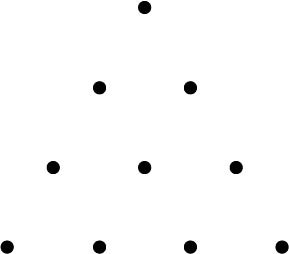
In addition to a more-than-passing familiarity with Pythagoras (Πῡθαγόρᾱς) and mysticism in the ancient Mediterranean world, I am also well versed in hexagons. You might be asking why I say hexagons when the tetractys is triangular. Well, the lattice for the equilateral triangle and the hexagon are the same—as a regular hexagon is made up of six equilateral triangles and the lattice points for both define a hexagonal nucleus; put another way, a hexagon is a truncated triangle—and the Pythagorean symbol is just a discrete set of points within this lattice:

I know the pattern well. It was one you’d get by staring at the tessellae of a midcentury bathroom floor—a favorite activity of mine. When you move out from the basic tile, you get a triangle, then a rose; a hex made of seven hexes (i.e. six corners and a center).

This rose was also the shape of Honeycomb cereal, which I would painstakingly nibble to make stars, triangles, individual cells. From the hex rose, if you add three corners, you’re back to a triangle, another three and a flower with more pronounced petals, or what I’d later come to know as a Star of David.

When I was seven, I unknowingly encountered the tetractys at a friend’s cub scout meeting, made of 10 pennies and presented together with the fiction it was a squadron of jets in formation needing to reverse course and resume the same formation while only changing the positions of three planes. To me, the pennies were simply inexact representations of the hexagons I loved to play with, so of course I knew what to do.

It appeared in other places too, bowling alleys, real honeycombs, cut paper snowflakes, Chinese Checkers, rock candy, chicken wire, the quartz crystals in my brother’s rock collection. Of these, the tenpins pattern and the colored corners of the Chinese Checkers board are true examples of the tetractys, as is the baryon decuplet (the Chinese Checkers field can be thought of as another set of six tetractys pointing inward and defining a hexagon). And when I got into strategy board games, there were those bathroom tiles again, now overlaying terrain maps. And then there were Japanese decorative motifs where the hexagon represents a scute from a tortoise’s carapace (亀甲, kikkō).

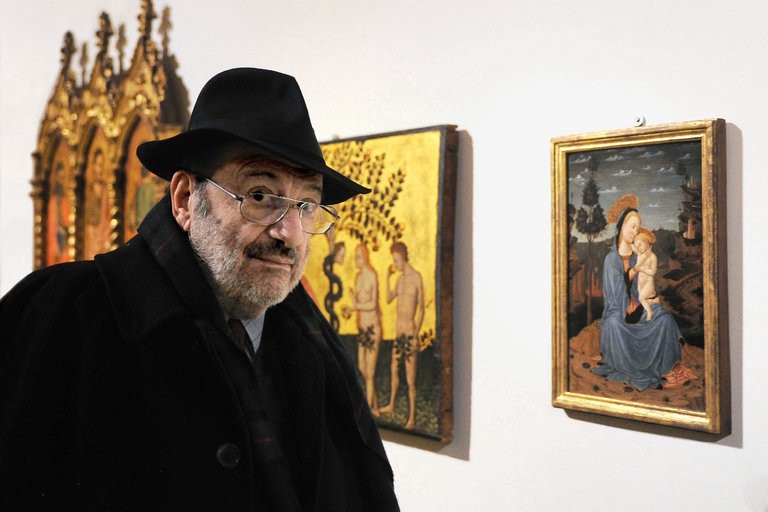
And now Eco tells me this is a sacred symbol of the Pythagoreans:¹

The Tetraktys is the symbolic figure by which Pythagoreans swore their oaths, and it represents a perfect and exemplary reduction of the numerical to the spatial and of the arithmetical to the geometrical. Each side of this triangle is formed by four points and at its center there stands a sole point, unity, from which all other numbers are generated.

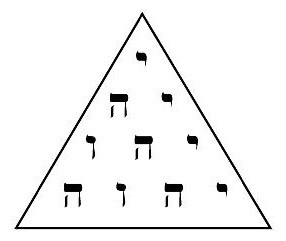
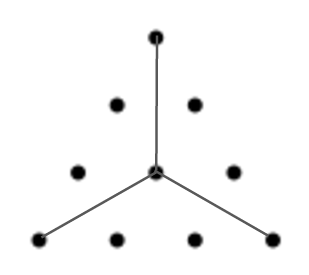
Unity is one of Pythagoras’ influential principles of numbers, in this case, the number one. It also represents deity, which has no parts. That is, it is indivisible. It also echoes the “one” at the center of the Adonai Square, and, indeed, that figure is related to this one via the dissemination of Pythagorean ideas throughout the Mediterranean, so much so the tetractys emblazoned with the Tetragrammaton has become a kabbalist symbol as well. In addition, one is the origin of all things, as Eco mentions. Each of the three corners can also be thought of as representing this same unity, which allows us to overlay the upsilon (Υ, ὖ ψιλόν). This letter is known as the Pythagorean or Samian letter (Samian as Pythagoras hailed from the island of Samos, Σάμος), symbolizing the branching path leading to earthly or divine wisdom—the path begins (at whichever corner) and branches at the center point:

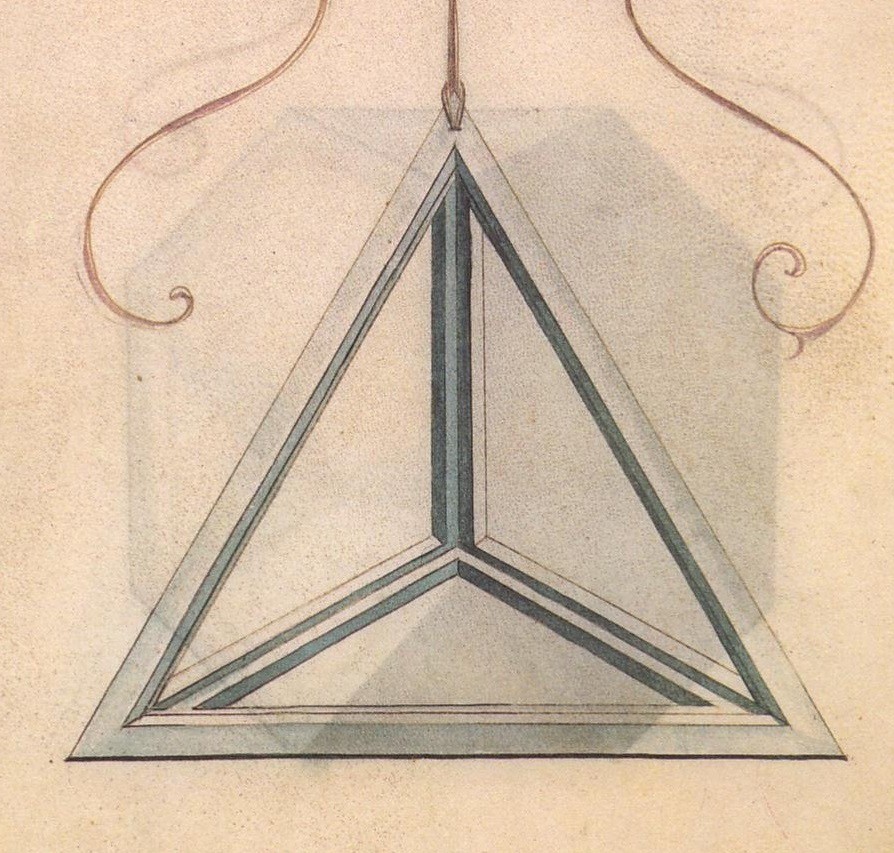
The influential principles continue, counting across the rows, where two is diversity, and therefore disorder, the principle of strife and all evil. This should not be mistaken for in any way being about race, or anything else like that, but reflected as in the Berber saying, “A devil takes one and makes two; a saint takes two and makes one.” The next row is three, which is perfect harmony, or the union of unity and diversity. Both principles reflect again the upsilon symbology. One can see the image below, LeonardoDaVinci’s representation of a “tetrahedron with empty planes” in perspective, closely resembles the upsilon tetractys. This set of numbers makes up the triangle itself and also symbolizes the Pythagorean idea of a threefold god: the beginning, middle, and end of all things. This older concept of a divine trinity can also be seen in the Hindu Trimūrti, wherein there is a triad of deities, Brahma the creator, Vishnu the preserver, and Shiva the destroyer, all ultimately aspects of a single avatar, Dattatreya. Furthermore, the soul has three vehicles: the ethereal, which is luminous and celestial, in which the soul resides in a state of bliss in the stars; the luminous, which suffers the punishment of sin after death; and between those two, the terrestrial, which is the vehicle it occupies on this earth.

The final line of the tetractys is four—Eco continues:²

Four thus becomes synonymous with strength, justice and solidity; the triangle formed by the series of four numbers is and remains a symbol of perfect equality.

As an influential principle, four represents perfection, also expressed as cosmos. One of the ideas most central to the symbol is the sum of these first four numbers is ten (1 + 2 + 3 + 4 = 10), the basis of all numbers. Four is also the first square (2 × 2 = 4).

These rows further represented geometrical ideas as points: the first row, being a single point, has zero dimensions. The second is a pair of points defining a line, the third is a plane—a two-dimensional figure requiring three points. The fourth line of four points creates the simplest solid: a tetrahedron, and the tetrahedron is the essential form of the caltrop in this site’s icon. These four lines further symbolize the four classical elements: fire, air, water, and earth, and therefore a whole series of associations: the four seasons, the four cardinal directions, the set of simple bodies (tetrahedron, octahedron, icosahedron, cube), the ages of man, etc. Also note the ancient symbols for the elements were a set of triangles and inverted triangles.

Further, the rows can be read musically as ratios: 1:1—the fundamental, 2:1—the octave, 3:2—the fifth, and 4:3—the fourth. These are the basic intervals of the Pythagorean scales and also form the basis of the concept of the music of the spheres. Also known as musica universalis, this is the idea the proportions and movements of celestial bodies create a kind of divine mathematical harmony—not, as is often mistakenly thought, literal, audible music.

Turning again to Eco:³

The sum of the points that form the triangle is the number ten, and with the first ten numbers all possible numbers can be expressed. If number is the essence of the universe, then the Tetraktys (or decade) represents a condensation of all universal wisdom, all numbers, and all possible numerical operations.

And this echoes the Aristotle (Ἀριστοτέλης) quote from Part 1, of which, we can be sure, Eco was aware.

The tetractys has found its way into art and architecture down through the ages, some even claim it to be the basis of the Masonic symbol depicted on the reverse of the Great Seal of the United States: an incomplete pyramid surmounted by the Eye of Providence. It also forms the basis of a layout for Tarot card readings, as well as a syllabic poetic form. The syllabic values for the lines are 1, 2, 3, 4, 10. Here’s an example penned by Ray Stebbing, the form’s creator:⁴

Your
fury
confuses
us all greatly.
Volatile, big-bodied tots are selfish.

I’ll leave you with one final fun fact: in the gematria, the value of the word τετρακτύς yields the value 1,234.


Read previous articles in the Tetractys series

Part 1: Eco, Pythagoras, and the Mystic


Notes

  1. Umberto Eco’s History of Beauty (Storia della bellezza), 2004.
  2. Ibid.
  3. Ibid.
  4. Ray Stebbing, “Mantrum”, date unknown.

Eco, Pythagoras, and the Mystic

Signore professore dottore schools me on Ancient Greek symbols (Tetractys, Part 1)

In reading Umberto Eco’s History of Beauty, I came across a symbol I hadn’t before.¹ First, a bit about the book itself: it is exactly similar in structure to The Book of Legendary Lands (Storia delle terre e dei luoghi leggendari), actually making up a trilogy with On Ugliness (Storia della bruttezza) being the final member. The book presents various concepts of beauty chronologically, with contemporary images and quotes illustrating each. I’d say it has a great deal more depth than the other books in the series, and often connects movements across art, architecture, philosophy, and religion.

When I attended the School of the Art Institute of Chicago, I was fortunate to have had an art history lecturer named Robert Loescher whose knowledge was immense and presentation style both humorous and thought provoking. Unfortunately, being a teenager, I was chronically sleep deprived, the lectures immediately followed lunch, and the newly renovated auditorium featured comfortable chairs and dim lighting better to show the slides. All of this meant I’d often suddenly jolt awake sometime in the middle of many lectures having missed an unknown number of pearls of wisdom and kicking myself. Worse, the sketchbook all my notes were in went missing some time ago, so I can only rely on my fallible mental software.

Even though art history is not the field Eco is best known for, he manages to surpass even this excellent lecturer. And it’s great to have the information in a book, so if I fall asleep, I won’t miss anything, and unlike my vanished sketchbook, this one can sit safe in my library to be referred to again and again. My only criticism, similar to what I said of Eco’s other book, is further breakdown of the images would be awesome, but I can also understand how this could increase the scope excessively, something like a full-scale map.² And I can simply have recourse to the internets if I want to know how Hans Holbein the Younger rendered the anamorphic skull in The Ambassadors.

Back to the original point: I’ve run across many things of which I was previously unaware in this book, but one I would have supposed I would have known was a symbol called the tetractys.

And why do I think I should already have known about the tetractys? Because it was a symbol of Pythagoras (Πυθαγόρας), who, while best known today for his supposed creation of the eponymous theorem (it is clear the Babylonians were aware of the mathematical relationships among the three sides of a right triangle, and other cultures also discovered it independently, but tradition assigns the first written proof to Pythagoras), was actually best known in antiquity as a thaumaturge (θαυματουργός)—a miracle worker.

And because of this, I had already researched him heavily for the creation of the Mystic class in Gods & Heroes.

Therefore, I had already learned of his near-mythic status in this regard, how he eschewed property, sharing all in common with his brethren instead, and how he espoused vegetarianism for ethical reasons. He also posited a heliocentric astronomical model well in advance of Copernicus.

This intertwining of mathematics and mysticism might seem strange, but Aristotle (Ἀριστοτέλης) made some sense of it in his Metaphysics (τα μετα τα φυσικά):³

[…] τούτων οἱ καλούμενοι Πυθαγόρειοι τῶν μαθημάτων ἁψάμενοι πρῶτοι ταῦτά τε προήγαγον, καὶ ἐντραφέντες ἐν αὐτοῖς τὰς τούτων ἀρχὰς τῶν ὄντων ἀρχὰς ᾠήθησαν εἶναι πάντων. ἐπεὶ δὲ τούτων οἱ ἀριθμοὶ φύσει πρῶτοι, ἐν δὲ τούτοις ἐδόκουν θεωρεῖν ὁμοιώματα πολλὰ τοῖς οὖσι καὶ γιγνομένοις, μᾶλλον ἢ ἐν πυρὶ καὶ γῇ καὶ ὕδατι, ὅτι τὸ μὲν τοιονδὶ τῶν ἀριθμῶν πάθος δικαιοσύνη τὸ δὲ τοιονδὶ ψυχή τε καὶ νοῦς ἕτερον δὲ καιρὸς καὶ τῶν ἄλλων ὡς εἰπεῖν ἕκαστον ὁμοίως, ἔτι δὲ τῶν ἁρμονιῶν ἐν ἀριθμοῖς ὁρῶντες τὰ πάθη καὶ τοὺς λόγους, ἐπεὶ δὴ τὰ μὲν ἄλλα τοῖς ἀριθμοῖς ἐφαίνοντο τὴν φύσιν ἀφωμοιῶσθαι πᾶσαν, οἱ δ᾽ ἀριθμοὶ πάσης τῆς φύσεως πρῶτοι, τὰ τῶν ἀριθμῶν στοιχεῖα τῶν ὄντων στοιχεῖα πάντων ὑπέλαβον εἶναι, καὶ τὸν ὅλον οὐρανὸν ἁρμονίαν εἶναι καὶ ἀριθμόν […].

[…] the so-called Pythagoreans applied themselves to mathematics, and were the first to develop this science; and through studying it they came to believe that its principles are the principles of everything. And since numbers are by nature first among these principles, and they fancied that they could detect in numbers[…] many analogues of what is and comes into being […] and since they saw further that the properties and ratios of the musical scales are based on numbers […] it seemed clear that all other things have their whole nature modelled upon numbers, and that numbers are the ultimate things in the whole physical universe, they assumed the elements of numbers to be the elements of everything, and the whole universe to be a proportion1 or number.

Aristotle uses the phrase “so-called” here, as he doesn’t think Pythagoras to have been a real person.

The prodigies ascribed to Pythagoras were many and varied, the best known being his golden thigh, his use of hypnotism, his claim he could write on the moon, at least one instance of bilocation, his possession of the Golden Arrow of Abaris (Ἄβαρις), as well as his doctrine of transmigration, regarding which he:⁴

[…] maintained that he distinctly recollected having occupied other human forms before his birth at Samos [Σάμος]: (1) He was Æthalides [Αἰθαλδης], son of Mercury; (2) Euphorbos [Εὔφορβος] the Phrygian [Φρυγος], son of Panthoos [Πανθοος], in which form he ran Patroclos [Πάτροκλος] through with a lance, leaving Hector [Ἕκτωρ] to dispatch the hateful friend of Achilles [Ἀχιλλεύς]; (3) Hermotimos [Ἑρμότιμος], the prophet of Clazomenae [Κλαζομεναί]; and; (4) a fisherman. To prove his Phrygian existence he was taken to the temple of Hera [Ἥρα], in Argos [Ἄργος], and asked to point out the shield of the son of Panthoos, which he did without hesitation.

For a bit more detail on these prodigies: having a golden thigh might seem an odd miracle, but it essentially meant he was part immortal. The same trope is at work in the tale of Pelops (Πέλοψ), who, after being hacked to bits and offered to the gods in a stew by his father, Tantalos (Τάνταλος), was put back together, and returned to life with an ivory shoulder. Bilocation means he was seen simultaneously by two different people in two far distant places. And the Arrow of Abaris allowed one to ride through the air, become invisible, cure diseases, and give oracles.

Quoting myself from a developer diary I wrote about the Mystic in Gods & Heroes:⁵

This Roman tradition of “sorcery” centered around a couple of things—mastery of time and space, nature control, various healing arts including uses of medicines, and cursing, generally associated with necromancy.

One can see see apart from the dark magic at the list’s end, and which I drew from other sources, these fit well with the tale of Pythagoras. For dark magic, I drew on traditions across the ancient Mediterranean, best known from the use of defixiones (Greek κατάδεσμοί), which invoke the aid of underworld gods to act against a subject. The skills available to the class included some clearly influenced by these ideas as well, including:

  • Acquired Immunity
  • Cleanse
  • Mesmerize
  • Hypnotize
  • Persuasion
  • Insubstantiality
  • Transmigration
  • Summon Shade

Of these, the last is slightly less clear in referring to Pythagoras’ feat of bilocation, but is essentially a dark form thereof, just as there were negative forms of other abilities, such as Miasma in opposition to Cleanse. The application of the word mesmerize is a bit awkward as it is named after German physician, Franz Anton Mesmer (1734–1815). Regardless, the “animal magnetism” described by Mesmer matches well with the descriptions of Pythagoras’ dominion over beasts and birds by the power of his voice and touch.

In any case, the tetractys is a simple-seeming symbol, but which has a ton of depth. There are different versions of the figure, but the basic version looks like this:

A discussion of its manifold meanings will have to wait for Part 2.


Read the other article in the Tetractys series

Part 2: A Child’s Garden of Tessellae


Notes

1.

  1. Umberto Eco, Storia della bellezza (History of Beauty), 2004.
  2. The reference is to Eco’s essay, “On the Impossibility of Drawing a Map of the Empire on a Scale of 1 to 1” (“Dell’impossibilità di costruire la carta dell’impero 1 a 1”), collected in How to Travel with a Salmon & Other Essays, a partial translation of Il secondo diario minimo, 1994.
  3. Ἀριστοτέλης (Aristotle), τα μετα τα φυσικά (Metaphysics), 1.985b.24–986a.1, mid- to late-fourth century BCE.
  4. Ebenezer Cobham Brewer, Dictionary of Phrase and Fable, 1870.
  5. Stieg Hedlund, “On the Serendipitous Convergence of Gameplay and Reality or How the Healer Became the Mystic”, Gods & Heroes Dev Diaries, April 2005.

Closing the Circle

An economist’s “new approach recapitulates long-extant modes (Creator Styles, Part 3)

Continuing through David Galenson’s Old Masters and Young Geniuses,¹ he goes over what he sees as a continuation of the pattern he theorizes through more media apart from painting, which he started with. While interesting, it’s also something of a dry read, filled out as it is with charts and statistics. Specifically, he covers poetry, literature, and film direction. And this last one provides a much closer corollary to the medium I work in, videogames. He also touches briefly on architects and economists, and posits these same types might apply to all fields of intellectual activities.

In order to discuss film, he conveniently skips over the fact he accepts auteurism wholesale. This value system was popularized in the ’40s and ’50s by Cahiers du cinéma and, in particular, François Truffaut, who wrote for the film journal. Since then it has found application in both film and in games. Wikipedia defines it as positing:²

[A] singular artist who controls all aspects of a collaborative creative work, a person equivalent to the author of a novel or a play.

What Galenson utterly omits to mention is there is significant criticism of this idea in both media. Indeed, few people today, especially in games, accept the notion all the achievements in this type of work are attributable to one individual. And I say this is as a game designer—a role typically benefiting from auteur theory.

I don’t think it’s either fair or true. I always try to promote the contributions of my coworkers when interviews attempt to focus on my role. My belief has always been the whole, at least, should be greater than the sum of its parts, and working with smart, creative people who can improve on one another’s ideas is one of the dynamics that continues to attract me to this field of endeavor. If holism is not occurring, it’s a red flag for me. Additionally, as many in this business have, I have had my name struck from credits, and indeed, have worked at companies in which individual credits were never given. These practices simply suck; if nothing else, games should learn from the standardized and guaranteed credits in Hollywood.

Furthermore, Galenson has focused all along on artists’ critical reception and, in the case of film directors, monetary success in evaluating them and which category they belong to. But not only is criticism inherently subjective, it can also be fickle, so these criteria are flawed ones. Just take a look at the ratings for some of your favorite movies on Rotten Tomatoes if you want to see: 1. audiences and critics don’t always agree, and 2. you are likely to not agree with either of them.

As I have learned through the hard knocks of my own career, there’s many a slip ’twixt the cup and the lip—lots of factors are beyond a creator’s control even if they are somehow the auteur of a work: patronage, changing audience tastes, and in our modern era marketing, user acquisition costs, and a dozen other things.

Just one such factor in the timing of a creator’s success in their field, which Galenson himself points out, is the complexity involved in an activity:³

[The] Abstract Expressionists dominated the advanced art world of the late 1940s and early ’50s with visual works that were highly complex, and generally required long periods of apprenticeship from important contributors.

However, he notes conceptual dudes come along and change things:⁴

Within a brief span of time, however, in the late 1950s Jasper Johns and Robert Rauschenberg created new conceptual forms of art that were much less complex, and could be assimilated much more quickly, with very brief required apprenticeships. Thus the contributions of Frank Stella, Andy Warhol, Roy Lichtenstein, and many others who followed Johns and Rauschenberg were highly conceptual, and were generally made much earlier in their careers than those of Jackson Pollock, Willem de Kooning, Mark Rothko, and the other important Abstract Expressionists.

And with this, he expands his taxonomy of his two types, to include:⁵

Aesthetic Experimenter

  • Inductive
  • Empirical
  • Discover methods during process
  • Continue to improve over a long career
  • Anti-intellectual
  • Value audience reception (commercial success)
  • Do not show themselves in a work
  • Add content to media

Conceptual Innovator

  • Deductive
  • Theoretical
  • Plan everything, then execute
  • Peak young (run out of things to say)
  • Intellectual
  • Self-pleasing (about their own ideas, not the audience)
  • Autobiographical
  • Change and simplify media

And here, some ideas he ascribes to his types begin to sound familiar. The types of translations of poetry expounded by Jorge Luis Borges in his “Two Ways to Translate”, I’ve previously covered, we recall, were Classical:⁶

The classical way of thinking is interested only in the work of art, never the artist. The classics believe in absolute perfection and seek it out. They despise localisms, oddities, contingencies.

And Romantic:⁷

Romantics never seek the work of art, but rather the man himself. […] That reverence for the I, for the irreplaceable human difference that is any I, justifies literal translations.

Based on Galenson’s expanded descriptions of his two types, it seems clear Aesthetic Experimenter and Classicist are synonymous, as are Conceptual Innovator and Romanticist.

Furthermore, the dyad of artistic values Borges refers to, just like the one Galenson proposes, permeates all creative endeavors. And indeed, as Galenson suggests of his categories, these might apply across intellectual activities. So ultimately, the categories presented in Old Masters and Young Geniuses don’t appear to be new, but simply restate these long extant ones.

Arguably, the categories Borges uses are both too value-laden with respect to the terminology employed and less well-known in modernity. The only value Galenson seems to add then is a discussion of the relative ages of creators belonging to one or the other group as related to their successes in their chosen field. And, as related previously, a great deal of statistical data intended to prove out these categorizations.

But again, I think this boils down to a commonplace: there is a certain brash reductiveness required of the Romantic point of view that nearly directly implies youth—or at least makes this approach appealing to younger creators.

In the end, Galenson concludes to be successful, ambition and aptitude are more important than the concerns of method. Here we finally agree, and indeed, being aware of these styles and changing one’s approach as needed might be still more important.


Read previous articles in the Creator Styles series

Part 1: Passing on Picasso

Part 2: The Role of the Ear-Lopper


Notes

  1. David Galenson, Old Masters and Young Geniuses: The Two Life Cycles of Artistic Creativity, 2007.
  2. “Auteur”, Wikipedia, retrieved February 2017.
  3. Galenson, 2007.
  4. Ibid.
  5. Adapted from Ibid.
  6. Jorge Luis Borges, “Two Ways to Translate” (“Las dos maneras de traducir”), 1926, collected in English in On Writing, Suzanne Jill Levine, ed., 2010.
  7. Ibid.

And the Rotas Go ’Round

The intricate solution to an ancient enigma (Sator Square, Part 2)

The discovery of the Sator Square in Pompeii set a terminus ante quem of 79 CE, making it pretty clear it wasn’t Christian in origin. Other solutions were put forward, more or less far-fetched, involving overlaying a Templar cross on the figure, as well as several other patterns. Other religious contexts were also suggested, including Mithraism. I won’t go into this except to say this cult was even more of a newcomer than Christianity to the Roman world, with the earliest literary references dating to around 80 CE. A Templar origin is absurdly anachronistic.

But the one that seems best thought out and most satisfying is one saying the Square is Judaic in origin. Rome had conquered the area of Judea in 63 BCE, eventually coming to rule it directly as a province. As with any Roman conquest, subsequently these people would have come to the Roman homelands, both as slaves and free people. There is also significant evidence of a Jewish presence in Pompeii, and while this community was not large, it gets past the test where any supposed Christian origin falls down. Indeed, there being a small community—one expelled from the Roman nation on two separate occasions—also makes sense to the necessity of this coded message.

Dr. Nicolas Vinel, if not the originator of the Judaic interpretation of the Square, certainly appears to have tied it up with a bow, and his work is the main source of what I’m relating here.¹ I’ll note also what convinces me is this is not a single solution, but a kind of web of correspondences that so completely covers every aspect of the Square even if some part of it weren’t true, there would still be a lot right.

The first such element relates to the size and shape of the Square, which corresponds to the bronze altar Moses is instructed to build in Exodus:²

“And you shall make the altar of acacia wood, five cubits long and five cubits wide; the altar shall be square, and its height shall be three cubits. And you shall make its horns on its four corners; its horns shall be of one piece with it, and you shall overlay it with bronze.”

In Joshua, the important symbolic function of this altar is described thus:³

“[The altar is] a witness between us that YHWH [is] God.”

Thus, simply by its 5×5 size and shape, the Square is a representation of this altar in plan, itself a symbol of the Jewish Diaspora and faith in their God.

The next part of the solution involves a transformation of the square based on its underlying numbers. This moves the 5×5 of numbers in order into a new configuration thus:

Essentially, two rotations are performed: the central cross is rotated clockwise 45 degrees, and the diagonal cross is also rotated the same direction, but the numbers alternate rather than maintaining their positions, with the other numbers falling fairly easily into place after that.

As I’ve implied in the title to this article, the fact a rotation is performed, and the solution uses the proper rotas-first form of the square allows the first line to give a clue to its solution.

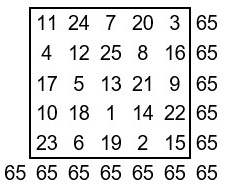
Now we are looking at a figure known as a magic square: In a magic square, a figure whose discovery easily predates the Square, the numbers in each row and column, as well as the diagonals, add up to the same number. In the 5×5 version, this number is 65, the center remains 13, and in each of the two concentric squares adding a number with the one across from it adds up to 26.

The numbers 13, 26, and 65 are numerical representations of the divine name in the gematria, a system that assigns numerical values to words. Though it was originally AssyroBabylonianGreek, its use in Jewish mysticism has a long and well-known history. Using this system, 13 is אֶחָד (ehad) “One”, and indeed, there is but one ⟨N⟩—in the center where all things begin. 26 is the numerical value of the Tetragrammaton, the four letters transliterating the name of God, i.e. YHWH. At some point, people decided that saying YHWH aloud was not cool—think the repeated stonings in Monty Python’s Life of Brian (1979)—and אֲדֹנָי (Adonai) was used in its place. 65 is the gematric value of Adonai. Now, while it is true there are many, many names of God, these, particularly the last two, are very important ones. 13 also corresponds to ⟨N⟩, in yet another way, as it is the 13th letter of both the Greek and Latin alphabets. Note it is not contended the letters simply correspond to the numerical values of the magic square, but the magic square is important to transforming the square.

When we move from the numbers back to the letters, the result of the transformation is a set of rows and columns, each of which is its own palindrome, and the central tenet cross remains, but on a diagonal.

T O P O T
A E R E A
R S N S R
A E R E A
T O P O T

The fact this transformation yields this result is compelling in itself, but there’s more: Now there appears not only the words, but a picture also of the bronze altar of the temple: now we see it in profile, where its dimensions are 5×3, and it is made up of the Latin words:

ARA AEREA

altar of bronze

The tenet’s ⟨T⟩s at the corners also correspond to the biblical instructions for the altar’s construction as the “horns on its four corners”,⁴ where the physical shape of the ⟨T⟩ is suggestive of this description. Furthermore, as the holiest part of the altar, there is a tradition of grabbing these horns as a sort of sanctuary, such that in the Vulgate version of Kings it says of אֲדֹנִיָּה‎ (Adonijah), a servant of Solomon fearful of being put to death:⁵

[…] tenuit cornu altaris.

[…] he […] took hold of the horns of the altar.

The cryptogram’s use of ⟨T⟩ to represent these horns as well as tying in the word tenet as what one does with them can only be called extremely clever—here, tenuit is simply an inflected form of tenet. Also, though I am aware the Vulgate did not yet exist, having pointed it out in the previous part, I am not engaging in an anachronism, as this is a simple one-word correspondence between Hebrew and Latin.

Furthermore, and working off the same aerea we’ve already seen, is a reference to the prophylactic symbol of the brazen snake created by Moses to cure those poisoned by real ones:

SERPENS AEREA

snake of bronze

And, as with the previously revealed words, the word serpens describes what it is with its shape, tracing a snaky path. Additionally, it is “lifted up” just as the snake it represents was on a pole. The corresponding bible passage from Numbers is:⁶

And the Lord said to him: Make a brazen serpent, and set it up for a sign: whosoever being struck shall look on it, shall live. Moses therefore made a brazen serpent, and set it up for a sign: which when they that were bitten looked upon, they were healed.

Finally, both the double ara aerea and the double serpens in the square, rather than simply being palindromes, continue forever. They share their first and last letters and read in an unending circle—the opposite of the ungodly, as described in Solomonic wisdom:⁷

[A]fter our end there is no returning: for it is fast sealed, so that no man cometh again.

There is still more evidence provided by the inscriptions that accompany one of the Pompeiian Squares, but it’s beyond the scope of the cryptogram itself, so I won’t discuss it here.


Read subsequent articles in the Sator Square series

Addendum: Loosening “Tenet”’s Hold


Read previous articles in the Sator Square series

Part 1: Attempted Unravelings

Part 1 Addendum A: Blessings Through Sator

Part 1 Addendum B: Acrostic as Microcosm


Notes

  1. Nicolas Vinel, “The Hidden Judaism of the Sator Square in Pompeii”, Revue de l’histoire des religions, April 2006.
  2. Exod. 27:1, New American Standard Bible (NASB), 1977.
  3. Josh. 22:34, Literal Standard Version (LSV), 2020.
  4. Exod. 27:1, New King James Bible (NKJV), 1982.
  5. Reges 1:51, Biblia Sacra Vulgata (VULGATE), 405, my translation and emphasis.
  6. Num. 21:8–9, Douay-Rheims Bible, 1609.
  7. Wis. 2:5, King James Version (KJV), 1611.

Sator Square Non-Starters

Failed solutions to an ancient rebus (Sator Square, Part 1)

The so-called Sator Square, a palindromic grid of letters which can be read beginning at any of the four corners, has captured people’s imaginations for millennia. Early in its history, those who ostensibly understood it inscribed it widely, and it eventually came to have a cultural value similar to that of the Icelandic Rune Staves I have also written about. More recently, lacking a key to its understanding, scholars and lay folk have theorized about its meaning. So, in something of a turnabout from my posts about the Witham Sword, I want to evaluate some of the different solutions to this mysterious square.

The text reads:

R O T A S
O P E R A
T E N E T
A R E P O
S A T O R

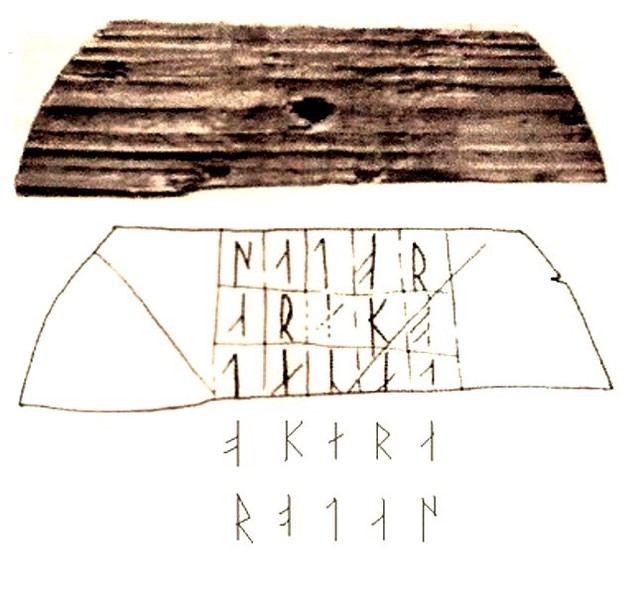
This appears to be some type of Latin phrase, and has puzzled many since it first started appearing. And appear it did, reaching a status some have described as memelike long before the intertubes began trading in such stuff. Its earliest appearances seem to have been on the Italian Peninsula, but it has been seen in France, Portugal, and as far away as England and Syria. There is even a runic inscription of the square Although somehow this has been characterized and spread across the internet as being a runestone, it is (as can be seen in the image, below) carved into wood—the bottom of a bowl of some kind, partly missing, but which doubtless finished the Square.

Then, as I noted, the secret of the square seems to have been lost. The earliest known attempt at a decipherment of the Square came from a Byzantine scribe in the 14th century, but there have been many since. The 19th century saw a boom in scholarly efforts, which continued until last century when they dropped off, with codebreakers either feeling it to be unsolvable or being satisfied with the efforts already made.

On the unsolvable front, Rose Mary Sheldon has provided us with an exhaustive 34-page bibliography of the solutions posited.¹ Let’s turn to just a few of the solutions she considers to have failed. First there’s the one of that first Byzantine scribe, who broke it down thus:

σάτορ—ὁσπεἱρων [sower]
άρέπο—ἄροτρον [plow]
τένετ—ϰραεί [holds]
ὄπερα—ἔργα [works]
ρότας—τροχούς [wheels]

There are problems, of course. Mainly these are around arepo, which would continue to bedevil would-be codebreakers as we shall see. The scribe here claims is ἄροτρον (L. arepum, of which arepo would be an inflected form) supposedly meaning “plow”, although it is found in no other source. Some have suggested a borrowing from a Gaulish or Celtic term, *arepos, which again is nullibiquitous. The asterisk in *arepos is used by linguists to mark a reconstructed word—that is, one unattested but conjectured to exist. Wanting arepo to mean plow or opera rotas to somehow imply it seems a clear case of confirmation bias: “it says ‘sower’ so it must say ‘plow’.” I think given the brevity of the rebus, the inclusion of such redundancies would actually be quite undesirable. Still, it lives on in many modern interpretations which hold the phrase’s full translation, with the other words translating in order as “the sower”, “to hold”, “works”, and “wheel”, is therefore:

The sower holds the plow, the works, the wheels.

Others have decided arepo is a proper name, again choosing to set aside the fact it’s a hapax legomenon, and so render the phrase:

The sower Arepo holds the works, the wheels.

They somehow feel “the works, the wheels” implies a plow, even though the plows of the appropriate time in no way resembled such a description. Frustration with the word led some to dismiss it as a term like abracadabra—without meaning, but while some such terms are attested, it’s a far from satisfying conclusion. Abracadabra, rather, seems to derive from ΑΒΛΑΝΑΘΑΝΑΛΒΑ (ablanathanalba), a palindromic term associated with the rooster-headed anguipede, ΑΒΡΑΣΑΞ (Abrasax). Ad repo, “I creep towards” is another interpretation suggested but results in still worse nonsense. Yet another suggestion is the Latinized and shortened name of the popular god of good luck from Graeco-Roman Egypt, Harpocrates (Har-pa-khered, “Horus the Child”).

To get from Harpocrates to Arepo, elide the initial ⟨h⟩ (the Greek is Ἁρποκράτης), inject a vowel ⟨e⟩ to break up the consonant cluster ⟨rp⟩, drop the entire second half, and Robert is your father’s brother. The meaning (in a charitable reading) thus becomes a decently apotropaic formula:

The sower Harpocrates keeps in check toils and tortures.

Never mind the god is nowhere depicted as a “sower”, appearing in Egyptian stelae perched on a crocodile’s back, snakes clutched in his outstretched hands—an image calling to mind Herakles…. And later, and especially in the Graeco-Roman context as a child with a finger pressed to his lips. Varro was apparently the first to describe the gesture thus:²

[…] Harpocrates digito significat, ut taceam.

[…] Harpocrates with his finger makes a sign to me to be quiet.

However, it is important to note this pose actually relates to the form of the hieroglyph for “child”, and did not have a meaning relating to silence or secrecy in its original context. This sometimes-winged figure was later conflated with Cupid—Cupid with a uraeus on his head, though later forms morphed it into a topknot. If anything, he is shown holding a cornucopia—the polar opposite of the idea of sowing.

The next major direction of exploration came from the idea the inscription should be read boustrophedonically. The term means “as (plowing) oxen-turn”, therefore referring to a reading alternating directions, so:

SATOR
OPERA
TENET
(TENET)
OPERA
SATOR

The image of plowing oxen probably was a temptation to employ this type of reading, but it’s just more fruit of the poison arepo tree. And again, applying a generous amount of imagination to the reading, we can interpret this as the New Testament dictum:³

[W]hatever a man sows, that he will also reap.

This solution also has its share of issues: first, inscriptions in boustrophedon appeared only in the prehellenic Greek (until 510 BCE) and archaic Etruscan (until 480 BCE) periods, coinciding with the advent of the Phoenician-based alphabet into those cultures, before they had settled on a single reading direction; left-right for Greek and right-left for Etruscan. So these predate the first known appearance of the square by just about 500 years.

Second, in boustrophedon inscriptions, the letters themselves are typically reversed to show the reading direction. Such inscriptions also invariably begin left to right, while this solution requires a right-to-left start. That is, this solution would require the versions beginning with sator to be the older, original form, which contradicts all evidence. Indeed, the desire to read the cryptogram boustrophedonically may have actually prompted the current dominance of the sator-first form.

Finally, the symmetry of the square is a major element of its magic, or at any rate, aesthetics. The 5×5=25 form is destroyed by the 30-letter reading required for the boustrophedon to work. Furthermore, the words arepo and rotas are omitted entirely in this solution, which seems like taking the easy way out.

As you may have also noticed, we have now entered a realm where interpretations are based on the idea the inscription is a Christian one. And the locations it has been found in suggest such an association, as they include Benedictine and Cistercian abbeys, a cathedral, an Anglican church, and a private chapel.

And many other seeming links to Christian tradition have been noted in potential solutions: An old Cappadocian tradition gave the shepherds of the Nativity the names Sator, Arepon, and Teneton. An old Byzantine biblical tradition names the Three Magi as Ator, Sator, and Peratoras. And the Ethiopians and Abyssinians invoke the Savior by enumerating the five nails of the Cross: Sador, Alador, Danet, Adera, and Rodas.

Attempts were also made to read the opening lines of the square as a set of abbreviations, similar to those I used in my solution for the Witham Sword:

SAlvaTOR A REx Pontifex O

and

SATOR A Rerum Extremarum Principio Omni

Of the two, the first is execrable and the second only somewhat less so, but again, nowhere apart from this posited solution to the Square are these words found together—a fairly clear sign there was no such phrase to code into a rebus.

One solution seeming to satisfy many interprets the Square as an anagram of Pater Noster, the opening words of the Lord’s Prayer, with a leftover pair of ⟨A⟩s and ⟨O⟩s as Alpha and Omega, representing God’s omnipresence.

Some aver this could not possibly be a coincidence and this must be the solution. However, when it comes to anagrams, quite a few attractive ones are possible—and some even manage to use all the letters—including:

  • Oro te, oro te, pater, sanas.
  • O pater, ores pro aetate nostra.
  • Ora, operare, ostenta te pastor.
  • Retro, Satana, toto opere asper.
  • Satan, oro te pro arte, a te spero.
  • Satan, ter oro te, opera praesto.

However, all of these Christian associations are easily swept aside by the fact the earliest known versions of the Square are graffiti from Pompeii. Two such were found in the city in separate locations written in different hands and were buried in the ash of the exploding Vesuvius, giving a clear and irrefutable terminus ante quem of 79 CE. Not only was there no known Christian population in the city by that time, 1. It is not known how long before 79 CE the inscriptions were made—one of them has at least one responding graffito, so it had to have stood there for at least a while, and 2. If this were a Christian cryptogram it would likely have had to have been formulated and dispersed from other areas with larger communities and there is zero evidence for this.

On top of this, the language of the early New Testament was either Aramaic or Greek—some debate remains as to whether Greek was originally used or if there was an Aramaic urtext—with the earliest possible date for the Gospels in any form being around 40 AD. That accomplished, a Latin translation would have to have been undertaken—for which, I might add, there is also no evidence until the Vetus Latina, a hodgepodge of translated sections from the 2nd century at the earliest. Then a cryptogram relating to such a text would need to be created and disseminated even to places with a negligible Christian community, all within a maximum of 39 years. The whole hypothesis is pretty sketchy—even accepting the several unproven bits, the timeline just doesn’t work.

Finally, the phrase:⁴

ἐγώ εἰμί τὸ Ἄλφα καὶ τὸ Ὦ

I am the Alpha and the Omega

Has as its source, the Book of Revelation written by the Apostle John. Although this was to become one of the titles of Christ and God, traditional sources and historians agree its first use dates to the reign of the Roman emperor Domitian (81–96), and so could not possibly have been used in Pompeii.

In fact, the discovery of the first of the Pompeiian Squares in 1936 was most likely the cause of the decline of scholarship on the issue more specifically than the cases I mentioned earlier—nearly everything had to be simply thrown away. The second, while actually found in 1925, was in much worse shape, coming from a ruined house, and was only able to be identified via the model of the other graffito. In Part 2, I’ll get to a theory I do credit, and why.


Read subsequent articles from the Sator Square series

Part 1 Addendum A: Blessings Through Sator

Part 1 Addendum B: Acrostic as Microcosm

Part 2: And the Rotas Go ’Round

Part 2 Addendum: Loosening “Tenet”’s Hold


Notes

  1. Rose Mary Sheldon, “The Sator Rebus: An Unsolved Cryptogram”, Cryptologia, July 2003.
  2. Marcus Terentius Varro, De lingua latina libri XXV (On the Latin Language in 25 Books), 5.10, ca. 47–44 BCE.
  3. Gal. 6.7, King James Bible (KJV), 1611, though the original dates to ca. 40–60.
  4. Rev. 1:8, 81–96.

Trouble with “Tarzan”

Lord of the Jungle: exemplar for Edgar Rice Burroughs’ political views (DeDisneyfication, Part 6)

Although at first blush it might seem like an innocent-though-improbable adventure yarn, Tarzan is a troubling tale on many levels: its author, Edgar Rice Burroughs clearly believed in social Darwinism, class hierarchy, patriarchy, eugenics, the supremacy of the white race, and indeed his own superiority, claiming a “pure” Anglo-Saxon lineage. The name Tarzan itself is concocted to mean “white skin” in the language of the apes.

It is fair to call him a man of his times, since these ideas were widespread in the US in the teens and ’20s, when mainstream journals would describe anyone from anywhere south of Paris as “swarthy”, but I’m not quite ready to fall over myself forgiving him. There’s also the oft-raised question of whether we can or should hate the artist but love the art.

However, it would also be fairly difficult to disentangle Burroughs’ worldview from his works. Even though he dissembled, saying,¹

Entertainment is fiction’s purpose, [not] disseminating any great truths or spreading any propaganda […].¹

Such things are still frequently incorporated into his works, sometimes allegorically, but sometimes quite overtly as well. The first of the Tarzan books, Tarzan of the Apes, was published in 1912, to enthusiastic reception in America as well as Europe. But after the outbreak of WWI, Burroughs used subsequent books as a platform to attack and insult the German people, even though it lost him their readership. During the Red Scare, stories like The Moon Maid were used to condemn socialism as well.

And indeed, the author did not stick to fiction when talking about his views. He opined on the Hickman murder trial the perpetrator was a “moral imbecile” and,²

If we hang him we have removed […] a potential menace to peace and happiness and safety of countless future generations, for moral imbeciles breed moral imbeciles, criminals breed criminals, murderers breed murderers just as St. Bernards breed St. Bernards.

He continued:³

[A] new species of man has been evolving through the ages and only when society awakens […] will it realize that the members of this new species may not be judged by the same standards that hold for us […]. Destruction and sterilization are our only defense and we should invoke them while we are yet numerically in the ascendancy.

In his unpublished article, “I See a New Race”, Burroughs imagined a future civilization that had adopted strict policies of intelligence testing and forced sterilization:⁴

The sterilization of criminals, defectives and incompetents together with wide dissemination of birth control information and public instruction on eugenics resulted in a rapid rise in the standards of national intelligence after two generations […] prizes went to families that produced the most intelligent children. Stupidity became unfashionable.

Returning to his fiction, the Tarzan stories don’t just contain vague allusions to these ideas, they are a philosophical embodiment of them. The entire premise of the works is that a noble white man will come to master his environment regardless of how many obstacles he must overcome to do so. Remember, Tarzan’s birth name is John Clayton, Viscount Greystoke. Burroughs’ premise is millions of years of evolution have made Tarzan not only superior to the creatures of the jungle but also to humans of other races and of lower social classes, including women.

Peppered throughout are his tales are descriptions of “surly” and “rapacious” Arabs, and “superstitious” black people, though some of the stronger terms used in earlier editions have been subsequently edited out; Burroughs would unhesitatingly use the N-word, as well as charming terms like “smoke”. Indeed, Tarzan seems to enjoy killing black men, detecting some relatedness to himself, but not believing them to be fully human. He posts a sign on his home to announce himself upon the arrival of Caucasians, reading:⁵

This is the House of Tarzan, The Killer of Beasts and Many Black Men.

Because of this propensity, professor of American history Gail Bederman refers to him as “lyncher Tarzan”.⁶

Burroughs sees modern civilization, and particularly the racially mixed communities found therein as decadent, for which he sees social Darwinism, which he believes is “nature’s law”, as the cure. In Tarzan and the Lost Empire, Burroughs’ glorification of eugenics again surfaces, in the form of an empire called Honus Hasta, whose rulers, in order to counter the rampant criminality that long ago plagued the place,⁷

[…] made laws so drastic that no thief or murderer lived to propagate his kind. Indeed, the laws of Honus Hasta destroyed not only the criminal but all members of his family, so that there were none to transmit to posterity the criminal inclinations of a depraved sire […] the laws of Honus Hasta prevented the breeding of criminals.

Burroughs dabbled in creating such a community himself when he subdivided his Tarzana Ranch to create a new suburb of Los Angeles:⁸

True to the namesake who personifies “White-Skin,” Tarzana evolved along the lines of other 20th-century suburbs, as a place designed to ensure that Anglo-American civilization could thrive in isolation and where ordinary white people could become extraordinary Anglo-Saxons.

Disney, whether blithely unaware of this background, or choosing to ignore it, decided to make a movie about this character. And again they are far from alone, in addition to the 24 novels Burroughs originally penned, there were another dozen unauthorized ones, radio and stage productions, eight silent films, over 40 classic serial films, a pile of TV shows, nine more recent films, and several documentaries, including 1997’s Investigating Tarzan, which explored the durability of the character’s mystique despite the racism inherent in it and Burroughs’ other works.

I’d be the last to say art should shy away from controversy, but Disney’s approach is not an embrace, it’s just a fresh coat of whitewash. There is an implicit societal idea the studio takes on board works created for children such as their films should contain ethical meaning and lessons but over and over they talk down to their audience and sanitize and trivialize the problems and conflicts encountered.

I’ll present a longtime hero of mine for contrast: Maurice Sendak. In answer to the question, “what is appropriate to tell children?” he said simply:⁹

Tell them anything you want.

That is, he did not think children needed to be condescended to, and no topic was off limits. His books, Where the Wild Things Are, Mickey in the Night Kitchen, and Outside Over There, make up a sort of trilogy. All of them were controversial, with Mickey drawing fire in particular for showing the titular character nude. He says they are:¹⁰

[…] all variations on the same theme: how children master various feelings—danger, boredom, fear, frustration, jealousy—and manage to come to grips with the realities of their lives.

Some pretty real topics there, and if you’ve read any of those books, you know he leans in.

Disney sidesteps some of the Tarzan issues by painting an Africa where only he and various animals live until more Europeans arrive—effectively whitewashing black people out of existence. Nonetheless, the most laughable part of Burroughs’ tales, Tarzan teaching himself to read, write and speak English from the books he finds in his dead parents’ home, remains in the film. From a linguistic standpoint, calling this impossible would be an understatement. The animation studio does manage to also add some positive messages about family bonds, human guardianship of nature, and, of course, the evil and greedy villains are defeated in the end.

However, while Disney clearly can’t be accused of subscribing to Burroughs’ worldview, as we have already seen, particularly in Pocahontas and The Hunchback of Notre Dame, they do present a corporate Barthesian myth: the best way to deal with problematic differences between people is to simply pretend they don’t exist. And while this is certainly a step up from advocating the eradication of the other, “just look away” is a pretty poor lesson too.


Read subsequent articles in the DeDisneyfication series

Part 7A: The Wrong Rabbit Hole

Part 7A Addendum A: Curious Curation

Part 7A Addendum B: “Alice” in Revolt

Part 7A Addendum C: How “Alice” Grew Big in Japan

Part 7B: Alice’s Adventures in the Cousins’ War

Part 7B Addendum: Repainting the Roses

Part 8: Guerrillas and the “Jungle”

Part 9A: Through a Magic Mirror Marred

Part 9A Addendum: The Woods “Over the Wall”

Part 9B: The Sum of its Versions

Part 9C: The “Snow White” Studio

Part 9D: Snowhaus

Part 10: The Little Less-Than

Part 11: Batmouse 3D

Part 12: Mork & Scheherazade


Read previous articles in the DeDisneyfication series

Part 1: Straightening out “Hunchback”

Part 2: Making over “Mulan”

Part 2 Addendum B: Your Western Wuxia Is Weak

Part 3A: “Hercules”: Myths and Mistakes

Part 3B: Doing Hera’s Work on “Hercules”

Part 4: Tale As Old As Agriculture

Part 4 Addendum: The Enchanted and the Postmodern

Part 5: Putting “Pocahontas” to Rest

Part 5 Addendum: Powhatan’s Mantle


Notes

  1. Edgar Rice Burroughs, “Entertainment Is Fiction’s Purpose”, Writers Digest,
    June 1930.
  2. Burroughs, “‘He’s Moral Imbecile,’ Famous Writer Says”, Los Angeles Examiner, January 1928.
  3. Burroughs, “Burroughs Calls Him ‘Instinctive Criminal’”, Los Angeles Examiner, January 1928.
  4. Burroughs, “I See a New Race”, ca. 1935, unpublished, quoted in John Taliaferro, Tarzan Forever: the life of Edgar Rice Burroughs, Creator of Tarzan, 1999.
  5. Burroughs, Tarzan of the Apes, 1912.
  6. Gail Bederman, Manliness and Civilization: A Cultural History of Gender and Race in the United States, 1880–1917, 1995.
  7. Burroughs, Tarzan and the Lost Empire, 1928–1929.
  8. Catherine Jurca, “Tarzan, Lord of the Suburbs”, Modern Language Quarterly, 1996.
  9. Selma G. Lane, The Art of Maurice Sendak, 1998.
  10. Ibid.

Putting “Pocahontas” to Rest

The historical realities behind a persistent national myth (DeDisneyfication, Part 5)

Disney’s Pocahontas is in many ways an easy target for criticism: both those who see it as overly politically correct and those who see it as a continuation of the mythmaking of a culturally dominant group find fault. Still, it seems a good film to tackle at this juncture, as these polar points of view also strongly color our current national political discourse.

In the interest of full disclosure, I won’t leave this information to the end: I have already revealed my white-trash-royalty heritage, so of course I am related to Pocahontas. Not by blood—John Rolfe’s brother, Henry, is in my direct ancestral line, so Matoaka (as she is more properly called) would be a many-times-great grand aunt by marriage. It was common practice for the Powhatan peoples to have many names, and to use them based on context. Matoaka was her birth name, meaning “Bright Stream Between the Hills”, and which they did not use among the English. Pocahontas was apparently a childhood nickname meaning “Playful One”.

So, let’s get right to it: the story is nearly entirely nonsense, made up of tales concocted by Smith to enhance his personal reputation, and then romanticized by a dozen hacks selling visions of “noble savages” and “manifest destiny”.

Disney’s Pocahontas originated with a director vaguely pondering ideas and running across an image of Princess Tigerlily from Peter Pan. This image is about as culturally sensitive as anything from the ’50s—perhaps a minor step up from the Cleveland Indians’ logo. Indeed, as far as Barthesian myths go, the Pocahontas story is already a whopper larger than any Disney could concoct: an important element of the lore clothing the Wille zur Macht realities of our national origin story.

That Disney tries to smooth out the edges of this story draws flak as political correctness, but the fact they touch it at all is something anyone who cares about historicity will decry. But I’ll note Disney is far from alone in the repeated retreading of this malarkey—again, as with most of their efforts, they chose a subject often retold. But attempts to restore the facts long predate this version, so the animation studio had to deliberately reach back for a version less rooted in history.

The central problem seems to be—once again—that Disney’s goal, repeating the success of their romantic epic, Beauty and the Beast, did not couple well with their subject, a repeatedly embellished tall tale about the origin of the United States. As usual, their choice of methods to solve this round-peg-square-hole problem is to get a large hammer and beat the entire works into jelly.

The historical facts are hard to find, but I’ll relate what I can. Even Smith never said he had anything but a friendly relationship with Matoaka. She was around 10 years old at the time, and even by 17th-century standards, that would have been wildly inappropriate. Smith told nearly the same story he did about Matoaka concerning his execution being prevented among the Hungarian Turks; it was apparently a favorite of his, with details cribbed from popular contemporary moral tales of faithful Christians prevailing through harrowing events: the maiden interposing her own body between Smith and his would-be executioner. He related the Turkish version in his book, True Travels

Next, the English kidnapped and held Matoaka for three years, used her to ransom prisoners back from Powhatan, but still didn’t release her when this had been accomplished. In a very real Stockholm-Syndrome scenario, she refused to return to her people when, at last given the chance, was baptized Rebecca, and subsequently married John Rolfe. Their union finally cooled the tensions between the natives and the colonists, at least for a while.

Rolfe, in his letter to the Virginia Governor asking to marry Matoaka, says of her:²

[Her] education hath bin rude, her manners barbarous, her generation accursed, and so discrepant in all nurtriture frome my selfe […].

Still, he is willing to take up this burden

[F]or the good of this plantation, for the honour of our countrie, for the glory of God, for my own salvation, and for the converting to the true knowledge of God and Jesus Christ, an unbeleeving creature, namely Pokahuntas.

Although perhaps these are just his rationalizations as he also says she is the one…⁴

To whom my hartie and best thoughts are, and have a long time bin so intagled, and inthralled […].

It seems he’s having a Huck Finn moment, so that’s at least progress.

Three years into their marriage, Rolfe returned to England with Matoaka to drum up investment for the colonial venture and presented her to James I as a princess, which she really was not. Despite Rolfe’s and Disney’s desires to call her such, Powhatan apparently had a vast number of children, and she in no way figured into any sort of succession. They were just about to head back to Virginia when she sickened and died—as did many Native Americans coming into contact with Europeans, likely from some disease she had no natural resistance against. She was 21 years old.

Powhatan also died soon after, and peace with the English came to an end. Nonetheless, Matoaka and her father are inextricably woven into the story of the US through their many notable descendants, including two First Ladies and several members of the First Families of Virginia.

I’ve held off on specific criticisms of Disney’s film mainly because it would be a quagmire boggier than the Lernaean swamp. And it’s honestly so empty-headed it’s not even worth nitpicking: several of those involved in its making removed—or wished they could remove—their names from the production, for example, Co-Director Eric Goldberg worked under the pseudonym Claude Raynes. Most notable among these is Shirley “Little Dove” Custalow-McGowan, a Powhatan native brought in as a cultural consultant, but who became disenchanted with the work when it became clear there would be little done to attempt historical accuracy.

Let’s just say the film brings nearly no light to this subject, and despite the cries of political correctness, falls back repeatedly on racial stereotypes, even with its comic-relief animals, Percy and Meeko. A bright spot, if it can be so called, is because of how fraught it is, we are likely to be spared a live-action redux.

Lydia Howard Sigourney wrote a poem now seldom recalled, but which was adapted into 1910’s silent film version of the tale. I’d characterize Sigourney’s overall tone as imperialist nostalgia, but she has some genuine feeling for her titular heroine, and though florid—the style at the time—in the end it’s a more fitting tribute:⁵

The council-fires are quench’d, that erst so red
Their midnight volume mid the groves entwined;
King, stately chief, and warrior-host are dead,
Nor remnant nor memorial left behind:
But thou, O forest-princess, true of heart,
When o’er our fathers waved destruction’s dart,
Shalt in their children’s loving hearts be shrined;
Pure, lonely star, o’er dark oblivion’s wave,
It is not meet thy name should moulder in the grave.


Read subsequent articles in the DeDisneyfication series

Part 5 Addendum: Powhatans Mantle

Part 6: Trouble with “Tarzan”

Part 7A: The Wrong Rabbit Hole

Part 7A Addendum A: Curious Curation

Part 7A Addendum B: “Alice” in Revolt

Part 7A Addendum C: How “Alice” Grew Big in Japan

Part 7B: Alice’s Adventures in the Cousins’ War

Part 7B Addendum: Repainting the Roses

Part 8: Guerrillas and the “Jungle”

Part 9A: Through a Magic Mirror Marred

Part 9A Addendum: The Woods “Over the Wall”

Part 9B: The Sum of its Versions

Part 9C: The “Snow White” Studio

Part 9D: Snowhaus

Part 10: The Little Less-Than

Part 11: Batmouse 3D

Part 12: Mork & Scheherazade


Read previous articles in the DeDisneyfication series

Part 1: Straightening out “Hunchback”

Part 2: Making over “Mulan”

Part 2 Addendum B: Your Western Wuxia Is Weak

Part 3A: “Hercules”: Myths and Mistakes

Part 3B: Doing Hera’s Work on “Hercules”

Part 4: Tale As Old As Agriculture

Part 4 Addendum: The Enchanted and the Postmodern


Notes

  1. John Smith, The True Travels, Adventures, and Observations of Captain John Smith into Europe, Asia, Africa, and America From Ann. Dom. 1593 to 1629, 1630.
  2. Quoted in Lyon Gardiner Tyler, ed., Narratives of Early Virginia, 1606–1625, 1907.
  3. Ibid.
  4. Ibid.
  5. Lydia Howard Sigourney, “Pocahontas”, Pocahontas, and Other Poems, 1841.