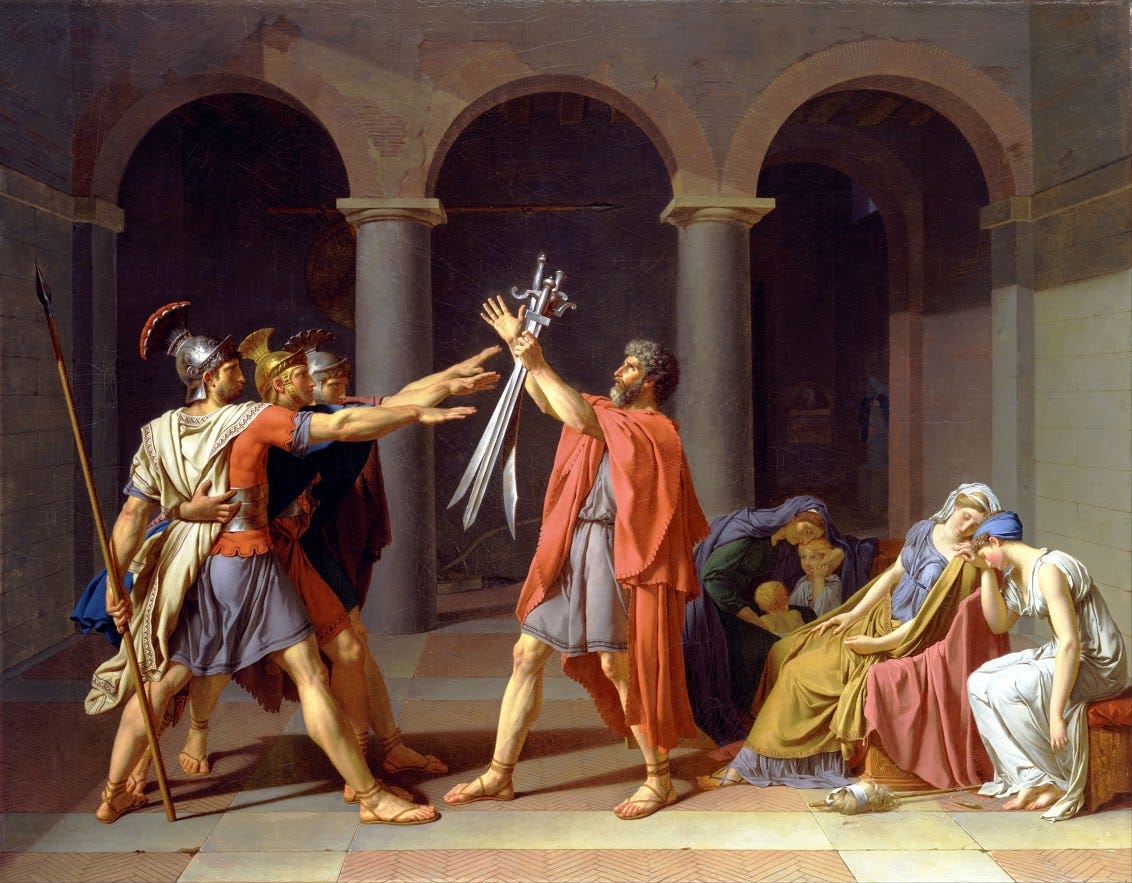
Wonderland Gone Awry

“Curiouser” curation in the Victoria and Albert (DeDisneyfication, Part 7A Addendum A)

Back in October, my family and I could finally go to an exhibition at the Victoria and Albert Museum (V&A) celebrating the “origins, adaptations and reinventions over 157 years” of Lewis Carroll’s Alice books. This show, titled “Alice: Curiouser and Curiouser”, had been set to open in spring of 2020, but as that was to become peak plague season, it was understandably delayed. So I’d been looking forward to it for some time when we actually saw it last month. Perhaps because of this anticipation, and likely also because of how well I know the subject, it was a disappointment.

The top-line papers presented unmixed reviews of the show, singing its praises. The reasons for this are multifarious, but I’ll sum up some I think are at work.

First, I think they’re reviewing Carrol and his Alice books rather than the show. This is akin to Rami Malek’s Oscar win—his performance in Bohemian Rhapsody (2018) was fine, but it was really an award for Freddie Mercury, whom he was portraying. Similarly, there have been award nods or wins for actors pretty clearly riding the coattails of their biopics’ subjects: Abraham Lincoln, Ray Charles, Johnny Cash.

Second, there’s a definite undercurrent of jingoistic fervor, not to say imperialist nostalgia. The Victorian era (1837–1901) was the halcyon of the Empire, as well as the time in which Carroll lived and worked. This is coupled with a longing for the great British polymaths and influential writers, who also represent a bygone age.

Finally, there’s the supposed stoicism of the British, often expressed in terms of the well-known wartime propaganda quip, “keep calm and carry on”. This remains a notable myth valorizing dealing with adversity by pretending everything is fine. The slogan is actually:¹

[…] the forgotten remnant of a rather spectacular failure, a failure of planning, of understanding, but mainly just a failure caused by events.

I went to art school, where we would ruthlessly critique one another’s works daily. The object of this wasn’t to knock someone down or tell them they sucked, but to help them improve their craft. Certainly, Whiplash (2014) presents one extreme of this spectrum. Sycophancy has the opposite effect: faults receive positive reinforcement, and so are likely to be repeated.

One thing that confirmed to my family North Carolina was a cultural wasteland from which we needed to flee was when we attended a performance of Turandot. This serious opera quickly turned into a comedy of errors—the set broke and the last part of one act had to be performed in front of the curtain, midperformance Norton Antivirus started its check on the PC running the supertitles, which also featured a terrible translation, among many other things. The newspaper of record ignored all of this, mindlessly raving, “‘Turandot’ a Triumph”.²

After a thorough search of the V&A show’s reviews, I could only locate one presenting any critical balance whatsoever:³

It’s just a shame these exhibits are not better presented. The links between Carroll’s work and the phenomena it inspired are barely explained: we learn that surrealists like Max Ernst and Dorothea Tanning “adored” his books, but little about how they affected them. Later, we are told that CERN has named an experiment after Alice; it’s a fascinating detail, but “no attempt is made to elaborate” on it.

Despite all the four- and five-star reviews the show garnered, I’d give it three at best. 

The biggest issue, which isn’t the fault of the exhibit itself, was the people; I’d give them one star. As I’ve mentioned before, museumgoers often have zero clue about etiquette here, and often are more interested in gramming their awesome trip to the exhibition than the experience itself. We encountered people carrying on lengthy conversations having nothing to do with the artifacts they were blocking the view of, and which they weren’t even bothering pretending to look at, people texting with their backs to the items we were trying to see, and many other obnoxious activities.

People impeding one another’s ability to view objects was also built into the design of the space. This is a complaint I often have about exhibitions and sometimes museums: if you hang two things in proximity on the inside corner of a wall, you’re creating this situation. This seems so obvious there should be a rule about it.

The Getty—which certainly presents one of the best museum experiences I can think of—at least expresses proper concern and the mindfulness required, though without specifics on how to address it:⁴

To display more art within a finite amount of gallery space is a quintessential museum struggle, so during design development we had ongoing discussions about density to ensure optimal environments for delivering an ideal visitor experience. Museum staff prepared the maximum number of objects and cases for deployment. Then, during gallery installation, there were further adjustments to improve sightlines and address overcrowding.

I found another article which, while it was more focused on proper lighting, summed up some shortcomings of exhibitions I’ve been to recently, also characterizing it as a modern and self-perpetuating problem. But even this author mainly discussed proper lighting rather than offering any specifics on the spacing of objects for optimal viewing.⁵

Modern museum design tends to emphasise visual impact and “interpretation”, sometimes augmented by interactive displays and dramatic lighting and sound, where often it seems that the objects of interest are subordinate to the general “environment” and “experience”. The opportunity to educate as well as to entertain should not be lost in modern exhibits. Some very simple, basic principles should be adhered to when developing […] displays.

A friend of mine who works at museums describes what goes on behind the scenes as:

[…] a struggle / collaboration between academic curators with highly detailed subject knowledge whose instinct is to cram in as many objects and screeds of text as possible and interpretation / design people who will have design qualifications and an instinct to clarify and simplify the visitor experience.

The subject of our discussion then was “Troy: myth and reality” at the British Museum, which I have to say is one of the worst exhibitions I’ve ever attended. Likely because he’s on the design side, my friend suggested the fault in that show may have been in curation, but I think it was actually both, which was what made it such a terrible experience. Designers definitely brought us the crowning folly: they built a Trojan horse on the floor, creating a narrow space within which they displayed many artifacts, with a chokepoint at either end. Even though they used timed entries, as most of these shows do, it was such a swarm of humanity we gave up seeing any of the horse’s contents. This dubious feature was such a clusterfuck more than 20 people would have made it unmanageable, let alone the hundreds in attendance. If the designers’ intent was to create an immersive experience of being shoved into a small, dark space with an uncomfortable mass of humanity, then job well done.

On the curation side, not only were there far too many objects, I recognized many of them as belonging to the British’s permanent collection, so one could see them at one’s leisure at any other time without all this tsuris. Indeed, the net effect on me of the show—which again garnered fours and fives in the press—was to secure my fervent vow to limit my visits to anything but the exhibitions in the future.

The “Alice” show, too, suffered from over-clever design, much of it intended to reflect the topsy-turvy atmosphere of Wonderland. Its first room, however, containing materials about the context and creation of the Alice stories and books, was clearly intended to emulate the museums of the Victorian era, with vitrines, dark walls, and dim lighting. While this was effective in creating such an atmosphere, with small objects—including Sir John Tenniel’s drawings, which were at 1:1 scale to the tiny woodblock prints made from them—tightly packed together and a general lack of flow, it was hardly conducive to viewing anything.

My final criticism of the show is similar to what I found in the press: lack of depth. Yes, I realize, as my museum-worker friend suggests, this is at odds with the issues I’ve outlined above. Again, I’ll quote the article on modern museum design:⁶

[Recognize] that there are varying levels of interest and hence information required, by the visiting public, and therefore that a “layered” approach has much to commend it. i.e. do not “dumb everything down” to the lowest common denominator.

As I may also have made clear in other posts, I’ve been to a few museum exhibitions, and I know it can be done. Thus far among UK museums, the Ashmolean has by far the best show game. Their “Last Supper in Pompeii” was excellent and I only nitpicked a translation (update: rightly so). The show was well curated and well designed, offering excellent breadth and depth on food in ancient Rome, and specifically in Pompeii. And, I at no point had the urge to strangle anyone. Yes, the Ashmolean benefits from being in Oxford, and so less crowded, and the people I’ve encountered there are ‌much better behaved, but even without those advantages I feel their show was laid out well enough to cope with any issues.

Anyway, remember, I gave “Alice: Curiouser and Curiouser” three stars; by no means a brutal pan. Apart from the design, there were a few things content-wise I’d have liked to have seen covered in a bit more depth. I’ll try to provide this myself in future posts, so I’d say the show was inspirational.


Read subsequent articles in the DeDisneyfication series

Part 7A Addendum B: “Alice” in Revolt

Part 7A Addendum C: How “Alice” Grew Big in Japan

Part 7B: Alice’s Adventures in the Cousins’ War

Part 7B Addendum: Repainting the Roses

Part 8: Guerrillas and the “Jungle”

Part 9A: Through a Magic Mirror Marred

Part 9A Addendum: The Woods “Over the Wall”

Part 9B: The Sum of its Versions

Part 9C: The “Snow White” Studio

Part 9D: Snowhaus

Part 10: The Little Less-Than

Part 11: Batmouse 3D

Part 12: Mork & Scheherazade


Read previous articles in the DeDisneyfication series

Part 1: Straightening out “Hunchback”

Part 2: Making over “Mulan”

Part 2 Addendum B: Your Western Wuxia Is Weak

Part 3A: “Hercules”: Myths and Mistakes

Part 3B: Doing Hera’s Work on “Hercules”

Part 4: Tale As Old As Agriculture

Part 4 Addendum: The Enchanted and the Postmodern

Part 5: Putting “Pocahontas” to Rest

Part 5 Addendum: Powhatan’s Mantle

Part 6: Trouble with “Tarzan”

Part 7A: The Wrong Rabbit Hole


Notes

  1. “What a Carry On”, Quad Royal, July 2011.
  2. I can’t find the exact issue to cite it, but I remember the headline being in the Raleigh News & Observer in May 2004.
  3. The Week Staff, “What the critics are saying about Alice: Curiouser and Curiouser at the V&A”, The Week, August 2021.
  4. Amanda Ramirez, “Redesigning the Getty Villa Galleries”, The Iris, June 2018. Also, for reference, Museo Nacional del Prado is one of the worst museumgoing experiences I’ve had.
  5. Roy Starkey, “The Good, the Bad and the Ugly Museum Displays—why do we keep making the same mistakes?”, 2021.
  6. Ibid.

The Row over “Hollywood” Continues

I throw in with neither Team Tarantino nor Team Lee (Mythmaking in the Martial Arts, Part 5 Addendum B)

Once Upon a Time in Hollywood (OUaTiH) has been back in the news lately because of various high-profile comments about Bruce Lee’s portrayal therein. The first came from Kareem Abdul-Jabbar, whose arguments I’d sum up like this:¹

  • Lee taught him martial arts, discipline, and spiritualism, which allowed him to have a long NBA career with few injuries.
  • Lee fought against the racist stereotypes in Hollywood, through his acting, writing, and creation of Jeet Kune Do.
  • Tarantino is punching down in his film just as Hollywood did in the ’70’s.
  • Lee would never accept challenges to fight, though there were many.

I’m pretty far down the list of people who are going to say Hollywood’s not racist; indeed, I know the opposite is true. And I agree Tarantino is using the platform of a big-budget Hollywood film to tarnish the image of Lee. I hope I have established in this series, such is not my intent.

Regarding Lee’s teachings allowing Abdul-Jabbar to stay injury free, perhaps, though Lee did manage to badly injure his own back by failing to warm up properly before a workout in 1970. This rookie mistake saw him laid up for months, and some even link it to his untimely demise because of drugs he took to manage the pain, so not a great advertisement for training with Bruce.

On the part about Lee never taking challenges, there are other sources among the caretakers of his legacy who say he did, and always won. I’m much more inclined to believe Abdul-Jabbar on this one as having firsthand knowledge and no vested interest in perpetuating the myth of Lee the unbeatable martial artist, in addition to jibing with my research for this series.

More recently, Tarantino fired back at criticisms like Abdul-Jabbar’s in an interview. I’d summarize his points thus:²

  • His source indicates Lee had contempt for stuntmen in the Green Hornet era,
  • He would deliberately make contact instead of pulling blows in fight scenes with them,
  • So Gene LeBell was brought in to keep him in line.

Matthew Polly, whose book Bruce Lee, a Life, Tarantino cites as his source, differs with this characterization:³

What I said in my book is that Bruce wanted to change American fight choreography so that the blows would miss by millimeters rather than by feet (aka the John Wayne punch) in order to better sell the technique. But in the process, Bruce did bang up some of the stuntmen on The Green Hornet, which pissed them off. So they asked Gene LeBell to settle Bruce down.

Now I’m not going to run out and buy Polly’s book to track down what he says there, but his description of the LeBell incident is paraphrased in an article, “Q&A: Bruce Lee & ESPN”, thus:⁴

[…] Lee had, apparently, been rough with the stunt actors while shooting The Green Hornet, and the stunt coordinator told Labell [sic] (who was already a heavyweight Judo champion) to restrain him. Labell picked up Lee in a fireman’s carry and started running around the set with him.

Jackie Chan (成龍) confirms Lee whacked him in the head with a stick on the set of Enter the Dragon (《龍爭虎鬥》).⁵

So it seems despite my initial sense of convergence, Tarantino came at his portrayal of Lee from a very different place than my series: he’s both factually incorrect as well as buying into the Lee myth to the extent he uses it to index Cliff’s martial prowess.

Shannon Lee again responded to Tarantino, her main arguments being:⁶

  • Tarantino repeatedly rips off Bruce Lee without giving him credit, e.g. in Kill Bill: Volume 1 (2003), but now in OUaTiH when he finally does name him, it’s only to denigrate him.
  • She’s tired of being white/ mansplained to about who her father was.
  • Bruce Lee was a true martial artist, taught it, wrote about it, created his own, and innovated in training, but didn’t fight in tournaments because he thought “combat should be ‘real’”.
  • He also had a huge impact on action films and fight choreography, inspired interest in the martial arts, and continues to inspire people as a source of pride for Asian Americans and people of color.
  • Tarantino uses him to establish Cliff’s badassery, and tears him down as “a mediocre, arrogant martial artist”.
  • Going after Bruce Lee again when there is increasing violence against Asian Americans is pretty tone deaf

These are some pretty good points, and I agree with most of them—especially that Tarantino essentially fails with his portrayal of Lee: Cliff beating up Bruce Lee the martial arts icon shows us how tough the character is, but Lee’s really just a blowhard without a lot of skill—and you can’t really have it both ways.

The part of Shannon Lee’s article I disagree with, obviously, is about Bruce, the martial artist. He did teach martial arts, but with a maximum of two years of experience when he started. He did create and write about his own, which was largely transparently plagiarized from other sources and has never produced a champion. And finally—and Shannon Lee slips up a bit here—if he avoided tournaments because he wanted combat to be real, why did he engage so enthusiastically in the inherent fakery of martial arts films?

As for the current climate of violence against Asian Americans, It’s disgusting, especially since those perpetrating it seem to target older people, and so couple cowardice with virulent racism. Full disclosure: yes, I am white, but these articles were written in defense of Wong Jia Man (黃澤民), a Chinese-born American whose name the Lee mythmaking machine has used its power and a ton of money to defame for decades. If anything, I could be accused of being offended on behalf of someone who’s not, since, as I’ve mentioned, Wong would joke about the lies told about him. And I am sad to report, since I began this series, this true master of Hsing-I-Bagua (形意-八卦), T’ai Chi Ch’üan (太極拳), and Northern Sil Lum (北少林, Běishàolín) passed away in December 2018.

Returning to the feud between Tarantino and Shannon Lee, again, it helps them both: on Tarantino’s side, there’s a saying a work can succeed either by being good or being controversial—for instance The Satanic Verses’ banning only sold more books—and mouthing off in very public fora and in highly inflammatory ways about Martial Arts Jesus is sure to reach a large audience. On the Lee, Inc. side, as I said in the previous Addendum, this controversy only serves to renew interest, so Shannon Lee is just a pot to the kettle she accuses Tarantino of being.

Present also is the kind of divisiveness and polarization much of our discourse these days tends toward. You have to decide if you’re going to be on Team Lee or Team Tarantino, because the kind of nuanced, fact-based view I’ve presented is either TL; DR, or puts me in Quentin’s camp, where I really don’t want to be.


Read previous articles in the Mythmaking in the Martial Arts series

Part 1: The Bruce Lie

Part 2: Enter the Tycoon

Part 3: Fists of Flim-Flam

Part 4: Urban Lee

Part 5: The Littlest Dragon

Part 5 Addendum A: Kato’s Comeuppance


Notes

  1. Kareem Abdul-Jabbar, “Bruce Lee Was My Friend, and Tarantino’s Movie Disrespects Him”, The Hollywood Reporter, August, 2019.
  2. “Quentin Tarantino”, The Joe Rogan Experience, June, 2021.
  3. Matthew Polly (@MatthewEPolly), Twitter, July 1, 2021.
  4. Starke, “Q&A: Bruce Lee & ESPN”, How to Fight Write, 2020. Polly liked a Tweet of this blogpost, so I assume it’s accurate.
  5. “Jackie Chan in Conversation”, SOH Talks, August 2016.
  6. Shannon Lee, “Does Quentin Tarantino Hate Bruce Lee? Or Does It Just Help Sell Books?”, The Hollywood Reporter, July, 2021.

Public Sausages, Private Votives

Roman lucanicae and lararia (Pompeii and Pigs, Addendum)

I’ve always loved museums. Growing up in Chicago, I’d clamor to go to them. And we had some good ones, mainly owing to the World’s Fair of 1893 and some robber-baron noblesse oblige in the 1930s. When I was very young, the Museum of Science and Industry was my favorite despite a recurring nightmare I was locked in at night with its chattering animatronic fiends. For its time, the museum was quite interactive, with buttons to push, wheels to spin, and even games to play.

After my parents split up, when I was a preteen living in Skokie, my brother and I would have Jewish holidays off, our mom had to work, and if left at home with no TV, we’d have wrecked the place. Instead, we had memberships to the Field Museum of Natural History, and after taking the El downtown and explaining what Rosh Hashanah or what have you was to Chicago cops looking to bust us as truants, we’d make our way to the lakefront museum campus to wander the lesser known halls of the cavernous institution for the day. 

A great side benefit of this latchkey-kid babysitting service was their members’ nights. There was some awkwardness meeting acquaintances from school, we’d certainly never see on those holidays, and their families. But all the mysterious doors were opened, and you could see all the cool stuff that was normally hidden from view, relating to the daily work of conservation, education, and research.

I visit museums of all descriptions wherever I go. Depending on the topic, I often know more than the typically far-too-brief interpretive plaques can tell. I get audio guides. I take docent tours. I crave greater access but seldom get it, having no credentials as an academician or researcher of any sort. So when I saw there was to be an online lecture, Last Supper in Pompeii, Revisited, delivered by Dr. Paul Roberts, the exhibition’s curator, I jumped at the chance.

One really clever thing about this talk was how it used Zoom’s features: typing into the chat sent a private message to the person organizing the call rather than interrupting anyone and, at the end, she read the questions to the speaker. This meant two things for me: first, I could write my questions down as soon as they came into my mind rather than trying to remember them until the end, and second, I could ask whatever questions I had without feeling self-conscious.

And so I did. Roberts was discussing how the city had passed through the hands of various peoples, including Oscans, Greeks, Etruscans, Samnites, and Romans, and mentioned the Lucanians in that context. As I mentioned in my original article, I created a set of food items for players to use for Gods & Heroes, which included lucanicae—Lucanian sausages. I had recently seen λουκάνικο (loukániko) on the menu of a Greek restaurant and thought, wow, this is what they mean! And since the talk was about food, I asked if they really were related.

It turns out the sausages were not just favored by the Romans; they were shipped all across the ancient Mediterranean world. Indeed, just as bible came to mean book because of the strength of exports of papyrus from the Phoenician city of 𐤂𐤁𐤋‎ (Gebal) which the Greeks called Βύβλος (Búblos) or parchment to refer to the cheaper animal-skin substitute for papyrus from the Hellenistic city of Πέργαμον (Pergamon) in Asia Minor, lucanica meant sausage.

You can see the name of the sausage travel and morph—certainly across the Mediterranean, where it’s fun to watch the scripts change—but also, via Portuguese and Spanish, to the New World, and via the latter, as far as the Philippines. Here are some modern versions of the name:

  • لَقَانِق‎ (laqāniq), Arabic
  • lekëngë, Albanian
  • likëngë, Albanian
  • linguiça, Brazilian/ Portuguese
  • llonganissa, Catalan
  • llukanik, Albanian
  • longaínza, Galician
  • longaniza, Latin American/ Philippine/ Spanish
  • longganisa, Cebuano/ Tagalog
  • λουκάνικο (loukániko), Greek
  • лоуканка (loukanka), Bulgarian
  • lucánic, Aromanian
  • lucanica, Italian
  • lucanică, Romanian
  • luganega, Italian/ Venetian
  • lukainka, Basque
  • луканци (lukanci), Macedonian
  • луканец (lukanec), Macedonian
  • луканка (lukanka), Bulgarian
  • לוקניק‎ (lūqānīq), Aramaic
  • مَقَانِق‎ (maqāniq), Arabic
  • نکانک‎ (nakânak), Persian
  • نَقَانِق‎ (naqāniq), Arabic
  • נַקְנִיק‎ (naqnīq), Hebrew

In the US, I’ve definitely tucked into the odd linguiça or longaniza, entirely unaware of its Lucanian descent.

Sausage is a fairly ancient concept, stemming from the need to store meat without it rotting. The name itself comes from the Latin salsīcius, meaning “seasoned with salt”, an important preservative. The first written evidence of sausage comes from a tablet written in Akkadian cuneiform around 1500 BCE.¹ So it’s old news by the time of the first attestation of the lucanica, coming from Varro in the first century BCE, which is straightforward enough:²

Quod fartum intestinum crassum, Lucanicam dicunt, quod milites a Lucanis didicerunt […].

A sausage made with the large intestine of pork is called Lucanica because the soldiers learned how to make it from the Lucanians […].

In the following century, Martial gives us an idea of how this popular sausage was to be served in one of his Epigrams; a little poem written to accompany a gift of this food to a friend:³

Filia Picenae venio Lucanica porcae:
Pultibus hinc niveis grata corona datur.

I come, a Lucanian sausage, daughter of a Picene sow;
hence is given a welcome garnish to white porridge.

You can see there’s an inflected form of puls, translated as “porridge here, but which a Latin dictionary describes as:

[A] thick pap or pottage made of meal, pulse, etc.

Sausage and beans or sausage and polenta—the latter of which in Latin originally referred to barley rather than New World corn—remain popular ways of serving the product, with a thousand permutations. It’s also worth noting Picene pork is being used, coming from a northeastern part of the peninsula rather than the former home of the Lucanians in the south. 

Apicius, writing in the same time period as Martial, gives us a fairly complete recipe:⁵

Lucanicas similiter ut supra scriptum est: Lucanicarum confectio teritur piper, cuminum, satureia, ruta, petroselinum, condimentum, bacae lauri, liquamen, et admiscetur pulpa bene tunsa ita ut denuo bene cum ipso subtrito fricetur. Cum liquamine admixto, pipere integro et abundanti pinguedine et nucleis inicies in intestinum perquam tenuatim perductum, et sic ad fumum suspenditur.

Lucanian sausage is prepared as written above. Pound pepper, cumin, savoury, rue, parsley, spice of bay berry [sic]. Also add liquamen and meat that has been pounded well, in such a way that it blends well with the pounded (spices). Add liquamen with whole pepper corns [sic], plenty of fat and pine nuts. Put it in skins, draw them quite thinly, and hang them in the smoke.

Liquamen here refers to the ubiquitous Roman umamiful fermented fish sauce condiment, also known as garum. What we learn from these accounts is at least by Apicius’ time, the lucanica was a heavily spiced, cured, dried, smoked pork sausage. This certainly could describe many such today, and some combination of its flavor and the preservation methods used in its production seem to have been what spread its fame across the ancient world.

In Italy today, there are sausages still bearing some form of this name, including various luganeghe from Lombardy, Trentino, and Veneto, but the most authentic is apparently lucanica di Picerno, from an area called Basilicata, part of the original territory of the Lucanians.

The modern version contains chilies which obviously came to Europe via the Columbian Exchange and would not have been available to the original makers, who, if Apicius is to be believed, used both powdered and whole Piper nigrum—black pepper—instead.

My second question related to the votive pig my original article discussed at length, asking if it was really from a lararium rather than a temple. Interestingly, Roberts confirmed not only that it was from a lararium but also that such finds are common. I suppose it makes sense votives in temples and shrines would be more plentiful as well as better known and researched, which would be why I would know of them rather than ones from lararia.

Additionally, Roberts disagreed with the translation of the pig’s inscription given in his own exhibition, which just shows you have to trust but verify. Nor does he agree with my version. He said it was simply:

To Hercules, a votive
Herculi VO(E)tivus (M L)

Obviously he’s oversimplifying, since he’s left out the M L, but this implies he agrees with the EDCS’ interpretation, that it is:⁶

HERculi VOt(E)um [solvit] Merito Libens
To Hercules, (he) fulfills? (his vow) willingly and deservedly

To be clear, the inscription’s VOE is a hapax legomenon, so we’re all of us guessing. But given the item is from a lararium, I’m more inclined to accept this interpretation. In a public temple or shrine, there’s a bunch of votives from various people, and it’s important not only for the god to know who’s made good on their oath, but also for other people, who will see Quintus Domitius Tutus is a man of his word, and reveres the gods. In a lararium, within the atrium of a family’s home, the gods should already know to whom the votive pertains, and people who visit similarly know this family has dutifully given a votive to the gods, so inscribing a name is less important.

In any case, this kind of program from museums is great, and it was awesome to get my quite specific questions answered directly rather than fishing around on the internet as I usually do. I’ll be looking for more in the future.


Read the original article

Pompeii and Pigs


Notes

  1. Many sources say such a tablet exists, though I couldn’t find it.
  2. Marcus Terentius Varro, De lingua latina libri XXV (On the Latin Language in 25 Books) 5.111, ca. 47–44 century BCE, my translation.
  3. Marcus Valerius Martialis, 13.35, “Lucanicae”, Epigrammata, 86–103 CE. translation from D. R. Shackleton Bailey, ed., Epigrams, 1993. Pultibus is the dative plural form of puls.
  4. Charlton T. Lewis and Charles Short, Latin Dictionary, 1879.
  5. Caelius Apicius, IV, “Lucanicae”, Book II, “Sarcoptes” (“The Meat Mincer”), De re coquinaria, ca. 1st century CE, translation from Christianne Muusers, “Lucanian Sausages, a Roman Recipe”, Coquinaria, 2012.
  6. Epigraphik-Datenbank Clauss/ Slaby (EDCS).

Loosening “Tenet”’s Hold

Palindrome and film (Sator Square, Addendum)

Something strange happened recently: views on my site spiked. Although spread across Medium and my own page, some of my more popular posts have a lot of views. The one on Icelandic magical staves, for example, has some 7,600. I’m also aware views do not equate to reads, which are likely less than half that, especially given my penchant for exploring arcane subject matter with some degree of abstruseness.

These views accrue slowly: Medium doesn’t promote content that isn’t monetized and I can’t be bothered fiddling with Google AdWords or any of that sort of nonsense. For example, the article I mentioned earlier was published in 2016, so those views are spread fairly evenly across more than four years. A few of my posts did get a lot of attention when they came out, such as those in my series on the mythmaking around Bruce Lee, because they were controversial.

So it was odd to see traffic to my site balloon to over 30 times its usual rate over the course of a few days. I wasn’t sure exactly how to feel about this. As I’ve said, there’s no money in it for me and I’m not trying to develop any kind of following, but it’s still cool to see people interested in what I have to say.

I remember Art Spiegelman saying in a lecture I attended when he boiled down comics as a medium; it was images arranged in sequence to form a narrative printed on paper for mass distribution, and he could have simply drawn his deconstructive work in Raw on a piece of paper and showed it to the five people who would get it. While I have to admire the will to power that brought us Maus—likely the greatest anthropomorphized narrative of the Shoah—I have no such qualms. Publishing on the internet is cheap and easy. I don’t have to worry about wasting ink and paper or fighting for shelf space in a physical store. I simply write these missives and dispatch them into the intervoid, hoping they’ll be read and enjoyed by at least a few people who get them.

Looking into the explosion of views on my site, I could see they centered on the pair of articles I had done back in 2017 about the so-called Sator Square. There was no rise in likes, follows, comments, or even many views of other articles, so it was hard to tell how my writing was being received. Again, I’ve given up on the idea of any sort of community or interaction around these articles, instead spending time in some highly specific subreddits like /r/Etymology and /r/Cuneiform. Ultimately, these articles scratch an intellectual and creative itch. Indeed, it’s similar to my day job though exploring different realms; I’d also do that for free if not for the bills I have to pay.

Committing to (usually) monthly deliveries of complete articles ensures my exploration of the ideas they contain doesn’t simply remain as indefinitely open browser tabs. Instead, I carefully research, synthesize ideas, and try to write them all down in a coherent and hopefully compelling way. And so the work continues.

As this surge in views related to the Sator Square, I assume it is the movie Tenet, which will have stoked interest in this rebus. I had already been intending to do a follow up to these articles, but I felt I should prioritize it, so with no further ado:

In 2020, during the early days of the plague, I remember seeing posters for a movie that featured the leading man, John David Washington, cutting a rather dashing figure in a suit and wielding a handgun. I was reminded of a recent groundswell of support for the idea of casting Idris Elba as the next James Bond—perhaps that was too radical a move for Hollywood, and they were serving up something merely Bondesque instead? Apart from this, there was nothing very remarkable about the poster except the film’s name, Tenet.

Of course this word is familiar to me in English as meaning “a belief”. And also the Latin word whence it comes, the third-person singular active indicative inflection of teneō, “to hold”, so he/she/it holds. But it seemed clear neither of these could be the intended sense. Was it the name (or code name) of the character on the posters? The spy or military group to which he belonged? There was one other possibility I thought was remote: was it a reference to one of the Sator Square’s lines?

I later learned Tenet was a Christopher Nolan film. His films are positively cerebral compared to the usual Hollywood fare; even his take on Batman had some pretty clever elements. The slim chance of the film’s name being related to the last of the above points grew, and I was still more intrigued to see whether Nolan was among the cognoscenti and, if so, to what degree. So in this frame of mind, I watched the movie.

One of the central tropes of Tenet is playing with the chronology of the narrative. The tradition of non-linear storytelling has been around at least since the Iliad began in medias res. Still, there was a time and place when it violated norms, as painter El Greco was to find out after painting The Martyrdom of Saint Maurice in 1582:¹

[I]n between the main figures—the main Christian Roman generals—are contemporary generals. What El Greco is doing here is making a very clever, concise, contemporary point about the fight against heresy, and linking the 16thcentury struggle with the struggle of the early Christian martyrs. But in a way, he was being too clever, because in Counter-Reformation Spain, anything that transcended Christian orthodoxy was viewed with suspicion. And Philip II had real problems with this picture because time was conflated […].

Nonetheless, analepsis was a widely used trope appearing in the Mahābhārata as well as Arabian Nights tales such as “Sinbad the Sailor”. In Film, Citizen Kane in 1941 has the protagonist die in the film’s opening, with the remainder consisting of a series of flashbacks framed as interviews of those who knew Kane. And 1950’s Rashōmon (『羅生門』) shows us flashbacks of conflicting testimonies at a trial. Quentin Tarantino’s 1994 film, Pulp Fiction, is generally acknowledged as having ushered in the current craze for slice-and-dice narrative structures. 

Nolan certainly has explored the trope extensively; notably with the fractured narrative of Memento, the film that put him on the map, so to speak, in 2000. Indeed, I’d say he’s guilty of using it when it’s not needed, as in 2017’s Dunkirk. I definitely understand the instinct to try to spice up a distinctly British piece of jingoism about how a terrible military defeat could have been worse. Sure, it’s a very familiar tale with a plodding gait, but chopping up the timeline doesn’t fix it. Nolan’s flair for inventive storytelling lets him down here: present is the disorientation caused by such chronological gimmickry, but there’s no clever reveal, no reconfiguration of narrative expectations—in short, no payoff. Still, I see that as a rare lapse among his films.

And so we move to Tenet. This film employs a different narrative strategy: the chronology, apart from a few occasional flashbacks, is straight; time itself is what’s distorted. Certainly there are many time-travel films—it’s nearly its own subgenre—but this is a bit different. Instead of time travel as such, people, things, and the events related to them are happening via time moving in two opposing directions. Furthermore, rather than avoiding the tropes that have arisen among these films, such as timeline damage or splitting and various other temporal anomalies, Tenet leans into them. In particular, the classic grandfather paradox is everywhere: characters meeting themselves going the other way in time impels their own actions.

This means free will is an illusion as everything has already happened in one time direction or the other, so in a sense, there’s no tension, despite the many action scenes and explosions. This isn’t to say it’s not an interesting watch. I have long believed that so-called spoilers should be no obstacle to the enjoyment of a story, as the storytelling itself should be what provides that. So with Tenet, seeing how we get to the various encounters with inverted people and things we’ve already seen from the other direction is an absorbing experience. The mental contortions needed to choreograph car chases and hand-to-hand fights that make any kind of sense in both directions are equally impressive.

Crete - law of Gortyn - boustrophedon.JPG

And here we come to the connection between the film and the ancient rebus. The Sator Square seems to have been the inspiration for the film’s palindromic structure. In particular, the idea of the square being read in boustrophedon seems to be operative in Tenet, as the various characters change directions in time multiple times on screen—and many more off screen. Of course the Sator Square has more directions it can be read in, which are omitted by the film, as are the deeper resonances I’ve pointed out previously, but given the limitations of a medium that’s inherently linear, it’s a pretty good realization of a very tricky structure.

In case there’s any doubt about the film’s inspiration, it is literally spelled out:

  • Rotas is the name of the security company that guards the free port, in which art, some of it forged, is also held, but also the location of a turnstile that reverses entropy, which in form and function is also a wheel.
  • Opera is where the opening scene takes place in Ukraine, but also part of the name of the anti-terrorist squad, КОРД, (KORD), Rapid Operational Response Unit (Корпус Оперативно-Раптової Дії—it also works in Cyrillic) that the Protagonist (that’s really the main character’s name) acts alongside.
  • Tenet obviously the name of the film, as well as a codeword the Protagonist is given early in the story.
  • Arepo is the name of an art forger working with Kat Barton (Elizabeth Debicki), estranged wife of:
  • Sator, first name, Andrei (Kenneth Branagh); the villain of the piece.

Tenet was clearly chosen as the film’s title because as the central line of the rebus it is also a palindrome itself. Just as with the correspondences above, there are many ways each word is realized, so there is a literal tenet offered in the film as well, by Neil (Robert Pattinson):

What’s happened, happened. It’s an expression of faith in the mechanics of the world; it’s not an excuse for doing nothing.

This is essentially a recapitulation of paradoxical Calvinistic beliefs about predestination, which state briefly, while the ultimate fate of an individual is foreordained, they still retain moral agency and responsibility. Only more so in this case—these people already know exactly what will occur but must perform it, nonetheless.

Regarding tenets, the beliefs the Protagonist and others who become embroiled in this story have about the nature of the world they live in at its beginning are slowly broken down over its course. What Tenet ends up reminding me of is Jorge Luis Borges’ “Tlön, Uqbar, Orbis Tertius”.² For a brief description of this short story, here’s psychology professor David Pizarro:³

It turns out that the minute that people become aware of the radical idealism of the fictional world, Tlön, that was supposedly the product of a real-world Uqbar, which was, in fact, itself a fictional world created by neoplatonic secret societies, […] the hardcore idealism of this […] metathis third worldmakes its way into our existence and starts changing reality because people believe it […] and therefore destroys [reality].

Note the sense of the term idealism here is not that of striving toward perfection, but the metaphysical concept there is no reality other than what one perceives.

Is it far-fetched to impute a Borgesian reference to Nolan? I think not. First, the director said in an interview:⁴

[…] I started thinking about the narrative freedoms that authors had enjoyed for centuries and it seemed to me that filmmakers should enjoy those freedoms as well.

When you think “narrative freedoms”, you have to think of the avant-garde, where Borges’ influence is widespread. But if that isn’t compelling enough, consider Memoriam is an inversion of “Funes the Memorious”. And just as the Protagonist and other characters do in Tenet, Borges meets an older version of himself in a spatial-temporal anomaly in “The Other” in a way that nullifies time itself.⁵

More directly, in “Tlön”, there is a discussion of the various metaphysical doctrines on the fictitious planet of the same name:⁶

One of the schools of Tlön goes so far as to negate time: it reasons that the present is indefinite, that the future has no reality other than as a present memory. Another school declares that all time has already transpired and that our life is only the crepuscular and no doubt falsified and mutilated memory or reflection of an irrecoverable process.

Not only do these statements turn our perceptions of time on their heads, but the last sentence connects directly to the password given in the opening minutes of Tenet: “We live in a twilight world.” Twilight, of course, having a dual meaning as the beginning of the day and the end of it. But also this metaphysical concept from Tlön, which Nolan nearly plagiarizes, is we are actually permanently frozen in the temporal condition of twilight.

Borges was arguably one of the first postmodern writers, reacting, particularly in “Tlön”, to the horrors—including WWII, which had already begun at his time of writing—created by the rejection of history that was modernism. As he says near the story’s close:⁷

[A]ny symmetry, any system with an appearance of order—dialectical materialism, anti-Semitism, Nazism—could spellbind and hypnotize mankind.

Our post-ironic times, too, are plagued with new forms of dangerous irrationality where conspiracy theories are embraced and facts denied. For this reason, Nolan chooses climate disaster, which we are rushing headlong toward, as the impetus for people from the future to infiltrate the past to attempt to rectify, though they must ultimately fail. Perhaps this film is in fact an expression of Nolan’s feelings of helplessness to stop what seems inevitable.


Read previous articles in the Sator Square series

Part 1: Sator Square Non-Starters

Part 1 Addendum A: Blessings Through Sator

Part 1 Addendum B: Acrostic as Microcosm

Part 2: And the Rotas Go ’Round


Notes

  1. “El Greco”, Great Artists with Tim Marlow, 2001.
  2. Jorge Luis Borges, “Tlön, Uqbar, Orbis Tertius”, 1940, translated by Andrew Hurley in Collected Fictions, 1998.
  3. “Episode 154: Metaphysical Vertigo”, Very Bad Wizards (podcast), 2018.
  4. Geoff Andrew, “The Guardian Interviews at the BFI: Christopher Nolan”, The Guardian, 2002.
  5. Borges, “Funes el memorioso”, 1942 and “El otro”, 1972, both also translated in Hurley, 1998.
  6. Borges, 1940.
  7. Ibid.

The Celtic Undercurrents of Bath

Native religion in rebellion (Defixiones, Part 9)

I’ve detailed in this series how a type of magic spread from the Ancient Near East (ANE) right across Europe and eventually to Britain, at the farthest northeast edge of the Roman Empire. How this occurred in these islands—likely similar to other regions—is related by Cameron Moffett, curator of collections at English Heritage:¹

The Romans brought with them both literacy and this extensive material culture, which was more substantial than what had existed in Britain before. And it’s usually in all this new stuff, which was spread across most of mainland Britain by the mechanism of a newly introduced market economy, that we see the evidence of magic.

While of course, we see evidence of Graeco-Roman magic and religion following the invasion, as Moffet states, that’s not where the record begins. Some specific elements of native beliefs in evidence generally in the Celtic world and specifically at Aquae Sulis (modern Bath) bear further examination.

In fact, there were certain similarities in Celtic and Roman practices that likely made the adoption of some systems of the latter so quick to catch on. However, this also muddies the situation and makes it difficult to untangle which is which. For example, like the Romans, the Celts had a reverence for springs and other watery spots, so Aquae Sulis was a site of worship prior to the Romans’ arrival.

We can also see the Gauls—one of the main groups of Continental Celts—established a shrine at the source of the Seine near modern Dijon in the second or first century BCE, prior to Roman conquest, and another at the spring of Chamalières, the source of the Rhône, near modern Clermont-Ferrand. The former seems to have been consecrated to the goddess Sequana, the patron goddess of the Seine, and indeed the river’s name derives from hers. She is known for her mischievous duck familiars. The latter was to Maponos, meaning “great son”, a god of youth—and likely a trickster himself—who was syncretized with Apollo after the arrival of the Romans.

In both locations, there is evidence of pre-Roman construction and the deposition of wooden objects, which are apparently votives. As at Aquae Sulis, the Romans and Romano-Gauls sought the intervention of syncretized versions of native gods via a large array of items, including defixiones (lead curse tablets).

Disentangling Roman deposits from those predating their influence becomes quite difficult because of the cross-pollination of some of these traditions. While I think I’ve been able to argue for the ANE as a clear source of cursing traditions, votives, particularly their deposition in bodies of water, are a clearly attested Celtic tradition. So while curse tablets don’t appear before the Roman period, and so we can assume the knowledge of them came with the Romans, we can also see them as a continuation of ancient Celtic practices relating to watery sites.

One noteworthy example of Celtic water deposition is the Battersea Shield. This gorgeous La Tène-style bronze repoussé shield dates from the second–first century BCE and was found during excavation for a previous incarnation of London’s Battersea Bridge in the mid-19th century. The shield is believed to have been deliberately placed in the Thames as a votive. This mighty British river was a site where many items of arms and armor were offered in sacrifice in the Bronze and Iron Ages, including other notable finds such as the Wandsworth Shield and the Waterloo Helmet.

The Thames also figures as a locus for divination during Boudica’s doomed uprising against the Romans (ca. 60 CE) when the waters themselves were used as a kind of scrying object. Although Tacitus only mentions it in passing, a vision in the river is given as one of the omens seen by the Britons as fortuitous for the rebellion:²

[…] visamque speciem in aestuario Tamesae subversae coloniae […].

[…] and in the estuary of the Thames had been seen the appearance of an overthrown [Roman] town […].

Other sites were still more important; excavations at Fiskerton, on the Witham, have yielded a rich selection of Iron Age artifacts, including several swords, spearheads, an axe, and a dagger, many of them ritually damaged or destroyed before their deposition in the river. There are similar sites throughout the British Isles and mainland Europe, such as Llyn Cerrig Bach in Wales, the Lisnacrogher Bog in Ireland, Orton Meadows (on the former course of the Nene) in East Anglia, and the eponymous La Tène on Lake Neuchâtel, Switzerland.

Circling back to Bath, the archaeology is tricky, as the Roman construction overlays and supplants the earlier Celtic structures. But it is generally agreed there was a temple to Sulis sited at modern Bath. Some estimate this could have occurred as much as 10,000 years ago, placing it in the Early Neolithic period, which, to be honest, seems exaggerated, as the Windmill Hill culture only dates to around 3000 BCE. In any case, it seems clear there was a Celtic Iron Age temple to their local deity, Sulis, when the Romans arrived.

Even with all the Roman-period construction, eighteen Late Iron Age coins were found in modernity, hidden in the anaerobic mud of the spring’s reservoir. Given their condition, and barring some unlikely event such as a hoard being dug up and then redeposited, it seems clear they must have been there prior to the Roman presence.³

This would seem to invalidate the hypothesis I had previously accepted from Marina Piranomonte the use of coins as votives was because of the decline in literacy and the ability to inscribe defixiones, but so it goes in science. And perhaps both can be true; at Aquae Sulis the deposition of coins may have returned because of the decline of public epigraphy and in the case of the Fons Annae Perrenae (Piranomonte’s subject) the cross-pollination of an originally Celtic practice might be what’s at work.

Even the lead ingot I mentioned in Part 1 may also have been a votive. One of the original archaeologists surveying the site, Barry Cunliffe, noted it as such.⁴ Its presence in the temple itself, rather than at some outbuilding where pipes might have been manufactured is certainly strange. Indeed, it is the only such object found on the site, and bears marks appearing to have been made by an axe to ritually damage it prior to deposition.

Another important Celtic tradition is known as the cult of the head. Summed up, it venerates the head as the locus of the individual’s soul, personality, and spiritual potency, and a symbol of the regeneration of life. This is true to such an extent the physical body is a sometimes disposable element of the complex symbolic structure. Indeed, the cult of the head was a core part of Celtic religious ideology, from the culture’s origins through to its demise, evidenced in its folklore, myth, and art.

While  the medieval display of heads warned of punishments for transgressors, they had an entirely different meaning to the ancient Celts. Classical sources clearly relate—and local vernacular traditions verify—the importance of heads as war trophies, which decorated the exteriors of both dwellings and temples in their villages. Certainly martial prowess is thus shown, but these heads also acted as amulets as well.

On the topic, Strabo tells us:⁵

[…] βάρβαρον και το ἔκφυλον, ὃ τοῖς προσβόρροις ἔθνεσι παρακολουθεῖ πλεῖστον, το ἀπο τῆς μάχης ἀπιόντας τας κεφαλας τῶν πολεμίων ἐξάπτειν ἐκ τῶν αὐχένων τῶν ἵππων, κομίσαντας δε προσπατταλεύειν τοῖς προπυλαίοις. […] τας δε τῶν ἐνδόξων κεφαλας κεδροῦντες ἐπεδείκνυον τοῖς ξένοις, και οὐδε προς ἰσοστάσιον χρυσον ἀπολυτροῦν ἠξίουν

[T]hey have a barbarous and absurd custom […] of suspending the heads of their enemies from their horses’ necks on their return from battle, and when they have arrived nailing them as a spectacle to their gates. […] The heads of any illustrious persons they embalm with cedar, exhibit them to strangers, and would not sell them for their weight in gold.

Archaeological evidence shows skulls mainly near fortification walls, gates, doorways, etc. of settlements, just as classical and vernacular traditions suggest.

The Celtic homeland areas of central Europe, and in particular the unique temple sanctuaries of southern Provence, have direct and datable archaeological evidence for a head cult making use of votive human skulls. For one such site, Roquepertuse, whose temple’s portico featured pillars with cavities for the deposition of skulls, that date is at least third century BCE but possibly even from as early as the sixth century, with the temple’s destruction by the Romans in 124 BCE giving us a terminus ante quem.

In Britain, too, finds give evidence of the head cult from the late Iron Age and early Roman period. These include skulls kept as trophies, skulls buried by themselves, and—importantly for our purposes here—skulls found in springs and wells:⁶

[H]uman skulls were frequently offered in ritual contexts at watery places during the Roman period, apparently as a direct continuation of a deeply-rooted native British tradition. One skull found on the site of the Bank of London was found as part of a deliberate filling of an early Roman well, dating from the first to the third century AD, which suggested it was part of a complex foundation ritual. […] The existence of a long-standing tradition of offering skulls to watery places may explain a number of isolated finds in the archaeological record, such as the skull of a young woman […] which was found buried in the lining of a well at a first century settlement in Odell, Bedfordshire. In Brigantia, a well at a Romano-British settlement site at Rothwell near Leeds dating from the fourth or fifth centuries AD yielded a single human skull. […] [?] Merrifield has noted a number of similar instances from Roman London, and another skull from the third century well of a Roman villa at Northwood, Hertfordshire […]. Describing these puzzling finds, he says heads are unlikely to be dropped into wells by accident or as discarded rubbish, and sees significance in the fact that heads are often found as “closing” deposits into wells which previously supplied water for domestic or industrial purposes.

Welsh legend relates the head of Bendigeidfran (also known as King Brân the Blessed) was buried in London on the spot where the White Tower would later be built. The head’s presence there was said to protect Britain from invasion, but King Arthur decided he was badass enough on his own and dug it up.

In addition to actual heads, watery sites commonly include votives symbolic of heads. For example, in both the Fontes Sequanae and Chamalières, some of the votives I previously mentioned were human heads carved from wood. These seem to date from the pre-Roman period because they show no signs of Mediterranean influence in their style, bearing instead the oval eyes characteristic of Celtic art. The carved jack-o’-lantern of modern Halloween clearly relates to this tradition via the co-opted insular festival of Samhain, even down to the locations in which they are displayed.

We see such symbolism repeatedly in stone heads, including janiform and tricephalous heads, face pots, wooden carvings, masks, and antefixes. One such head is discussed by Professor Anne Ross, thus:⁷

[In the territory of the Belgic Remi tribe] the deity is symbolised by an enormous bearded tricephalos, having a leaf-crown, and usually equated with the classical Mercury. These particular representations would seem to testify to the concept of some autochthonous deity as a head alone, the head sufficing for the total being, the vital part, embued with the power of the whole.

Although Strabo wrote with contempt of the Celtic fascination with severed heads, a similar figure appears in the Graeco-Roman tradition as well, even including the apotropaic function: Medusa’s. Also known as a Gorgoneion, the image of this grotesque severed head is a well-known device on armor and shields as well as coins, temple pediments, antefixes, garments, dishes, and weapons. Thus it shared similar ubiquity and longevity to the Celtic head cult, even exceeding it, as it survived well into Christian times and was revived in Renaissance and neoclassical contexts, right down to the present where it appears in the logo of the Versace fashion brand.

The prevalence of the image of the Gorgon’s disembodied head, while of course referring to the Perseus myth, also closely matches the spirit of the Celtic head cult:⁸

It is […] apparent that in her essence, Medusa is a head and nothing more; her potency […] resides in the head […].

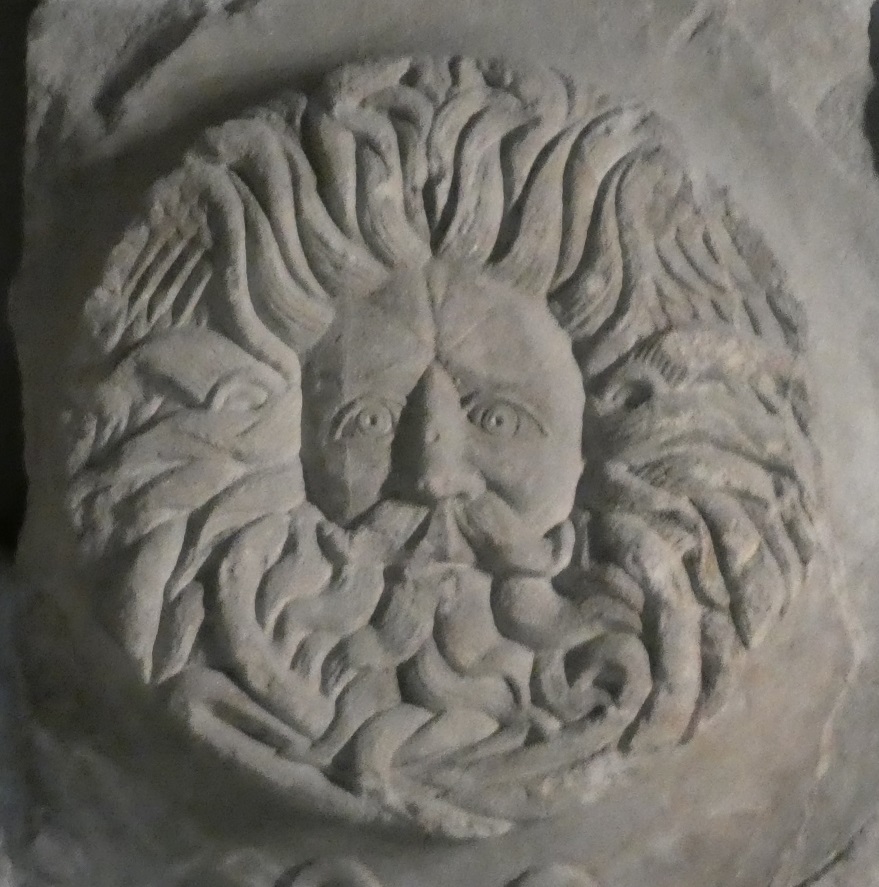
If one superimposes the Gorgoneion and the image of the enormous, bearded, disembodied head Ross has given us (minus the triple aspect), it’s hard not to think of one of the more famous images from Aquae Sulis, which she also discusses:⁹

The Gorgon’s head on the shield of Sulis-Minerva in the pediment of the temple is the finest example of the blending of native and classical imagery. The head is male, bearded and moustached, and its ancestry can be traced directly to the human heads which are so prolific on La Tène metalwork. The furrowed brow and two-dimensional features are typical of many examples of Romano-British heads in stone, as is the expression of the face. The convention of the writhing serpents which here spring from the hair and are entwined in the beard and moustache is classical, but the connection of serpents with human heads is found deeply rooted in the native tradition.

Another head emblematic of the site at Bath is that of Sulis-Minerva. This beautiful gilt bronze head evinces Graeco-Roman influence and is believed to have once worn a Corinthian helmet as well. This is generally interpreted as a fragment of a full-body cultic statue, but given the significance of the head in Celtic religious practice I’ve just discussed, I’m not so sure.

Obviously there are many factors, but much older finds such as the shields I’ve mentioned are in excellent condition, so the idea the rest of the statue dissolved in its entirety seems odd. The head isn’t perfect to be sure. There is some pitting on the lower right of the face. But it also shows six layers of gilding, which would have provided additional protection against corrosion and there’s no reason to believe the rest of the statue would not have been similarly gilt. Why then would it not make sense this too was either a disembodied head representing cultic beliefs or even a votive head deposited in the spring?

Certainly Roman religion had some traits in common with that of the Celts, and the interpretatio romana combines the names of their deities, but the Britons didn’t necessarily think of their own gods in this way. Besides Graeco-Roman gods and syncretized ones, the names of distinctly Celtic ones appear in inscriptions from Bath: Nemetona, the Suleviae, Sulis, “the mother goddess”. And even syncretization can be a form of rebellion, as African slaves could secretly worship a native deity such as Ogun, who they recognized in the image of the Christian Saint Peter.

While Romanization was quite thorough in some parts of the Empire, it was less so in Britain. Resistance to the invasion was quite stubborn and prolonged, even though native military tactics were not up to the task. The adoption of Roman customs, too, seems to have been met with little enthusiasm in many parts of the Isles. Rather than building temples in the classical style, Romano-Celtic ones were the norm, and indeed there are many natural sites votive finds attest were sacred, such as groves and springs. These, it is clear, predated Roman influence, and some of them, like that of Sulis at Bath, had structures added to them under Roman rule.

And indeed, there seems to have been a revival of Celtic practices as Roman power waned. For example, already by the late Roman period decapitated burials reemerge, clearly relating to the cult of the head. Many such beliefs continued past the Anglo-Saxon settlement of Britain, even down to its Christianization.


Read previous articles in the Defixiones series

Part 1: The Curses of Aquae Sulis

Part 2: Malefic Traditional

Part 3: Sympathy for Sauron

Part 4: Bargaining with the Gods

Part 5: Secundina’s Beef

Part 6: More Than Money Can Buy

Part 7: The Punic Curse Trail

Part 8: Hellenism Schmellenism


Notes

  1. Episode 93, “Superstition, magic and the Evil Eye in the Roman world”, The English Heritage Podcast, 2020.
  2. Cornelius Tacitus, Annales, 14.32, ca. 115–ca. 120. I’ve used the Alfred John Church & William Jackson Brodribb translation, 1888.
  3. Barry Cunliffe and Peter Davenport, “The Temple at Bath (Aquae Sulis) in the context of classical temples in the west European provinces”, The Temple Of Sulis Minerva At Bath Vol. I: The Site, 1985.
  4. Cunliffe, Excavations in Bath 1950–1975, 1979.
  5. Στράβων (Strabo), Γεωγραφικά (Geographica), 4.4.5, ca. 15 BCE. I’ve used the William Falconer translation, 1903–06.
  6. David Clarke, “The Head Cult: tradition and folklore surrounding the symbol of the severed human head in the British Isles”, 1998.
  7. Anne Ross, “The Human Head In Insular Pagan Celtic Religion”, Proceedings of the Society of Antiquaries of Scotland, 1958.
  8. Jane Ellen Harrison, “The Ker as Gorgon”, Prolegomena to the study of Greek religion, 1903.
  9. Ross, 1958.

The Ironclad Test Oath and Why It Doesn’t Work

Mentalis restrictio in the US Constitution (Logic of Lies, Part 5 Addendum)

As the new members of the executive branch were inaugurated in the US, I was struck by the language of the Vice Presidential oath of office—notably, it’s quite different from the one used for the President. Here’s how it runs:¹

I, [full name] do solemnly swear that I will support and defend the Constitution of the United States against all enemies, foreign and domestic; that I will bear true faith and allegiance to the same; that I take this obligation freely, without any mental reservation or purpose of evasion; that I will well and faithfully discharge the duties of the office on which I am about to enter. So help me God.

And there’s that term; “mental reservation”. This is the casuistry-based Jesuitic proposition condemned by Catholics and Protestants alike since the 17th century. This doctrine of equivocation was employed in order to say one thing while having something entirely different in one’s mind. Here, we’re talking about a “lie of necessity” a malefactor could use to infiltrate a government.

Using this phrase in the oath seems archaic—perhaps reflecting the country’s founding in the late 18th century. Looking at what is provided for the swearing in of the President in the US Constitution, however, there’s much simpler language:²

I do solemnly swear (or affirm) that I will faithfully execute the Office of President of the United States, and will to the best of my Ability, preserve, protect and defend the Constitution of the United States.

This oath has remained much the same since its use by George Washington in 1789. The only elements changed are the inclusion of the oath-taker’s full name, and the concluding line, “So help me God”.

The Vice Presidential oath of office is not set out in the Constitution and instead uses the same language as for any member of Congress. That document merely specifies such members, “shall be bound by Oath or Affirmation to support this Constitution”.³ The first Congress interpreted this fairly literally into a brief statement, thus:⁴

I do solemnly swear (or affirm) that I will support the Constitution of the United States.

So how did these 14 words expand to the rather lengthy oath we now hear and how did it come to include swearing not to engage in Jesuitical equivocation? According to the website of the US Senate, these changes stem from the 19th century:⁵

[T]he current oath is a product of the 1860s, drafted by Civil War-era members of Congress intent on ensnaring traitors.

President Abraham Lincoln himself initially spurred the current affirmation, termed the “Ironclad Test Oath”, using the expanded oath for civil servants within the executive branch in 1861. In an emergency session, Congress enacted legislation for their own expanded oath to be taken by employees in the legislature. The new language was drafted, argued, delayed by war, and eventually applied across the board in 1884.

“Without mental reservation” appears in many oaths as it turns out, including that used by US military enlistees, though I highly doubt any but a very few understand what they are swearing to. And in fact, the phrase actually refers to a specific type of untruth in which one utters one part aloud and the rest in their mind, thus “telling the truth to God”. Literally, this unspoken part is reserved from human ears and is instead mental. Thus, theoretically, one could take the original congressional oath of office and practice mental reservation like so:

I do solemnly swear that I will support the Constitution of the United States (only as far as it serves my own interests).

So the mental reservation language is added to the oath presumably to prevent this sort of thing, but it seems to me one could still take the same approach:

I take this obligation freely, without any mental reservation (as far as you know)….

There is, of course, another element to the doctrine of mental reservation which moral  theology and philosophy have struggled with forever: when it is permissible to lie. One prolific and popular moral theologian, St. Alphonsus Liguori (1696–1787) says it must be for a “just cause”, which he defines broadly:⁶

Justa autem causa esse potest quicumque finis honestus, ad servanda bona spiritui vel corpori utilia.

[A] just cause can be any honest end whatsoever, for the keeping of things good for the spirit or useful to the body.

To be fair, the specific cases of just cause he lists do seem reasonable, including a priest protecting the seal of confession, a defendant or witness illegitimately interrogated, and a traveler coming from a town falsely believed to be infected with plague. Still, he goes on to say, “an absolutely serious cause is not required”.⁷

And another respected scholar in much more recent time, Benoît Merkelbach, clearly knowing the history of deception and specifically Liguori’s work on the subject, makes it still more general:⁸

[…] dummodo ad veritatem occultandam iusta causa adsit et aliud medium desit honestum […].

[…] as long as a just cause is present, and other honest means of hiding the truth is wanting […].

First, it’s entertaining such works are still written in a moribund language in modern times, second, the lack of irony with which Merkelbach produces the phrase, “honest means of hiding the truth”, is astounding, but third, and most importantly to our topic, it seems exactly the process of casuistry described by Pope Francis is at work here, where general laws are established on the basis of exceptional cases.⁹ It’s also worthy of note, the pontiff’s comment was in the context of the sexual abuse cases that have plagued the Catholic Church in recent decades, in which many officials were clearly far less than honest, often using casuistry to rationalize their mendacity.

Moving to the realm of moral philosophy, Immanuel Kant makes his case by positing a man who needs to borrow money, realizes no one will lend it to him unless he promises to repay it, and which he won’t be able to repay—all consistent with the Jesuitical doctrines above—and therefore produces the maxim:¹⁰

[W]hen I believe myself to be in need of money I shall borrow money and promise to repay it, even though I know that this will never happen.

And Kant further states, were this case to become a universal law, just as Francis felt such things would:

[If] everyone, when he believes himself to be in need, could promise whatever he pleases with the intention of not keeping it would make the promise and the end one might have in it itself impossible, since no one would believe what was promised him but would laugh at all such expressions as vain pretenses.

And while all of this may have been a matter of conjecture in the 17th and 18th centuries, as we know, this is exactly what has come to pass. Regardless of what may be considered moral, people have lied to benefit themselves to such an extent a matter such as a loan has become a highly legalistic one, with few options apart from bankruptcy to escape a debt, and sometimes not even that, as with student loans, among others.

And furthermore, this slippery slope has led us inevitably to the Russian doctrine of what Timothy Snyder calls “implausible deniability” weaponizing the combination of fact and its evil twin, disinformation. The example he cites is the Russian invasion of Crimea:¹¹

The adage that there are two sides to a story makes sense when those who represent each side accept the factuality of the world and interpret the same set of facts. Putin’s strategy of implausible deniability exploited this convention while trying to destroy its basis. He positioned himself as a side of the story while mocking factuality. […] Western Editors, although they had the reports of the Russian invasion on their desks in the late days of February and the early days of March 2014, chose to feature Putin’s exuberant denials. And so the narrative of the Russian Invasion of Ukraine shifted in a subtle but profound way: it was not about what was happening to Ukrainians, but about what the Russian president chose to say about Ukraine. A real war had become reality television, with Putin as the hero. […] When Putin later admitted that Russia had invaded Ukraine, this only proved that the Western press had been a player in his show.

OK, I know I said in my previous article I was going to give politics a rest, but these things are closely intertwined and certainly this is a realm where various types of deception are most at play. Neither of the moral theologians I’ve discussed here could have foreseen how things have ended up. Right or wrong, they believed people are essentially good and even if there were a bit of fibbing, society would not be harmed. Instead, the jinn they have released can never be returned to its bottle.

On the other hand, Kant’s view is a utopian one; as Umberto Eco tells us, truth is in the realm of the theoretical: limited by our abilities as humans to perceive and communicate it. And of course, there are those white lies we all tell to preserve the feelings of others. Still, the issue with the products of casuistry is how they seek to create statements that are sort of true, but really not, As Liguori says:¹²

[N]on decipimus proximum, sed ex justa causa permittimus ut ipse se decipiat.

[W]e do not deceive our neighbor, but for a just cause we allow that he deceive himself.

Where I would reply with the Berber saying:

A smooth lie is better than a distorted truth.


Read previous articles in the Logic of Lies series

Part 1: The Fakes That Launched a Thousand Ships

Part 2: It’s Fascinating What One Can Deduce about a Man Just by Knowing his Name

Part 3: The Luwian Menace

Part 3 Addendum: Fruit from a Poisonous Pseudoarchaeological Tree

Part 4: Romancing the Hellenes

Part 5: Descent into the Absurd


Notes

  1. “Oath of Office”, United States Senate (website); emphasis mine.
  2. US Constitution, Article II, Section 1, Clause 8.
  3. Ibid, Article IV, Clause 3.
  4. US Senate.
  5. Ibid.
  6. Alphonsus Maria de Liguori, Theologia moralis, 1905-1912.
  7. Ibid, “non requiritur causa absolute gravis […].”
  8. Benoît Henri Merkelbach. Summa Theologiae Moralis, 1938.
  9. Francis X. Rocca, “Pope to meet with sex abuse victims for first time in June”, Catholic News Service, 2014.
  10. Immanuel Kant, Grundlegung zur Metaphysik der Sitten (Groundwork for the Metaphysic of Morals), 1785, Mary J. Gregor, trans., 1998.
  11. Timothy Snyder, The Road to Unfreedom: Russia, Europe, America, 2018.
  12. Liguori, 1905–1912.