Loosening “Tenet”’s Hold

Palindrome and film (Sator Square, Addendum)

Something strange happened recently: views on my site spiked. Although spread across Medium and my own page, some of my more popular posts have a lot of views. The one on Icelandic magical staves, for example, has some 7,600. I’m also aware views do not equate to reads, which are likely less than half that, especially given my penchant for exploring arcane subject matter with some degree of abstruseness.

These views accrue slowly: Medium doesn’t promote content that isn’t monetized and I can’t be bothered fiddling with Google AdWords or any of that sort of nonsense. For example, the article I mentioned earlier was published in 2016, so those views are spread fairly evenly across more than four years. A few of my posts did get a lot of attention when they came out, such as those in my series on the mythmaking around Bruce Lee, because they were controversial.

So it was odd to see traffic to my site balloon to over 30 times its usual rate over the course of a few days. I wasn’t sure exactly how to feel about this. As I’ve said, there’s no money in it for me and I’m not trying to develop any kind of following, but it’s still cool to see people interested in what I have to say.

I remember Art Spiegelman saying in a lecture I attended when he boiled down comics as a medium; it was images arranged in sequence to form a narrative printed on paper for mass distribution, and he could have simply drawn his deconstructive work in Raw on a piece of paper and showed it to the five people who would get it. While I have to admire the will to power that brought us Maus—likely the greatest anthropomorphized narrative of the Shoah—I have no such qualms. Publishing on the internet is cheap and easy. I don’t have to worry about wasting ink and paper or fighting for shelf space in a physical store. I simply write these missives and dispatch them into the intervoid, hoping they’ll be read and enjoyed by at least a few people who get them.

Looking into the explosion of views on my site, I could see they centered on the pair of articles I had done back in 2017 about the so-called Sator Square. There was no rise in likes, follows, comments, or even many views of other articles, so it was hard to tell how my writing was being received. Again, I’ve given up on the idea of any sort of community or interaction around these articles, instead spending time in some highly specific subreddits like /r/Etymology and /r/Cuneiform. Ultimately, these articles scratch an intellectual and creative itch. Indeed, it’s similar to my day job though exploring different realms; I’d also do that for free if not for the bills I have to pay.

Committing to (usually) monthly deliveries of complete articles ensures my exploration of the ideas they contain doesn’t simply remain as indefinitely open browser tabs. Instead, I carefully research, synthesize ideas, and try to write them all down in a coherent and hopefully compelling way. And so the work continues.

As this surge in views related to the Sator Square, I assume it is the movie Tenet, which will have stoked interest in this rebus. I had already been intending to do a follow up to these articles, but I felt I should prioritize it, so with no further ado:

In 2020, during the early days of the plague, I remember seeing posters for a movie that featured the leading man, John David Washington, cutting a rather dashing figure in a suit and wielding a handgun. I was reminded of a recent groundswell of support for the idea of casting Idris Elba as the next James Bond—perhaps that was too radical a move for Hollywood, and they were serving up something merely Bondesque instead? Apart from this, there was nothing very remarkable about the poster except the film’s name, Tenet.

Of course this word is familiar to me in English as meaning “a belief”. And also the Latin word whence it comes, the third-person singular active indicative inflection of teneō, “to hold”, so he/she/it holds. But it seemed clear neither of these could be the intended sense. Was it the name (or code name) of the character on the posters? The spy or military group to which he belonged? There was one other possibility I thought was remote: was it a reference to one of the Sator Square’s lines?

I later learned Tenet was a Christopher Nolan film. His films are positively cerebral compared to the usual Hollywood fare; even his take on Batman had some pretty clever elements. The slim chance of the film’s name being related to the last of the above points grew, and I was still more intrigued to see whether Nolan was among the cognoscenti and, if so, to what degree. So in this frame of mind, I watched the movie.

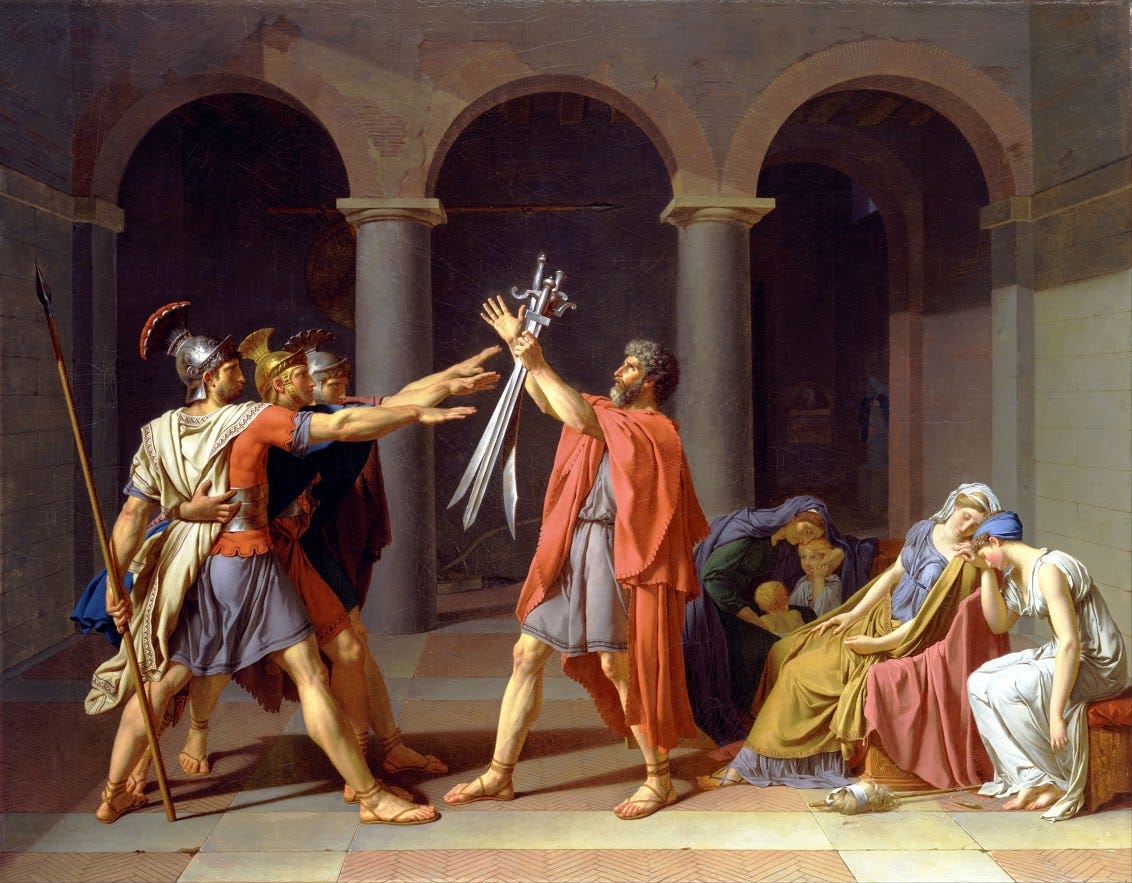
One of the central tropes of Tenet is playing with the chronology of the narrative. The tradition of non-linear storytelling has been around at least since the Iliad began in medias res. Still, there was a time and place when it violated norms, as painter El Greco was to find out after painting The Martyrdom of Saint Maurice in 1582:¹

[I]n between the main figures—the main Christian Roman generals—are contemporary generals. What El Greco is doing here is making a very clever, concise, contemporary point about the fight against heresy, and linking the 16thcentury struggle with the struggle of the early Christian martyrs. But in a way, he was being too clever, because in Counter-Reformation Spain, anything that transcended Christian orthodoxy was viewed with suspicion. And Philip II had real problems with this picture because time was conflated […].

Nonetheless, analepsis was a widely used trope appearing in the Mahābhārata as well as Arabian Nights tales such as “Sinbad the Sailor”. In Film, Citizen Kane in 1941 has the protagonist die in the film’s opening, with the remainder consisting of a series of flashbacks framed as interviews of those who knew Kane. And 1950’s Rashōmon (『羅生門』) shows us flashbacks of conflicting testimonies at a trial. Quentin Tarantino’s 1994 film, Pulp Fiction, is generally acknowledged as having ushered in the current craze for slice-and-dice narrative structures. 

Nolan certainly has explored the trope extensively; notably with the fractured narrative of Memento, the film that put him on the map, so to speak, in 2000. Indeed, I’d say he’s guilty of using it when it’s not needed, as in 2017’s Dunkirk. I definitely understand the instinct to try to spice up a distinctly British piece of jingoism about how a terrible military defeat could have been worse. Sure, it’s a very familiar tale with a plodding gait, but chopping up the timeline doesn’t fix it. Nolan’s flair for inventive storytelling lets him down here: present is the disorientation caused by such chronological gimmickry, but there’s no clever reveal, no reconfiguration of narrative expectations—in short, no payoff. Still, I see that as a rare lapse among his films.

And so we move to Tenet. This film employs a different narrative strategy: the chronology, apart from a few occasional flashbacks, is straight; time itself is what’s distorted. Certainly there are many time-travel films—it’s nearly its own subgenre—but this is a bit different. Instead of time travel as such, people, things, and the events related to them are happening via time moving in two opposing directions. Furthermore, rather than avoiding the tropes that have arisen among these films, such as timeline damage or splitting and various other temporal anomalies, Tenet leans into them. In particular, the classic grandfather paradox is everywhere: characters meeting themselves going the other way in time impels their own actions.

This means free will is an illusion as everything has already happened in one time direction or the other, so in a sense, there’s no tension, despite the many action scenes and explosions. This isn’t to say it’s not an interesting watch. I have long believed that so-called spoilers should be no obstacle to the enjoyment of a story, as the storytelling itself should be what provides that. So with Tenet, seeing how we get to the various encounters with inverted people and things we’ve already seen from the other direction is an absorbing experience. The mental contortions needed to choreograph car chases and hand-to-hand fights that make any kind of sense in both directions are equally impressive.

Crete - law of Gortyn - boustrophedon.JPG

And here we come to the connection between the film and the ancient rebus. The Sator Square seems to have been the inspiration for the film’s palindromic structure. In particular, the idea of the square being read in boustrophedon seems to be operative in Tenet, as the various characters change directions in time multiple times on screen—and many more off screen. Of course the Sator Square has more directions it can be read in, which are omitted by the film, as are the deeper resonances I’ve pointed out previously, but given the limitations of a medium that’s inherently linear, it’s a pretty good realization of a very tricky structure.

In case there’s any doubt about the film’s inspiration, it is literally spelled out:

  • Rotas is the name of the security company that guards the free port, in which art, some of it forged, is also held, but also the location of a turnstile that reverses entropy, which in form and function is also a wheel.
  • Opera is where the opening scene takes place in Ukraine, but also part of the name of the anti-terrorist squad, КОРД, (KORD), Rapid Operational Response Unit (Корпус Оперативно-Раптової Дії—it also works in Cyrillic) that the Protagonist (that’s really the main character’s name) acts alongside.
  • Tenet obviously the name of the film, as well as a codeword the Protagonist is given early in the story.
  • Arepo is the name of an art forger working with Kat Barton (Elizabeth Debicki), estranged wife of:
  • Sator, first name, Andrei (Kenneth Branagh); the villain of the piece.

Tenet was clearly chosen as the film’s title because as the central line of the rebus it is also a palindrome itself. Just as with the correspondences above, there are many ways each word is realized, so there is a literal tenet offered in the film as well, by Neil (Robert Pattinson):

What’s happened, happened. It’s an expression of faith in the mechanics of the world; it’s not an excuse for doing nothing.

This is essentially a recapitulation of paradoxical Calvinistic beliefs about predestination, which state briefly, while the ultimate fate of an individual is foreordained, they still retain moral agency and responsibility. Only more so in this case—these people already know exactly what will occur but must perform it, nonetheless.

Regarding tenets, the beliefs the Protagonist and others who become embroiled in this story have about the nature of the world they live in at its beginning are slowly broken down over its course. What Tenet ends up reminding me of is Jorge Luis Borges’ “Tlön, Uqbar, Orbis Tertius”.² For a brief description of this short story, here’s psychology professor David Pizarro:³

It turns out that the minute that people become aware of the radical idealism of the fictional world, Tlön, that was supposedly the product of a real-world Uqbar, which was, in fact, itself a fictional world created by neoplatonic secret societies, […] the hardcore idealism of this […] metathis third worldmakes its way into our existence and starts changing reality because people believe it […] and therefore destroys [reality].

Note the sense of the term idealism here is not that of striving toward perfection, but the metaphysical concept there is no reality other than what one perceives.

Is it far-fetched to impute a Borgesian reference to Nolan? I think not. First, the director said in an interview:⁴

[…] I started thinking about the narrative freedoms that authors had enjoyed for centuries and it seemed to me that filmmakers should enjoy those freedoms as well.

When you think “narrative freedoms”, you have to think of the avant-garde, where Borges’ influence is widespread. But if that isn’t compelling enough, consider Memoriam is an inversion of “Funes the Memorious”. And just as the Protagonist and other characters do in Tenet, Borges meets an older version of himself in a spatial-temporal anomaly in “The Other” in a way that nullifies time itself.⁵

More directly, in “Tlön”, there is a discussion of the various metaphysical doctrines on the fictitious planet of the same name:⁶

One of the schools of Tlön goes so far as to negate time: it reasons that the present is indefinite, that the future has no reality other than as a present memory. Another school declares that all time has already transpired and that our life is only the crepuscular and no doubt falsified and mutilated memory or reflection of an irrecoverable process.

Not only do these statements turn our perceptions of time on their heads, but the last sentence connects directly to the password given in the opening minutes of Tenet: “We live in a twilight world.” Twilight, of course, having a dual meaning as the beginning of the day and the end of it. But also this metaphysical concept from Tlön, which Nolan nearly plagiarizes, is we are actually permanently frozen in the temporal condition of twilight.

Borges was arguably one of the first postmodern writers, reacting, particularly in “Tlön”, to the horrors—including WWII, which had already begun at his time of writing—created by the rejection of history that was modernism. As he says near the story’s close:⁷

[A]ny symmetry, any system with an appearance of order—dialectical materialism, anti-Semitism, Nazism—could spellbind and hypnotize mankind.

Our post-ironic times, too, are plagued with new forms of dangerous irrationality where conspiracy theories are embraced and facts denied. For this reason, Nolan chooses climate disaster, which we are rushing headlong toward, as the impetus for people from the future to infiltrate the past to attempt to rectify, though they must ultimately fail. Perhaps this film is in fact an expression of Nolan’s feelings of helplessness to stop what seems inevitable.


Read previous articles in the Sator Square series

Part 1: Sator Square Non-Starters

Part 1 Addendum A: Blessings Through Sator

Part 1 Addendum B: Acrostic as Microcosm

Part 2: And the Rotas Go ’Round


Notes

  1. “El Greco”, Great Artists with Tim Marlow, 2001.
  2. Jorge Luis Borges, “Tlön, Uqbar, Orbis Tertius”, 1940, translated by Andrew Hurley in Collected Fictions, 1998.
  3. “Episode 154: Metaphysical Vertigo”, Very Bad Wizards (podcast), 2018.
  4. Geoff Andrew, “The Guardian Interviews at the BFI: Christopher Nolan”, The Guardian, 2002.
  5. Borges, “Funes el memorioso”, 1942 and “El otro”, 1972, both also translated in Hurley, 1998.
  6. Borges, 1940.
  7. Ibid.

The Celtic Undercurrents of Bath

Native religion in rebellion (Defixiones, Part 9)

I’ve detailed in this series how a type of magic spread from the Ancient Near East (ANE) right across Europe and eventually to Britain, at the farthest northeast edge of the Roman Empire. How this occurred in these islands—likely similar to other regions—is related by Cameron Moffett, curator of collections at English Heritage:¹

The Romans brought with them both literacy and this extensive material culture, which was more substantial than what had existed in Britain before. And it’s usually in all this new stuff, which was spread across most of mainland Britain by the mechanism of a newly introduced market economy, that we see the evidence of magic.

While of course, we see evidence of Graeco-Roman magic and religion following the invasion, as Moffet states, that’s not where the record begins. Some specific elements of native beliefs in evidence generally in the Celtic world and specifically at Aquae Sulis (modern Bath) bear further examination.

In fact, there were certain similarities in Celtic and Roman practices that likely made the adoption of some systems of the latter so quick to catch on. However, this also muddies the situation and makes it difficult to untangle which is which. For example, like the Romans, the Celts had a reverence for springs and other watery spots, so Aquae Sulis was a site of worship prior to the Romans’ arrival.

We can also see the Gauls—one of the main groups of Continental Celts—established a shrine at the source of the Seine near modern Dijon in the second or first century BCE, prior to Roman conquest, and another at the spring of Chamalières, the source of the Rhône, near modern Clermont-Ferrand. The former seems to have been consecrated to the goddess Sequana, the patron goddess of the Seine, and indeed the river’s name derives from hers. She is known for her mischievous duck familiars. The latter was to Maponos, meaning “great son”, a god of youth—and likely a trickster himself—who was syncretized with Apollo after the arrival of the Romans.

In both locations, there is evidence of pre-Roman construction and the deposition of wooden objects, which are apparently votives. As at Aquae Sulis, the Romans and Romano-Gauls sought the intervention of syncretized versions of native gods via a large array of items, including defixiones (lead curse tablets).

Disentangling Roman deposits from those predating their influence becomes quite difficult because of the cross-pollination of some of these traditions. While I think I’ve been able to argue for the ANE as a clear source of cursing traditions, votives, particularly their deposition in bodies of water, are a clearly attested Celtic tradition. So while curse tablets don’t appear before the Roman period, and so we can assume the knowledge of them came with the Romans, we can also see them as a continuation of ancient Celtic practices relating to watery sites.

One noteworthy example of Celtic water deposition is the Battersea Shield. This gorgeous La Tène-style bronze repoussé shield dates from the second–first century BCE and was found during excavation for a previous incarnation of London’s Battersea Bridge in the mid-19th century. The shield is believed to have been deliberately placed in the Thames as a votive. This mighty British river was a site where many items of arms and armor were offered in sacrifice in the Bronze and Iron Ages, including other notable finds such as the Wandsworth Shield and the Waterloo Helmet.

The Thames also figures as a locus for divination during Boudica’s doomed uprising against the Romans (ca. 60 CE) when the waters themselves were used as a kind of scrying object. Although Tacitus only mentions it in passing, a vision in the river is given as one of the omens seen by the Britons as fortuitous for the rebellion:²

[…] visamque speciem in aestuario Tamesae subversae coloniae […].

[…] and in the estuary of the Thames had been seen the appearance of an overthrown [Roman] town […].

Other sites were still more important; excavations at Fiskerton, on the Witham, have yielded a rich selection of Iron Age artifacts, including several swords, spearheads, an axe, and a dagger, many of them ritually damaged or destroyed before their deposition in the river. There are similar sites throughout the British Isles and mainland Europe, such as Llyn Cerrig Bach in Wales, the Lisnacrogher Bog in Ireland, Orton Meadows (on the former course of the Nene) in East Anglia, and the eponymous La Tène on Lake Neuchâtel, Switzerland.

Circling back to Bath, the archaeology is tricky, as the Roman construction overlays and supplants the earlier Celtic structures. But it is generally agreed there was a temple to Sulis sited at modern Bath. Some estimate this could have occurred as much as 10,000 years ago, placing it in the Early Neolithic period, which, to be honest, seems exaggerated, as the Windmill Hill culture only dates to around 3000 BCE. In any case, it seems clear there was a Celtic Iron Age temple to their local deity, Sulis, when the Romans arrived.

Even with all the Roman-period construction, eighteen Late Iron Age coins were found in modernity, hidden in the anaerobic mud of the spring’s reservoir. Given their condition, and barring some unlikely event such as a hoard being dug up and then redeposited, it seems clear they must have been there prior to the Roman presence.³

This would seem to invalidate the hypothesis I had previously accepted from Marina Piranomonte the use of coins as votives was because of the decline in literacy and the ability to inscribe defixiones, but so it goes in science. And perhaps both can be true; at Aquae Sulis the deposition of coins may have returned because of the decline of public epigraphy and in the case of the Fons Annae Perrenae (Piranomonte’s subject) the cross-pollination of an originally Celtic practice might be what’s at work.

Even the lead ingot I mentioned in Part 1 may also have been a votive. One of the original archaeologists surveying the site, Barry Cunliffe, noted it as such.⁴ Its presence in the temple itself, rather than at some outbuilding where pipes might have been manufactured is certainly strange. Indeed, it is the only such object found on the site, and bears marks appearing to have been made by an axe to ritually damage it prior to deposition.

Another important Celtic tradition is known as the cult of the head. Summed up, it venerates the head as the locus of the individual’s soul, personality, and spiritual potency, and a symbol of the regeneration of life. This is true to such an extent the physical body is a sometimes disposable element of the complex symbolic structure. Indeed, the cult of the head was a core part of Celtic religious ideology, from the culture’s origins through to its demise, evidenced in its folklore, myth, and art.

While  the medieval display of heads warned of punishments for transgressors, they had an entirely different meaning to the ancient Celts. Classical sources clearly relate—and local vernacular traditions verify—the importance of heads as war trophies, which decorated the exteriors of both dwellings and temples in their villages. Certainly martial prowess is thus shown, but these heads also acted as amulets as well.

On the topic, Strabo tells us:⁵

[…] βάρβαρον και το ἔκφυλον, ὃ τοῖς προσβόρροις ἔθνεσι παρακολουθεῖ πλεῖστον, το ἀπο τῆς μάχης ἀπιόντας τας κεφαλας τῶν πολεμίων ἐξάπτειν ἐκ τῶν αὐχένων τῶν ἵππων, κομίσαντας δε προσπατταλεύειν τοῖς προπυλαίοις. […] τας δε τῶν ἐνδόξων κεφαλας κεδροῦντες ἐπεδείκνυον τοῖς ξένοις, και οὐδε προς ἰσοστάσιον χρυσον ἀπολυτροῦν ἠξίουν

[T]hey have a barbarous and absurd custom […] of suspending the heads of their enemies from their horses’ necks on their return from battle, and when they have arrived nailing them as a spectacle to their gates. […] The heads of any illustrious persons they embalm with cedar, exhibit them to strangers, and would not sell them for their weight in gold.

Archaeological evidence shows skulls mainly near fortification walls, gates, doorways, etc. of settlements, just as classical and vernacular traditions suggest.

The Celtic homeland areas of central Europe, and in particular the unique temple sanctuaries of southern Provence, have direct and datable archaeological evidence for a head cult making use of votive human skulls. For one such site, Roquepertuse, whose temple’s portico featured pillars with cavities for the deposition of skulls, that date is at least third century BCE but possibly even from as early as the sixth century, with the temple’s destruction by the Romans in 124 BCE giving us a terminus ante quem.

In Britain, too, finds give evidence of the head cult from the late Iron Age and early Roman period. These include skulls kept as trophies, skulls buried by themselves, and—importantly for our purposes here—skulls found in springs and wells:⁶

[H]uman skulls were frequently offered in ritual contexts at watery places during the Roman period, apparently as a direct continuation of a deeply-rooted native British tradition. One skull found on the site of the Bank of London was found as part of a deliberate filling of an early Roman well, dating from the first to the third century AD, which suggested it was part of a complex foundation ritual. […] The existence of a long-standing tradition of offering skulls to watery places may explain a number of isolated finds in the archaeological record, such as the skull of a young woman […] which was found buried in the lining of a well at a first century settlement in Odell, Bedfordshire. In Brigantia, a well at a Romano-British settlement site at Rothwell near Leeds dating from the fourth or fifth centuries AD yielded a single human skull. […] [?] Merrifield has noted a number of similar instances from Roman London, and another skull from the third century well of a Roman villa at Northwood, Hertfordshire […]. Describing these puzzling finds, he says heads are unlikely to be dropped into wells by accident or as discarded rubbish, and sees significance in the fact that heads are often found as “closing” deposits into wells which previously supplied water for domestic or industrial purposes.

Welsh legend relates the head of Bendigeidfran (also known as King Brân the Blessed) was buried in London on the spot where the White Tower would later be built. The head’s presence there was said to protect Britain from invasion, but King Arthur decided he was badass enough on his own and dug it up.

In addition to actual heads, watery sites commonly include votives symbolic of heads. For example, in both the Fontes Sequanae and Chamalières, some of the votives I previously mentioned were human heads carved from wood. These seem to date from the pre-Roman period because they show no signs of Mediterranean influence in their style, bearing instead the oval eyes characteristic of Celtic art. The carved jack-o’-lantern of modern Halloween clearly relates to this tradition via the co-opted insular festival of Samhain, even down to the locations in which they are displayed.

We see such symbolism repeatedly in stone heads, including janiform and tricephalous heads, face pots, wooden carvings, masks, and antefixes. One such head is discussed by Professor Anne Ross, thus:⁷

[In the territory of the Belgic Remi tribe] the deity is symbolised by an enormous bearded tricephalos, having a leaf-crown, and usually equated with the classical Mercury. These particular representations would seem to testify to the concept of some autochthonous deity as a head alone, the head sufficing for the total being, the vital part, embued with the power of the whole.

Although Strabo wrote with contempt of the Celtic fascination with severed heads, a similar figure appears in the Graeco-Roman tradition as well, even including the apotropaic function: Medusa’s. Also known as a Gorgoneion, the image of this grotesque severed head is a well-known device on armor and shields as well as coins, temple pediments, antefixes, garments, dishes, and weapons. Thus it shared similar ubiquity and longevity to the Celtic head cult, even exceeding it, as it survived well into Christian times and was revived in Renaissance and neoclassical contexts, right down to the present where it appears in the logo of the Versace fashion brand.

The prevalence of the image of the Gorgon’s disembodied head, while of course referring to the Perseus myth, also closely matches the spirit of the Celtic head cult:⁸

It is […] apparent that in her essence, Medusa is a head and nothing more; her potency […] resides in the head […].

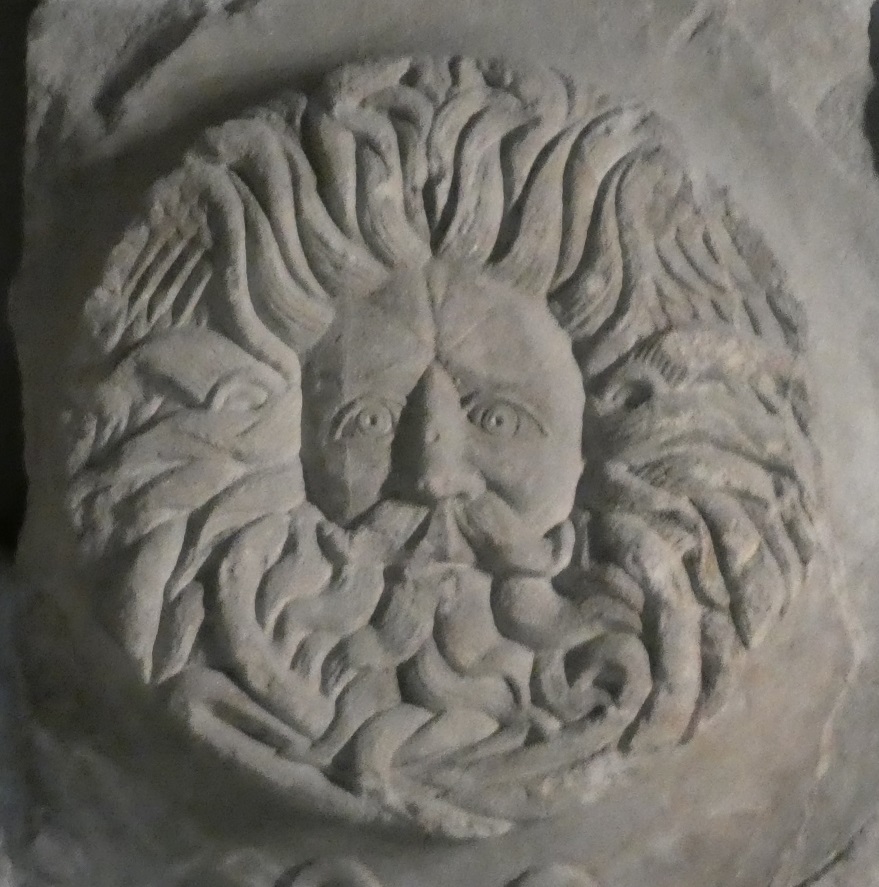
If one superimposes the Gorgoneion and the image of the enormous, bearded, disembodied head Ross has given us (minus the triple aspect), it’s hard not to think of one of the more famous images from Aquae Sulis, which she also discusses:⁹

The Gorgon’s head on the shield of Sulis-Minerva in the pediment of the temple is the finest example of the blending of native and classical imagery. The head is male, bearded and moustached, and its ancestry can be traced directly to the human heads which are so prolific on La Tène metalwork. The furrowed brow and two-dimensional features are typical of many examples of Romano-British heads in stone, as is the expression of the face. The convention of the writhing serpents which here spring from the hair and are entwined in the beard and moustache is classical, but the connection of serpents with human heads is found deeply rooted in the native tradition.

Another head emblematic of the site at Bath is that of Sulis-Minerva. This beautiful gilt bronze head evinces Graeco-Roman influence and is believed to have once worn a Corinthian helmet as well. This is generally interpreted as a fragment of a full-body cultic statue, but given the significance of the head in Celtic religious practice I’ve just discussed, I’m not so sure.

Obviously there are many factors, but much older finds such as the shields I’ve mentioned are in excellent condition, so the idea the rest of the statue dissolved in its entirety seems odd. The head isn’t perfect to be sure. There is some pitting on the lower right of the face. But it also shows six layers of gilding, which would have provided additional protection against corrosion and there’s no reason to believe the rest of the statue would not have been similarly gilt. Why then would it not make sense this too was either a disembodied head representing cultic beliefs or even a votive head deposited in the spring?

Certainly Roman religion had some traits in common with that of the Celts, and the interpretatio romana combines the names of their deities, but the Britons didn’t necessarily think of their own gods in this way. Besides Graeco-Roman gods and syncretized ones, the names of distinctly Celtic ones appear in inscriptions from Bath: Nemetona, the Suleviae, Sulis, “the mother goddess”. And even syncretization can be a form of rebellion, as African slaves could secretly worship a native deity such as Ogun, who they recognized in the image of the Christian Saint Peter.

While Romanization was quite thorough in some parts of the Empire, it was less so in Britain. Resistance to the invasion was quite stubborn and prolonged, even though native military tactics were not up to the task. The adoption of Roman customs, too, seems to have been met with little enthusiasm in many parts of the Isles. Rather than building temples in the classical style, Romano-Celtic ones were the norm, and indeed there are many natural sites votive finds attest were sacred, such as groves and springs. These, it is clear, predated Roman influence, and some of them, like that of Sulis at Bath, had structures added to them under Roman rule.

And indeed, there seems to have been a revival of Celtic practices as Roman power waned. For example, already by the late Roman period decapitated burials reemerge, clearly relating to the cult of the head. Many such beliefs continued past the Anglo-Saxon settlement of Britain, even down to its Christianization.


Read previous articles in the Defixiones series

Part 1: The Curses of Aquae Sulis

Part 2: Malefic Traditional

Part 3: Sympathy for Sauron

Part 4: Bargaining with the Gods

Part 5: Secundina’s Beef

Part 6: More Than Money Can Buy

Part 7: The Punic Curse Trail

Part 8: Hellenism Schmellenism


Notes

  1. Episode 93, “Superstition, magic and the Evil Eye in the Roman world”, The English Heritage Podcast, 2020.
  2. Cornelius Tacitus, Annales, 14.32, ca. 115–ca. 120. I’ve used the Alfred John Church & William Jackson Brodribb translation, 1888.
  3. Barry Cunliffe and Peter Davenport, “The Temple at Bath (Aquae Sulis) in the context of classical temples in the west European provinces”, The Temple Of Sulis Minerva At Bath Vol. I: The Site, 1985.
  4. Cunliffe, Excavations in Bath 1950–1975, 1979.
  5. Στράβων (Strabo), Γεωγραφικά (Geographica), 4.4.5, ca. 15 BCE. I’ve used the William Falconer translation, 1903–06.
  6. David Clarke, “The Head Cult: tradition and folklore surrounding the symbol of the severed human head in the British Isles”, 1998.
  7. Anne Ross, “The Human Head In Insular Pagan Celtic Religion”, Proceedings of the Society of Antiquaries of Scotland, 1958.
  8. Jane Ellen Harrison, “The Ker as Gorgon”, Prolegomena to the study of Greek religion, 1903.
  9. Ross, 1958.

The Ironclad Test Oath and Why It Doesn’t Work

Mentalis restrictio in the US Constitution (Logic of Lies, Part 5 Addendum)

As the new members of the executive branch were inaugurated in the US, I was struck by the language of the Vice Presidential oath of office—notably, it’s quite different from the one used for the President. Here’s how it runs:¹

I, [full name] do solemnly swear that I will support and defend the Constitution of the United States against all enemies, foreign and domestic; that I will bear true faith and allegiance to the same; that I take this obligation freely, without any mental reservation or purpose of evasion; that I will well and faithfully discharge the duties of the office on which I am about to enter. So help me God.

And there’s that term; “mental reservation”. This is the casuistry-based Jesuitic proposition condemned by Catholics and Protestants alike since the 17th century. This doctrine of equivocation was employed in order to say one thing while having something entirely different in one’s mind. Here, we’re talking about a “lie of necessity” a malefactor could use to infiltrate a government.

Using this phrase in the oath seems archaic—perhaps reflecting the country’s founding in the late 18th century. Looking at what is provided for the swearing in of the President in the US Constitution, however, there’s much simpler language:²

I do solemnly swear (or affirm) that I will faithfully execute the Office of President of the United States, and will to the best of my Ability, preserve, protect and defend the Constitution of the United States.

This oath has remained much the same since its use by George Washington in 1789. The only elements changed are the inclusion of the oath-taker’s full name, and the concluding line, “So help me God”.

The Vice Presidential oath of office is not set out in the Constitution and instead uses the same language as for any member of Congress. That document merely specifies such members, “shall be bound by Oath or Affirmation to support this Constitution”.³ The first Congress interpreted this fairly literally into a brief statement, thus:⁴

I do solemnly swear (or affirm) that I will support the Constitution of the United States.

So how did these 14 words expand to the rather lengthy oath we now hear and how did it come to include swearing not to engage in Jesuitical equivocation? According to the website of the US Senate, these changes stem from the 19th century:⁵

[T]he current oath is a product of the 1860s, drafted by Civil War-era members of Congress intent on ensnaring traitors.

President Abraham Lincoln himself initially spurred the current affirmation, termed the “Ironclad Test Oath”, using the expanded oath for civil servants within the executive branch in 1861. In an emergency session, Congress enacted legislation for their own expanded oath to be taken by employees in the legislature. The new language was drafted, argued, delayed by war, and eventually applied across the board in 1884.

“Without mental reservation” appears in many oaths as it turns out, including that used by US military enlistees, though I highly doubt any but a very few understand what they are swearing to. And in fact, the phrase actually refers to a specific type of untruth in which one utters one part aloud and the rest in their mind, thus “telling the truth to God”. Literally, this unspoken part is reserved from human ears and is instead mental. Thus, theoretically, one could take the original congressional oath of office and practice mental reservation like so:

I do solemnly swear that I will support the Constitution of the United States (only as far as it serves my own interests).

So the mental reservation language is added to the oath presumably to prevent this sort of thing, but it seems to me one could still take the same approach:

I take this obligation freely, without any mental reservation (as far as you know)….

There is, of course, another element to the doctrine of mental reservation which moral  theology and philosophy have struggled with forever: when it is permissible to lie. One prolific and popular moral theologian, St. Alphonsus Liguori (1696–1787) says it must be for a “just cause”, which he defines broadly:⁶

Justa autem causa esse potest quicumque finis honestus, ad servanda bona spiritui vel corpori utilia.

[A] just cause can be any honest end whatsoever, for the keeping of things good for the spirit or useful to the body.

To be fair, the specific cases of just cause he lists do seem reasonable, including a priest protecting the seal of confession, a defendant or witness illegitimately interrogated, and a traveler coming from a town falsely believed to be infected with plague. Still, he goes on to say, “an absolutely serious cause is not required”.⁷

And another respected scholar in much more recent time, Benoît Merkelbach, clearly knowing the history of deception and specifically Liguori’s work on the subject, makes it still more general:⁸

[…] dummodo ad veritatem occultandam iusta causa adsit et aliud medium desit honestum […].

[…] as long as a just cause is present, and other honest means of hiding the truth is wanting […].

First, it’s entertaining such works are still written in a moribund language in modern times, second, the lack of irony with which Merkelbach produces the phrase, “honest means of hiding the truth”, is astounding, but third, and most importantly to our topic, it seems exactly the process of casuistry described by Pope Francis is at work here, where general laws are established on the basis of exceptional cases.⁹ It’s also worthy of note, the pontiff’s comment was in the context of the sexual abuse cases that have plagued the Catholic Church in recent decades, in which many officials were clearly far less than honest, often using casuistry to rationalize their mendacity.

Moving to the realm of moral philosophy, Immanuel Kant makes his case by positing a man who needs to borrow money, realizes no one will lend it to him unless he promises to repay it, and which he won’t be able to repay—all consistent with the Jesuitical doctrines above—and therefore produces the maxim:¹⁰

[W]hen I believe myself to be in need of money I shall borrow money and promise to repay it, even though I know that this will never happen.

And Kant further states, were this case to become a universal law, just as Francis felt such things would:

[If] everyone, when he believes himself to be in need, could promise whatever he pleases with the intention of not keeping it would make the promise and the end one might have in it itself impossible, since no one would believe what was promised him but would laugh at all such expressions as vain pretenses.

And while all of this may have been a matter of conjecture in the 17th and 18th centuries, as we know, this is exactly what has come to pass. Regardless of what may be considered moral, people have lied to benefit themselves to such an extent a matter such as a loan has become a highly legalistic one, with few options apart from bankruptcy to escape a debt, and sometimes not even that, as with student loans, among others.

And furthermore, this slippery slope has led us inevitably to the Russian doctrine of what Timothy Snyder calls “implausible deniability” weaponizing the combination of fact and its evil twin, disinformation. The example he cites is the Russian invasion of Crimea:¹¹

The adage that there are two sides to a story makes sense when those who represent each side accept the factuality of the world and interpret the same set of facts. Putin’s strategy of implausible deniability exploited this convention while trying to destroy its basis. He positioned himself as a side of the story while mocking factuality. […] Western Editors, although they had the reports of the Russian invasion on their desks in the late days of February and the early days of March 2014, chose to feature Putin’s exuberant denials. And so the narrative of the Russian Invasion of Ukraine shifted in a subtle but profound way: it was not about what was happening to Ukrainians, but about what the Russian president chose to say about Ukraine. A real war had become reality television, with Putin as the hero. […] When Putin later admitted that Russia had invaded Ukraine, this only proved that the Western press had been a player in his show.

OK, I know I said in my previous article I was going to give politics a rest, but these things are closely intertwined and certainly this is a realm where various types of deception are most at play. Neither of the moral theologians I’ve discussed here could have foreseen how things have ended up. Right or wrong, they believed people are essentially good and even if there were a bit of fibbing, society would not be harmed. Instead, the jinn they have released can never be returned to its bottle.

On the other hand, Kant’s view is a utopian one; as Umberto Eco tells us, truth is in the realm of the theoretical: limited by our abilities as humans to perceive and communicate it. And of course, there are those white lies we all tell to preserve the feelings of others. Still, the issue with the products of casuistry is how they seek to create statements that are sort of true, but really not, As Liguori says:¹²

[N]on decipimus proximum, sed ex justa causa permittimus ut ipse se decipiat.

[W]e do not deceive our neighbor, but for a just cause we allow that he deceive himself.

Where I would reply with the Berber saying:

A smooth lie is better than a distorted truth.


Read previous articles in the Logic of Lies series

Part 1: The Fakes That Launched a Thousand Ships

Part 2: It’s Fascinating What One Can Deduce about a Man Just by Knowing his Name

Part 3: The Luwian Menace

Part 3 Addendum: Fruit from a Poisonous Pseudoarchaeological Tree

Part 4: Romancing the Hellenes

Part 5: Descent into the Absurd


Notes

  1. “Oath of Office”, United States Senate (website); emphasis mine.
  2. US Constitution, Article II, Section 1, Clause 8.
  3. Ibid, Article IV, Clause 3.
  4. US Senate.
  5. Ibid.
  6. Alphonsus Maria de Liguori, Theologia moralis, 1905-1912.
  7. Ibid, “non requiritur causa absolute gravis […].”
  8. Benoît Henri Merkelbach. Summa Theologiae Moralis, 1938.
  9. Francis X. Rocca, “Pope to meet with sex abuse victims for first time in June”, Catholic News Service, 2014.
  10. Immanuel Kant, Grundlegung zur Metaphysik der Sitten (Groundwork for the Metaphysic of Morals), 1785, Mary J. Gregor, trans., 1998.
  11. Timothy Snyder, The Road to Unfreedom: Russia, Europe, America, 2018.
  12. Liguori, 1905–1912.

Your Western Wuxia Is Weak

New film, new issues (DeDisneyfication, Part 2 Addendum B)

Against my better judgment, I watched the live-action remake of Mulan. It was visually stunning, had a ton of star power, and flashy martial arts. Still, it did little to address the issues of the original film, instead opening new ones, and ultimately lacked depth.

There are, of course, several political issues with the film, which have been well discussed elsewhere; I would encourage readers to be aware of them, but don’t feel they need to be rehashed here, especially since I’ve been on that sort of soapbox too much recently, and I’d like to get back to my usual media-culture-history bailiwick.

As my earlier article suggested, the new film did lose the anthropomorphic animals, but also the singing and has instead become a wuxia flick (武俠电影). I’m down with the genre in general, but using it in this context is pretty strange, especially as it typically favors style over substance even more than a Disney film. Additionally, there are very few Hollywood success stories in the genre, which doesn’t mean no one should try, but it should at the very least be a caution sign.

And this film crashes: although Mulan is replete with martial skills, the essential story remains unchanged. Her accomplishments are no more spectacular; she merely does them with greater flair. Furthermore, the emperor Mulan is trying to save is played by Jet Li (李连杰), who naturally displays his own fighting prowess and so seems in little need of saving. Nonetheless, they somehow contrive to make a rescue necessary.

This also means there’s no character arc: Mulan as a young girl is already running across rooftops like Spiderman, so where can she go from there? Only some vague idea females have to hide their chi (氣) holds her back, but the struggle to set this aside feels as abstract as the “rule” itself.

Again, it’s great they didn’t present someone as inept as Mulan was at the beginning of the original film, but the result is this flatness. All that happens is she decides to stop hiding her chi and be the badass she is—not much of a change. What’s more, the plot seems lifted directly from Frozen, but at least there the fear of witchcraft makes it more plausible.

Mushu (Eddie Murphy) has been replaced with a phoenix, which makes some kind of sense, as the Chinese fenghuang (鳳凰) is often used as a feminine counterpart to the masculine dragon. However, they clearly have in mind the Western mythical creature, having only superficial resemblance to the Eastern king of birds. The legend related in the film of the creature rising from its own ashes has nothing whatsoever to do with the lore of the fenghuang. In the end, this new “character” does nothing—it doesn’t speak; it only turns up when Mulan needs help, though it provides none and she has to rely on herself instead.

By contrast, the witch Xianniang (線娘, played by Gong Li; 巩俐) is a pretty cool and intriguing new character. She reminds me distinctly of Baigujing (白骨精, White Bone Demon) from Journey to the West,¹ who I imagine the creators may have had in mind. Indeed, it’s probably no coincidence Baigujing was also played by Gong Li in The Monkey King 2.² This demon is able to transform herself and uses the ability to deceive all but the wily Sun Wukong (孫悟空) who eventually defeats her. Xianniang too can change shape at will, including assuming the forms of other people as well as a falcon, and indeed, seems to be a replacement for Shan Yu’s trained hunting bird. 

As her name implies, Baigujing is a skeleton spirit, since depictions of bones are anathema in games in the PRC, where I’ve had to change art many times in order to meet these standards. Certainly 500-odd years have passed since Journey to the West was first penned, but it’s still an odd shift in cultural norms. I wondered while watching Mulan whether the bony details of Xianniang’s headdress and belt would make it past the censors.

The name of this new character seems to be a reference to Dou Xianniang (竇線娘), a female Chinese general who defeats and captures, Huā in a fanfic penned by Chu Renhuo in the early Qing Dynasty (大清, 1636–1912).³ Even though she is a barbarian, Huā wins the enemy commander’s respect through her display of Confucian virtues, and they become blood sisters. Indeed, this background might be what informs Mulan’s Xianniang abruptly choosing to take an arrow for the protagonist, which makes no sense to the actual film. In fact, the witch is the most powerful character in the film, making one wonder why she serves Böri Khan (Jason Scott Lee), the new film’s replacement for Shan Yu.

On the plus side, the film is beautiful. The scenery is breathtaking, with filming mainly taking place in New Zealand rather than the PRC. The island nation was easily the biggest star of The Lord of the Rings and The Hobbit film trilogies as well. In fact, one location tipped me off to the fact we weren’t in China even before the credits rolled: Mulan rides past a rock outcropping I distinctly remembered being overrun by warg-riders.

In the end, the film does nothing to address the likely non-Chinese identity of the “real” Huā Mùlán (花木蘭). Huā’s Chineseness is widely acknowledged to be incorrect, as I’ve previously mentioned. One surname under which she is known, Wei (魏), is drawn from the name of an Empire to the north whose people the Chinese referred to as suolu (索虜, “Plaited Barbarians”) because of the requisite male hairstyle of long, braided hair coiled atop their heads. Even Chu’s version clearly states Huā’s half-Han (漢人) race and status, describing her as a jienu (羯奴; “barbarian slave”) after her capture.⁴ As professor of Chinese literature Wilt Idema notes:⁵

[O]nly in the final years of the Qing is Mulan turned into a Han dynasty Chinese maiden patriotically fighting the northern Xiongnu.

The historicity of the new Mulan’s setting is an improvement of the hodgepodge of elements from throughout Chinese history presented in the original. But the time period they depict is that of the Tang dynasty (唐; 618–690, 705–907). This is not correct to the known-but-lost original 5th century Ballad of Mulan.

Chu’s version contains authentic details the film omits entirely: the Xianbei (鮮卑) with which Huā would have been associated underwent a program of Sinicization, intermarrying with their southern neighbors. This meant mixed ancestry became common, though mainly among the nation’s elites, so not squaring with the film’s low-status Mulan. These programs of cultural borrowing also included Taoism, Buddhism, and Confucianism (道教, 漢傳佛教, and 儒家, respectively), so aspects, particularly of the morals of the last, which are portrayed in both films may well have eventually penetrated even to remote villages.

Overall, it seems the production team took some pains to educate themselves in the lore of this woman warrior, as there are clear references to not just one, but a variety of versions of the Mulan tale in the film, which even quotes knowingly from the sixth century version’s closing passage about the hares as I did in my original article. But being informed didn’t stop them from making bad decisions as to their protagonist’s ethnic origin, the historical time period portrayed, and their retention of much of the original film’s structure.

One reason for this is although the production staff did contain several women—most notably the director and most of the writing staff—there was a distinct lack of East Asians of any kind. Another factor was the hard courting of the Chinese audience, which, while it’s something many studios have been doing of late, often yields not-so-great results because of how forced it is.

Presenting a non-Han Mulan would hardly have endeared a film to those viewers, but even this nationalistically Chinese one failed to find favor. Despite an all-Asian cast, audiences in the PRC found the performances wooden and the themes and trappings stereotypical.⁶ Ironically, it ends up falling short in many of the same ways as the original, but viewers missed the humor and music of the first one.

Furthermore, very much in keeping with Disney’s risk aversion, the story of Huā Mùlán has already been told repeatedly, with no fewer than 17 large- and small-screen versions having been produced in China since 1920. Although I might not find my Xianbei Huā among them, I can only imagine there would be some that improve dramatically on this flashy-but-flat one.


Read subsequent articles in the DeDisneyfication series

Part 3A: “Hercules”: Myths and Mistakes

Part 3B: Doing Hera’s Work on “Hercules”

Part 4: Tale As Old As Agriculture

Part 4 Addendum: The Enchanted and the Postmodern

Part 5: Putting “Pocahontas” to Rest

Part 5 Addendum: Powhatan’s Mantle

Part 6: Trouble with “Tarzan

Part 7A: The Wrong Rabbit Hole

Part 7A Addendum A: Curious Curation

Part 7A Addendum B: “Alice” in Revolt

Part 7A Addendum C: How “Alice” Grew Big in Japan

Part 7B: Alice’s Adventures in the Cousins’ War

Part 7B Addendum: Repainting the Roses

Part 8: Guerrillas and the “Jungle

Part 9A: Through a Magic Mirror Marred

Part 9A Addendum: The Woods “Over the Wall”

Part 9B: The Sum of Its Versions

Part 9C: The “Snow White” Studio

Part 9D: Snowhaus

Part 10: The Little Less-Than

Part 11: Batmouse 3D

Part 12: Mork & Scheherazade


Read previous articles in the DeDisneyfication series

Part 1: Straightening out “Hunchback”

Part 2: Making Over “Mulan”


Notes

  1. 吳承恩 (Wu Cheng’en), 《西遊記》 (Xīyóu Jì, Journey to the West), ca. 1592.
  2. 《西遊記之孫悟空三打白骨精》 (The Monkey King 2), 2016.
  3. 褚人獲 (Chu Renhuo), 《隋唐演義》 (Sui Tang yanyi, Romance of the Sui and the Tang), ca. 1675.
  4. Ibid.
  5. Wilt Idema, “Blasé Literati: Lu T’ien-Ch’eng and the Lifestyle of the Chiang-nan Elite in the Final Decades of the Wan-Li Period”, Erotic Color Prints of the Ming Period with an Essay on Chinese Sex Life from the Han to the Ch’ing Dynasty, 2004.
  6. Rebecca Davis, “China Hates Disney’s ‘Mulan,’ but It Has Nothing to Do With Politics”, Variety, 2020.

A Mesmerizing Lost Reality

The ’80s and the rewhitening of film (Roll Over McFly”, Addendum B)

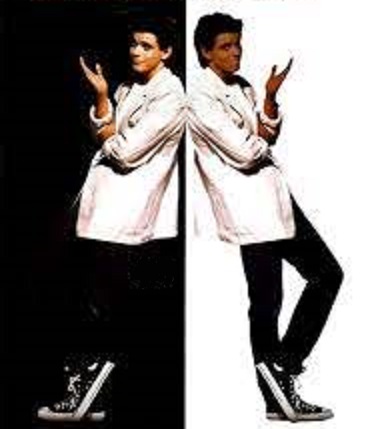
John Oliver invoked Back to the Future in a recent show:¹

[…] Marty McFly was white, because black people don’t generally hang around John C. Calhoun lookalikes who’re obsessed with going back to the 1950s.

This was an excellent reminder of the cultural and political scene that spawned the film and its messages about race and history. Oliver’s aside came within a piece about these same topics, so despite its brevity, it was well aimed.

I’ve discussed previously how white flight set the stage for new cheap-to-produce film genres for urban audiences including Spaghetti Westerns, Kung Fu, and blaxploitation, but by the 1980s, these trends had reversed. Karina Longworth details this occurrence’s particular effect on African Americans in film:²

The decade of the 1980s saw a decline in Hollywood films featuring mostly black casts and black heroes. In 1974, the peak of blaxploitation, at least in terms of volume, 7% of the films released by the major studios told stories primarily about black people. That number had dropped to 2.5% by 1981. […] Perhaps wary of […] controversies, on the big screen Hollywood steered clear of tackling the black experience, historically or in the present. In the interest of trying to target as many demographics as possible in each film, black movie stars like Richard Pryor and Eddie Murphy were frequently paired with white co-stars in movies that were set in largely white worlds.

I’d differ slightly with Longworth as to the two actors she mentions: both Pryor and Murphy had enough star power—not to mention talent—they frequently wore multiple hats for their films, including various combinations of writing, directing, and producing. So they often shaped the worlds in which they appeared. This included films like Pryor’s autobiographical Jo Jo Dancer, Your Life is Calling (1986), Murphy’s African fairy tale, Coming to America (1988), and Harlem Nights (1989), a historical crime drama for which the two teamed up. Still, they are exceptions to the trend Longworth otherwise describes correctly.

The first episode of GLOW, set in 1985, captures the situation in a brief conversation between a director and a black actress at a casting call:³

Sam Sylvia (Marc Maron): [Your] resume gets kinda thin after 1979.
Cherry Bang (Sydelle Noel): Movies get a little white after 1979.

And alongside this trend, beginning in the mid-’70s and intensifying in the ’80s, there was a glut of films featuring nostalgia for the ’50s. A short list of the better known ones is:

  • American Graffiti (1973)
  • Grease (1978)
  • Diner (1982)
  • Back to the Future (1985)
  • Stand by Me (1986)
  • Peggy Sue Got Married (1986)
  • Driving Miss Daisy (1989)

And on the small screen, Happy Days—closely related to American Graffiti, as the film sold the concept, as well as borrowing Ron Howard from the TV show’s pilot, among other elements—aired for 10 years (1974-1984), spawning multiple spinoffs.

The surge in ’50s nostalgia and the simultaneous drop in films starring people of color is far from coincidental. The blacklash is evident, with no major roles and sometimes not even minor ones for people of color in any of them, with the exception of Driving Miss Daisy. Even there, Hoke Colburn (Morgan Freeman) is the titular white woman’s servant, so he’s far from an equal.

So what was behind these changes in the film business? Longworth suggests it was due to a corresponding shift in the overall political climate. In particular, the “conservative revolution” ushered in by the Reagan administration, which she characterizes as:⁵

[A] presidential administration which married a nostalgia for a white-supremacist past with Hollywood production values. […] [“Post racial”] terminology […] was used by conservatives as part of the argument against affirmative action and other social programs aimed at balancing racial disparity. In the republican argument—an argument that was inherently racist in that it demonized people of color for needing things like welfare, or asking for any acknowledgement of continued imbalance—the work of balancing the playing field was supposedly finished, and urban violence of the 1970s was a sign that white people needed to start looking out for themselves again. Reaganism reframed the activism and fights for equality of the 1960s and -70s as “chaos” and posited Reagan and the republican party as the solution to restore the order of the 1950s.

This last feature of conservatism is what Oliver was referring to on his show; one defining the movement to this day. Not only were governmental policies based on these misguided ideas, they also precipitated a spike in violence by groups like the KKK throughout the decade. Anthropologist Wade Davis filled in further details on the topic in a recent article for Rolling Stone:⁴

For many years, those on the conservative right in the United States have invoked a nostalgia for the 1950s, and an America that never was, but has to be presumed to have existed to rationalize their sense of loss and abandonment, their fear of change, their bitter resentments and lingering contempt for the social movements of the 1960s, a time of new aspirations for women, gays, and people of color.

But, as the Breitbart Doctrine has it, “politics is downstream from culture.” The political scene, and even Hollywood’s, were ultimately symptoms of a cultural shift: Having fled to the suburbs, boomers were settling down, having kids, getting jobs, and the appearance of new suburban megaplex theaters coincided with these trends. Some would even say the drug of choice for this generation went from laid-back slacker cannabis to vigorously capitalist cocaine, which, in addition to amping up energy, also required a straight job because of its expense. In any case, one result was the supposed family values” of the ’50s were revalorized, but this version of the past was an imagined one.

Additionally, art itself suffered a reversal, moving from the irony of postmodernism to the so-called earnestness of post-postmodernism. This translated to a certain lack of depth, which literary critic Fredric Jameson described in 1983 as pastiche:⁶

Pastiche is, like parody, the imitation of a particular or unique style, the wearing of a stylistic mask, speech in a dead language: but it is a neutral practice of such mimicry, without parody’s ulterior motive, without the satirical impulse, without laughter, without that still latent feeling that there exists something normal compared with which what is being imitated is rather comic. Pastiche is a blank parody, parody that has lost its sense of humor […].

Even at this, Jameson sees the wave of nostalgia films as embodying a particular form of pastiche, and further connects it strongly to the political and cultural realms:⁷

Nostalgia films restructure the whole issue of pastiche and project it onto a collective and social level, where the desperate attempt to appropriate a missing past is now refracted through the iron law of fashion change and the emergent ideology of the generation. The inaugural film of this new aesthetic discourse, George Lucas’ American Graffiti (1973), set out to recapture, as so many films have attempted since, the henceforth mesmerizing lost reality of the Eisenhower era; and one tends to feel, that for Americans at least, the 1950s remain the privileged lost object of desire […].

But the ’50s nostalgia film was just one part of this new cinematic landscape. There are a few other films released in the decade worth discussing as part of this cultural trend. 

There is much to love about one of the biggest hits of 1980, The Blues Brothers. In addition to some amazing comedy and an absurd number of car crashes, it also features many excellent performances from black musicians including James Brown, Ray Charles, Aretha Franklin, and John Lee Hooker. It’s still problematic the titular duo is white.

The backstory has Curtis (Cab Calloway) raise Jake and Elwood Blues (John Belushi and Dan Aykroyd) and school them in the musical form from which they take their name, so they are effectively black on the inside, an act of twisted alchemy similar to how Scarlett Johansson playing Kusanagi Motoko (草薙 素子), in 2017’s Ghost in the Shell was rationalized. In both the film and eponymous band, Belushi and Aykroyd have stolen the headliner glory from the musicians who should take center stage.

With much more on-the-nose minstrelsy, the 1986 film Soul Man is the tale of a white guy who pretends to be black in order to win a Harvard Law scholarship set aside for African Americans. NAACP Chapter President Willis Edwards summed up the issue even more at the core than a main character appearing in blackface for much of the film’s running time:⁸

We certainly believe it is possible to use humor to reveal the ridiculousness of racism. However the unhumorous and quite seriously made plot point of Soul Man is that no black student could be found in all of Los Angeles who was academically qualified for a scholarship geared to blacks.

Such criticisms did not deter the first couple from screening it at Camp David, though they did at least have the excuse their son Ron Reagan appeared in it. A White House spokesman let The LA Times know, The Reagans enjoyed the film and especially enjoyed seeing their son Ron.”⁹

The final film I’ll note here was not a new one, but a rerelease: 1946’s Song of the South returned to theaters in both 1980 and 1986 to wild success. Rather than confronting the work’s appropriated folktales and depictions of happy slaves, Disney and their apologists tried to dismiss the film as a lighthearted fantasy. But as Longworth notes:¹⁰

[T]o reposition [Disney’s] movies as fully escapist was in keeping with a level of denial and wishful fantasizing that was integral to Reagan America […].

And indeed, there was widespread controversy and protest of the film this time around, with Ron Finney of the LA Times declaring:¹¹

We’ve seen 1980 close with the re-release of a film that has debased blacks for 34 years.

Criticism extended to protests that shut down some screenings of the film to such a degree, following its 1986 showing it went back in the “vault” forever, with only carefully curated clips shown on television. Eventually, these too disappeared until only Oscar-winning “Zip-a-Dee-Doo-Dah” as the theme song of the Disney parks’ attraction, Splash Mountain, remained. This song was based in part on the racially charged song Zip Coon”, which also gave rise to a minstrel show character of the same name. This year, Disney quietly decided to cease playing the song as well.

And here we come again to the theme of cancel culture. If you’ll remember, in the previous Addendum I wasn’t so sure if I was on board with it. Since then, I’ve changed my mind. It turns out it’s of a piece with the right wing’s weaponization of liberal values against the holders of those same values. My first clue should have been Bill Maher’s wholehearted embrace of it, and my second should have been how unevenly the term is applied. As Billy Bragg noted on a recent episode of Intelligence Squared:¹²

Any cursory review of recent high-profile cases of “cancel culture” will reveal a troubling pattern: the victims of this trend are always defenders of the status quo.

Billy Bragg, who I have enjoyed since his self-roadied first tour of the US, isn’t just a musician, he’s a pretty astute guy, especially when it comes to politics, a realm into which his music regularly ventures. He goes on to sum up the case up quite well:¹³

Like the term “political correctness” before it, cancel culture is a trope used by reactionaries to police the limits of social change. It allows the proponents of white male supremacy to portray themselves as the victims of discrimination, undermining the rights of the real victims of structural inequality.

And so we’ve returned to the beginning of this tale. We see the rhetoric of the right hasn’t changed, only their level of desperation, with the Trump administration recently issuing an executive order outlawing any teaching about our nation’s white supremacist past. But all this posturing hasn’t stopped society from becoming increasingly enlightened—although quite gradually, I’ll admit. And let’s be clear, although it was protested, Song of the South was never “canceled”; Disney seems to have decided it simply no longer embodied values they wanted to project and removed it quietly and without prompting.


Read the original article and previous addendum

Roll Over McFly

Addendum A: The Immaculate Miscegenation


Notes

  1. “U.S. History”, Last Week Tonight with John Oliver, August 2020.
  2. Karina Longworth, “Splash Mountain” (Six Degrees of Song of the South, Episode 6), You Must Remember This, November 2019.
  3.  “Pilot”, GLOW, June 2017. Uncoincidentally, Back to the Future also makes an appearance in the series.
  4. Longworth, 2019.
  5. Wade Davis, “The Unraveling of America”, Rolling Stone, August 2020.
  6. Fredric Jameson, “Postmodernism and Consumer Society”, The Cultural Turn: Selected Writings on the Postmodern, 1983-1998, 1983. I’ll note he describes this trend as postmodernist, but Umberto Eco and others make it clear Jameson is actually describing the shift to post-postmodernism.
  7. Fredric Jameson, “Postmodernism, Or, The Cultural Logic of Late Capitalism”, New Left Review, July–August 1984.
  8. Bob Thomas, “Los Angeles NAACP Protest”. The Lewiston Daily, October 1986.
  9. “Reagans on ‘Soul Man’: Thumbs Up”. The Los Angeles Times, November 1986.
  10. Longworth, 2019.
  11. Ron Finney, “‘Song of the South’ Again Sings its Debasement of Blacks”, Los Angeles Times, January 1981.
  12. “Debate: Cancel Culture is Threatening Our Freedoms”, Intelligence Squared, September 2020.
  13. Ibid.

The Woods “Over the Wall”

Monomyth tropes well done (DeDisneyfication, Part 9A Addendum)

Autumnal tidings, reader. As I’ve noted before, I’m a good one for being late to the party, so I’ve only just learned about an excellent animated series, Over the Garden Wall (OtGW hereafter) from six years ago. The work is set on Halloween, which makes it a good one to discuss around now, and also plays with folkloric elements, which makes it fit well with this series.

Myth & Moor: Into the Woods, 7: The Dark Forest

I became aware of the cartoon through another source; a quite good series of video essays, What’s So Great About That?, in which Grace Lee thoughtfully discusses various aspects of film, animation, and culture. Her piece,“Over the Garden Wall: Why Is The Unknown So Familiar?”¹ sold me on the animated seriesnot a hard sell since, as I mentioned, it already fits with a field of interest of mine. In fact, I wondered why my hipper friends hadn’t already brought it to my attention.

The setting OtGW spends much of its time in is called The Unknown, which is described in the first episode thus:²

Somewhere lost in the clouded annals of history, lies a place that few have seen—a mysterious place, called The Unknown, where long-forgotten stories are revealed to those who travel through the wood.

The title of Lee’s essay plays on the fact that despite the place’s name, the material is familiar:³

There’s this uncanny feeling that we’ve been here before. Snow White. Babes in the Wood, Hansel and Gretel—the idea of children lost in the woods is one of the most familiar fairy tale conventions. And Over the Garden Wall even makes explicit reference to several of these stories.

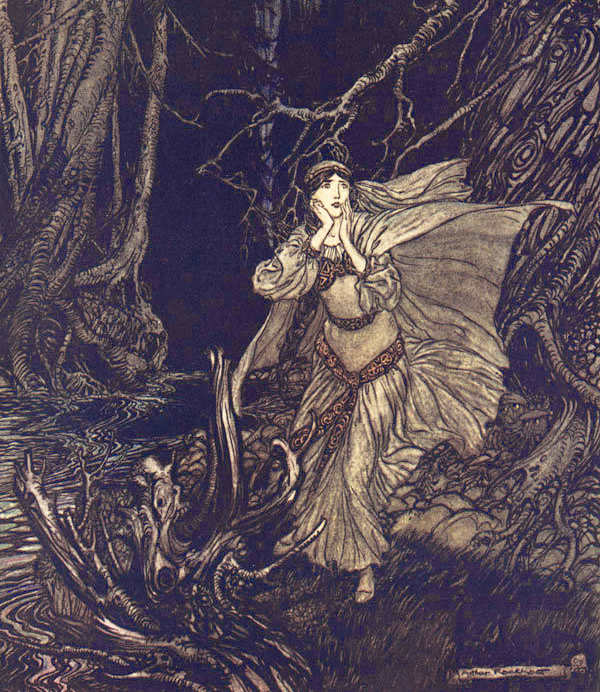
And again, as she notes, The Unknown consists largely of a forest. And here is where my interest grew beyond Lee’s essay: she spent a lot of time discussing the elements that recall classic film and animation but the folklore was my interest—in fact, I’d say say OtGW’s creators used the references Lee talks about because they are the modern audience’s main connection to folkloric materials, and so made sense as a way to reach them and get this tale across to them. 

As to the mythical role of the woods, let me point to the same quote I did in the article to which this is an addendum:⁴

Being deep in the forest at the house of the dwarfs, Snow White has symbolically returned to the mythic beginnings of time, the liminal period of chaos when the mysterious gods and ancestral creatures of creation were active.

Even without the house of the dwarves, which serves only to deepen the mythic themes, the woods remain a liminal and primal space. As Lee states, this is a common theme, particularly in folklore and myth, as Joseph Conrad relates one branch of:⁵

A very common [motif…] that appears in Celtic myths, of someone who had followed the lure of a deer or animal that he has been following, and then carries him into a range of forest and landscape that he’s never been in before.

While OtGW’s protagonists end up in the woods as a result of running away from the police rather than chasing something, the trope remains nearly identical. And it doesn’t appear only in myths and folktales; Dante Alighieri’s Divine Comedy opens:⁶

Nel mezzo del cammin di nostra vita
mi ritrovai per una selva oscura
ché la diritta via era smarrita.

In the middle of the journey of our life,
I discovered I was in a dark forest,
having wandered from the straightforward path.

OtgW’s girl transformed into a bird, who guides the other protagonists, Wirt and Greg, around The Unknown, is named Beatrice, a clear reference to Dante’s guide of the same name. The figurative wood also appears in the title and body of Robert Frost’s poem “Stopping by Woods on a Snowy Evening”.⁷ The woods are just one common version of what OtGW refers to as The Unknown, which again has mythic resonances, many of which the show goes on to explore.

Putting a name to this mythic realm is difficult, which is why OtGW uses the term it does. Campbell quotes the Upanishads about what he sometimes terms the yonder shore:⁸

There the eye goes not,
speech goes not, nor the mind.
We know not, we understand not,
how one would teach it?

So what is it? Death or the nether- or underworld is one version, as suggested by both Dante and Frost. Death is also referenced in OtGW repeatedly: Wirt and Greg dig what they think are their own graves in Pottsfield⁹ and in the “real” world, we find out the garden over whose wall the pair went was a cemetery.¹⁰ The cemetery’s name is Eternal Garden, but “garden of the dead” was a standard metaphor for a graveyard in times past. Additionally, the ferry they take to get to Adelaide’s house costs two cents,¹¹ corresponding to the ὀβολοί (oboloí) needed to pay the ferryman Χάρων (Kharon) to get to the Graeco-Roman underworld.

This well-known fare first appears in Aristophanes’ comedy, The Frogs, in which Dionysos (Διόνῡσος) is bound for Haides (ᾍδης):¹²

Herakles [Ἡρακλῆς]: Which will you try?
Dionysos: The way you went yourself.
Herakles: A parlous voyage that, for first you’ll come to an enormous lake of fathomless depth.
Dionysos: And how am I to cross?
Herakles: An ancient mariner will row you over in a wee boat, so big. The fare’s two obols.

I’ll note the correspondence between an obolos and a cent is inexact, as this silver coin is worth eight copper khalkoi (χαλκοί), but again, it’s a pretty standard rendering in modern works. And as for Aristophanes, although the cloud city Greg visits makes obvious reference to The Wizard of Oz (1939) with Munchkinland-style welcoming committees—just as Adelaide’s death by exposure to night air recalls the Wicked Witch of the West’s undoing by water—the kingdom of the titular animals, Νεφελοκοκκυγία (Nephelokokkugía, Cloud Cuckoo Land) in The Birds is a pretty clear reference as well.¹³

Greg visits cloud city in a dream within this dream, as he turns further into his unconscious to help him and his brother out of their troubles:¹⁴

Greg: I better take a nap too. I need to dream up a good way of leading us home.

And speaking of birds, the way Adelaide plans to change Beatrice and her family back into humans is by cutting off their feathers with a pair of scissors, recalling the crude methods of Hans Christian Andersen’s sea witch.¹⁵

Water is another liminal space referred to repeatedly in OtGW. I’ve already mentioned the ferry trip, but Wirt and Greg also sail across a lake. And it turns out in their normal world, they fell into a body of water after nearly being run down by a train, and so the show can be seen as taking place as they hover between life and death by drowning.

Greg has a frog, whom he spends much of the series trying to find a name for. But this is a common mythic harbinger as well; a liminal creature, at home as much in the human world as in the underwater realm. We see them repeatedly in folktales as frog princes, calling heroes to adventure. In The Frogs, the amphibians’ only appearance is during Dionysos’ trip across the Ἀχέρων (Akheron), so literally at the border between worlds.¹⁶ Birds too, for similar reasons, but pertaining to realms above rather than below, make repeated mythic appearances.

The point of the journey into The Unknown in OtGW is, as in many folktales, initiation. Wirt is a teenager, poised on the brink of adulthood, and needs to figure out how he needs to change in order to take on this new role. All the creatures in this realm are, again quotingthe Girardot passage I did earlier:¹⁷

[D]ivine ancestors, teachers, refiners, guardians, or helpers necessary for a successful initiation.

And it’s certainly the case the peril of these encounters is not real. In fact, Wirt’s normal world problems are so daunting he’d rather die than face them, and in fact, in the reading I mentioned earlier, he nearly does. The progression through the episodes toward winter—a common metaphor for death, as well as, more literally, the cold of the lake they are immersed in—reflects this. His problems—being responsible for a younger sibling, liking a girl, risking being hurt, losing her to a rival suitor—seem trivial, but they’re also entirely relatable to just about anyone who’s been a teen.

And indeed, Wirt returns triumphant from this night sea journey having learned these lessons: Sara, who he didn’t dare to approach before his journey, he now talks to easily and invites on a date. He saves his brother (and himself) from drowning. Just as in The Wizard of Oz, the passage through The Unknown can be seen as having been “just a dream”, with elements such as the light of the onrushing train having been transformed in the logic of the unconscious into the eyes of the Beast who dogs the brothers’ steps in the otherworld. But the magic bell previously owned by Adelaide’s sister, Auntie Whispers, which returns with them to their normal world, glowing in the belly of Greg’s frog, tells a different tale.

While I’ve been critical of how folktales are realized on screen, I’m happy to have been proved wrong. OtGW’s creators have done well here: as I noted earlier, they used nostalgic film and animation references to relate to modern audiences, but didn’t shy away from classical references either. They didn’t attempt to usurp the place of folktale traditions with a retelling. And they didn’t dumb down the messages or supplant them with corporate myths.


Read subsequent articles in the DeDisneyfication series

Part 9B: The Sum of Its Versions

Part 9C: The “Snow White” Studio

Part 9D: Snowhaus

Part 10: The Little Less-Than

Part 11: Batmouse 3D

Part 12: Mork & Scheherazade


Read previous articles in the DeDisneyfication series

Part 1: Straightening out “Hunchback”

Part 2: Making Over “Mulan”

Part 2 Addendum B: Your Western Wuxia Is Weak

Part 3A: “Hercules”: Myths and Mistakes

Part 3B: Doing Hera’s Work on “Hercules”

Part 4: Tale As Old As Agriculture

Part 4 Addendum: The Enchanted and the Postmodern

Part 5: Putting Pocahontas to Rest

Part 5 Addendum: Powhatan’s Mantle

Part 6: Trouble with “Tarzan”

Part 7A: The Wrong Rabbit Hole

Part 7A Addendum A: Curious Curation

Part 7A Addendum B: “Alice” in Revolt

Part 7A Addendum C: How “Alice” Grew Big in Japan

Part 7B: Alice’s Adventures in the Cousins’ War

Part 7B Addendum: Repainting the Roses

Part 8: Guerrillas and the “Jungle”

Part 9A: Through a Magic Mirror Marred


Notes

  1. Grace Lee, “Over the Garden Wall: Why Is The Unknown So Familiar?”, What’s So Great About That, October, 2017.
  2. Episode 1, “The Old Grist Mill”, OtGW, 2014.
  3. Lee, 2017.
  4. N. J. Girardot, “Initiation and Meaning in the Tale of Snow White and the Seven Dwarfs”, The Journal of American Folklore, 1977.
  5. Episode 1, “The Hero’s Adventure”, The Power of Myth, 1988.
  6. Dante Alighieri, Inferno, Divina Commedia (The Divine Comedy) I,1, 1320, my translation.
  7. Robert Frost, “Stopping by Woods on a Snowy Evening”, 1922.
  8. A. S. Woodburne, “The Idea of God in Hinduism”, The Journal of Religion, 1925.
  9. Episode 2, “Hard Times at the Huskin’ Bee”, OtGW, 2014.
  10. Episode 9, “Into the Unknown”, OtGW, 2014.
  11. Episode 5, “Mad Love”, OtGW, 2014.
  12. Ἀριστοφανης (Aristophanes), Βάτραχοι (Bátrachoi—The Frogs), 405 BCE, O’Neill translation, 1938; emphasis mine.
  13. Aristophanes, Ὄρνιθες (OrnithesThe Birds), 414 BCE.
  14. Episode 8, “Babes in the Wood”, OtGW, 2014.
  15. Hans Christian Andersen, “Den lille havfrue”, (“The Little Mermaid”), Eventyr, fortalte for Børn. Første Samling. Tredie Hefte (Fairy Tales Told for Children. First Collection. Third Booklet), 1837.
  16. Aristophanes, 405 BCE.
  17. Girardot, 1977.

The Immaculate Miscegenation

The whitening of rock and roll (“Roll Over McFly” Addendum A/ Gladwellocalypse, Part 4)

Another of Malcolm Gladwell’s more misguided podcasts from season four of Revisionist History provided me with a reason to revisit the appropriation and revisionism in Back to the Future. The episode, “In a Metal Mood”, concerns cultural appropriation, but makes terrible analogies and draws poor conclusions, so also fitting into my Gladwellocalypse series.¹

Let’s get Gladwell’s central premise out of the way: he wants to tell us conservative Christian rocker Pat Boone’s vanilla covers of songs originally by black performers are morally preferable to those by Elvis Presley because the latter is stealing their style as well. He argues for Boone’s inclusion in the Rock and Roll Hall of Fame for this reason as well as because his career was only second to Presley’s, spanning decades with dozens of top-10 singles and albums.

Just to touch on it briefly, the strained comparison Gladwell makes to Boone’s music is—wait for it—Taco Bell. He reasons their food is an acceptable form of appropriation because it isn’t trying to eclipse Mexican cuisine but to create something entirely new merely inspired by it.

As absurd as this is, his thoughts about Presley are still stranger. He and his panel, including childhood friend and partner on the Broken Record podcast, Bruce Headlam, Justin Richmond, that podcast’s producer, and Gladwell’s producer, Jacob Smith, and which Gladwell calls a “cultural appropriation summit”, listen to “Don’t be Cruel” as recorded by Elvis and then songwriter Otis Blackwell’s version of the song. Their reaction was as follows:

Gladwell (voice over): It’s the same song! As we’re listening, Justin puts his head in his hands.
Gladwell: I’m sorry, that’s brutal.
Richmond: I forget how bad it is every time I hear it—this is just Elvis.

And later, listening to “One Broken Heart for Sale” they’re not sure whether they’re listening to Presley or Blackwell, and when they determine it’s the latter, Gladwell says:

[E]lvis has completely… he’s completely stolen this guy’s sound.

And based on this finding, Gladwell concludes:

This is the King of Rock and Roll. The singer with his own vast dedicated room at the [Rock and Roll] Hall of Fame. Now imagine how Otis Blackwell or any of the other black songwriters of that era felt about what Elvis did. They’d been asked to write a song for someone much more famous than they were. Fine. What hurts is when a so-called genius takes the song that you wrote and that came out of your cultural community and doesn’t change a lick of it.

But this is complete nonsense: Presley didn’t “steal” Blackwell’s sound, Blackwell quite literally sold it to him. If anything, the songwriter became part of the behind-the-scenes packaging of The King, exactly on the lines of Sam Phillips’ vision for the whitening of rock and roll.

On the same 1984 Late Night with David Letterman episode on which Gladwell’s group watched Blackwell’s performance of “Don’t be Cruel”, there’s also an interview not discussed on the podcast, which obviates us imagining how Blackwell feels. The interview includes the following exchange:²

Letterman: Did you feel funny about [Presley] imitating so closely what you were putting on tape or… or not?
Blackwell: Well, no—I felt a little funny the first time, but after he sold four million, I didn’t.

And later in the same interview, Blackwell goes further:

[H]e was doing [the songs] the way I would like for them to be done.

Blackwell details that while he had been a performer, he hadn’t done well and had given it up when he had discovered he could make good money in songwriting. In another 1984 interview, he added still more detail on the topic:³

I was surprised when I heard “Don’t Be Cruel” because it was just like I had done the demo. I used to sing all my own demos, and it just so happened that a lot of what Presley and Jerry Lee [Lewis] did sounded alike. I thought they did justice to the songs. They put the kind of feeling into it that I felt.

After Presley’s success with this song, Blackwell went on selling him songs in similar fashion for five years, including such hits as “All Shook Up” and “Return to Sender”, and valued the relationship so highly he became superstitious, refusing to meet with Elvis in person because of the possibility of jinxing it.

So was Blackwell hurt by cultural appropriation? Yes; just not in the way or for the reasons Gladwell posits. The podcaster’s silly analogies and reductive arguments are ill-suited to deal with a widespread, insidious, emotionally charged, and highly complex issue. It’s an issue also closely linked with “cancel culture”, which has the admirable goal of performing social justice but potentially tramples freedom of speech in doing so. I honestly approach this topic with trepidation, as it’s hardly my hill to die on, but hope I can offer a bit more sensitivity and insight than Gladwell does.

Elvis Presley - Wikipedia

Time for some real talk. In her scathing article, “Ripping Off Black Music”, Margo Jefferson links white rock and roll closely to minstrelsy, with white performers essentially mimicking black ones, and quotes John Lennon as saying, “We sing more colored than the Africans.” As for Presley, she states:⁴

Elvis and his contemporaries shocked and thrilled because they were hybrids. What had taken place was a kind of Immaculate Miscegenation, resulting in a creature who was at once a Prancing N— and a Blue-Eyed Boy.

Effectively, Blackwell and other black rockers ceded the territory to this minstrelsy, and worse, sold out by giving them a script and model for how to make their shows most effective. Lest you think I’m casting these black artists as the real villains of the piece, I’m not: as Blackwell himself notes, he’s trying to overcome economic disadvantage, as he describes himself prior to getting the writing gig:⁵

No hat, holes in the shoes, standing on the corner […]

Songwriting happened to be his means of doing so, apart from, “Anything that came along that would make me a dollar or two”. Indeed, he seems mainly to have cared about the $25 advance for the six songs he initially sold, realizing only later how lucrative they could turn out to be. Not that he was treated at all fairly in the relationship, being forced to give Presley a songwriting credit despite the singer not having contributed anything in that regard, thus cutting himself in for half the royalties from the songs.

Already by the ’60s, Jefferson notes:⁶

Blacks, it seemed, had lost the battle for mythological ownership of rock, as future events would prove.

And one major issue with the whitening of rock (or indeed anything else stolen from another culture) is white interpretation—they become the critics and arbiters of taste for everything within the genre, including the black performers who created it. Jefferson tells us in the environment so created:⁷

[N]o black performer yet has been able to get the praise and attention he or she deserves independent of white tutelage and translation.

Furthermore, this appropriation distorts meaning—when Chuck Berry sings:⁸

Roll over Beethoven
And dig these rhythm and blues!

Jefferson tells us, “it is an outlaw’s challenge to white culture”.⁹ This is why I alluded to it in the title of my original piece. But when the Beatles sing the same lyrics, they are creating a continuity between the classical music of their culture’s past (even in childish faux rebellion against it) and the rock and roll also putatively of their culture in modernity.

Done well, recontextualization can be clever and thought provoking as in Jorge Luis Borges’ “Pierre Menard, Author of the Quixote”, in which said book is being written in the 20th century by a Frenchman,¹⁰ or Umberto Eco’s critical analysis of Alessandro Manzoni’s The Betrothed as if it were a work of James Joyce in “My Examination Round his Factification for Incamination to Reduplication with Ridecolation of a Portrait of the Artist as Manzoni”.¹¹ But the Beatles and other white rockers do so without considering the implications, simply as a byproduct of the act of appropriation.

Finally, because rock and roll is now white territory, black performers have become oddities in the space you can tick off on one hand: Jimi Hendrix, Living Color, Fishbone. And they are problematic both within the scene they’ve chosen to be part of as well as within the black community. Taking Hendrix, for example, academician and culture critic Jack Hamilton tells us:¹²

[D]uring his career [he] was judged by many as a fraud or sellout, his blackness rendering his music as inauthentically rock at the same time that his music rendered his person as inauthentically black.

Even though he was able to become an important, even iconic figure in music, arguably this conflict was one of the reasons for his drug abuse, and ultimately, his premature death, 50 years ago last week. Far from being harmless, there are pretty real consequences here and this is just one performer who’s particularly well known—there’s no way of knowing how many others there have been.

For another real-world example, let’s look at Fishbone. This band played an eclectic mix of ska, punk, metal, and funk. Although they were highly talented, they never achieved the mainstream success of arguably less talented mainly white bands from the same scene, like No Doubt. Comedian Damon Wayans incorporated a story about attending one of Fishbone’s shows into his standup, discussing some of the issues:¹³

I went to see Fishbone. Yeah. Just like two people [clapping in Wayans’ audience]. Black people don’t know Fishbone; they go, “Is that that soul food restaurant?” No, these some brothers that play that heavy metal—like [makes guitar noises]. That stuff you see on MTV and turn from. […] White people—nothin’ but white people in here [i.e., at the Fishbone show].

You can clearly see Wayans, and presumably his audience, reject the band as playing “white people’s music” for a white audience. But, despite his claims, we can also see from their lack of accolades, white audiences do not accept the band as legitimate either, because they are PoCs.

So to recap:

  • Pat Boone: A cultural appropriator for audiences who didn’t want any vestige of blackness in their rock and roll. This makes his music inauthentic as rock and roll, so the Hall of Fame is happy to decry and exclude him.
  • Elvis Presley: A cultural appropriator for audiences who wanted a minstrelsy version of rock and roll. The Hall of Fame adores him because he is essential to white rock and roll, which is rock and roll as they define it.
  • Otis Blackwell: An authentic rock and roll creator who sold his creations in order to overcome his economic circumstances. He probably couldn’t foresee PoC being excluded from the musical genre they had created to the extent they have been.
  • Sam Phillips: The mastermind behind stealing cultural products from PoC like Blackwell and packaging them into rock and roll minstrelsy. He knew exactly what the audience wanted and made lots of money giving it to them.
  • Taco Bell: Faux Mexican junk food; inauthentic as cultural product and also as food.

In the end, Gladwell’s piece is deeply self-serving: he shows he’s against cultural appropriation (sort of), promotes another podcast he’s associated with, and justifies his love of Taco Bell. But really, and more insidiously, he’s whitewashing his own appropriation of thought from the intellectual realm into the mainstream.

I think this really will conclude the Gladwellocalypse series. When it began, it was to point out a rare misstep in RevHist’s first season. I followed it up because there was another minor issue I wanted to discuss in season two. Season three was largely uninteresting, but then came season four. I’ve already taken issue with a three-part miniseries appearing there, even while generally defending Gladwell. And there was little to like in season five. Even when I disagreed with RevHist initially, it was fun to argue with. Lately I just find it disappointing, so I guess I should find a different podcast to listen to.


Read the subsequent addendum

Addendum B: A Mesmerizing Lost Reality


Read the original article

Roll Over McFly


Read previous articles in the Gladwellocalypse series

Part 1: The Limits of Revisionist History

Part 2: The Unfit “King”

Part 3: Descent into the Absurd


Notes

  1. Malcolm Gladwell, “In a Metal Mood”, Revisionist History, 2019.
  2. January 10th Broadcast, Late Night with David Letterman, 1984.
  3. Otis Blackwell, Interview with Jan-Erik Kjeseth, 1984.
  4. Margo Jefferson, “Ripping Off Black Music”, Harper’s Magazine, 1973. She’s quite frank with her language. I couldn’t find another source for the Lennon quote, but that’s exactly the sort of thing that would be whitewashed from his legacy.
  5. Letterman, 1984.
  6. Jefferson, 1973.
  7. Ibid.
  8. Chuck Berry, “Roll Over Beethoven”,1956.
  9. Jefferson, 1973.
  10. Jorge Luis Borges, “Pierre Menard, autor del Quijote” (“Pierre Menard, Author of the Quixote”), collected in Fictions (Ficciones), 1962, Miguel de Cervantes, Don Quixote, 1605.
  11. Alessandro Manzoni, I promessi sposi (The Betrothed), 1827, Umberto Eco, “My Examination Round his Factification for Incamination to Reduplication with Ridecolation of a Portrait of the Artist as Manzoni”, collected in Diario minimo (Misreadings), 1993.
  12. Jack Hamilton, “How Rock and Roll Became White”, Slate, 2016.
  13. Damon Wayans, Damon Wayans: The Last Stand?, 1991.

Indelible Women

The female warrior in Japan

Often correspondents make me aware of articles they feel I’d be interested in. This was the case a while back when Vice featured one about Japanese women warriors. It’s definitely a topic I’m interested in and the actual information about the historical women warriors was pretty good, though it wasn’t anything I hadn’t seen before.

I did, however, take issue with the central argument of the piece, which right from the title, is these figures were “Erased from History”.¹ The claim both sensationalist and self-serving, of course, as the writer, Christobel Hastings, makes herself the discoverer of this lost information.

When did this erasure take place and by whom? I wondered, thinking immediately of the well-known exploits of Tomoe Gozen (巴 御前), among many others. The article seems to offer multiple theories: during the Tokugawa bakufu (徳川幕府, 1600–1868), the Meiji era (明治時代, 1868–1912), or by Westerners coming into contact with the culture.

Let’s look at these claims one at a time, beginning with the Tokugawa or Edo period (江戸時代). In the article, Hastings states:²

The advent of the Edo Period at the beginning of the 17th century brought a huge shift to the status of women in Japanese society. During these years, the dominant Neo-Confucian philosophy [宋明理學] and burgeoning marriage market heralded a radical change for the onna-bugeisha [女武芸者], whose status as fearsome warriors stood in stark opposition to the new order of peace, political stability, and rigid social convention.

The Edo period marked a shift for everyone in Japanese society. In particular, the historically landed samurai class (侍), were dispossessed and their property handed over to their feudal lords, the daimyō (大名). This left three options open to samurai, the first, and most unappealing one, was to become peasants, the second to become rōnin (浪人), which also meant leaving the country as it was at peace, or finally to find roles as paid retainers of the daimyō; essentially as aristocratic bureaucrats and administrators. In short, there was no place in Japan for warriors of any type, although of course these changes would have landed harder on onna-bugeisha.

Rulers at the end of the warring states period (戦国時代, Sengoku Jidai 1467–1615) sought to curtail the excesses of the warrior class in general, with both Oda Nobunaga (織田 信長) and his former retainer who came into power after him, Toyotomi Hideyoshi (豐臣 秀吉), conducting sword hunts (刀狩, katanagari) late in the 18th century—immediately prior to the ascendancy of the Tokugawa. The countryside was scoured and weapons confiscated under these edicts in order to prevent others from coming into power by force of arms, as these two just had done.

As to Confucian thought being a factor, paradoxically, it had come to Japan in the form of the ritsuryō (律令) system, which contained both administrative and criminal codes, well before the time Hastings suggests, during the Asuka period (飛鳥時代, late sixth century–710). Moreover, the system’s collapse during Japan’s medieval period—again immediately prior to Tokugawa rule—is what actually ushered in widespread patriarchy across Japan. Before these changes in the social order, for example, it was the norm for a man to marry into a woman’s family instead of the other way around.

Additionally, even as male-led family structures became the norm, exceptions could naturally be made among the aristocratic samurai class. A pair of letters sent by Toyotomi recently came to light, which were sent to his allies, the Munakata (宗像) clan, whose male head, Ujisada (氏貞) had recently died:³

Both letters were addressed to Saikaku [才鶴], showing that Hideyoshi acknowledged Ujisada’s wife as head of the Munakata clan.

In any case, as we saw with Huā Mùlán (花 木蘭), when Confucianism encountered the woman warrior where they wanted to see a devoted wife and mother, rather than “erasing” her, they simply altered the narrative to better fit their social dictates.

Hastings’ claims about the naginata (薙刀), a polearm with a sword-like blade, also struck me as odd:⁴

Martial arts training, therefore, was a means for a woman to practice servitude towards the men of the household, and cultivate an ordered, domesticated life free of the energies of war.

I was unable to find any support for this bizarre claim, but she attributed it to an article by Ellis Amdur, a martial arts instructor who does not provide any source for his information in his decidedly unscholarly work.⁵ The naginata was used ubiquitously in feudal Japan by samurai, ‌warrior monks known as sōhei (僧兵), as well as ashigaru (足軽)—general infantry, for entirely practical purposes: the weapon features the cutting prowess of the sword together with the longer range of a polearm, which also allows better ability to block and greater leverage in attacks.

Regardless, if the erasure of warrior women was supposed to have been effected during the rule of the Tokugawa, Hastings herself contradicts it by opening the piece recounting the deeds of Nakano Takeko (中野 竹子) who fought in the Boshin War (戊辰戦争) in 1868, one of the conflicts leading up to the Meiji Restoration (明治維新) later the same year and long past the reforms of the Edo period.

But let’s talk about the Meiji period in case this is when women warriors are meant to have been disappeared. The government actually outlawed all samurai, male and female, also making Nakano one of the last if not the last of this warrior class—that’s right, the last samurai may have been a female one, and sure as hell not Tom Cruise. Again, this woman warrior being active during the Meiji era flies in the face of Hastings’ claims as to any erasures having taken place during that time.

As for Westerners effecting an erasure of warrior women, Hastings presents no support for the idea. Such an effacement of a culture’s history would be rather unlikely to affect a people’s own views and as I’ve discussed in other articles, already during the Meiji era, foreign influence was being pushed back on, which became quite thorough during the subsequent Taishō era (大正時代, 1912–1926).

Nonetheless, as Hastings suggests, Westerners have fetishized Japanese women essentially from their first sight of them, with French naval officer Pierre Loti writing a nearly autobiographical account of an affair he had with Kane Kiku (金菊) when he was stationed in Nagasaki (長崎) in the summer of 1885.⁶ The work was highly successful, running to 25 editions in five years, and inspiring several other works, including Giacomo Puccini’s 1904 opera Madama Butterfly. Loti summed up his exoticist and reductive view as, “France for food, Japan for wives.”⁷

Writer Lafcadio Hearn, although also from the West (Greek-Irish by way of the US), settled in Japan, was married, had a family, and became a teacher. Understanding the culture on a much deeper level, he commented:⁸

Of course Loti is very unjust to the Japanese woman, and has not yet even learned that to understand the beauty of another race so remote as the Japanese, requires both time and study. It does not strike a European at the first glance. He knows also nothing about their morals or manners, and his divinations are all wrong on these subjects.

And so finally, there is a thread of truth here: I doubt you’ll hear much about Japan’s warrior women in a history class outside of the country unless you get in pretty deep. I may indeed have stumbled onto the germ of Hastings’ article, whence I conjecture an editor asking for its claims to be more far-reaching. It should probably have been something like:

Hey, Uneducated Roundeye, You Probably Haven’t Heard of Japan’s Warrior Women

Which actually would have been a good bet, but means this article is not directed at me. Not only did I live and work in Japan for several years, certainly researching history extensively while working on many of the highly accurate games based in Japan’s past my employer, Kōei (光栄) was famous for, but I also acted as research assistant for my wife when she produced a set of books about the nation’s history and culture as part of her master’s degree. She also went on to work at the US Japan Institute, with professor Mitsuko Saito Duerr, a noted expert in Japanese women’s studies.

As Hearn did, my wife and I came to understand Japanese culture on a deeper level, including the fact that while it appears patriarchal, the apron strings are strong, as writer Kaori Shoji notes:⁹

On the surface, Japan is entrenched in a fukenshakai (父権社会, patriarchal society), but if the nation’s women were to quit their chores en masse, the damage would be far more serious than any earthquake. This is probably why the kanji characters for state (国家, kokka) consist of kuni (, country) and ie (, house) and finances are often called daidokorojijyō (台所事情, kitchen circumstances).

This is why, for example, banks and insurance companies always target women in their advertising: with few exceptions, they are the financial decision makers of the household.

Another point of access to the Japanese traditions of the woman warrior for me was ukiyo-e (浮世絵), an art form I’ve been a fan of for quite a long time. Edo Japan being a closed society, there was a high degree of regulation and censorship of the arts, and even sumptuary laws dictating what the burgeoning merchant class could wear. As to art, even in the somewhat more open culture of late 19th century Britain, Leopold I of Belgium warned his niece, Queen Victoria:¹⁰

[D]ealings with artists, for instance, require great prudence; they are acquainted with all classes of society, and for that very reason dangerous.

Ukiyo-e was especially troubling as it was an art clamored for by the masses: beautiful, vividly colored works that, as they were prints, could be reproduced in vast numbers and sold cheaply. The Tokugawa government went from outright bans and punishment of artists to dictating everything down to the sizes of paper that could be used and heavy censorship of themes, content, and representations thereof. Artists were required to produce smaller scale black-and-white proofs of the works they intended to create and submit them for approval before they could proceed. The final prints feature government stamps showing they had been officially authorized. And there are many, many prints of female warriors.

So these woodblock prints tell a different story—they made it past the careful censorship of the Tokugawa administration, so they can’t have been controversial, and were included in series about warriors (musha-e 武者絵) rather than beauties (bijin-ga 美人画)—another extremely popular theme. We can only conclude the artists and the government wanted to celebrate their badassery without regard to gender.

And also, it seems without regard to origin: legendary warriors from China and Korea also appear in prints. When I worked on Bandit Kings of Ancient China,¹¹ a game based on the Chinese classic, Water Margin,¹² I created a black-and-white splash page image based on a woodblock print by Tsukioka Yoshitoshi (月岡 芳年), one of my favorite artists of all time. The image is of one of the main characters (and one of the most colorful ones), Lu Zhishen (魯智深, Japanese Rochishen), who is in the process of smashing the guardian statues of his own monastery, ’cause he’s drunk and crazy.

Later, while I was still working at Kōei, I visited Aomori (青森), at the northern end of Honshu (本州), Japan’s main island, for the Nebuta festival (ねぶた祭り), which presents heroic figures in colorful floats made of paper and lit from within. The imagery is closely connected with ukiyo-e both thematically and visually, and indeed some of the merch sold there was two-dimensional art. I selected a noren (暖簾) featuring Gu Dasao (顧大嫂, Japanese Kodaisō), somewhat personal to me from having worked on Bandit Kings, in which she appears. Her image adorned the doorway to our kitchen for many years and I regretted not knowing there were awesome ukiyo-e of this warrior woman such as this one by Utagawa Kuniyoshi (歌川国芳) when I was working on the game.


Notes

  1. Christobel Hastings, “How Onna-Bugeisha, Feudal Japan’s Women Samurai, Were Erased From History”, Vice, 2018.
  2. Ibid.
  3. Kunihiko Imai, “Hideyoshi acknowledged woman as head of samurai clan”, Asahi Shimbun, 2019. Note there’s a weird tradition of using the leader’s given name.
  4. Hastings, 2018.
  5. Ellis Amdur, “Women Warriors of Japan, The Role of the Arms-Bearing Women in Japanese History”, 2002.
  6. Pierre Loti, Madame Chrysanthème,1887.
  7. Ibid.
  8. Lafcadio Hearn, Letters, 1893–1894.
  9. Kaori Shoji, “Nadeshiko—adorable till they die”, The Japan Times, 2013.
  10. The Letters of Queen Victoria: A Selection from Her Majesty’s Correspondence Between the Years 1837 and 1861, 1907. The quote has appeared lately in a slightly pithier form and with various incorrect attributions.
  11. 『水滸伝・天命の誓い』 (Suikoden: Tenmei no Chikai—“Water Margin: oath of destiny”—Bandit Kings of Ancient China), Koei, 1989.
  12. 施耐庵 (Shī Nài’ān), 《水浒传》 (Shuǐhǔ Zhuàn, Water Margin), possibly mid-14th century.

Those Frumious Jaws

The self-aware failure of Black Mirror: Bandersnatch (Interactive Storytelling, Part 2)

Hardly one not to be late to a party, I noted the existence of Black Mirror: Bandersnatch (BM:B) more than a year ago, but only recently bothered to watch it. Gamedev circles were abuzz when it came out late in 2018—not only was it an interactive narrative, but it concerned the early history of gamemaking—so I was often asked if I had seen it and/ or told I should.

In brief, the story, written by series creator Charlie Brooker, concerns a young developer named Stefan Butler (Fionn Whitehead), working on a game incorporating interactive story elements in 1984. The protagonist’s psychological issues stemming from the death of his mother and deadline pressure from the company he’s working for propel the tale’s action.

Game nerds, naturally enough, gravitated towards discussion of where and how the story branched, and the number of endings there were. My focus was more on if or how the piece improved or expanded the form. Sadly, I can’t say it did.

Present was the foldback, the device I’ve mentioned before as a means of ending up with the same result while giving the appearance of choice. Ben Allen described the player experience of this in Radio Times

In some cases, we arrived at the exact same scene, just with different options.

Additionally, in our playthrough, some choices were repeatedly pointed to, which felt rather more like being led somewhere than choosing your own adventure. I believe it is the combination of foldbacks and forced decisions to which the NYT review refers, saying:²

[I]t’s the “decisions” masquerading as free will that are really frustrating.

Many reviewers and acquaintances alike pointed to the first few branches of the tale, which are quite innocuous and almost definitely inconsequential. The NYT piece reports:³

The minute choices you get to make, like which album he listens to, read as eye roll-worthy contrivances only a small child would get excited about.

As to the endings, Hollywood Reporter contributor, Jackie Strause says:⁴

[…] Brooker and Jones are clear as to not “prescribe” one ending over the others, especially because they couldn’t agree on what exactly defines one.

But this is BS; the ending where you have Stefan take his meds and the game is delivered on time as a commercial flop is clearly a bad ending, which also sends the swell metamessage it’s OK for artists to sacrifice their personal health and well-being to produce superior entertainment experiences. Even a rather effusive review from David Sims of The Atlantic finally notes the serious shortcoming of the endings:⁵

Through the various branches I found, I never got to an ending of “Bandersnatch” that felt truly happy or fulfilling, though I’m sure one exists; the best (and last) one I arrived at was, at least, somewhat peaceful and touching, if a little mournful.

The tone of Black Mirror itself might be what’s at work here and no good ending is intended, but as I noted in Part 1, bad endings are a common feature of the format. I “played” BM:B with my family and, as nearly everyone has at least a passing understanding of the form, we played it safe, routinely choosing whichever path seemed least likely to result in disaster. I’ve mentioned this aspect of the form as a way the branches are reduced, but it also acts as yet another way the form preempts choice—interesting or humorous options often are left unexplored. Atlas Obscura contributor Sara Laskow noted of another interactive narrative, Journey under the Sea:⁶

This book is particularly tough on readers. One analysis found that more than 75 percent of the endings are unfavorable or deadly.

Even apart from this unpleasant feature, the more general ways these works break the rules of traditional storytelling are not surprising and delightful but off-putting. What is lost is the reader’s ability to anticipate what will happen and either have those expectations gratified or thwarted by the author. Back in 1995, The Economist dedicated a lengthy editorial to the form, offering various criticisms, including the following mirroring mine:⁷

The snag with most electronic stories is that they tamper with the foundation of narrative structure. When stories wobble and change with our whim, they lose their believability, and with it our willingness to care. […]. But what the typical reader wants to know is: which is the right word to click on? Which path generates the closest thing to a satisfying linear story, the sort that life, experience and thousands of years of story-telling have taught us to expect? For every path taken, there is the path not taken. In frustration, we re-read the story, trying to exhaust all the possibilities in the search for the satisfying tale that surely must lie somewhere within.

So, if you take BM:B on the superficial level of an interactive narrative, it is a failure in all the usual ways such vehicles are. However, this film is self aware, saving it as art to an extent—as I already pointed out above, Brooker understands and subverts the expectations of someone playing it safe by giving them a mediocre ending for their trouble. The insignificant choices, such as which breakfast cereal Stefan should eat, the lack of real choice, including foldbacks and repeats, are there deliberately.”

Brooker is attempting to comment on the form rather than simply using it as a gimmick, as several critics have noted; Stefan even says, “Free will is an illusion.” The problem is, as I found viewing Hot Fuzz, the standard tropes are so goofy it’s hard to satirize them through exaggeration.

Right from the start, BM:B is self-referential, beginning with interactive narrative: the game Stefan is making is the same form as the film, and the game is based on a book that’s one too. Bandersnatch was also the title of a real game project from the period which not only failed to launch after being heavily hyped, but bankrupted the developer, Imagine Software. This is alluded to directly in BM:B with a cover of classic gaming mag Crash carrying news of the company’s closure. Finally, there is a scene in the film where Stefan can turn down the opportunity to make his game, mirroring the way Brooker and EP Annabel Jones initially turned down Netflix’ offer to make an interactive film. In both cases, they decide to do it anyway, but on their own terms.⁸

File:New-alice-bandersnatch.png

Another obvious Bandersnatch connection is to the Lewis Carroll creature. It appears in Through the Looking Glass in the famous nonsense poem “Jabberwocky”:⁹

“Beware the Jabberwock, my son!
the jaws that bite, the claws that catch!
Beware the Jubjub bird, and shun
The frumious Bandersnatch!”

The creature appears again in The Hunting of the Snark in greater detail,¹⁰ but the point in BM:B is multiple realities, such as the Looking Glass world of the Alice book. The film even contains a scene in which Stefan literally goes through a mirror, just as Alice does after conjecturing as to the existence of this other reality:¹¹

And certainly the glass was beginning to melt away, just like a bright silvery mist. […]. In another moment Alice was through the glass, and had jumped lightly down into the Looking-glass room.

Another such notion present in Carroll’s work is everything and everyone exists in the Red King’s dream and would disappear if he were to wake. Other references fly thick and fast in the film: to Philip K. Dick’s Ubik, with psychic spies in a world where the shape of reality shifts,¹² and Katsuhiro Otomo’s Akira, where powerful psychics cause people to be sucked into other dimensions.¹³

These allusions manifest in the film as theories held by different characters as to the nature of the reality they inhabit. One other is explored; that of a massive government conspiracy, which is present in both these last works, but particularly in Dick’s. This author got a little crazy, or at least obsessive himself, even attempting to kill his third wife, and in BM:B, some paths have Stefan murder his father. 

There’s also an awkwardness interactive narratives create with the separation between you, the player, and the character you are playing. This structure denies immersion in the role, as you telling them what to do is essentially a deus ex machina. A sampling of the dialogue between played and player points out this failing:¹⁴

  • “That’s not on fire.”
  • “That doesn’t need to be kept fresh.”
  • “Pick up the moon! Are you nuts?”

Again BM:B explores this space, with Stefan questioning and resisting your choices if they don’t seem natural to him, and therefore also criticizing you as a player. Eventually, he speaks directly to you, asking if someone is there and demanding to know who it is. In the film’s world, Stefan’s sense of an entity outside telling him what to do is seen as part of his growing psychosis, though we as the audience know at least on this score he’s perfectly sane.

Another element referring to the nature of interactive narrative is “the glyph”, essentially an upside-down squared-off ⟨Y⟩ Stefan obsessively draws in the film. This represents the branching structure, just as the Samian letter does, with a single path bifurcating to a pair leading to either virtue or vice. And as I’ve previously noted, the repeated branching needed in interactive narrative leads to the Lernian Hydra’s madness of geometric progression.

But all this impressive self-awareness fails to yield a good work of art. There’s high irony in the fact the film’s bad ending—Stefan’s safe production of a mediocre game—is the fate shared by BM:B itself, which received a tepid 72% Tomatometer score compared to the series’ overall 83% (update: it’s also aged poorly, dropping to 56%).¹⁵

I know my views on this type of storytelling risk cries of “treason”. Interactivity is an important element of games, which would seem on its face to suit it to the realization of interactive narrative. My goal in games is to give players meaningful choices supported by continued, engaging gameplay, so false choice is a huge pet peeve of mine as it runs directly counter to that. Interactive narrative regularly—some would say inherently—engages in false choices. Literature remains the main realm in which I’ve seen a possibility space created within a narrative for the reader to explore. Tellingly, although its setting and structure come from games, most of the references in BM:B are not to games but to print.

Umberto Eco codified and espoused what he termed the “open work” (opera aperta), based on the reading experiences he had enjoyed most, together with some postmodernist semiotic theories. In his works on the topic, he declares a “closed work”, one limiting the reader’s understanding to a single, unambiguous, linear interpretation is the least rewarding one—which I’ll note is essentially what interactive fictions do, but with bad storytelling and false choices along the way to make things even worse. By contrast, an open work creates an interplay between work and audience where infinite readings are possible.¹⁶

Eco’s starting point seems to have been James Joyce’s Finnegans Wake,¹⁷ which he describes thus:¹⁸

[Finnegans Wake] constitutes the most terrifying document of formal instability and semantic ambiguity that we possess.

I must confess to have washed out on a full reading of this book, but as with many games, I’d argue it’s not about getting to the end, but the journey. The difficulties in reading the book are down to the words themselves, many of which are invented. Take one of my favorite passages:¹⁹

Which we all like. Rain. When we sleep. Drops. But wait until our sleeping. Drain. Sdops.

The basic level of meaning here is, “we all like rain when we sleep, but wait until our sleeping stops.” but the breakup of the sentences is poetry—evoking the interruptive quality of the raindrops, whose sound intrudes on the meaning of the words themselves with the word sdops, which then also links to the Italian word sdoppiare, “to split in two”, and so on.

Eco sees such fields of possibility even within single words within Finnegans Wake, such as “meandertale”, which he discusses at length as to how it can be a pun on “Neanderthal” which appears nowhere in the text:²⁰

Our experiment thus has two senses: first, to see if, from a point outside Joyce’s linguistic universe, we can enter into the universe; then, departing from a point internal to that universe, to see whether or not we can connect, through multiple and continuous pathways, as in a garden where the paths fork, all the other points.

The reference to Jorge Luis Borges’ “The Garden of Forking Paths” is not accidental here as Eco was a fan of his works as well and for similar reasons.²¹ So here Eco is saying Joyce’s work is a successful realization of Borges’ concept of expanding possibilities in book form, and I agree.

Still, the qualities Eco sets forth for the creation of an open work are available to any medium; they are:²²

  • Dynamism
  • Indefiniteness
  • Ambiguity
  • Indeterminacy
  • Defamiliarization
  • Suggestiveness

I’m quite keen to produce a work in games incorporating these elements in order to build an active interplay between the audience and the work, generating meaning in constantly shifting ways, as Eco describes. But such a work would almost necessarily not be a commercial one, and unfortunately I need to earn a living.


Read subsequent articles in the Interactive Storytelling series

Part 3: Adventure Game Hijinx and Deconstruction

Part 3 Addendum: More Genre Coffin Nails


Read the previous article in the Interactive Storytelling series

Part 1: Lizzie’s Game


Notes

  1. Ben Allen, “How many endings does Black Mirror’s interactive film Bandersnatch have?”, Radio Times, July 2018.
  2. Aisha Harris, Margaret Lyons and Maureen Ryan, “‘Bandersnatch’ Has Many Paths, but Do Any of Them Add Up to Anything?”, NYT, January 2019.
  3. Ibid.
  4. Jackie Strause, “‘Black Mirror’s’ Interactive Film: How to Navigate ‘Bandersnatch’”, The Hollywood Reporter, December 2018.
  5. David Sims, “The Branching Horrors of Black Mirror’s ‘Bandersnatch’”, The Atlantic, December 2018.
  6. Sara Laskow, “These Maps Reveal the Hidden Structures of ‘Choose Your Own Adventure’ Books”, Atlas Obscura, June 2017.
  7. “Multimedia feature: Interactive fiction. But is it story-telling?”, The Economist, November 1995.
  8. Lewis Carroll, Through the Looking Glass, 1871.
  9. Ibid.
  10. Carroll, The Hunting of the Snark, 1876.
  11. Carroll, 1871.
  12. Philip K. Dick, Ubik, 1969.
  13. 大友 克洋 (Katsuhiro Otomo), 『AKIRA』 (Akira), 1982–1990.
  14. The first quote is from Grim Fandango, 1998, and the other two from Escape from Monkey Island, 1997.
  15. “Black Mirror: Bandersnatch”, Rotten Tomatoes (website), retrieved June 2020, and again in May 2025.
  16. Umberto Eco, Opera Aperta (The Open Work), 1962.
  17. James Joyce, Finnegans Wake, 1939.
  18. Eco, The Limits of Interpretation, 1990.
  19. Joyce, 1939.
  20. Eco, 1990; emphasis mine.
  21. Borges, “El jardín de senderos que se bifurcan” (“The Garden of Forking Paths”), 1941.
  22. Eco, 1962.

Hellenism, Schmellenism

Judaism’s rich curse traditions (Defixiones, Part 8/ Continuity of Magic from East to West, Part 5)

I hand over to you angels of disquiet who stand upon the fourth step, the life and the soul and the spirit of [name] son of [name] so that you may tie him in chains of iron and bind him to a bronze yoke. Do not give sleep, nor slumber, nor drowsiness to his eyelids; let him weep and cry like a woman at childbirth, and do not permit any (other) man to release him (from this spell).

I ran across this striking example of a curse to be inscribed on “a strip of lead pipe”.¹ The formula and physical form seem consistent with a defixio (lead curse tablet). In this series of articles, we’ve explored ancient Europe, the ancient Near East (ANE) and North Africa, but this example bears looking into and takes us further in the direction begun in the previous Part.

The source might be a bit controversial as the actual manuscript is dated quite late—from the late third century to early fourth CE. Still this text, the Sefer HaRazim (ספר הרזים‎, “Book of Secrets”, SHR hereafter), purports itself to be much older, having been given to Noah by Raziel (רזיאל‎), the “Angel of Mysteries”. Eventually it was passed down to Solomon (שלמה), renowned for his wisdom and mystical powers. Some see SHR as belonging to Hellenistic Judaism, while others see it as merely heretical. 

Nonetheless, I will attempt to establish here cursing is deeply ingrained in Judaic tradition, including some of the specific elements related to the defixio, as well as a continuity with the ANE praxes, which are ultimately the wellspring for this type of magic. This is to say even granting the influence of Hellenism on some of the specific content of the SHR, since Greek magic was based on ANE models, it would have easily resonated with people who had already long since been influenced by those same sources.

Genizah Manuscripts - Faculty of Divinity 50 Treasures

First a bit more about the source: the SHR was pieced together by Jewish scholar Mordecai Margalioth from a group of fragmentary manuscripts known as the Cairo Geniza in the mid-’60s. A geniza (גְּנִיזָה) is a storeroom of damaged sacred texts awaiting ritual burial. The dating is uncertain as much of the Geniza is still more recent, leading some to push for a still later date for the SHR, but there is no indication this book was original and not copied from still earlier versions. In fact, similar to a book of recipes, it was likely collecting previously extant scattered folklore and magical information into one cohesive treatise. And as we’ve seen, there is a general Western bias toward moving dates later for ANE materials.

There is actually some doubt about the entire concept of Hellenistic Judaism—implying a joining of Greek mysticism with Jewish religious tradition—as relates various texts, including SHR

Sefer HaRazim cannot be dismissed as mere magic and superstition. Nor can evidence […] hitherto considered to be “pagan,” be ignored, especially where the documents are shot through and through with Judaic allusions and possess little or no pagan references.

By contrast, actual Hellenistic Judaism comes from figures like Philo of Alexandria (Φίλων, AKA יְדִידְיָה, Yedidia). His works represent the height of syncretization between Greek philosophies, particularly Pythagoreanism and Stoicism, with the Torah. Historian David Miano notes some elements emblematic of Philo are:³

[T]he idea that the first man, Adam, was a transcendent being with superhuman qualities and mystical descriptions of the ascent of the soul through celestial spheres.

The bit of biblical evidence for cursing I provided in Part 7 was really aimed at establishing the practice among the Canaanites whose land the Israelites had moved into in the Book of Judges, adopting some of their customs. In short, I was looking at it as an outlier and didn’t expect to find a rich tradition within Judaism proper. But I was wrong—it’s everywhere—so I’ll end up quoting myself a bit here. As an example of how curse-laden the religious canon is, most of Deuteronomy 28 is taken up with imprecations against those failing to obey God.

One important element of cursing both in the Graeco-Roman world and in the ANE is that of the dead mediating help from (the) god(s): I’ve laid out the practice of depositing defixiones in necropoleis and, as we saw in the previous Part, Assyrian texts present remedies for when one’s figurine has been “handed over to Eresh’k’ikala (𒀭𒊩𒆠𒃲, Queen of the Underworld) in dilapidated places,” which is to say tombs, where one who is dead performs this mediative function.⁴

While this may seem to some to be at odds with Judeo-Christian values, it’s actually been there since way before Christendom’s reliquaries of saints’ body parts. The tomb of Rachel at the north entrance to Bethlehem has been a place of pilgrimage from ancient times—i.e., before Israel was subjugated by the Neo-Assyrians in 722 BCE—to this very day, with barren women visiting to pray directly to the matriarch to grant them progeny. David, Maimonides, and Rabbi Simeon Bar Yochai, apparently also fall into this category. Such a deceased matriarch or patriarch is:⁵

[…] privy to the requests of supplicants and himself has, as it were, the ear of the deity. That the deceased constitutes an active intermediary, rather than a passive instrument of communication, seems evident in that prayer may be addressed to the deceased rather than to a divine being. More properly put, the deceased has become a divine being in some serious sense, and therefore like God or an angel, may be efficaciously beseeched in prayer.

Another divine agency to which the petitioner can appeal are angels, as can be seen in the formula from SHR. This might seem strange at first blush, but as professor of Jewish studies Philip S. Alexander notes:⁶

[A]ngels, shockingly, function like demons […] there is no moral dimension to the ill that they are required to inflict.

Again, this is not at all out of line; the distinction between angels and demons is a fairly recent one in the Judeo-Christian milieu, likely entering post-biblical Judaism under the influence of Zoroastrianism—which sees the world as a battleground between the forces of good and evil—and transforming them into the semi-divine benevolent beings familiar to us today. The word itself comes down to us from Mycenaean Greek a-ke-ro (probably angelos, similar to Modern Greek) simply meaning “messenger”, probably via a Semitic loanword with a related meaning, ’engirtā (𐡀𐡍‬𐡂𐡓𐡕‬𐡀‎ “message”). The term demon in fact has similarly ambivalent origins, coming from Ancient Greek δαίμων (daimon) simply meaning a deity.

As we can see from the SHR formula we started with, one cursed is “handed over” to these angels who are meant to cause physical harm. Of one such group of angels, the SHR reports:⁷

There is no mercy in them but they (wish) only to take revenge and to punish him who is delivered into their hands.

Persuasive analogy is another key element of sympathetic magic, one seen everywhere in the Graeco-Roman context, as well as in the ANE, for which I provided an example in the previous Part from the third millennium BCE:⁸

tukkats’tsakin khekats’kats

May it be smashed to bits like a pot!

Which would also have had the supplicant physically break a pot.

Not only are such persuasive analogies part and parcel of Judaic cursing, as we can already detect in the SHR one, but this exact analogy is also present in the Book of Jeremiah, with the titular prophet being told by God to, “Get a potter’s earthen bottle and go to the valley of the son of Hinnom,” and:⁹

Then shalt thou break the bottle in the sight of the men that go with thee, and shalt say unto them: Thus saith the LORD of hosts: Even so will I break this people and this city, as one breaketh a potter’s vessel, that cannot be made whole again.

Here the divine agent is the divine agent, God himself:¹⁰

Whilst divine agency features in many curses (especially in Tanakh), in imprecatory cursing, God is explicitly addressed through prayer as the one who will inflict physical suffering in the form of a curse upon another.

The SHR also carries on the pot-breaking tradition, prescribing a rite using “unfired pottery vessels” which are to be broken:¹¹

[A]ccept from my hand at this time that which I throw to you, to affect N son of N, to break his bones, to crush all his limbs, and to shatter his conceited power, as these pottery vessels are broken. And may there be no recovery for him just as there is no repair for these pottery vessels.

Lest you think there’s still a significant difference in character between Biblical curses and the ones from this text on black magic in spite of the similar themes and rhetoric applied to both, let’s get down and dirty. Here is one from Psalm 109. The psalmist is falsely accused by his enemies, who seek to have him tried and put to death. He begins with a direct address, “O God, whom I praise, do not remain silent”, asking for vengeance against those who have wronged him. The subsequent text resonates with the plea for justice type of defixio, where quite explicit and exaggerated punishments are called for. Further, reversals appear as well as various other persuasive analogies:¹²

Let his days be few;
Let another take his charge.
Let his children be fatherless,
And his wife a widow.
Let his children be vagabonds, and beg;
And let them seek their bread out of their desolate places.
Let the creditor distrain all that he hath;
And let strangers make spoil of his labor.
Let there be none to extend kindness unto him;
Neither let there be any to be gracious unto his fatherless children.
Let his posterity be cut off;
In the generation following let their name be blotted out.
Let the iniquity of his fathers be brought to remembrance unto the LORD;
And let not the sin of his mother be blotted out.
Let them be before the LORD continually,
That He may cut off the memory of them from the earth.
Because that he remembered not to do kindness,
But persecuted the poor and needy man,
And the broken in heart he was ready to slay.
Yea, he loved cursing, and it came unto him;
And he delighted not in blessing, and it is far from him.
He clothed himself also with cursing as with his raiment,
And it is come into his inward parts like water,
And like oil into his bones.

It ends with a sort of ex-voto oath, telling what the psalmist undertakes to perform if the aid he asks is given: “With my mouth I will greatly extol the LORD; in the great throng I will praise him.” 

In general, biblical scholars are clearly uncomfortable with these passages and attempt to dismiss them in various ways—these things are not meant literally, they belong to magic and not religion, the curses are actually those of the psalmist’s enemies—but their objections ring false. Here’s another quite explicit curse formula taken from the Qumran version of Deuteronomy:¹³

They shall begin to speak and shall say: “Accursed are you for all your wicked, blameworthy deeds. May God hand you over to terror by the hand of all those carrying out acts of vengeance. May he bring upon you destruction without mercy, according to the darkness of your deeds, and sentenced to the gloom of everlasting fire. May God not be merciful when you entreat him. May he not forgive by purifying your iniquities. May he lift the countenance of his anger to avenge himself on you, and may there be no peace for you by the mouth of those who intercede.”

Just to put a fine point on it, let’s date the sections of the Bible we’re looking at here: Jeremiah’s ministry was active from around 626-587 BCE and the eponymous book of the Hebrew Bible was set down soon afterward—at the latest by the end of the same century. The last of the Psalms likely come from the post-Exilic period, that is the fifth century BCE, so the one quoted above would be some time before then.

Finally, Deuteronomy, meant to be authored by Moses, is generally agreed to date from between the seventh and fifth centuries BCE, with the actual Qumran manuscript coming from somewhere between the last two centuries BCE and the first century CE, but almost necessarily drawing on earlier material. Meanwhile, the period of Hellenism is 323–31 BCE, so only the Qumran Deuteronomy and the Geniza SHR have actual overlap. Also, despite Graeco-Roman curses presenting numerous, colorful persuasive analogies, I haven’t seen pot-smashing appear except in the ANE and the examples above.

So while there may have been some Hellenizing influence on the SHR, it seems the Judaic curse tradition was already present, much of it drawn directly from the same culture that influenced those Western praxes. This is likely why, assuming there were any Greek materials introduced, they would have resonated with those clearly already in existence among Jewish mystics, found favor, and been incorporated into the SHR.

As to the idea the SHR is a heretical text, according to professor of Jewish thought and folklore, Yuval Harari, it seems to have been quite popular in Judaism and beyond….¹⁴

[…] during the Byzantine period [395–1453] and the subsequent centuries. Near the turn of the millennium it was mentioned by Karaite leaders as a paradigm of the “Rabbanite books of magic.” It was repeatedly copied in both Europe and the Muslim world and was partially embedded in the most influential magic compilation Book of the Angel Razi’el.

So those wishing to denounce the SHR today are really just trying to rewrite history.


Read subsequent articles in the Defixiones series

Part 9: The Celtic Undercurrents at Bath


Read previous articles in the Defixiones series

Part 1: The Curses of Aquae Sulis

Part 2: Malefic Traditional

Part 3: Sympathy for Sauron

Part 4: Bargaining with the Gods

Part 5: Secundina’s Beef

Part 6: More Than Money Can Buy

Part 7: The Punic Curse Trail


Read subsequent articles in the Continuity of Magic from East to West series

Part 6: Myth and Magic in the Cultural Koiné

Part 7: Lux Orientis

Part 8: No Ewoks, Only the Dead


Read previous articles in the Continuity of Magic from East to West series

Part 1: The Griffin and the Phoenix

Part 2A: Hark, a Haruspex!

Part 2B: Go West, Young Mantis

Part 3A: Coda Etrusca

Part 3B: Devoted More Than All Others

Part 4A: Romancing the Hellenes

Part 4B: The Chthonian Connection


Notes

  1. Michael A. Morgan, Sefer HaRazim: The Book of Mysteries, 1983.
  2. Jack Lightstone, “Christian Anti-Judaism in its Judaic Mirror: The Judaic Context of Early Christianity Revised”, Anti-Judaism in Early Christianity, Volume 2: Separation and Polemic, Peter Richardson, David M. Granskou, Stephen G. Wilson eds., 1986.
  3. David Miano, “Who was Hermes Trismegistus? The Hermetica Explained”, World of Antiquity, April 2021.
  4. Text 34, Graham Cunningham, Deliver Me from Evil: Mesopotamian Incantations, 2500–1500 BC, 1997.
  5. Lightstone, 1986.
  6. Philip S. Alexander, “Sefer Ha-Razim and the Problem of Black Magic in Early Judaism”, Magic in the Biblical World: From the Rod of Aaron to the Ring of Solomon, T. E. Klutz, ed., 2004.
  7. Morgan, 1983.
  8. Text 62, Cunningham, 1997. I have used my own transliteration and translation.
  9. Jeremiah 191-15, The Holy Scriptures According to the Masoretic Text, a New Translation, Jewish Publication Society (JPS Tanakh), 1917.
  10. David Raymond Smith, “‘Hand this man over to Satan’: Curse, Exclusion and Salvation in 1 Corinthians 5”, 2005.
  11. Morgan, 1983.
  12. Psalm 109, JPS Tanakh.
  13. 4Q11:1-6, Dead Sea Scrolls.
  14. Yuval Harari, “Sefer ha-Razim (the Book of Mysteries) (Jewish magical text)”, The Encyclopedia of Ancient History, Roger S. Bagnall, Kai Brodersen, Craige B. Champion, Andrew Erskine, and Sabine R. Huebner, eds., 2012. Not anthropologist and historian Yuval Noah Harari—this is a different guy.