Asakusa Opera

Modernism in musical theater (Taishō, Part 3B)

When people think of the Japanese theatrical arts, their thoughts run to kabuki, noh, and possibly even bunraku (能, 歌舞伎, and 文楽, respectively). But, just as this series has shown in the fields of film and architecture, the Taishō era (大正時代, 1912–26) saw the creation of its own new, massively popular form of theater, now all but forgotten.

The culture of the erotic and the grotesque (eroguro, エログロ) was present in Japan from the early Heian period (平安時代, 794–1185), characterized by sexually themed paintings. Such imagery has full continuity to the modern era as a distinctively and recognizably Japanese aesthetic. Nonetheless, Taishō culture both altered the meaning of the extant term and added its own new elements, dubbing the new movement “Erotic grotesque nonsense” (ero guro nansensu, エロ・グロ・ナンセンス).¹ Jim Reichert, a professor of Japanese literature, describes it as a:²

[…] prewar, bourgeois cultural phenomenon that devoted itself to explorations of the deviant, the bizarre, and the ridiculous.

This, however, is far too narrow a definition—assuming he means sexually deviant, it’s almost tautological. The only new information presented is as to the class involved, and on this point, film critic and historian Iwasaki Akira paints a more complex picture, saying it resulted from:³

[…] the capitalist […] system [having] advertised bourgeois consumer culture to Japanese petit-bourgeois and proletarian spectators, drawing them into an eroticism of a bourgeoisie on the decline.

It should be noted for those left in any doubt Iwasaki was also a Marxist.

I’d also note through his synonymy, Reichert makes light of the movement, as many others have. They’re happy to agree with the right wingers, authoritarians, and defenders of the “traditional” it was inherently corrupt, materialistic, and superficial.

The thread of their illogic is the culture is gone, so the Moderns must’ve abandoned it easily, so it can’t have had any real substance. But this ignores constant government censorship and repeated crackdowns, one of the largest urban disasters of all time, a worldwide depression landing particularly hard on Japan, and the Second World War and subsequent US occupation, under which dissidents were purged.

Returning to the definition of the movement, it’s clear ero includes not only manifestations and consummations of physical desire but also the sensual as experienced in gustatory pleasure and visual culture. Guro, meanwhile, is about the sideshow freak and the grossly oversized or deformed, but also the desperation of poverty; the dark side of modernization which only worsened following the Great Kanto Earthquake. Nansensu covers a range of associations, including nihilism, surrealism, irony, and satire. Asakusa (浅草), the foremost amusement quarter (盛り場, sakariba) of the day, had all these in abundance.

Popular songs, such as the “New Tokyo March” tied the movement directly to Asakusa:⁴

昨日チャンバラ、今日エロレビュー、モダン浅草ナンセンス。
Yesterday, chambara. Today, ero revue. Modern Asakusa nansensu.

I discussed chambara in the previous Part. Here its simulated bloody stabbings and hackings are a reference to guro.

As already touched on, Asakusa was home to a variety of food, from restaurants, cafés, and street vendors with stalls or carts. Some Taishō eateries still sell in the district and there is a continuity of content and style, even among newer shops. The old motto was “cheap, fast, and good,” and the food was defined by the place:⁵

[T]empura in Asakusa was Asakusa tempura; one did not go to Asakusa to eat grilled eel, one ate “grilled eel in Asakusa.” [Gonda gives] an account of a man seeking the best tempura in Asakusa before taking the last train home to his village. His souvenir would be the memory of the food.

These made up some of the ero experiences of the place, while guro manifested in Barnumesque street performers including a variety of animal acts, various foreigners—we were still worth a good stare when I lived there in the ’80s and ’90s—musicians, hypnotists, fortune tellers, men covered in tattoos, giants, strongmen, female acrobats, and the numerous beggars and vagrants, organized into a sort of guild with its own argot, allotting locations and shares, including some with disabilities including advanced cases of leprosy.

Film participated in the full range of ero guro nansensu, with the mere experience of spectation working in the first element, together with the presentation of more literally erotic elements in some. Chambara, as already mentioned, acted as guro, while slapstick, as well as surrealism, to a lesser extent, filled out the nansensu category.

Another such catchall was Asakusa Opera (浅草オペラ). The district’s 14 cinemas were more than matched by its many live musical theaters; as many as 23. All varieties of musical performance in these theaters fell under this “opera” heading. There was revue and operetta as well as traditional opera, with Japanese versions of Rigoletto and Carmen being shown and attracting massive audiences. Following the typical Taishō pattern, these forms evolved rapidly from wholesale adoption of Western styles to a uniquely Japanese aesthetic.

Asakusa Opera  proper dates from the 1917 premiere of Female Troops Go to the Frontline (『女軍出征』, Josei-gun no shuppatsu). Another high point came from Jacques Offenbach’s Orpheus in the Underworld (Orphée aux enfers). The opera is itself a satirical parody fitting with the ero guro nansensu movement, and featured the risque “Galop infernal” (“Infernal Galop”) best known today as the music of the “can-can” and which initially shocked audiences everywhere. In Asakusa Opera, the work was renamed Tengoku to jigoku (『天国と地獄』, “Heaven and Hell”) and significantly altered.

Even though it actually came in 1929, when Taishō was over, though only by three years, Casino Folies (カジノ・フォーリー, Kajino Fōrī) was backward-looking to the heyday of the Asakusa scene and clearly a part of the ero guro nansensu movement. Despite drawing its name from the Western Folies Bergère and Casino de Paris, it was again uniquely Japanese. What made the revue a household word was the serialized publication of a fictional tale, The Scarlet Gang of Asakusa, which mentioned the show, together with a (false) rumor about the female performers dropping their bloomers during performances.⁶

The works of Asakusa Opera were decidedly strange, comprising skits, songs, and dances created by a group of intellectuals, and then put on by actresses who couldn’t even follow a script. The writers notably approved of this development because, as they said, the Asakusa audience would not laugh at a script.⁷ They didn’t look down on their audience either, but sought to fulfill their desires as well as to comment on social issues of the moment. The nansensu aspect in particular was politically subversive, as it suggested the constructs of society—power inequities and moral codes, for example—were arbitrary and could be easily cast off.

Perhaps even more peculiar than the form itself were its fans: peragoro (ペラゴロ) were fanatical male enthusiasts of popular opera and revues from affluent families who would monopolize seats, shout the names of their favorite stars, and throw love letters onto the stage. Some discussion of the etymology of the term is worthwhile here:⁸

Everyone agrees that the first two syllables are the last two of “opera.” As for the last two, some say that they derive from “gigolo,” others that they are from gorotsuki, an old word for “thug” or “vagrant.” The latter signification, whether or not is was there from the start, came to predominate. The peragoro were the disorderly elements that hung around [Asakusa] park. They went to the theaters night after night, provided unpaid claques for favorite singers, and formed gangs, whose rivalries were not limited to vehement support for singers […]. Their lady friends […] were sometimes called peragorina, though this expression had by no means the currency of peragoro.

Kusama Yaso (草間八十雄) who taxonomized the criminal element in Asakusa, placed these groups in the category of what he termed “soft-core delinquents”.⁹ Both accounts somewhat downplay their criminality, suggesting they were simply rabid fans, but they essentially acted as gangs, dividing according to which stars they followed and physically attacking one another. Furthermore, at least some of those who came to Asakusa for the entertainments did so until they had no money to leave and so filled out the ranks of the vagabondage there, regardless of the class they came from. It’s strange that a culture strong enough to have this kind of fandom should entirely vanish, but so it did.

Or did it? There is a single remnant of those days, though rather than Asakusa, it’s from the tiny town of Takarazuka. Marxist or not, Iwasaki’s theory of the origins of this type of entertainment is evident in the work of Kobayashi Ichizo (小林 一三), an industrialist and politician whose main goal was to boost ticket sales on the Hanyku Railways (阪急電鉄株式会社) he owned and whose terminus from Osaka (大阪) was in Takarazuka (宝塚市). Looking around the modern entertainments of the day, he decided an all-female theater group performing Western-influenced song and dance shows like Female Troops Go to the Frontline would be exactly the kind of attraction he needed. His decision to use only women was because of the demographic he was targeting: the new female consumer. This was what became the Takarazuka Review (宝塚歌劇団), opening in 1914.

In 1969, Japanese playwright Kara Jūrō (唐十郎) shocked audiences with The Virgin’s Mask (少女仮面, Shōjo kamen), a surrealistic play about the revue. One sentence drew a direct line, proclaiming:¹⁰

The Asakusa Operas have disappeared and only Takarazuka remains.

The Takarazuka Review has been running for more than 100 years, though not entirely to Kobayashi’s plan:¹¹

[W]hereas Kobayashi sought to use the actor as a vehicle for introducing the spectacular artistry of the theater into the home, some Takarasiennes and their fans used the theater as a starting point for an opposing strategy, which included the rejection of gender roles associated with the patriarchal household.

It is somehow fitting the subversive elements, and particularly those relating to the new roles of women in modern Japan, live on.


Read subsequent articles in the Taishō series

Part 4: The Mysteries of Zūja-Go

Part 5: How “Alice” Grew Big in Japan


Read previous articles in the Taishō series

Part 1: Japan’s Turbulent Taishō

Part 2A: Epochal Architecture

Part 2B: When Tokyo Moved West

Part 3A: Asakusa Movies


Notes

  1. The kanaized, unabbreviated terms are エロチック, グロテスク, and ナンセンス.
  2. Jim Reichert, “Deviance and Social Darwinism in Edogawa Ranpo’s Erotic-Grotesque Thriller ‘Kotō no oni’”, The Journal of Japanese Studies, 2001.
  3. 岩崎 昶 (Iwasaki Akira), 「映画イデオロギー」 (“Film ideology”), 中央公論 (Chūōkōron), 1930, paraphrased in Miriam Silverberg, Erotic Grotesque Nonsense: The Mass Culture of Japanese Modern Times, 2007.
  4. 西條 八十 (Saijo Yaso) lyrics, 「新東京行進曲」 (“New Tokyo March”), 1930.
  5. Silverberg, 2007.
  6. 川端 康成 (Kawabata Yasunari), 『浅草紅團』 (The Scarlet Gang of Asakusa, Asakusa Kurenaidan), serialized in 東京朝日新聞 (Tokyo Asahi Newspaper), 1929–1930.
  7. サトウ・ハチロー (Satō Hachirō), 『浅草』 (Asakusa), 1932, paraphrased in Silverberg, 2007.
  8. Edward Seidensticker, Low City, High City: Tokyo from Edo to the Earthquake: How the Shogun’s Ancient Capital Became a Great Modern City, 1867–1923, 1983.
  9. Silverberg, 2007.
  10. 唐 十郎 (Kara Jūrō), 『少女仮面』 (The Virgin’s Mask, Shōjo Kamen), 1969.
  11. Jennifer Robertson, Takarazuka: Sexual Politics and Popular Culture in Modern Japan, 1998.

Powhatan’s Mantle

The Ashmolean’s Pocahontas-relevant artifact (DeDisneyfication, Part 5 Addendum)

Britain has some of the finest museums going, particularly when it comes to historical artifacts from around the world. How they got there is a matter of controversy at the very least. The scene in Black Panther where Erik Killmonger (Michael B. Jordan) recovers a Wakandan artifact from a British museum, though obviously fictionalized, is a clear reference to the fact these items are, in many cases, straight-up plunder.

Another artifact discussed in the scene is from Benin, a kingdom in what is now southern Nigeria, with which the Portuguese began trading in the 15th century. In 1897, the British sent a force of 1,200 to capture, loot, and raze the capital city as punishment for the country’s crime of defending itself from an attempt by a previous British expeditionary force of 250 bent on deposing the king and looting the capital. Much of the treasure ended up in the British Museum, most notably the Benin Bronzes, a group of more than a thousand metal plaques and sculptures that once decorated the royal palace of the African kingdom.

There are ongoing bids by several countries, including Nigeria, to repatriate various items from British museums, which the government has been noncommittal about. The so-called Elgin Marbles are the best known of these, obtained via questionably legal means from the Ottomans, occupiers of Greece in the early 1800s when this took place.

I must admit to being of two minds about this type of looting as ruin sites like the Athenian Acropolis have often simply acted as quarries for the people living nearby, and many Greek and Roman works in particular might’ve been completely lost if not for imperialist pillagers like the Earl of Elgin. The bronze from the pediment of the Pantheon in Rome is rumored to have found its way into St. Peter’s Baldachin, and so we are left to guess what a key element of one of the most amazing buildings of the ancient world looked like. To be clear, this in no way excuses what was done in Benin—the British saved the bronzes from themselves, for themselves.

In any case, one of the more unexpected artifacts on display in the Ashmolean Museum in Oxford is “Powhatan’s Mantle”. This item is made of four deerskins trimmed, stitched together with sinew, and decorated with some 20,000 polished discs of shell depicting a large standing central figure flanked by a deer and mountain lion, along with circular motifs thought to represent villages. The 1656 catalog of the Tradescant Collection—the founding set of artifacts for the Ashmolean—describes the item as:

Pohatan, King of Virginia’s habit all embroidered with shells, or Roanoke.

The museum’s label for the item is notably wrong; it was neither a garment nor did it belong to Mataoka’s (aka Pocahontas) father, Powhatan (… discuss). It’s far too large and heavy to be worn unless the great chief, whose name was properly Wahunsenaca, was some kind of Andre-the-Giant-esque prodigy. Instead, it’s generally acknowledged that it was a decorative hanging. Incidentally, the name Powhatan was both the name of his people and village and may have been used as a sort of title for Wahunsenaca as their leader.

Mainly though, one wonders how this artifact found its way here. It’s one of the earliest items from North America still preserved in a European museum. Different theories exist, such as it was collected by the younger John Tradescant while visiting Virginia in 1637. Another more likely one is Chief Wahunsenaca gave it to Captain Christopher Newport in 1608 to present to King James I, not as a tribute but a gift from one monarch to another.

There was actually a pair of visits to the Jamestown colony by Newport in 1608. Both were supply missions, as the Jamestown settlement was doing a terrible job of growing crops to feed its people. While the Powhatan had initially allied themselves with the English, being worried about the activities of the Spanish, when John Smith reneged on their treaties and turned to the coercion of supplies from the surrounding villages, the relationship soured.

When Newport arrived in January 1608, there seems to have been some attempt to settle these troubles since Wahunsenaca sent a young man, Namontack, to London with the English ships as a gesture of goodwill, even though Smith seems to have been the aggressor. Nonetheless, the more likely timing for the transfer of the artifact in question is on Newport’s return with more supplies and colonists from England, when there was a noted exchange of gifts at an attempted coronation of Wahunsenaca, which he refused as he was already a king.


Read subsequent articles in the DeDisneyfication series

Part 6: Trouble with “Tarzan

Part 7A: The Wrong Rabbit Hole

Part 7A Addendum A: Curious Curation

Part 7A Addendum B: “Alice” in Revolt

Part 7A Addendum C: How “Alice” Grew Big in Japan

Part 7B: Alice’s Adventures in the Cousins’ War

Part 7B Addendum: Repainting the Roses

Part 8: Guerrillas and the “Jungle”

Part 9A: Through a Magic Mirror Marred

Part 9A Addendum: The Woods “Over the Wall”

Part 9B: The Sum of its Versions

Part 9C: The “Snow White” Studio

Part 9D: Snowhaus

Part 10: The Little Less-Than

Part 11: Batmouse 3D

Part 12: Mork & Scheherazade


Read previous articles in the DeDisneyfication series

Part 1: Straightening out “Hunchback”

Part 2: Making over “Mulan”

Part 2 Addendum B: Your Western Wuxia Is Weak

Part 3A: “Hercules”: Myths and Mistakes

Part 3B: Doing Hera’s Work on “Hercules”

Part 4: Tale As Old As Agriculture

Part 4 Addendum: The Enchanted and the Postmodern

Part 5: Putting “Pocahontas” to Rest

Asakusa Movies

The Tokugawa Times Square becomes a foundry for new forms (Taishō Part 3A)

During the time of the Tokugawa bakufu (徳川幕府, 1600–1868), the pre-modern city of Edo (江戸) began to grow as the place from which the shōgun (将軍) ruled, and so it was with its district of Asakusa (浅草). The Buddhist temple, Sensō-ji (浅草寺), the nucleus around which the town was to grow, was founded in 645, dedicated to Kannon Bosatsu (観音菩薩, Avalokiteśvara), the Bodhisattva of compassion. It remains a central feature of the area to this day, despite having been entirely destroyed in WWII.

Various shops spring up near temples in Japan, and there are frequent fairs; as I mentioned in the previous article in this series, they were a type of sakariba (盛り場—amusement quarter). The declaration of Sensō-ji as a tutelary temple of the Tokugawa clan (徳川氏) also swelled the district, as did the growing affluence of the middle class during the period, since they were the major consumers of the entertainments the place offered.

Add to this the fact Asakusa was essentially the gateway to the Yoshiwara red-light district (吉原遊廓), an extremely popular sort of proto-Disneyland for adult entertainment. When theater performances were banned in Yoshiwara in 1841, they simply moved to Asakusa. All this meant even prior to the modern period, the district was known as the Tokugawa Times Square.

Already the top sakariba, the advances of the Meiji (明治時代, 1868–1912) and early Taishō eras (大正時代, 1912–26) only accelerated Asakusa’s status. There was a new landmark, the Ryōunkaku (凌雲閣, “Cloud-Surpassing Tower”). Better known as Asakusa 12 Stories (浅草十二階, Asakusa Jūnikai), it was the country’s first skyscraper. The main impetus, however, was from new forms of entertainment; in addition to the temple, brothels, theaters (though kabuki—歌舞伎—began to fall out of favor), street performers, food, and shops, Japan’s embrace of the West meant cinemas and Asakusa Opera (浅草オペラ) came into vogue. Both types of theater were centered in Asakusa’s Sixth Ward (六区), often simply called Rokku.

To get some idea of the feeling of the place in these times, let’s turn to anarchist songwriter Azenbō Soeda’s Asakusa Undercurrents

In Asakusa, all sorts of things are thrown out in raw form.
All sorts of human desires are dancing naked.
Asakusa is the heart of Tokyo—
Asakusa is a marketplace of humans—
Asakusa is the Asakusa for all.
It’s a safe zone where everybody can expose themselves to their guts.
The Asakusa where the masses keep walking hour by hour; the Asakusa of those masses, is a foundry where all old forms are melted down, to be transformed into new forms.
One day’s dream. Fleeting adoration for the outdated.
Asakusa mood. Those without authority who grieve for the real Asakusa, ignoring new currents, withdraw.
You, proponent of cleanliness who aims to make Asakusa into a palace of lapis lazuli, pull back.
All things of Asakusa may be vulgar; they lack refinement.
But they boldly walk the walk of the masses, they move with vitality.
The Modernist who inhales nourishment from the Western painting of the new era walks alongside believers of the Goddess of Mercy who buy favors from the Buddha with copper coins.
A huge stream of all sorts of classes, all sorts of peoples, all mixed up together. A strange rhythm lying at the base of that stream. That’s the flow of instincts.
Sounds and Brightness. Entangled, whirl, one grand symphony—There’s the beauty of discord there.
Men, Women, flow into the rushing around of these colors and this symphony, and from within it they pick out the hope to live on tomorrow.

Asakusa was the location of the first movie theater in Japan, the Denkikan (電気館). Originally a hall for electrical spectacles (電気, denki), it was converted into a cinema in October 1903 by Yoshizawa Shōten (吉沢商店), a film studio and importer. Before the Great Kanto Earthquake (関東大震災) of 1927, the total number rose to 14.

Gonda Yasunosuke, film theorist and sociologist discussed the phenomenon of what he described as “moving-picture fever”:²

[Gonda] recorded the jeering of laborers at the Fuji showcase for the swashbuckling idol Matsunosuke, and the dialogue yelled back and forth between film narrators [benshi] and “girl and boy tykes” in the audience, while elsewhere women (and their husbands) wept to melodrama alongside vocational school students and a scattering of soldiers, who clattered their swords. There was also the rapt response of students and intellectuals who applauded when the names of their foreign idols appeared on screen. And there were finer distinctions: the Imperial claimed students from Tokyo Imperial University, while the Cinema Club catered to Keiō University students, and so on. The places that showed foreign films and played a smattering of Mozart and Beethoven for their audiences had “high-class” customers.

It is interesting to see that class distinctions played out even in film offerings. The dazzling variety of entertainments for different audiences is hard to even picture from our perspective today where movies, and especially theaters, are entirely generic. Gonda’s article’s title refers to the atmosphere pervading the “movie streets” of Asakusa, where hundreds of advertisements appeared:³

Different syllabaries vied for prominence on the banners hanging in front of the theaters and suspended across the streets, and movie titles were juxtaposed with the huge billboards depicting samurai dramas and Hollywood heroines. These images, preserved in photographs of Asakusa, enable us to imagine the movement and energy there […].

Kondo Nobuyuki, although only a child in the waning days of the Taishō Asakusa scene, recalls similar elements:⁴

垂れ幕や絵看板、あちらこちらから聞こえてくる音楽や呼びこみの声、それにぞろぞろと歩く足音がもつれあって、不思議な雰囲気をかもしだしている。

Banners and painted signboards, music and barkers’ calls, and the shuffle of feet tangled into a peculiar atmosphere.

As was to become their pattern, the Japanese created their own unique style: audiences weren’t there to see foreign movies or even Japanese movies—there were plenty of other venues in Tokyo and elsewhere in the country for those—they were there to see Asakusa movies.

First, the district itself was an experience, as I’ve already suggested, but additionally, Asakusa was on the forefront in creating a new way of presenting films. Here silent films were accompanied by the live performances of musicians and voice actors called benshi (弁士) for foreign and domestic films alike. While movies were often accompanied by music in the West, Japanese cinema performances drew heavily on the traditions of kabuki and noh, employing their musical instruments in some cases, but particularly their style of declamation.

These performances proved so popular the benshi, not the screen actors, were the main draw for a film, with their photographs prominently displayed outside the theaters. Though talkies were introduced in the late ’20s, silents continued to dominate through the mid ’30s. As of 1927, nearly 7000 benshi were working in Japan, including 180 women. Gonda notes junior high school students competing in speech contests would attempt to emulate the speech patterns of popular benshi.⁵

The Japanese film essentially grew up around the benshi, understanding they would elaborate the plot as well as performing all the voices. The still-popular Jidaigeki (時代劇, “period drama”) genre came into being in the Taishō, along with many others.

The chambara (チャンバラ) subgenre of Jidaigeki in particular was a response to Western models of realistic and spectacular stunts, such as those of Harold Lloyd, and more specifically, Douglas Fairbanks’ swashbuckling films, as well as the needs of the new medium. The highly mannered swordplay of Kabuki, where real swords were used, but only cut air, was completely upended with fake swords that made real contact. Gore was likewise amped up. Benshi would also describe the fighting in chambara just as one played by Mifune Toshiro (三船敏郎) did in the 1994 film Picture Bride.

Asakusa movies turned self-referential with 1935’s Three Sisters with Maiden Hearts.⁶ The film was based on a short story, itself a retelling of one of the tales in The Scarlet Gang of Asakusa.⁷ In it, the titular sisters attempt to hold on to their morals while earning a living in the notorious den of evil. The film also features locations in the amusement quarter, which, though damaged in the earthquake, show its character before its complete destruction in WWII.

In particular, the third daughter, 千枝子 (Chieko), a moga (モガ—modern girl) has a personality completely opposite her older sisters’ and dances in a revue. The character is portrayed by 梅園 龍子 (Umezono Ryūko), who was actually a dancer in the inaugural performance of Asakusa-based actor, singer, and comedian Enomoto Kenichi’s (榎本 健一) Second Casino Folies (第2次カジノ・フォーリー). She then worked with the Pioneer Quintet Dance Company (パイオニヤ・クインテット舞踊団) and Masuda Takashi’s Trio Dance Company (益田隆のトリオ舞踊団) before switching to film acting, where Three Sisters with Maiden Hearts was her debut.⁸

This, coincidentally, brings us to the next topic I plan to explore. Just as film was a unique experience in Taishō Japan, seen particularly in Asakusa, revue, generally termed Asakusa Opera, was a thing unto itself.


Read subsequent articles in the Taishō series

Part 3B: Asakusa Opera

Part 4: The Mysteries of Zūja-Go

Part 5: How “Alice” Grew Big in Japan

Read previous articles in the Taishō series

Part 1: Japan’s Turbulent Taishō

Part 2A: Epochal Architecture

Part 2B: When Tokyo Moved West


Notes

  1. 添田 唖蝉坊 (Azenbō Soeda), 『浅草底流記』 (Asakusa Undercurrents), 1930, translated in Miriam Silverberg, Erotic Grotesque Nonsense: The Mass Culture of Japanese Modern Times, 2007.
  2. 権田 保之助 (Gonda Yasunosuke), 『ポスターの衢』 (Crossroads of Posters), 1921, paraphrased in Silverberg, 2007.
  3. Ibid.
  4. [近藤 信行 (Kondo Nobuyuki), 「東京・遠く近き」 (“Tokyo, Far and Near”), 『學鐙』 (Gakuto), 1997–2003, my translation.
  5. Silverberg, 2007.
  6. 『乙女ごころ三人姉妹』(Three Sisters with Maiden Hearts, Otomegokoro Sannin Shimai), 1935.
  7. The short story is 川端 康成 (Kawabata Yasunari), 『浅草の姉妹』 (Asakusa Sisters, Asakusa no Shimai), 1932, and the book by the same author, 『浅草紅團』 (The Scarlet Gang of Asakusa, Asakusa Kurenaidan), serialized in 東京朝日新聞 (Tokyo Asahi Newspaper), 1929–1930.
  8. コトバンク(Kotobank), 新撰 芸能人物事典 明治~平成 (Newly Selected Encyclopedia of Entertainers from the Meiji Period to the Heisei Period), accessed February 2, 2021.

Snowhaus

The Disney Artists Collective (DeDisneyfication, Part 9D)

In making Snow White, Walt Disney proved himself a business visionary by pivoting his studio from working solely on shorts to producing feature films. But it took more than just understanding the advantages of this move and seizing the opportunity. He had a band of artists who were quite skillful, as the Oscars racked up by the studio attest, but that skill lay in clever gags for funny animals, and now something quite different was required of them, and here Disney proved no less of a visionary.

He sprang into action to create a wide-ranging program of art education, inviting writers, painters and sculptors, as well as animators, to either work or teach at the studio. The Chouinard Art Institute in particular provided instruction in a variety of areas, including drawing, action analysis, and color theory. This was the school Walt and Roy Disney would later guide into a merger with the Los Angeles Conservatory of Music to establish the California Institute of the Arts in 1961, a school I nearly attended. Walt also screened countless films in the studio to develop a deeper knowledge of the medium, a shared understanding of the techniques and tropes employed in it, and to inspire his artists with its great works.

Loyal readers might think I’ve been hitting the Disney Kool-Aid but I do actually have nearly unmixed admiration for not only the commitment to the huge effort this move required but also because Walt sought out not just the best fine art sources to inspire the studio’s artists, but embraced the avant-garde. This again had its foundation in the business concept the studio’s work had to be defensible, in the sense someone else couldn’t easily accomplish what they had. They perceived it was in their interest to get to—and remain on—the bleeding edge.

The studio carefully studied the works of illustrators like Arthur Rackham and Kay Nielsen, who were of particular interest because of their work with fairy tales, and so aligned with the direction Walt was pushing, and eventually the latter artist would come to work for Disney. Later for Bambi, they’d look at Beatrix Potter’s Benjamin Bunny drawings and Sir Edwin Lanseer’s paintings of deer, and then on The Lady and the Tramp, they’d also study Lanseer’s dog images.

Pioneering architect Frank Lloyd Wright lectured at the studio.  Artists like Jean Charlot came to give painting lessons. Though lesser known, Charlot was solidly in the avant-garde, working alongside Diego Rivera in the founding of Mexican muralism as well as working extensively with lithographs and woodcuts.

Then there was Heinrich Kley, who properly belongs to the Jugendstil movement (essentially Art Nouveau in Germany) but whose works of “high art” are less well known than his often darkly humorous pen drawings, published in the art magazines Jugend and Simplicissimus, which mixed art with political brashness and literature including works by Thomas Mann and Rainer Maria Rilke. Of Kley’s connection with Disney, it was noted:¹

Kley’s drawings were not animated yet each drawing possessed such rhythm and humour they seemed to move. Young animators diligently studied his work to learn how to bring their characters to life. The influence of his drawing style is particularly strong in Fantasia’s Dance of the Hours.

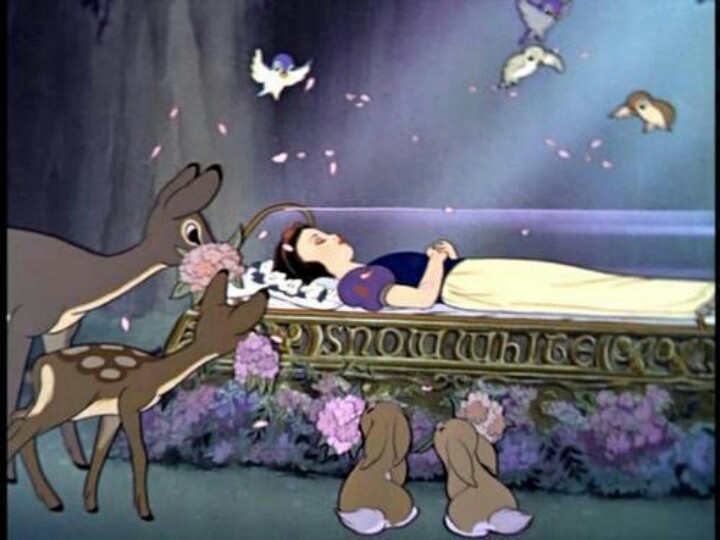
As to filmic references, German Expressionism seems to have been at least one major influence on Disney’s artists. The image of Snow White in the glass coffin, in particular, is a clear lift from Fritz Lang’s 1927 Metropolis. In the latter film the evil inventor Rotwang (Rudolf Klein-Rogge) gives his Machine-Person (Maschinenmensch) the form of Maria (Brigitte Helm) in order to sow dissent among the workers who revere her. The theme of losing one’s humanity is common in the interbellum, even predating Lang, in Karel Čapek’s 1920 play RUR (Rossum’s Universal Robots, Czech Rossumovi Univerzální Roboti), and is central to this scene.

Not only is the scene from Snow White similar, the mad scientist is the descendant of the wicked witch for the modern era, and Disney is simply turning the clock back on the motif. The transformation performed in the Metropolis version contains the Tesla coils seen in many a SciFi production since, replaced in the Disney version with the soon-to-become-ubiquitous kiss of true love.

The scene is reiterated yet again in the “cellular regeneration tube”, a technological glass coffin in which Leeloo (Milla Jovovich) is brought back to life in The Fifth Element, merging the two versions.

And Jean Cocteau, whom I mentioned in the context of Beauty and the Beast? A surrealist. In a documentary, David Lynch introduces Cocteau’s 1930 film Blood of a Poet (Le Sang d’un Poete) thus:²

In my opinion, Cocteau is the heavyweight of surrealism.

One can see why Lynch was drawn to it: it’s a disturbing film, whose release was so controversial it was put off for a year, and even then partially censored.

Salvador Dalí, too, came to Disney. According to an article in The New York Times

Like his Surrealist colleagues, [Dalí] recognized that America’s animated cartoonists were unwittingly applying Surrealist principles in their films. Spontaneous subconscious association, anti-logical juxtaposition of imagery, unconnected gags and dream logic abound in the work of Max and Dave Fleischer, Tex Avery and also Disney: his “Pink Elephants on Parade” sequence in Dumbo (1941) is one of American Surrealism’s most sublime moments.

I would argue the article’s characterization of the application of Surrealism in animation as “unwitting” is the one glaring inaccuracy here. Disney and Dalí would go on to collaborate on a film called Destino, whose fate was unfortunately to stall and remain so for another 57 years until its release in 2003.

Despite all his efforts, it turned out Walt’s vision of an unassailably bleeding-edge position was not; other animation groups could simply learn from Disney’s films the things the studio had striven so hard to learn from the masters. Indeed, there is even a counter influence of Disney’s work on fine art, which can be seen in the works of Roy Lichtenstein, Andy Warhol, Claes Oldenburg, Christian Boltanski, and many others.


Read subsequent articles in the DeDisneyfication series

Part 10: The Little Less-Than

Part 11: Batmouse 3D

Part 12: Mork & Scheherazade


Read previous articles in the DeDisneyfication series

Part 1: Straightening out “Hunchback”

Part 2: Making over “Mulan”

Part 2 Addendum B: Your Western Wuxia Is Weak

Part 3A: “Hercules”: Myths and Mistakes

Part 3B: Doing Hera’s Work on “Hercules”

Part 4: Tale As Old As Agriculture

Part 4 Addendum: The Enchanted and the Postmodern

Part 5: Putting “Pocahontas” to Rest

Part 5 Addendum: Powhatan’s Mantle

Part 6: Trouble with “Tarzan”

Part 7A: The Wrong Rabbit Hole

Part 7A Addendum A: Curious Curation

Part 7A Addendum B: “Alice” in Revolt

Part 7A Addendum C: How “Alice” Grew Big in Japan

Part 7B: Alice’s Adventures in the Cousins’ War

Part 7B Addendum: Repainting the Roses

Part 8: Guerrillas and the “Jungle”

Part 9A: Through a Magic Mirror Marred

Part 9A Addendum: The Woods “Over the Wall”

Part 9B: The Sum of its Versions

Part 9C: The “Snow White” Studio


Notes

  1. Bruno Girveau, Once Upon a Time: Walt Disney: The Sources of Inspiration for the Disney Studios, 2007.
  2. David Lynch Presents the History of Surrealist Film, 1987.
  3. John Canemaker, “The New Season/ Film: The Lost Cartoon by Disney and Dalí, Fellow Surrealists”, New York Times, September 2003.

Urban Lee

Identification and appropriation (Mythmaking in the Martial Arts, Part 4)

Bruce Lee went around the San Francisco Bay Area shooting his mouth off. He said his kung fu was the best and challenged local practitioners to prove him wrong. Wong Jia Man defeated the braggart, but declined to injure him in doing so. This failed to shut Lee up, and his oft-repeated version of events runs thus:

I’d gotten into a fight in San Francisco with a Kung-Fu cat, and after a brief encounter, the son-of-a-bitch started to run.

There’s a video I’ve seen but have been unable to locate showing this interview or one where he says substantially the same thing—it was well rehearsed, and probably carefully scripted as well, since there are several variants I was able to locate. Personally, even apart from the fact it’s pure fabrication and false bravado, the appropriated language is what struck me. Lee’s manner and dress in the interview are also signals to his audience he’s a major dude.

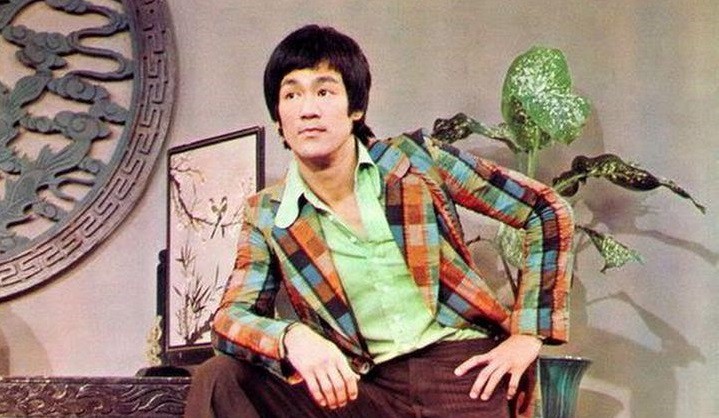
The video I recall has Lee wearing absurdly flaring bell-bottom pants, a suede jacket, and a shiny print shirt, these last two items with extremely wide collars. The video is in black and white, but the jacket has to be orange, the shirt black, and the pants some other garish color. You can find many pictures of Lee dressed with similar early-’70s flair: he’s with it, he’s far out, he’s real groovy. In a 1971 interview, Lee says:¹

[U]nder the sky, under the heaven, man, there is but one family. It just so happen, man, that people are different.

In his first screen test, Lee verges on nerdy in dress and manner, with no sign of the “cat”s, “man”s, and “baby”s that later came to flavor his speech. So why the abrupt shift? Marketing and demographics.

In the especially hagiographic biopic, I Am Bruce Lee, director/ producer and sometime writer of Black Panther comics, Reginald Hudlin says of him:²

He’s got swagger. We [i.e. black audiences] love his style. He had style the way Muhammad Ali had style in the ring.

It’s no accident Hudlin makes the connection between Ali and Lee. The folklore has it Enter the Dragon (《龍爭虎鬥》) costar, John Saxon, remarked on all the Ali films Lee possessed and obsessively viewed during filming and asked him why. Lee reportedly told him he would fight Ali one day. It is clearthis was mere bluster. Instead, Lee was both studying Ali’s moves, as we shall see, as well as this badass African American’s way of presenting himself.

But why? As I’ve already discussed, the martial arts craze had been sweeping the US for some time when Lee jumped on the bandwagon. The return of soldiers from Korea and Vietnam was one of the main motivating factors. One such person was former marine, Steve Sanders, who took the name Steve Muhammad upon converting to Islam. He summed up the experience thus:³

I didn’t enjoy being over there. Anybody who says he did is either a nut who enjoys seeing people killed or a liar. I really don’t know why I was there in the first place. I didn’t hate the North Vietnamese or the VCs. They looked the same as the South Vietnamese who we were supposed to be helping. How can you like one and hate the other? As far as I’m concerned, those people just want to be left alone to do their own thing.

This was a common sentiment: minorities were disproportionately drafted for the war, and found themselves fighting other people of color on behalf of the white power structure in the US and their abusive and corrupt puppet regime in Saigon.

Muhammad studied karate in Okinawa during his service as well, and went on to co-found the Black Karate Federation, as well as playing a minor part in Enter the Dragon as Williams’ instructor. Williams (Jim Kelly) seemed based on Muhammad—a Vietnam vet who identifies with the downtrodden and seeks justice.

Another factor was white flight from urban centers, which, together with the rise of television, left theaters needing to reduce costs and find new audiences. The Hong Kong film industry provided a cheap product in the form of dubbed martial arts films which had already proved successful in Chinatowns across the nation, and so simply spread to other inner city venues. This was the time of the grindhouse kung fu palace, where I too spent time.

Certainly, the action was a factor. Warrington Hudlin, producer and Reginald’s brother, relates of his childhood:⁴

We’d go and watch films all day. The whole time we’d be going, “Oh man, how’d they do that?” Because it happened so fast, you’d have to screen a film three or four times to get the technique. So we’d be like, “Okay, man, you watch his feet, I’ll watch his hands, and we’ll compare notes in the lobby.” Me and my friends, we used to live in those theaters.

Spaghetti Westerns and blaxploitation were other attempts to deal with the new financial and demographic realities of the urban theater, and while they also contained a decent amount of action, the latter could not compete in terms of cost or speed to produce, the former didn’t offer nonwhite heroes. Kung fu films often featured a lone underdog of color combating villainous forces of greater economic power, and so hit home in black America. Reginald Hudlin describes how Lee fit into this countercultural matrix:⁵

You had Muhammad Ali; you had Malcolm X; you had the Black Panthers; you had a lot of radicalism going on—Bruce Lee represented that same kind of radicalism.

Hong Kong film detected this success and began leaning into it well before Lee arrived on the scene. Initially, the Japanese were typically targeted as the villains of these movies, with their role in WWII still a relatively fresh memory on both sides of the Pacific. Hong Kong superstar Jimmy Wang Yu (王羽), who was eventually to be supplanted by Lee, paradoxically worked frequently with Japanese filmmakers making films expressing over-the-top hatred towards their own countrymen. In particular, the 1970 film that made Wang king of kung fu film, The Chinese Boxer (《龙虎斗》) was practically a dress rehearsal for Lee’s Fist of Fury (《精武門》) two years later. Their plots are interchangeable: Japanese karate goons beat up Chinese people in a kung fu school; one student takes revenge.

Returning to Lee, his Hollywood career had not gone well. The Green Hornet was canceled after the single 1966–67 season, failing to find the success of its contemporary Batman, and he was reduced to taking bit parts and action director (i.e. fight choreographer) roles. There were also some projects he tried to pitch, notably The Warrior, which the Lee faction claims later became Kung Fu, though there is only circumstantial evidence for this. Of the project, Lee said in an interview:⁶

Can you dig that? All these cowboys on horses with guns and me with a long, green hunk of bamboo, right? Far out.

In 1971, he took a role in a Hong Kong production called The Big Boss (《唐山大兄》), flying from LA to the filming location in Thailand. Linda Lee Cadwell claims Lee had secured creative control on the picture, and he himself claimed to have done some script rewrites on it, but it’s clear the director had him do things he was not comfortable with, he did not choreograph the fight scenes, and he was not even supposed to have had the lead role. A last-minute change of directors led to this last-minute shift from the veteran actor James Tien-chun (田俊) to Lee in his first Hong Kong film. So lots of mythmaking right there.

The film was a smash hit, raking in a record-breaking HK$3.2M (just over US$500,000) over an only 15-day run, and going on to have massive showings worldwide as well. In an interview from the time, Lee said of it:⁷

We knew from the outset that the film was going to be a success, but I have to admit we weren’t really expecting it to be that successful.

It was the break Lee had been looking for since 1964 when he had been reminded by Wong Jia Man he wasn’t a martial artist at all, and was really trying to be discovered by Hollywood. He also had a unique qualification compared to the other Hong Kong stars of the day: he was in touch with the American viewing public. Lee’s collaborators knew he was connected to the American kung fu craze and understood the black community’s affinity for martial arts cinema. Certainly he had several African-American students, including Kareem Abdul-Jabbar, and one of his earliest, James Glover, who said of those days:⁸

He’s seeing working class folks, he’s seeing people of color and that’s shaping his idea of who he should become. […] I helped him with […] just how to act on the street, how to read people and things like that. Attitudes and what was cool behavior and what wasn’t cool behavior.

If anything, Lee had problems fitting in as Chinese—he did not speak Mandarin, and admitted:⁹

There were some scenes in The Big Boss where I really didn’t think I was being Chinese enough. […] You really have to do a lot of adjusting.

In 1972’s The Way of the Dragon (《猛龍過江》), produced and directed by Lee, the typical ghetto myth is portrayed, but his fight with Colt (Chuck Norris) is pivotal. Initially Colt is getting the better of Tang (Lee), who then decides to adjust his tactics: he starts to bounce—something not a part of traditional kung fu—dancing around his bewildered opponent. The reference is clearly to Ali’s “float like a butterfly” footwork, which he would use to remain mobile and unpredictable in the ring, tiring out his opponents. Of the moment Tang defeats Colt, Reginald Hudlin says:¹⁰

So when he fought Chuck Norris, Bruce Lee represented the entire Third World; he represented all people of color fighting the Western oppressor. […] I can tell you at the Fox Theater in St. Louis, which was 100% all black, we cheered for him.

Ultimately, Lee was simply the best tool in the Hong Kong cinema industry’s shed for selling the ghetto myths they had already been engaged with to a black urban US audience. Bill Brown, a professor specializing in American culture, found:¹¹

While his films theatricalize racial and national conflict—exhibiting Lee in combat with Russian, black American, and, most often, Japanese opponents—Lee’s success, including the extraordinary success in Japan, has been attributed to the simplicity with which his films villainize the capitalist; heroize the worker (particularized as the Hong Kong laborer); locate the power to defeat oppression in the body; and insist on a lawless, violent resolution to class conflict.

Cultural appropriation is so clearly at work here it’s perhaps not worth remarking on, but I will repeat Killer Mike’s rather sensible take on the topic vis-à-vis Elvis Presley:¹²

If you’re gonna do our music—if you’re gonna, say for instance, do hip-hop or rock or blues—when the people who create that—the culture who creates that—when our ass is on the line, step up and be there.

There’s no section in Lee’s Wikipedia page describing his charitable works or activism, and even Reginald Hudlin, I think, meant Lee represented activism in his films, rather than anywhere else. And, as Mickey Rourke noted of him in I Am Bruce Lee:¹³

He was like the Elvis of martial arts.


Read subsequent articles in the Mythmaking in the Martial Arts series

Part 5: The Littlest Dragon

Part 5 Addendum A: Kato’s Comeuppance

Part 5 Addendum B: The Row over “Hollywood” Continues


Read previous articles in the Mythmaking in the Martial Arts series

Part 1: The Bruce Lie

Part 2: Enter the Tycoon

Part 3: Fists of Flim-Flam


Notes

  1. The Pierre Berton Show, December, 1971.
  2. Jon Shirota, “I’m Not a Militant: Equal Opportunity Sensei”, Black Belt Magazine, 1973.
  3. Jeff Yang, “Black belt jonesing: American martial arts culture’s roots in the black community”, SF Gate, 2009.
  4. I Am Bruce Lee, 2021.
  5. Ibid.
  6. Daniel Moss, “Bruce Lee: the big boss and the $3 million man”, South China Morning Post, 1971.
  7. Ibid.
  8. Be Water, 2020.
  9. Moss, 1971.
  10. I Am Bruce Lee, 2021.
  11. Bill Brown, “Global Bodies/Postnationalities: Charles Johnson’s Consumer Culture”, Representations, 1997.
  12. Season 16, Episode 15, Real Time with Bill Maher, May, 2018.
  13. I Am Bruce Lee, 2021.

Bargaining with the Gods

Votives and value in Roman religion (Defixiones, Part 4)

In the spring of 1830, French farmer Prosper Taurin was preparing his field for planting near the hamlet of Villeret, Normandy, when his plowshare grated against what turned out to be a Roman tile about six inches below the surface. When he borrowed a pickaxe and pried the tile up, he found beneath it a hastily buried cache of silver and silver-gilt objects. These hundred-odd items all dated from the first or second century and came from a sanctuary dedicated to a Gallo-Roman version of the god Mercury. Here I’d like to point out if someone had used Latin-descended words meaning “lucky bull” to make up the name of a plowman who stumbled across a Roman treasure, we would scoff at them for being so on the nose.

This hoard, known as the Berthouville Treasure, belongs to Paris’ Bibliothèque nationale, but was eventually sent to the Getty Villa for five years of study and conservation, after which it went on the road, visiting the Legion of Honor where I was able to see it a few years ago in an exhibition called “Ancient Luxury and the Roman Silver Treasure from Berthouville”.

Of course, I have brought up this collection as a way of talking about another aspect of Roman religion. Scholars of ancient religion and magic, Richard Gordon and Francisco Marco Simón, note while the cost of votive items such as these might seem like a side effect, it’s actually an important element of the offering:¹

Investment in an expensive gem attracts divine benevolence in special measure.

Many of the precious Berthouville objects bear the initialism VSLM, which is to be read as:

V[otum] S[olvit] L[ibens] M[erito]

He/ she fulfills [his/ her] vow willingly [and] deservedly.

The term votum, in particular, is key. Cognate in English is our word vow, which is exactly what this is—specifically a promise made to a deity. If you were thinking of vote as a cognate for votum, you’re not wrong: this is what’s called a doublet—a reborrowed word with a different form and meaning. Vota are intended as gifts for the helping figure, but also as a testimony for later visitors to the shrine of the help received. This type of votum is known as an ex-voto from the phrase:

ex voto suscepto

from the vow made

In fact, this latter term also appears nearly verbatim in inscriptions on the items from the sanctuary of Mercurius Canetonensis in Normandy. Nine of the most luxurious Berthouville objects come from one patron in particular, a Quintus Domitius Tutus. One of his cups bears the text:²

MERCURIO AVGUSTO Q[uintus] DOMITIUS TUTUS EX VOTO

To August Mercury from Quintus Domitius Tutus, as vowed.

Thus we can see vota as reflecting a contractual quality of Roman religion. According to classicist professor Georg Luck, writing specifically about magic, which as we’ve seen is an aspect of worship:³

Magic is, in a way, a business transaction between the practitioner and the client. The client wants results, and he wants them here and now. He pays for the service, and he may not be inclined to submit to any spiritual discipline. To a certain extent, ancient religion also has a business-like aspect—the do ut des principle. But in magic, this is carried to an extreme.

Luck raises a phrase expressing this bargaining aspect of religion:

do ut des

I give that you might give.

If you think this concept sounds similar to quid pro quo (lit. “something for something”), you’re again, not wrong. Actually, the latter phrase has only fairly recently supplanted do ut des, which also carried the same connotations in a legal setting. Quid pro quo originally meant to substitute one thing for another, particularly ingredients in the field of medicine.

Turning back to the vota, one can imagine Quintus, in some sort of dire straits and feeling in need of divine aid, swearing something like, “Mercury, help me now, and I’ll give five librae (Roman pounds) of silver to your sanctuary.” And later, as he felt he had received the aid requested, he dutifully made the donation he had promised.

Possibly the most famous and dramatic votum was the ver sacrum affirmed in a vote by the entire citizenry of Rome during the darkest days of Hannibal’s invasion of the Italic Peninsula during the Second Punic War. The text of the vow included this detail:⁴

[P]opulus Romanus Quiritium, quod ver attulerit ex suillo ovillo caprino bovillo grege quaeque profana erunt, Iovi fieri, ex qua die senatus populusque iusserit.

[T]he Roman people of Quirites [i.e. citizens] will give as gift what the spring will bring forth out of the swine, sheep, goat and cattle herds, and which are not consecrated elsewhere, to be sacrificed to Jove, from that day the Senate and people will have decreed.

To be clear, ver sacrum, literally “sacred spring”, is a sacrifice of all animals born in a given spring, and in this case, across the entirety of Rome—they really needed Jupiter to help them out.

The main difference between ex-voto offerings and ones like the ver sacrum and defixiones, is the former category are repayments for a service the gods have already provided, while the latter category are payments in advance for prodigies yet unrealized.

In the British Museum, there is a lamella of soft metal slightly wider than an inch and about two and a half inches tall. Found in plow soil in the south of Oxfordshire in 2007, it is incised on the first three lines with 12 magical charakteres, followed by the main text reading:⁵

CΑΜΙΟΥ
ΗΡΙCΦΑΛΜΑ ΧΝΟΥΝ
ΙΑΧΜΑΤΙΑΝ ΦΝΕ
ΦΝΕ ΩΧ ΠΟΙΗCΑ
ΤΕ ΤΟΙC [υ]ΜΕΤΕΡΟΙC
ΑΓΙΟC ΟΝΟΜΑCΙ
ΙΝΑ ΤΟ Ε[γ]ΚΥΟΝ
ΚΡΑΤΗC[ει] ΚΑΙ
ΥΓΙ[αι]ΝΥCΑ ΦΑΒΙ[-]
Α ΗΝ ΕΤΕΚΕΝ ΤΕΡΕ[Ν-]
ΤΙΑ ΜΗΤΗΡ [αιει] ΟΝΟ[-]
ΜΑΤΟC ΤΟΥ ΚΥΡΙΟΝ
ΚΑΙ ΜΕΓΑΛΟΝ ΘΕΟΥ

Make with your holy names that Fabia whom Terentia her mother bore, being in full fitness and health, shall master the unborn child and bring it to birth; the name of the Lord and Great God being everlasting.

A few things are worth noting here: first it is written in Latinate Greek, using C rather than ⟨Σ⟩ throughout. Second, a specific god is not named, and some think it may even have been devoted to the Christian God rather than a Romano-British one, in which case it demonstrates the conversion to this new religion did nothing to dispel these practices.

This votive also seems similar in form to a defixio in many ways, but seeks a blessing rather than a curse, and is uncoincidentally inscribed on gold rather than lead. It fits the pattern we have seen where the votive object itself can have value.

It may seem a defixio made of lead is a comparatively cheap offering, but it’s important to understand the tablet is just one component of the ritual. Most scholars suggest a prayer, possibly the text of the tablet, would be spoken out loud, and it can also be seen from inscriptions like the defixio to Nodens and the following one, there was a separate donation:⁶

Basilia donat in templum Martis anilum argenteum, si ser[v]us si liber medius fuerit vel aliquid de hoc nouerit ut […] configatur.

Basilia gives to the temple of Mars (her) silver ring, that so long as (someone), whether slave or free, keeps silent or knows anything about it, he may be accursed […].

Additionally, there is a general notion an unbinding costs twice as much as a curse, and Jürgen Blänsdorf notes of a defixio from the sanctuary of Isis in Mainz:⁷

The writer demands the women [being cursed] may not even redeem themselves by “sacrifices bearing wool” [… which] simply means “sheep”, [… nor] by means of lead (i.e. defixiones), gold or silver […].

We see here the do ut des principle of trading material wealth for supernatural acts pervades Roman religious practice. Incorporated within this is a bankerly sense of fungibility among commodities such as precious stones and metals, currency, and livestock; I’ve already discussed the substitution of coins for defixiones. We also find once again curses conform completely with this context and indeed are entirely integral to them. There is a clear implication better curses cost more and therefore cost more to undo.

Some have wondered why in ancient times the Berthouville Treasure was hastily buried rather than melted down for a more portable source of wealth. The reason is simple: the silver did not belong to the priests, but to Mercurius Canetonensis and so wasn’t theirs to take, but only to keep in that god’s name.

A folkloric sense such wealth bore a stamp of otherworldliness long outlived the Romans, lasting even into the 19th century: Taurin refused to touch the silver objects, instead pushing them into a sack with the borrowed pickaxe and irreparably damaging several of the priceless items.


Read subsequent articles in the Defixiones series

Part 5: Secundina’s Beef

Part 6: More Than Money Can Buy

Part 7: The Punic Curse Trail

Part 8: Hellenism Schmellenism

Part 9: The Celtic Undercurrents of Bath


Read previous articles in the Defixiones series

Part 1: The Curses of Aquae Sulis

Part 2: Malefic Traditional

Part 3: Sympathy for Sauron


Notes

  1. Richard Gordon & Francisco Marco Simón, “Introduction”, Magical Practice in the Latin West, Papers from the International Conference Held at the University of Zaragoza, 30 Sept.–1 Oct. 2005, Gordon & Simón, eds., 2010.
  2. Dedicatory inscription from Berthouville/ Lugdunensis, HD068147, Heidelberg Epigraphic Database, emphasis mine.
  3. Georg Luck, Arcana Mundi: Magic and the Occult in the Greek and Roman Worlds, 1985.
  4. Titus Livius (Livy), Ab urbe condita (From the Founding of the City), 22.10, 27–9 BCE.
  5. Brit. 40.97, inscribed gold leaf amulet, ca. 250–350, Roger Simon Ouin Tomlin’s translation.
  6. Sulis 97.
  7. Jürgen Blänsdorf, “The Curse-tablets from the Sanctuary of Isis and Mater Magna in Mainz”, Magical Practice in the Latin West, Papers from the International Conference Held at the University of Zaragoza, 30 Sept.–1 Oct. 2005, Gordon & Simón, eds., 2010.

Gladwell’s Golf Guff Gets Grief

A small-but-vocal demographic (Gladwellocalypse, Part 2 Addendum)

In an earlier article, I characterized Malcolm Gladwell’s Revisionist History (RevHist) episode on golf as a softball piece,¹ I found out there is at least one point of overlap between Gladwell’s audience and people who play golf: surprisingly, the answer is Larry Wilmore. And apparently, the RevHist episode ruffled a lot of other feathers as well.

Wilmore invited Gladwell to appear on his podcast² to talk about other things, mainly his take on Satire,³ which, of course, Wilmore pushes back on as well since it relates directly to his profession. But Wilmore begins by questioning Gladwell’s criticism of golf:⁴

Now, I feel as an attack of country clubs—completely valid. But you go after golf itself. And I’m like, “Wait, hold on a second, Malcolm. Why are you attacking the game?” […] This is what we call playa hatin’ on golf, because there’s no reason to go after the game of golf.

Both of them, people I respect (update: maybe not so much Gladwell anymore), take the opportunity to be both right and wrong on a number of scores. Gladwell attempts to contrast golf with mahjong, saying the former is addictivein the RevHist episode he said golf was “crack cocaine for rich white guys”⁵—but mahjong is actually nearly inextricably associated with gambling in East Asian culture, as well as being well known for its addictive qualities, which have caused it to be banned in the People’s Republic of China since the Cultural Revolution.

Then Gladwell comes at the golf issue from a different angle:⁶

Gladwell: I cannot believe you of all people are calling me to task for taking on a sacred cow […]. Can I remind Larry Wilmore who Larry Wilmore is?

Wilmore: I’m keeping it a hundred: Larry Wilmore is someone who respects sports.

Gladwell: You served as the inspiration for people like me. I remember your absolutely brilliant [… White House] Correspondents’ [Association] Dinner [speech]: that was one of the high-water marks of my last decade […] watching those guys squirm. So […] if someone had come up to you afterward and said, “Larry, you didn’t have to go that far”? […] and the correct answer is, “Fuck you! I’m not going to pass up that opportunity. They’re all a bunch of fat cats. Let them squirm for 20 minutes.” That’s the right answer.

Wilmore backs down after the exchange, but continues to voice his love of the game of golf, telling Gladwell,

But we have to take you out and play some golf sometime.

Gladwell too backs down. And I suppose for both Gladwell and myself, we should be more cautious about criticizing things we have not experienced. When Wilmore says it’s “a very democratic game”,⁷ he’s actually right: 71% of all golf courses are accessible to the public, and certainly disparaging it because of its Jim Crow past would open that same can of worms for just about any other sport. And maybe my sport, fencing, might seem elitist to those viewing it from the outside, though I think it’s anything but. Still, for all the reasons Gladwell outlined, and from my personal experience of everyone I’ve ever known who was into it, golf seems pretty douchey.


Read subsequent articles in the Gladwellocalypse series

Part 3: Descent into the Absurd

Part 4: The Immaculate Miscegenation


Read previous articles in the Gladwellocalypse series

Part 1: The Limits of “Revisionist History”

Part 2: The Unfit “King”


Notes

  1. Malcolm Gladwell, “A Good Walk Spoiled”, Revisionist History, June 2017.
  2. “Malcolm Gladwell on Pioneers, Tokens, and ‘The Satire Paradox’”, Larry Wilmore: Black on the Air (LM: BA), July 2017.
  3. Gladwell, “The Satire Paradox”, Revisionist History, August 2016.
  4. LM: BA, July 2017.
  5. Gladwell, 2017.
  6. LM: BA, July 2017.
  7. Ibid.

The “Snow White” Studio

How it really all began (DeDisneyfication, Part 9C)

I only hope that we never lose sight of one thing—that it was all started by a mouse.

Walt Disney

Once his company, poised on a financial razor’s edge for quite some time, finally found its footing, Disney began mythologizing the company’s origins. Mickey Mouse has become the company’s official mascot to reflect this myth, and “House of Mouse” is the company’s nickname and Mickey is now nearly synonymous with Disney. But if credit were given where it’s due, Walt Disney Animation Studios should be called the Snow White Studio.

Walt’s previous two ventures, Iwerks-Disney Commercial Artists and Laugh-O-Gram Studios actually did fail. His third stayed on the raw edge of failure right up through Cinderella, which one could also argue for as the watershed moment. The only real contender for what started the company, however, is Oswald the Lucky Rabbit.

In the mid-’20s, together with Koko the Clown, a pair of cats dominated the animated films of the day; Felix and Krazy. Felix in particular was a massive hit and Disney’s cat clone, Julius, had already begun appearing in Walt’s early works, including the Alice Comedies.

When Laugh-O-Gram went bust and Walt moved to Hollywood to start another business, he tried to avoid doing any type of animation at all because of the more well-established studios responsible for the cats, but couldn’t get anywhere with that, so he borrowed money from his Uncle Robert and brother Roy to finish up the first Alice film and send it to a distributor named Margaret Winkler, who said she’d take it. Mixed live action and animation was expensive to produce, however, and when Winkler married Charles Mintz, he took over the business and brought together Disney, all-animated shorts, and Universal Studios. Disney pitched a character to them, moving away from the cats—and potential lawsuits—to a rabbit.

The original model sheet for Oswald is Disney’s work, and it’s both derivative and poor, with some elements of each of the cats, and an overall lumpy and dumpy look. In fact, the first Oswald film, Poor Papa, was rejected by Universal, who said:¹

[…] Oswald […] is far from being a funny character. […] He’s just flat. He has no outstanding trait. […] Why is Oswald so old, sloppy and fat?

It seems, among other things, the head-to-body ratio that creates the sense of cuteness was not so well known in those days. Ub Iwerks took on responsibility for adjusting the character to be both more appealing, as well as more animatable for the first public appearance of Oswald in Trolley Troubles.

Disney mythmakers will tell you he was a great artist or a storyteller, but his chief talent seemed to be an Edisonian one: he found people with an amazing knack for art and animation and took credit for their work. Iwerks was only the first of these. Hugh Harman and Rudy Ising, later well-known as the founders of both the Warner Brothers and MGM animation studios, also worked for Disney in the Laugh-O-Gram days and followed him to California to work on Oswald. Even Disney himself said:²

Now, to tell you the truth, I was never a good artist. I was never satisfied with what I did, but it was a means to an end.

Oswald was a success, but with that success came trouble. First, the studio had sold the character, not just the films to Universal, and second, with the tight margins animated shorts of the day entailed, Mintz started looking to cut the fat. He tried to negotiate a lower contract rate when Disney was looking to raise it because of the popularity of the films. Failing that, Mintz simply did not renew. He didn’t need to: he stole the studio’s employees and opened his own shop. Mintz’ studio was given the boot in favor of an internal Universal studio only about a year later, an obvious next step.

Disney quickly developed Mickey Mouse as a replacement to which his company retained all rights. The new character also became popular, and, despite the defections of Iwerks, Harman, and Ising, among several others, the team grew strong as well. Disney won every single Oscar for Short Subjects, Cartoons (now called Best Animated Short Film) in the ’30s. In fact, in only three of those eight years did they not have multiple nominated films.

However, the ’30s were also a time of peak funny pic: all the major film studios had built their own animation departments, and there was a plethora of indies as well. All this competition meant studios had to keep costs low or risk being undercut. Additionally, even though the shorts had begun to draw audiences, the payment model was based on a combination of the profitability of the features they were paired with and their running time.

The Three Little Pigs, a Silly Symphony short, in particular, was a case study for how the business model would not work: it was a hugely popular both in the US and overseas, scored an Oscar, and continued to play in first-run theaters for a year until it was supplanted by its own sequel. It cost $22,000 to produce and grossed $150,000 over the course of 15 months. Later rereleases tacked on another $100,000 to the gross. Sounds amazing, right?

But the gross isn’t what Disney took to the bank. As of four and a half months into the film’s run, when theater owners were complaining about still having to pay full price to show the reel, Disney told the press his share of the profits still hadn’t covered P&A.³ That’s Hollywood jargon for prints and advertising, which, together with actually producing the film makes up the bulk of costs the gross dollars taken in by a movie have to repay before it becomes profitable. While The Three Little Pigs had another seven and a half months to earn out, all this boils down to the fact even a phenomenally successful short like this one had the potential to never get into the black. It also was clear the film was making a lot of money for someone, it just wasn’t the studio.

Switching to feature films might seem like a brilliant flash of lateral thinking, but it was really the only choice for Disney, directly answering the issues I’ve just discussed: bigger budgets, longer production times, a bigger share of the profits and, maybe more than anything, being top of the marquee, and therefore authors of their own box office fate. It’s hardly a coincidence production on Snow White began in early 1934, the year after The Three Little Pigs’ release.

Nonetheless, Walt’s vision wasn’t an easy sell. Hollywood dubbed it “Disney’s Folly” and the fact production ran to nearly four years and cost $1.49M—an enormous sum for the day—did nothing to diminish their derision. Roy Disney tried in vain to talk his brother out of it, but Walt instead proceeded to mortgage his house to help finance the effort. The studio continued to execute shorts, but they became proofs of concept for the feature rather than money-making ventures in their own right.

Snow White premiered on December 21, 1937. By May of the following year, Disney was able to repay all the loans he had taken out to produce it. After six months, the film had grossed $2M, and by the May following that, it had become the highest-grossing US film ever at $6.7M. The studio became self sufficient and used the profits to put a down payment on 51 acres in Burbank and a purpose-built production facility for animated films.

In 1990, the Team Disney Building opened as the company’s new corporate headquarters. I’ve been a guest there on a few occasions, and depending which side you enter from, you will see an architectural tribute to the importance of Snow White in the studio’s history: the facade incorporates the Seven Dwarfs as caryatids. The decision to use them in this way was nonsensical since they rather obviously lack the stature to work well as pillars, not holding up the whole building but only the top few floors.


Read subsequent articles in the DeDisneyfication series

Part 9D: Snowhaus

Part 10: The Little Less-Than

Part 11: Batmouse 3D

Part 12: Mork & Scheherazade


Read previous articles in the DeDisneyfication series

Part 1: Straightening out “Hunchback”

Part 2: Making Over “Mulan”

Part 2 Addendum B: Your Western Wuxia Is Weak

Part 3A: “Hercules”: Myths and Mistakes

Part 3B: Doing Hera’s Work on “Hercules”

Part 4: Tale As Old As Agriculture

Part 4 Addendum: The Enchanted and the Postmodern

Part 5: Putting “Pocahontas” to Rest

Part 5 Addendum: Powhatan’s Mantle

Part 6: Trouble with “Tarzan”

Part 7A: The Wrong Rabbit Hole

Part 7A Addendum A: Curious Curation

Part 7A Addendum B: “Alice” in Revolt

Part 7A Addendum C: How “Alice” Grew Big in Japan

Part 7B: Alice’s Adventures in the Cousins’ War

Part 7B Addendum: Repainting the Roses

Part 8: Guerrillas and the “Jungle”

Part 9A: Through a Magic Mirror Marred

Part 9A Addendum: The Woods “Over the Wall”

Part 9B: The Sum of Its Versions


Notes

  1. Charles Mintz, telegram to Walt Disney, April 15, 1927, quoted in Timothy S. Susanin, Walt Before Mickey: Disney’s Early Years, 1919–1928, 2014.
  2. “Walt Disney and the Gift of Art”, Walt Disney Family Museum Blog, December, 2011.
  3. “Three Little Pigs-Big Little Picture”, J. B. Kaufman, American Cinematographer, November, 1988.

The Sum of Its Versions

Getting comparatist with “Snow White” (DeDisneyfication, Part 9B)

As previously mentioned, together with myth and legend, fairy tales like “Snow White” are one of the main genres of prose folklore.¹ But what is meant by folklore? While the matter wearing this label can be quite old, the term itself is actually a relatively modern coinage—one that can be accurately pinpointed to August 12, 1846. The coiner and locus are also known: a letter pseudonymously signed “Ambrose Merton” to a journal called The Athenaeum

This long-defunct London weekly’s cover announced its themes as “literature, science, and the fine arts”, and each huge folio volume was still more dizzyingly eclectic within. Nonetheless, in those times of rampant polymathy, The Athenaeum’s readership was both broad and loyal. The letter’s writer, whose real name was William John Thoms, had identified one particular thread in the journal:³

Your pages have so often given evidence of the interest which you take in what we in England designate as Popular Antiquities, or Popular Literature (though by-the-by it is more a Lore than a Literature, and would be most aptly described by a good Saxon compound, Folk-Lore,—the Lore of the People)—that I am not without hopes of enlisting your aid in garnering the few ears which are remaining, scattered over that field from which our forefathers might have gathered a goodly crop. No one who has made the manners, customs, observances, superstitions, ballads, proverbs, etc., of the olden time his study, but must have arrived at two conclusions:—the first how much that is curious and interesting in those matters is now entirely lost—the second, how much may yet be rescued by timely exertion.

Not only did The Athenaeum publish Thoms’ note in its letters column, they created a folklore department and installed him as its editor.

More importantly for our purposes, we have a definition, albeit quite broad, for what belongs in this category. Just as Italo Calvino describes the “artlessness” of these tales,⁴ Thoms says they are not literature, but lore. That they are originally an oral tradition is clear from Calvino and also hinted at by Thoms when he says they were being lost. In Telling Tales, Zanzibari media scholar, Mariam Hamdani discusses how this loss is occurring:⁵

When we were little, you know, it was the grandmothers who were telling stories. Most of the stories were about these genies, magicians — [in] all these stories somebody was turned into a stone, somebody was turned into a snake, somebody was turned into a cow, whatever. Within there, they were teaching us: be nice to the neighbor, be nice to each other. So they were teaching us—all these stories—the meaning of them. […] Which is different from nowadays: people don’t have time for that, you know.

Despite Thoms’ and Hamadani’s dire predictions, folktales are everywhere today, and in particular, form the basis for many of the Disney Animation Studio’s works. This is possibly in part because they are royalty free. Given the name, one might think that they have always been with us, but this is actually far from the case. Calvino discusses how such tales came to be part of pop culture in the introduction to his Italian Folktales beginning with how the folktale became a matter for aristocratic literature:⁶

[E]ver since the seventeenth century in France, fairy tales had flourished in Versailles at the court of the Sun King, where Charles Perrault created a genre and set down in writing a refined version of simple popular tales which, up to then, had been transmitted by word of mouth. The genre became fashionable and lost its artlessness: noble ladies and précieuses took to transcribing and inventing fairy stories.

As Calvino also mentions, following on this movement, the Grimms saw their work as one both reflecting and promoting the Volksgeist, essentially a form of German nationalism, and so they altered the source material to reflect proper German morals. Netflix’ surprisingly good series, Myths & Monsters, takes up that thread:⁷

Presenter: [T]he brothers began a patriotic project to collect the folktales of their own land. They spoke to German peasants and aristocrats, farmers and city dwellers, and documented the stories they heard […].

Prof. Nicholas Saul: They were adapting the tales, of course, for an educated, literate public, a middle-class aristocratic public and they were adapting the content of those tales, of course, to the expectations of that public.

Presenter: The Grimms’ enterprise was not simply an act of scholarly record, however; over the years, the brothers rewrote many of the stories themselves. They minimalized sexual elements and softened other darker themes. In earlier versions, Little Red Riding Hood was eaten by the Big Bad Wolf, Sleeping Beauty was raped, not kissed, and Hansel and Gretel were neglected, not by their evil stepmother, but by their own parents.

Nor was Snow White sent out with the Huntsman to be killed by a stepmother; in an earlier version, it is her natural mother who takes her out to the wilderness and abandons her there. According to Kurt Ranke, a leading scholar of Germanic folktales, this switch was performed,⁸

[T]o make the villainess an outsider in the family circle.

I’ll also note the idea the Grimms, “spoke to German peasants and aristocrats, farmers and city dwellers, and documented the stories they heard,” isn’t actually true. That’s what they said they did, perhaps what their goal was. They actually mainly recorded the stories of a few young women from their neighborhood in Kassel.

So while from the time of Louis XIV down to our own, various people have been trying to record folktales, this preservation also changes them. As noted in another episode of Telling Tales, when there is an oral tradition:⁹

[E]ach telling is different, and each storyteller and each listener is different. It reflects the culture it emerges from and has to be understood in that context, and it is part of a continuous line of teller and listener caught in time and place.

Or, as folklorist Kay Stone notes:¹⁰

Stories created verbally are continually fluid and adaptable according to time and place, tellers and listeners, and other contextual factors. Some folklorists describe this vibrancy as “emergent quality,” meaning that the precise text of any story emerges at the actual event of its telling. […] No one story can be considered original in the sense of either primacy or individual innovation.

When the Grimms or Calvino set down a version of a tale, it is their telling and they change it, seeming to fit with the same pattern. But the fact a well-known author is the one who has set it down moves it from lore to literature. It also becomes concrete, a definitive version which is cited and alluded to forever after. As Stone continues:¹¹

Stories composed in writing tend to become fixed and unchanging, and authors and readers no longer share simultaneously in the creative event. When texts become attached to specific creators, the notion of originality in the dual senses of primacy and uniqueness come into play.

Then we come to the content of these tales. Discussing his people’s legend of the saguaro, Vice President the Tohono O’odham Nation, Verlon Jose, says:¹²

Like so many ancient tales […] this story can be understood on numerous levels and deals in an abstract and symbolic way with human behavior, emotions, aspirations, and deep psychological issues.

Calvino, as I’ve previously noted, shows restraint in altering the source materials, but as we’ve already seen, the Grimms much less so. It is for this reason comparing versions is not only interesting, it’s necessary. Dr. Steven Swann Jones, in advocating for a comparative method of study in the field, notes that there is a:¹³

[…] folkloristic axiom that a folktale is the sum of its versions. It is in the different versions that we can observe the changing shapes that the tale assumes and the consistent patterns of forms that it maintains.

So, to return to Snow White, she is clearly a wunderkind: her mother wishes her into being in the Grimm version. “La schiavottella” (“The Little Slave”), a slightly wry version found in the Pentamerone, meanwhile, makes the supernatural birth of the heroine the result of her mother swallowing a rose leaf during a jumping competition.¹⁴ Other sources say she is an orphan, another common mysterious birth trope.

The Grimms introduced the three-color combination characterizing the heroine. Though white and red are often used as colors characterizing beauty, as in “Schneeweißchen und Rosenrot” (“Snow-White and Rose-Red”), or “Pomo e Scorzo” (“Pome and Peel”), in other versions, if they describe her hair, it is golden. The color language the Grimms adopt instead draws on Celtic sources relating to the triple goddess, the Morrígna. The colors are an ill omen, representing blood, snow, and ravens. The Grimms even describe the heroine as an Unglückskind—child of bad luck. In later versions, they take it down a notch by having an ebony window frame suggest the black color rather than the death-portending bird of Badb.

As for the relationship between the heroine and her persecutor, “La Bella Venezia” preserves the information that it is her own mother. This makes it clear she is jealous of her daughter’s growing beauty, and in this version, the kitchen boy is put up to her murder. Additionally, rather than a queen, Bella Venezia is an innkeeper, a widespread Romance motif. Yet another version Calvino presents is “Giricoccola”, who is persecuted by her two jealous sisters, similarly to a Greek version, Η Μυρσίνη (Myrsina)—both of which therefore confound the tale with “Cinderella”. And again, modern literature versions added the step- to these figures.

And this is something that occurs frequently: just as we suddenly found ourselves in “Ali Baba” or “Goldilocks” in the wilderness of the previous Part, you can feel you are wandering into other tales through these versions. In an Armenian variant, “Nourie Hadig”, you end up in “The Dead Man’s Palace”, and in “La Bella Venezia” we find a daughter sent into “Rapunzel”-like seclusion. Still other versions lead you to “Sleeping Beauty” or “Beauty and the Beast”.

Bella Venezia’s “mirror” is her guests, whom she charges less if they tell her she is beautiful, and more if they prefer her daughter, while in Myrsina the sun is consulted and “Giricoccola” and “Nourie Hadig” evidence a version stretching to the southeast as they ask the moon. In the Celtic Gold-Tree and Silver-Tree, a liminal trout is the bearer of the bad news.

The Grimms must’ve known of more “Bella Venezia”-esque versions as they share the fairly grisly element of the mother requiring body parts to be brought back as proof of the heroine’s death. In the Italian version, it’s eyes and blood, the Grimms have lungs and liver, and Disney has the heart. Indeed, this is a strong folktale motif that appears again and again, with different tales seemingly trying to outdo one another in gruesomeness. In the Grimm version and others, the evil mother eats these organs, making her a cannibal by intent, if not fact.

Uncharacteristically for these tales, Bella Venezia manages to go unpunished—she is simply not mentioned again after she sends a witch to kill her daughter at the bandits’ lair. When Myrsina’s sisters find out they have failed to destroy her, they simply die of rage. In the Disney version, the dwarves chase the queen, cornering her on a precipice which is struck by lighting, causing her to fall to her certain but offscreen death in a fairly unsatisfying deus ex machina.

But at Sneewittchen’s wedding her stepmother is shod in red-hot iron and dances until she is dead (cf. Hans Christian Andersen’s “The Red Shoes”). The punishment is quite abrupt in the tale, but brings together the idea a mother should be happy at her daughter’s wedding and so dance, and because the queen did not naturally have these feelings, she needs to be prompted, but it is also a prefiguration of the torments she is expected to suffer in Hell for her misdeeds. Together with rewarding the good, the punishment of the wicked is nearly a requirement for these tales—often in Dantean contrappassi.

Again, I have only compared a few versions and looked at a few motifs here. Ernst Böklen’s Schneewittchenstudien: Fünfundsiebzig Varianten im engern Sinn (Snow White Studies: Seventy-Five Variants in the Narrow Sense) boasts so many versions in the title, it has just made my reading list. However, as I have only been able to find it in German, it may take me a while to get through it.

Returning to Stone, she describes the final transformation of folktales into movies thus:¹⁵

Films create an even greater separation of makers and viewers, giving the latter even less possibility for interaction. Both story-listening and story-reading give us the opportunity to provide our own visual, oral, emotional, and other elaborations, but film provides these all ready-made for our consumption.

Strangely, she seems to have an even harsher take than me on the shortcomings of movies. I only went so far as to say there are elements inherent in each medium that uniquely suit it to specific ways of conveying meaning. Her statement seems to simply condemn the lack of richness and interactivity of the form generally. But that would be taking her remarks out of context; she’s only arguing film is probably the worst suited medium to the telling of folktales.


Read subsequent articles in the DeDisneyfication series

Part 9C: The “Snow White” Studio

Part 9D: Snowhaus

Part 10: The Little Less-Than

Part 11: Batmouse 3D

Part 12: Mork & Scheherazade


Read previous articles in the DeDisneyfication series

Part 1: Straightening out “Hunchback”

Part 2: Making Over “Mulan”

Part 2 Addendum B: Your Western Wuxia Is Weak

Part 3A: “Hercules”: Myths and Mistakes

Part 3B: Doing Hera’s Work on “Hercules”

Part 4: Tale As Old As Agriculture

Part 4 Addendum: The Enchanted and the Postmodern

Part 5: Putting “Pocahontas” to Rest

Part 5 Addendum: Powhatan’s Mantle

Part 6: Trouble with “Tarzan”

Part 7A: The Wrong Rabbit Hole

Part 7A Addendum A: Curious Curation

Part 7A Addendum B: “Alice” in Revolt

Part 7A Addendum C: How “Alice” Grew Big in Japan

Part 7B: Alice’s Adventures in the Cousins’ War

Part 7B Addendum: Repainting the Roses

Part 8: Guerrillas and the “Jungle”

Part 9A: Through a Magic Mirror Marred

Part 9A Addendum: The Woods “Over the Wall”


Notes

  1. “Telling (fairy) tales”, OUPblog, February 2017.
  2. Anatoly Liberman, “William John Thoms, The Man Who Invented The Word Folklore”, The Oxford Etymologist, July 2008.
  3. Ambrose Merton (William John Thoms), “Folk-Lore”, The Athenæum, Letters, August, 1846.
  4. Italo Calvino, Italian Folktales (Fiabe italiane), 1956.
  5. “The Sultan’s Son and the Rich Man’s Daughter”, Telling Tales, March, 2018, BBC News World Service.
  6. Calvino, 1956.
  7. “The Wild Unknown”, Myths & Monsters, December, 2017.
  8. Kurt Ranke, Folktales of Germany, 1966.
  9. “The Tohono O’odham Nation”, Telling Tales, March, 2018, BBC News World Service.
  10. Kay Stone, “Three Transformations of Snow White”, The Brothers Grimm and Folktale, James M. McGlathery, ed., 1991.
  11. Ibid.
  12. Telling Tales, March, 2018.
  13. In “The Pitfalls of Snow White Scholarship”, The Journal of American Folklore, 1979.
  14. Giambattista Basile (posthumously and pseudonymously as Gian Alesio Abbatutis), Pentamerone, 1634–1636.
  15. Stone, 1991.

Through a Magic Mirror Marred

Of pantos, dwarves, and “Snow White” (DeDisneyfication, Part 9A)

While in Bath, we attended the Theatre Royal’s production of Snow White. This show was what is known as a pantomime, or as the locals say, “panto”. It’s a brand of musical comedy particular to the UK typically put on during the “festive season”. Panto contains songs, to which the audience sings along, jokes, often with references to pop culture, slapstick, dancing, and cross-dressing actors, with the audience periodically encouraged to shout responses at various performers—“Oh, yes it is!” and “Oh, no it isn’t!” being a common exchange—or boo and hiss at the villains. All this is wrapped up in a well-known story. The tradition derives from the Italian commedia dell’arte and the Victorian music hall, and carries on—minus the family-friendly part—through The Rocky Horror Picture Show.

This production of Snow White contained all these elements and more. Even though it seemed a fairly straightforward retelling, the pacing of the show felt a bit off until the introduction of Muddles, the court Jester, was introduced. While some other characters occasionally broke the fourth wall, for him, there was nothing there to break. Dame Dolly, Muddles’ mum—played by a man—and the Evil Queen rounded out the main comedic players, with some additional gags from the various dwarves.

A quick aside: plural dwarves has been preferred for the sense regarding the mythical creatures since J. R. R. Tolkien began using it in that fashion, while the spelling dwarfs refers to people of short stature. I’ll be using the former except in direct quotes and titles.

Soon I could catch on to the rhythm of the thing and even complete the performers’ jokes before they did, such as:

Dolly: The other day I told the Queen she’d drawn her eyebrows on too high.
Muddles: What did she say?
Dolly: Nothing; she just looked surprised.

And:

Muddles: I’ve been having an irresistible urge (aside to audience: not that kind!) to climb to the castle’s highest tower and yell obscenities out the window. I think I’ve got turrets syndrome.

Others were cultural references that were so totally lost on me, even Googling in real time wouldn’t have helped (as well as being poor theater-going etiquette). There were many off-color gags, mostly going over the heads of the kids in the audience and there for the parents accompanying them, but the essential story remained unaltered: jealous queen, magic mirror, handsome prince, mining dwarves, beautiful princess.

It was clear the Disney version was the main point of reference: the costumes were similar and they even used several songs from the film. And yet the dwarves, played by little people, had entirely different names:

  • Pop
  • Kip
  • Twitcher
  • Smiler
  • Sneezer
  • Grouchy
  • Soppy

It seems Walt was able to copyright the names Doc, Grumpy, Happy, Sleepy, Bashful, and Dopey.¹ They apparently didn’t think Sneezy was worth bothering with. The Grimm brothers didn’t give individual names to the dwarves, but while Disney claims it was their idea, the Broadway play of 1912 had:

  • Blick
  • Flick
  • Glick
  • Plick
  • Snick
  • Whick
  • Quee

Winthrop Ames adapted the 1916 silent film script from the hit play he had also written under the pseudonym Jessie Braham White and both also starred Marguerite Clark. The film was clearly the model for Walt’s, bearing the title the Disney work used as well—Snow White and the Seven Dwarfs—while the Grimms made no titular mention of dwarves.

Robert T. Sidwell attempts to establish Disney drew his dwarf names from the tradition of Germanic lore embodied in the Eddas.² There are indeed dwarf names scattered throughout those works: the Vǫluspá, the Dverga heiti, and the Nafnaþulur each contain versified lists of dwarves, with the Gylfaginning essentially repeating that of the first.³ Sidwell presents the following list of correspondences between the names of dwarves found therein and the names of the filmic seven—I’ve restored the Old Norse spellings of the names here:

  • Tóki “foolish one”: Dopey
  • Skávaerr “goodnatured one” [sic]: Happy
  • Varr “shy one”: Bashful
  • Dúri “sleepy one”: Sleepy
  • Orinn “quarrelsome one”: Grumpy
  • Grerr “roaring one”: Sneezy
  • Ráðsviðr “one who gives wise advice”: Doc

As attractive as this theory is, it is lacking a fairly important element: any sort of evidence at all. The Eddic traditions are easy to locate in these days of the internet, but would have been pretty arcane territory for team Disney to have wandered into, much less to have comprehended fully enough to understand, select, and cleverly translate a set of dwarvish names from.

The work Sidwell cites as the source for the film’s names is “Dwarf-Names: A Study in Old Icelandic Religion”.⁴ This is an obscure article in a highly academic journal that would likely have been hard to access—I’d imagine one could’ve done so only at the library of a university with a strong language department—let alone comprehend. The article is probably better known today among Old Norse enthusiasts than when it was published. In any case, literally the only things that work are the article’s timing (prior to the 1937 film) and the language it’s written in (English). Sidwell himself notes the epics name some 60 dwarves,⁵ giving a pretty large pool to go fishing in for these seven generous “matches”.

Actual accounts of the Disney dwarves’ creation relate a far different story; they were always intended to be the comedic relief and their names related to their personalities for that purpose rather than being cleverly rendered Nordic idionyms. The set eventually whittled down to the seven we know included:⁶

Jumpy, Deafy, Dizzey, Hickey, Wheezy, Baldy, Gabby, Nifty, Sniffy, Swift, Lazy, Puffy, Stuffy, Tubby, Shorty, and Burpy.

We should perhaps be grateful these did not make the cut. Still, even the ones that did drew criticism from C. S. Lewis, who disliked the,⁷

[…] bloated, drunken, low comedy faces of the dwarfs. Neither the wisdom, the avarice, nor the earthiness of true dwarfs were there, but an imbecility of arbitrary invention.

Sidwell attempts to establish a parallel by presenting a list of Tolkien’s dwarves from The Hobbit, which are fairly well known to have been drawn from Eddic sources. Disney’s and Tolkien’s works also came out in the same year. I’ve corrected and completed the list here:

  • Bífurr “quivering one”: Bifur
  • Bǫfurr ?: Bofur (a nonsense word simply pairing with Bífurr)
  • Bǫmburr “swollen one”: Bombur
  • Nóri “shrunken one”: Nori
  • Óri “the raver”: Ori
  • Óinn “shy one”: Oin
  • Þorinn “bold one”: Thorin
  • Fíli “the filer”: Fili
  • Kíli “the wedge”: Kili
  • Glóinn “glowing one”: Gloin
  • Dóri “the borer”: Dori
  • Dvalinn “the delayer”: Dwalin
  • Bálin “fiery one”: Balin

Gandalf is also the name of an Eddic dwarf—the original being Gandálfr, meaning “magic staff elf”—making Bilbo, named for a sword of Spanish origin, even more of an outsider to the group.

Tolkien was an Oxford Professor of English Language and Literature and Professor of Anglo-Saxon, a philologist, author, and poet. Disney never finished high school. Sidwell is a Professor of Education while I’m an autodidact, so it may seem like we’re both veering wildly out of our respective lanes—he to attempt to place these two on a par in this arena, and me to decry that as ridiculous—but I think mine is the only realistic conclusion.

Taking a step back to the symbolism of dwarves in myth, Joseph Campbell describes them thus:⁸

The titans, dwarfs, and giants are represented as the powers of an earlier mythological age—crude and loutish, egotistic and lawless […].

Adolf Roeder concurs, adding some color on the differences between dwarves and giants:⁹

Evidently these giants are representations of the gigantic forces of nature and of spirit, while the dwarfs are equivalent representations of the minute forces of nature and of spirit. […] Sometimes the gods require the help of the minute forces of nature, and Loge and Wotan descend into the cave of Niflheim to find the ring and the Tarnhelm. And sometimes man’s spiritual side—that is to say, the gods, must struggle with the dwarfish powers of nature, but he must do so always by ingenuity and cunning, and not by force, as witness the story of Siegfried and Mime.

As to the specific role of the dwarves in this tale, PhD in the History of Religions, N. J. Girardot sums it up so well, there’s very little I can add:¹⁰

Being deep in the forest at the house of the dwarfs, Snow White has symbolically returned to the mythic beginnings of time, the liminal period of chaos when the mysterious gods and ancestral creatures of creation were active. In many tales the dwarfs, as chthonic creatures, are malevolent and destructive beings; but, as in this case, they can also be the creative agents of growth and rebirth. Indeed, in this story the dwarfs […] can be taken as the divine ancestors, teachers, refiners, guardians, or helpers necessary for a successful initiation. They help to mine gold from the black earth of Snow White’s soul as the smith and alchemist assist in the divine work of accelerating the processes of nature, or the shaman heals through the agency of various spirit-animals.

These are the reasons folklorists and mythologists, if they even condescend to give opinions of Disney’s works, are less than favorably disposed: depictions such as of the dwarves as two-dimensionally comedic characters are completely at odds with how central the theme of the ambivalence of cruelty and innocence is to folktales.

A closely related Italian version of the tale, La Bella Venezia, has banditti instead of dwarves, but their role is the same: initiatory figures who live outside the strictures of normal society. Their lair in the wilderness opens to a magic formula, “Open up, desert!” linking them to another set of robbers, those in the tale of Ali Baba and the Forty Thieves. And these act out the malevolent side of the trope, repeatedly trying to do Ali Baba in. The magic opening formula is “Apriti, deserto!” in Italian, and the closing one,“Chiuditi, deserto!” In Italian, the Ali Baba versions simply use sesamo instead of deserto.¹¹ That both groups of outlaws live essentially within the earth links them again to the chthonic dwarves.

After hiding nearby and hearing the password, the nameless daughter of Bella Venezia enters the home of the bandits when they leave, and seeing food and being hungry, she eats a wing from each of their 12 chickens, a bite from each loaf of bread, and a sip of wine from every bottle. This too puts us in mind of another folktale, Goldilocks and the Three Bears and the Grimm Brothers’ version of Snow White (Schneewittchen) has an even closer version of the sampling performed by the yellow-haired waif. The title is partially standardized Low German: snee = “snow”, witt = “white”, + diminutive ending -ken, so “little Snow-white” (standard German Schneeweißchen).︎ The bears are yet another version of these semi-human guardian figures, and it’s also worth noting three, seven, and 12 are common folkloric magic numbers. Tolkien (via Gandalf) had Bilbo join the 13 dwarves out of triskaidekaphobic concerns, in a related trope of avoiding an unlucky number.

I hope I’ve been able to show some of the intricacy, depth, and resonance of these supposed children’s stories, even though I’ve only discussed one element of this one so far. In the introduction to his Italian Folktales, Italo Calvino discusses how daunting approaching the field of study was:¹²

For the Brothers Grimm, the salvaging meant bringing to light the fragments of an ancient religion that had been preserved by the common people and had lain dormant until the glorious day of Napoleon’s defeat had finally awakened the German national consciousness. […] To the anthropologists it signified the somber and bloody initiation rites of tribal youths, rites that have been identical from time immemorial, from paleolithic hunters to today’s primitive peoples. The followers of the Finnish school, in setting up a method for tracing migrations among Buddhist countries, Ireland, and the Sahara, applied a system similar to that used for the classification of coleoptera, which, in their cataloging process, reduced findings to algebraic sigla of the Type-index and Motif-index. What the Freudians salvaged was a repertory of ambiguous dreams common to all men, plucked from the oblivion of awakenings and set down in canonical form to represent the most basic anxieties. And for the students of local traditions everywhere, it was a humble faith in an unknown god, rustic and familiar, who found a mouthpiece in the peasantry.

Calvino’s is a relatively pure work; he has scoured the countryside in search of variants of each tale, with straightforward criteria for selection among these versions:¹³

Because of the various texts at my disposal, this particular one struck me as not only the most beautiful or the richest or the most skillfully narrated, but also as the one most rooted in its native heath, had drawn from it the most pith […].

Not to say there is nothing of the author in this compilation; he freely admits to adding his own innovations, but the effort is to create rhythm, symmetry—to make better folkloric sense of the material.

Tolkien’s was an original work (based on Celtic and Germanic sources), created an entire world—peoples, religions, languages, conflicts—with his tales set against that backdrop: a folktale world reimagined. It wasn’t Tolkien’s plan to even publish his works, just something he was doing for its own sake.

By contrast, Disney’s work was a reductive one: taking the characters and setting of a folktale and forcing that round peg into the square hole of the then-popular screwball romcom. Even the menace presented in the film is there because of how well known the woman-in-peril motif was for manipulating audience emotions. And the ultimate purpose of the work was to sell a lot of popcorn in order to save the financially troubled company. Overall, he made it safe and outwardly attractive; features that led Tolkien to liken Disney’s works to “vulgar plastic toys”.¹⁴ The comparison was ironically prescient, since these films have become, more or less, vehicles for the sale of such stuff. Disney strongly considers the “toyation” angle of any works they produce.

It is unsurprising the pantos would gravitate toward this version: not just because it is the most safe and familiar one—ostensibly for children, but with gags for the parents that perforce must watch with them, a feature that has long since become a hallmark of Disney’s works—but because it offers a nearly blank canvas upon which to splash their own over-the-top buffoonery.


Read subsequent articles in the DeDisneyfication series

Part 9B: The Sum of its Versions

Part 9C: The “Snow White” Studio

Part 9D: Snowhaus

Part 10: The Little Less-Than

Part 11: Batmouse 3D

Part 12: Mork & Scheherazade


Read previous articles in the DeDisneyfication series

Part 1: Straightening out “Hunchback”

Part 2: Making over “Mulan”

Part 2 Addendum B: Your Western Wuxia Is Weak

Part 3A: “Hercules”: Myths and Mistakes

Part 3B: Doing Hera’s Work on “Hercules”

Part 4: Tale As Old As Agriculture

Part 4 Addendum: The Enchanted and the Postmodern

Part 5: Putting “Pocahontas” to Rest

Part 5 Addendum: Powhatan’s Mantle

Part 6: Trouble with “Tarzan”

Part 7A: The Wrong Rabbit Hole

Part 7A Addendum A: Curious Curation

Part 7A Addendum B: “Alice” in Revolt

Part 7A Addendum C: How “Alice” Grew Big in Japan

Part 7B: Alice’s Adventures in the Cousins’ War

Part 7B Addendum: Repainting the Roses

Part 8: Guerrillas and the “Jungle”


Notes

  1. Matthew Moore, “Pantomime renames dwarfs to avoid breaching Disney copyright”, The Telegraph, 2008. Note the article is not about the Bath panto but the topic seems to come up quite regularly.
  2. Robert T. Sidwell, “Naming Disney’s Dwarfs”, Children’s Literature in Education, 1980.
  3. Vǫluspá (Prophecy of the vǫlva), Konungsbók (King’s Book) GKS 2365 4º, ca. 1270s. Anonymous, Dverga heiti (Þul Dverga; Names of dwarves) and Snorri Sturluson, Nafnaþulur, the final section of Skáldskaparmál (The language of poetry) and Gylfaginning (The beguiling of Gylfi), Snorra Edda (also called the Prose Edda), ca. 1220.
  4. Sidwell, 1980.
  5. Chester Nathan Gould, “Dwarf-Names: A Study in Old Icelandic Religion”, Publications of the Modern Language Association of America, 1929.
  6. Bob Thomas, Disney’s Art of Animation: From Mickey Mouse to Beauty and the Beast, 1991.
  7. C. S. Lewis to Tolkien letter quoted in Christina Scull and Wayne G. Hammond, The J. R. R. Tolkien Companion & Guide: Reader’s Guide, 2006.
  8. Joseph Campbell, The Masks Of God, Volume 1: Primitive Mythology, 1959.
  9. Adolf Roeder, Symbol Psychology: A New Interpretation of Race Traditions, 1903. Clearly, what are acceptable personal names and names of works have changed since. Note also he is using the Wagnerian Germanizations of names from Norse myth.
  10. In “Initiation and Meaning in the Tale of Snow White and the Seven Dwarfs”, The Journal of American Folklore, 1977.
  11. Italo Calvino, Italian Folktales (Fiabe italiane), 1956.
  12. Ibid.
  13. Ibid.
  14. The Collected Letters of C.S.Lewis: Volume II, Books, Broadcasts and the War, 19311949, Walter Hooper, ed., 2004.